| {"year": "2013", "tier": "T3", "problem_label": "1", "problem_type": null, "exam": "INMO", "problem": "Let $\\Gamma_{1}$ and $\\Gamma_{2}$ be two circles touching each other externally at $R$. Let $l_{1}$ be a line which is tangent to $\\Gamma_{2}$ at $P$ and passing through the center $O_{1}$ of $\\Gamma_{1}$. Similarly, let $l_{2}$ be a line which is tangent to $\\Gamma_{2}$ at $Q$ and passing through the center $O_{2}$ of $\\Gamma_{2}$. Suppose $l_{1}$ and $l_{2}$ are not parallel and interesct at $K$. If $K P=K Q$, prove that the triangle $P Q R$ is equilateral.", "solution": "Suppose that $P$ and $Q$ lie on the opposite sides of line joining $O_{1}$ and $O_{2}$. By symmetry we may assume that the configuration is as shown in the figure below. Then we have $K P>K O_{1}>K Q$ since $K O_{1}$ is the hypotenuse of triangle $K Q O_{1}$. This is a contradiction to the given assumption, and therefore $P$ and $Q$ lie on the same side of the line joining $O_{1}$ and $O_{2}$.\n\n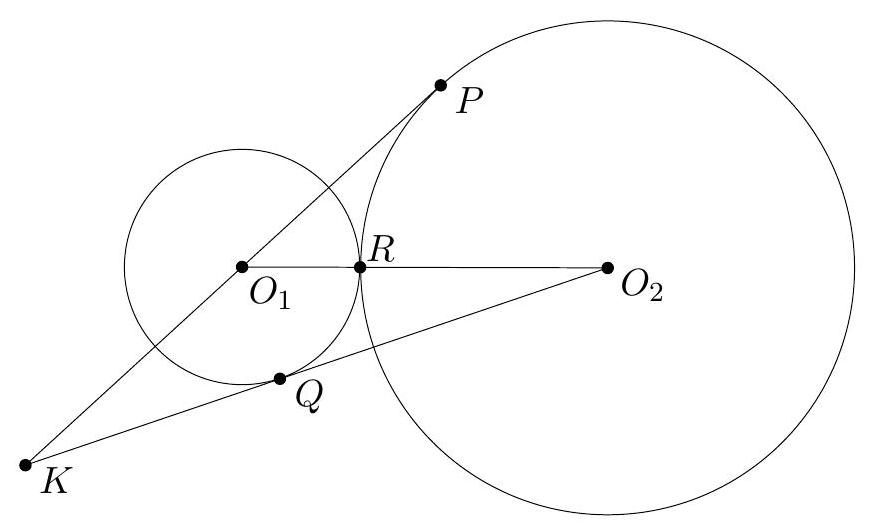\n\nSince $K P=K Q$ it follows that $K$ lies on the radical axis of the given circles, which is the common tangent at $R$. Therefore $K P=K Q=K R$ and hence $K$ is the cirumcenter of $\\triangle P Q R$.\n\n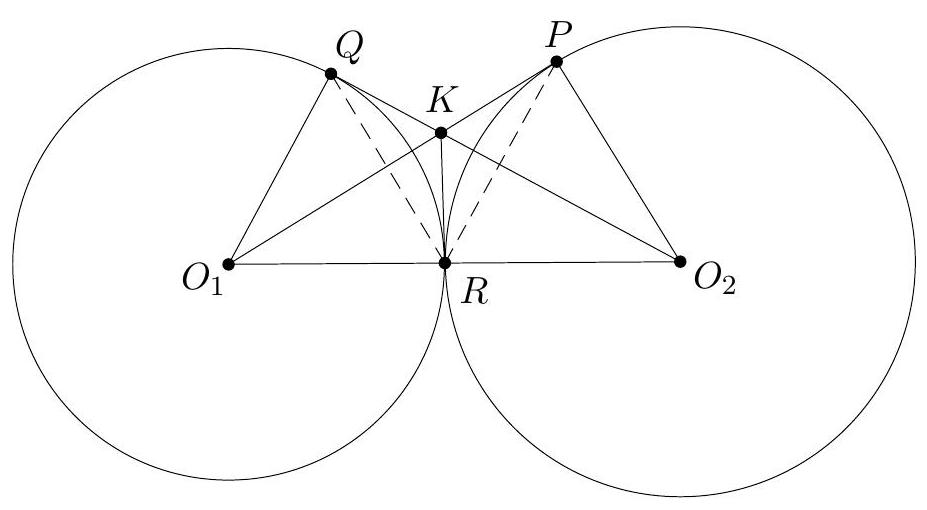\n\nOn the other hand, $\\triangle K Q O_{1}$ and $\\triangle K R O_{1}$ are both right-angled triangles with $K Q=K R$ and $Q O_{1}=R O_{1}$, and hence the two triangles are congruent. Therefore $\\widehat{Q K O_{1}}=\\widehat{R K O_{1}}$, so $K O_{1}$, and hence $P K$ is perpendicular to $Q R$. Similarly, $Q K$ is perpendicular to $P R$, so it follows that $K$ is the orthocenter of $\\triangle P Q R$. Hence we have that $\\triangle P Q R$ is equilateral.\n\nAlternate solution. We again rule out the possibility that $P$ and $Q$ are on the opposite side of the line joining $O_{1} O_{2}$, and assume that they are on the same side.\n\nObserve that $\\triangle K P O_{2}$ is congruent to $\\triangle K Q O_{1}$ (since $K P=K Q$ ). Therefore $O_{1} P=O_{2} Q=r$ (say). In $\\triangle O_{1} O_{2} Q$, we have $\\widehat{O_{1} Q O_{2}}=\\pi / 2$ and $R$ is the midpoint of the hypotenuse, so $R Q=$ $R O_{1}=r$. Therefore $\\triangle O_{1} R Q$ is equilateral, so $\\widehat{Q R O_{1}}=\\pi / 3$. Similarly, $P R=r$ and $\\widehat{P R O_{2}}=\\pi / 3$, hence $\\widehat{P R Q}=\\pi / 3$. Since $P R=Q R$ it follows that $\\triangle P Q R$ is equilateral.", "metadata": {"resource_path": "INMO/segmented/en-inmo2013-solutions.jsonl", "problem_match": "\nProblem 1.", "solution_match": "\nSolution."}} |
| {"year": "2013", "tier": "T3", "problem_label": "2", "problem_type": null, "exam": "INMO", "problem": "Find all positive integers $m, n$, and primes $p \\geq 5$ such that\n\n$$\nm\\left(4 m^{2}+m+12\\right)=3\\left(p^{n}-1\\right)\n$$", "solution": "Rewriting the given equation we have\n\n$$\n4 m^{3}+m^{2}+12 m+3=3 p^{n}\n$$\n\nThe left hand side equals $(4 m+1)\\left(m^{2}+3\\right)$.\n\nSuppose that $\\left(4 m+1, m^{2}+3\\right)=1$. Then $\\left(4 m+1, m^{2}+3\\right)=\\left(3 p^{n}, 1\\right),\\left(3, p^{n}\\right),\\left(p^{n}, 3\\right)$ or $\\left(1,3 p^{n}\\right)$, a contradiction since $4 m+1, m^{2}+3 \\geq 4$. Therefore $\\left(4 m+1, m^{2}+3\\right)>1$.\n\nSince $4 m+1$ is odd we have $\\left(4 m+1, m^{2}+3\\right)=\\left(4 m+1,16 m^{2}+48\\right)=(4 m+1,49)=7$ or 49 . This proves that $p=7$, and $4 m+1=3 \\cdot 7^{k}$ or $7^{k}$ for some natural number $k$. If $(4 m+1,49)=7$ then we have $k=1$ and $4 m+1=21$ which does not lead to a solution. Therefore $\\left(4 m+1, m^{2}+3\\right)=49$. If $7^{3}$ divides $4 m+1$ then it does not divide $m^{2}+3$, so we get $m^{2}+3 \\leq 3 \\cdot 7^{2}<7^{3} \\leq 4 m+1$. This implies $(m-2)^{2}<2$, so $m \\leq 3$, which does not lead to a solution. Therefore we have $4 m+1=49$ which implies $m=12$ and $n=4$. Thus $(m, n, p)=(12,4,7)$ is the only solution.", "metadata": {"resource_path": "INMO/segmented/en-inmo2013-solutions.jsonl", "problem_match": "\nProblem 2.", "solution_match": "\nSolution."}} |
| {"year": "2013", "tier": "T3", "problem_label": "3", "problem_type": null, "exam": "INMO", "problem": "Let $a, b, c, d$ be positive integers such that $a \\geq b \\geq c \\geq d$. Prove that the equation $x^{4}-a x^{3}-b x^{2}-c x-d=0$ has no integer solution.", "solution": "Suppose that $m$ is an integer root of $x^{4}-a x^{3}-b x^{2}-c x-d=0$. As $d \\neq 0$, we have $m \\neq 0$. Suppose now that $m>0$. Then $m^{4}-a m^{3}=b m^{2}+c m+d>0$ and hence $m>a \\geq d$. On the other hand $d=m\\left(m^{3}-a m^{2}-b m-c\\right)$ and hence $m$ divides $d$, so $m \\leq d$, a contradiction. If $m<0$, then writing $n=-m>0$ we have $n^{4}+a n^{3}-b n^{2}+c n-d=n^{4}+n^{2}(a n-b)+(c n-d)>0$, a contradiction. This proves that the given polynomial has no integer roots.", "metadata": {"resource_path": "INMO/segmented/en-inmo2013-solutions.jsonl", "problem_match": "\nProblem 3.", "solution_match": "\nSolution."}} |
| {"year": "2013", "tier": "T3", "problem_label": "4", "problem_type": null, "exam": "INMO", "problem": "Let $n$ be a positive integer. Call a nonempty subset $S$ of $\\{1,2, \\ldots, n\\}$ good if the arithmetic mean of the elements of $S$ is also an integer. Further let $t_{n}$ denote the number of good subsets of $\\{1,2, \\ldots, n\\}$. Prove that $t_{n}$ and $n$ are both odd or both even.", "solution": "We show that $T_{n}-n$ is even. Note that the subsets $\\{1\\},\\{2\\}, \\cdots,\\{n\\}$ are good. Among the other good subsets, let $A$ be the collection of subsets with an integer average which belongs to the subset, and let $B$ be the collection of subsets with an integer average which is not a member of the subset. Then there is a bijection between $A$ and $B$, because removing the average takes a member of $A$ to a member of $B$; and including the average in a member of $B$ takes it to its inverse. So $T_{n}-n=|A|+|B|$ is even.\n\nAlternate solution. Let $S=\\{1,2, \\ldots, n\\}$. For a subset $A$ of $S$, let $\\bar{A}=\\{n+1-a \\mid a \\in A\\}$. We call a subset $A$ symmetric if $\\bar{A}=A$. Note that the arithmetic mean of a symmetric subset is $(n+1) / 2$. Therefore, if $n$ is even, then there are no symmetric good subsets, while if $n$ is odd then every symmetric subset is good.\n\nIf $A$ is a proper good subset of $S$, then so is $\\bar{A}$. Therefore, all the good subsets that are not symmetric can be paired. If $n$ is even then this proves that $t_{n}$ is even. If $n$ is odd, we have to show that there are odd number of symmetric subsets. For this, we note that a symmetric subset contains the element $(n+1) / 2$ if and only if it has odd number of elements. Therefore, for any natural number $k$, the number of symmetric subsets of size $2 k$ equals the number of symmetric subsets of size $2 k+1$. The result now follows since there is exactly one symmetric subset with only one element.", "metadata": {"resource_path": "INMO/segmented/en-inmo2013-solutions.jsonl", "problem_match": "\nProblem 4.", "solution_match": "\nSolution."}} |
| {"year": "2013", "tier": "T3", "problem_label": "5", "problem_type": null, "exam": "INMO", "problem": "In an acute triangle $A B C, O$ is the circumcenter, $H$ is the orthocenter and $G$ is the centroid. Let $O D$ be perpendicular to $B C$ and $H E$ be perpendicular to $C A$, with $D$ on $B C$ and $E$ on $C A$. Let $F$ be the midpoint of $A B$. Suppose the areas of triangles $O D C, H E A$ and $G F B$ are equal. Find all the possible values of $\\widehat{C}$.", "solution": "Let $R$ be the circumradius of $\\triangle A B C$ and $\\Delta$ its area. We have $O D=R \\cos A$ and $D C=\\frac{a}{2}$, so\n\n$$\n[O D C]=\\frac{1}{2} \\cdot O D \\cdot D C=\\frac{1}{2} \\cdot R \\cos A \\cdot R \\sin A=\\frac{1}{2} R^{2} \\sin A \\cos A\n$$\n\nAgain $H E=2 R \\cos C \\cos A$ and $E A=c \\cos A$. Hence\n\n$$\n[H E A]=\\frac{1}{2} \\cdot H E \\cdot E A=\\frac{1}{2} \\cdot 2 R \\cos C \\cos A \\cdot c \\cos A=2 R^{2} \\sin C \\cos C \\cos ^{2} A\n$$\n\nFurther\n\n$$\n[G F B]=\\frac{\\Delta}{6}=\\frac{1}{6} \\cdot 2 R^{2} \\sin A \\sin B \\sin C=\\frac{1}{3} R^{2} \\sin A \\sin B \\sin C\n$$\n\nEquating (1) and (2) we get $\\tan A=4 \\sin C \\cos C$. And equating (1) and (3), and using this relation we get\n\n$$\n\\begin{aligned}\n3 \\cos A & =2 \\sin B \\sin C=2 \\sin (C+A) \\sin C \\\\\n& =2(\\sin C+\\cos C \\tan A) \\sin C \\cos A \\\\\n& =2 \\sin ^{2} C\\left(1+4 \\cos ^{2} C\\right) \\cos A\n\\end{aligned}\n$$\n\nSince $\\cos A \\neq 0$ we get $3=2 t(-4 t+5)$ where $t=\\sin ^{2} C$. This implies $(4 t-3)(2 t-1)=0$ and therefore, since $\\sin C>0$, we get $\\sin C=\\sqrt{3} / 2$ or $\\sin C=1 / \\sqrt{2}$. Because $\\triangle A B C$ is acute, it follows that $\\widehat{C}=\\pi / 3$ or $\\pi / 4$.\n\nWe observe that the given conditions are satisfied in an equilateral triangle, so $\\widehat{C}=\\pi / 3$ is a possibility. Also, the conditions are satisfied in a triangle where $\\widehat{C}=\\pi / 4, \\widehat{A}=\\tan ^{-1} 2$ and $\\widehat{B}=\\tan ^{-1} 3$. Therefore $\\widehat{C}=\\pi / 4$ is also a possibility.\n\nThus the two possible values of $\\widehat{C}$ are $\\pi / 3$ and $\\pi / 4$.", "metadata": {"resource_path": "INMO/segmented/en-inmo2013-solutions.jsonl", "problem_match": "\nProblem 5.", "solution_match": "\nSolution."}} |
| {"year": "2013", "tier": "T3", "problem_label": "6", "problem_type": null, "exam": "INMO", "problem": "Let $a, b, c, x, y, z$ be positive real numbers such that $a+b+c=x+y+z$ and abc $=x y z$. Further, suppose that $a \\leq x<y<z \\leq c$ and $a<b<c$. Prove that $a=x, b=y$ and $c=z$.", "solution": "Let\n\n$$\nf(t)=(t-x)(t-y)(t-z)-(t-a)(t-b)(t-c)\n$$\n\nThen $f(t)=k t$ for some constant $k$. Note that $k a=f(a)=(a-x)(a-y)(a-z) \\leq 0$ and hence $k \\leq 0$. Similarly, $k c=f(c)=(c-x)(c-y)(c-z) \\geq 0$ and hence $k \\geq 0$. Combining the two, it follows that $k=0$ and that $f(a)=f(c)=0$. These equalities imply that $a=x$ and $c=z$, and then it also follows that $b=y$.", "metadata": {"resource_path": "INMO/segmented/en-inmo2013-solutions.jsonl", "problem_match": "\nProblem 6.", "solution_match": "\nSolution."}} |
|
|


