| {"year": "2008", "tier": "T1", "problem_label": "1", "problem_type": null, "exam": "USAMO", "problem": "Prove that for each positive integer $n$, there are pairwise relatively prime integers $k_{0}, \\ldots, k_{n}$, all strictly greater than 1 , such that $k_{0} k_{1} \\ldots k_{n}-1$ is the product of two consecutive integers.", "solution": " In other words, if we let $$ P(x)=x(x+1)+1 $$ then we would like there to be infinitely many primes dividing some $P(t)$ for some integer $t$. In fact, this result is true in much greater generality. We first state: ## Theorem 1.1 (Schur's theorem) If $P(x) \\in \\mathbb{Z}[x]$ is nonconstant and $P(0)=1$, then there are infinitely many primes which divide $P(t)$ for some integer $t$. Let $S$ be any finite set of prime numbers. Consider then the value $$ P\\left(k \\prod_{p \\in S} p\\right) $$ for some integer $k$. It is $1(\\bmod p)$ for each prime $p$, and if $k$ is large enough it should not be equal to 1 (because $P$ is not constant). Therefore, it has a prime divisor not in $S$. Remark. In fact the result holds without the assumption $P(0) \\neq 1$. The proof requires only small modifications, and a good exercise would be to write down a similar proof that works first for $P(0)=20$, and then for any $P(0) \\neq 0$. (The $P(0)=0$ case is vacuous, since then $P(x)$ is divisible by $x$.) $$ \\begin{aligned} P\\left(x_{1}\\right) & \\equiv 0 \\quad\\left(\\bmod p_{1}\\right) \\\\ P\\left(x_{2}\\right) & \\equiv 0 \\quad\\left(\\bmod p_{2}\\right) \\\\ \\vdots & \\\\ P\\left(x_{n}\\right) & \\equiv 0 \\quad\\left(\\bmod p_{n}\\right) \\end{aligned} $$ as promised by Schur's theorem. Then, by Chinese remainder theorem, we can find $x$ such that $x \\equiv x_{i}\\left(\\bmod p_{i}\\right)$ for each $i$, whence $P(x)$ has at least $n$ prime factor.", "metadata": {"resource_path": "USAMO/segmented/en-USAMO-2008-notes.jsonl"}} |
| {"year": "2008", "tier": "T1", "problem_label": "2", "problem_type": null, "exam": "USAMO", "problem": "Let $A B C$ be an acute, scalene triangle, and let $M, N$, and $P$ be the midpoints of $\\overline{B C}, \\overline{C A}$, and $\\overline{A B}$, respectively. Let the perpendicular bisectors of $\\overline{A B}$ and $\\overline{A C}$ intersect ray $A M$ in points $D$ and $E$ respectively, and let lines $B D$ and $C E$ intersect in point $F$, inside triangle $A B C$. Prove that points $A, N, F$, and $P$ all lie on one circle.", "solution": " 【 Barycentric solution. First, we find the coordinates of $D$. As $D$ lies on $\\overline{A M}$, we know $D=(t: 1: 1)$ for some $t$. Now by perpendicular bisector formula, we find $$ 0=b^{2}(t-1)+\\left(a^{2}-c^{2}\\right) \\Longrightarrow t=\\frac{c^{2}+b^{2}-a^{2}}{b^{2}} $$ Thus we obtain $$ D=\\left(2 S_{A}: c^{2}: c^{2}\\right) . $$ Analogously $E=\\left(2 S_{A}: b^{2}: b^{2}\\right)$, and it follows that $$ F=\\left(2 S_{A}: b^{2}: c^{2}\\right) $$ The sum of the coordinates of $F$ is $$ \\left(b^{2}+c^{2}-a^{2}\\right)+b^{2}+c^{2}=2 b^{2}+2 c^{2}-a^{2} $$ Hence the reflection of $A$ over $F$ is simply $$ 2 F-A=\\left(2\\left(b^{2}+c^{2}-a^{2}\\right)-\\left(2 b^{2}+2 c^{2}-a^{2}\\right): 2 b^{2}: 2 c^{2}\\right)=\\left(-a^{2}: 2 b^{2}: 2 c^{2}\\right) . $$ It is evident that $F^{\\prime}$ lies on $(A B C):-a^{2} y z-b^{2} z x-c^{2} x y=0$, and we are done.", "metadata": {"resource_path": "USAMO/segmented/en-USAMO-2008-notes.jsonl"}} |
| {"year": "2008", "tier": "T1", "problem_label": "2", "problem_type": null, "exam": "USAMO", "problem": "Let $A B C$ be an acute, scalene triangle, and let $M, N$, and $P$ be the midpoints of $\\overline{B C}, \\overline{C A}$, and $\\overline{A B}$, respectively. Let the perpendicular bisectors of $\\overline{A B}$ and $\\overline{A C}$ intersect ray $A M$ in points $D$ and $E$ respectively, and let lines $B D$ and $C E$ intersect in point $F$, inside triangle $A B C$. Prove that points $A, N, F$, and $P$ all lie on one circle.", "solution": " II Synthetic solution (harmonic). Here is a synthetic solution. Let $X$ be the point so that $A P X N$ is a cyclic harmonic quadrilateral. We contend that $X=F$. To see this it suffices to prove $B, X, D$ collinear (and hence $C, X, E$ collinear by symmetry). 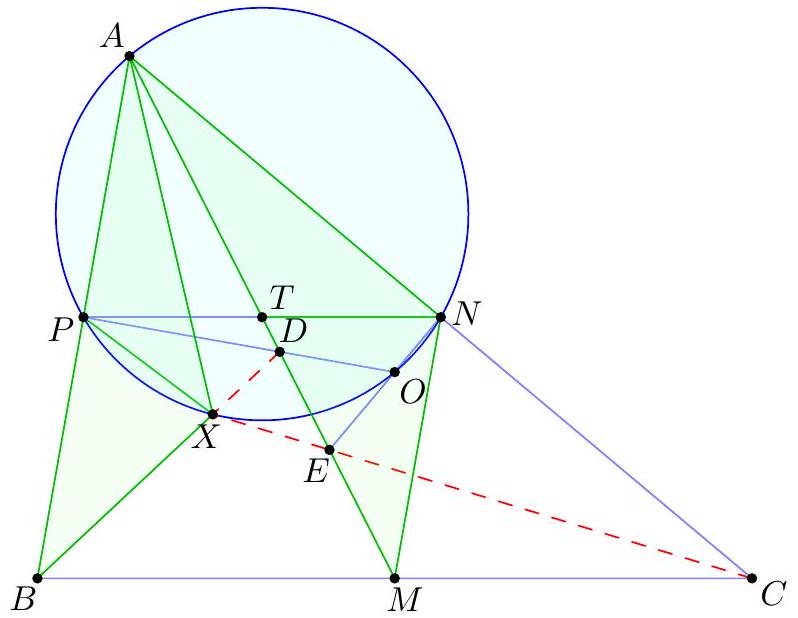 Let $T$ be the midpoint of $\\overline{P N}$, so $\\triangle A P X \\sim \\triangle A T N$. So $\\triangle A B X \\sim \\triangle A M N$, ergo $$ \\measuredangle X B A=\\measuredangle N M A=\\measuredangle B A M=\\measuredangle B A D=\\measuredangle D B A $$ as desired.", "metadata": {"resource_path": "USAMO/segmented/en-USAMO-2008-notes.jsonl"}} |
| {"year": "2008", "tier": "T1", "problem_label": "2", "problem_type": null, "exam": "USAMO", "problem": "Let $A B C$ be an acute, scalene triangle, and let $M, N$, and $P$ be the midpoints of $\\overline{B C}, \\overline{C A}$, and $\\overline{A B}$, respectively. Let the perpendicular bisectors of $\\overline{A B}$ and $\\overline{A C}$ intersect ray $A M$ in points $D$ and $E$ respectively, and let lines $B D$ and $C E$ intersect in point $F$, inside triangle $A B C$. Prove that points $A, N, F$, and $P$ all lie on one circle.", "solution": " 【 Angle chasing solution (Mason Fang). Obviously $A N O P$ is concyclic. Claim - Quadrilateral BFOC is cyclic. $$ \\begin{aligned} \\measuredangle B F C=\\measuredangle F B C+\\measuredangle B C F & =\\measuredangle F B A+\\measuredangle A B C+\\measuredangle B C A+\\measuredangle A C F \\\\ & =\\measuredangle D B A+\\measuredangle A B C+\\measuredangle B C A+\\measuredangle A C E \\\\ & =\\measuredangle B A D+\\measuredangle A B C+\\measuredangle B C A+\\measuredangle E A C \\\\ & =2 \\angle B A C=\\angle B O C . \\end{aligned} $$ Define $Q=\\overline{A A} \\cap \\overline{B C}$. Claim - Point $Q$ lies on $\\overline{F O}$. $$ \\begin{aligned} \\measuredangle B O Q=\\measuredangle B O A+\\measuredangle A O Q & =2 \\measuredangle B C A+90^{\\circ}+\\measuredangle A Q O \\\\ & =2 \\measuredangle B C A+90^{\\circ}+\\measuredangle A M O \\\\ & =2 \\measuredangle B C A+90^{\\circ}+\\measuredangle A M C+90^{\\circ} \\\\ & =\\measuredangle B C A+\\measuredangle M A C=\\measuredangle B C A+\\measuredangle A C E \\\\ & =\\measuredangle B C E=\\measuredangle B O F . \\end{aligned} $$ As $Q$ is the radical center of $(A N O P),(A B C)$ and $(B F O C)$, this implies the result.", "metadata": {"resource_path": "USAMO/segmented/en-USAMO-2008-notes.jsonl"}} |
| {"year": "2008", "tier": "T1", "problem_label": "2", "problem_type": null, "exam": "USAMO", "problem": "Let $A B C$ be an acute, scalene triangle, and let $M, N$, and $P$ be the midpoints of $\\overline{B C}, \\overline{C A}$, and $\\overline{A B}$, respectively. Let the perpendicular bisectors of $\\overline{A B}$ and $\\overline{A C}$ intersect ray $A M$ in points $D$ and $E$ respectively, and let lines $B D$ and $C E$ intersect in point $F$, inside triangle $A B C$. Prove that points $A, N, F$, and $P$ all lie on one circle.", "solution": " 【 Inversive solution (Kelin Zhu). Invert about $A$ with radius $\\sqrt{b c}$ followed by a reflection over the angle bisector of $\\angle A$, and denote the image of a point $X$ by $X^{\\prime}$. The inverted problem now states the following: In triangle $A P^{*} N^{*}$, let $B^{*}, C^{*}$ be the midpoints of $A P^{*}, A N^{*}$ and $D^{*}, E^{*}$ be the intersection of the $A$ symmedian with $\\left(A P^{*}\\right),\\left(A N^{*}\\right)$, respectively. $\\left(A B^{*} D^{*}\\right),\\left(A C^{*} E^{*}\\right)$ intersect at a point $F^{*}$; prove that it lies on $P^{*} N^{*}$. I claim that, in fact, the midpoint of $P^{*} N^{*}$ is the desired intersection. Redefine that point as $F^{*}$ and I will prove that $\\left(A B^{*} D^{*}\\right),\\left(A C^{*} E^{*}\\right)$ pass through it. Note that $$ \\angle A D^{*} B^{*}=\\angle D^{*} A B^{*}=\\angle F^{*} A N^{*}=\\angle A F^{*} B^{*}, $$ where the first equality is due to $B^{*}$ being the circumcircle of $A D^{*} P^{*}$, the second equality is due to the definition of the symmedian, and the third equality is due to the parallelogram $A B^{*} F^{*} C^{*}$. A symmetric argument for $C$ finishes.", "metadata": {"resource_path": "USAMO/segmented/en-USAMO-2008-notes.jsonl"}} |
| {"year": "2008", "tier": "T1", "problem_label": "3", "problem_type": null, "exam": "USAMO", "problem": "Let $n$ be a positive integer. Denote by $S_{n}$ the set of points $(x, y)$ with integer coordinates such that $$ |x|+\\left|y+\\frac{1}{2}\\right|<n $$ A path is a sequence of distinct points $\\left(x_{1}, y_{1}\\right),\\left(x_{2}, y_{2}\\right), \\ldots,\\left(x_{\\ell}, y_{\\ell}\\right)$ in $S_{n}$ such that, for $i=2, \\ldots, \\ell$, the distance between $\\left(x_{i}, y_{i}\\right)$ and $\\left(x_{i-1}, y_{i-1}\\right)$ is 1 . Prove that the points in $S_{n}$ cannot be partitioned into fewer than $n$ paths.", "solution": " 【 First solution (local). We proceed by induction on $n$. The base case $n=1$ is clear, so suppose $n>1$. Let $S$ denote the set of points $$ S=\\left\\{(x, y): x+\\left|y+\\frac{1}{2}\\right| \\geq n-2\\right\\} $$ An example when $n=4$ is displayed below. 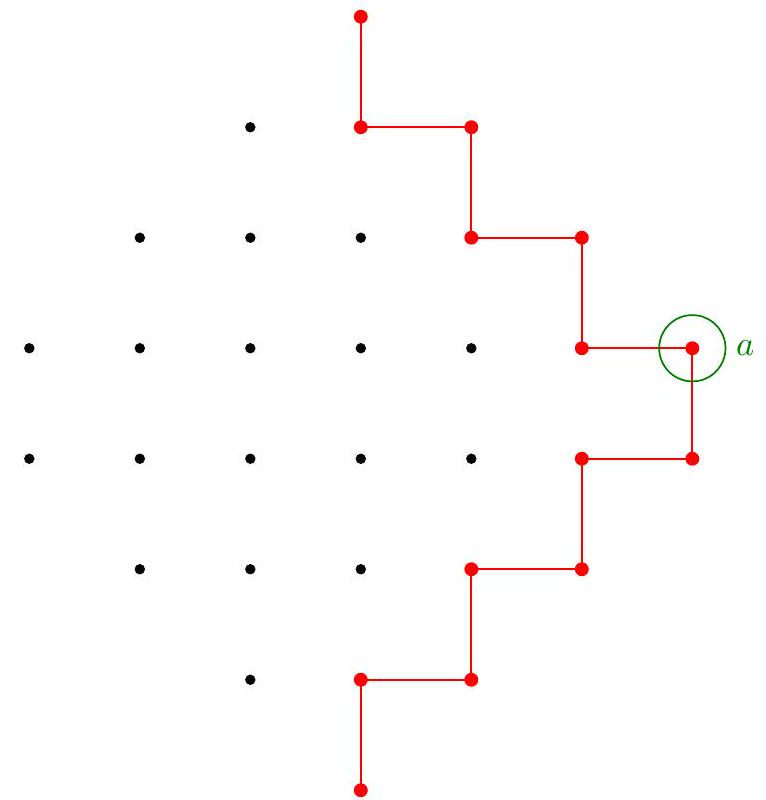 For any minimal partition $\\mathcal{P}$ of $S_{n}$, let $P$ denote the path passing through the point $a=(n-1,0)$. Then the intersection of $P$ with $S$ consists of several disconnected paths; let $N$ be the number of nodes in the component containing $a$, and pick $\\mathcal{P}$ such that $N$ is maximal. We claim that in this case $P=S$. Assume not. First, note $a=(n-1,0)$ must be connected to $b=(n-1,-1)$ (otherwise join them to decrease the number of paths). Now, starting from $a=(n-1,0)$ walk along $P$ away from $b$ until one of the following three conditions is met: - We reach a point $v$ not in $S$. Let $w$ be the point before $v$, and $x$ the point in $S$ adjacent to $w$. Then delete $v w$ and add $w x$. This increases $N$ while leaving the number of edges unchanged: so this case can't happen. - We reach an endpoint $v$ of $P$ (which may be $a$ ), lying inside the set $S$, which is not the topmost point $(0, n-1)$. Let $w$ be the next point of $S$. Delete any edge touching $w$ and add edge $v w$. This increases $N$ while leaving the number of edges unchanged: so this case can't happen. - We reach the topmost point $(0, n-1)$. Thus we see that $P$ must follow $S$ until reaching the topmost point $(0, n-1)$. Similarly it must reach the bottom-most point $(0,-n)$. Hence $P=S$. The remainder of $S_{n}$ is just $S_{n-1}$, and hence this requires at least $n-1$ paths to cover by the inductive hypothesis. So $S_{n}$ requires at least $n$ paths, as desired. Remark (Motivational comments from Evan). Basically the idea is that I wanted to peel away the right path $S$ highlighted in red in the figure, so that one could induct. But the problem is that the red path might not actually exist, e.g. the set of paths might contain the mirror of $S$ instead. Nonetheless, in those equality cases I found I could perturb some edges (e.g. change from $(-1, n-2)-(0, n-2)$ to $(0, n-2)-(1, n-2))$. So the idea then was to do little changes and try to convert the given partition into one where the red path $S$ exists, (and then peel it away for induction) without decreasing the total number of paths. To make this work, you actually want the incisions to begin ear the points $a$ and $b$, because that's the point of $S$ that is most constrained (e.g. you get $a-b$ right away for free), and assemble the path from there. (If you try to do it from the top, it's much less clear what's happening.) That's why the algorithm starts the mutations from around a.", "metadata": {"resource_path": "USAMO/segmented/en-USAMO-2008-notes.jsonl"}} |
| {"year": "2008", "tier": "T1", "problem_label": "3", "problem_type": null, "exam": "USAMO", "problem": "Let $n$ be a positive integer. Denote by $S_{n}$ the set of points $(x, y)$ with integer coordinates such that $$ |x|+\\left|y+\\frac{1}{2}\\right|<n $$ A path is a sequence of distinct points $\\left(x_{1}, y_{1}\\right),\\left(x_{2}, y_{2}\\right), \\ldots,\\left(x_{\\ell}, y_{\\ell}\\right)$ in $S_{n}$ such that, for $i=2, \\ldots, \\ell$, the distance between $\\left(x_{i}, y_{i}\\right)$ and $\\left(x_{i-1}, y_{i-1}\\right)$ is 1 . Prove that the points in $S_{n}$ cannot be partitioned into fewer than $n$ paths.", "solution": " II Second solution (global). Here is a much shorter official solution, which is much trickier to find, and \"global\" in nature. Color the upper half of the diagram with a blue/red checkerboard pattern such that the uppermost point $(n-1,0)$ is blue. Reflect it over to the bottom, as shown. Assume there are $m$ paths. Cut in two any paths with two adjacent blue points; this occurs only along the horizontal symmetry axis. Thus: - After cutting there are at most $m+n$ paths, since at most $n$ cuts occur. - On the other hand, there are $2 n$ more blue points than red points. Hence after cutting there must be at least $2 n$ paths (since each path alternates colors, except possibly for double-red pairs). So $m+n \\geq 2 n$, hence $m \\geq n$. Remark. This problem turned out to be known already. It appears in this reference: Nikolai Beluhov, Nyakolko Zadachi po Shahmatna Kombinatorika, Matematika Plyus, 2006, issue 4, pages 61-64. Section 1 of 2 was reprinted with revisions as Nikolai Beluhov, Dolgii Put Korolya, Kvant, 2010, issue 4, pages 39-41. The reprint is available at http://kvant.ras.ru/pdf/2010/ 2010-04.pdf. Remark (Nikolai Beluhov). As pointed out in the reference above, this problem arises naturally when we try to estimate the greatest possible length of a closed king tour on the chessboard of size $n \\times n$ with $n$ even, a question posed by Igor Akulich in Progulki Korolya, Kvant, 2000, issue 3, pages $47-48$. Each one of the two references above contains a proof that the answer is $n+\\sqrt{2}\\left(n^{2}-n\\right)$.", "metadata": {"resource_path": "USAMO/segmented/en-USAMO-2008-notes.jsonl"}} |
| {"year": "2008", "tier": "T1", "problem_label": "4", "problem_type": null, "exam": "USAMO", "problem": "For which integers $n \\geq 3$ can one find a triangulation of regular $n$-gon consisting only of isosceles triangles?", "solution": " The answer is $n$ of the form $2^{a}\\left(2^{b}+1\\right)$ where $a$ and $b$ are nonnegative integers not both zero. Call the polygon $A_{1} \\ldots A_{n}$ with indices taken modulo $n$. We refer to segments $A_{1} A_{2}$, $A_{2} A_{3}, \\ldots, A_{n} A_{1}$ as short sides. Each of these must be in the triangulation. Note that - when $n$ is even, the isosceles triangles triangle using a short side $A_{1} A_{2}$ are $\\triangle A_{n} A_{1} A_{2}$ and $\\triangle A_{1} A_{2} A_{3}$ only, which we call small. - when $n$ is odd, in addition to the small triangles, we have $\\triangle A_{\\frac{1}{2}(n+3)} A_{1} A_{2}$, which we call big. This leads to the following two claims. Claim - If $n>4$ is even, then $n$ works iff $n / 2$ does.  Thus the sides of $\\mathcal{P}$ must pair off, and when we finish drawing we have an $n / 2$-gon. Since $n=4$ works, this implies all powers of 2 work and it remains to study the case when $n$ is odd. Claim - If $n>1$ is odd, then $n$ works if and only if $n=2^{b}+1$ for some positive integer $b$. Then we get $\\frac{1}{2}(n-1)$ small triangles, pairing up the remaining sides. Now repeating the argument with the triangles on each half shows that the number $n-1$ must be a power of 2 , as needed.", "metadata": {"resource_path": "USAMO/segmented/en-USAMO-2008-notes.jsonl"}} |
| {"year": "2008", "tier": "T1", "problem_label": "5", "problem_type": null, "exam": "USAMO", "problem": "Three nonnegative real numbers $r_{1}, r_{2}, r_{3}$ are written on a blackboard. These numbers have the property that there exist integers $a_{1}, a_{2}, a_{3}$, not all zero, satisfying $a_{1} r_{1}+a_{2} r_{2}+a_{3} r_{3}=0$. We are permitted to perform the following operation: find two numbers $x, y$ on the blackboard with $x \\leq y$, then erase $y$ and write $y-x$ in its place. Prove that after a finite number of such operations, we can end up with at least one 0 on the blackboard.", "solution": " We first show we can decrease the quantity $\\left|a_{1}\\right|+\\left|a_{2}\\right|+\\left|a_{3}\\right|$ as long as $0 \\notin\\left\\{a_{1}, a_{2}, a_{3}\\right\\}$. Assume $a_{1}>0$ and $r_{1}>r_{2}>r_{3}$ without loss of generality and consider two cases. - Suppose $a_{2}>0$ or $a_{3}>0$; these cases are identical. (One cannot have both $a_{2}>0$ and $a_{3}>0$.) If $a_{2}>0$ then $a_{3}<0$ and get $$ 0=a_{1} r_{1}+a_{2} r_{2}+a_{3} r_{3}>a_{1} r_{3}+a_{3} r_{3} \\Longrightarrow a_{1}+a_{3}<0 $$ so $\\left|a_{1}+a_{3}\\right|<\\left|a_{3}\\right|$, and hence we perform $\\left(r_{1}, r_{2}, r_{3}\\right) \\mapsto\\left(r_{1}-r_{3}, r_{2}, r_{3}\\right)$. - Both $a_{2}<0$ and $a_{3}<0$. Assume for contradiction that $\\left|a_{1}+a_{2}\\right| \\geq-a_{2}$ and $\\left|a_{1}+a_{3}\\right| \\geq-a_{3}$ both hold (if either fails then we use $\\left(r_{1}, r_{2}, r_{3}\\right) \\mapsto\\left(r_{1}-r_{2}, r_{2}, r_{3}\\right)$ and $\\left(r_{1}, r_{2}, r_{3}\\right) \\mapsto\\left(r_{1}-r_{3}, r_{2}, r_{3}\\right)$, respectively). Clearly $a_{1}+a_{2}$ and $a_{1}+a_{3}$ are both positive in this case, so we get $a_{1}+2 a_{2}$ and $a_{1}+2 a_{3} \\geq 0$; adding gives $a_{1}+a_{2}+a_{3} \\geq 0$. But $$ \\begin{aligned} 0 & =a_{1} r_{1}+a_{2} r_{2}+a_{3} r_{3} \\\\ & >a_{1} r_{2}+a_{2} r_{2}+a_{3} r_{2} \\\\ & =r_{2}\\left(a_{1}+a_{2}+a_{3}\\right) \\\\ \\Longrightarrow 0 & <a_{1}+a_{2}+a_{3} . \\end{aligned} $$ Since this covers all cases, we see that we can always decrease $\\left|a_{1}\\right|+\\left|a_{2}\\right|+\\left|a_{3}\\right|$ whenever $0 \\notin\\left\\{a_{1}, a_{2}, a_{3}\\right\\}$. Because the $a_{i}$ are integers this cannot occur indefinitely, so eventually one of the $a_{i}$ 's is zero. At this point we can just apply the Euclidean Algorithm, so we're done.", "metadata": {"resource_path": "USAMO/segmented/en-USAMO-2008-notes.jsonl"}} |
| {"year": "2008", "tier": "T1", "problem_label": "6", "problem_type": null, "exam": "USAMO", "problem": "At a certain mathematical conference, every pair of mathematicians are either friends or strangers. At mealtime, every participant eats in one of two large dining rooms. Each mathematician insists upon eating in a room which contains an even number of his or her friends. Prove that the number of ways that the mathematicians may be split between the two rooms is a power of two (i.e. is of the form $2^{k}$ for some positive integer $k$ ).", "solution": " Take the obvious graph interpretation where we are trying to 2 -color a graph. Let $A$ be the adjacency matrix of the graph over $\\mathbb{F}_{2}$, except the diagonal of $A$ has $\\operatorname{deg} v(\\bmod 2)$ instead of zero. Then let $\\vec{d}$ be the main diagonal. Splittings then correspond to $A \\vec{v}=\\vec{d}$. It's then immediate that the number of ways is either zero or a power of two, since if it is nonempty it is a coset of $\\operatorname{ker} A$. Thus we only need to show that: Claim - At least one coloring exists. It's also possible to use linear algebra. We prove the following lemma: ## Lemma (grobber) Let $V$ be a finite dimensional vector space, $T: V \\rightarrow V$ and $w \\in V$. Then $w$ is in the image of $T$ if and only if there are no $\\xi \\in V^{\\vee}$ for which $\\xi(w) \\neq 0$ and yet $\\xi \\circ T=0$. ## Corollary In a symmetric matrix $A \\bmod 2$, there exists a vector $v$ such that $A v$ is a copy of the diagonal of $A$. $$ 0=w^{\\top} \\cdot T \\cdot w=\\xi(d) $$ because this extracts the sum of coefficients submatrix of $T$, and all the symmetric entries cancel off. Thus no $\\xi$ as in the previous lemma exists.", "metadata": {"resource_path": "USAMO/segmented/en-USAMO-2008-notes.jsonl"}} |
|
|