| {"year": "2010", "tier": "T1", "problem_label": "1", "problem_type": null, "exam": "USAMO", "problem": "Let $A X Y Z B$ be a convex pentagon inscribed in a semicircle of diameter $A B$. Denote by $P, Q, R, S$ the feet of the perpendiculars from $Y$ onto lines $A X, B X$, $A Z, B Z$, respectively. Prove that the acute angle formed by lines $P Q$ and $R S$ is half the size of $\\angle X O Z$, where $O$ is the midpoint of segment $A B$.", "solution": " 【 First approach using angle chasing. Define $T=\\overline{P Q} \\cap \\overline{R S}$. Also, let $2 \\alpha, 2 \\beta, 2 \\gamma, 2 \\delta$ denote the measures of $\\operatorname{arcs} \\widehat{A X}, \\widehat{X Y}, \\widehat{Y Z}, \\widehat{Z B}$, respectively, so that $\\alpha+\\beta+\\gamma+\\delta=90^{\\circ}$. 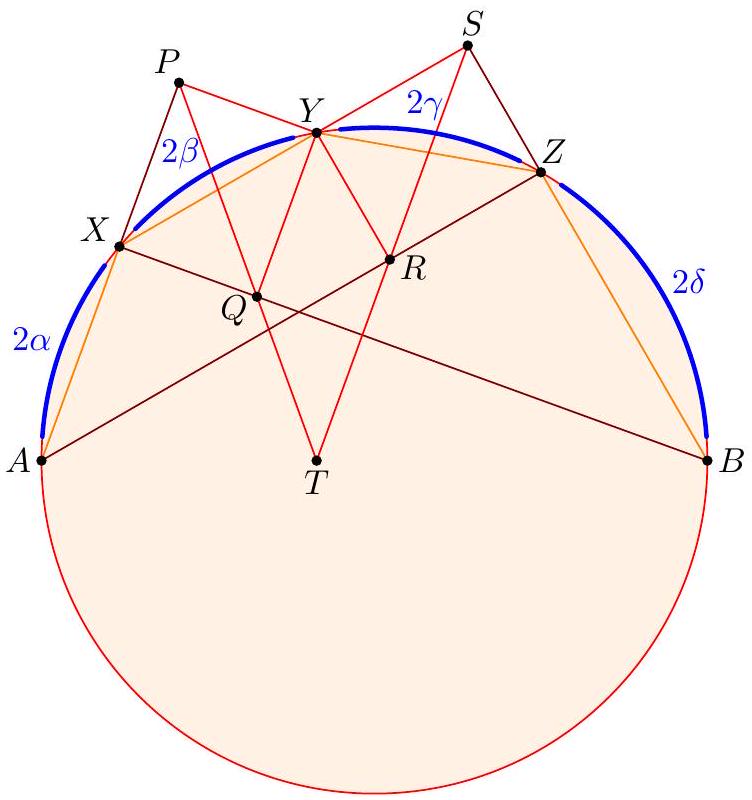 We now compute the following angles: $$ \\begin{aligned} & \\angle S R Y=\\angle S Z Y=90^{\\circ}-\\angle Y Z A=90^{\\circ}-(\\alpha+\\beta) \\\\ & \\angle Y Q P=\\angle Y X P=90^{\\circ}-\\angle B X Y=90^{\\circ}-(\\gamma+\\delta) \\\\ & \\angle Q Y R=180^{\\circ}-\\angle(\\overline{Z R}, \\overline{Q X})=180^{\\circ}-\\frac{2 \\beta+2 \\gamma+180^{\\circ}}{2}=90^{\\circ}-(\\beta+\\gamma) \\end{aligned} $$ Hence, we can then compute $$ \\begin{aligned} \\angle R T Q & =360^{\\circ}-\\left(\\angle Q Y R+\\left(180^{\\circ}-\\angle S R Y\\right)+\\left(180^{\\circ}-\\angle Y Q P\\right)\\right) \\\\ & =\\angle S R Y+\\angle Y Q P-\\angle Q Y R \\end{aligned} $$ $$ \\begin{aligned} & =\\left(90^{\\circ}-(\\alpha+\\beta)\\right)+\\left(90^{\\circ}-(\\gamma+\\delta)\\right)-\\left(90^{\\circ}-(\\beta+\\gamma)\\right) \\\\ & =90^{\\circ}-(\\alpha+\\delta) \\\\ & =\\beta+\\gamma . \\end{aligned} $$ Since $\\angle X O Z=\\frac{2 \\beta+2 \\gamma}{2}=\\beta+\\gamma$, the proof is complete.", "metadata": {"resource_path": "USAMO/segmented/en-USAMO-2010-notes.jsonl"}} |
| {"year": "2010", "tier": "T1", "problem_label": "1", "problem_type": null, "exam": "USAMO", "problem": "Let $A X Y Z B$ be a convex pentagon inscribed in a semicircle of diameter $A B$. Denote by $P, Q, R, S$ the feet of the perpendiculars from $Y$ onto lines $A X, B X$, $A Z, B Z$, respectively. Prove that the acute angle formed by lines $P Q$ and $R S$ is half the size of $\\angle X O Z$, where $O$ is the midpoint of segment $A B$.", "solution": " 【 Second approach using Simson lines, ignoring the diameter condition. In this solution, we will ignore the condition that $\\overline{A B}$ is a diameter; the solution works equally well without it, as long as $O$ is redefined as the center of $(A X Y Z B)$ instead. We will again show the angle formed by lines $P Q$ and $R S$ is half the measure of $\\widehat{X Z}$. 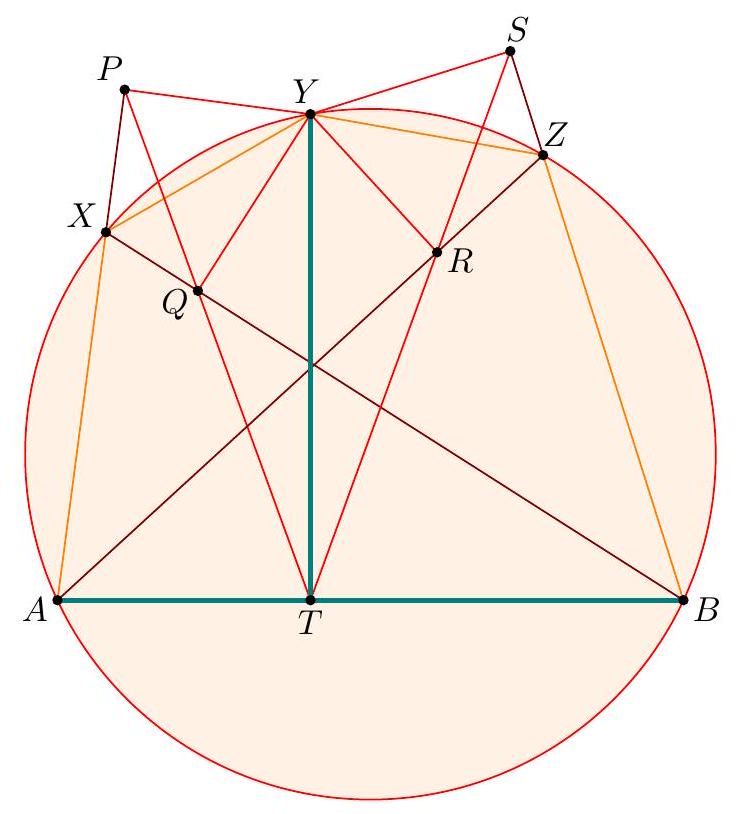 Now it's straightforward to see $A P Y R T$ is cyclic (in the circle with diameter $\\overline{A Y}$ ), and therefore $$ \\angle R T Y=\\angle R A Y=\\angle Z A Y $$ Similarly, $$ \\angle Y T Q=\\angle Y B Q=\\angle Y B X $$ Summing these gives $\\angle R T Q$ is equal to half the measure of $\\operatorname{arc} \\widehat{X Z}$ as needed.", "metadata": {"resource_path": "USAMO/segmented/en-USAMO-2010-notes.jsonl"}} |
| {"year": "2010", "tier": "T1", "problem_label": "2", "problem_type": null, "exam": "USAMO", "problem": "There are $n$ students standing in a circle, one behind the other. The students have heights $h_{1}<h_{2}<\\cdots<h_{n}$. If a student with height $h_{k}$ is standing directly behind a student with height $h_{k-2}$ or less, the two students are permitted to switch places. Prove that it is not possible to make more than $\\binom{n}{3}$ such switches before reaching a position in which no further switches are possible.", "solution": " The main claim is the following observation, which is most motivated in the situation $j-i=2$. Claim - The students with heights $h_{i}$ and $h_{j}$ switch at most $|j-i|-1$ times. For $d \\geq 2$, look at only students $h_{j}, h_{i+1}$ and $h_{i}$ ignoring all other students. After $h_{j}$ and $h_{i}$ switch the first time, the relative ordering of the students must be $h_{i} \\rightarrow h_{j} \\rightarrow h_{i+1}$. Thereafter $h_{j}$ must always switch with $h_{i+1}$ before switching with $h_{i}$, so the inductive hypothesis applies to give the bound $1+j-(i+1)-1=j-i-1$. Hence, the number of switches is at most $$ \\sum_{1 \\leq i<j \\leq n}(|j-i|-1)=\\binom{n}{3} $$", "metadata": {"resource_path": "USAMO/segmented/en-USAMO-2010-notes.jsonl"}} |
| {"year": "2010", "tier": "T1", "problem_label": "3", "problem_type": null, "exam": "USAMO", "problem": "The 2010 positive real numbers $a_{1}, a_{2}, \\ldots, a_{2010}$ satisfy the inequality $a_{i} a_{j} \\leq i+j$ for all $1 \\leq i<j \\leq 2010$. Determine, with proof, the largest possible value of the product $a_{1} a_{2} \\ldots a_{2010}$.", "solution": " The answer is $3 \\times 7 \\times 11 \\times \\cdots \\times 4019$, which is clearly an upper bound (and it's not too hard to show this is the lowest number we may obtain by multiplying 1005 equalities together; this is essentially the rearrangement inequality). The tricky part is the construction. Intuitively we want $a_{i} \\approx \\sqrt{2 i}$, but the details require significant care. Note that if this is achievable, we will require $a_{n} a_{n+1}=2 n+1$ for all odd $n$. Here are two constructions: - One can take the sequence such that $a_{2008} a_{2010}=4018$ and $a_{n} a_{n+1}=2 n+1$ for all $n=1,2, \\ldots, 2009$. This can be shown to work by some calculation. As an illustrative example, $$ a_{1} a_{4}=\\frac{a_{1} a_{2} \\cdot a_{3} a_{4}}{a_{2} a_{3}}=\\frac{3 \\cdot 7}{5}<5 . $$ - In fact one can also take $a_{n}=\\sqrt{2 n}$ for all even $n$ (and hence $a_{n-1}=\\sqrt{2 n}-\\frac{1}{\\sqrt{2 n}}$ for such even $n$ ). Remark. This is a chief example of an \"abstract\" restriction-based approach. One can motivate it in three steps: - The bound $3 \\cdot 7 \\cdots \\cdot 4019$ is provably best possible upper bound by pairing the inequalities; also the situation with 2010 replaced by 4 is constructible with bound 21 . - We have $a_{n} \\approx \\sqrt{2 n}$ heuristically; in fact $a_{n}=\\sqrt{2 n}$ satisfies inequalities by AM-GM. - So we are most worried about $a_{i} a_{j} \\leq i+j$ when $|i-j|$ is small, like $|i-j|=1$. I then proceeded to spend five hours on various constructions, but it turns out that the right thing to do was just require $a_{k} a_{k+1}=2 k+1$, to make sure these pass: and the problem almost solves itself. Remark. When 2010 is replaced by 4 it is not too hard to manually write an explicit example: say $a_{1}=\\frac{\\sqrt{3}}{1.1}, a_{2}=1.1 \\sqrt{3}, a_{3}=\\frac{\\sqrt{7}}{1.1}$ and $a_{4}=1.1 \\sqrt{7}$. So this is a reason one might guess that $3 \\times 7 \\times \\cdots \\times 4019$ can actually be achieved in the large case. Remark. Victor Wang says: I believe we can actually prove that WLOG (!) assume $a_{i} a_{i+1}=2 i+1$ for all $i$ (but there are other ways to motivate that as well, like linear programming after taking logs), which makes things a bit simpler to think about.", "metadata": {"resource_path": "USAMO/segmented/en-USAMO-2010-notes.jsonl"}} |
| {"year": "2010", "tier": "T1", "problem_label": "4", "problem_type": null, "exam": "USAMO", "problem": "Let $A B C$ be a triangle with $\\angle A=90^{\\circ}$. Points $D$ and $E$ lie on sides $A C$ and $A B$, respectively, such that $\\angle A B D=\\angle D B C$ and $\\angle A C E=\\angle E C B$. Segments $B D$ and $C E$ meet at $I$. Determine whether or not it is possible for segments $A B, A C, B I$, $I D, C I, I E$ to all have integer lengths.", "solution": " The answer is no. We prove that it is not even possible that $A B, A C, C I, I B$ are all integers.  First, we claim that $\\angle B I C=135^{\\circ}$. To see why, note that $$ \\angle I B C+\\angle I C B=\\frac{\\angle B}{2}+\\frac{\\angle C}{2}=\\frac{90^{\\circ}}{2}=45^{\\circ} . $$ So, $\\angle B I C=180^{\\circ}-(\\angle I B C+\\angle I C B)=135^{\\circ}$, as desired. We now proceed by contradiction. The Pythagorean theorem implies $$ B C^{2}=A B^{2}+A C^{2} $$ and so $B C^{2}$ is an integer. However, the law of cosines gives $$ \\begin{aligned} B C^{2} & =B I^{2}+C I^{2}-2 B I \\cdot C I \\cos \\angle B I C \\\\ & =B I^{2}+C I^{2}+B I \\cdot C I \\cdot \\sqrt{2} \\end{aligned} $$ which is irrational, and this produces the desired contradiction.", "metadata": {"resource_path": "USAMO/segmented/en-USAMO-2010-notes.jsonl"}} |
| {"year": "2010", "tier": "T1", "problem_label": "5", "problem_type": null, "exam": "USAMO", "problem": "Let $q=\\frac{3 p-5}{2}$ where $p$ is an odd prime, and let $$ S_{q}=\\frac{1}{2 \\cdot 3 \\cdot 4}+\\frac{1}{5 \\cdot 6 \\cdot 7}+\\cdots+\\frac{1}{q(q+1)(q+2)} $$ Prove that if $\\frac{1}{p}-2 S_{q}=\\frac{m}{n}$ for integers $m$ and $n$, then $m-n$ is divisible by $p$.", "solution": " By partial fractions, we have $$ \\frac{2}{(3 k-1)(3 k)(3 k+1)}=\\frac{1}{3 k-1}-\\frac{2}{3 k}+\\frac{1}{3 k+1} $$ Thus $$ \\begin{aligned} 2 S_{q} & =\\left(\\frac{1}{2}-\\frac{2}{3}+\\frac{1}{4}\\right)+\\left(\\frac{1}{5}-\\frac{2}{6}+\\frac{1}{7}\\right)+\\cdots+\\left(\\frac{1}{q}-\\frac{2}{q+1}+\\frac{1}{q+2}\\right) \\\\ & =\\left(\\frac{1}{2}+\\frac{1}{3}+\\frac{1}{4}+\\cdots+\\frac{1}{q+2}\\right)-3\\left(\\frac{1}{3}+\\frac{1}{6}+\\cdots+\\frac{1}{q+1}\\right) \\\\ & =\\left(\\frac{1}{2}+\\frac{1}{3}+\\frac{1}{4}+\\cdots+\\frac{1}{q+2}\\right)-\\left(\\frac{1}{1}+\\frac{1}{2}+\\cdots+\\frac{1}{\\frac{q+1}{3}}\\right) \\\\ \\Longrightarrow 2 S_{q}-\\frac{1}{p}+1 & =\\left(\\frac{1}{1}+\\frac{1}{2}+\\cdots+\\frac{1}{p-1}\\right)+\\left(\\frac{1}{p+1}+\\frac{1}{p+2} \\cdots+\\frac{1}{q+2}\\right)-\\left(\\frac{1}{1}+\\frac{1}{2}+\\cdots+\\frac{1}{\\frac{q+1}{3}}\\right) \\end{aligned} $$ Now we are ready to take modulo $p$. The given says that $q-p+2=\\frac{q+1}{3}$, so $$ \\begin{aligned} 2 S_{q}-\\frac{1}{p}+1 & =\\left(\\frac{1}{1}+\\frac{1}{2}+\\cdots+\\frac{1}{p-1}\\right)+\\left(\\frac{1}{p+1}+\\frac{1}{p+2}+\\cdots+\\frac{1}{q+2}\\right)-\\left(\\frac{1}{1}+\\frac{1}{2}+\\cdots+\\frac{1}{\\frac{q+1}{3}}\\right) \\\\ & \\equiv\\left(\\frac{1}{1}+\\frac{1}{2}+\\cdots+\\frac{1}{p-1}\\right)+\\left(\\frac{1}{1}+\\frac{1}{2}+\\cdots+\\frac{1}{q-p+2}\\right)-\\left(\\frac{1}{1}+\\frac{1}{2}+\\cdots+\\frac{1}{\\frac{q+1}{3}}\\right) \\\\ & =\\frac{1}{1}+\\frac{1}{2}+\\cdots+\\frac{1}{p-1} \\\\ & \\equiv 0 \\quad(\\bmod p) . \\end{aligned} $$ So $\\frac{1}{p}-2 S_{q} \\equiv 1(\\bmod p)$ which is the desired.", "metadata": {"resource_path": "USAMO/segmented/en-USAMO-2010-notes.jsonl"}} |
| {"year": "2010", "tier": "T1", "problem_label": "6", "problem_type": null, "exam": "USAMO", "problem": "There are 68 ordered pairs (not necessarily distinct) of nonzero integers on a blackboard. It's known that for no integer $k$ does both $(k, k)$ and $(-k,-k)$ appear. A student erases some of the 136 integers such that no two erased integers have sum zero, and scores one point for each ordered pair with at least one erased integer. What is the maximum possible score the student can guarantee?", "solution": " The answer is 43. The structure of this problem is better understood as follows: we construct a multigraph whose vertices are the entries, and the edges are the 68 ordered pairs on the blackboard. To be precise, construct a multigraph $G$ with vertices $a_{1}, b_{1}, \\ldots, a_{n}, b_{n}$, with $a_{i}=-b_{i}$ for each $i$. The ordered pairs then correspond to 68 edges in $G$, with self-loops allowed (WLOG) only for vertices $a_{i}$. The student may then choose one of $\\left\\{a_{i}, b_{i}\\right\\}$ for each $i$ and wishes to maximize the number of edges adjacent to the set of chosen vertices. 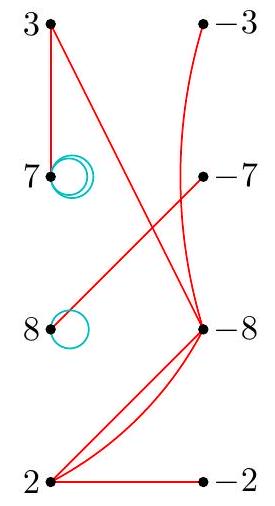 First we use the probabilistic method to show $N \\geq 43$. We select the real number $p=\\frac{\\sqrt{5}-1}{2} \\approx 0.618$ satisfying $p=1-p^{2}$. For each $i$ we then select $a_{i}$ with probability $p$ and $b_{i}$ with probability $1-p$. Then - Every self-loop $\\left(a_{i}, a_{i}\\right)$ is chosen with probability $p$. - Any edge $\\left(b_{i}, b_{j}\\right)$ is chosen with probability $1-p^{2}$. All other edges are selected with probability at least $p$, so in expectation we have $68 p \\approx 42.024$ edges scored. Hence $N \\geq 43$. For a construction showing 43 is optimal, we let $n=8$, and put five self-loops on each $a_{i}$, while taking a single $K_{8}$ on the $b_{i}$ 's. The score achieved for selecting $m$ of the $a_{i}$ 's and $8-m$ of the $b_{i}$ 's is $$ 5 m+\\left(\\binom{8}{2}-\\binom{m}{2}\\right) \\leq 43 $$ with equality when either $m=5$ and $m=6$. Remark (Colin Tang). Here is one possible motivation for finding the construction. In equality case we probably want all the edges to either be $a_{i}$ loops or $b_{i} b_{j}$ edges. Now if $b_{i}$ and $b_{j}$ are not joined by an edge, one can \"merge them together\", also combining the corresponding $a_{i}$ 's, to get another multigraph with 68 edges whose optimal score is at most the original ones. So by using this smoothing algorithm, we can reduce to a situation where the $b_{i}$ and $b_{j}$ are all connected to each other. It's not unnatural to assume it's a clique then, at which point fiddling with parameters gives the construction. Also, there is a construction for $\\lceil 2 / 3 n\\rceil$ which is not too difficult to find, and applying this smoothing operation to this construction could suggest a clique of at least 8 vertices too. Remark (David Lee). One could consider changing the probability $p(n)$ to be a function of the number $n$ of non-loops (hence there are $68-n$ loops); we would then have $$ \\mathbb{E}[\\text { points }] \\geq(68-n) p(n)+n\\left(1-p(n)^{2}\\right) $$ The optimal value of $p(n)$ is then $$ p(n)= \\begin{cases}\\frac{68-n}{2 n}=\\frac{34}{n}-\\frac{1}{2} & n \\geq 23 \\\\ 1 & n<22\\end{cases} $$ For $n>23$ we then have $$ \\begin{aligned} E(n)= & (68-n)\\left(\\frac{34}{n}-\\frac{1}{2}\\right)+n\\left(1-\\left(\\frac{34}{n}-\\frac{1}{2}\\right)^{2}\\right) \\\\ & =\\frac{5 n}{4}+\\frac{34^{2}}{n}-34 \\end{aligned} $$ which has its worst case at around $5 n^{2}=68^{2}$, so at $n=30$ and $n=31$. Indeed, one can find $$ \\begin{aligned} & E(30)=42.033 \\\\ & E(31)=42.040 \\end{aligned} $$ This gives another way to get the lower bound 43, and gives a hint about approximately how many non-loops one would want in order to achieve such a bound.", "metadata": {"resource_path": "USAMO/segmented/en-USAMO-2010-notes.jsonl"}} |
|
|


