# TSTST 2012 Solution Notes
Lincoln, Nebraska
\author{ Evan Chen《陳誼廷》
}
15 April 2024
This is a compilation of solutions for the 2012 TSTST. The ideas of the solution are a mix of my own work, the solutions provided by the competition organizers, and solutions found by the community. However, all the writing is maintained by me.
These notes will tend to be a bit more advanced and terse than the "official" solutions from the organizers. In particular, if a theorem or technique is not known to beginners but is still considered "standard", then I often prefer to use this theory anyways, rather than try to work around or conceal it. For example, in geometry problems I typically use directed angles without further comment, rather than awkwardly work around configuration issues. Similarly, sentences like "let $\mathbb{R}$ denote the set of real numbers" are typically omitted entirely.
Corrections and comments are welcome!
## Contents
0 Problems ..... 2
1 Solutions to Day 1 ..... 4
1.1 TSTST 2012/1, proposed by Palmer Mebane ..... 4
1.2 TSTST 2012/2 ..... 5
1.3 TSTST 2012/3 ..... 6
2 Solutions to Day 2 ..... 8
2.1 TSTST 2012/4 ..... 8
2.2 TSTST 2012/5 ..... 9
2.3 TSTST 2012/6, proposed by Sung-Yoon Kim ..... 10
3 Solutions to Day 3 ..... 11
3.1 TSTST 2012/7 ..... 11
3.2 TSTST 2012/8, proposed by Palmer Mebane ..... 13
3.3 TSTST 2012/9, proposed by John Berman ..... 15
## §0 Problems
1. Determine all infinite strings of letters with the following properties:
(a) Each letter is either $T$ or $S$,
(b) If position $i$ and $j$ both have the letter $T$, then position $i+j$ has the letter $S$,
(c) There are infinitely many integers $k$ such that position $2 k-1$ has the $k$ th $T$.
2. Let $A B C D$ be a quadrilateral with $A C=B D$. Diagonals $A C$ and $B D$ meet at $P$. Let $\omega_{1}$ and $O_{1}$ denote the circumcircle and circumcenter of triangle $A B P$. Let $\omega_{2}$ and $O_{2}$ denote the circumcircle and circumcenter of triangle $C D P$. Segment $B C$ meets $\omega_{1}$ and $\omega_{2}$ again at $S$ and $T$ (other than $B$ and $C$ ), respectively. Let $M$ and $N$ be the midpoints of minor arcs $\widehat{S P}$ (not including $B$ ) and $\overparen{T P}$ (not including $C$ ). Prove that $\overline{M N} \| \overline{O_{1} O_{2}}$.
3. Let $\mathbb{N}$ be the set of positive integers. Let $f: \mathbb{N} \rightarrow \mathbb{N}$ be a function satisfying the following two conditions:
(a) $f(m)$ and $f(n)$ are relatively prime whenever $m$ and $n$ are relatively prime.
(b) $n \leq f(n) \leq n+2012$ for all $n$.
Prove that for any natural number $n$ and any prime $p$, if $p$ divides $f(n)$ then $p$ divides $n$.
4. In scalene triangle $A B C$, let the feet of the perpendiculars from $A$ to $\overline{B C}, B$ to $\overline{C A}$, $C$ to $\overline{A B}$ be $A_{1}, B_{1}, C_{1}$, respectively. Denote by $A_{2}$ the intersection of lines $B C$ and $B_{1} C_{1}$. Define $B_{2}$ and $C_{2}$ analogously. Let $D, E, F$ be the respective midpoints of sides $\overline{B C}, \overline{C A}, \overline{A B}$. Show that the perpendiculars from $D$ to $\overline{A A_{2}}, E$ to $\overline{B B_{2}}$ and $F$ to $\overline{C C_{2}}$ are concurrent.
5. A rational number $x$ is given. Prove that there exists a sequence $x_{0}, x_{1}, x_{2}, \ldots$ of rational numbers with the following properties:
(a) $x_{0}=x$;
(b) for every $n \geq 1$, either $x_{n}=2 x_{n-1}$ or $x_{n}=2 x_{n-1}+\frac{1}{n}$;
(c) $x_{n}$ is an integer for some $n$.
6. Positive real numbers $x, y, z$ satisfy $x y z+x y+y z+z x=x+y+z+1$. Prove that
$$
\frac{1}{3}\left(\sqrt{\frac{1+x^{2}}{1+x}}+\sqrt{\frac{1+y^{2}}{1+y}}+\sqrt{\frac{1+z^{2}}{1+z}}\right) \leq\left(\frac{x+y+z}{3}\right)^{5 / 8} .
$$
7. Triangle $A B C$ is inscribed in circle $\Omega$. The interior angle bisector of angle $A$ intersects side $B C$ and $\Omega$ at $D$ and $L$ (other than $A$ ), respectively. Let $M$ be the midpoint of side $B C$. The circumcircle of triangle $A D M$ intersects sides $A B$ and $A C$ again at $Q$ and $P$ (other than $A$ ), respectively. Let $N$ be the midpoint of segment $P Q$, and let $H$ be the foot of the perpendicular from $L$ to line $N D$. Prove that line $M L$ is tangent to the circumcircle of triangle $H M N$.
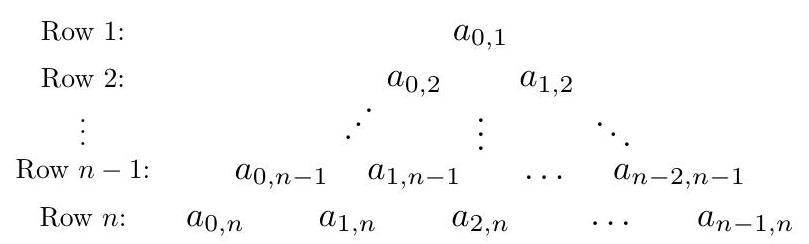
8. Let $n$ be a positive integer. Consider a triangular array of nonnegative integers as follows:
Call such a triangular array stable if for every $0 \leq i1$, let $A_{k}=\left\{a_{1}, a_{2}, \ldots, a_{k}\right\}$. By (b) and symmetry, we have
$$
2 k-1 \geq \frac{\left|A_{k}-A_{k}\right|-1}{2}+\left|A_{k}\right| \geq \frac{2\left|A_{k}\right|-2}{2}+\left|A_{k}\right|=2 k-1 .
$$
But in order for $\left|A_{k}-A_{k}\right|=2\left|A_{k}\right|-1$, we must have $A_{k}$ an arithmetic progression, whence $a_{n}=2 n-1$ for all $n$ by taking $k$ arbitrarily large.
## §1.2 TSTST 2012/2
Available online at https://aops.com/community/p2745851.
## Problem statement
Let $A B C D$ be a quadrilateral with $A C=B D$. Diagonals $A C$ and $B D$ meet at $P$. Let $\omega_{1}$ and $O_{1}$ denote the circumcircle and circumcenter of triangle $A B P$. Let $\omega_{2}$ and $O_{2}$ denote the circumcircle and circumcenter of triangle $C D P$. Segment $B C$ meets $\omega_{1}$ and $\omega_{2}$ again at $S$ and $T$ (other than $B$ and $C$ ), respectively. Let $M$ and $N$ be the midpoints of minor arcs $\widehat{S P}$ (not including $B$ ) and $\widehat{T P}$ (not including $C$ ). Prove that $\overline{M N} \| \overline{O_{1} O_{2}}$.
Let $Q$ be the second intersection point of $\omega_{1}, \omega_{2}$. Suffice to show $\overline{Q P} \perp \overline{M N}$. Now $Q$ is the center of a spiral congruence which sends $\overline{A C} \mapsto \overline{B D}$. So $\triangle Q A B$ and $\triangle Q C D$ are similar isosceles. Now,
$$
\measuredangle Q P A=\measuredangle Q B A=\measuredangle D C Q=\measuredangle D P Q
$$
and so $\overline{Q P}$ is bisects $\angle B P C$.
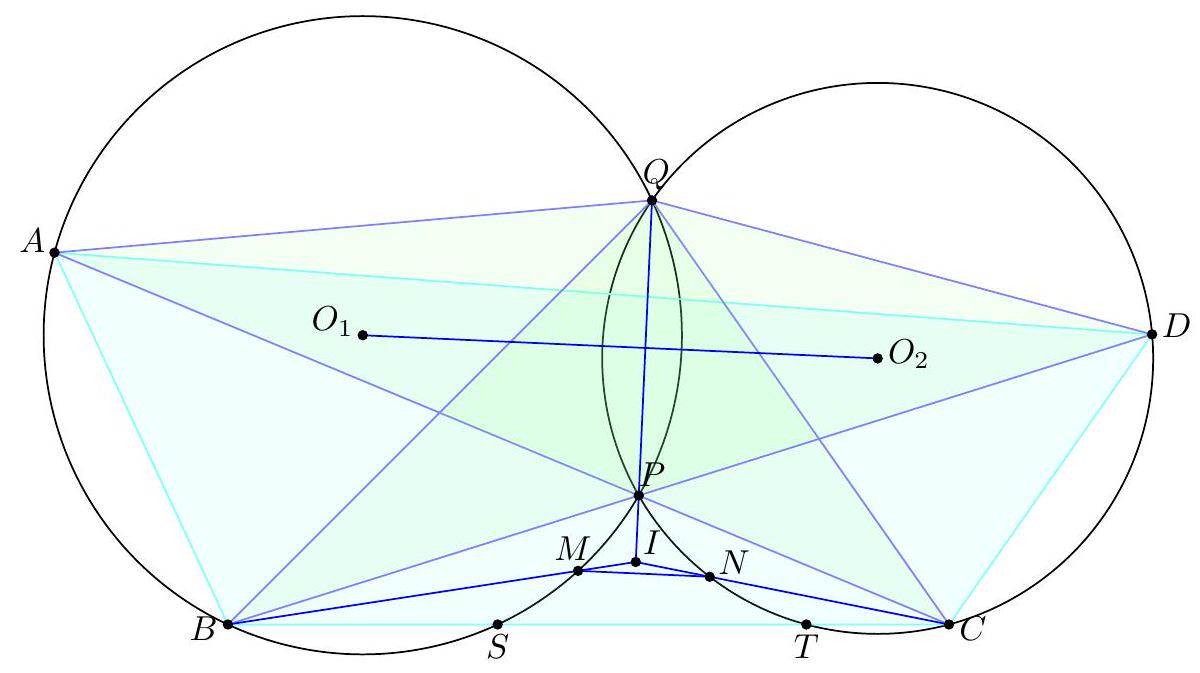
Now, let $I=\overline{B M} \cap \overline{C N} \cap \overline{P Q}$ be the incenter of $\triangle P B C$. Then $I M \cdot I B=I P \cdot I Q=$ $I N \cdot I C$, so $B M N C$ is cyclic, meaning $\overline{M N}$ is antiparallel to $\overline{B C}$ through $\angle B I C$. Since $\overline{Q P I}$ passes through the circumcenter of $\triangle B I C$, it follows now $\overline{Q P I} \perp \overline{M N}$ as desired.
## §1.3 TSTST 2012/3
Available online at https://aops.com/community/p2745877.
## Problem statement
Let $\mathbb{N}$ be the set of positive integers. Let $f: \mathbb{N} \rightarrow \mathbb{N}$ be a function satisfying the following two conditions:
(a) $f(m)$ and $f(n)$ are relatively prime whenever $m$ and $n$ are relatively prime.
(b) $n \leq f(n) \leq n+2012$ for all $n$.
Prove that for any natural number $n$ and any prime $p$, if $p$ divides $f(n)$ then $p$ divides $n$.
【 First short solution, by Jeffrey Kwan. Let $p_{0}, p_{1}, p_{2}, \ldots$ denote the sequence of all prime numbers, in any order. Pick any primes $q_{i}$ such that
$$
q_{0}\left|f\left(p_{0}\right), \quad q_{1}\right| f\left(p_{1}\right), \quad q_{2} \mid f\left(p_{2}\right), \text { etc. }
$$
This is possible since each $f$ value above exceeds 1 . Also, since by hypothesis the $f\left(p_{i}\right)$ are pairwise coprime, the primes $q_{i}$ are all pairwise distinct.
Claim - We must have $q_{i}=p_{i}$ for each $i$. (Therefore, $f\left(p_{i}\right)$ is a power of $p_{i}$ for each $i$.)
Proof. Assume to the contrary that $q_{0} \neq p_{0}$. By changing labels if necessary, assume $\min \left(p_{1}, p_{2}, \ldots, p_{2012}\right)>2012$. Then by Chinese remainder theorem we can choose an integer $m$ such that
$$
\begin{array}{rr}
m+i & \equiv 0 \\
m & \left(\bmod q_{i}\right) \\
m & \equiv{ }^{\prime} \\
\left(\bmod p_{i}\right)
\end{array}
$$
for $0 \leq i \leq 2012$. But now $f(m)$ should be coprime to all $f\left(p_{i}\right)$, ergo coprime to $q_{0} q_{1} \ldots q_{2012}$, violating $m \leq f(m) \leq m+2012$.
All that is left to do is note that whenever $p \nmid n$, we have $\operatorname{gcd}(f(p), f(n))=1$, hence $p \nmid f(n)$. This is the contrapositive of the problem statement.
【 Second solution with a grid. Fix $n$ and $p$, and assume for contradiction $p \nmid n$.
Claim - There exists a large integer $N$ with $f(N)=N$, that also satisfies $N \equiv 1$ $(\bmod n)$ and $N \equiv 0(\bmod p)$.
Proof. We'll need to pick both $N$ and an ancillary integer $M$. Here is how: pick $2012 \cdot 2013$ distinct primes $q_{i, j}>n+p+2013$ for every $i=1, \ldots, 2012$ and $j=0, \ldots, 2012$, and use
it to fill in the following table:
| | $N+1$ | $N+2$ | $\ldots$ | $N+2012$ |
| :---: | :---: | :---: | :---: | :---: |
| $M$ | $q_{0,1}$ | $q_{0,2}$ | $\ldots$ | $q_{0,2012}$ |
| $M+1$ | $q_{1,1}$ | $q_{1,2}$ | $\ldots$ | $q_{1,2012}$ |
| $\vdots$ | $\vdots$ | $\vdots$ | $\ddots$ | $\vdots$ |
| $M+2012$ | $q_{2012,1}$ | $q_{2012,2}$ | $\ldots$ | $q_{2012,2012}$ |.
By the Chinese Remainder Theorem, we can construct $N$ such that $N+1 \equiv 0\left(\bmod q_{i, 1}\right)$ for every $i$, and similarly for $N+2$, and so on. Moreover, we can also tack on the extra conditions $N \equiv 0(\bmod p)$ and $N \equiv 1(\bmod n)$ we wanted.
Notice that $N$ cannot be divisible by any of the $q_{i, j}$ 's, since the $q_{i, j}$ 's are greater than 2012.
After we've chosen $N$, we can pick $M$ such that $M \equiv 0\left(\bmod q_{0, j}\right)$ for every $j$, and similarly $M+1 \equiv 0\left(\bmod q_{1, j}\right)$, et cetera. Moreover, we can tack on the condition $M \equiv 1$ $(\bmod N)$, which ensures $\operatorname{gcd}(M, N)=1$.
What does this do? We claim that $f(N)=N$ now. Indeed $f(M)$ and $f(N)$ are relatively prime; but look at the table! The table tells us that $f(M)$ must have a common factor with each of $N+1, \ldots, N+2012$. So the only possibility is that $f(N)=N$.
Now we're basically done. Since $N \equiv 1(\bmod n)$, we have $\operatorname{gcd}(N, n)=1$ and hence $1=\operatorname{gcd}(f(N), f(n))=\operatorname{gcd}(N, f(n))$. But $p \mid N$ and $p \mid f(n)$, contradiction.
## §2 Solutions to Day 2
## §2.1 TSTST 2012/4
Available online at https://aops.com/community/p2745854.
## Problem statement
In scalene triangle $A B C$, let the feet of the perpendiculars from $A$ to $\overline{B C}, B$ to $\overline{C A}$, $C$ to $\overline{A B}$ be $A_{1}, B_{1}, C_{1}$, respectively. Denote by $A_{2}$ the intersection of lines $B C$ and $B_{1} C_{1}$. Define $B_{2}$ and $C_{2}$ analogously. Let $D, E, F$ be the respective midpoints of sides $\overline{B C}, \overline{C A}, \overline{A B}$. Show that the perpendiculars from $D$ to $\overline{A A_{2}}, E$ to $\overline{B B_{2}}$ and $F$ to $\overline{C C_{2}}$ are concurrent.
We claim that they pass through the orthocenter $H$. Indeed, consider the circle with diameter $\overline{B C}$, which circumscribes quadrilateral $B C B_{1} C_{1}$ and has center $D$. Then by Brokard theorem, $\overline{A A_{2}}$ is the polar of line $H$. Thus $\overline{D H} \perp \overline{A A_{2}}$.
## §2.2 TSTST 2012/5
Available online at https://aops.com/community/p2745867.
## Problem statement
A rational number $x$ is given. Prove that there exists a sequence $x_{0}, x_{1}, x_{2}, \ldots$ of rational numbers with the following properties:
(a) $x_{0}=x$;
(b) for every $n \geq 1$, either $x_{n}=2 x_{n-1}$ or $x_{n}=2 x_{n-1}+\frac{1}{n}$;
(c) $x_{n}$ is an integer for some $n$.
Think of the sequence as a process over time. We'll show that:
Claim - At any given time $t$, if the denominator of $x_{t}$ has some odd prime power $q=p^{e}$, then we can delete a factor of $p$ from the denominator, while only adding powers of two to the denominator.
(Thus we can just delete off all the odd primes one by one and then double appropriately many times.)
Proof. The idea is to add only fractions of the form $\left(2^{k} q\right)^{-1}$.
Indeed, let $n$ be large, and suppose $t<2^{r+1} q<2^{r+2} q<\cdots<2^{r+m} qb$ if $a b=b a=a$. The following are proved by finite casework, using the fact that $\{a b, b c, c a\}$ always has exactly two distinct elements for any different $a, b, c$.
- If $a>b$ and $b>c$ then $a>c$.
- If $a \sim b$ and $b \sim c$ then $a b=a$ if and only if $b c=b$.
- If $a \sim b$ and $b \sim c$ then $a \sim c$.
- If $a \sim b$ and $a>c$ then $b>c$.
- If $a \sim b$ and $c>a$ then $c>b$.
This gives us the total ordering on the elements and the equivalence classes by $\sim$. In this we way can check the claimed operations are the only ones.
We can then (as in the first solution) verify that every full string is equivalent to a unique double rainbow - but this time we prove it by simply considering all possible $\times$, because we have classified them all.