# USA TSTST 2022 Solutions
United States of America - TST Selection Test
Andrew Gu and Evan Chen
64 ${ }^{\text {th }}$ IMO 2023 Japan and $12^{\text {th }}$ EGMO 2023 Slovenia
## Contents
0 Problems ..... 2
1 Solutions to Day 1 ..... 4
1.1 TSTST 2022/1, proposed by Holden Mui ..... 4
1.2 TSTST 2022/2, proposed by Hongzhou Lin ..... 7
1.3 TSTST 2022/3 ..... 9
2 Solutions to Day 2 ..... 11
2.1 TSTST 2022/4, proposed by Merlijn Staps ..... 11
2.2 TSTST 2022/5, proposed by Ray Li ..... 12
2.3 TSTST 2022/6, proposed by Hongzhou Lin ..... 14
3 Solutions to Day 3 ..... 17
3.1 TSTST 2022/7, proposed by Merlijn Staps ..... 17
3.2 TSTST 2022/8, proposed by Merlijn Staps ..... 18
3.3 TSTST 2022/9, proposed by Vincent Huang ..... 19
## §0 Problems
1. Let $n$ be a positive integer. Find the smallest positive integer $k$ such that for any set $S$ of $n$ points in the interior of the unit square, there exists a set of $k$ rectangles such that the following hold:
- The sides of each rectangle are parallel to the sides of the unit square.
- Each point in $S$ is not in the interior of any rectangle.
- Each point in the interior of the unit square but not in $S$ is in the interior of at least one of the $k$ rectangles.
(The interior of a polygon does not contain its boundary.)
2. Let $A B C$ be a triangle. Let $\theta$ be a fixed angle for which
$$
\theta<\frac{1}{2} \min (\angle A, \angle B, \angle C)
$$
Points $S_{A}$ and $T_{A}$ lie on segment $B C$ such that $\angle B A S_{A}=\angle T_{A} A C=\theta$. Let $P_{A}$ and $Q_{A}$ be the feet from $B$ and $C$ to $\overline{A S_{A}}$ and $\overline{A T_{A}}$ respectively. Then $\ell_{A}$ is defined as the perpendicular bisector of $\overline{P_{A} Q_{A}}$.
Define $\ell_{B}$ and $\ell_{C}$ analogously by repeating this construction two more times (using the same value of $\theta$ ). Prove that $\ell_{A}, \ell_{B}$, and $\ell_{C}$ are concurrent or all parallel.
3. Determine all positive integers $N$ for which there exists a strictly increasing sequence of positive integers $s_{0}1$ be a fixed positive integer. Prove that if $n$ is a sufficiently large positive integer, there exists a sequence of integers with the following properties:
- Each element of the sequence is between 1 and $n$, inclusive.
- For any two different contiguous subsequences of the sequence with length between 2 and $k$ inclusive, the multisets of values in those two subsequences is not the same.
- The sequence has length at least $0.499 n^{2}$.
## §1 Solutions to Day 1
## §1.1 TSTST 2022/1, proposed by Holden Mui
Available online at https://aops.com/community/p25516960.
## Problem statement
Let $n$ be a positive integer. Find the smallest positive integer $k$ such that for any set $S$ of $n$ points in the interior of the unit square, there exists a set of $k$ rectangles such that the following hold:
- The sides of each rectangle are parallel to the sides of the unit square.
- Each point in $S$ is not in the interior of any rectangle.
- Each point in the interior of the unit square but not in $S$ is in the interior of at least one of the $k$ rectangles.
(The interior of a polygon does not contain its boundary.)
We give the author's solution. In terms of $n$, we wish find the smallest integer $k$ for which $(0,1)^{2} \backslash S$ is always a union of $k$ open rectangles for every set $S \subset(0,1)^{2}$ of size $n$.
We claim the answer is $k=2 n+2$.
The lower bound is given by picking
$$
S=\left\{\left(s_{1}, s_{1}\right),\left(s_{2}, s_{2}\right), \ldots,\left(s_{n}, s_{n}\right)\right\}
$$
for some real numbers $00$. The four rectangles covering each of
$$
\left(s_{1}-\varepsilon, s_{1}\right),\left(s_{1}, s_{1}-\varepsilon\right),\left(s_{n}+\varepsilon, s_{n}\right),\left(s_{n}, s_{n}+\varepsilon\right)
$$
cannot cover any other points in $S^{\prime}$; all other rectangles can only cover at most 2 points in $S^{\prime}$, giving a bound of
$$
k \geq 4+\frac{\left|S^{\prime}\right|-4}{2}=2 n+2
$$

To prove that $2 n+2$ rectangles are sufficient, assume that the number of distinct $y$-coordinates is at least the number of distinct $x$-coordinates. Let
$$
0=x_{0}0$ gives a total of
$$
(m+n+2)+(n-m)=2 n+2
$$
rectangles.
## §1.2 TSTST 2022/2, proposed by Hongzhou Lin
Available online at https://aops.com/community/p25516988.
## Problem statement
Let $A B C$ be a triangle. Let $\theta$ be a fixed angle for which
$$
\theta<\frac{1}{2} \min (\angle A, \angle B, \angle C)
$$
Points $S_{A}$ and $T_{A}$ lie on segment $B C$ such that $\angle B A S_{A}=\angle T_{A} A C=\theta$. Let $P_{A}$ and $Q_{A}$ be the feet from $B$ and $C$ to $\overline{A S_{A}}$ and $\overline{A T_{A}}$ respectively. Then $\ell_{A}$ is defined as the perpendicular bisector of $\overline{P_{A} Q_{A}}$.
Define $\ell_{B}$ and $\ell_{C}$ analogously by repeating this construction two more times (using the same value of $\theta$ ). Prove that $\ell_{A}, \ell_{B}$, and $\ell_{C}$ are concurrent or all parallel.
We discard the points $S_{A}$ and $T_{A}$ since they are only there to direct the angles correctly in the problem statement.
【 First solution, by author. Let $X$ be the projection from $C$ to $A P_{A}, Y$ be the projection from $B$ to $A Q_{A}$.
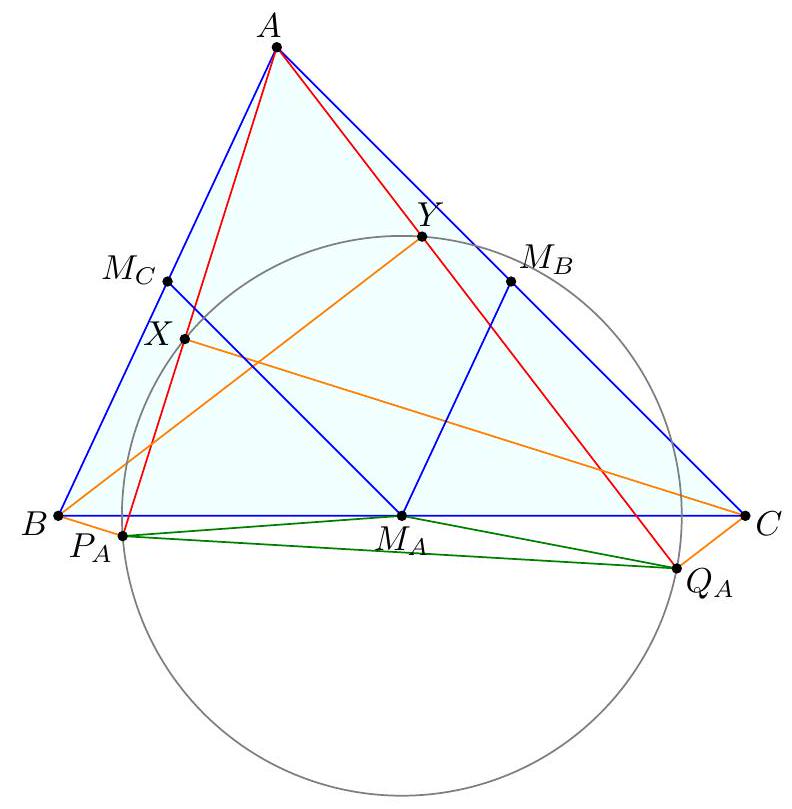
Claim - Line $\ell_{A}$ passes through $M_{A}$, the midpoint of $B C$. Also, quadrilateral $P_{A} Q_{A} Y X$ is cyclic with circumcenter $M_{A}$.
Proof. Since
$$
A P_{A} \cdot A X=A B \cdot A C \cdot \cos \theta \cos (\angle A-\theta)=A Q_{A} \cdot A Y
$$
it follows that $P_{A}, Q_{A}, Y, X$ are concyclic by power of a point. Moreover, by projection, the perpendicular bisector of $P_{A} X$ passes through $M_{A}$, similar for $Q_{A} Y$, implying that $M_{A}$ is the center of $P_{A} Q_{A} Y X$. Hence $\ell_{A}$ passes through $M_{A}$.
$$
\text { Claim }-\measuredangle\left(M_{A} M_{C}, \ell_{A}\right)=\measuredangle Y P_{A} Q_{A}
$$
Proof. Indeed, $\ell_{A} \perp P_{A} Q_{A}$, and $M_{A} M_{C} \perp P_{A} Y$ (since $M_{A} P_{A}=M_{A} Y$ from $\left(P_{A} Q_{A} Y_{A} X\right)$ and $M_{C} P_{A}=M_{C} M_{A}=M_{C} Y$ from the circle with diameter $\left.A B\right)$. Hence $\measuredangle\left(M_{A} M_{C}, \ell_{A}\right)=$ $\measuredangle\left(P_{A} Y, P_{A} Q_{A}\right)=\measuredangle Y P_{A} Q_{A}$.
Therefore,
$$
\frac{\sin \angle\left(M_{A} M_{C}, \ell_{A}\right)}{\sin \angle\left(\ell_{A}, M_{A} M_{B}\right)}=\frac{\sin \angle Y P_{A} Q_{A}}{\sin \angle P_{A} Q_{A} X}=\frac{Y Q_{A}}{X P_{A}}=\frac{B C \sin (\angle C+\theta)}{B C \sin (\angle B+\theta)}=\frac{\sin (\angle C+\theta)}{\sin (\angle B+\theta)},
$$
and we conclude by trig Ceva theorem.
【 Second solution via Jacobi, by Maxim Li. Let $D$ be the foot of the $A$-altitude. Note that line $B C$ is the external angle bisector of $\angle P_{A} D Q_{A}$.
Claim - $\left(D P_{A} Q_{A}\right)$ passes through the midpoint $M_{A}$ of $B C$.
Proof. Perform $\sqrt{b c}$ inversion. Then the intersection of $B C$ and $\left(D P_{A} Q_{A}\right)$ maps to the second intersection of $(A B C)$ and $\left(A^{\prime} P_{A} Q_{A}\right)$, where $A^{\prime}$ is the antipode to $A$ on $(A B C)$, i.e. the center of spiral similarity from $B C$ to $P_{A} Q_{A}$. Since $B P_{A}: C Q_{A}=A B: A C$, we see the center of spiral similarity is the intersection of the $A$-symmedian with $(A B C)$, which is the image of $M_{A}$ in the inversion.
It follows that $M_{A}$ lies on $\ell_{A}$; we need to identify a second point. We'll use the circumcenter $O_{A}$ of $\left(D P_{A} Q_{A}\right)$. The perpendicular bisector of $D P_{A}$ passes through $M_{C}$; indeed, we can easily show the angle it makes with $M_{C} M_{A}$ is $90^{\circ}-\theta-C$, so $\angle O_{A} M_{C} M_{A}=90-\theta-C$, and then by analogous angle-chasing we can finish with Jacobi's theorem on $\triangle M_{A} M_{B} M_{C}$.
## §1.3 TSTST 2022/3
Available online at https://aops.com/community/p25517008.
## Problem statement
Determine all positive integers $N$ for which there exists a strictly increasing sequence of positive integers $s_{0}2^{21}$ possible colorings. If Bob makes less than 22 queries, then he can only output $2^{21}$ possible colorings, which means he is wrong on some coloring.
Now we show Bob can always win in 22 queries. A key observation is that the set of red points is convex, as is the set of blue points, so if a set of points is all the same color, then their convex hull is all the same color.
## Lemma
Let $B_{0}, \ldots, B_{k+1}$ be equally spaced points on a circular arc such that colors of $B_{0}$ and $B_{k+1}$ differ and are known. Then it is possible to determine the colors of $B_{1}$, $\ldots, B_{k}$ in $\left\lceil\log _{2} k\right\rceil$ queries.
Proof. There exists some $0 \leq i \leq k$ such that $B_{0}, \ldots, B_{i}$ are the same color and $B_{i+1}$, $\ldots, B_{k+1}$ are the same color. (If $i\lceil k / 2\rceil$, then the segment $P B_{i}$ is blue and intersect the segment $B_{0} B_{\lceil k / 2\rceil}$, which is red, contradiction.
Now the strategy is: Bob picks $A_{1}$. WLOG it is red. Now suppose Bob does not know the colors of $\leq 2^{k}-1$ points $A_{i}, \ldots, A_{j}$ with $j-i+1 \leq 2^{k}-1$ and knows the rest are red. I claim Bob can win in $2 k-1$ queries. First, if $k=1$, there is one point and he wins by querying the point, so the base case holds, so assume $k>1$. Bob queries $A_{i+\lceil(j-i+1) / 2\rceil}$. If it is blue, he finishes in $2 \log _{2}\lceil(j-i+1) / 2\rceil \leq 2(k-1)$ queries by the first lemma, for a total of $2 k-1$ queries. If it is red, he can query one more point and learn some half of $A_{i}, \ldots, A_{j}$ that are red by the second lemma, and then he has reduced it to the case with $\leq 2^{k-1}-1$ points in two queries, at which point we induct.
## §2.3 TSTST 2022/6, proposed by Hongzhou Lin
Available online at https://aops.com/community/p25516957.
## Problem statement
Let $O$ and $H$ be the circumcenter and orthocenter, respectively, of an acute scalene triangle $A B C$. The perpendicular bisector of $\overline{A H}$ intersects $\overline{A B}$ and $\overline{A C}$ at $X_{A}$ and $Y_{A}$ respectively. Let $K_{A}$ denote the intersection of the circumcircles of triangles $O X_{A} Y_{A}$ and $B O C$ other than $O$.
Define $K_{B}$ and $K_{C}$ analogously by repeating this construction two more times. Prove that $K_{A}, K_{B}, K_{C}$, and $O$ are concyclic.
We present several approaches.
\ First solution, by author. Let $\odot O X_{A} Y_{A}$ intersects $A B, A C$ again at $U, V$. Then by Reim's theorem $U V C B$ are concyclic. Hence the radical axis of $\odot O X_{A} Y_{A}, \odot O B C$ and $\odot(U V C B)$ are concurrent, i.e. $O K_{A}, B C, U V$ are concurrent, Denote the intersection as $K_{A}^{*}$, which is indeed the inversion of $K_{A}$ with respect to $\odot O$. (The inversion sends $\odot O B C$ to the line $B C$ ).
Let $P_{A}, P_{B}, P_{C}$ be the circumcenters of $\triangle O B C, \triangle O C A, \triangle O A B$ respectively.
Claim $-K_{A}^{*}$ coincides with the intersection of $P_{B} P_{C}$ and $B C$.
Proof. Note that $d(O, B C)=1 / 2 A H=d\left(A, X_{A} Y_{A}\right)$. This means the midpoint $M_{C}$ of $A B$ is equal distance to $X_{A} Y_{A}$ and the line through $O$ parallel to $B C$. Together with $O M_{C} \perp A B$ implies that $\angle M_{C} X_{A} O=\angle B$. Hence $\angle U V O=\angle B=\angle A V U$. Similarly $\angle V U O=\angle A U V$, hence $\triangle A U V \simeq \triangle O U V$. In other words, $U V$ is the perpendicular bisector of $A O$, which pass through $P_{B}, P_{C}$. Hence $K_{A}^{*}$ is indeed $P_{B} P_{C} \cap B C$.
Finally by Desargue's theorem, it suffices to show that $A P_{A}, B P_{B}, C P_{C}$ are concurrent. Note that
$$
\begin{aligned}
& d\left(P_{A}, A B\right)=P_{A} B \sin \left(90^{\circ}+\angle C-\angle A\right) \\
& d\left(P_{A}, A C\right)=P_{A} C \sin \left(90^{\circ}+\angle B-\angle A\right)
\end{aligned}
$$
Hence the symmetric product and trig Ceva finishes the proof.
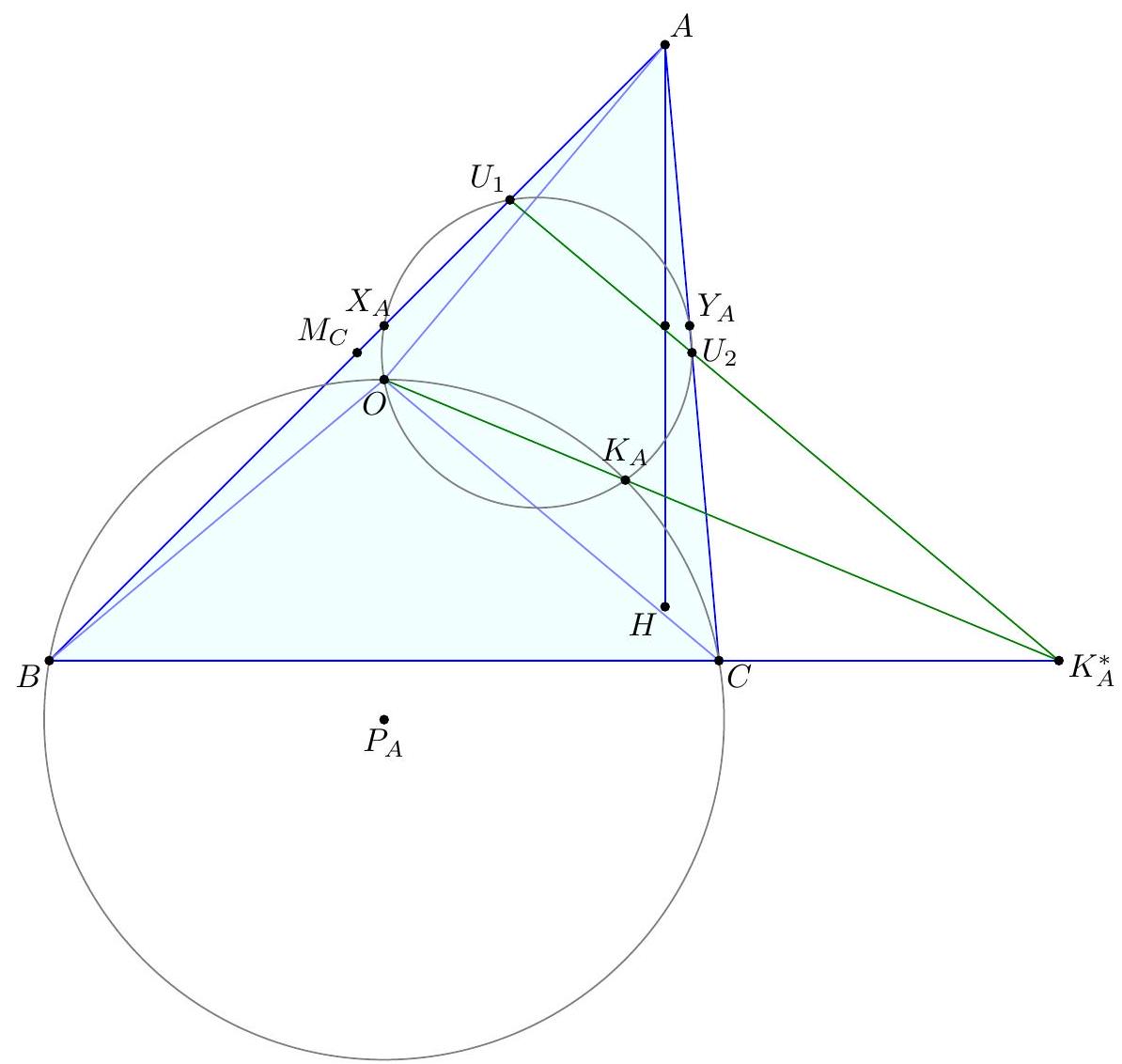
I Second solution, from Jeffrey Kwan. Let $O_{A}$ be the circumcenter of $\triangle A X_{A} Y_{A}$. The key claim is that:
Claim $-O_{A} X_{A} Y_{A} O$ is cyclic.
Proof. Let $D E F$ be the orthic triangle; we will show that $\triangle O X_{A} Y_{A} \sim \triangle D E F$. Indeed, since $A O$ and $A D$ are isogonal, it suffices to note that
$$
\frac{A X_{A}}{A B}=\frac{A H / 2}{A D}=\frac{R \cos A}{A D}
$$
and so
$$
\frac{A O}{A D}=R \cdot \frac{A X_{A}}{A B \cdot R \cos A}=\frac{A X_{A}}{A E}=\frac{A Y_{A}}{A F}
$$
Hence $\angle X_{A} O Y_{A}=180^{\circ}-2 \angle A=180^{\circ}-\angle X_{A} O_{A} Y_{A}$, which proves the claim.
Let $P_{A}$ be the circumcenter of $\triangle O B C$, and define $P_{B}, P_{C}$ similarly. By the claim, $A$ is the exsimilicenter of $\left(O X_{A} Y_{A}\right)$ and $(O B C)$, so $A P_{A}$ is the line between their two centers. In particular, $A P_{A}$ is the perpendicular bisector of $O K_{A}$.
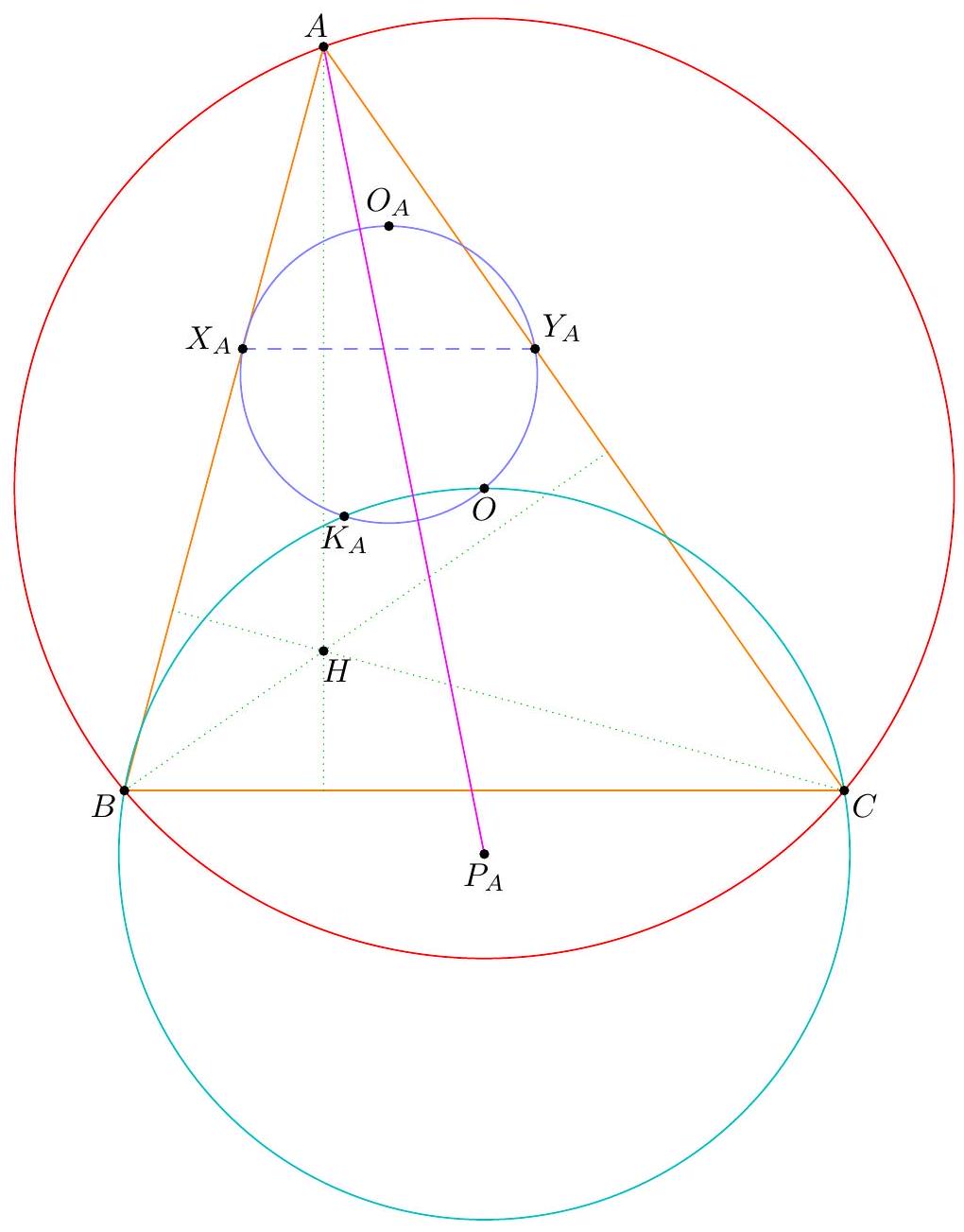
Claim $-A P_{A}, B P_{B}, C P_{C}$ concur at $T$.
Proof. The key observation is that $O$ is the incenter of $\triangle P_{A} P_{B} P_{C}$, and that $A, B, C$ are the reflections of $O$ across the sides of $\triangle P_{A} P_{B} P_{C}$. Hence $P_{A} A, P_{B} B, P_{C} C$ concur by Jacobi.
Now $T$ lies on the perpendicular bisectors of $O K_{A}, O K_{B}$, and $O K_{C}$. Hence $O K_{A} K_{B} K_{C}$ is cyclic with center $T$, as desired.
## §3 Solutions to Day 3
## §3.1 TSTST 2022/7, proposed by Merlijn Staps
Available online at https://aops.com/community/p25516961.
## Problem statement
Let $A B C D$ be a parallelogram. Point $E$ lies on segment $C D$ such that
$$
2 \angle A E B=\angle A D B+\angle A C B,
$$
and point $F$ lies on segment $B C$ such that
$$
2 \angle D F A=\angle D C A+\angle D B A .
$$
Let $K$ be the circumcenter of triangle $A B D$. Prove that $K E=K F$.
Let the circle through $A, B$, and $E$ intersect $C D$ again at $E^{\prime}$, and let the circle through $D$, $A$, and $F$ intersect $B C$ again at $F^{\prime}$. Now $A B E E^{\prime}$ and $D A F^{\prime} F$ are cyclic quadrilaterals with two parallel sides, so they are isosceles trapezoids. From $K A=K B$, it now follows that $K E=K E^{\prime}$, whereas from $K A=K D$ it follows that $K F=K F^{\prime}$.
Next, let the circle through $A, B$, and $E$ intersect $A C$ again at $S$. Then
$$
\angle A S B=\angle A E B=\frac{1}{2}(\angle A D B+\angle A C B)=\frac{1}{2}(\angle A D B+\angle D A C)=\frac{1}{2} \angle A M B,
$$
where $M$ is the intersection of $A C$ and $B D$. From $\angle A S B=\frac{1}{2} \angle A M B$, it follows that $M S=M B$, so $S$ is the point on $M C$ such that $M S=M B=M D$. By symmetry, the circle through $A, D$, and $F$ also passes through $S$, and it follows that the line $A S$ is the radical axis of the circles $(A B E)$ and $(A D F)$.
By power of a point, we now obtain
$$
C E \cdot C E^{\prime}=C S \cdot C A=C F \cdot C F^{\prime},
$$
from which it follows that $E, F, E^{\prime}$, and $F^{\prime}$ are concyclic. The segments $E E^{\prime}$ and $F F^{\prime}$ are not parallel, so their perpendicular bisectors only meet at one point, which is $K$. Hence $K E=K F$.
## §3.2 TSTST 2022/8, proposed by Merlijn Staps
Available online at https://aops.com/community/p25516968.
## Problem statement
Find all functions $f: \mathbb{N} \rightarrow \mathbb{Z}$ such that
$$
\left\lfloor\frac{f(m n)}{n}\right\rfloor=f(m)
$$
for all positive integers $m, n$.
There are two families of functions that work: for each $\alpha \in \mathbb{R}$ the function $f(n)=\lfloor\alpha n\rfloor$, and for each $\alpha \in \mathbb{R}$ the function $f(n)=\lceil\alpha n\rceil-1$. (For irrational $\alpha$ these two functions coincide.) It is straightforward to check that these functions indeed work; essentially, this follows from the identity
$$
\left\lfloor\frac{\lfloor x n\rfloor}{n}\right\rfloor=\lfloor x\rfloor
$$
which holds for all positive integers $n$ and real numbers $x$.
We now show that every function that works must be of one of the above forms. Let $f$ be a function that works, and define the sequence $a_{1}, a_{2}, \ldots$ by $a_{n}=f(n!) / n!$. Applying the give condition with $(n!, n+1)$ yields $a_{n+1} \in\left[a_{n}, a_{n}+\frac{1}{n!}\right)$. It follows that the sequence $a_{1}, a_{2}, \ldots$ is non-decreasing and bounded from above by $a_{1}+e$, so this sequence must converge to some limit $\alpha$.
If there exists a $k$ such that $a_{k}=\alpha$, then we have $a_{\ell}=\alpha$ for all $\ell>k$. For each positive integer $m$, there exists $\ell>k$ such that $m \mid \ell$ !. Plugging in $m n=\ell$ !, it then follows that
$$
f(m)=\left\lfloor\frac{f(\ell!)}{\ell!/ m}\right\rfloor=\lfloor\alpha m\rfloor
$$
for all $m$, so $f$ is of the desired form.
If there does not exist a $k$ such that $a_{k}=\alpha$, we must have $a_{k}<\alpha$ for all $k$. For each positive integer $m$, we can now pick an $\ell$ such that $m \mid \ell$ ! and $a_{\ell}=\alpha-x$ with $x$ arbitrarily small. It then follows from plugging in $m n=\ell$ ! that
$$
f(m)=\left\lfloor\frac{f(\ell!)}{\ell!/ m}\right\rfloor=\left\lfloor\frac{\ell!(\alpha-x)}{\ell!/ m}\right\rfloor=\lfloor\alpha m-m x\rfloor .
$$
If $\alpha m$ is an integer we can choose $\ell$ such that $m x<1$, and it follows that $f(m)=\lceil\alpha m\rceil-1$. If $\alpha m$ is not an integer we can choose $\ell$ such that $m x<\{\alpha m\}$, and it also follows that $f(m)=\lceil\alpha m\rceil-1$. We conclude that in this case $f$ is again of the desired form.
## §3.3 TSTST 2022/9, proposed by Vincent Huang
Available online at https://aops.com/community/p25517112.
## Problem statement
Let $k>1$ be a fixed positive integer. Prove that if $n$ is a sufficiently large positive integer, there exists a sequence of integers with the following properties:
- Each element of the sequence is between 1 and $n$, inclusive.
- For any two different contiguous subsequences of the sequence with length between 2 and $k$ inclusive, the multisets of values in those two subsequences is not the same.
- The sequence has length at least $0.499 n^{2}$.
For any positive integer $n$, define an $(n, k)$-good sequence to be a finite sequence of integers each between 1 and $n$ inclusive satisfying the second property in the problem statement. The problems asks to show that, for all sufficiently large integers $n$, there is an $(n, k)$-good sequence of length at least $0.499 n^{2}$.
Fix $k \geq 2$ and consider some prime power $n=p^{m}$ with $p>k+1$. Consider some $0k+1$ be a prime. Then for $n=p^{2}$ we can find a $(n, k)$-good sequence of length $\frac{p(p-1)\left(p^{2}+2\right)}{2}$.
Proof of last claim. Let $g$ be the smallest primitive root modulo $n=p^{2}$, so that $a=$ $\frac{p(p-1)}{2}$. As long as we can show that $g<\frac{n}{k}-1$, we can apply the previous claim to get the desired bound.
We will prove a stronger statement that $g