Note that in this solutions file, we present slightly stronger versions of problems 4 and 6 on the January TST than actually appeared on the exams.
## USA IMO TST 2017 Solutions
United States of America - IMO Team Selection Tests
Evan Chen《陳誼廷》
$58^{\text {th }}$ IMO 2017 Brazil
## Contents
0 Problems
1 Solutions to Day 1 ..... 4
1.1 USA TST 2017/1, proposed by Po-Shen Loh ..... 4
1.2 USA TST 2017/2, proposed by Evan Chen ..... 6
1.3 USA TST 2017/3, proposed by Alison Miller ..... 8
2 Solutions to Day 2 ..... 10
2.1 USA TST 2017/4, proposed by Linus Hamilton ..... 10
2.2 USA TST 2017/5, proposed by Danielle Wang, Evan Chen ..... 12
2.3 USA TST 2017/6, proposed by Noam Elkies ..... 13
## §0 Problems
1. In a sports league, each team uses a set of at most $t$ signature colors. A set $S$ of teams is color-identifiable if one can assign each team in $S$ one of their signature colors, such that no team in $S$ is assigned any signature color of a different team in $S$. For all positive integers $n$ and $t$, determine the maximum integer $g(n, t)$ such that: In any sports league with exactly $n$ distinct colors present over all teams, one can always find a color-identifiable set of size at least $g(n, t)$.
2. Let $A B C$ be an acute scalene triangle with circumcenter $O$, and let $T$ be on line $B C$ such that $\angle T A O=90^{\circ}$. The circle with diameter $\overline{A T}$ intersects the circumcircle of $\triangle B O C$ at two points $A_{1}$ and $A_{2}$, where $O A_{1}1$ other contestant's guesses before writing your own. For each question, after all guesses are submitted, the emcee announces the correct answer. A correct guess is worth 0 points. An incorrect guess is worth -2 points for other contestants, but only -1 point for you, because you hacked the scoring system. After announcing the correct answer, the emcee proceeds to read out the next question. Show that if you are leading by $2^{n-1}$ points at any time, then you can surely win first place.
5. Let $A B C$ be a triangle with altitude $\overline{A E}$. The $A$-excircle touches $\overline{B C}$ at $D$, and intersects the circumcircle at two points $F$ and $G$. Prove that one can select points $V$ and $N$ on lines $D G$ and $D F$ such that quadrilateral $E V A N$ is a rhombus.
6. Prove that there are infinitely many triples $(a, b, p)$ of integers, with $p$ prime and $0\operatorname{deg}\left(Q^{\prime} P-Q P^{\prime}\right)
\end{aligned}
$$
This can only occur if $Q^{\prime} P-Q P^{\prime}=0$ or $(P / Q)^{\prime}=0$ by the quotient rule! But $P / Q$ can't be constant, the end.
Remark. The result is previously known; see e.g. Lemma 1.6 of http://math.mit.edu/ ebelmont/ec-notes.pdf or Exercise 6.5.L(a) of Vakil's notes.
## §2 Solutions to Day 2
## §2.1 USA TST 2017/4, proposed by Linus Hamilton
Available online at https://aops.com/community/p7732191.
## Problem statement
You are cheating at a trivia contest. For each question, you can peek at each of the $n>1$ other contestant's guesses before writing your own. For each question, after all guesses are submitted, the emcee announces the correct answer. A correct guess is worth 0 points. An incorrect guess is worth -2 points for other contestants, but only -1 point for you, because you hacked the scoring system. After announcing the correct answer, the emcee proceeds to read out the next question. Show that if you are leading by $2^{n-1}$ points at any time, then you can surely win first place.
We will prove the result with $2^{n-1}$ replaced even by $2^{n-2}+1$.
We first make the following reductions. First, change the weights to be $+1,-1,0$ respectively (rather than $0,-2,-1$ ); this clearly has no effect. Also, WLOG that all contestants except you initially have score zero (and that your score exceeds $2^{n-2}$ ). WLOG ignore rounds in which all answers are the same. Finally, ignore rounds in which you get the correct answer, since that leaves you at least as well off as before - in other words, we'll assume your score is always fixed, but you can pick any group of people with the same answers and ensure they lose 1 point, while some other group gains 1 point.
The key observation is the following. Consider two rounds $R_{1}$ and $R_{2}$ such that:
- In round $R_{1}$, some set $S$ of contestants gains a point.
- In round $R_{2}$, the set $S$ of contestants all have the same answer.
Then, if we copy the answers of contestants in $S$ during $R_{2}$, then the sum of the scorings in $R_{1}$ and $R_{2}$ cancel each other out. In other words we can then ignore $R_{1}$ and $R_{2}$ forever.
We thus consider the following strategy. We keep a list $\mathcal{L}$ of subsets of $\{1, \ldots, n\}$, initially empty. Now do the following strategy:
- On a round, suppose there exists a set $S$ of people with the same answer such that $S \in \mathcal{L}$. (If multiple exist, choose one arbitrarily.) Then, copy the answer of $S$, causing them to lose a point. Delete $S$ from $\mathcal{L}$. (Importantly, we do not add any new sets to $\mathcal{L}$.)
- Otherwise, copy any set $T$ of contestants, selecting $|T| \geq n / 2$ if possible. Let $S$ be the set of contestants who answer correctly (if any), and add $S$ to the list $\mathcal{L}$. Note that $|S| \leq n / 2$, since $S$ is disjoint from $T$.
By construction, $\mathcal{L}$ has no duplicate sets. So the score of any contestant $c$ is bounded above by the number of times that $c$ appears among sets in $\mathcal{L}$. The number of such sets is clearly at most $\frac{1}{2} \cdot 2^{n-1}$. So, if you lead by $2^{n-2}+1$ then you ensure victory. This completes the proof!
Remark. Several remarks are in order. First, we comment on the bound $2^{n-2}+1$ itself. The most natural solution using only the list idea gives an upper bound of $\left(2^{n}-2\right)+1$, which is the number of nonempty proper subsets of $\{1, \ldots, n\}$. Then, there are two optimizations one can observe:
- In fact we can improve to the number of times any particular contestant $c$ appears in some set, rather than the total number of sets.
- When adding new sets $S$ to $\mathcal{L}$, one can ensure $|S| \leq n / 2$.
Either observation alone improves the bound from $2^{n}-1$ to $2^{n-1}$, but both together give the bound $2^{n-2}+1$. Additionally, when $n$ is odd the calculation of subsets actually gives $2^{n-2}-\frac{1}{2}\binom{n-1}{\frac{n-1}{2}}+1$. This gives the best possible value at both $n=2$ and $n=3$. It seems likely some further improvements are possible, and the true bound is suspected to be polynomial in $n$.
Secondly, the solution is highly motivated by considering a true/false contest in which only two distinct answers are given per question. However, a natural mistake (which graders assessed as a two-point deduction) is to try and prove that in fact one can "WLOG" we are in the two-question case. The proof of this requires substantially more care than expected. For instance, set $n=3$. If $\mathcal{L}=\{\{1\},\{2\},\{3\}\}$ then it becomes impossible to prevent a duplicate set from appearing in $\mathcal{L}$ if all contestants give distinct answers. One might attempt to fix this by instead adding to $\mathcal{L}$ the complement of the set $T$ described above. The example $\mathcal{L}=\{\{1,2\},\{2,3\},\{3,1\}\}$ (followed again by a round with all distinct answers) shows that this proposed fix does not work either. This issue affects all variations of the above approach.
Because the USA TST did not have any solution-writing process at this time, this issue was not noticed until January 15 (less than a week before the exam). When it was brought up by email by Evan, every organizer who had testsolved the problem had apparently made the same error.
Remark. Here are some motivations for the solution:
1. The exponential bound $2^{n}$ suggests looking at subsets.
2. The $n=2$ case suggests the idea of "repeated rounds". (I think this $n=2$ case is actually really good.)
3. The "two distinct answers" case suggests looking at rounds as partitions (even though the WLOG does not work, at least not without further thought).
4. There's something weird about this problem: it's a finite bound over unbounded time. This is a hint to not worry excessively about the actual scores, which turn out to be almost irrelevant.
## §2.2 USA TST 2017/5, proposed by Danielle Wang, Evan Chen
Available online at https://aops.com/community/p7732197.
## Problem statement
Let $A B C$ be a triangle with altitude $\overline{A E}$. The $A$-excircle touches $\overline{B C}$ at $D$, and intersects the circumcircle at two points $F$ and $G$. Prove that one can select points $V$ and $N$ on lines $D G$ and $D F$ such that quadrilateral $E V A N$ is a rhombus.
Let $I$ denote the incenter, $J$ the $A$-excenter, and $L$ the midpoint of $\overline{A E}$. Denote by $\overline{I Y}$, $\overline{I Z}$ the tangents from $I$ to the $A$-excircle. Note that lines $\overline{B C}, \overline{G F}, \overline{Y Z}$ then concur at $H$ (unless $A B=A C$, but this case is obvious), as it's the radical center of cyclic hexagon $B I C Y J Z$, the circumcircle and the $A$-excircle.
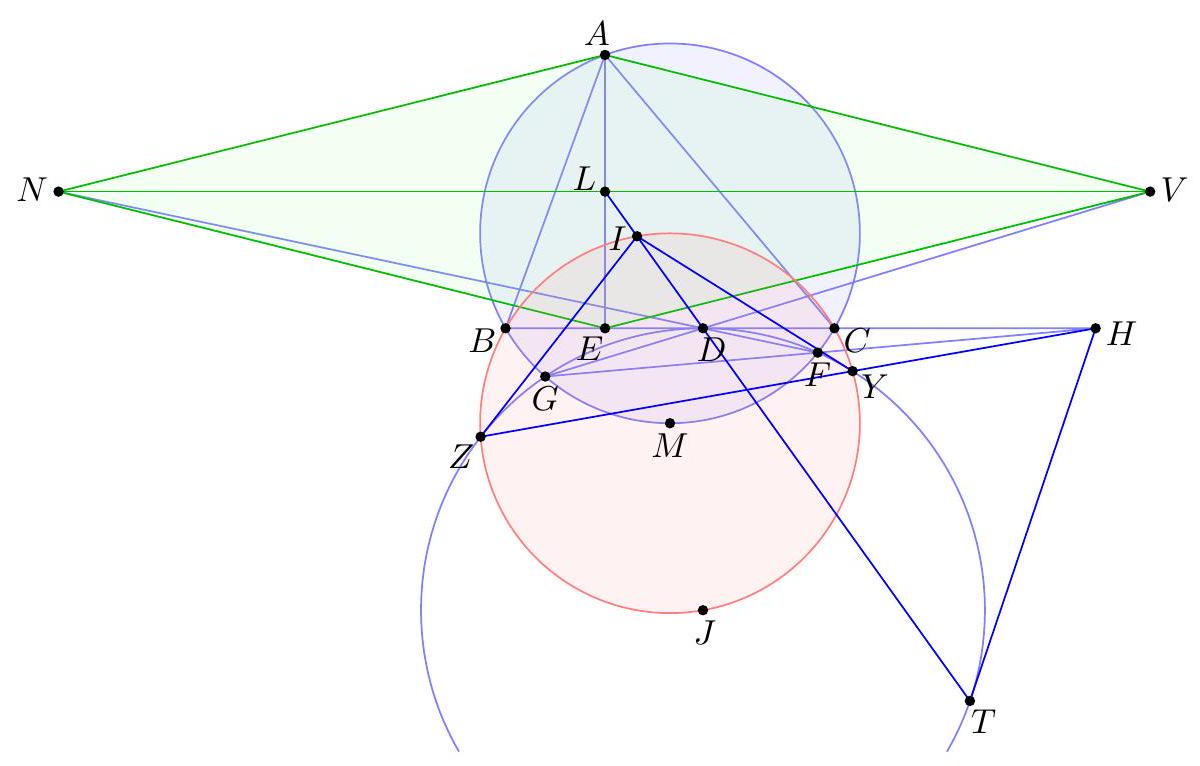
Now let $\overline{H D}$ and $\overline{H T}$ be the tangents from $H$ to the $A$-excircle. It follows that $\overline{D T}$ is the symmedian of $\triangle D Z Y$, hence passes through $I=\overline{Y Y} \cap \overline{Z Z}$. Moreover, it's well known that $\overline{D I}$ passes through $L$, the midpoint of the $A$-altitude (for example by homothety). Finally, $(D T ; F G)=-1$, hence project through $D$ onto the line through $L$ parallel to $\overline{B C}$ to obtain $(\infty L ; V N)=-1$ as desired.
【 Authorship comments. This is a joint proposal with Danielle Wang (mostly by her). The formulation given was that the tangents to the $A$-excircle at $F$ and $G$ was on line $\overline{D I}$; I solved this formulation using the radical axis argument above. I then got the idea to involve the point $L$, already knowing it was on $\overline{D I}$. Observing the harmonic quadrilateral, I took perspectivity through $M$ onto the line through $L$ parallel to $\overline{B C}$ (before this I had tried to use the $A$-altitude with little luck). This yields the rhombus in the problem.
## §2.3 USA TST 2017/6, proposed by Noam Elkies
Available online at https://aops.com/community/p7732203.
## Problem statement
Prove that there are infinitely many triples $(a, b, p)$ of integers, with $p$ prime and $0