# USA IMO TST 2020 Solutions
United States of America - IMO Team Selection Tests
Ankan Bhattacharya and Evan Chen
$61^{\text {th }}$ IMO 2020 Russia
## Contents
0 Problems
1 Solutions to Day 1 ..... 3
1.1 USA TST 2020/1, proposed by Carl Schildkraut, Milan Haiman ..... 3
1.2 USA TST 2020/2, proposed by Merlijn Staps ..... 5
1.3 USA TST 2020/3, proposed by Nikolai Beluhov ..... 8
2 Solutions to Day 2 ..... 12
2.1 USA TST 2020/4, proposed by Zack Chroman, Mehtaab Sawhney ..... 12
2.2 USA TST 2020/5, proposed by Carl Schildkraut ..... 14
2.3 USA TST 2020/6, proposed by Michael Ren ..... 16
## §0 Problems
1. Choose positive integers $b_{1}, b_{2}, \ldots$ satisfying
$$
1=\frac{b_{1}}{1^{2}}>\frac{b_{2}}{2^{2}}>\frac{b_{3}}{3^{2}}>\frac{b_{4}}{4^{2}}>\cdots
$$
and let $r$ denote the largest real number satisfying $\frac{b_{n}}{n^{2}} \geq r$ for all positive integers $n$. What are the possible values of $r$ across all possible choices of the sequence $\left(b_{n}\right)$ ?
2. Two circles $\Gamma_{1}$ and $\Gamma_{2}$ have common external tangents $\ell_{1}$ and $\ell_{2}$ meeting at $T$. Suppose $\ell_{1}$ touches $\Gamma_{1}$ at $A$ and $\ell_{2}$ touches $\Gamma_{2}$ at $B$. A circle $\Omega$ through $A$ and $B$ intersects $\Gamma_{1}$ again at $C$ and $\Gamma_{2}$ again at $D$, such that quadrilateral $A B C D$ is convex.
Suppose lines $A C$ and $B D$ meet at point $X$, while lines $A D$ and $B C$ meet at point $Y$. Show that $T, X, Y$ are collinear.
3. Let $\alpha \geq 1$ be a real number. Hephaestus and Poseidon play a turn-based game on an infinite grid of unit squares. Before the game starts, Poseidon chooses a finite number of cells to be flooded. Hephaestus is building a levee, which is a subset of unit edges of the grid, called walls, forming a connected, non-self-intersecting path or loop.
The game then begins with Hephaestus moving first. On each of Hephaestus's turns, he adds one or more walls to the levee, as long as the total length of the levee is at most $\alpha n$ after his $n$th turn. On each of Poseidon's turns, every cell which is adjacent to an already flooded cell and with no wall between them becomes flooded as well.
Hephaestus wins if the levee forms a closed loop such that all flooded cells are contained in the interior of the loop - hence stopping the flood and saving the world. For which $\alpha$ can Hephaestus guarantee victory in a finite number of turns no matter how Poseidon chooses the initial cells to flood?
4. For a finite simple graph $G$, we define $G^{\prime}$ to be the graph on the same vertex set as $G$, where for any two vertices $u \neq v$, the pair $\{u, v\}$ is an edge of $G^{\prime}$ if and only if $u$ and $v$ have a common neighbor in $G$. Prove that if $G$ is a finite simple graph which is isomorphic to $\left(G^{\prime}\right)^{\prime}$, then $G$ is also isomorphic to $G^{\prime}$.
5. Find all integers $n \geq 2$ for which there exists an integer $m$ and a polynomial $P(x)$ with integer coefficients satisfying the following three conditions:
- $m>1$ and $\operatorname{gcd}(m, n)=1$;
- the numbers $P(0), P^{2}(0), \ldots, P^{m-1}(0)$ are not divisible by $n$; and
- $P^{m}(0)$ is divisible by $n$.
Here $P^{k}$ means $P$ applied $k$ times, so $P^{1}(0)=P(0), P^{2}(0)=P(P(0))$, etc.
6. Let $P_{1} P_{2} \ldots P_{100}$ be a cyclic 100-gon, and let $P_{i}=P_{i+100}$ for all $i$. Define $Q_{i}$ as the intersection of diagonals $\overline{P_{i-2} P_{i+1}}$ and $\overline{P_{i-1} P_{i+2}}$ for all integers $i$.
Suppose there exists a point $P$ satisfying $\overline{P P_{i}} \perp \overline{P_{i-1} P_{i+1}}$ for all integers $i$. Prove that the points $Q_{1}, Q_{2}, \ldots, Q_{100}$ are concyclic.
## §1 Solutions to Day 1
## §1.1 USA TST 2020/1, proposed by Carl Schildkraut, Milan Haiman
Available online at https://aops.com/community/p13654466.
## Problem statement
Choose positive integers $b_{1}, b_{2}, \ldots$ satisfying
$$
1=\frac{b_{1}}{1^{2}}>\frac{b_{2}}{2^{2}}>\frac{b_{3}}{3^{2}}>\frac{b_{4}}{4^{2}}>\cdots
$$
and let $r$ denote the largest real number satisfying $\frac{b_{n}}{n^{2}} \geq r$ for all positive integers $n$. What are the possible values of $r$ across all possible choices of the sequence $\left(b_{n}\right)$ ?
The answer is $0 \leq r \leq 1 / 2$. Obviously $r \geq 0$.
In one direction, we show that
Claim (Greedy bound) - For all integers $n$, we have
$$
\frac{b_{n}}{n^{2}} \leq \frac{1}{2}+\frac{1}{2 n}
$$
Proof. This is by induction on $n$. For $n=1$ it is given. For the inductive step we have
$$
\begin{aligned}
b_{n} & \frac{\left[r(n+1)^{2}+(n+1)\right]+1}{(n+1)^{2}}>\frac{b_{n+1}}{(n+1)^{2}}
$$
where the middle inequality is true since it rearranges to $\frac{1}{n}>\frac{n+2}{(n+1)^{2}}$.
## §1.2 USA TST 2020/2, proposed by Merlijn Staps
Available online at https://aops.com/community/p13654481.
## Problem statement
Two circles $\Gamma_{1}$ and $\Gamma_{2}$ have common external tangents $\ell_{1}$ and $\ell_{2}$ meeting at $T$. Suppose $\ell_{1}$ touches $\Gamma_{1}$ at $A$ and $\ell_{2}$ touches $\Gamma_{2}$ at $B$. A circle $\Omega$ through $A$ and $B$ intersects $\Gamma_{1}$ again at $C$ and $\Gamma_{2}$ again at $D$, such that quadrilateral $A B C D$ is convex.
Suppose lines $A C$ and $B D$ meet at point $X$, while lines $A D$ and $B C$ meet at point $Y$. Show that $T, X, Y$ are collinear.
We present four solutions.
ब First solution, elementary (original). We have $\triangle Y A C \sim \triangle Y B D$, from which it follows
$$
\frac{d(Y, A C)}{d(Y, B D)}=\frac{A C}{B D}
$$
Moreover, if we denote by $r_{1}$ and $r_{2}$ the radii of $\Gamma_{1}$ and $\Gamma_{2}$, then
$$
\frac{d(T, A C)}{d(T, B D)}=\frac{T A \sin \angle\left(A C, \ell_{1}\right)}{T B \sin \angle\left(B D, \ell_{2}\right)}=\frac{2 r_{1} \sin \angle\left(A C, \ell_{1}\right)}{2 r_{2} \sin \angle\left(B D, \ell_{2}\right)}=\frac{A C}{B D}
$$
the last step by the law of sines.
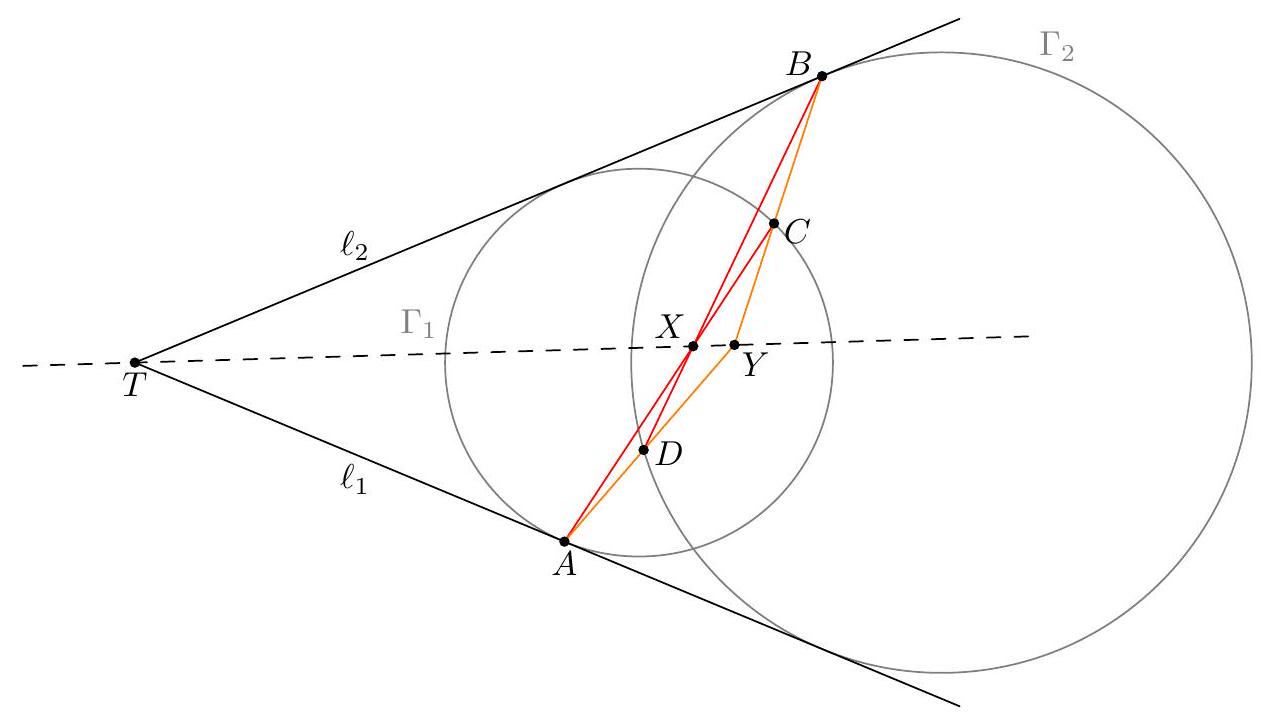
This solves the problem up to configuration issues: we claim that $Y$ and $T$ both lie inside $\angle A X B \equiv \angle C X D$. WLOG $T A2$ then Hephaestus wins, but when $\alpha=2$ (and hence $\alpha \leq 2$ ) Hephaestus cannot contain even a single-cell flood initially.
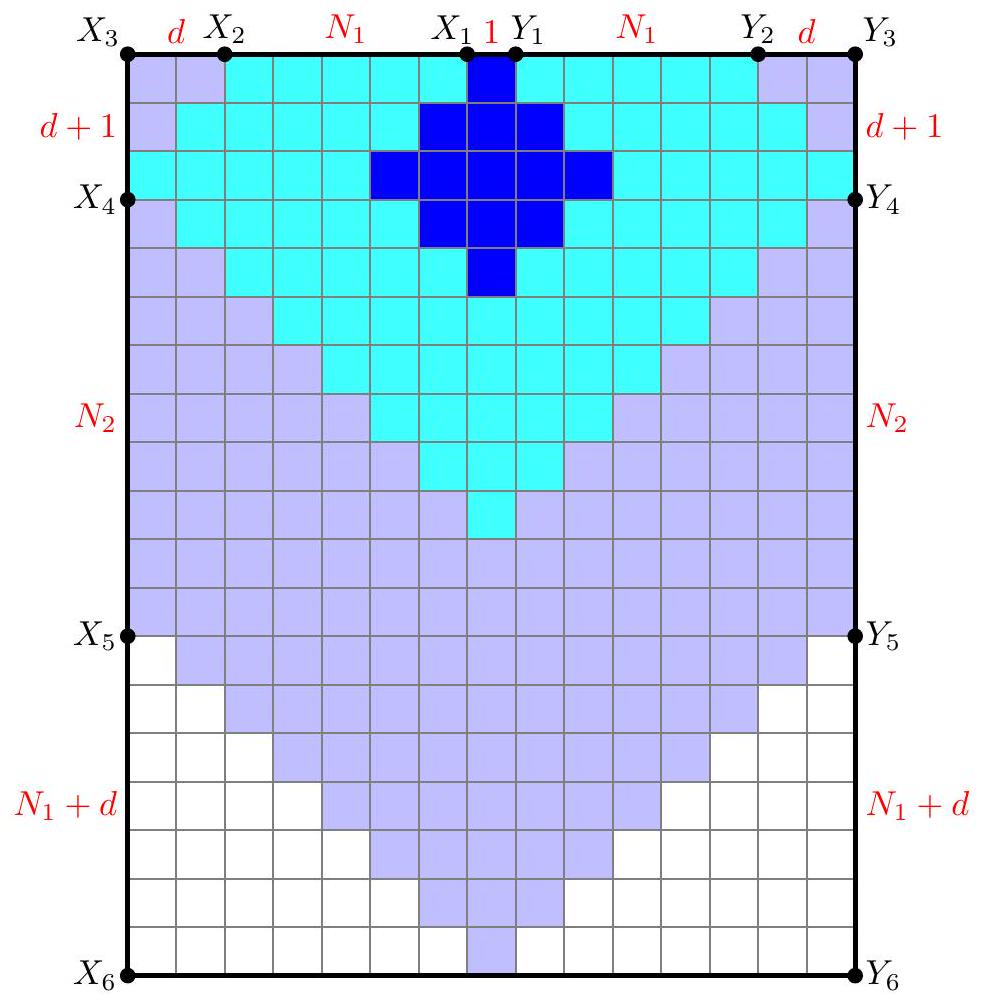
Strategy for $\alpha>2$ : Impose $\mathbb{Z}^{2}$ coordinates on the cells. Adding more flooded cells does not make our task easier, so let us assume that initially the cells $(x, y)$ with $|x|+|y| \leq d$ are flooded for some $d \geq 2$; thus on Hephaestus's $k$ th turn, the water is contained in $|x|+|y| \leq d+k-1$. Our goal is to contain the flood with a large rectangle.
We pick large integers $N_{1}$ and $N_{2}$ such that
$$
\begin{gathered}
\alpha N_{1}>2 N_{1}+(2 d+3) \\
\alpha\left(N_{1}+N_{2}\right)>2 N_{2}+\left(6 N_{1}+8 d+4\right)
\end{gathered}
$$
Mark the points $X_{i}, Y_{i}$ as shown in the figure for $1 \leq i \leq 6$. The red figures indicate the distance between the marked points on the rectangle.
We follow the following plan.
- Turn 1: place wall $X_{1} Y_{1}$. This cuts off the flood to the north.
- Turns 2 through $N_{1}+1$ : extend the levee to segment $X_{2} Y_{2}$. This prevents further flooding to the north.
- Turn $N_{1}+2$ : add in broken lines $X_{4} X_{3} X_{2}$ and $Y_{4} Y_{3} Y_{2}$ all at once. This cuts off the flood west and east.
- Turns $N_{1}+2$ to $N_{1}+N_{2}+1$ : extend the levee along segments $X_{4} X_{5}$ and $Y_{4} Y_{5}$. This prevents further flooding west and east.
- Turn $N_{1}+N_{2}+2$ : add in the broken line $X_{5} X_{6} Y_{6} Y_{5}$ all at once and win.
Proof for $\alpha=2$ : Suppose Hephaestus contains the flood on his $(n+1)$ st turn. We prove that $\alpha>2$ by showing that in fact at least $2 n+4$ walls have been constructed.
Let $c_{0}, c_{1}, \ldots, c_{n}$ be a path of cells such that $c_{0}$ is the initial cell flooded, and in general $c_{i}$ is flooded on Poseidon's $i$ th turn from $c_{i-1}$. The levee now forms a closed loop enclosing all $c_{i}$.
Claim - If $c_{i}$ and $c_{j}$ are adjacent then $|i-j|=1$.
Proof. Assume $c_{i}$ and $c_{j}$ are adjacent but $|i-j|>1$. Then the two cells must be separated by a wall. But the levee forms a closed loop, and now $c_{i}$ and $c_{j}$ are on opposite sides.
Thus the $c_{i}$ actually form a path. We color green any edge of the unit grid (wall or not) which is an edge of exactly one $c_{i}$ (i.e. the boundary of the polyomino). It is easy to see there are exactly $2 n+4$ green edges.
Now, from the center of each cell $c_{i}$, shine a laser towards each green edge of $c_{i}$ (hence a total of $2 n+4$ lasers are emitted). An example below is shown for $n=6$, with the levee marked in brown.

Claim - No wall is hit by more than one laser.
Proof. Assume for contradiction that a wall $w$ is hit by lasers from $c_{i}$ and $c_{j}$. WLOG that laser is vertical, so $c_{i}$ and $c_{j}$ are in the same column (e.g. $(i, j)=(0,5)$ in figure).
We consider two cases on the position of $w$.
- If $w$ is between $c_{i}$ and $c_{j}$, then we have found a segment intersecting the levee exactly once. But the endpoints of the segment lie inside the levee. This contradicts the assumption that the levee is a closed loop.
- Suppose $w$ lies above both $c_{i}$ and $c_{j}$ and assume WLOG $i2$.
Remark (Author comments). The author provides the following remarks.
- Even though the flood can be stopped when $\alpha=2+\varepsilon$, it takes a very long time to do that. Starting from a single flooded cell, the strategy I have outlined requires $\Theta\left(1 / \varepsilon^{2}\right)$ days. Starting from several flooded cells contained within an area of diameter $D$, it takes $\Theta\left(D / \varepsilon^{2}\right)$ days. I do not know any strategies that require fewer days than that.
- There is a gaping chasm between $\alpha \leq 2$ and $\alpha>2$. Since $\alpha \leq 2$ does not suffice even when only one cell is flooded in the beginning, there are in fact no initial
configurations at all for which it is sufficient. On the other hand, $\alpha>2$ works for all initial configurations.
- The second half of the solution essentially estimates the perimeter of a polyomino in terms of its diameter (where diameter is measured entirely within the polyomino).
It appears that this has not been done before, or at least I was unable to find any reference for it. I did find tons of references where the perimeter of a polyomino is estimated in terms of its area, but nothing concerning the diameter.
My argument is a formalisation of the intuition that if $P$ is any shortest path within some weirdly-shaped polyomino, then the boundary of that polyomino must hug $P$ rather closely so that $P$ cannot be shortened.
## §2 Solutions to Day 2
## §2.1 USA TST 2020/4, proposed by Zack Chroman, Mehtaab Sawhney
Available online at https://aops.com/community/p13913804.
## Problem statement
For a finite simple graph $G$, we define $G^{\prime}$ to be the graph on the same vertex set as $G$, where for any two vertices $u \neq v$, the pair $\{u, v\}$ is an edge of $G^{\prime}$ if and only if $u$ and $v$ have a common neighbor in $G$. Prove that if $G$ is a finite simple graph which is isomorphic to $\left(G^{\prime}\right)^{\prime}$, then $G$ is also isomorphic to $G^{\prime}$.
We say a vertex of a graph is fatal if it has degree at least 3, and some two of its neighbors are not adjacent.
Claim - The graph $G^{\prime}$ has at least as many triangles as $G$, and has strictly more if $G$ has any fatal vertices.
Proof. Obviously any triangle in $G$ persists in $G^{\prime}$. Moreover, suppose $v$ is a fatal vertex of $G$. Then the neighbors of $G$ will form a clique in $G^{\prime}$ which was not there already, so there are more triangles.
Thus we only need to consider graphs $G$ with no fatal vertices. Looking at the connected components, the only possibilities are cliques (including single vertices), cycles, and paths. So in what follows we restrict our attention to graphs $G$ only consisting of such components.
Remark (Warning). Beware: assuming $G$ is connected loses generality. For example, it could be that $G=G_{1} \sqcup G_{2}$, where $G_{1}^{\prime} \cong G_{2}$ and $G_{2}^{\prime} \cong G_{1}$.
First, note that the following are stable under the operation:
- an isolated vertex,
- a cycle of odd length, or
- a clique with at least three vertices.
In particular, $G \cong G^{\prime \prime}$ holds for such graphs.
On the other hand, cycles of even length or paths of nonzero length will break into more connected components. For this reason, a graph $G$ with any of these components will not satisfy $G \cong G^{\prime \prime}$ because $G^{\prime}$ will have strictly more connected components than $G$, and $G^{\prime \prime}$ will have at least as many as $G^{\prime}$.
Therefore $G \cong G^{\prime \prime}$ if and only if $G$ is a disjoint union of the three types of connected components named earlier. Since $G \cong G^{\prime}$ holds for such graphs as well, the problem statement follows right away.
Remark. Note that the same proof works equally well for an arbitrary number of iterations $G^{\prime \prime} \ldots{ }^{\prime \prime} \cong G$, rather than just $G^{\prime \prime} \cong G$.
Remark. The proposers included a variant of the problem where given any graph $G$, the operation stabilized after at most $O(\log n)$ operations, where $n$ was the number of vertices of $G$.
## §2.2 USA TST 2020/5, proposed by Carl Schildkraut
Available online at https://aops.com/community/p13913769.
## Problem statement
Find all integers $n \geq 2$ for which there exists an integer $m$ and a polynomial $P(x)$ with integer coefficients satisfying the following three conditions:
- $m>1$ and $\operatorname{gcd}(m, n)=1$;
- the numbers $P(0), P^{2}(0), \ldots, P^{m-1}(0)$ are not divisible by $n$; and
- $P^{m}(0)$ is divisible by $n$.
Here $P^{k}$ means $P$ applied $k$ times, so $P^{1}(0)=P(0), P^{2}(0)=P(P(0))$, etc.
The answer is that this is possible if and only if there exists primes $p^{\prime}0 \mid P^{e}(0) \equiv 0 \bmod N\right\}
$$
where we set $\min \varnothing=0$ by convention. Note that in general we have
$$
\operatorname{zord}(P \bmod N)=\operatorname{lcm}_{q \mid N}(\operatorname{zord}(P \bmod q))
$$
where the index runs over all prime powers $q \mid N$ (by Chinese remainder theorem). This will be used in both directions.
Construction: First, we begin by giving a construction. The idea is to first use the following prime power case.
Claim - Let $p^{e}$ be a prime power, and $1 \leq k