THIRD BENELUX
MATHEMATICAL OLYMPIAD
Luxembourg, 6-8 May 2011
## PROBLEMS
## AND
## SOLUTIONS
## Problem 1
An ordered pair of integers $(m, n)$ with $1\widehat{B A D}$. But
$$
\widehat{E I A}=180^{\circ}-\frac{1}{2} \widehat{B A C}-\widehat{B E A}=180^{\circ}-\frac{1}{2} \widehat{B A C}-\left(\frac{1}{2} \widehat{C B A}+\widehat{B C A}\right)=90^{\circ}-\frac{1}{2} \widehat{B C A}
$$
It follows that $\widehat{N M I}=\widehat{B C I}$, which implies that $M N B C$ is cyclic, as the points $I$ and $D$ lie on the same side of $M N$.
There are now two ways of completing the proof:
## Solution 1 (using $A M D B$ and $M N B C$ )
Since $A M D B$ is cyclic, $\widehat{M A I}=\widehat{M A D}=\widehat{M B D}$, as, by construction, $B$ and $M$ lie on either side of $A D$. Moreover, $\widehat{M B D}=\widehat{M B C}=\widehat{M N C}$ for $M N B C$ is cyclic. Thus $\widehat{M A I}=\widehat{M N I}$, so $A M I N$ is cyclic, for $M$ and $N$ lie on either side of $A D$.
## Solution 2 (using $A M D B$ and $A N D C$ )
Since $A M D B$ and $A N D C$ are cylic, $\widehat{A M I}+\widehat{A N I}=\widehat{A M B}+\widehat{A N C}=\widehat{A D B}+\widehat{A D C}=180^{\circ}$, because $B$ and $M$, and $C$ and $N$ lie on either side of $A D$. Hence $A M I N$ is cyclic, for $M$ and $N$ lie on either side of $A D$.
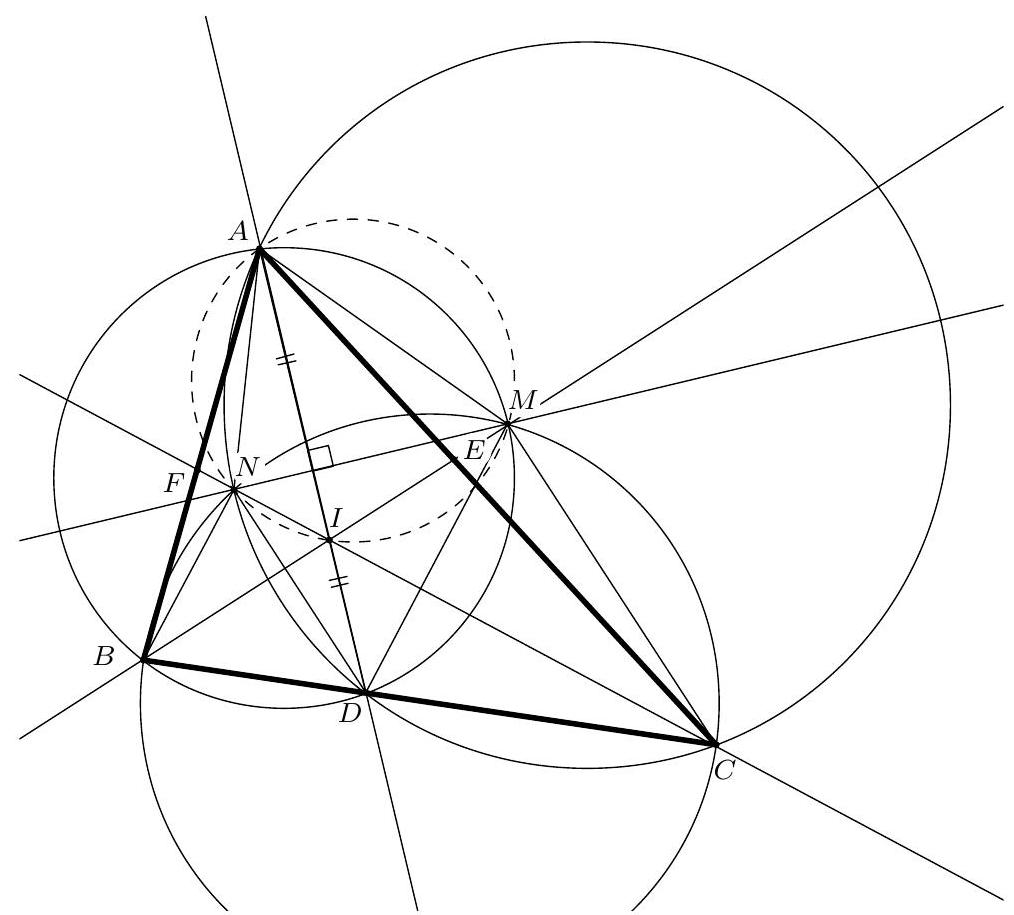
Remark. It is moreover true that $B M \perp D N$ and $C N \perp D M$. Indeed, symmetry implies that the image $J$ of $I$ under reflection in $M N$ lies on the circumcircle of $D M N$. Moreover, $D I$ is a height of $D M N$, so the fact that $I$ and $J$ are equidistant from the side $[M N]$ implies that $I$ is the orthocentre of $D M N$. This implies the claim.
## Problem 3
If $k$ is an integer, let $\mathrm{c}(k)$ denote the largest cube that is less than or equal to $k$. Find all positive integers $p$ for which the following sequence is bounded:
$$
a_{0}=p \quad \text { and } \quad a_{n+1}=3 a_{n}-2 c\left(a_{n}\right) \quad \text { for } n \geqslant 0
$$
## Solution
Since $\mathrm{c}\left(a_{n}\right) \leqslant a_{n}$ for all $n \in \mathbb{N}, a_{n+1} \geqslant a_{n}$ with equality if and only if $\mathrm{c}\left(a_{n}\right)=a_{n}$. Hence the sequence is bounded if and only if it is eventually constant, which is if and only if $a_{n}$ is a perfect cube, for some $n \geqslant 0$. In particular, the sequence is bounded if $p$ is a perfect cube.
We now claim that, if $a_{n}$ is not a cube for some $n$, then neither is $a_{n+1}$. Indeed, if $a_{n}$ is not a cube, $q^{3}a_{n}>q^{3}$, so $q^{3}