# 12th Benelux Mathematical Olympiad
Virtual, 2nd-3rd May 2020
## Problems and Solutions
# BxMO 2020: Problems and Solutions
## Problem 1
Find all positive integers $d$ with the following property: there exists a polynomial $P$ of degree $d$ with integer coefficients such that $|P(m)|=1$ for at least $d+1$ different integers $m$.
## Solution
Note that $P(x)=c$ for a fixed constant has at most $d$ solutions, since the polynomial $P(x)-c$ of degree $d$ cancels at most $d$ times. This implies that there are integers $m$ satisfying $P(m)=1$, as well as integers $m$ such that $P(m)=-1$.
Next, we prove the following lemma.
Lemma. If $a$ and $b$ are integers such that $P(a)=-1$ and $P(b)=1$, then $|b-a| \leq 2$.
Proof Since $b-a \mid P(b)-P(a)$ by a well-known lemma (corollary of $a-b \mid a^{n}-b^{n}$ for every integer $n \geq 0$ ), the conclusion follows.
Let us first consider the case that $d \geq 4$, and assume that there exists a polynomial P with at least $d+1 \geq 5$ solutions to $|P(m)|=1$. Let $a$ and $b$ be the smallest and largest solution respectively. Since $b-a \geq 4$, we need $P(a)=P(b)$ by the lemma. Without loss of generality (by switching $P$ with $-P$ if necessary) we can assume $P(a)=P(b)=1$. Take a value $m$ such that $P(m)=-1$. Due to the lemma, we need $b-m$ and $m-a$ to be both at most 2 . Since $b-a \geq 4$, there is only one possibility left in which case $b-a=4$ and thus $d=4$. By considering $P(x-m)$, we can assume $P( \pm 2)=P( \pm 1)=1$ and $P(0)=-1$. The unique fourth degree polynomial satisfying these equalities is $P(x)=-0.5\left(x^{2}-4\right)\left(x^{2}-1\right)+1$ which is not a polynomial with integer coefficients.
For $1 \leq d \leq 3$, there exist polynomials satisfying the conditions.
For $d=1$ we can take $P_{1}(X)=X$ as $P_{1}(-1)=-1$ and $P_{1}(1)=1$.
For $d=2, P_{2}(X)=2 X(X-2)+1$ satisfies $P_{2}(0)=1, P_{2}(1)=-1$ and $P_{2}(2)=1$.
For $d=3$, the polynomial ; $P_{3}(X)=(X+1) X(X-2)+1$ satisfies $P_{3}(-1)=1=P_{3}(0)=P_{3}(2)=1$ and $P_{3}(1)=-1$. So $\left|P_{3}(m)\right|=1$ for $m \in\{-1,0,1,2\}$.
Thus the integers with the required property are precisely $d=1,2,3$. This completes the proof.
## BxMO 2020: Problems and Solutions
## Problem 2
Let $N$ be a positive integer. A collection of $4 N^{2}$ unit tiles with two segments drawn on them as shown is assembled into a $2 N \times 2 N$ board. Tiles can be rotated.
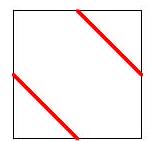
The segments on the tiles define paths on the board. Determine the least possible number and the largest possible number of such paths.
## Solution
Let $p$ denote the number of paths. Notice that there are two types of paths: (1) those that start and end at a point on the boundary of the board and (2) closed paths in the interior of the board. Let $p_{1}, p_{2}$ denote the respective numbers of paths of either type. There are $8 N$ points on the boundary of the board, and each of these is the starting point or endpoint of exactly one path, so $p_{1}=4 \mathrm{~N}$. Trivially, $p_{2} \geqslant 0$, so $p=p_{1}+p_{2} \geqslant 4 N$.
The paths on the board are made up of $8 N^{2}$ segments in total. There are only 4 possible paths of one segment, in the corners of the board. All other paths on the boundary of the board therefore consist of at least 2 segments. Moreover, all closed paths in the interior of the board consist of at least 4 segments. Hence
$$
8 N^{2} \geqslant 4 \cdot 1+\left(p_{1}-4\right) \cdot 2+p_{2} \cdot 4 \Longleftrightarrow p_{2} \leqslant N^{2}+(N-1)^{2}, \text { so } p=p_{1}+p_{2} \leqslant N^{2}+(N+1)^{2}
$$
We have thus shown that $4 N \leqslant p \leqslant N^{2}+(N+1)^{2}$. These minimum and maximum values can indeed be attained, as shown below for $N=3$.
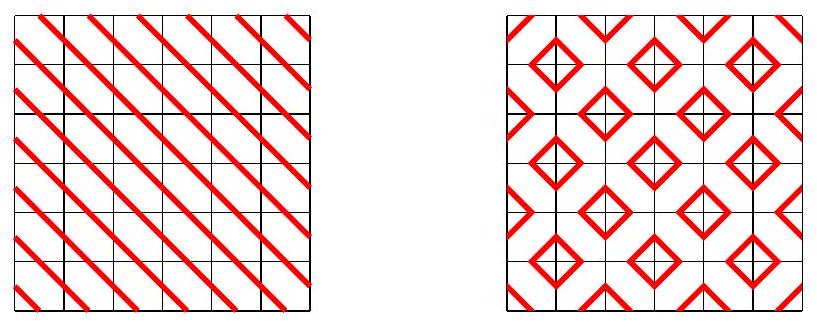
The constructions generalise easily.The constructions clearly attain the required bounds because they satisfy the equalities in our arguments showing the two bounds. Indeed the board on the left has $p_{2}=0$ so give the lower bound. The one on the right has exactly 4 boundary paths with one segment, all other $4 N-4$ boundary paths with 2 segments, and all remaining paths with 4 segments.
Remark. The same ideas solve the analogous problem for a $(2 N+1) \times(2 N+1)$ assembled from $(2 N+1)^{2}$ such tiles. For this board, $p \geqslant p_{1}=2(2 N+1)$. Next, there are $2(2 N+1)^{2}$ segments, so, again,
$$
2(2 N+1)^{2} \geqslant 4 \cdot 1+\left(p_{1}-4\right) \cdot 2+p_{2} \cdot 4 \Longleftrightarrow p_{2} \leqslant 2 N^{2}+\frac{1}{2}
$$
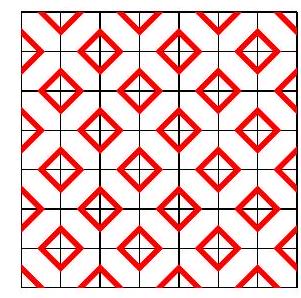
But $p_{2}$ is an integer, so $p_{2} \leqslant 2 N^{2}$, and hence $p \leqslant 2(N+1)^{2}$. We have thus shown that $2(2 N+1) \leqslant p \leqslant 2(N+1)^{2}$. The construction for the lower bound is the same as for the $2 N \times 2 N$ board; the construction for the upper bound, shown for $N=3$, is a small modification of that for the $2 N \times 2 N$ board and again generalises easily.
## BxMO 2020: Problems and Solutions
## Problem 3
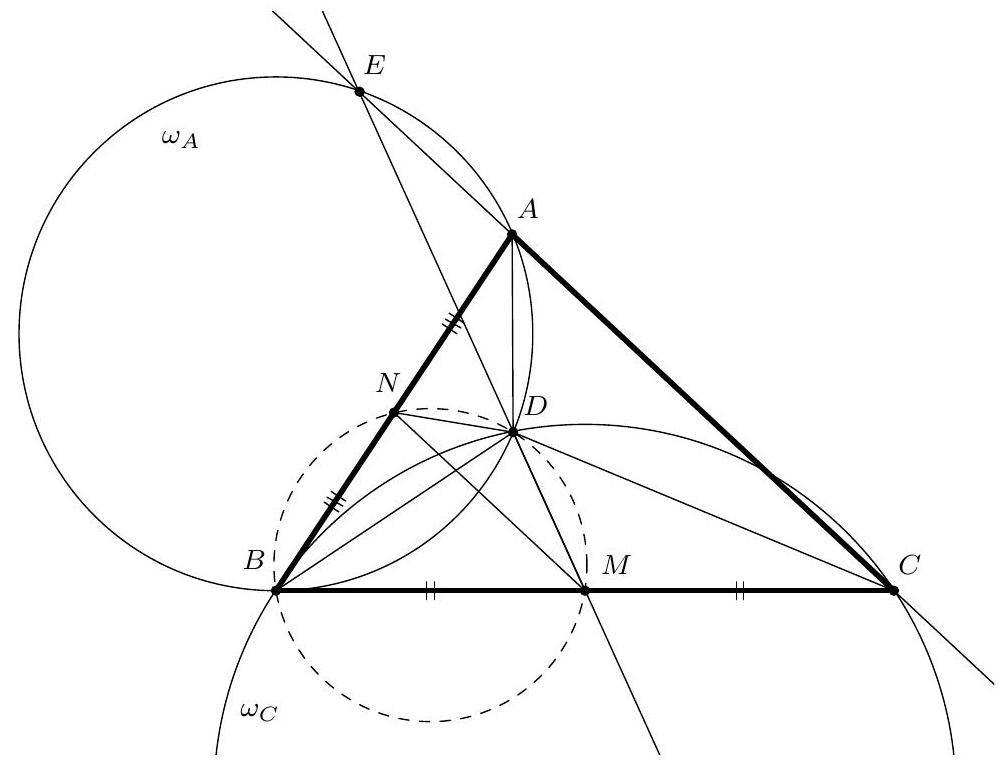
Let $A B C$ be a triangle. The circle $\omega_{A}$ through $A$ is tangent to line $B C$ at $B$. The circle $\omega_{C}$ through $C$ is tangent to line $A B$ at $B$. Let $\omega_{A}$ and $\omega_{C}$ meet again at $D$. Let $M$ be the midpoint of line segment [ $B C]$, and let $E$ be the intersection of lines $M D$ and $A C$. Show that $E$ lies on $\omega_{A}$.
## Solution 1
Let $N$ be the midpoint of $[A B]$. By tangential angles, $\angle C B D=\angle B A D$ and $\angle D B A=\angle D C B$, so triangles $D A B$ and $D B C$ are similar. By definition of the midpoints $M, N$, so are triangles $A N D$ and $B M D$. In particular, $\angle B N D=180^{\circ}-\angle D N A=180^{\circ}-\angle D M B$, so $B N D M$ is cyclic. But $M N \| A C$ by construction, so $\angle D B A=\angle D B N=\angle D M N=\angle E M N=\angle M E A=\angle D E A$, hence $E A D B$ is cyclic, completing the proof.
## Solution 2
Let $S$ be the point on $\omega_{C}$ such that $B S$ is parallel to $A C$, and let $E^{\prime}$ be the reflection of $S$ in $M$ (such that $B S C E^{\prime}$ is a parallellogram and $E^{\prime}$ lies on $A C$ ). Now we do some (directed) angle chasing:
$$
\begin{aligned}
\angle A E^{\prime} B & =\angle C E^{\prime} B\left(\text { since } A, E^{\prime} \text { and } C \text { are collineair }\right) \\
& =\angle B S C\left(B S C E^{\prime} \text { is a parallellogram }\right) \\
& =\angle A B C\left(\text { inscribed angles on } \omega_{C}\right) \\
& =\angle A D B\left(\text { inscribed angles on } \omega_{A}\right) .
\end{aligned}
$$
Hence $E^{\prime}$ lies on $\omega_{A}$. Further $\angle A E^{\prime} D=\angle A B D=\angle B S D$, and because $A E^{\prime}$ is parallel to $B S$ we find that $E^{\prime} D$ is parallel to $S D$. This means that $E^{\prime}$ lies on $M D$, so $E^{\prime}=E$ and $E$ lies on $\omega_{A}$.
# BxMO 2020: Problems and Solutions
## Problem 4
A divisor $d$ of a positive integer $n$ is said to be a close divisor of $n$ if $\sqrt{n}m$. Any divisor of $n$ is then of the form $2^{\ell} d$ where $d$ is a divisor of $m$. We will now show that for every such divisor $d$, there exists a unique $\ell$ such that $2^{\ell} d$ is a close divisor. Because $\sqrt{n}$ is not an integer, there certainly is a unique integer $a$ such that $\sqrt{n}<2^{a} d<2 \sqrt{n}$. Because $2^{k}>m$, we have $m<\sqrt{n}<2^{k}$. Combining with $1 \leq d \leq m$, we find $1<\frac{\sqrt{n}}{d}<2^{a}<\frac{2 \sqrt{n}}{d}<2 \cdot 2^{k}$ and so we see that $0