# 1998
SOLUTIONS
The solutions to the problems of the 1998 CMO presented below are taken from students papers.
Some minor editing has been done - unnecesary steps have been eliminated and some wording has been changed to make the proofs clearer. But for the most part, the proofs are as submitted.
## Solution to Problem 1 - David Arthur, Upper Canada College, Toronto, ON
Let $a=30 k+r$, where $k$ is an integer and $r$ is a real number between 0 and 29 inclusive.
Then $\left[\frac{1}{2} a\right]=\left[\frac{1}{2}(30 k+r)\right]=15 k+\left[\frac{r}{2}\right]$. Similarly $\left[\frac{1}{3} a\right]=10 k+\left[\frac{r}{3}\right]$ and $\left[\frac{1}{5} a\right]=6 k+\left[\frac{r}{5}\right]$.
Now, $\left[\frac{1}{2} a\right]+\left[\frac{1}{3} a\right]+\left[\frac{1}{5} a\right]=a$, so $\left(15 k+\left[\frac{r}{2}\right]\right)+\left(10 k+\left[\frac{r}{3}\right]\right)+\left(6 k+\left[\frac{r}{5}\right]\right)=30 k+r$ and hence $k=r-\left[\frac{r}{2}\right]-\left[\frac{r}{3}\right]-\left[\frac{r}{5}\right]$.
Clearly, $r$ has to be an integer, or $r-\left[\frac{r}{2}\right]-\left[\frac{r}{3}\right]-\left[\frac{r}{5}\right]$ will not be an integer, and therefore, cannot equal $k$.
On the other hand, if $r$ is an integer, then $r-\left[\frac{r}{2}\right]-\left[\frac{r}{3}\right]-\left[\frac{r}{5}\right]$ will also be an integer, giving exactly one solution for $k$.
For each $r(0 \leq r \leq 29), a=30 k+r$ will have a different remainder mod 30 , so no two different values of $r$ give the same result for $a$.
Since there are 30 possible values for $r(0,1,2, \ldots, 29)$, there are then 30 solutions for $a$.
Solution to Problem 2 - Jimmy Chui, Earl Haig S.S., North York, ON
Since $\left(x-\frac{1}{x}\right)^{1 / 2} \geq 0$ and $\left(1-\frac{1}{x}\right)^{1 / 2} \geq 0$, then $0 \leq\left(x-\frac{1}{x}\right)^{1 / 2}+\left(1-\frac{1}{x}\right)^{1 / 2}=x$.
Note that $x \neq 0$. Else, $\frac{1}{x}$ would not be defined so $x>0$.
Squaring both sides gives,
$$
\begin{aligned}
x^{2} & =\left(x-\frac{1}{x}\right)+\left(1-\frac{1}{x}\right)+2 \sqrt{\left(x-\frac{1}{x}\right)\left(1-\frac{1}{x}\right)} \\
x^{2} & =x+1-\frac{2}{x}+2 \sqrt{x-1-\frac{1}{x}+\frac{1}{x^{2}}} .
\end{aligned}
$$
Multiplying both sides by $x$ and rearranging, we get
$$
\begin{aligned}
x^{3}-x^{2}-x+2 & =2 \sqrt{x^{3}-x^{2}-x+1} \\
\left(x^{3}-x^{2}-x+1\right)-2 \sqrt{x^{3}-x^{2}-x+1}+1 & =0 \\
\left(\sqrt{x^{3}-x^{2}-x+1}-1\right)^{2} & =0 \\
\sqrt{x^{3}-x^{2}-x+1} & =1 \\
x^{3}-x^{2}-x+1 & =1 \\
x\left(x^{2}-x-1\right) & =0 \\
x^{2}-x-1 & =0 \quad \text { since } x \neq 0 .
\end{aligned}
$$
Thus $x=\frac{1 \pm \sqrt{5}}{2}$. We must check to see if these are indeed solutions.
Let $\alpha=\frac{1+\sqrt{5}}{2}, \beta=\frac{1-\sqrt{5}}{2}$. Note that $\alpha+\beta=1, \alpha \beta=-1$ and $\alpha>0>\beta$.
Since $\beta<0, \beta$ is not a solution.
Now, if $x=\alpha$, then
$$
\begin{aligned}
\left(\alpha-\frac{1}{\alpha}\right)^{1 / 2}+\left(1-\frac{1}{\alpha}\right)^{1 / 2} & =(\alpha+\beta)^{1 / 2}+(1+\beta)^{1 / 2} & & (\text { since } \alpha \beta--1) \\
& =1^{1 / 2}+\left(\beta^{2}\right)^{1 / 2} & & \left(\text { since } \alpha+\beta=1 \text { and } \beta^{2}=\beta+1\right) \\
& =1-\beta & & (\text { since } \beta<0) \\
& =\alpha & & (\text { since } \alpha+\beta=1) .
\end{aligned}
$$
So $x=\alpha$ is the unique solution to the equation.
Solution 1 to Problem 3 - Chen He, Columbia International Collegiate, Hamilton, ON
$$
1+\frac{1}{3}+\ldots+\frac{1}{2 n-1}=\frac{1}{2}+\frac{1}{2}+\frac{1}{3}+\frac{1}{5}+\ldots \frac{1}{2 n-1}
$$
Since
$$
\frac{1}{3}>\frac{1}{4}, \frac{1}{5}>\frac{1}{6}, \ldots, \frac{1}{2 n-1}>\frac{1}{2 n}
$$
(1) gives
$$
1+\frac{1}{3}+\ldots+\frac{1}{2 n-1}>\frac{1}{2}+\frac{1}{2}+\frac{1}{4}+\frac{1}{6}+\ldots+\frac{1}{2 n}=\frac{1}{2}+\left(\frac{1}{2}+\frac{1}{4}+\frac{1}{6}+\ldots+\frac{1}{2 n}\right) .
$$
Since
$$
\frac{1}{2}>\frac{1}{4}, \frac{1}{2}>\frac{1}{6}, \frac{1}{2}>\frac{1}{8}, \ldots, \frac{1}{2}>\frac{1}{2 n}
$$
then
$$
\frac{n}{2}=\underbrace{\frac{1}{2}+\frac{1}{2}+\frac{1}{2}+\ldots+\frac{1}{2}}_{n}>\frac{1}{2}+\frac{1}{4}+\frac{1}{6}+\ldots+\frac{1}{2 n}
$$
So
$$
\frac{1}{2}>\frac{1}{n}\left(\frac{1}{2}+\frac{1}{4}+\frac{1}{6}+\ldots+\frac{1}{2 n}\right) .
$$
Then (1), (2) and (3) show
$$
\begin{aligned}
1+\frac{1}{3}+\ldots+\frac{1}{2 n-1} & >\frac{1}{n}\left(\frac{1}{2}+\frac{1}{4}+\frac{1}{6}+\ldots+\frac{1}{2 n}\right)+\left(\frac{1}{2}+\frac{1}{4}+\frac{1}{6}+\ldots+\frac{1}{2 n}\right) \\
& =\left(1+\frac{1}{n}\right)\left(\frac{1}{2}+\frac{1}{4}+\ldots+\frac{1}{2 n}\right) \\
& =\frac{n+1}{n}\left(\frac{1}{2}+\frac{1}{4}+\ldots+\frac{1}{2 n}\right) .
\end{aligned}
$$
Therefore $\frac{1}{n+1}\left(1+\frac{1}{3}+\ldots+\frac{1}{2 n-1}\right)>\frac{1}{n}\left(\frac{1}{2}+\frac{1}{4}+\ldots+\frac{1}{2 n}\right)$ for all $n \in N$ and $n \geq 2$.
Solution 2 to Problem 3 - Yin Lei, Vincent Massey S.S., Windsor, ON
Since $n \geq 2, n(n+1) \geq 0$. Therefore the given inequality is equivalent to
$$
n\left(1+\frac{1}{3}+\ldots+\frac{1}{2 n-1}\right) \geq(n+1)\left(\frac{1}{2}+\frac{1}{4}+\ldots+\frac{1}{2 n}\right) .
$$
We shall use mathematical induction to prove this.
For $n=2$, obviously $\frac{1}{3}\left(1+\frac{1}{3}\right)=\frac{4}{9}>\frac{1}{2}\left(\frac{1}{2}+\frac{1}{4}\right)=\frac{3}{8}$.
Suppose that the inequality stands for $n=k$, i.e.
$$
k\left(1+\frac{1}{3}+\ldots+\frac{1}{2 k-1}\right)>(k+1)\left(\frac{1}{2}+\frac{1}{4}+\ldots+\frac{1}{2 k}\right) .
$$
Now we have to prove it for $n=k+1$.
We know
$$
\begin{aligned}
& \left(1+\frac{1}{3}+\ldots+\frac{1}{2 k-1}\right)-\left(\frac{1}{2}+\frac{1}{4}+\ldots+\frac{1}{2 k}\right) \\
& =\left(1-\frac{1}{2}\right)+\left(\frac{1}{3}-\frac{1}{4}\right)+\left(\frac{1}{5}-\frac{1}{6}\right)+\ldots+\left(\frac{1}{2 k-1}-\frac{1}{2 k}\right) \\
& =\frac{1}{1 \times 2}+\frac{1}{3 \times 4}+\frac{1}{5 \times 6}+\ldots+\frac{1}{(2 k-1)(2 k)} .
\end{aligned}
$$
Since
$$
1 \times 2<3 \times 4<5 \times 6<\ldots<(2 k-1)(2 k)<(2 k+1)(2 k+2)
$$
then
$$
\frac{1}{1 \times 2}+\frac{1}{3 \times 4}+\ldots+\frac{1}{(2 k-1)(2 k)}>\frac{k}{(2 k+1)(2 k+2)}
$$
hence
$$
1+\frac{1}{3}+\ldots+\frac{1}{2 k-1}>\frac{1}{2}+\frac{1}{4}+\ldots+\frac{1}{2 k}+\frac{k}{(2 k+1)(2 k+2)}
$$
Also
$$
\frac{k+1}{2 k+1}-\frac{k+2}{2 k+2}=\frac{2 k^{2}+2 k+2 k+2-2 k^{2}-4 k-k-2}{(2 k+1)(2 k+2)}=-\frac{k}{(2 k+1)(2 k+2)}
$$
therefore
$$
\frac{k+1}{2 k+1}=\frac{k+2}{2 k+2}-\frac{k}{(2 k+1)(2 k+2)}
$$
Adding 1, 2 and 3 :
$k\left(1+\frac{1}{3}+\ldots+\frac{1}{2 k-1}\right)+\left(1+\frac{1}{3}+\ldots+\frac{1}{2 k-1}\right)+\frac{k+1}{2 k+1}$
$>(k+1)\left(\frac{1}{2}+\frac{1}{4}+\ldots+\frac{1}{2 k}\right)+\left(\frac{1}{2}+\frac{1}{4}+\ldots+\frac{1}{2 k}\right)+\frac{k}{(2 k+1)(2 k+2)}+\frac{k+2}{2 k+2}-\frac{k}{(2 k+1)(2 k+2)}$
Rearrange both sides to get
$$
(k+1)\left(1+\frac{1}{3}+\ldots+\frac{1}{2 k+1}\right)>(k+2)\left(\frac{1}{2}+\frac{1}{4}+\ldots+\frac{1}{2 k+2}\right) .
$$
Proving the induction.
Solution 1 to Problem 4 - Keon Choi, A.Y. Jackson S.S., North York, ON
Suppose $H$ is the foot of the perpendicular line from $A$ to $B C$; construct equilateral $\triangle A B G$, with $C$ on $B G$. I will prove that if $F$ is the point where $A H$ meets $B D$, then $\angle F C B=70^{\circ}$. (Because that means $A H$, and the given lines $B D$ and $C E$ meet at one point and that proves the question.) Suppose $B D$ extended meets $A G$ at $I$.
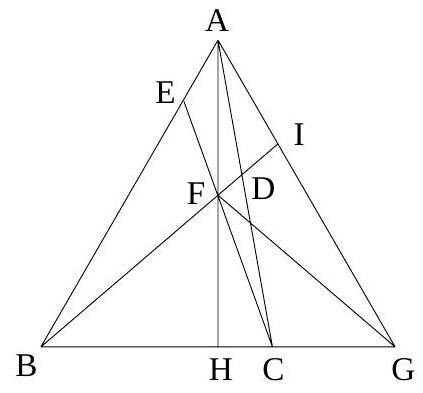
Now $B F=G F$ and $\angle F B G=\angle F G B=40^{\circ}$ so that $\angle I G F=20^{\circ}$. Also $\angle I F G=\angle F B G+\angle F G B=$ $80^{\circ}$, so that
$$
\begin{aligned}
\angle F I G & =180^{\circ}-\angle I F G-\angle I G F \\
& =180^{\circ}-80^{\circ}-20^{\circ} \\
& =80^{\circ} .
\end{aligned}
$$
Therefore $\triangle G I F$ is an isoceles triangle, so
$$
G I=G F=B F
$$
But $\triangle B G I$ and $\triangle A B C$ are congruent, since $B G=A B, \angle G B I=\angle B A C, \angle B G I=\angle A B C$.
Therefore
$$
G I=B C .
$$
From (1) and (2) we get
$$
B C=B F \text {. }
$$
So in $\triangle B C F$,
$$
\angle B C F=\frac{180^{\circ}-\angle F B C}{2}=\frac{180^{\circ}-40^{\circ}}{2}=70^{\circ} .
$$
Thus $\angle F C B=70^{\circ}$ and that proves that the given lines $C E$ and $B D$ and the perpendicular line $A H$ meet at one point.
Solution 2 to Problem 4 - Adrian Birka, Lakeshore Catholic H.S., Port Colborne, ON
First we prove the following lemma:
In $\triangle A B C, A A^{\prime}, B B^{\prime}, C C^{\prime}$ intersect if-f
$$
\frac{\sin \alpha_{1}}{\sin \alpha_{2}} \cdot \frac{\sin \beta_{1}}{\sin \beta_{2}} \cdot \frac{\sin \gamma_{1}}{\sin \gamma_{2}}=1
$$
where $\alpha_{1}, \alpha_{2}, \beta_{1}, \beta_{2}, \gamma_{1}, \gamma_{2}$ are as shown in the diagram just below.
(Editor: This is a known variant of Ceva's Theorem.)
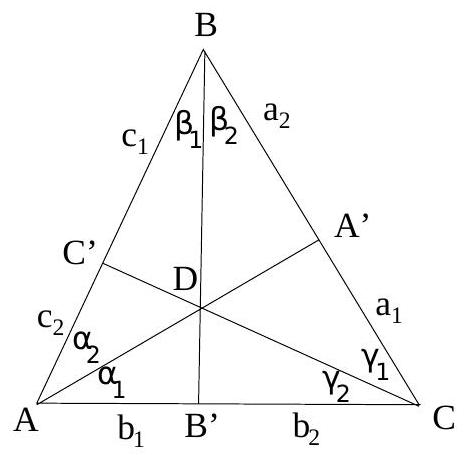
Proof: Let $\angle B B^{\prime} C=x$, then $\angle B B^{\prime} A=180^{\circ}-x$. Using the sine law in $\triangle B B^{\prime} C$ yields
$$
\frac{b_{2}}{\sin \beta_{2}}=\frac{a}{\sin x} .
$$
Similarly using the sine law in $\triangle B B^{\prime} A$ yields
$$
\frac{b_{1}}{\sin \beta_{1}}=\frac{c}{\sin \left(180^{\circ}-x\right)}=\frac{c}{\sin x} .
$$
Hence,
$$
b_{1}: b_{2}=\frac{c \sin \beta_{1}}{a \sin \beta_{2}}
$$
(from (1),(2)). (Editor: Do you recognize this when $\beta_{1}=\beta_{2}$ ?)
Similarly,
$$
a_{1}: a_{2}=\frac{b \sin \alpha_{1}}{c \sin \alpha_{2}}, \quad c_{1}: c_{2}=\frac{a \sin \gamma_{1}}{b \sin \gamma_{2}}
$$
By Ceva's theorem, the necessary and sufficient condition for $A A^{\prime}, B B^{\prime}, C C^{\prime}$ to intersect is: $\left(a_{1}: a_{2}\right) \cdot\left(b_{1}: b_{2}\right) \cdot\left(c_{1}: c_{2}\right)=1$. Using (3), (4) on this yields:
$$
\frac{b}{c} \cdot \frac{\sin \alpha_{1}}{\sin \alpha_{2}} \cdot \frac{a}{b} \cdot \frac{\sin \gamma_{1}}{\sin \gamma_{2}} \cdot \frac{c}{a} \cdot \frac{\sin \beta_{1}}{\sin \beta_{2}}=1
$$
$$
\frac{\sin \alpha_{1}}{\sin \alpha_{2}} \cdot \frac{\sin \beta_{1}}{\sin \beta_{2}} \cdot \frac{\sin \gamma_{1}}{\sin \gamma_{2}}=1
$$
This is just what we needed to show, therefore the lemma is proved.
Now, in our original question, give $\angle B A C=40^{\circ}, \angle A B C=60^{\circ}$. It follows that $\angle A C B=80^{\circ}$.
Since $\angle C B D=40^{\circ}, \angle A B D=\angle A B C-\angle D B C=20^{\circ}$. Similarly, $\angle E C A=20^{\circ}$.
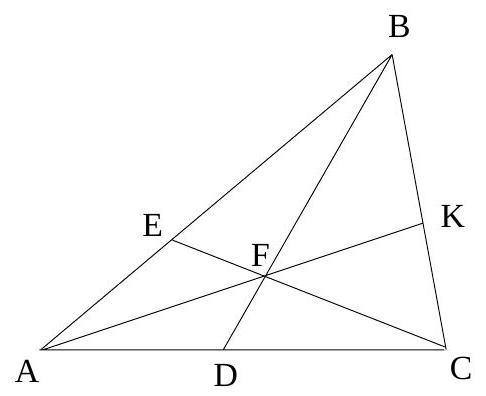
Now let us show that $\angle F A D=10^{\circ}$. Suppose otherwise. Let $F^{\prime}$ be such that $F, F^{\prime}$ are in the same side of $A C$ and $\angle D A F^{\prime}=10^{\circ}$. Then $\angle B A F^{\prime}=\angle B A C-\angle D A F^{\prime}=30^{\circ}$.
Thus
$$
\begin{aligned}
\frac{\sin \angle A B D}{\sin \angle D B C} \cdot \frac{\sin \angle B C E}{\sin \angle E C A} \cdot \frac{\sin \angle C A F^{\prime}}{\sin \angle F^{\prime} A B} & =\frac{\sin 20^{\circ}}{\sin 40^{\circ}} \cdot \frac{\sin 70^{\circ}}{\sin 10^{\circ}} \cdot \frac{\sin 10^{\circ}}{\sin 30^{\circ}} \\
& =\frac{\sin 20^{\circ}}{2 \sin 20^{\circ} \cos 20^{\circ}} \cdot \frac{\cos 20^{\circ}}{\sin 30^{\circ}} \\
& =\frac{1}{2 \sin 30^{\circ}}=1 .
\end{aligned}
$$
By the lemma above, $A F^{\prime}$ passes through $C E \cap B D=F$. Therefore $A F^{\prime}=A F$, and $\angle F A D=10^{\circ}$, contrary to assumption. Thus $\angle F A D$ must be $10^{\circ}$. Now let $A F \cap B C=K$. Since $\angle K A C=$ $10^{\circ}, \angle K C A=80^{\circ}$, it follows that $\angle A K C=90^{\circ}$. Therefore $A K \perp B C \Rightarrow A F \perp B C$ as needed.
Solution to Problem 5 - Adrian Chan, Upper Canada College, Toronto, ON
Let us first prove by induction that $\frac{a_{n}^{2}+a_{n+1}^{2}}{a_{n} \cdot a_{n+1}+1}=m^{2}$ for all $n \geq 0$.
Proof:
Base Case $(n=0): \frac{a_{0}^{2}+a_{1}^{2}}{a_{0} \cdot a_{1}+1}=\frac{0+m^{2}}{0+1}=m^{2}$.
Now, let us assume that it is true for $n=k, k \geq 0$. Then,
$$
\begin{aligned}
\frac{a_{k}^{2}+a_{k+1}^{2}}{a_{k} \cdot a_{k+1}+1} & =m^{2} \\
a_{k}^{2}+a_{k+1}^{2} & =m^{2} \cdot a_{k} \cdot a_{k+1}+m^{2} \\
a_{k+1}^{2}+m^{4} a_{k+1}^{2}-2 m^{2} \cdot a_{k} \cdot a_{k+1}+a_{k}^{2} & =m^{2}+m^{4} a_{k+1}^{2}-m^{2} \cdot a_{k} \cdot a_{k+1} \\
a_{k+1}^{2}+\left(m^{2} a_{k+1}-a_{k}\right)^{2} & =m^{2}+m^{2} a_{k+1}\left(m^{2} a_{k+1}-a_{k}\right) \\
a_{k+1}^{2}+a_{k+2}^{2} & =m^{2}+m^{2} \cdot a_{k+1} \cdot a_{k+2} .
\end{aligned}
$$
So $\frac{a_{k+1}^{2}+a_{k+2}^{2}}{a_{k+1} \cdot a_{k+2}+1}=m^{2}$,
proving the induction. Hence $\left(a_{n}, a_{n+1}\right)$ is a solution to $\frac{a^{2}+b^{2}}{a b+1}=m^{2}$ for all $n \geq 0$.
Now, consider the equation $\frac{a^{2}+b^{2}}{a b+1}=m^{2}$ and suppose $(a, b)=(x, y)$ is a solution with $0 \leq x \leq y$. Then
$$
\frac{x^{2}+y^{2}}{x y+1}=m^{2}
$$
If $x=0$ then it is easily seen that $y=m$, so $(x, y)=\left(a_{0}, a_{1}\right)$. Since we are given $x \geq 0$, suppose now that $x>0$.
Let us show that $y \leq m^{2} x$.
Proof by contradiction: Assume that $y>m^{2} x$. Then $y=m^{2} x+k$ where $k \geq 1$.
Substituting into (1) we get
$$
\begin{aligned}
\frac{x^{2}+\left(m^{2} x+k\right)^{2}}{(x)\left(m^{2} x+k\right)+1} & =m^{2} \\
x^{2}+m^{4} x^{2}+2 m^{2} x k+k^{2} & =m^{4} x^{2}+m^{2} k x+m^{2} \\
\left(x^{2}+k^{2}\right)+m^{2}(k x-1) & =0 .
\end{aligned}
$$
Now, $m^{2}(k x-1) \geq 0$ since $k x \geq 1$ and $x^{2}+k^{2} \geq x^{2}+1 \geq 1$ so $\left(x^{2}+k^{2}\right)+m^{2}(k x-1) \neq 0$.
Thus we have a contradiction, so $y \leq m^{2} x$ if $x>0$.
Now substitute $y=m^{2} x-x_{1}$, where $0 \leq x_{1}0$.
Let us now show that $x_{1}0$.
With the same proof that $y \leq m^{2} x$, we have $x \leq m^{2} x_{1}$. So the substitution $x=m^{2} x_{1}-x_{2}$ with $x_{2} \geq 0$ is valid.
Substituting $x=m^{2} x_{1}-x_{2}$ into (2) gives $\frac{x_{1}^{2}+x_{2}^{2}}{x_{1} \cdot x_{2}+1}=m^{2}$.
If $x_{2} \neq 0$, then we continue with the substitution $x_{i}=m_{x_{i+1}}^{2}-x_{i+2}\left({ }^{*}\right)$ until we get $\frac{x_{j}^{2}+x_{j+1}^{2}}{x_{j} \cdot x_{j+1}+1}=m^{2}$ and $x_{j+1}=0$. (The sequence $x_{i}$ is decreasing, nonnegative and integer.)
So, if $x_{j+1}=0$, then $x_{j}^{2}=m^{2}$ so $x_{j}=m$ and $\left(x_{j+1}, x_{j}\right)=(0, m)=\left(a_{0}, a_{1}\right)$.
Then $\left(x_{j}, x_{j-1}\right)=\left(a_{1}, a_{2}\right)$ since $x_{j-1}=m^{2} x_{j}-x_{j+1}\left(\right.$ from $\left.\left(^{*}\right)\right)$.
Continuing, we have $\left(x_{1}, x\right)=\left(a_{n-1}, a_{n}\right)$ for some $n$. Then $(x, y)=\left(a_{n}, a_{n+1}\right)$.
Hence $\frac{a^{2}+b^{2}}{a b+1}=m^{2}$ has solutions $(a, b)$ if and only if $(a, b)=\left(a_{n}, a_{n+1}\right)$ for some $n$.
## GRADERS' REPORT
Each question was worth a maximum of 7 marks. Every solution on every paper was graded by two different markers. If the two marks differed by more than one point, the solution was reconsidered until the difference resolved. If the two marks differed by one point, the average was used in computing the total score.
The various grades assigned each solution are displayed below, as a percentage.
| MARKS | $\# 1$ | $\# 2$ | $\# 3$ | $\# 4$ | $\# 5$ |
| :---: | ---: | ---: | ---: | ---: | ---: |
| 0 | 7.6 | 9.8 | 40.2 | 31.0 | 73.9 |
| 1 | 14.1 | 27.7 | 7.1 | 27.7 | 9.2 |
| 2 | 10.9 | 16.8 | 16.8 | 21.7 | 12.0 |
| 3 | 6.5 | 16.3 | 3.8 | 1.6 | 1.1 |
| 4 | 3.3 | 2.2 | 1.6 | 2.2 | 0.5 |
| 5 | 6.0 | 14.1 | 4.3 | 3.8 | 0.0 |
| 6 | 16.3 | 6.0 | 7.1 | 2.2 | 1.1 |
| 7 | 35.3 | 7.1 | 19.0 | 9.8 | 2.2 |
## PROBLEM 1
This question was well done. 47 students received 6 or 7 and only 6 students received no marks. Many students came up with a proof similar to David Arthur's proof. Another common approach was to find bounds for $a$ (either $0 \leq a<60$ or $0 \leq a<90$ ) and to then check which of these $a$ satisfy the equation.
## PROBLEM 2
Although most students attempted this problem, there were only 6 perfect solutions. A further 6 solutions earned a mark of $6 / 7$ and 13 solutions earned a mark of $5 / 7$.
The most common approach was to square both sides of the equation, rearrange the terms to isolate the radical, and to then square both sides again. This resulted in the polynomial $x^{6}-2 x^{5}-x^{4}+$ $2 x^{3}+x^{2}=0$. Many students were unable to factor this polynomial, and so earned only 2 or 3 points.
The polynomial has three distinct roots: $0, \frac{1+\sqrt{5}}{2}$, and $\frac{1-\sqrt{5}}{2}$. Most students recognized that 0 is extraneous. One point was deducted for not finding that $\frac{1-\sqrt{5}}{2}$ is extraneous, and a further point was deducted for not checking that $\frac{1+\sqrt{5}}{2}$ is a solution. (It's not obvious that the equation has any solutions.) Failing to check for extraneous roots is considered to be a major error. The graders should, perhaps, have deducted more points for this mistake.
The solution included here avoids the 6th degree polynomial, thus avoiding the difficult factoring.
However, the solutions must still be checked.
## PROBLEM 3
There were 17 perfect solutions and eleven more contestants earned either 5 or 6 points.
The most elegant solution uses two simple observations: that $1=\frac{1}{2}+\frac{1}{2}$ and that $\frac{1}{2}$ is greater than
the average of $\frac{1}{2}, \frac{1}{4}, \ldots, \frac{1}{2 n}$. A telescope argument also works, adding the first and last terms from each side, and so on. The key to a successful proof by induction is to be careful with algebra and to avoid the temptation to use inequalities. For example, many students used the induction hypothesis to deduce that
$$
\frac{1}{n+2}\left(1+\frac{1}{3}+\ldots+\frac{1}{2 n+1}\right)>\frac{n+1}{(n+2) n}\left(1+\frac{1}{2}+\ldots+\frac{1}{2 n}\right)+\frac{1}{(n+2)(2 n+1)}
$$
then used $\frac{n+1}{(n+2) n}>\frac{1}{n+1}$, which is too sloppy for a successful induction proof.
## PROBLEM 4
Many contestants attempted this question, though few got beyond labeling the most apparent angles. Nine students successfully completed the problem, while another six made a significant attempt.
Most of these efforts employed trigonometry or coordinates to set up a trigonometric equation for an unknown angle. This yields to an assault by identities. Adrian Birka produced a very clean solution of this nature.
Only Keon Choi managed to complete a (very pretty) synthetic solution. One other contestant made significant progress with the same idea.
## PROBLEM 5
Many students were successful in finding the expression for the terms of the sequence $\left\{a_{n}\right\}$ by a variety of methods: producing an explicit formula, by means of a generating function and as a sum of binomial coefficients involving parameter $m$. Unfortunately this does not help solving the problem. Nevertheless seventeen contestants were able to prove by induction that the terms of the sequence satisfy the required relation.
To prove the "only if" part one should employ the method of descent which technically is the same calculation as in the direct part of the problem. Three students succeeded in this, but only two obtained a complete solution by showing that the sequence constructed by descent is decreasing and must have $m$ and 0 as the last two terms.