# Solutions to the $2004 \mathrm{CMO}$
written March 31, 2004
1. Find all ordered triples $(x, y, z)$ of real numbers which satisfy the following system of equations:
$$
\left\{\begin{array}{l}
x y=z-x-y \\
x z=y-x-z \\
y z=x-y-z
\end{array}\right.
$$
## Solution 1
Subtracting the second equation from the first gives $x y-x z=2 z-2 y$. Factoring $y-z$ from each side and rearranging gives
$$
(x+2)(y-z)=0
$$
so either $x=-2$ or $z=y$.
If $x=-2$, the first equation becomes $-2 y=z+2-y$, or $y+z=-2$. Substituting $x=-2, y+z=-2$ into the third equation gives $y z=-2-(-2)=0$. Hence either $y$ or $z$ is 0 , so if $x=-2$, the only solutions are $(-2,0,-2)$ and $(-2,-2,0)$.
If $z=y$ the first equation becomes $x y=-x$, or $x(y+1)=0$. If $x=0$ and $z=y$, the third equation becomes $y^{2}=-2 y$ which gives $y=0$ or $y=-2$. If $y=-1$ and $z=y=-1$, the third equation gives $x=-1$. So if $y=z$, the only solutions are $(0,0,0),(0,-2,-2)$ and $(-1,-1,-1)$.
In summary, there are 5 solutions: $(-2,0,-2),(-2,-2,0),(0,0,0),(0,-2,-2)$ and $(-1,-1,-1)$.
## Solution 2
Adding $x$ to both sides of the first equation gives
$$
x(y+1)=z-y=(z+1)-(y+1) \Rightarrow(x+1)(y+1)=z+1 .
$$
Similarly manipulating the other two equations and letting $a=x+1, b=y+1$, $c=z+1$, we can write the system in the following way.
$$
\left\{\begin{array}{l}
a b=c \\
a c=b \\
b c=a
\end{array}\right.
$$
If any one of $a, b, c$ is 0 , then it's clear that all three are 0 . So $(a, b, c)=(0,0,0)$ is one solution and now suppose that $a, b, c$ are all nonzero. Substituting $c=a b$ into the second and third equations gives $a^{2} b=b$ and $b^{2} a=a$, respectively. Hence $a^{2}=1$, $b^{2}=1$ (since $a, b$ nonzero). This gives 4 more solutions: $(a, b, c)=(1,1,1),(1,-1,-1)$, $(-1,1,-1)$ or $(-1,-1,1)$. Reexpressing in terms of $x, y, z$, we obtain the 5 ordered triples listed in Solution 1.
2. How many ways can 8 mutually non-attacking rooks be placed on the $9 \times 9$ chessboard (shown here) so that all 8 rooks are on squares of the same colour?
[Two rooks are said to be attacking each other if they are placed in the same row or column of the board.]
## Solution 1
We will first count the number of ways of placing 8 mutually non-attacking rooks on black squares and then count the number of ways of placing them on white squares. Suppose that the rows of the board have been numbered 1 to 9 from top to bottom.
First notice that a rook placed on a black square in an odd numbered row cannot attack a rook on a black square in an even numbered row. This effectively partitions the black squares into a $5 \times 5$ board and a $4 \times 4$ board (squares labelled $O$ and $E$ respectively, in the diagram at right) and rooks can be placed independently on these two boards. There are 5 ! ways to place 5 non-attacking rooks on the squares labelled $O$ and 4 ! ways to
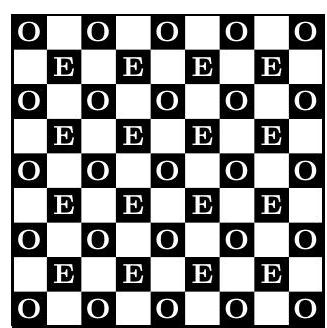
place 4 non-attacking rooks on the squares labelled $E$.
This gives 5!4! ways to place 9 mutually non-attacking rooks on black squares and removing any one of these 9 rooks gives one of the desired configurations. Thus there are $9 \cdot 5 ! 4$ ! ways to place 8 mutually non-attacking rooks on black squares.
Using very similar reasoning we can partition the white squares as shown in the diagram at right. The white squares are partitioned into two $5 \times 4$ boards such that no rook on a square marked $O$ can attack a rook on a square mark $E$. At most 4 non-attacking rooks can be placed on a $5 \times 4$ board and they can be placed in $5 \cdot 4 \cdot 3 \cdot 2=5$ ! ways. Thus there are $(5 !)^{2}$ ways to place 8 mutually non-attacking rooks on white squares.
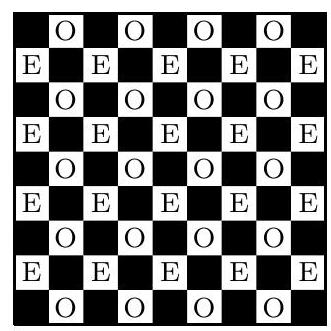
In total there are $9 \cdot 5 ! 4 !+(5 !)^{2}=(9+5) 5 ! 4 !=14 \cdot 5 ! 4 !=40320$ ways to place 8 mutually non-attacking rooks on squares of the same colour.
## Solution 2
Consider rooks on black squares first. We have 8 rooks and 9 rows, so exactly one row will be without rooks. There are two cases: either the empty row has 5 black squares or it has 4 black squares. By permutation these rows can be made either last or second last. In each case we'll count the possible number of ways of placing the rooks on the board as we proceed row by row.
In the first case we have 5 choices for the empty row, then we can place a rook on any of the black squares in row 1 ( 5 possibilities) and any of the black squares in row 2 (4 possibilities). When we attempt to place a rook in row 3, we must avoid the column containing the rook that was placed in row 1 , so we have 4 possibilities. Using similar reasoning, we can place the rook on any of 3 possible black squares in row 4 , etc. The total number of possibilities for the first case is $5 \cdot 5 \cdot 4 \cdot 4 \cdot 3 \cdot 3 \cdot 2 \cdot 2 \cdot 1=(5 !)^{2}$. In the second case, we have 4 choices for the empty row (but assume it's the second last row). We now place rooks as before and using similar logic, we get that the total number of possibilities for the second case is $4 \cdot 5 \cdot 4 \cdot 4 \cdot 3 \cdot 3 \cdot 2 \cdot 1 \cdot 1=4(5 ! 4 !)$.
Now, do the same for the white squares. If a row with 4 white squares is empty ( 5 ways to choose it), then the total number of possibilities is $(5 !)^{2}$. It's impossible to have a row with 5 white squares empty, so the total number of ways to place rooks is
$$
(5 !)^{2}+4(5 ! 4 !)+(5 !)^{2}=(5+4+5) 5 ! 4 !=14(5 ! 4 !)
$$
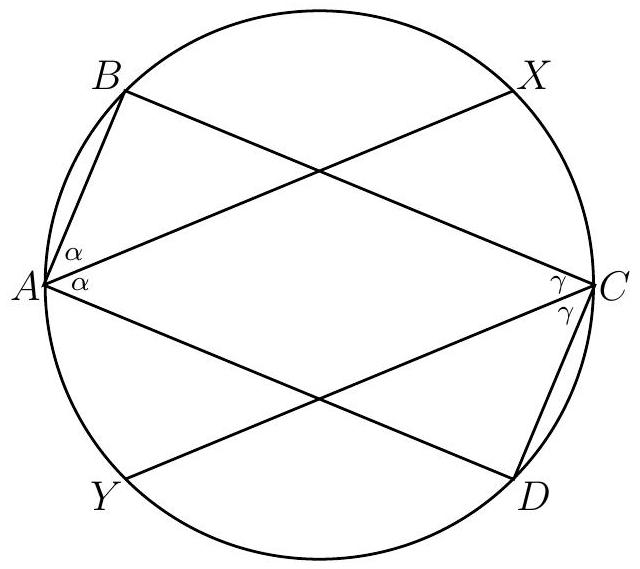
3. Let $A, B, C, D$ be four points on a circle (occurring in clockwise order), with $A BC D$. Let the bisector of angle $B A D$ meet the circle at $X$ and the bisector of angle $B C D$ meet the circle at $Y$. Consider the hexagon formed by these six points on the circle. If four of the six sides of the hexagon have equal length, prove that $B D$ must be a diameter of the circle.
## Solution 1
We're given that $A BY A, D Y>A B$. Similar reasoning confirms that $X$ lies between $B$ and $C$ and $B X>X C, B X>C D$. So if $A B X C D Y$ has 4 equal sides, then it must be that $Y A=A B=X C=C D$.
Let $\measuredangle B A X=\measuredangle D A X=\alpha$ and let $\measuredangle B C Y=\measuredangle D C Y=\gamma$. Since $A B C D$ is cyclic, $\measuredangle A+\measuredangle C=180^{\circ}$, which implies that $\alpha+\gamma=90^{\circ}$. The fact that $Y A=A B=X C=C D$ means that the arc from $Y$ to $B$ (which is subtended by $\measuredangle Y C B$ ) is equal to the arc from $X$ to $D$ (which is subtended by $\measuredangle X A D$ ). Hence $\measuredangle Y C B=\measuredangle X A D$, so $\alpha=\gamma=45^{\circ}$. Finally, $B D$ is subtended by $\measuredangle B A D=2 \alpha=90^{\circ}$. Therefore $B D$ is a diameter of the circle.
## Solution 2
We're given that $A BY A, D Y>A B$. Similar reasoning confirms that $X$ lies between $B$ and $C$ and $B X>X C, B X>C D$. So if $A B X C D Y$ has 4 equal sides, then it must be that $Y A=A B=X C=C D$. This implies that the arc from $Y$ to $B$ is equal to the arc from $X$ to $D$ and hence that $Y B=X D$. Since $\measuredangle B A X=\measuredangle X A D, B X=X D$ and since $\measuredangle D C Y=\measuredangle Y C B$, $D Y=Y B$. Therefore $B X D Y$ is a square and its diagonal, $B D$, must be a diameter of the circle.
4. Let $p$ be an odd prime. Prove that
$$
\sum_{k=1}^{p-1} k^{2 p-1} \equiv \frac{p(p+1)}{2} \quad\left(\bmod p^{2}\right)
$$
[Note that $a \equiv b(\bmod m)$ means that $a-b$ is divisible by $m$.]
## Solution
Since $p-1$ is even, we can pair up the terms in the summation in the following way (first term with last, 2nd term with 2nd last, etc.):
$$
\sum_{k=1}^{p-1} k^{2 p-1}=\sum_{k=1}^{\frac{p-1}{2}}\left(k^{2 p-1}+(p-k)^{2 p-1}\right)
$$
Expanding $(p-k)^{2 p-1}$ with the binomial theorem, we get
$$
(p-k)^{2 p-1}=p^{2 p-1}-\cdots-\left(\begin{array}{c}
2 p-1 \\
2
\end{array}\right) p^{2} k^{2 p-3}+\left(\begin{array}{c}
2 p-1 \\
1
\end{array}\right) p k^{2 p-2}-k^{2 p-1},
$$
where every term on the right-hand side is divisible by $p^{2}$ except the last two. Therefore
$$
k^{2 p-1}+(p-k)^{2 p-1} \equiv k^{2 p-1}+\left(\begin{array}{c}
2 p-1 \\
1
\end{array}\right) p k^{2 p-2}-k^{2 p-1} \equiv(2 p-1) p k^{2 p-2}\left(\bmod p^{2}\right)
$$
For $1 \leq ka_{2}$, then $u_{1}$ is a multiple of $u_{2}$ and if $a_{1}