# 2009
58th Czech and Slovak
Mathematical Olympiad
Edited by
Karel Horák
Translated into English by
Miroslav Engliš
First Round of the 58th Czech and Slovak
Mathematical Olympiad
Problems for the take-home part
(October 2008)

1. Find all real solutions of the system
$$
\begin{aligned}
& 2 \sin x \cos (x+y)+\sin y=1 \\
& 2 \sin y \cos (y+x)+\sin x=1
\end{aligned}
$$
Solution. Using the familiar formulas
$$
\cos (x+y)=\cos x \cos y-\sin x \sin y, \quad \sin 2 x=2 \sin x \cos x, \quad \cos 2 x=1-2 \sin ^{2} x
$$
we can rewrite the left-hand side of the first equation as
$$
\begin{aligned}
2 \sin x \cos (x+y)+\sin y & =2 \sin x(\cos x \cos y-\sin x \sin y)+\sin y= \\
& =2 \sin x \cos x \cos y+\left(1-2 \sin ^{2} x\right) \sin y= \\
& =\sin 2 x \cos y+\cos 2 x \sin y= \\
& =\sin (2 x+y) .
\end{aligned}
$$
Similarly the left-hand side of the second equation equals $\sin (2 y+x)$. The given system is thus equivalent to
$$
\begin{aligned}
& \sin (2 x+y)=1 \\
& \sin (2 y+x)=1
\end{aligned}
$$
Since the sine function assumes the value 1 precisely at points of the form $\frac{1}{2} \pi+$ $2 k \pi$, where $k$ is an integer, the solutions of the last system will be precisely those pairs $(x, y)$ for which there exist integers $k, l$ such that
$$
2 x+y=\frac{1}{2} \pi+2 k \pi, \quad 2 y+x=\frac{1}{2} \pi+2 l \pi .
$$
Multiplying the first equation by two and subtracting the second (or expressing one of the variables from the first equation and substituting it into the second), we obtain after a small manipulation
$$
x=\frac{1}{6} \pi+\frac{2}{3}(2 k-l) \pi, \quad y=\frac{1}{6} \pi+\frac{2}{3}(2 l-k) \pi .
$$
The solutions of the system are therefore the pairs $\left(\frac{1}{6} \pi+\frac{2}{3}(2 k-l) \pi, \frac{1}{6} \pi+\frac{2}{3}(2 l-k)\right)$, where $k, l$ are arbitrary integers. Verification is not necessary, since it is clear from the argument that these pairs satisfy the relations (2), and, hence, also the system (1), which is equivalent to the original system.
Remark. The result can be written also in a different way: since $y-x=\frac{1}{3}(6 l-$ $6 k) \pi=2(l-k) \pi$, setting $m=l-k, n=2 k-l$ we can write $x=\frac{1}{6} \pi+\frac{2}{3} n \pi$, $y=x+2 m \pi$, so the solutions are the pairs $\left(\frac{1}{6} \pi+\frac{2}{3} n \pi, \frac{1}{6} \pi+\frac{2}{3} n \pi+2 m \pi\right)$, where $m$, $n$ are arbitrary integers. (If $k, l$ range over all possible pairs of integers, then so do $m, n$.)
2. A cyclic quadrangle $A B C D$ is given. Show that the line connecting the orthocenter of the triangle $A B C$ with the orthocenter of the triangle $A B D$ is parallel to the line $C D$.
Solution. Denote by $k$ the circumcircle of the quadrangle $A B C D$, and by $U$ and $V$ the orthocenters of the triangles $A B C$ and $A B D$, respectively (Fig. 1).

Fig. 1
The image $U^{\prime}$ of the point $U$ under the symmetry with respect to the side $A B$ lies on the circumcircle of the triangle $A B C$, i.e. on $k$. (This holds even if the triangle $A B C$ is obtuse.) Similarly, the image $V^{\prime}$ of the point $V$ under the same symmetry lies on $k$.
Assume that the triangles $A B C$ and $A B D$ are acute. The points $U, V$ then lie in the half-plane $A B C$. The two perpendiculars $C U^{\prime}$ and $D V^{\prime}$ to the side $A B$ are parallel, thus the quadrangle $C U^{\prime} V^{\prime} D$ is a cyclic trapezoid, which has to be equilateral. From this fact and properties of axial symmetry we obtain the equalities
$$
\left|\angle C D V^{\prime}\right|=\left|\angle U^{\prime} V^{\prime} D\right|=\left|\angle U V V^{\prime}\right| \text {. }
$$
Since the points $C$ and $U$ lie in the same half-plane determined by the line $V^{\prime} D$, the lines $C D$ and $U V$ are parallel, which is what we wanted to prove. (We are using the fact that the points $D, V$, and $V^{\prime}$ lie on the line in this order.)
In the case when at least one of the triangles $A B C$ and $A B D$ is obtuse, the argument is quite analogous. The points $C, D, V^{\prime}$ and $U^{\prime}$ always form an equilateral trapezoid, though not necessarily with vertices in this order.
3. Find all pairs of natural numbers $x, y$ such that $\frac{x y^{2}}{x+y}$ is a prime.
Solution. Assume that the natural numbers $x, y$ and a prime $p$ satisfy the equation
$$
\frac{x y^{2}}{x+y}=p
$$
Denote by $d$ the greatest common divisor of $x$ and $y$. Then $x=d a$ and $y=d b$, where $a$ and $b$ are relatively prime. Substituting into (1), clearing the denominators and dividing by the positive number $d$, we obtain
$$
d^{2} a b^{2}=p(a+b) .
$$
Since the numbers $a$ and $b$ are relatively prime, so are the two numbers $b^{2}$ and $a+b$ from the two sides of the equality (2). It follows ${ }^{1}$ that $b^{2} \mid p$. The prime $p$ has only two divisors: 1 and $p$, of which the second is not a square; thus necessarily $b=1$. Substituting this into (2) gives
$$
d^{2} a=p(a+1)
$$
Arguing again as above, i.e. since $a$ is a divisor of the left-hand side of (3), it is also a divisor of the right-hand side, and as $a, a+1$ are relatively prime, we conclude that $a \mid p$. Thus either $a=1$, or $a=p$. We discuss these two cases separately.
If $a=1,(3)$ reads $d^{2}=2 p$. As $p$ is a prime, $2 p$ can be a square only if $p=2$. Then also $d=2$ and we arrive at the first solution $x=d a=2, y=d b=2$.
If $a=p$, then dividing by the positive number $p$ (3) becomes $d^{2}=p+1$, or $p=(d+1)(d-1)$. As $p$ is a prime and $d-11)$, the following assertion is true: The sequence $(*)$ either does not contain a $k$-th power of a natural number, or contains infinitely many $k$-th powers of natural numbers.
Solution. a) Set, for instance, $a=1, d=1$. The sequence $(*)$ then has the form
$$
1,2,3,4, \ldots,
$$
i.e. contains all natural numbers; among these, there are clearly infinitely many $k$-th powers for any $k$.
b) Set, for instance, $a=2, d=4$. The sequence $(*)$ then has the form
$$
2,6,10,14, \ldots
$$
i.e. is formed by all even numbers of the form $4 n+2$, where $n=0,1,2, \ldots$ This sequence certainly does not contain a $k$-th power of an odd number. On the other hand, a $k$-th power of an arbitrary even number is divisible by $2^{k}$, hence also by 4 (since we are considering only $k \geqslant 2$ ); but no number of the form $4 n+2$ is divisible by 4 . Our sequence therefore does not contain a $k$-th power of any natural number, no matter which $k=2,3, \ldots$ we choose.
c) Set, for instance, $a=8, d=16$. The sequence $(*)$ then has the form
$$
8,24,40,56, \ldots
$$
i.e. consists precisely of the odd multiples $8(2 n+1)$ of eight, where $n=0,1,2, \ldots$. This sequence cannot contain a square, because the prime factorization of $8(2 n+1)$ contains the prime 2 with multiplicity three $\left(8=2^{3}\right.$ and $2 n+1$ is odd), whereas in the prime factorization of a square, each prime occurs with an even multiplicity.
On the other hand, the sequence contains the infinitely many cubes $8 \cdot 1^{3}, 8 \cdot 3^{3}, 8$. $5^{3}, \ldots$, since the cube of an odd number is again odd, thus of the form $2 n+1$, and our sequence consists of all numbers of the form $8(2 n+1)$.
d) Assume that for the given $k>1$, the sequence $(*)$ contains at least one $k$-th power, say, the number $m^{k}$ for some natural $m$. Thus $m^{k}=a+n d$ for some nonnegative integer $n$. We claim that the sequence $(*)$ then contains also all the (infinitely many) powers $(m+d)^{k},(m+2 d)^{k},(m+3 d)^{k}, \ldots$.
Indeed, if $t$ is any positive integer, then by the binomial theorem
$$
\begin{aligned}
(m+t d)^{k} & =m^{k}+k m^{k-1} t d+\left(\begin{array}{l}
k \\
2
\end{array}\right) m^{k-2} t^{2} d^{2}+\cdots+k m t^{k-1} d^{k-1}+t^{k} d^{k}= \\
& =m^{k}+d \cdot\left(k m^{k-1} t+\left(\begin{array}{l}
k \\
2
\end{array}\right) m^{k-2} t^{2} d+\cdots+k m t^{k-1} d^{k-2}+t^{k} d^{k-1}\right)= \\
& =m^{k}+d \cdot M=(a+n d)+d M=a+d(n+M) .
\end{aligned}
$$
Since $M$ (the expression in the big parentheses) is clearly a positive integer, the number $(m+t d)^{k}=a+d(n+M)$ is a member of our sequence $(*)$, and the claim follows.
5. In each vertex of a regular 2008-gon there lies one coin. We choose two coins and move each of them into an adjacent vertex, one in the clockwise direction, the other anti-clockwise. Decide if, continuing in this fashion, it is possible to move all the coins into
a) 8 heaps of 251 coins each,
b) 251 heaps of 8 coins each.
Solution. Enumerate the vertices of the given polygon successively by the numbers $1,2, \ldots, 2008$.
a) We describe a way of moving the coins so as to obtain eight 251-coin heaps.
First of all, move successively the coins from the first 251 vertices $1,2, \ldots, 251$ into a single heap in vertex 251 , compensating their movements by moving "symmetrically" the coins from the last 251 vertices $1758,1759, \ldots, 2008$ into the vertex 1758 . This produces the first two 251-coin heaps. We continue by moving analogously all the coins from the vertices 252 to 502 into a single heap in vertex 502, again compensating by symmetrical movements leading to another 251-coin heap in the vertex with number 1757 - 250, i.e. 1507 . We perform this procedure two more times, in the end obtaining the last two 251-coin heaps in the two adjacent vertices 1004 and 1005 .
b) We show that this cannot be achieved.
Assign to each coin the number of the vertex in which it lies (at the moment). Let us see how the sum $S$ of all these 2008 numbers changes upon moving any pair of coins in the manner allowed. If none of the coins is moved between the vertices 1 and 2008 , the value of $S$ is clearly unchanged, since for one of the coins its assigned number increases by 1 , while for the other coin being moved it decreases by 1 (while for all the remaining coins, which are not being moved, the assigned numbers do not change). Similarly, $S$ does not change if we simply move a coin from 2008 into 1 and the other coin from 1 into 2008. Finally, if one of the coins is moved between 1 and 2008 and the other between some other pair of vertices, then $S$ changes into $S \pm 2008$, since the numbers assigned to the two coins that are being moved will either both increase, or both decrease, by the values of 1 and 2007 , respectively (in both cases).
Summarizing, we thus see that from its original value $S_{0}=1+2+\cdots+2008=$ $1004 \cdot 2009$, the sum $S$ can only assume values of the form $S=S_{0}+2008 k$, where $k$ is an integer.
If it were possible to move all the coins into 251 eight-coin heaps, say, at the vertices with numbers $v_{1}, v_{2}, \ldots, v_{251}$, then we would have the equality
$$
1004 \cdot 2009+2008 k=8\left(v_{1}+v_{2}+\cdots+v_{251}\right),
$$
which cannot hold for any integer $k$, since the right-hand side is a multiple of eight, while the left-hand side is not (the number $2008 k$ is divisible by eight, but $1004 \cdot 2009$ is not). Consequently, no such sequence of movements of the coins exists.
6. A triangle $A B C$ is given. In the interior of its sides $A C, B C$, there are given points $E, D$, respectively, such that $|A E|=|B D|$. Denote by $M$ the midpoint of the side $A B$, and by $P$ the intersection of the lines $A D$ and $B E$. Show that the image of the point $P$ in the central symmetry with respect to $M$ lies on the bisector of the angle $A C B$.
Solution. Denote by $Q$ the image of $P$ in the central symmetry with center $M$. The point $Q$ will lie on the bisector of the angle $A C B$ if and only if it has the same distance from the lines $A C$ and $B C$. Since the segments $A E$ and $B D$ have the same length, we see that $Q$ will have the same distance from the lines $A C$ and $B C$ if and only if the triangles $A E Q$ and $B D Q$ have the same area (Fig. 2). We now prove the equality of these areas.

Fig. 2
From the construction of the point $Q$ it follows that $A Q B P$ is a parallelogram, i.e. the line $Q B$ is parallel to $A D$; the triangles $Q B D$ and $Q B A$ thus have equal areas (having equal altitudes to the common base $Q B$ ). Similarly from $Q A \| B E$ it follows that the areas of the triangles $Q A E$ and $Q A B$ are equal. Thus the areas of the triangles $A E Q$ and $B D Q$ are equal as well, as claimed.
First Round of the 58th Czech and Slovak Mathematical Olympiad
(December 2nd, 2008)
$\mathbb{N} / / 1 /$
1. Find all pairs of positive integers $m$ and $n$ for which
$$
\sqrt{m^{2}-4}<2 \sqrt{n}-m<\sqrt{m^{2}-2} .
$$
Solution. If $m, n$ satisfy the given inequalities, then clearly
$$
m \geqslant 2 \text { and } 2 \sqrt{n}-m>0 \text {, }
$$
otherwise the square roots would not be defined or the middle term $2 \sqrt{n}-m$ would not be positive, and thus could not be greater than the nonnegative expression $\sqrt{m^{2}-4}$.
Assuming that the conditions (1) are satisfied, we can make the following equivalent manipulations of the given inequalities (note that in each of the four squarings both sides are defined and nonnegative, and equally both divisions are by the positive number $n$, so all these manipulations are correct):
$$
\begin{array}{rlrlrl}
2 \sqrt{n}-m & <\sqrt{m^{2}-2} & { }^{2} & \sqrt{m^{2}-4} & <2 \sqrt{n}-m \\
4 n-4 m \sqrt{n}+m^{2} & 0, \\
2 \sqrt{m^{2}-2} & >m,\left.\quad\right|^{2} \\
4\left(m^{2}-2\right) & >m^{2}, \\
3 m^{2} & >8 .
\end{aligned}
$$
The last inequality holds, however, for any $m \geqslant 2$.
Answer. The sought pairs are precisely those of the form $(m, n)=\left(m, m^{2}-2\right)$, where $m \geqslant 2$ is any positive integer.
2. Let $A B C$ be an acute triangle whose interior angle at the vertex $A$ has magnitude $45^{\circ}$. Denote by $D$ the foot of the perpendicular from the vertex $C$, and let $P$ be an arbitrary interior point of the altitude $C D$. Show that the lines $A P$ and $B C$ are perpendicular if and only if the segments $A P$ and $B C$ are congruent.
Solution. We start with the first implication. Let $A P \perp B C$; then the point $P$ is the orthocenter of the triangle $A B C$. We need to show that the segments $A P$ and $B C$ are congruent; we do this by finding two congruent triangles, in which these segments are a pair of corresponding sides.
Denote by $E$ the intersection of the line $B P$ with the side $A C$, i.e. $E$ is the foot of the altitude from the vertex $B$. From the right triangle $A B E$ and the given magnitude of the angle $B A C$, it is easy to see that $|\angle P B D|=45^{\circ}$. The triangle $P D B$ is thus right and isosceles, hence $|D P|=|D B|$ (Fig. 1). The similar triangle $A D C$ is right and, in view of the magnitude of the angle at the vertex $A$, also isosceles; thus $|D A|=|D C|$. By the sas theorem, the right triangles $A P D$ and $C B D$ are congruent, and their hypotenuses $A P, B C$ thus have equal lengths.

Fig. 1
It remains to show the converse implication. Assume that $|A P|=|B C|$. Since $A D C$ is an isosceles right triangle, necessarily $|A D|=|C D|$, so the triangles $P A D$ and $B C D$ are congruent by the $S s a$ theorem. Hence $|P D|=|B D|$, and thus $|\angle A B P|=45^{\circ}$. Denote again by $E$ the intersection of the line $B P$ with the side $A C$. In the triangle $A B E$ the angle $B E A$ is right, so the line $B P$ is the altitude of the triangle $A B C$ (Fig. 1) and the point $P$ is therefore its orthocenter. It follows that $A P$ is the altitude to the side $B C$, hence $A P \perp B C$.
3. Find all integers greater than 1 by which a cancellation can be made in some fraction of the form
$$
\frac{3 p-q}{5 p+2 q}
$$
where $p$ and $q$ are mutually prime integers.
Solution. The fraction admits cancellation by an integer $d>1$ if and only if $d$ is a common divisor of its numerator and its denominator. Let us thus assume that $d \mid 3 p-q$ and at the same time $d \mid 5 p+2 q$, where $p$ and $q$ are mutually prime integers. Adding up the appropriate multiples of the two binomials $3 p-q$ and $5 p+2 q$, we get
$$
2(3 p-q)+(5 p+2 q)=11 p \quad \text { and } \quad 3(5 p+2 q)-5(3 p-q)=11 q
$$
Since both $3 p-q$ and $5 p+2 q$ are assumed to be divisible by $d$, the two numbers $11 p$ and $11 q$ must also be multiples of $d$. However, $p$ and $q$ are mutually prime by hypothesis and 11 is a prime, thus the numbers $11 p$ and $11 q$ have only one common divisor greater than 1 , namely the number 11. Thus $d=11$.
We now need to show that it is indeed possible to make a cancellation by 11 in some fraction of the given form. That is, we need to find a pair of mutually prime integers $p$ and $q$ so that $11 \mid 3 p-q$ and at the same time $11 \mid 5 p+2 q$. Solving the system of equations
$$
3 p-q=11 m \text { and } \quad 5 p+2 q=11 n
$$
we get $(p, q)=(2 m+n, 3 n-5 m)$, and $p, q$ will certainly be prime if we choose them so that $q=3 n-5 m=1$, thus e.g. for $n=2$ and $m=1$, when $(p, q)=(4,1)$ and the corresponding fraction is $11 / 22$.
Answer. The only integer greater than 1 , which can be cancelled in some fraction of the given form, is the number 11 .
## Second Round of the 58th Czech Mathematical Olympiad (January 20th, 2009)

1. A four-digit natural number is given which is divisible by seven. If we write its digits in the reverse order, we obtain another four-digit natural number, which is greater and is also divisible by seven. Furthermore, both numbers give the same remainder upon division by 37. Determine the original four-digit number.
Solution. Denote the given number by $n=\overline{a b c d}=1000 a+100 b+10 c+d$, and the one obtained by reversing the order of digits $k=\overline{d c b a}=1000 d+100 c+10 b+a$. Since both numbers $k, n$ give the same remainder upon dividing by 37 , their difference
$$
\begin{aligned}
k-n & =(1000 d+100 c+10 b+a)-(1000 a+100 b+10 c+d)= \\
& =999(d-a)+90(c-b)=37 \cdot 27(d-a)+90(c-b)
\end{aligned}
$$
must be divisible by 37 , whence $37 \mid 90(c-b)$. As 37 is a prime and 90 is not its multiple, necessarily $37 \mid c-b$. For two digits $b, c$, this is only possible if $b=c$. Conversely, if $b=c$, then it follows from (1) that the difference $k-n$ is divisible by 37, regardless of the values of $a$ and $d$, so the two numbers $k$ and $n$ give the same remainder upon division by 37 . From now on, we can therefore assume that $n=\overline{a b b d}$ and $k=\overline{d b b a}$, and will be concerned only with the conditions of the divisibility by seven.
From the conditions $7|n, 7| k$ we have
$$
7 \mid k-n=37 \cdot 27(d-a)
$$
(we have substituted the equality $b=c$ into (1)). Since the numbers 7 and $37 \cdot 27$ are relatively prime, we must have $7 \mid d-a$. Since we know that $k>n$, necessarily $d>a$; and as $a, d$ are digits, this is only possible if $d-a=7$. Finally, as $a$ is the first digit of the four-digit number $n$, we must have $a>0$; thus the only possibilities are $a=1, d=8$ or $a=2, d=9$.
For $a=1$ and $d=8$, the numbers
$$
\begin{aligned}
& n=\overline{1 b b 8}=1008+110 b=7 \cdot(144+15 b)+5 b, \\
& k=\overline{8 b b 1}=8001+110 b=7 \cdot(1143+15 b)+5 b,
\end{aligned}
$$
are divisible by seven if and only if $7 \mid 5 b$, or $b \in\{0,7\}$. We thus get the first two solutions $n=1008$ and $n=1778$.
Similarly, for $a=2$ and $d=9$,
$$
\begin{aligned}
& n=\overline{2 b b 9}=2009+110 b=7 \cdot(287+15 b)+5 b, \\
& k=\overline{9 b b 2}=9002+110 b=7 \cdot(1286+15 b)+5 b
\end{aligned}
$$
are divisible by seven iff $7 \mid 5 b$, which leads to the two remaining solutions $n=2009$ and $n=2779$.
The original four-digit number can be any of the numbers 1008, 1778, 2009 and 2779 (and no other).
2. Two circles $k_{a}$ and $k_{b}$ are given, whose centers lie on the legs of lengths a and b, respectively, of a right triangle. Both circles are tangent to the hypotenuse of the triangle pass through the vertex opposite to the hypotenuse. Denote the radii of the circles by $\rho_{a}$ and $\rho_{b}$. Find the greatest real number $p$ such that the inequality
$$
\frac{1}{\rho_{a}}+\frac{1}{\rho_{b}} \geqslant p\left(\frac{1}{a}+\frac{1}{b}\right)
$$
holds for all right triangles.
Solution. Denote the vertices of the triangle by $A, B, C$, with $A, B$ lying opposite the legs with lengths $a$ and $b$, respectively.
Let us first determine the magnitudes of the two radii $\rho_{a}$ and $\rho_{b}$. Denote by $A^{\prime}$ the image of $A$ in the symmetry with respect to the line $B C$. The circle $k_{a}$ is the incircle of the triangle $A^{\prime} A B$ (Fig. 1). The isosceles triangle $A B A^{\prime}$ has perimeter $o=2(b+c)$ and area $S=a b$, so by the familiar formula the radius $\varrho_{a}$ of its incircle $k_{a}$ is
$$
\varrho_{a}=\frac{2 S}{o}=\frac{a b}{b+c} .
$$
Similarly $\varrho_{b}=a b /(a+c)$.
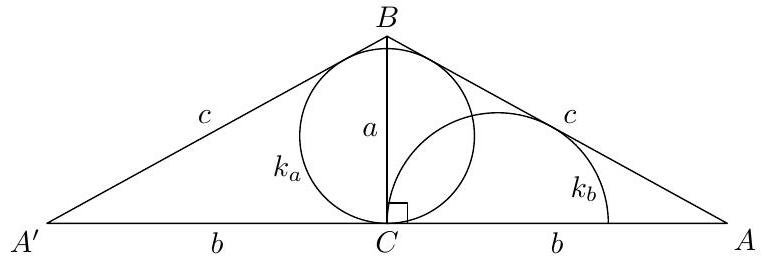
Fig. 1
The number $p$ is to satisfy
$$
p \leqslant \frac{\frac{1}{\varrho_{a}}+\frac{1}{\varrho_{b}}}{\frac{1}{a}+\frac{1}{b}}=\frac{\frac{b+c}{a b}+\frac{a+c}{a b}}{\frac{a+b}{a b}}=\frac{a+b+2 c}{a+b}=1+\frac{2 c}{a+b}=1+\frac{2 \sqrt{a^{2}+b^{2}}}{a+b}
$$
for any right triangle with legs $a, b$.
Since for $a=b$ the last expression equals $1+\sqrt{2}$, any such number $p$ must satisfy $p \leqslant 1+\sqrt{2}$. If we can show that
$$
\frac{2 \sqrt{a^{2}+b^{2}}}{a+b} \geqslant \sqrt{2}
$$
for any positive $a$ and $b$, it will follow that $p=1+\sqrt{2}$ is the solution of the problem.
The inequality (1) for arbitrary positive $a, b$ is easily shown to be equivalent to an inequality whose validity is evident:
$$
\begin{aligned}
2 \sqrt{a^{2}+b^{2}} & \geqslant \sqrt{2}(a+b), \\
4\left(a^{2}+b^{2}\right) & \geqslant 2(a+b)^{2}, \\
4 a^{2}+4 b^{2} & \geqslant 2 a^{2}+4 a b+2 b^{2}, \\
2(a-b)^{2} & \geqslant 0 .
\end{aligned}
$$
Alternatively, one can appeal to Cauchy's inequality $2\left(a^{2}+b^{2}\right) \geqslant(a+b)^{2}$, or to the inequality between the quadratic and arithmetic mean
$$
\sqrt{\frac{a^{2}+b^{2}}{2}} \geqslant \frac{a+b}{2}
$$
Answer. The sought real number $p$ is $1+\sqrt{2}$.
Remark. The magnitude of the radii $\varrho_{a}, \varrho_{b}$ can be derived also in another way: expressing the sine of the angle $A B C$ in two ways from the right triangles $S_{a} B T$ a $A B C$ (Fig. 2), we get
$$
\frac{\varrho_{a}}{a-\varrho_{a}}=\frac{b}{c}
$$
implying that $\varrho_{a}=a b /(b+c)$. Similarly for $\varrho_{b}$.
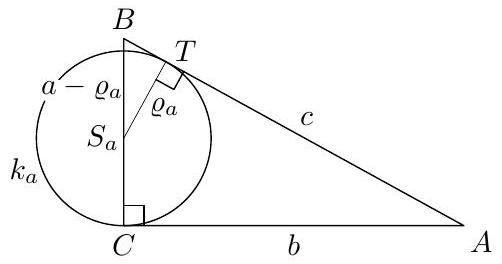
Fig. 2
3. Find the magnitudes of the interior angles $\alpha, \beta, \gamma$ of a triangle which satisfy
$$
\begin{aligned}
& 2 \sin \beta \sin (\alpha+\beta)-\cos \alpha=1 \\
& 2 \sin \gamma \sin (\beta+\gamma)-\cos \beta=0
\end{aligned}
$$
Solution. Similarly as in the solution of the first problem of the First Round we can derive the following formula
$$
\cos x-2 \sin y \sin (x+y)=\cos (x+2 y)
$$
which holds for arbitrary real numbers $x, y$. From conditions of the given problem we get the following two equations for magnitudes of the interior angles $\alpha, \beta, \gamma$ of a triangle:
$$
\begin{aligned}
& \cos \alpha-2 \sin \beta \sin (\alpha+\beta)=\cos (\alpha+2 \beta)=-1, \\
& \cos \beta-2 \sin \gamma \sin (\beta+\gamma)=\cos (\beta+2 \gamma)=0 .
\end{aligned}
$$
This yields
$$
\begin{aligned}
& \alpha+2 \beta=\pi+2 k \pi, \\
& \beta+2 \gamma=\frac{\pi}{2}+l \pi,
\end{aligned}
$$
where $k, l$ are arbitrary non-negative integers. Adding up (1) and (2) we obtain
$$
\alpha+3 \beta+2 \gamma=\frac{3 \pi}{2}+(2 k+l) \pi
$$
Since $\alpha, \beta, \gamma$ are magnitudes of interior angles of a triangle $(\alpha+\beta+\gamma=\pi)$ we have
$$
2 \beta+\gamma=\frac{\pi}{2}+(2 k+l) \pi
$$
where $k, l$ are non-negative integers. Further from (2) a (3) we obtain after short manipulation
$$
\beta+\gamma=\frac{\pi}{3}+\frac{2}{3}(k+l) \pi
$$
Regarding $\beta+\gamma<\pi$ we have $k=l=0$, thus
$$
\beta+\gamma=\frac{\pi}{3} \text {. }
$$
From (2) and (4) it easily follows $\beta=\gamma=\frac{1}{6} \pi$, hence $\alpha=\frac{2}{3} \pi$.
Conclusion. The magnitudes of interior angles of the considered triangle are $\alpha=120^{\circ}, \beta=\gamma=30^{\circ}$.
Another solution. From the equality $\alpha+\beta+\gamma=\pi$ and standard goniometric formulas we have
$$
\begin{aligned}
\sin (\alpha+\beta) & =\sin \gamma \\
\cos \alpha & =-\cos (\beta+\gamma)=-\cos \beta \cos \gamma+\sin \beta \sin \gamma
\end{aligned}
$$
Substituting these values of $\sin (\alpha+\beta)$ and $\cos \alpha$ into the first equation of the given system and simplifying, we get
$$
\begin{aligned}
2 \sin \beta \sin \gamma-(-\cos \beta \cos \gamma+\sin \beta \sin \gamma) & =1 \\
\cos \beta \cos \gamma+\sin \beta \sin \gamma & =1 \\
\cos (\beta-\gamma) & =1
\end{aligned}
$$
The last equality holds if and only if $\beta=\gamma$, since the difference of two interior angles of a triangle always lies in the interval $(-\pi, \pi)$, in which the cosine functions assume the value 1 only at the point zero. We have thus shown that the first equation of the given system is fulfilled if and only if $\beta=\gamma$.
Now it is easy to solve also the second equation of the system, if we make the substitution $\beta=\gamma$ in it:
$$
\begin{aligned}
2 \sin \beta \sin 2 \beta-\cos \beta & =0, \\
4 \sin ^{2} \beta \cos \beta-\cos \beta & =0, \\
\left(4 \sin ^{2} \beta-1\right) \cos \beta & =0 .
\end{aligned}
$$
Hence either $\cos \beta=0$, or $\sin \beta= \pm \frac{1}{2}$. However, the equality $\beta=\gamma$ for angles in a triangle means that the angle $\beta$ is acute, hence $\cos \beta>0$. Thus $\sin \beta=\frac{1}{2}$ (the possibility $\sin \beta=-\frac{1}{2}$ is ruled out for an angle $\beta$ in the interval $(0, \pi)$ ). We have thus arrived at the only possible values $\beta=\gamma=30^{\circ}$, implying $\alpha=120^{\circ}$. These values are indeed a solution of the original system, since the first equation holds owing to the equality $\beta=\gamma$, while the second has been treated under the assumption of $\beta=\gamma$ only by equivalent manipulations.
4. A point $D$ has been chosen in the interior of the side $B C$ of an acute triangle $A B C$, and another point $P$ in the interior of the segment $A D$ but not lying on the median from the vertex $C$. The line containing this median intersects the circumcircle of the triangle $C P D$ at a point which we denote by $K(K \neq C)$. Show that the circumcircle of the triangle AKP passes in addition to A through another fixed point which does not depend on the choice of the points $D$ and $P$.
Solution. Denote by $\phi$ the magnitude of the angle between the line $t_{c}$ containing the median from the vertex $C$ and the line containing the side $B C$ of the given triangle. In view of the definition of the point $K$, the lines $K P$ and $A D$ will meet also at the same angle $\phi$. This means, however, that on the circumcircle of the triangle $A K P$ there also lies the point $M$ of the line $t_{c}$ at which the line $A M$ meets the line $t_{c}$ at the angle $\phi$. This property is clearly possessed by the point $M$ symmetric to $C$ with respect to the midpoint of the side $A B$; and this point does not depend on the choice of the points $D$ and $P$ (Fig. 3 ).

Fig. 3
Let us now show the above in more detail. Denote by $Q$ the intersection of the median $t_{c}$ with the segment $A D$ (that is, $Q$ is the "forbidden" choice for the point $P$ ). The point $P$ lies either in the interior of the segment $D Q$ (Fig.3), or in the interior of the segment $Q A$ (Fig. 5).
In the former case, the point $Q$ lies in the exterior of the circumcircle of the triangle $C P D$, and the point $K$ thus belongs to the interior of the half-line $Q C$. If the point $K$ lies in the interior of the segment $Q C$, the points $C$ and $P$ are the opposite vertices of the cyclic quadrangle $C D P K$, thus $|\angle A P K|=\phi$. Furthermore, the points $P$ and $M$ lie in the same half-plane determined by the line $A K$, and from the congruence of the angles $A M K$ and $A P K$ it therefore follows that the quadrangle $A M P K$ is cyclic, so the point $M$ indeed lies on the circumcircle of the triangle $A K P$.
If the point $K$ does not lie in the interior of the segment $Q C$ and $K \neq C$ (Fig. 4), then $|\angle K P D|=|\angle K C D|=180^{\circ}-\phi$, whence $|\angle K P A|=\phi=|\angle K M A|$. (The last equality holds, of course, also for $K=C$.) Since the points $P$ and $M$ lie in the same half-plane determined by the line $K A$, the point $M$ lies also in this case on the circumcircle of the triangle $A K P$.

Fig. 4
In the second case the point $K$ lies in the interior of the half-line $Q M$. If $K$ lies in the interior of the segment $Q M$ (Fig.5), the points $P$ and $M$ lie in opposite half-planes determined by $A K$, and from the equality of the angles $D C K$ and $D P K$

Fig. 5
subtending the chord $D K$ we have $|\angle D P K|=\phi=|\angle A M K|$, which guarantees that the quadrangle $A M K P$ is cyclic, so that the point $M$ lies on the circumcircle of the triangle $A K P$.
If the point $K$ does not lie in the interior of the segment $Q M$ (Fig. 6), we have $|\angle K P A|=|\angle K M A|=180^{\circ}-\phi$. Since the points $P$ and $M$ lie in the same halfplane determined by $K A$, the point $M$ lies also in this case on the circumcircle of the triangle $A K P$.

Fig. 6
Final Round of the 58th Czech
Mathematical Olympiad
(March 23-24, 2009)
$\mathbb{N} / /$ (6)
1. Show that if the numbers $p, 3 p+2,5 p+4,7 p+6,9 p+8$ and $11 p+10$ are all primes, then the number $6 p+11$ is composite.
Solution. Assume that all of the numbers $p, 3 p+2,5 p+4,7 p+6,9 p+8$ a $11 p+10$ are primes. Let us see what are the possible remainders of $p$ upon division by five, i.e. what numbers $l$ from the set $\{0,1,2,3,4\}$ and nonnegative integers $k$ can satisfy $p=5 k+l$.
$\triangleright$ If $p=5 k$ is a prime, then $p=5$, but then $11 p+10=65$ is not a prime.
$\triangleright$ If $p=5 k+1$, then $3 p+2=5(3 k+1)$ is a prime only if $k=0$, but then $p=1$ which is not a prime.
$\triangleright$ If $p=5 k+2$, then $7 p+6=5(7 k+4)$ cannot be a prime for any $k \geqslant 0$.
$\triangleright$ If $p=5 k+3$, then $9 p+8=5(9 k+7)$ cannot be a prime for any $k \geqslant 0$.
The prime $p$ thus must be of the form $5 k+4$. But then $6 p+11=5(6 k+7)$ is a composite number, for any integer $k \geqslant 0$.
Remark. The least prime $p$ for which all the numbers $3 p+2,5 p+4,7 p+6,9 p+8$ and $11 p+10$ are also primes is $p=2099$.
2. On the shorter of the arcs $C D$ of the circumcircle of a rectangle $A B C D$, a point $P$ is chosen. Denote the feet of the perpendiculars from $P$ onto the lines $A B, A C$ and $B D$ by $K, L$ and $M$, respectively. Show that the angle $L K M$ has magnitude $45^{\circ}$ if and only if $A B C D$ is a square.
Solution. We will show that the angle $L K M$ has the same magnitude as the angle $C B D$ (Fig. 1). This already implies the desired assertion in a trivial way (the angle $C B D$ has magnitude $45^{\circ}$ if and only if $|B C|=|C D|$, i.e. if and only if $A B C D$ is a square).

Fig. 1
The points $B, K, M, P$ lie, in this order, on the Thaletian circle over the diameter $B P$. For the magnitudes of the angles subtending the chord $P M$ we thus have $|\angle P K M|=|\angle P B M|$. Similarly the points $A, K, L, P$ lie (in this order) on the Thaletian circle over the diameter $A P$ and for the angles subtending the chord $P L$ we have $|\angle L K P|=|\angle L A P|$. Finally, for the magnitudes of the angles subtending the chord $C P$ in the circumcircle of the rectangle $A B C D$ we obtain $|\angle C A P|=|\angle C B P|$.
Combining these equalities yields
$$
\begin{aligned}
|\angle L K M| & =|\angle L K P|+|\angle P K M|=|\angle L A P|+|\angle P B M|=|\angle C A P|+|\angle P B D|= \\
& =|\angle C B P|+|\angle P B D|=|\angle C B D|,
\end{aligned}
$$
which is what we wanted to prove.
Remark. The above argument applies also in the trivial case when $P=C$ or $P=D$; some of the angles considered will then have zero magnitude.
Another solution. We again show that the angles $L K M$ and $C B D$ have the same magnitude. Denote by $N$ the foot of the perpendicular from the point $P$ onto the line $B C$. The points $K, L, N$ lie on Simpson's line corresponding to the point $P$ and triangle $A B C$ (Fig. 2). The Thaletian circle over diameter $P B$ contains the points $K, M$ and $N$. By the magnitudes of the angles subtending the chord $M N$ of the same circle we thus get
$$
|\angle L K M|=|\angle N K M|=|\angle N B M|=|\angle C B D| \text {. }
$$

Fig. 2
3. Find the least positive number $x$ with the following property: if $a, b, c, d$ are arbitrary positive numbers whose product is 1 , then
$$
a^{x}+b^{x}+c^{x}+d^{x} \geqslant \frac{1}{a}+\frac{1}{b}+\frac{1}{c}+\frac{1}{d} .
$$
Solution. Let $a, b, c, d$ be positive numbers whose product equals 1 . From the inequality between the arithmetic and geometric mean of the three numbers $a^{x}, b^{x}$, $c^{x}$, with arbitrary $x>0$, we obtain
$$
\frac{a^{x}+b^{x}+c^{x}}{3} \geqslant \sqrt[3]{a^{x} b^{x} c^{x}}=\sqrt[3]{\frac{1}{d^{x}}}
$$
Choosing $x=3$ gives the inequality $\frac{1}{3}\left(a^{3}+b^{3}+c^{3}\right) \geqslant 1 / d$. Similarly,
$$
\frac{1}{3}\left(a^{3}+b^{3}+d^{3}\right) \geqslant 1 / c, \quad \frac{1}{3}\left(a^{3}+c^{3}+d^{3}\right) \geqslant 1 / b, \quad \frac{1}{3}\left(b^{3}+c^{3}+d^{3}\right) \geqslant 1 / a .
$$
Adding up these four inequalities we obtain
$$
a^{3}+b^{3}+c^{3}+d^{3} \geqslant \frac{1}{a}+\frac{1}{b}+\frac{1}{c}+\frac{1}{d}
$$
so for $x=3$ the given inequality always holds.
We now show that $x=3$ is the smallest number with this property, that is, that for any positive $x<3$ there is some quadruple $(a, b, c, d)$, abcd $=1$, for which the given inequality fails. We will look for such a quadruple in the form $a=b=c=t$ and $d=1 / t^{3}$ with suitable $t>1$ (depending on $x<3$ ). Positive numbers $a, b, c, d$ like this certainly satisfy $a b c d=1$, while
$$
a^{x}+b^{x}+c^{x}+d^{x}=3 t^{x}+\frac{1}{t^{3 x}}<4 t^{x} \text { and } \quad \frac{1}{a}+\frac{1}{b}+\frac{1}{c}+\frac{1}{d}=\frac{3}{t}+t^{3}>t^{3} .
$$
Thus if we can choose $t$ so that $4 t^{x}4^{\frac{1}{3-x}}
$$
which is certainly fulfilled for $t$ large enough.
Conclusion. The least number with the desired property is $x=3$.
4. We are interested in natural numbers (positive integers) $n$ with the property that there exist exactly four natural numbers $k$ such that $n+k$ is a divisor of $n+k^{2}$.
a) Show that $n=58$ has this property, and find the corresponding four numbers $k$.
b) Show that an even number $n=2 p$, where $p \geqslant 3$, has this property if and only if both $p$ and $2 p+1$ are primes.
Solution. From the equality $n+k^{2}=(k+n)(k-n)+n(n+1)$ we see that $n+k \mid n+k^{2}$ is equivalent to $n+k \mid n(n+1)$. The number of such $k$ is equal to the number of divisors of $D=n(n+1)$ which are greater than $n$.
a) For $n=58$, the prime factorization of the corresponding $D=58 \cdot 59=2 \cdot 29 \cdot 59$ reveals that the divisors of $D$ greater than 58 are precisely the four numbers 59 , $2 \cdot 59=118,29 \cdot 59=1711$ and $2 \cdot 29 \cdot 59=3422$. These are equal to $58+k$, so the corresponding four values of $k$ are, in turn, $k=1, k=60, k=1653$ and $k=3364=58^{2}$. (We remark that the two numbers $k=1$ and $k=n^{2}$ satisfy the condition $n+k \mid n+k^{2}$ for any $n$.)
b) For an even $n=2 p$, where $p \geqslant 3$, we have $D=2 p(2 p+1)$, and we can easily list four divisors of $D$ which are greater than $n=2 p$ :
$$
2 p+1<2(2 p+1)2+\frac{1}{p} \text { and } q1$; in the remaining vertex $A_{1}$, there will be $n-1$ coins different from $M$ (since the total number of coins remains the same all the time), while the coin $M$ ends up in some - as yet unknown - vertex. If we can show that this vertex is $A_{1}$, then we are finished. However, this happens if and only if the number $n$ of vertices is such that the sum $S$ gives the same remainder upon division by $n$ in the initial and in the final position. And we have found all such $n$ in the fist part of the solution.
Answer. The coins can be moved into such position if and only if $n$ gives remainder either 1 or 5 upon division by six.
6. Two distinct points $O$ and $T$ are given in the plane $\omega$. Find the locus of vertices of all triangles lying in $\omega$ whose centroid is $T$ and whose circumcenter is $O$.
Solution. Consider a point $A$ in the plane $\omega$. In order that $A$ be a vertex of a triangle as required, $A$ must be different from $T$ and $O$. We first describe how to construct a triangle $A B C$ if its vertex $A$, its centroid $T$ and its circumcenter $O$ are given (for three mutually distinct points $A, O, T$ ). Then we check for which points $A$ it is impossible to construct such triangle.
Denote by $A^{\prime}$ the midpoint of the side $B C$. The point $A^{\prime}$ is the image of $A$ in the homothety with center $T$ and coefficient $-\frac{1}{2}$. If $A^{\prime} \neq O$, the points $B$ and $C$ lie on the perpendicular $p$ through $A^{\prime}$ to the line $O A^{\prime}$, and at the same time on the circumcircle $k$ with center $O$ and radius $|O A|$ (Fig.3).

Fig. 3
For a given $A$, it is always possible to construct its image $A^{\prime}$ in the homothety as above. Assume first that $A^{\prime} \neq O$. In order to obtain two different points $B$ and $C$, the line $p$ must be a secant of the circle $k$. This happens if and only if $\left|O A^{\prime}\right|<|O A|$. Denote by $O^{\prime}$ the image of $O$ in the homothety with center $T$ and coefficient -2 . Then $\left|O^{\prime} A\right|=2\left|O A^{\prime}\right|$, so the above condition can be expressed as $\left|O^{\prime} A\right|<2|O A|$. The point $A$ must therefore lie in the exterior of the Apollonian circle $m(S ;|S T|)$, where $S$ is the point symmetric to $T$ with respect to $O$ (Fig. 4).

Fig. 4
Thus if $A^{\prime} \neq O$, or $A \neq O^{\prime}$, the construction yields three points $A, B, C$. These will be vertices of a triangle as required, provided they are not collinear. They are collinear if and only if the line $B C$ coincides with the line $A T$, i.e. if and only if the line $O A^{\prime}$ is perpendicular to $A T$. The point $A^{\prime}$ thus must not lie on the Thaletian circle over diameter $O T$, i.e. (upon applying the homothety with center $T$ and coefficient -2) the point $A$ must not lie on the Thaletian circle with diameter $O^{\prime} T$ (Fig. 5).

Fig. 5
In the case when the point $A$ coincides with $O^{\prime}$, i.e. $A^{\prime}=O$, we can take instead of the perpendicular $p$ any line (different from $A T$ ) passing through $O$ (Fig. 6). In this way we obtain infinitely many different triangles $A B C$ with right angles at the vertex $A$ which satisfy the conditions of the problem.

Fig. 6

Fig. 7
Conclusion. The sought locus is the exterior of the circle $m$, except for the points lying on the Thaletian circle with diameter $O^{\prime} T$, but including the point $O^{\prime}$ (Fig. 7).

## I N V E S T I C E D O R O Z V O J E V Z D Ě L Á V Á N Í
Zhotoveno v rámci projektu „Zkvalitnění přípravy matematických talentů základních a středních škol Olomouckého kraje“, registrační číslo CZ.1.07/1.2.12/01.0027.
Tento projekt je spolufinancován Evropským sociálním fondem
a státním rozpočtem České republiky.
[^0]: 1 If $k$ and $l$ are relatively prime and $k \mid l m$, then $k \mid m$.