# 2010
59th Czech and Slovak
Mathematical Olympiad
Edited by
Karel Horák
Translated into English by
Martin Panák
First Round of the 59th Czech and Slovak Mathematical Olympiad
Problems for the take-home part (October 2009)
$\mathbb{W} / / \mid / 2$
1. Find all real solutions of the system
$$
\begin{aligned}
& \sqrt{x^{2}-y}=z-1, \\
& \sqrt{y^{2}-z}=x-1, \\
& \sqrt{z^{2}-x}=y-1 .
\end{aligned}
$$
Solution. The left hand sides of the equations are square roots, i.e. non-negative, thus right hand sides are non-negative as well and $z \geqslant 1, x \geqslant 1, y \geqslant 1$.
We square the equations to get
$$
x^{2}-y=(z-1)^{2}, \quad y^{2}-z=(x-1)^{2}, \quad z^{2}-x=(y-1)^{2} \text {, }
$$
and sum up and simplify:
$$
\begin{aligned}
\left(x^{2}-y\right)+\left(y^{2}-z\right)+\left(z^{2}-x\right) & =(z-1)^{2}+(x-1)^{2}+(y-1)^{2}, \\
\left(x^{2}+y^{2}+z^{2}\right)-(x+y+z) & =\left(z^{2}+x^{2}+y^{2}\right)-2(z+x+y)+3, \\
x+y+z & =3 .
\end{aligned}
$$
On the other hand, summing up the inequalities $x \geqslant 1, y \geqslant 1$ a $z \geqslant 1$ we obtain $x+y+z \geqslant 3$, therefore $x=y=z=1$ is the only possibility. The triple $(x, y, z)=(1,1,1)$ is indeed a solution.
Conclusion: The problem has the unique solution $(x, y, z)=(1,1,1)$.
2. Let $A B C D$ be a rhombus and let a tangent of its incircle cut the sides $B C$ and $C D$, and denote $R, S$ the intersections of the tangent with the lines $A B, B C$ respectively. Prove that the value of the product $|B R| \cdot|D S|$ is independent of the choice of the tangent.
Solution. Let $U, V, W, T$ be the points of tangency of the incircle with the sides $A B$, $B C, D A$, and with the tangent respectively (Fig. 1). Further let $X$ be the intersection point of the tangent and the side $B C$, and let $a=|A B|=|A D|, b=|B U|=|B V|=$ $|D W|$ be fixed quantities, while $r=|B R|$ and $s=|D S|$ are the variables dependent on the choice of the tangent. We will show that the product $|B R| \cdot|D S|(=r \cdot s)$ equals to $a \cdot b$.

Fig. 1
The point $R$ is the center of similitude of the triangles $A R S$ and $B R X$. Moreover the incircle (of the triangle $A R S$ ) is simultaneously being the excircle of the triangle $B R X$ tangent to the side $B X$. According to the well-known fact, the center of $B X$ is the symmetry center of the points of tangency of the incircle and of the excircle with $B X$. This means that the ratio $|S W|:|A R|$ in the triangle $A R S$ corresponds to the ratio $|B V|:|B R|$ in the triangle $B R X$, that is
$$
\frac{b+s}{a+r}=\frac{b}{r}, \quad \text { and } \quad r \cdot s=a \cdot b
$$
which completes the proof.
3. There are numbers 1,2,.., 33 written on a blackboard. In one step we choose two numbers on the blackboard such that one of them divides the other one, we erase the two numbers and write their integer quotient instead. We proceed in this manner until no number on the blackboard divides another one. What is the least possible amount of numbers left on the blackboard?
Solution. In the process, apparently only numbers from the set $M=\{1,2, \ldots, 33\}$ can be on the blackboard. Prime numbers 17, 19,23, 29 a 31 are going to stay on the blackboard, in one copy each, because they have no other divisor than the number 1 and the set $M$ does not contain any other of their multiples.
We explain now, why there must always be two other numbers on the blackboard. the product of all numbers is
$$
S=33 !=2^{31} \cdot 3^{15} \cdot 5^{7} \cdot 7^{4} \cdot 11^{3} \cdot 13^{2} \cdot 17 \cdot 19 \cdot 23 \cdot 29 \cdot 31
$$
at the beginning.
In each step we choose a pair $(x, y)$ with $x \mid y$, that is numbers of the form $x=a, y=k a$ and we replace them with the number $y / x=k$. the product $S$ of all the numbers on the blackboard changes to the new value $S / a^{2}$. It is evident, that the parity of the exponent of each prime number divisor in the prime number factorization of $S$ is preserved. Especially the four primes 2, 3, 5, and 11 divide the product $S$ throughout the process. Since $2 \cdot 3 \cdot 5 \cdot 11>33$ it follows that on the table there always must be at least two numbers which product is divisible by $2 \cdot 3 \cdot 5 \cdot 11$. On the whole, there must always be at least seven numbers on the blackboard.
The sequence of steps
$$
\begin{gathered}
32,16 \rightarrow 2, \quad 30,15 \rightarrow 2, \quad 28,14 \rightarrow 2, \quad 26,13 \rightarrow 2, \quad 24,12 \rightarrow 2, \quad 22,11 \rightarrow 2 \\
27,9 \rightarrow 3, \quad 21,7 \rightarrow 3, \quad 18,6 \rightarrow 3, \quad 25,5 \rightarrow 5, \quad 20,4 \rightarrow 5, \quad 8,2 \rightarrow 4 \\
5,5 \rightarrow 1, \quad 4,2 \rightarrow 2, \quad 3,3 \rightarrow 1, \quad 3,3 \rightarrow 1, \quad 2,2 \rightarrow 1, \quad 2,2 \rightarrow 1, \quad 2,2 \rightarrow 1
\end{gathered}
$$
leaves numbers $17,19,23,29,31,10,33$, and seven numbers 1 on the blackboard. The 1s can be eliminated in seven further steps, which leaves just seven numbers on the blackboard.
Conclusion: the least amount of numbers which can be left on the blackboard is seven.
4. In an acute-angled triangle with pairwaise different sides let $O, V$, and $S$ be the circumcenter, the orthocentre, and the incenter respectively. Prove that the perpendicular bisector of the segment $O V$ meets $S$ if and only if one of the inner angles of the triangle $A B C$ is $60^{\circ}$.
Solution. First, we show that in any acute-angled triangle $A B C$ holds
$$
\gamma=60^{\circ} \Longleftrightarrow|C O|=|C V|,
$$
where $\gamma$ is the angle by $C$. Let us consider triangles $C V A_{0}$ and $C O B_{1}$, where $A_{0}$ is the foot of the altitute through $A$, and $B_{1}$ is the center of $A C$ (see Fig. 2). From the triangle $A C A_{0}$ we get
$$
\gamma=60^{\circ} \Longleftrightarrow\left|C A_{0}\right|=\frac{|A C|}{2} \Longleftrightarrow\left|C A_{0}\right|=\left|C B_{1}\right|
$$
The last equality is between the legs of two right triangles with the equal angles $V C A_{0}$ and $O C B_{1}$ with the value $90^{\circ}-\beta$ (to see this for the angle $V C A_{0}$ look at the right triangle $B C C_{0}$; as for the angle $O C B_{1}$, observe that $B_{1} 0 C$ is the half of the central angle corresponding to the circumferential angle $A B C=\beta$ in the circumcircle of $A B C)$. Thus the equality of the legs $C A_{0}$ and $C B_{1}$ is equivalent to the equality of the hypotenuses $C O$ and $C V$, which proves (1).

Fig. 2
The angles $V C A_{0}$ and $O C B_{1}$ are equal, hence $C S$ (recall that $S$ is the incenter) is in any acute-angled triangle $A B C$ not only the bisector of the angle $A C B$ but
the bisector of the angle $O C V$ as well. If $\gamma=60^{\circ}$ then $|C O|=|C V|$ and the line $C S$ is a perpendicular bisector of the base OV of the equilateral triangle $O V C$ (the points $O$ and $V$ are two different points, since $A B C$ has different sides), in other words the perpendicular bisector of $O V$ meets $S$. The same is true if $\alpha=60^{\circ}$ or $\beta=60^{\circ}$.
On the contrary, suppose that the perpendicular bisector of $O V$ meets $S$ and none of the inner angles is $60^{\circ}$. According (1), $|A O| \neq|A V|,|B O| \neq|B V|$, and $|C O| \neq$ $|C V|$. Consider the triangle $O V C$ again, the bisector $C S$ of the inner angle $O C V$ is different from the perpendicular bisector of the base $O V$, that is its intersection $S$ lies on the circumcircle of $O C V$ according to the well known fact. Equivalently, $C$ lies on the circumcircle of $O V S$. But the same arguments put points $A$ and $B$ on the circle as well, which means the circumcircle of $A B C$ passes through its center $O$, which is impossible. This completes the proof.
5. They were $n$ fishermen and they caught $r_{0}$ fishes together and put them in the fish tank. They come one by one to take their part of the catch. Everyone thinks he is the first one at the tank and after letting one fish free he takes exactly $1 / n$ of the current number of fishes in the tank. Determine the smallest possible $r_{0}$ (depending on $n \geqslant 2$ ) if everyone takes home at least one fish.
Solution. Let us denote $r_{k}$ the number of fishes in the tank after the $k$-th fisherman took his fishes, $k=1,2, \ldots, n$.
These numbers are determined by $r_{0}$ and the reccurence formula
$$
r_{k+1}=\frac{n-1}{n}\left(r_{k}-1\right) \quad(k=0,1, \ldots, n-1) .
$$
For convenience, we rewrite the formulas as
$$
r_{k+1}=q \cdot r_{k}+d, \quad \text { kde } \quad q=\frac{n-1}{n} \quad \text { a } \quad d=\frac{1-n}{n} \text {. }
$$
First, we derive the explicit expression of the sequence given by the linear recurrence formula $r_{k+1}=q \cdot r_{k}+d(q, d=$ const.). For $q=1$ it is just an arithmetic progression, for $q \neq 1$ we have
$$
\begin{aligned}
& r_{1}=q r_{0}+d, \\
& r_{2}=q r_{1}+d=q\left(q r_{0}+d\right)+d=q^{2} r_{0}+(q+1) d, \\
& r_{3}=q r_{2}+d=q\left(q^{2} r_{0}+(q+1) d\right)+d=q^{3} r_{0}+\left(q^{2}+q+1\right) d, \\
& r_{4}=q r_{3}+d=q\left(q^{3} r_{0}+\left(q^{2}+q+1\right) d\right)+d=q^{4} r_{0}+\left(q^{3}+q^{2}+q+1\right) d,
\end{aligned}
$$
and we get the expression
$$
r_{k}=q^{k} r_{0}+\left(q^{k-1}+q^{k-2}+\cdots+q+1\right) d=q^{k}\left(r_{0}+\frac{d}{q-1}\right)-\frac{d}{q-1} .
$$
Thus
$$
r_{k}=q^{k} r_{0}+\frac{\left(q^{k}-1\right) d}{q-1}=q^{k}\left(r_{0}+\frac{d}{q-1}\right)-\frac{d}{q-1} .
$$
In our case
$$
\frac{d}{q-1}=\frac{(1-n) / n}{(n-1) / n-1}=n-1
$$
and
$$
r_{k}=\frac{(n-1)^{k}\left(r_{0}+n-1\right)}{n^{k}}-n+1 \quad(k=0,1,2 \ldots, n) .
$$
Since the numbers $(n-1)^{k}$ and $n^{k}$ are relatively prime, the values $r_{k}$ are integer if and only if the number $r_{0}+n-1$ is divisible by $n^{k}$, for all $k=0,1,2, \ldots, n$, that is by $n^{n}$. Hence there exists an integer $j$ such that $r_{0}+n-1=j \cdot n^{n}$, which is $r_{0}=j \cdot n^{n}-n+1$, and we can express $r_{k}$ as
$$
r_{k}=j \cdot(n-1)^{k} \cdot n^{n-k}-n+1 \quad(k=0,1,2 \ldots, n)
$$
Now we are searching for the least integer $j \geqslant 1$ such that all $r_{k}$ are positive. Since these numbers form a decreasing sequence, the smallest one is $r_{n}=j \cdot(n-1)^{n}-n+1$, which is for $n \geqslant 3$ positive already for $j=1\left(r_{0}=n^{n}-n+1\right)$, while for $n=2$ the least $j$ is equal to $2\left(r_{0}=2 \cdot 2^{2}-1=7\right)$.
Conclusion: The least possible $r_{0}$ is 7 for $n=2$ and $r_{0}=n^{n}-n+1$ for $n \geqslant 3$.
6. For a given prime $p$, determine the number of tuples $(a, b, c)$, consisting of numbers from the set $\left\{1,2,3, \ldots, 2 p^{2}\right\}$, which satisfy
$$
\frac{[a, c]+[b, c]}{a+b}=\frac{p^{2}+1}{p^{2}+2} \cdot c,
$$
where $[x, y]$ denotes the least common multiple of $x$ and $y$.
Solution. Let us transform the equation using the well-known relation $(x, y) \cdot[x, y]=$ $x \cdot y$, where $(x, y)$ is the greatest common divisor of $x$ and $y$. If we denote $u=(a, c)$, and $v=(b, c)$ then the LHS reads
$$
\frac{[a, c]+[b, c]}{a+b}=\frac{a c / u+b c / v}{a+b}=\left(\frac{a}{u}+\frac{b}{v}\right) \cdot \frac{c}{a+b} .
$$
Thus the original equation is equivalent to (after the multiplication with $(a+b) / c$ )
$$
\frac{a}{u}+\frac{b}{v}=\frac{p^{2}+1}{p^{2}+2} \cdot(a+b)
$$
Since $p^{2}>0$ we have the following estimates for the RHS
$$
\frac{1}{2}<\frac{p^{2}+1}{p^{2}+2}<1
$$
consequently
$$
\frac{a+b}{2}<\frac{a}{u}+\frac{b}{v}4 \text { and }(p+q)^{2}>4
$$
Further the smaller root of the equation (1) has to be positive and the bigger root of (2) has to be negative, that is
$$
\frac{q-p-\sqrt{(p-q)^{2}-4}}{2}>0 \text { and } \quad \frac{p+q+\sqrt{(p+q)^{2}-4}}{2}<0 .
$$
We rewrite the first inequality:
$$
q-p>\sqrt{(p-q)^{2}-4}
$$
and we get $q-p>0$, which together with (3) means $q-p>2$. Then the inequality (5) is satisfied as well, because
$$
q-p=\sqrt{(p-q)^{2}}>\sqrt{(p-q)^{2}-4} .
$$
Thus we have proved that (1) has two different positive solutions if and only if $q-p>2$, which is the first condition in
$$
p-q+2<0, \quad p+q+2<0 .
$$
Analogously we rewrite the second condition in (4) as
$$
\sqrt{(p+q)^{2}-4}<-(p+q) \quad(\text { which implies } p+q<0)
$$
which for negative $p+q$ gives $p+q<-2$, The inequalities (6) are thus equivalent to the statement in question.
But is is easy to verify
$$
(p-q+2<0 \wedge p+q+2<0) \Leftrightarrow p+|q|+2<0 .
$$
Since $|q|=\max \{-q, q\}$ implies
$$
p+|q|+2=\max \{p-q+2, p+q+2\},
$$
and the maximum of two real numbers is negative if and only if both of them are negative.
2. Let $A B C D$ be a parallelogram with the obtuse angle $A B C$. We choose a point $P$ on the diagonal $A C$ and in the halfplane $B D C$ such that $|\angle B P D|=|\angle A B C|$. Prove that the line $C D$ is tangent to the circumcircle of the triangle $B C P$, if and only if $A B=B D$.
Solution. The line $B D$ separates points $A$ and $P$, and
$$
|\angle B A D|+|\angle B P D|=|\angle B A D|+|\angle A B C|=180^{\circ},
$$
which shows that the quadrangle $A B P D$ is cyclic (Fig. 1), thus
$$
|\angle D B P|=|\angle D A P|=|\angle D A C|=|\angle A C B|=|\angle B C P| \text {. }
$$

Fig. 1
Since the line $B P$ separates the points $C$ and $D$, we can use the tangent-chord theorem for the circumcircle $k$ of the triangle $B C P$ to conclude that $B D$ is tangent to $k$ (with the touch point in $B$ ). The proof of the problem is easy now:
(i) If the line $C D$ is tangent to $k$, the symmetry of $C D$ and $B D$ implies $|C D|=$ $|B D|$, that is $|A B|=|B D|$.
(ii) In the opposite direction, if $|A B|=|B D|$, that is $|C D|=|B D|$, the point $D$ lies on the perpendicular axis of the chord $B C$ of the circle $k$, and $C D$ and $B C$ are symmetric with respect to this axis. Then not only $B D$ is tangent to $k$ but its symmetry image $C D$ as well.
3. Find all positive integers $m$, $n$, such that $n$ divides $2 m-1$ and $m$ divides $2 n-1$.
Solution. We seek the pairs of positive integers $m, n$, such that
$$
2 m-1=k n \quad \text { a } \quad 2 n-1=l m \text {. }
$$
for some positive integers $k, l$.
Considering $k, l$ as parameters, we can eliminate the variable $n$, or we can eliminate the variable $m$ to get:
$$
(4-k l) m=k+2, \quad \text { or } \quad(4-k l) n=l+2 \text {; }
$$
Since the RHS of both equation is positive, the LHS must be positive as well and we get $4-k l>0$, which is $k l<4$. We go through cases $k l=1, k l=2$ a $k l=3$ one by one.
If $k l=1$, then $k=l=1$ and the equations (2) read $3 m=3$ and $3 n=3$, which is $m=n=1$.
Since $m$ and $n$ have to be odd, it cannot be $k l=2$.
If $k l=3$ then $\{k, l\}=\{1,3\}$, and we get $m=5$ and $n=3$, or $m=3$ and $n=5$.
Conclusion. The solution are pairs $(1,1),(3,5)$, and $(5,3)$.
4. In a triangle $A B C$, let $O$ be the incenter, $P$ the excenter opposite $A$, and $D$ the intersection of the bisector of the angle $A$ and the side $B C$.
Prove
$$
\frac{2}{|A D|}=\frac{1}{|A O|}+\frac{1}{|A P|}
$$
Solution. We will use the known formulas
$$
\rho=\frac{2 S}{a+b+c} \quad \text { and } \quad \rho_{a}=\frac{2 S}{b+c-a} .
$$
for the sides $a, b$, and $c, \rho$ the incircle radius, $\rho_{a}$ the radius of the excircle opposite $A$, and $S$, the area of $A B C$.
Since $O$ and $P$ lie on the axis of the angle $A, \rho$ and $\rho_{a}$ are legs of the right triangles with hypotenuses $A O$ and $A P$ respectively, opposite the angle $\frac{1}{2} \alpha$ (Fig. 2), thus $\rho=|A O| \sin \frac{1}{2} \alpha$, and $\rho_{a}=|A P| \sin \frac{1}{2} \alpha$. We can now express the right hand side of the given equality as
$$
\begin{aligned}
\frac{1}{|A O|}+\frac{1}{|A P|} & =\frac{\sin \frac{1}{2} \alpha}{\rho}+\frac{\sin \frac{1}{2} \alpha}{\rho_{a}}= \\
& =\frac{((a+b+c)+(b+c-a)) \sin \frac{1}{2} \alpha}{2 S}=\frac{(b+c) \sin \frac{1}{2} \alpha}{S}
\end{aligned}
$$
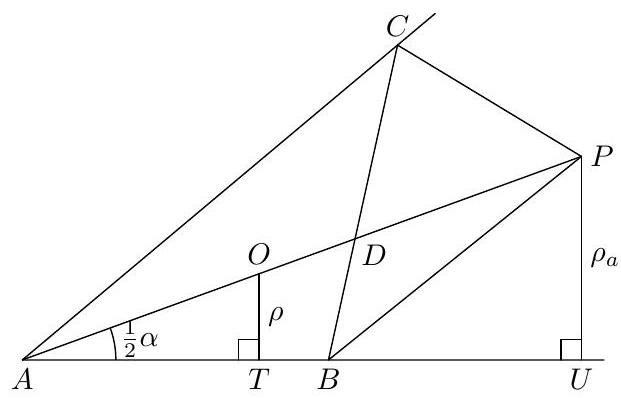
Fig. 2
On the other hand, the area $S$ is the sum of the areas of $A B D$ and $A C D$, and we can calculate these using the lengths of their sides from $A$ and the angle by $A$, which is in both triangles $\frac{1}{2} \alpha$.
$$
S=S_{A B D}+S_{A C D}=\frac{c|A D| \sin \frac{1}{2} \alpha}{2}+\frac{b|A D| \sin \frac{1}{2} \alpha}{2}=\frac{(b+c)|A D| \sin \frac{1}{2} \alpha}{2}
$$
And we get
$$
\frac{2}{|A D|}=\frac{(b+c) \sin \frac{1}{2} \alpha}{S}
$$
Thus the LHS and the RHS have the same value which finishes the proof.
Let us remark that using $S=\frac{1}{2} b c \sin \alpha=b c \sin \frac{1}{2} \alpha \cos \frac{1}{2} \alpha$ we can extend the equality in question as
$$
\frac{2}{|A D|}=\frac{1}{|A O|}+\frac{1}{|A P|}=\frac{b+c}{b c \cos \frac{1}{2} \alpha}
$$
## Final Round of the 59th Czech and Slovak Mathematical Olympiad
(March 22-23, 2010)

1. Find all positive integers $a$ a $b$, such that
$$
4^{a}+4 a^{2}+4=b^{2} \text {. }
$$
Solution. The equation implies, that $b^{2}$ is even and greater than $4^{a}$, which means that $b$ is even and greater than $2^{a}$, that is $b \geqslant 2^{a}+2$, and
$$
4^{a}+4 a^{2}+4=b^{2} \geqslant\left(2^{a}+2\right)^{2}=4^{a}+4 \cdot 2^{a}+4 .
$$
which gives $a^{2} \geqslant 2^{a}$, and consequently $a \leqslant 4$.
Substituting the possible values $a=1,2,3,4$ to the original equation we find out solutions $(a, b)=(2,6)$ and $(a, b)=(4,18)$.
2. Nineteen shots hit the circular target with the radius $12 \mathrm{~cm}$. Prove, that there are two hits separated by a distance smaller than $7 \mathrm{~cm}$.
Solution. Let $r=4 \sqrt{3} \mathrm{~cm}$ and we divide the whole target (of radius $r \sqrt{3}$ ) into 18 disjoint parts. The first six parts are circular sectors with central angle $60^{\circ}$, which together form the circle of radius $r$ in the center of the target. Then we divide the remaining annulus into twelve equal annular sectors with central angle $30^{\circ}$ (Fig. 1).

Fig. 1
According to the picture, let us denote as $S$ the center of the target, and $A, B$, $C$ the vertices of the annular segments.
Since the circles bordering the annular segments have radii $r$ and $r \sqrt{3}$, and since $\cos 30^{\circ}=\frac{1}{2} \sqrt{3}$, the triangle $S A C$ is isosceles, and thus $|A C|=r$; moreover $A C$ is the longest side in the triangle $A B C$, which has inner angles $45^{\circ}, 75^{\circ}$, and $60^{\circ}$. That's why the maximal distance of two points lying in the same annular sector is $r$, which is the maximal distance of two points in one of the six sectors of the radii $r$ as well. The pigeonhole principle gives us, that there are two hits in the same part, that is their distance is at most $r=4 \sqrt{3}<7$.
Remark. Let us consider the statement: From $N$ points inside the circle of radius $r \sqrt{3}$, some two of them are separated by a distance at most $r$.
If we want to prove such a statement by comparing the sum of areas of $N$ equal circles of radius $r$ with the area of the circle of radius $r(1+2 \sqrt{3})$, we succeed, if and only if
$$
N \cdot \frac{\pi r^{2}}{4}>\frac{\pi r^{2}(1+2 \sqrt{3})^{2}}{4} \quad \text { or } \quad N>13+4 \sqrt{3} \doteq 19,9
$$
In the given problem, there is even stronger estimate of the distance of two points, namely $r_{1}=r \cdot \frac{7}{4 \sqrt{3}}$, and the similar condition gives
$N \cdot \frac{\pi r_{1}^{2}}{4}>\frac{\pi\left(r_{1}+2 r \sqrt{3}\right)^{2}}{4}$, after substitution $\quad N>\left(1+\frac{24}{7}\right)^{2} \doteq 19,6$.
That is we cannot prove the given problem with this "naive" approach.
3. A wizard kidnapped 31 members of the political party $A, 28$ members of the party $B$, 23 members of the party $C$, and 19 members of the party $D$ and kept them separately in single cells on his castle and made them to do some work. Each day after the work the party members could walk on the courtyard and talk to each other. But when three members of different parties started to talk to each other, the wizard re-registered them into the fourth party. (More than 3 kidnapped party members never talked to each other)
a) Is it possible, that after some time all the kidnapped people were members of one political party? Which one?
b) Find all the quadruples of positive integers with the sum 101 which admit, considered as numbers of kidnapped party members, that after some time they become, with the "help" of the wizard, the members of a single party.
Solution. a) Let $a, b, c$, and $d$ be the numbers of the kidnapped members of parties $A, B, C$, and $D$. The initial quadruple $(a, b, c, d)=(31,28,23,19)$ is according to the parity of the numbers of type $(o, e, o, o)$, where $o$ stands for odd, and $e$ for an even integer. Since the parity of all the numbers $a, b, c$, and $d$ changes in any reregistration, the quadruple of type $(o, e, o, o)$ becomes the quadruple of type $(e, o, e, e)$, this one then again changes the type to $(o, e, o, o)$ and so forth. If we get after some time the quadruple consisting of 101 and three zeros, the quadruple has to be of type $(e, o, e, e)$, that is all the kidnapped will be the members of the party $\mathrm{B}$, and the following table of changes shows, that this is really possible:
| $a:$ | 31 | 30 | 29 | 28 | 27 | 26 | 25 | 24 | 23 | 22 | $\ldots$ | 0 |
| :--- | :---: | :---: | :---: | :---: | :---: | :---: | :---: | :---: | :---: | :---: | :---: | :---: |
| $b:$ | 28 | 27 | 26 | 25 | 24 | 23 | 26 | 29 | 32 | 35 | $\ldots$ | 101 |
| $c:$ | 23 | 22 | 25 | 24 | 27 | 26 | 25 | 24 | 23 | 22 | $\ldots$ | 0 |
| $d:$ | 19 | 22 | 21 | 24 | 23 | 26 | 25 | 24 | 23 | 22 | $\ldots$ | 0 |
b) We show, that the sought quadruples $(a, b, c, d)$ are those, which contain three numbers which are the same modulo 4.
The equality $a+b+c+d=101$ implies that three of $a, b, c, d$ have the same parity and the fourth one the opposite one. Because of the symmetry we can suppose that we have
$$
a \equiv b \equiv c \not \equiv d \quad(\bmod 2)
$$
for the original quadruple. In any re-registration three of the numbers $a, b, c$, and $d$ increase by 3 , and the fourth one decreases by 1 , that is the differences $a-b, a-c$, $b-c$ remain the same modulo 4 . If in the end $a=b=c=0$, than the said differences have to be divisible by 4 already at the beginning, that is
$$
a \equiv b \equiv c \quad(\bmod 4)
$$
for the original $a, b$, and $c$.
Let us show that this condition is sufficient as well. Obviously it is enough to show, that the original quadruple $(a, b, c, d)$ satisfying the condition (1) can be after some steps (re-registrations) changed to the quadruple of the form $(e, e, e, f)$. Namely, after that it suffices to repeat the step $(e, e, e, f) \rightarrow(e-1, e-1, e-1, f+3)$.
Now, let $(a, b, c, d)$ be a quadruple with the sum 101, which fulfills the condition (1), and let us further suppose that $a=b=c$ does not hold true. We show, which steps to use to increase the value of $d$ (by 1 or 2 ). Since $d \leqslant 101$ always, those steps can be applied only finitely many times until $a=b=c$.
It is sufficient to describe the steps in case $a \geqslant b \geqslant c$ and $a>c$, which is $a-c \geqslant 4$ because of (1). ${ }^{1}$ Two changes
$$
(a, b, c, d) \rightarrow(a-1, b-1, c+3, d-1) \rightarrow(a-2, b-2, c+2, d+2),
$$
enlarge $d$ by 2 . These two steps cannot be taken only if $b=1$, but then (1) and $b \geqslant c$ imply $c=1$. A quadruple $(a, 1,1, d)$, where $a \geqslant 5$ and $d \geqslant 2$ (it cannot be $d=1$, because of the parity reason) can be transformed by the following three steps:
$$
(a, 1,1, d) \rightarrow(a-1,4,0, d-1) \rightarrow(a-2,3,3, d-2) \rightarrow(a-3,2,2, d+1),
$$
which increase $d$ by 1 .
This finishes the proof of the statement about satisfactory quadruples.
4. We are given a circle $k$ with a chord $A C$, which is not a diameter. On its tangent through $A$ we choose a point $X \neq A$ and let $D$ be the intersection point of $k$ with the interior of the segment $X C$ (if it exists). We complete the triangle $A C D$ into the trapezoid $A B C D$ inscribed into $k$. Determine the set of intersection points of lines $B C$ and $A D$ of such trapezoids.
Solution. Let us further consider only such trapezoids $A B C D$, where $A B \| C D$ (there is no intersection of lines $B C$ and $A D$ if $B C \| A D$ ).[^0]
Let $O$ be a center of circle $k, E$ the intersection of its tangents through $A$ and $C$ (Fig. 2). According to Thales, $A$ and $C$ lie on the circle $\tau$ with the diameter $O E$, moreover they are symmetric with respect to that diameter. We denote by $\phi$ the angles by $A$ and $C$ in the triangle $A C E$, and further let $k_{1}$ and $k_{2}$ be the interiors of longer and shorter arc $A C$ of the circle $k$ respectively.

Fig. 2

Fig. 3
a) Let $X$ be any point on the tangent $A E, X \neq A$. The circle $k$ meets the segment $X C$ in an inner point $D$, if and only if $X$ lies in the interior of $A E$, or in the interior of the half-line opposite to the half-line $A E$. We deal with these cases (Fig. 2 and Fig. 3) separately.
In the first case $D \in k_{1}$ and $B \in k_{2}$, and $\phi$ and acute angle $A B C$ are the same ( $A B C$ is inscribed angle into $k_{2}$ subtending the arc $A C, \phi$ is the tangent-chord angle corresponding to the chord $A C$ ). Moreover the angle $B A D$ is the same as well, because every inscribed trapezoid is isosceles. Thus $Y$, the intersection of half-lines $B C$ and $A D$, lies in the half-plane $A C E$. Triangles $A B Y$ and $A C E$ are isosceles, thus the angles $A Y C$ and $A E C$ are the same $(\pi-2 \phi)$, and $Y$ is on the arc $A E C$ of $\tau$. More precisely, $Y$ is inside the the shorter $\operatorname{arc} C E$, because $A D$ lies in the angle $C A E$.
The second case is analogous, we write it down briefly: $D \in k_{2}, B \in k_{1}$, $|\angle A D C|=\phi=|\angle B C D|$, the intersection $Y$ of the half-lines $C B$ and $D A$ lies in the half-plane $A C E$, and since $|\angle A Y C|=|\angle A E C|, Y$ lies on $\tau$, inside the shorter arc $A E$.
b) Now we show, that any point $Y$ inside the shorter $\operatorname{arcs} C E$ and $A E$ of $\tau$ is the intersection of $B C$ and $A D$ of some of the thought trapezoids $A B C D$. As before, there are two cases.
If $Y$ lies inside the arc $C E$, obviously there are points $D \in k_{1}$ and $B \in k_{2}$ such that $A, D$, and $Y$ lie on a line respectively, as well as $B, C$, and $Y$. Now $D \in k_{1}$
and therefore there is an intersection $X$ of the half-line $C D$ with the interior of the segment $A E$ ( $D$ corresponds to $X$ according to the construction from the statement of the problem). Now we explain why $A B \| C D$. Since $O$ and $Y$ lie on different arcs $A C$ of $\tau$ and $|A O|=|C O|$, the half-line $Y O$ is the bisector of the angle $A Y C$, and $A(D) Y$ a $B(C) Y$ are symmetric along the line $Y O$, which is a line of symmetry of the circle $k$, because it goes through its center. Thats why the intersections of lines $A(D) Y$ a $B(C) Y$ with $k$, have to be symmetric along $Y O$ as well, that is $A$ and $B$, and further $D$ and $C$ are symmetric. Thus $A B$ and $C D$ are perpendicular to $Y O$, and consequently parallel.
If $Y$ is inside the arc $A E$, we construct $D \in k_{2}$ and $B \in k_{1}$ in such a way, to have $D, A$, and $Y$ on a line respectively, and $C, B$, and $Y$ on a line respectively as well. The half-line $C D$ meets the half-line $A E$ in the desired point $X$ (since $D \neq A$, we have $X \neq A$ ), if $|\angle A E C|+|\angle E C D|<\pi$. This is really the case. Since $|\angle E C D|=\pi-|\angle C A D|=|\angle C A Y|$ according to the inscribed angle theorem, and since $|\angle A E C|=|\angle A Y C|$, the sum $|\angle A E C|+|\angle E C D|$ is equal to the sum of two inner angles of the triangle $A C Y$. Further $D(A) Y$ and $C(B) Y$ are symmetric along $O Y$, the bisector of $A Y C$, and we have $A B \| C D$ again.
Conclusion. The set in question is the union of interiors of shorter $\operatorname{arcs} C E$ and $A E$ of the circle $\tau$.
5. There are numbers 1, 2, .. , 33 written on a blackboard. In one step we choose two numbers on the blackboard such that their product is a square, we erase the two numbers and write their square root instead. We proceed in this manner until no product of any two numbers on the blackboard is a square. Prove, that there are at least 16 numbers left on the blackboard.
Solution. In one step we replace numbers $a$ and $b$ with one positive integer $\sqrt{a b}$. Since $a \leqslant b$ gives $a \leqslant \sqrt{a b} \leqslant b$, it is obvious that only numbers from the set $M=$ $\{1,2, \ldots, 33\}$ can be on the table. If $a$ is prime or a product of different primes, those primes have to be present in the prime factorization of $\sqrt{a b}$, which is $\sqrt{a b}=k a$ and $b=k^{2} a$ for some positive integer $k$. If $k=1$, there must be multiple occurrence of $a$ on the table. If $k \geqslant 2$, that is $b=k^{2} a \geqslant 4 a$, we have $4 a \leqslant 33$, and $4 a \in M$. Summing up, on the table there are always numbers which divide exactly one number from $M$, and also those $a \in M$, which are the product of different primes and satisfy $4 a>33$ which is $a \geqslant 9$. Thus we have showed, there are 15 numbers, which have to be on the blackboard:
$$
10,11,13,14,15,17,19,21,22,23,26,29,30,31,33 .
$$
We show, that beside them there is always at least one more number from the set $S=\{6,12,18,24\}$ there (there are all of them there at the beginning). If we choose $a$ and $b$ in one step, where $a \in S$, and replace them with $n=\sqrt{a b}$, then $n$ is a multiple of 6 , and since $a \leqslant 24$ and $b \leqslant 33$ we have $n \leqslant \sqrt{24 \cdot 33}=6 \sqrt{22}<30$, that is $n \in S$. All together there are always 15 numbers (mentioned above) on the blackboard and one number from $S$, which finishes the prove.
Remark. Those 16 numbers are really achievable, for example with the following
17 steps (the erased numbers are grey, the new one is at the end of the next line):
$$
\begin{gathered}
1,2,3,4,5,6,7,8,9,10,11,12,13,14,15,16,17,18,19,20,21,22,23,24,25,26,27,28,29,30,31,32,33 ; \\
1,2,3,4,5,6,8,9,10,11,12,13,14,15,16,17,18,19,20,21,22,23,24,25,26,27,29,30,31,32,33,14 ; \\
1,2,3,4,5,6,8,9,10,11,12,13,15,16,17,18,19,20,21,22,23,24,25,26,27,29,30,31,32,33,14 ; \\
1,2,3,4,6,8,9,10,11,12,13,15,16,17,18,19,21,22,23,24,25,26,27,29,30,31,32,33,14,10 ; \\
1,2,3,6,8,9,10,11,12,13,15,16,17,18,19,21,22,23,24,26,27,29,30,31,32,33,14,10,10 ; \\
1,2,3,6,8,9,11,12,13,15,16,17,18,19,21,22,23,24,26,27,29,30,31,32,33,14,10,10 ; \\
1,2,3,6,8,9,11,12,13,15,16,17,18,19,21,22,23,24,26,27,29,30,31,32,33,14,10 ; \\
1,2,3,6,8,9,11,13,15,16,17,18,19,21,22,23,24,26,29,30,31,32,33,14,10,18 ; \\
1,2,3,8,9,11,13,15,16,17,18,19,21,22,23,26,29,30,31,32,33,14,10,18,12 ; \\
1,2,3,8,9,11,13,15,16,17,19,21,22,23,26,29,30,31,32,33,14,10,12,18 ; \\
1,3,8,9,11,13,15,16,17,19,21,22,23,26,29,30,31,32,33,14,10,12,6 ; \\
1,3,9,11,13,15,16,17,19,21,22,23,26,29,30,31,33,14,10,12,6,16 ; \\
1,3,9,11,13,15,17,19,21,22,23,26,29,30,31,33,14,10,12,6,16 ; \\
3,9,11,13,15,17,19,21,22,23,26,29,30,31,33,14,10,12,6,4 ; \\
9,11,13,15,17,19,21,22,23,26,29,30,31,33,14,10,6,4,6 ; \\
11,13,15,17,19,21,22,23,26,29,30,31,33,14,10,6,6,6 ; \\
11,13,15,17,19,21,22,23,26,29,30,31,33,14,10,6,6 ; \\
11,13,15,17,19,21,22,23,26,29,30,31,33,14,10,6
\end{gathered}
$$
6. Find the minimum value of
$$
\frac{a+b+c}{2}-\frac{[a, b]+[b, c]+[c, a]}{a+b+c}
$$
where $a, b, c$ are integers grater than 1 and $[x, y]$ denotes the least common multiple of $x$ and $y$.
Solution. Because of the symmetry it suffices to work with $(a, b, c)$, where $a \geqslant b \geqslant c$. For the "least" of them, that is for $(2,2,2),(3,2,2),(3,3,2),(3,3,3)$, and $(4,2,2)$ the expression in question has values $2,3 / 2,17 / 8,7 / 2$, and $11 / 4$ respectively.
We show that $3 / 2$ is the minimal value, namely we show that $(a, b, c)$, which satisfy $a+b+c \geqslant 9$, also fulfill
$$
\frac{a+b+c}{2}-\frac{[a, b]+[b, c]+[c, a]}{a+b+c} \geqslant \frac{3}{2}
$$
We change the inequality equivalently:
$$
\begin{aligned}
& (a+b+c)^{2}-2([a, b]+[b, c]+[c, a]) \geqslant 3(a+b+c), \\
& a^{2}+b^{2}+c^{2}+2(a b-[a, b])+2(b c-[b, c])+2(c a-[c, a]) \geqslant 3(a+b+c) .
\end{aligned}
$$
Since $x y \geqslant[x, y]$ for any $x, y$, we neglect the non-negative multiples on the left hand side and we prove the (stronger) inequality
$$
a^{2}+b^{2}+c^{2} \geqslant 3(a+b+c) .
$$
The assumption $a+b+c \geqslant 9$ and Cauchy inequality $3\left(a^{2}+b^{2}+c^{2}\right) \geqslant(a+b+c)^{2}$ gives
$$
a^{2}+b^{2}+c^{2} \geqslant \frac{(a+b+c)^{2}}{3}=3(a+b+c) \cdot \frac{a+b+c}{9} \geqslant 3(a+b+c)
$$
which concludes the prove.
[^0]: 1 Let us point out that we do not exclude $c=0$. This is vital, because we end up with such a quadruple if the wizard uses two steps described further for $b=2$.