60th Czech and Slovak
Mathematical Olympiad
Edited by
Karel Horák
Translated into English by
Martin Panák
## First Round of the 60th Czech and Slovak Mathematical Olympiad Problems for the take-home part (October 2010)

1. The four real solutions of the equation
$$
a x^{4}+b x^{2}+a=1
$$
form an increasing arithmetic progression. One of the solutions is also a solution of
$$
b x^{2}+a x+a=1 .
$$
Find all possible values of real parameters $a$ and $b$.
(Peter Novotný)
Solution. According to the statement of the problem, the first equation has four distinct solutions, that is $a \neq 0$.
Let $x_{0}$ be the common solution of the equations. Then $x_{0}$ solves the difference of the equations as well, which gives $a x_{0}^{4}-a x_{0}=0$, or $a x_{0}\left(x_{0}^{3}-1\right)=0$. The common solution thus has to be either 0 or 1 .
Substituting $x_{0}=0$ into the first equation gives $a=1$, but the equation $x^{4}+b x^{2}=0$ has the solution 0 with the multiplicity at least two, thus it cannot be $x_{0}=0$.
The common solution therefore is $x_{0}=1$. Substituting this into any of the equations we obtain $b=1-a$ and we can rewrite the first equation as $a x^{4}-(1-2 a) x^{2}+$ $a-1=0$ and we can easily see, that -1 is a solution as well and we have
$$
(x-1)(x+1)\left(a x^{2}-a+1\right)=0 .
$$
The quadratic equation $a x^{2}-(a-1)$ should have two different real solutions, mutually opposite numbers $\xi$ and $-\xi$, which is the case for $a>1$ or $a<0$. If we choose $\xi>0$, then if $0<\xi<1$, then the arithmetic progression should be $-1,-\xi, \xi, 1$, and obviously $\xi=\frac{1}{3}$. Number $\frac{1}{3}$ is a solution of (1) if and only if $a=1 /\left(1-\xi^{2}\right)=\frac{9}{8}$, consequently $b=1-2 a=-\frac{5}{4}$.
If $\xi>1$, then the arithmetic progression should be $-\xi,-1,1, \xi$, which gives $\xi=3$. And 3 is a solution of (1), if and only if $a=1 /\left(1-3^{2}\right)=-\frac{1}{8}$, which gives $b=1-2 a=\frac{5}{4}$.
Conclusion. There are two pairs of solutions:
$$
(a, b) \in\left\{\left(-\frac{1}{8}, \frac{5}{4}\right),\left(\frac{9}{8},-\frac{5}{4}\right)\right\}
$$
2. Let $k, n$ be positive integers. Adam thinks, that if $k$ divides $(n-1)(n+1)$, then $k$ divides either $n-1$, or $n+1$. Find all $k$ for which the Adam's conclusion is correct for any $n$.
(Ján Mazák)
Solution. Let us begin with a
Lemma. Let $r>2$ and $s>2$ be relatively prime positive integers. Denote $k=r s$. There exists $n_{k}$ such that
$$
r \mid n_{k}-1 \quad \text { and } \quad s \mid n_{k}+1
$$
Proof. Consider $s$ numbers
$$
2, r+2,2 r+2, \ldots,(s-1) r+2 \text {. }
$$
which are pairwise non-congruent modulo $s$, and thus they form the complete residue set system modulo $s$. One of them, say $l r+2$, is therefore divisible by $s$. Then we let $n_{k}$ be $l r+1$.
The lemma shows that the sought $k$ s cannot be written as a product of two relatively prime numbers greater than 2 . Namely if $k=r s, r>2, s>2$ relatively prime, we choose $n=n_{k}$ and for this pair of numbers $k$ and $n$ is Adam wrong: then $k$ divides $(n-1)(n+1)$, but $k$ does not divide $n-1$ (since $s$ divides $n+1$ and $s>2$, $s$ does not divide $n-1$, thus neither does $k$ ) and analogously $k$ does not divide $n+1$.
Now any positive integer divisible by two odd primes can be written as a product of two relatively prime numbers greater than 2 . Thus the sought $k \mathrm{~s}$ have to be one of the following forms:
$$
k=2^{s}, \quad k=p^{t}, \quad k=2 p^{t},
$$
where $p$ is prime, $s$ non-negative integer, and $t$ positive integer.
If $k=2^{s}, s$ is positive integer, then $k=1$ and $k=2$ obviously do not comply. But $k=2^{2}=4$ is a solution: if 4 divides $(n-1)(n+1)$, then the factors are successive even numbers and thus just one of them is divisible by 4 . For $s \geqslant 3$ consider $n=2^{s-1}-1$ which proves Adam wrong.
Simple considerations show that $k=p^{t}$ and $k=2 p^{t}$ are solutions. Conclusion. The solutions of the problem are
$$
k=4, \quad k=p^{t}, \quad k=2 p^{t},
$$
where $p$ is odd prime and $t$ positive integer.
3. Circles $k$ and $l$ meet at points $A$ and $B$, a tangent touches the circles in $K$ and $L$ in such a way, that $B$ is inside the triangle $A K L$. Finally let us choose $N$ and $M$ on $k$ and respectively in such a way, that $A$ is inside $M N$. Prove, that the quadrilateral $K L M N$ is cyclic if and only if the line $M N$ is tangent to the circumcircle of $A K L$. (Jaroslav Švrček)
Solution. The tangent-chord theorem in $k$ implies $\angle K N A=\angle L K A$ and similarly we get $\angle V L M=\angle L A M$ in $l$, where $V$ is a point on the half-line opposite to the half-line $L K$ (Fig. 1).

Fig. 1
The quadrilateral $K L M N$ is cyclic if and only if $\angle K N A=\angle V L M$ or $\angle L K A=$ $\angle L A M$. According to the tangent-chord theorem this holds if and only if $M N$ is tangent to the circumcircle of $A K L$. The proof is finished.
4. There are $6 n$ chips which differ only in color, three pieces of each of $2 n$ colors. For any integer $n>1$ find the number $p_{n}$ of all partitions of these 6 n chips into two piles with $3 n$ chips each, such that no three same colored chips are in the same pile. Show, that $p_{n}$ is odd if and only if $n=2^{k}$ for some positive integer $k$.
(Jaromír Šimša)
Solution. No three chips of the same color should be in the same pile means, that there is at least one chip of any color in each of the two piles. Each described partition is thus given by the distribution of $2 n$ chips of each of $2 n$ colors into two piles of $n$ chips. Together we have
$$
p_{n}=\frac{1}{2}\left(\begin{array}{c}
2 n \\
n
\end{array}\right)=\frac{(2 n) !}{2(n !)^{2}}=\frac{2 n \cdot(2 n-1) !}{2 n \cdot(n-1) ! n !}=\left(\begin{array}{c}
2 n-1 \\
n
\end{array}\right)
$$
Further we show that $\left(\begin{array}{c}2 n-1 \\ n\end{array}\right)$ is odd if and only if $n$ is a power of 2 . This can be actually easily seen from the Pascal triangle (modulo 2):

Recall, that the (combinatorial) numbers in the triangle are given by the (recurrence) formulas
$$
\left(\begin{array}{l}
n \\
0
\end{array}\right)=\left(\begin{array}{l}
n \\
n
\end{array}\right)=1 \quad \text { and } \quad\left(\begin{array}{c}
n \\
i
\end{array}\right)=\left(\begin{array}{c}
n-1 \\
i-1
\end{array}\right)+\left(\begin{array}{c}
n-1 \\
i
\end{array}\right) \quad(1 \leqslant i \leqslant n-1)
$$
and we can consider these formulas modulo any positive integer, we did modulo 2 .
Notice that some of the rows (in the frame) contain only 1s. Let us call them framed rows. Because of the formulas (2) there is a triangle consisting of zeroes with 1s on the edges. The places in the triangle corresponding to the numbers $\left(\begin{array}{c}2 n-1 \\ n\end{array}\right)$ (circled ones) contain number 1 if and only if they lie in the framed row.
Let us prove this observation rigorously. First we prove by induction (over $k$ ): The rows containing only number 1 are just the rows corresponding to the numbers $\left(\begin{array}{c}n-1 \\ i\end{array}\right)(0 \leqslant i \leqslant n-1)$, where $n$ is of the form $n=2^{k}$. It holds for $k=1(n=1,2)$ trivially. Let us assume that the statement is true for all $n \leqslant 2^{k}$. Denote by $P_{n}$ the first $n=2^{k}$ rows of the scheme. Then the next $n$ rows are formed by three equilateral triangles: the first and the third one have exactly the same size and orientation as $P_{n}$, the second one is "upside-down", with $n-1$ rows, and because of the 1 s in the base of $P_{n}$ and the formulas (2) it is formed only by zeros. This is also why the first and third triangle have 1s not only in the top vertex but on the sides next to the second triangle. But from the definition of the Pascal triangle, the first and the third triangles have 1 s also on the outer sides. But then the recurrence formulas (2) guarantee, that the first and the third triangles are the exactly the same as the triangle $P_{n}$. That means that any row from $n+1$ to $2 n-1$ contains at least one zero (induction hypothesis) and the row $2 n$ contains only 1 s (it consists of the bottom sides of the first and the third triangle which are the same as the bottom side of $P_{n}$ ). The statement is true for all $n \leqslant 2^{k+1}$.
Now it is enough to notice that $p_{n}=\left(\begin{array}{c}2 n-1 \\ n\end{array}\right)=\left(\begin{array}{c}2 n-1 \\ n-1\end{array}\right)$ lies always in the middle of the even rows of the Pascal triangle, that is either in some gray triangle (see picture) or in the line of $1 \mathrm{~s}$, which finishes the proof.
Another solution. Alternatively, to prove the second statement of the problem about $p_{n}$, we write
$$
\begin{aligned}
p_{n} & =1 \cdot 3 \cdot \ldots \cdot(2 n-1) \cdot \frac{2 \cdot 4 \cdot \ldots \cdot(2 n-2)(2 n)}{2(n !)^{2}}=1 \cdot 3 \cdot \ldots \cdot(2 n-1) \cdot \frac{2^{n} n !}{2(n !)^{2}} \\
& =1 \cdot 3 \cdot \ldots \cdot(2 n-1) \cdot \frac{2^{n-1}}{n !} .
\end{aligned}
$$
The greatest integer $a$ such that $2^{a}$ divides $n$ ! is
$$
a=\left\lfloor\frac{n}{2}\right\rfloor+\left\lfloor\frac{n}{2^{2}}\right\rfloor+\cdots+\left\lfloor\frac{n}{2^{m}}\right\rfloor
$$
where $2^{m} \leqslant n<2^{m+1}$. Thus we have the estimate:
$$
a \leqslant \frac{n}{2}+\frac{n}{2^{2}}+\cdots+\frac{n}{2^{m}}=n\left(1-\frac{1}{2^{m}}\right)=n-\frac{n}{2^{m}} \leqslant n-1 .
$$
And from (3) follows that $p_{n}$ is odd if and only if $a=n-1$, that is $n$ is of the form $2^{m}$.
5. There are written six numbers on a cube, one on each face. In a move we choose any two adjacent faces and we increase the numbers written on them by one. Find the necessary and sufficient condition for the numbering of the cube, such that after finite number of moves we can end up with the cube with the same number on each of its faces.
(Peter Novotný)
Solution. The sum of the numbers on the cube increases by 2 in each move. If we end up with the cube with the same numbers, their sum is divisible by 6 , in particular it is even. The condition, that the sum of the numbers on the cube have to be even is thus necessary and we will show, it is sufficient as well. Let us have a cube satisfying the condition and denote its faces by $S_{1}, S_{2}, \ldots, S_{6}$, where $S_{1}$ is opposite to $S_{6}$, and $S_{2}$ opposite to $S_{5} \cdot{ }^{1}$ Let $k_{i j}$ be the move increasing the numbers on faces $S_{i}$ and $S_{j}$. We are rather interested in the difference between the numbers on the cube, than in the absolute value of the numbers. Therefore we will work with the differences of the numbers from the smallest number on the cube (which is a set of non-negative integers containing 0 ).
The sequence $k_{12}, k_{23}, k_{35}, k_{54}, k_{41}$ increases each number on the cube by 2 , except the number on $S_{6}$, which is actually equivalent to decreasing the number on $S_{6}$ by two (in the speech of differences). Analogously we can decrease any number on the cube and make all the numbers on the cube either 1 or 0 (but 0 has to be present).
Now we deal with following cases (remember the sum of the numbers has to be even):
a) There are only 0 on the faces. We are done.
b) There are exactly two $1 \mathrm{~s}$ on the faces. Regardless of the fact, whether the $1 \mathrm{~s}$ are on the adjacent or opposite faces, we can always split the faces with zeros into two pairs of adjacent faces and in two moves we even up all the numbers on the cube.
c) There are exactly four $1 \mathrm{~s}$ on the faces. We decrease each of the 0 s by two (with the sequence $\left.k_{12}, k_{23}, k_{35}, k_{54}\right)$ and we are in the situation of $\mathrm{b}$ ).
Conclusion. We can even up all the numbers on the cube if and only if their sum is even.
6. Prove
$$
\left(a^{2}+b^{2}\right) \cos (\alpha-\beta) \leqslant 2 a b
$$
in any triangle $A B C$ with an acute angle at $C$. When does the equality hold?
(Jaromír Šimša)
Solution. If $a=b$, then the equality holds trivially. Since the inequality is symmetric in $a$ and $b$ (cosine is an even function), we can assume $a>b$ or $\alpha>\beta$ without loss of generality.
Now since $\alpha>\beta$, we can find $D \in B C$ such that $\angle C A D=\beta$ and $\angle D A B=\alpha-\beta$. (see Fig. 2). The triangle $D A C$ is similar to $A B C$ with the coefficient of similarity $b: a$, therefore $|A D|=b c / a$ and $|D C|=b^{2} / a$, it follows $|B D|=|B C|-|D C|=\left(a^{2}-b^{2}\right) / a$.[^0]
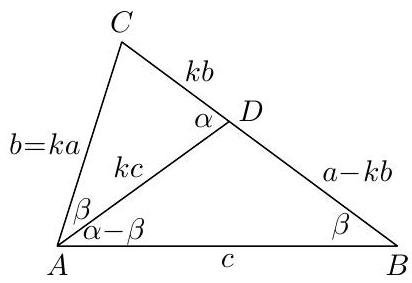
Fig. 2
We substitute these for $|A D|$ and $|B D|$ into the cosine formula for the triangle $A B D:$
$$
\begin{gathered}
|B D|^{2}=|A B|^{2}+|A D|^{2}-2|A B| \cdot|A D| \cos (\alpha-\beta) \\
\frac{\left(a^{2}-b^{2}\right)^{2}}{a^{2}}=c^{2}+\frac{b^{2} c^{2}}{a^{2}}-\frac{2 b c^{2} \cos (\alpha-\beta)}{a} \\
\left(a^{2}-b^{2}\right)^{2}=\delta \cdot c^{2}, \quad \text { where } \delta=a^{2}+b^{2}-2 a b \cos (\alpha-\beta)>0 .
\end{gathered}
$$
(The last inequality follows from the fact, that for $\alpha \neq \beta$ we have $\cos (\alpha-\beta)<1$.) Let $\Delta$ be the difference of the right and left hand side of the given inequality. Then using the relation (1) together with the equality $c^{2}=a^{2}+b^{2}-2 a b \cos \gamma$ we get
$$
\begin{aligned}
2 a b \Delta & =2 a b\left(2 a b-\left(a^{2}+b^{2}\right) \cos (\alpha-\beta)\right)=4 a^{2} b^{2}-\left(a^{2}+b^{2}\right) \cdot 2 a b \cos (\alpha-\beta) \\
& =4 a^{2} b^{2}-\left(a^{2}+b^{2}\right)\left(a^{2}+b^{2}-\delta\right)=\delta\left(a^{2}+b^{2}\right)-\left(a^{2}-b^{2}\right)^{2} \\
& =\delta\left(a^{2}+b^{2}\right)-\delta \cdot c^{2}=\delta\left(a^{2}+b^{2}-c^{2}\right)=\delta \cdot 2 a b \cos \gamma .
\end{aligned}
$$
If we divide by $2 a b$ we get $\Delta=\delta \cos \gamma$, and since $\delta>0$ and $0<\cos \gamma<1$ for $0<\gamma<90^{\circ}$ (recall we assume $a \neq b$ ) we have $\Delta>0$. Thus if $\gamma<90^{\circ}$ and $a \neq b$ we have the strong inequality. The given inequality is proven and the equality holds if and only if $a=b$.
1. Find all real $c$ such that the equation $x^{2}+\frac{5}{2} x+c=0$ has two real solutions which can be together with $c$ arranged into a three-member arithmetic sequence.
(Pavel Calábek, Jaroslav Švrček)
Solution. Let $c$ meets the criteria of the problem. Let us denote by $d$ the difference of the corresponding arithmetic sequence, and by $x_{1}, x_{2}$ the solutions of the equation.
a) If $c$ is a middle term of the arithmetic sequence, then $x_{1}=c-d$ and $x_{2}=c+d$. Further Monsieur Viète says $-\frac{5}{2}=x_{1}+x_{2}=2 c$, that is $c=-\frac{5}{4}$. Moreover for any negative $c$ the equation has two real solutions (especially for $c=-\frac{5}{4}$ we have $x_{1,2}=-\frac{5}{4} \pm \frac{3}{4} \sqrt{5}$ ).
b) If $c$ is the first or the last member of the sequence we have (in an appropriate notation of the solutions of the equation) $x_{1}=c+d, x_{2}=c+2 d$. Thus we get $-\frac{5}{2}=x_{1}+x_{2}=2 c+3 d$, which gives $d=-\frac{5}{6}-\frac{2}{3} c$ and substituting into $x_{1}=c+d$ and $x_{2}=c+2 d$ we get $x_{1}=\frac{1}{6}(2 c-5)$ and $x_{2}=-\frac{1}{3}(c+5)$. Monsieur helps again, since $x_{1} x_{2}=c$ and we get $2 c^{2}+23 c-25=0$, with solutions 1 and $-\frac{25}{2}$. (If $c=1$ the solutions are $x_{1}=-\frac{1}{2}, x_{2}=-2$; if $c=-\frac{25}{2}$ the solutions are $x_{1}=-5, x_{2}=\frac{5}{2}$.)
Conclusion. The conditions of the problem are met for $c \in\left\{-\frac{25}{2} ;-\frac{5}{4} ; 1\right\}$.
2. Let $P, Q, R$ are the points of the hypotenuse $A B$ of the right triangle $A B C$, with $|A P|=|P Q|=|Q R|=|R B|=\frac{1}{4}|A B|$. Prove that the intersection $M$ of circumcircles of $A P C$ and of $B R C$ (other than $C$ ) is the middle of $C Q$.
(Peter Novotný)
Solution. Let $M^{\prime}$ be the middle of $C Q$ (see Fig. 1). Since $P M^{\prime}$ and $R M^{\prime}$ are the midsegments of $A Q C$ and $B Q C$ (these are moreover isosceles with bases $A C$, resp. $B C$, since $Q$ is the circumcenter of $A B C$ ) the quadrilaterals $C A P M^{\prime}$ and $C B R M^{\prime}$ are isosceles trapezoids and their circumcircles meet in $C$ and $M^{\prime}$. But the circumcircles are the circumcircles of $A P C$ and $B R C$ as well and we are done.

Fig. 1
3. Prove
$$
\left|\frac{p}{q}-\frac{q}{p}\right|>\frac{4}{\sqrt{p q}}
$$
for any two distinct primes $p, q$ greater than 2.
Solution. Since $p, q$ are different odd primes we have $|p-q| \geqslant 2$.
The left hand side of the equation reads as
$$
\text { LHS }=\left|\frac{p}{q}-\frac{q}{p}\right|=\left|\frac{p^{2}-q^{2}}{p q}\right|=\frac{|p-q| \cdot(p+q)}{p q} \geqslant \frac{2(p+q)}{p q} .
$$
To prove
$$
\text { LHS }>\frac{4}{\sqrt{p q}}
$$
it is sufficient to show $p+q>2 \sqrt{p q}$, but this is trivial.
\section*{Second Round of the 60th Czech and Slovak Mathematical Olympiad (January 18th, 2011)

1. Consider 8-digit multiples of 4. Is there more of those which contain the digit 1 or those which do not?
(Ján Mazák)
Solution. Let us compute the number of all 8-digit multiples of 4 first. There are 9 possibilities for the first digit of such a number, 10 possibilities for each of the next 5 digits, and such a number has to end with two digits being one of the: 00,04 , $08,12, \ldots, 96$. All together $u=9 \cdot 10^{5} \cdot 25=22500000$ eight-digit multiples of 4 . Similarly there is $v=8 \cdot 9^{5} \cdot 23=10865016$ eight-digit multiples of 4 , which do not contain the digit 1 .
Conclusion. Since $u>2 v$ there is more of 8-digit multiples of 4 which contain number 1 then those which do not.
Remark. It is not necessary to compute $u$ and $v$ to prove $u>2 v$ :
$$
\frac{u}{v}=\frac{9 \cdot 10^{5} \cdot 25}{8 \cdot 9^{5} \cdot 23}=\frac{9}{8} \cdot\left(\frac{10}{9}\right)^{5} \cdot \frac{25}{23}
$$
Using binomial theorem we get:
$$
\left(\frac{10}{9}\right)^{5}=\left(1+\frac{1}{9}\right)^{5}>1+5 \cdot \frac{1}{9}+10 \cdot \frac{1}{9^{2}}=\frac{136}{81}=\frac{8 \cdot 17}{9^{2}}
$$
thus
$$
\frac{u}{v}=\frac{9}{8} \cdot\left(\frac{10}{9}\right)^{5} \cdot \frac{25}{23}>\frac{9}{8} \cdot \frac{8 \cdot 17}{9^{2}} \cdot \frac{25}{23}=\frac{17 \cdot 25}{9 \cdot 23}=\frac{425}{207}>2 .
$$
2. We are given a triangle $A B C$ with the area $S$. Let us further choose a point $U$ inside the triangle with vertices in the midpoints of the sides of $A B C$. Let $A^{\prime}, B^{\prime}$, and $C^{\prime}$ respectively, be the inversions of $A, B$, and $C$ with respect to $U$. Prove that the area of $A C^{\prime} B A^{\prime} C B^{\prime}$ is $2 S$.
(Pavel Leischner)
Solution. Let $K, L$, and $M$ be the midpoints of $A B, B C$, and $C A$. The homothety with center $A$ and ratio 2 sends the triangle $M K U$ to the triangle $C B A^{\prime}$ (see Fig. 1), consequently $S_{C B A^{\prime}}=4 \cdot S_{M K U}$. Similarly $S_{A C B^{\prime}}=4 \cdot S_{K L U}$ and $S_{B A C^{\prime}}=4 \cdot S_{L M U}$. Together we get
$$
S_{C B A^{\prime}}+S_{A C B^{\prime}}+S_{B A C^{\prime}}=4 \cdot S_{K L M}=S,
$$
and the area of the hexagon $A C^{\prime} B A^{\prime} C B^{\prime}$ is $2 S$.

Fig. 1
Another solution. If $U$ is the center of mass, the statement obviously holds. Let us suppose, that $U$ moves inside $T$ (the triangle with vertices in the midpoints of the sides of $A B C$ ) on a line $p$ parallel to $B C$. We show that the area of $A C^{\prime} B A^{\prime} C B^{\prime}$ stays the same. Namely $A^{\prime}, B^{\prime}$, and $C^{\prime}$ lie on the lines parallel to $p$ and thus the area of $A^{\prime} B C, B C B^{\prime} C^{\prime}$, and $B^{\prime} C^{\prime} A$ (which together form $A C^{\prime} B A^{\prime} C B^{\prime}$ ) stay the same. Analogously the area stays the same if $U$ moves on a line parallel to $A C$.

Fig. 2

Fig. 3
Any point $U$ inside $T$ is the image of the center of mass in the composition of two appropriate displacements: one parallel to $B C$ and one parallel to $A C$ and we are done.
3. Find all pairs $(m, n)$ of positive integers such that $(m+n)^{2}$ divides $4(m n+1)$. (Tomáš Jurík)
Solution. The problem is symmetric in $(m, n)$ and we can wlog assume $m \geqslant n$.
If positive integer $A=(m+n)^{2}$ divides positive integer $B=4(m n+1)$, we have
$$
(m+n)^{2} \leqslant 4(m n+1), \quad \text { or } \quad(m-n)^{2} \leqslant 4
$$
Thus $0 \leqslant m-n \leqslant 2$ and we are left with one of the following:
$\triangleright m=n$, then $A=4 n^{2}, B=4 n^{2}+4$, and $A$ divides $B$ if and only if $4 n^{2}$ divides 4 , that is $n=1$, and $(m, n)=(1,1)$.
$\triangleright m=n+1$, then $A=4 n^{2}+4 n+1, B=4 n^{2}+4 n+4=A+3$, and $A$ divides $B$ if and only if $4 n^{2}+4 n+1$ divides 3 . But for positive integers $n$ there is $4 n^{2}+4 n+1 \geqslant 4+4+1=9$, and thus we get no solution in this case.
$\triangleright m=n+2$, then $A=4 n^{2}+8 n+4=B$, thus any pair $(n+2, n)$ of positive integers is a solution.
Conclusion. The solutions are pair $(1,1)$ and any pair of the form $(n+2, n)$ or $(n, n+2)$, where $n$ is a positive integer.
4. Let $M$ be a set of six mutually different positive integers which sum up to 60 . We write these numbers on faces of a cube (on each face one). In a move we choose three faces with a common vertex and we increase each number on these faces by one. Find the number of all sets $M$, whose elements (numbers) can be written on the faces of the cube in such a way that we can even up the numbers on the faces in finitely many moves.
(Peter Novotný)
Solution. Let us denote the faces of the cube by $S_{1}, S_{2}, \ldots, S_{6}$, where $S_{1}$ is opposite to $S_{6}$, and $S_{2}$ opposite to $S_{5}$. Let $c_{i}$ be written on $S_{i}$. Since any vertex of the cube lies just in one of any pair of opposite faces, we increase by one the sums $c_{1}+c_{6}$, $c_{2}+c_{5}$ a $c_{3}+c_{4}$. Should at the end be $c_{1}=c_{2}=c_{3}=c_{4}=c_{5}=c_{6}$, and so
$$
c_{1}+c_{6}=c_{2}+c_{5}=c_{3}+c_{4}
$$
the sums of numbers on the opposite faces have to be the same already at the beginning (and after each move).
We show that (1) is also a sufficient condition. Let the numbers on faces of the cube satisfy (1). Let $k_{i j m}$ be the move, in which we increase the numbers on $S_{i}, S_{j}$, $S_{m}$. Wlog we may assume that $c_{1}=p$ is the maximal number on the cube. We make $\left(p-c_{2}\right)$ times move $k_{246}$ and $\left(p-c_{3}\right)$ times move $k_{356}$ after which the numbers on faces $S_{1}, S_{2}, S_{3}$ will be the same. Due to (1) the numbers on faces $S_{4}, S_{5}, S_{6}$ are the same as well, let us say $q$. If $p>q$ we make $(p-q)$ times move $k_{456}$, if $q>p$ we make $(q-p)$ times move $k_{123}$ and we are done.
Now let us determine the number of six element sets $M=\left\{c_{1}, c_{2}, c_{3}, c_{4}, c_{5}, c_{6}\right\}$ of positive integers, such that
$$
c_{1}+c_{2}+c_{3}+c_{4}+c_{5}+c_{6}=60 \quad \text { and } \quad c_{1}+c_{6}=c_{2}+c_{5}=c_{3}+c_{4} \text {, }
$$
that is
$$
c_{1}+c_{6}=c_{2}+c_{5}=c_{3}+c_{4}=20 \text {. }
$$
Wlog we may assume $c_{1}2 a$. Since the discriminant of $f(x)$ is symmetric with respect to $a$ and $c$, we get the same condition, if Adam replaces $a$. move.
So far we have: if $a \neq c$ or $b>\frac{2}{\sqrt{2}-1} a=2(\sqrt{2}+1) a$, Adam can win with his first
Let us from now on suppose $a=c$ and $b \leqslant 2(\sqrt{2}+1) a$.
a) Adam changes $f(x)$ into $a x^{2}+b x+(a+b)$ or $(a+b) x^{2}+b x+a$. Now it is Boris' turn. If he replaces $b$ he gets either $a x^{2}+a(a+b) x+(a+b)$ or $(a+b) x^{2}+a(a+b) x+a$, with the same discriminant $a^{2}(a+b)^{2}-4 a(a+b)=a(a+b)(a(a+b)-4)$, which is positive (recall $a \geqslant 2, b \geqslant 2$ ). Boris wins.
b) Adam changes $f(x)$ into $a x^{2}+2 a x+a$. Boris can replace the coefficient $2 a$ by $a \cdot a=a^{2}$ to get $a x^{2}+a^{2} x+a$ with the discriminant $a^{4}-4 a^{2}=a^{2}(a+2)(a-2)$. This is positive iff $a>2$. That is if $a>2$ Boris wins. If $a=2$, which means Adam left the polynomial $2 x^{2}+4 x+2$, Boris by replacing either the leading coefficient or the absolute term (in both cases 2 ) gets either polynomial $8 x^{2}+4 x+2$ or $2 x^{2}+4 x+8$. Since $2 \neq 8$ and Adam is on turn, he wins (as in the first paragraph of the solution). If Boris replaces the coefficient 4 , actually nothing happens, and the polynomial $2 x^{2}+4 x+2$ stays the same. Adam is on turn. But according to a) and b) the only non-losing move is to "change 4 by 4 ", that is to leave the polynomial $2 x^{2}+4 x+2$ after his move
as well. That is once we have the polynomial $2 x^{2}+4 x+2$ in the game, the player who actually changes it with his move, loses.
Conclusion.
$\triangleright$ If $a \neq c$ or $b>2(\sqrt{2}+1) a$, Adam has a winning strategy.
$\triangleright$ If $a=c>2$ and $b \leqslant 2(\sqrt{2}+1) a$, Boris has a winning strategy.
$\triangleright$ If $a=c=2$ and $b \leqslant 2(\sqrt{2}+1) a$, no one has a winning strategy.
5. In an acute non-equilateral triangle $A B C$ let $P$ be the foot of the altitude from $C, V$ the orthocenter, $O$ the circumcenter, $D$ the intersection of the ray $C O$ with the segment $A B$, and $E$ the midpoint of $C D$. Prove, that the line $E P$ goes through the midpoint of $O V$.
(Karel Horák)
Solution. If $A B C$ is isosceles with the base $A B$, the segment $O V$ lies on the line $E P$ and the statement of the problem holds trivially.
Let us further assume that $|A C| \neq|B C|$, that is $C V$ and $C O$ are different.
According to the well-known fact, the mirror image $V^{\prime}$ of $V$ with respect to the line $A B$ lies on the circumcircle of $A B C$, therefore $P$ is the midpoint of $V V^{\prime}$ (see Fig. 4).

Fig. 4
The triangle $C V^{\prime} O$ is isosceles with the base $C V^{\prime}$, and because the midpoint of $C D$ is the circumcenter of the right triangle $C P D$, with the hypotenuse $C D$, the triangle $C P E$ is isosceles as well. Moreover these two isosceles triangles are homothetic with center $C$ (they have the same base angle and $C, P, V^{\prime}$ are collinear as well as $C, E, O)$. Thus $P E \| V^{\prime} O$.
Since $P$ is the midpoint of $V V^{\prime}$, the midsegment of $V^{\prime} O V$ parallel to $V^{\prime} O$ lies on the line $P E$. Thus the line $P E$ intersect $O V$ in its midpoint, qed.
6. Find all $f: \mathbb{R}^{+} \rightarrow \mathbb{R}^{+}$satisfying
$$
f(x) f(y)=f(y) f(x f(y))+\frac{1}{x y}
$$
for any $x, y \in \mathbb{R}^{+}$, where $\mathbb{R}^{+}$denotes the set of positive real numbers.
(Pavel Calábek)
Solution. The formula implies $f(y) \neq 0$ for any $y>0$, thus
$$
f(x f(y))=f(x)-\frac{1}{x y f(y)}
$$
Let us denote $f(1)=a>0$. If we substitute $x=1$, resp. $y=1$ into (1) we get
$$
\begin{gathered}
f(f(y))=f(1)-\frac{1}{y f(y)}=a-\frac{1}{y f(y)} \quad\left(y \in \mathbb{R}^{+}\right) \\
f(a x)=f(x)-\frac{1}{a x} \quad\left(x \in \mathbb{R}^{+}\right)
\end{gathered}
$$
Substituting $x=1$ into (3) yields
$$
f(a)=f(1)-\frac{1}{a}=a-\frac{1}{a}
$$
Choosing $x=a$ in (1) together with (4) gives
$$
f(a f(y))=f(a)-\frac{1}{a y f(y)}=a-\frac{1}{a}-\frac{1}{a y f(y)} \quad\left(y \in \mathbb{R}^{+}\right) .
$$
Now using (3) and (2) we can rewrite the left hand side of the previous equation as
$$
f(a f(y))=f(f(y))-\frac{1}{a f(y)}=a-\frac{1}{y f(y)}-\frac{1}{a f(y)} .
$$
Comparing the right hand sides of the previous two equations we get
$$
f(y)=1+\frac{a-1}{y} \quad\left(y \in \mathbb{R}^{+}\right) .
$$
That is the only possible solutions are of the form (4). Substituting this form into the original equation we find $(a-1)^{2}=1$, which together with the condition $a>0$ gives $a=2$.
Conclusion. The unique solution of the problem is
$$
f(x)=1+\frac{1}{x} .
$$
[^0]: 1 The faces of a dice are numbered similarly: the opposite faces sum up to 7 .