# 2014
63rd Czech and Slovak
Mathematical Olympiad
Edited by
Jaromír Šimša and Karel Horák
Translated into English by
Jaromír Šimša
## First Round of the 63rd Czech and Slovak Mathematical Olympiad Problems for the take-home part (October 2013)

1. A number $n$ is a product of three (not necessarily distinct) prime numbers. Adding 1 to each of them, after multiplication we get a larger product $n+963$. Determine the original product $n$.
(Pavel Novotný)
Solution. We look for $n=p \cdot q \cdot r$, with primes $p \leqslant q \leqslant r$ satisfying
$$
(p+1)(q+1)(r+1)=p q r+963 .
$$
If $p=2$, the right-hand side of (1) is odd, hence the factors $q+1, r+1$ on the left must be odd too. This implies that $p=q=r=2$, which contradicts to (1). Thus we have proved that $p \geqslant 3$.
Now we will show that $p=3$. Suppose on the contrary that $31$, the following equalities hold:
$$
b_{n}=a_{n-1}+b_{n-1} \quad \text { and } \quad a_{n}=a_{n-1}+2 b_{n} .
$$[^1]
The first equality in (1) follows from a partition of all (above described) "incomplete" coverings of a chessboard $3 \times(2 n-1)$ into two (disjoint) classes which are formed by coverings of types A and B, respectively, see Fig. 3. Notice that the numbers of elements (i.e. coverings) in the two classes are $a_{n-1}$ and $b_{n-1}$, respectively.
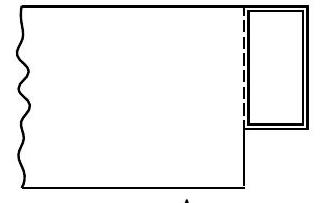
A
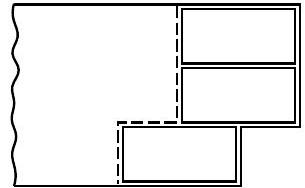
B
Fig. 3
Similarly, the second equality in (1) follows from a partition of all coverings of a chessboard $3 \times 2 n$ into three (disjoint) classes which are formed by coverings of types C, D and E respectively, see Fig. 4. It is evident that the numbers of elements in the three classes are $a_{n-1}, b_{n}$ and $b_{n}$, respectively.
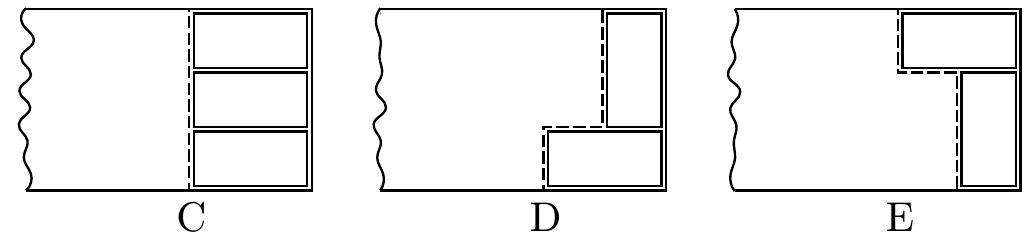
Fig. 4
Now we are ready to compute the requested number $a_{5}$. Since $a_{1}=3$ and $b_{1}=1$, the proved equalities (1) successively yield
$$
\begin{gathered}
b_{2}=a_{1}+b_{1}=4, a_{2}=a_{1}+2 b_{2}=11, b_{3}=a_{2}+b_{2}=15, a_{3}=a_{2}+2 b_{3}=41, \\
b_{4}=a_{3}+b_{3}=56, a_{4}=a_{3}+2 b_{4}=153, b_{5}=a_{4}+b_{4}=209, a_{5}=a_{4}+2 b_{5}=571 .
\end{gathered}
$$
Answer. The number of coverings of the chessboard $3 \times 10$ equals 571 .
Remark. Let us show that the numbers $a_{n}$ of coverings of a chessboard $3 \times 2 n$ by pieces $2 \times 1$ satisfy the following recurrence equation
$$
a_{n+2}=4 a_{n+1}-a_{n} \text { for each } n \geqslant 1 \text {. }
$$
(Thus the numbers $a_{n}$ can be computed without using auxiliary numbers $b_{n}$ from the above solution.) We prove (2) by excluding the numbers from the relations (1):
$$
\begin{aligned}
a_{n+2} & =a_{n+1}+2 b_{n+2}=a_{n+1}+2\left(a_{n+1}+b_{n+1}\right) \\
& =3 a_{n+1}+2 b_{n+1}=3 a_{n+1}+\left(a_{n+1}-a_{n}\right)=4 a_{n+1}-a_{n}
\end{aligned}
$$
Finally, let us remind a well known result: each sequence $\left(a_{n}\right)_{n=1}^{\infty}$ of numbers satisfying (2) is of the form $a_{n}=C_{1} \lambda_{1}^{n}+C_{2} \lambda_{2}^{n}$, where $\lambda_{1,2}=2 \pm \sqrt{3}$ are the roots of the equation $\lambda^{2}=4 \lambda-1$ while $C_{1,2}$ are arbitrary constants. Taking in account our values $a_{1}=3$ and $a_{2}=11$, we conclude that for each $n$, the number $a_{n}$ of all coverings of a chessboard $3 \times 2 n$ by pieces $2 \times 1$ is given by a direct formula
$$
a_{n}=\frac{3+\sqrt{3}}{6} \cdot(2+\sqrt{3})^{n}+\frac{3-\sqrt{3}}{6} \cdot(2-\sqrt{3})^{n} .
$$
6. We are given a triangle $A B C$. Find the locus of points $X$ in the plane $A B C$ whose reflections through the lines $A B, B C, C A$ are vertices of an equilateral triangle.
(Pavel Calábek)
Solution. For any point $X$ of the plane $A B C$, let $X_{a}, X_{b}$ and $X_{c}$ denote the reflections of $X$ through the lines $B C, C A$ and $A B$, respectively (Fig.5). First we prove that the distances between any two of the points $X_{a}, X_{b}$ and $X_{c}$ are given in general by formulæ
$$
\left|X_{a} X_{b}\right|=2|X C| \sin \gamma, \quad\left|X_{a} X_{c}\right|=2|X B| \sin \beta, \quad\left|X_{b} X_{c}\right|=2|X A| \sin \alpha
$$
in which $\alpha, \beta, \gamma$ denote the interior angles of the triangle $A B C$ as usual.

Fig. 5
It suffices to prove the first equality (1) which is obvious if $X=C$, because then $X_{a}=X_{b}(=X)$. If $X \neq C$, then the segment $X C$ is a diameter of a circle (see Fig. 5) which passes through the marked orthogonal projections $P_{a}$ and $P_{b}$ of $X$ onto $B C$ and $C A$, respectively (Thales' theorem). Since the chord $P_{a} P_{b}$ subtends inscribed angles $\gamma$ and $180^{\circ}-\gamma$, Law of Sines implies that $\left|P_{a} P_{b}\right|=|X C| \sin \gamma$. Using the homothety with centre $X$ and ratio 2 , we conclude that $\left|X_{a} X_{b}\right|=2\left|P_{a} P_{b}\right|$, and hence the equalities (1) are established for any point $X$.
The proved formulæ (1) imply that our task is to find exactly such points $X$ in the plane $A B C$ that satisfy
$$
2|X A| \sin \alpha=2|X B| \sin \beta=2|X C| \sin \gamma>0
$$
(recall that the triangle $X_{a} X_{b} X_{c}$ has to be equilateral). Otherwise speaking, we look for all points $X$ whose distances to $A, B$ and $C$ are positive and proportional as follows:
$$
|X A|:|X B|:|X C|=\frac{1}{\sin \alpha}: \frac{1}{\sin \beta}: \frac{1}{\sin \gamma}=\frac{1}{|B C|}: \frac{1}{|A C|}: \frac{1}{|A B|}
$$
(we have turned from angles to sides of $\triangle A B C$ using Law of Sines again). Such points $X$ are determined as common points of the following three circles of Apollonius (i.e. sets of points in the plane which have a specified ratio of distances to two fixed points):
$$
k_{a}: \frac{|X B|}{|X C|}=\frac{|A B|}{|A C|}, \quad k_{b}: \frac{|X A|}{|X C|}=\frac{|A B|}{|B C|}, \quad k_{c}: \frac{|X A|}{|X B|}=\frac{|A C|}{|B C|} .
$$
It is clear that any point shared by two of the circles lies on the third circle as well. ${ }^{3}$ It follows from (2) that $A \in k_{a}, B \in k_{b}$ a $C \in k_{c}$, which simplifies the construction of the three circles in practice: If the bisectors of interior angles in $\triangle A B C$ cut its interior in segments $A K, B L$ and $C M$ (Fig. 6), then $K \in k_{a}, L \in k_{b}$ and $M \in k_{c}$ (an immediate consequence of the well known proportions such as $|K B|:|K C|=|A B|:|A C|)$. Hence the centre of $k_{a}$ can be constructed as the intersection point of the line $B C$ and the perpendicular bisector of the segment $A K$ (excluding the case $|A B|=|A C|$, when $k_{a}$ becomes simply the perpendicular bisector of $B C$ ). Similarly, using the perpendicular bisectors of $B L$ and $C M$ we get centres od $k_{b}$ and $k_{c}$, respectively.)
Figure 6 illustrates the case when the circles $k_{a}, k_{b}, k_{c}$ meet in two distinct points and hence the given problem has two solutions marked as $X$ and $Y$, with the corresponding equilateral triangles $X_{a} X_{b} X_{c}$ and $Y_{a} Y_{b} Y_{c}$, respectively. ${ }^{4}$

Fig. 6
Despite of the fact that the requested locus of points $X$ is determined (by an Euclidean construction), we have to discuss how the number of solutions depends on
3 Some of these three sets (one or three) can be straight lines instead of circles — if the corresponding ratio equals 1 . We postpone this question to the closing discussion.
4 Afterwards we prove that two solutions exist whenever the given triangle $A B C$ is not equilateral. The fact that the last is not a trivial conclusion is supported by an observation that both solutions $X$ and $Y$ in Fig. 6 are situated in the exterior of the triangle $A B C$.
the choice of $\triangle A B C$. As we know, this reduces to the question of common points of any two of the circles $k_{a}, k_{b}, k_{c}$. This matter becomes easier if we involve again into consideration the segments $A K, B L, C M$ from Fig. 6 which are chords of $k_{a}, k_{b}$ and $k_{c}$, respectively.
Discussion.
a) If the triangle $A B C$ is equilateral, the "circles" $k_{a}, k_{b}, k_{b}$ are in fact perpendicular bisectors of the sides of $\triangle A B C$. Consequently, the problem has a unique solution - a point $X$ which coincides with the incentre of $\triangle A B C$.
b) If the triangle $A B C$ is isosceles (but not equilateral), say if $|A B| \neq|A C|=|B C|$, then the circle $k_{c}$ is a perpendicular bisector of the base $A B$ which meets the circle $k_{a}$ in two points, because $k_{c}$ meets the interior of the chord $A K$, and hence the both $\operatorname{arcs} A K$ of the circle $k_{a}$ as well. Consequently, the problem has two solutions.
c) Suppose that the triangle $A B C$ is scalene, with the largest side, say $A B$ (as in Fig. 6). Then the ratio $|X B| /|X C|$ for points $X \in k_{a}$ is larger than 1 , because of $A \in k_{a}$. Hence $B$ lies in the interior $k_{a}$, while $C$ lies in its exterior. The last together with $A \in k_{a}$ implies that $L$, an interior point of $A C$, lies in the exterior of $k_{a}$. Thus $k_{a}$ intersects the chord $B L$ of $k_{b}$ which means that $k_{a}$ and $k_{b}$ meet in two points. Consequently, the problem has two solutions.
## First Round of the 63rd Czech and Slovak Mathematical Olympiad
(December 10th, 2013)

1. Prove that for each integer number $n, n \geqslant 3$, the following $2 n$-digit number
$$
\underbrace{1 \ldots 1}_{n-1} 2 \underbrace{8 \ldots 8}_{n-2} 96
$$
is a perfect square.
(Vojtech Bálint)
Solution. The number under consideration can be expressed as follows:
$$
\begin{aligned}
\left(10^{2 n-1}+\right. & \left.10^{2 n-2}+\cdots+10^{n+1}\right)+2 \cdot 10^{n}+8 \cdot\left(10^{n-1}+10^{n-2}+\cdots+10^{2}\right)+96 \\
& =10^{n+1} \cdot \frac{10^{n-1}-1}{9}+2 \cdot 10^{n}+8 \cdot 10^{2} \cdot \frac{10^{n-2}-1}{9}+96 \\
& =\frac{10^{2 n}-10^{n+1}+18 \cdot 10^{n}+800 \cdot 10^{n-2}-800+9 \cdot 96}{9} \\
& =\frac{10^{2 n}+16 \cdot 10^{n}+64}{9}=\left(\frac{10^{n}+8}{3}\right)^{2} .
\end{aligned}
$$
As required, we have obtained a perfect square, because the number $10^{n}+8$ is divisible by 3 , as the sum of its digits equals 9 .
Another solution. Starting with examples
$$
1296=36^{2}, 112896=336^{2}, 11128896=3336^{2}, \ldots \text {, }
$$
we easily guess that for each $n \geqslant 2$,
$$
\underbrace{1 \ldots 1}_{n-1} 2 \underbrace{8 \ldots 8}_{n-2} 96=\underbrace{33 \ldots 3}_{n-1} 6^{2} .
$$
The exact proof can be done by using the usual multiplication scheme:
$$
\begin{array}{r}
333 \ldots 3336 \\
\times 333 \ldots 3336 \\
\hline 2000 \ldots 0016 \\
10000 \ldots 008 \\
100000 \ldots 08 \\
1000000 \ldots 8 \\
\therefore \quad . \\
1 \ldots 000008 \\
10 \ldots 00008 \\
100 \ldots 0008 \\
\hline 111 \ldots 112888 \ldots 8896
\end{array}
$$
Both (identical) factors are $n$-digit, hence an $(n+1)$-digit number stands in each of the $n$ rows between the two delimiting lines. From this fact, it is easy to determine the values of digits (including the numbers of appearances) in the resulting product.
2. Let $M$ be the midpoint of the side $A B$ of a triangle $A B C$. Prove that the equality $|\angle A B C|+|\angle A C M|=90^{\circ}$ holds if and only if the triangle $A B C$ is isosceles or right-angled, with $A B$ as a base or a hypotenuse, respectively. (Pavel Novotný)
Solution. Assume first that $|\angle A B C|+|\angle A C M|=90^{\circ}$. Using the notation $\phi=$ $|\angle A C M|$ and $\psi=|\angle B C M|$ (Fig. 1), we conclude from our assumption that $|\angle A B C|=$ $90^{\circ}-\phi$, and hence $|\angle B A C|=90^{\circ}-\psi$ as well, because of an easy angle computation in $\triangle A B C$ :
$$
\begin{aligned}
|\angle B A C| & =180^{\circ}-|\angle A B C|-|\angle A C B| \\
& =180^{\circ}-\left(90^{\circ}-\phi\right)-(\phi+\psi)=90^{\circ}-\psi .
\end{aligned}
$$

Fig. 1
Applying Law of Sines to $\triangle A C M$ and $\triangle B C M$, we get
$$
\frac{\sin \left(90^{\circ}-\psi\right)}{\sin \phi}=\frac{|C M|}{|A M|}=\frac{|C M|}{|B M|}=\frac{\sin \left(90^{\circ}-\phi\right)}{\sin \psi} .
$$
Comparing the two ratios of sines and using the formula $\sin \left(90^{\circ}-\omega\right)=\cos \omega$, we obtain an equality $\sin \phi \cos \phi=\sin \psi \cos \psi$ or $\sin 2 \phi=\sin 2 \psi$. Since the angles $\phi$ and $\psi$ are acute, both $2 \phi$ and $2 \psi$ are between $0^{\circ}$ and $180^{\circ}$. Thus by a well known sine property, the equality $\sin 2 \phi=\sin 2 \psi$ means that either $2 \phi=2 \psi$ or $2 \phi+2 \psi=180^{\circ}$. In the first case (when $\phi=\psi$ ), the interior angle of $\triangle A B C$ at the vertices $A$ and $B$ are equal, in the second case (when $\phi+\psi=90^{\circ}$ ) the interior angle at the vertex $C$ is right. This completes the proof of one of the two implications stated in the problem.
To prove the second (converse) implication, let us assume that (i) $|A C|=|B C|$ or (ii) $|\angle A C B|=90^{\circ}$.
Case (i). It follows from $|A C|=|B C|$ that the triangles $A C M$ and $B C M$ are congruent (by SSS theorem), with right interior angles at the vertex $M$. Consequently,
$$
|\angle A B C|+|\angle A C M|=|\angle M B C|+|\angle B C M|=180^{\circ}-|\angle B M C|=90^{\circ} \text {. }
$$
Case (ii). It follows from $|\angle A C B|=90^{\circ}$ that $|M B|=|M C|$ by Thales' theorem. Thus the angles $M C B$ and $M B C$ (or $A B C$ ) are congruent and hence
$$
|\angle A B C|+|\angle A C M|=|\angle M C B|+|\angle A C M|=|\angle A C B|=90^{\circ} .
$$
The converse implication is proven.
Another solution. Let $k$ be the circumcircle of the given triangle $A B C$. Its median $C M$ can be extended to the chord $C C^{\prime}$ of the circle $k$ (Fig.2). Since the inscribed angles $A B C^{\prime}$ and $A C C^{\prime}$ (or $A C M$ ) are congruent, the considered sum of angles $A B C$ and $A C M$ is equal to the angle $C B C^{\prime}$. By Thales' theorem the last angle $C B C^{\prime}$ is right if and only if the chord $C C^{\prime}$ is a diameter of the circle $k$. This happens if and only if the centre $S$ of $k$ lies on the ray $C M$. For such a situation, we distinguish two cases: $S=M$ and $S \neq M$. Note that $S=M$ holds if and only if the angle $A C B$ is right (by Thales' theorem again). Thus let us analyse the second case $S \neq M$ : The three distinct point $C, M$ and $S$ are obviously collinear if and only if the line $M S$, a perpendicular bisector of a segment $A B$, passes through the point $C$. However, the last condition is equivalent to the desired equality $|A C|=|B C|$. This completes the proof (common for the both composing implications).

Fig. 2

Fig. 3
Remark. Instead of the chord $C C^{\prime}$ of the circumcircle $k$, it is possible to consider the tangent line $t$ to the circle $k$ at its point $C$ (Fig.3). Since the inscribed angle $A B C$ is always congruent to the marked angle between $A C$ and $t$, the sum of the angles $A B C$ a $A C M$ equals $90^{\circ}$ if and only if the tangent $t$ is perpendicular to the ray $C M$. The last is equivalent to the condition from the above solution, namely that the ray $C M$ passes through the centre $S$ of $k$.
3. We are given a sheet of paper in the form of a rectangle $x \times y$, where $x$ and $y$ are integer numbers larger than 1. Let us draw a lattice of $x \cdot y$ unite squares on the sheet. Rolling up the rectangle and gluing it along its opposite sides we shape a lateral surface of a circular cylinder. Join each two distinct vertices of the marked unit squares on the surface by a segment. How many of all these segments are passing through an interior point of the cylinder? In the case $x>y$ decide when this number of "internal" segments is larger - for the cylinder with bases of perimeter $x$, or $y$ ?
(Vojtech Bálint)
Solution. We will compute the requested number $P$ of all internal segments for the cylinder formed by gluing the rectangle $x \times y$ along the opposite sides of length $y$.
This cylinder has two bases of perimeter $x$ and its lateral sides are of length $y$. We will use an obvious formula $P=P_{0}-P_{1}-P_{2}$, where $P_{0}$ denotes the total number of segments, while $P_{1}$ and $P_{2}$ denote the numbers of segments which lie on the lateral surface or on one of the two bases, respectively.
Note that the vertices of the unit squares are situated on the surface of the cylinder in such a way that exactly $y+1$ of them lie on the same of the $x$ lateral sides and, in the same time, exactly $x$ vertices lie on the same boundary circle of the two bases. These facts lead immediately to the following formulæ
$$
\begin{aligned}
& P_{0}=\left(\begin{array}{c}
x(y+1) \\
2
\end{array}\right)=\frac{x(y+1)(x y+x-1)}{2}, \\
& P_{1}=x \cdot\left(\begin{array}{c}
y+1 \\
2
\end{array}\right)=\frac{x(y+1) y}{2}, \\
& P_{2}=2 \cdot\left(\begin{array}{l}
x \\
2
\end{array}\right)=x(x-1) .
\end{aligned}
$$
Consequently,
$$
\begin{aligned}
P & =P_{0}-P_{1}-P_{2}=\frac{x(y+1)(x y+x-1)}{2}-\frac{x(y+1) y}{2}-x(x-1) \\
& =\frac{x(x-1)\left(y^{2}+2 y-1\right)}{2} .
\end{aligned}
$$
In view of symmetry, the number $Q$ of internal segments for the other cylinder (with base's perimeter $y$ and lateral sides of length $x$ ) is given by
$$
Q=\frac{y(y-1)\left(x^{2}+2 x-1\right)}{2} .
$$
To decide which of the inequalities $P>Q$ or $Q>P$ holds in the case when $x>y$, we factorize the difference $P-Q$ (since $P=Q$ if $x=y$, the polynomial $P-Q$ must be divisible by $x-y$ ):
$$
\begin{aligned}
2(P-Q)= & \left(x^{2}-x\right)\left(y^{2}+2 y-1\right)-\left(y^{2}-y\right)\left(x^{2}+2 x-1\right) \\
= & \left(x^{2} y^{2}-x y^{2}+2 x^{2} y-2 x y-x^{2}+x\right) \\
& -\left(x^{2} y^{2}-x^{2} y+2 x y^{2}-2 x y-y^{2}+y\right) \\
= & 3 x y(x-y)-(x-y)(x+y)+(x-y) \\
= & (x-y)(3 x y-x-y+1) .
\end{aligned}
$$
Thus $x>y$ implies that $P>Q$ if we show that the same condition $x>y$ implies that $3 x y-x-y+1>0$. The last is almost evident: it follows from $y \geqslant 2$ that $3 x y \geqslant 6 x$ and hence
$$
3 x y-x-y+1 \geqslant 5 x-y+1>4 x+1>0 \text {. }
$$
Answer. In the case when $x>y$, the number of internal segments is larger for the cylinder with bases which perimeter has length $x$.
Remark. Let us describe a shorter way of determining the number $P$. The orthogonal projection of each internal segment to the fixed base of the cylinder is one of the $\frac{1}{2} x(x-1)$ segments connecting $x$ vertices on the boundary circle. Each of these projections is common for exactly $(y+1)^{2}-2=y^{2}+2 y-1$ internal segments, because $y+1$ is the number of vertices on the same lateral side and all the segments connecting two distinct lateral sides are internal, with exception of the two segments lying on the bases of the cylinder. Hence,
$$
P=\frac{x(x-1)\left(y^{2}+2 y-1\right)}{2}
$$
## Second Round of the 63rd Czech and Slovak Mathematical Olympiad (January 14th, 2014)

1. Find all positive integers $n$ which are not powers of 2 and which satisfy the equation $n=3 D+5 d$, where $D$ (and d) denote the greatest (and the least) numbers among the all odd divisors of $n$ which are larger than 1.
(Tomáš Jurík)
Solution. Let $n=p_{1}^{\alpha_{1}} p_{2}^{\alpha_{2}} \ldots p_{k}^{\alpha_{k}}$ be the prime factorization of a satisfactory number $n$. Here $p_{1}2$. Consequently, there are infinitely many solutions in the case (ii) and all of them are given by $n=2^{3} p_{2}^{1}=8 p_{2}$, where $p_{2}$ is any odd prime number.
Answer. All the solutions $n$ are: $n=60, n=100$ and $n=8 p$, where $p$ is any odd prime number.
Remark. Let us show that the above solution can be presented more simply, if the "full" prime factorization of $n$ is replaced by a "partial" factorization $n=2^{\alpha} p l$, in which $2^{\alpha}$ is the greatest power of 2 dividing $n, p$ is the smallest prime divisor of $n$ and and $l$ is and odd number which has no prime divisor smaller than $p$ (thus we
have either $l=1$, or $l \geqslant p$ ). Using this factorization, we can write $D=p l, d=p$ and hence our task is to solve the equation
$$
n=2^{\alpha} p l=3 p l+5 p \quad \text { or } \quad\left(2^{\alpha}-3\right) l=5 \text {. }
$$
It follows that either $l=1$ and $2^{\alpha}-3=5$, or $l=5$ and $2^{\alpha}-3=1$. In the first case we have $\alpha=3$ and thus $n=8 p$, where $p$ is any prime number. In the second case it holds that $l=5, \alpha=2$ and thus $n=20 p$, but $5=l \geqslant p$ implies that $p \in\{3,5\}$, so there are only two solutions $n \in\{60,100\}$.
Another solution. The given equation $n=3 D+5 d$ implies that $n>3 D$ and $n \leqslant 3 D+5 D=8 D$ (because of $d \leqslant D$ ). Since the ratio $n: D$ must be a power of 2 , it follows from $3$ $r_{1}+r_{2}$. Find the locus of points $X$ which do not lie on the line $S_{1} S_{2}$ and possess the following property: The segments $S_{1} X$ and $S_{2} X$ intersect successively the circles $k_{1}$ and $k_{2}$ in such points whose distances to the line $S_{1} S_{2}$ are the same.
(Jaromír Šimša)
Solution. In the first part of our solution, we will assume that $X$ is any point with the required property. It is clear that $X$ lies in the exteriors of the circles $k_{1}$ and $k_{2}$ and that the points $S_{1}, S_{2}$ and $X$ are vertices of a triangle whose sides $S_{1} X, S_{2} X$ are intersected successively by the circles $k_{1}$ and $k_{2}$ in such points $Y_{1}$ a $Y_{2}$ which lie on the same line parallel to $S_{1} S_{2}$ (Fig. 1). Since the triangles $X Y_{1} Y_{2}$ and $X S_{1} S_{2}$ are similar (by theorem AA), it holds
$$
\frac{\left|X Y_{1}\right|}{\left|X S_{1}\right|}=\frac{\left|X Y_{2}\right|}{\left|X S_{2}\right|}
$$
which can be rewritten, because of the equalities
$$
\left|X Y_{1}\right|=\left|X S_{1}\right|-r_{1} \quad \text { a } \quad\left|X Y_{2}\right|=\left|X S_{2}\right|-r_{2}
$$
as an equation for lengths of the segments $X S_{1}$ and $X S_{2}$ :
$$
\frac{\left|X S_{1}\right|-r_{1}}{\left|X S_{1}\right|}=\frac{\left|X S_{2}\right|-r_{2}}{\left|X S_{2}\right|}
$$
or
$$
\frac{\left|X S_{1}\right|}{\left|X S_{2}\right|}=\frac{r_{1}}{r_{2}}
$$
Since the points $S_{1}$ and $S_{2}$ are fixed as well as the ratio $r_{1} / r_{2}$, the locus of points $X$

Fig. 1
satisfying equation (3) is a circle of Apollonius (which evidently becomes a straight line if the ratio $r_{1} / r_{2}$ equals 1 ). As known for the case when $r_{1} / r_{2} \neq 1$, the are exactly two solutions $X=H_{1}$ and $X=H_{2}$ of the equation (3) that lie on the line $S_{1} S_{2}$ and form a diameter $H_{1} H_{2}$ of the resulting circle of Apollonius. For our situation, let us add the fact that the points $H_{1}$ and $H_{2}$ are centres of both homotheties of the initially given circles $k_{1}$ and $k_{2}$.
In the second part of our solution, we will conversely assume that $X$ is a point of the circle of Apollonius given by the equation (3) and that $X$ lies outside of the line $S_{1} S_{2}$, i.e. $X \neq H_{1}$ and $X \neq H_{2}$. In view of the condition that $\left|S_{1} S_{2}\right|>r_{1}+r_{2}$, the whole circle of Apollonius (with diameter $H_{1} H_{2}$ ) lies in the exteriors of the circles $k_{1}$ and $k_{2}$. Indeed, the last fact follows from a known position of the homothety centres $H_{1}$ and $H_{2}$ on the line $S_{1} S_{2}$ : If for example $r_{1}r_{1}$ and $\left|X S_{2}\right|>r_{2}$. Thus there are points $Y_{1} \in k_{1}$ and $Y_{2} \in k_{2}$ lying on the segments $S_{1} X$ and $S_{2} X$, respectively. Since the equalities (2) are valid again, it is possible to transform the equation (3) to equation (1). Consequently, the triangles $X S_{1} S_{2}$ and $X Y_{1} Y_{2}$ are similar (now by SAS theorem) and hence $S_{1} S_{2} \| Y_{1} Y_{2}$. Therefore the distances of $Y_{1}$ and $Y_{2}$ to the line $S_{1} S_{2}$ are equal which proves the required property of the point $X$.
Answer. If $r_{1} \neq r_{2}$, the locus of points $X$ is the circle of Apollonius which is given given by the above equation (3), excepting the two points on the line $S_{1} S_{2}$. If $r_{1}=r_{2}$, the locus is the perpendicular bisector of the segment $S_{1} S_{2}$, with exception of the midpoint of $S_{1} S_{2}$.
Remark. Let us prove directly the needed fact that any solution (i.e. point) $X$ of the equation (3) lies in the exteriors of the circles $k_{1}$ and $k_{2}$. It follows easily from (3) that the differences $\left|X S_{1}\right|-r_{1}$ and $\left|X S_{2}\right|-r_{2}$ possess the same sign, which together with the following inequality
$$
\left(\left|X S_{1}\right|-r_{1}\right)+\left(\left|X S_{2}\right|-r_{2}\right) \leqslant\left|S_{1} S_{2}\right|-\left(r_{1}+r_{2}\right)>0
$$
leads to the conclusion that both the differences are positive, i.e. $\left|X S_{1}\right|>r_{1}$ and $\left|X S_{2}\right|>r_{2}$, as promised to be proven.
3. Find all triples of real numbers $x, y$ and $z$ for which
$$
x\left(y^{2}+2 z^{2}\right)=y\left(z^{2}+2 x^{2}\right)=z\left(x^{2}+2 y^{2}\right) .
$$
(Michal Rolínek)
Solution. If for example $x=0$, we get a system $0=y z^{2}=2 y^{2} z$ which means that one of the unknowns $y$ and $z$ vanishes and the other can be arbitrary. The cases $y=0$ or $z=0$ are discussed similarly. Thus we have obtained three groups of solutions $(x, y, z)$ which are formed by triples $(t, 0,0),(0, t, 0)$ and $(0,0, t)$ respectively, where $t$ is any real number. Moreover, we have observed that all the other solutions satisfy the condition $x y z \neq 0$, which is supposed to hold in what follows.
Factorizing the equation $x\left(y^{2}+2 z^{2}\right)=y\left(z^{2}+2 x^{2}\right)$ yields $(2 x-y)\left(z^{2}-x y\right)=0$. Thus we distinguish two cases (depending on the fact which of the two factors vanishes).
(i) $2 x-y=0$. After setting $y=2 x$ the given system is reduced to the only equation
$$
2 x\left(2 x^{2}+z^{2}\right)=9 x^{2} z,
$$
which can be simplified (by dividing $x \neq 0$ ) to
$$
4 x^{2}+2 z^{2}-9 x z=0 \quad \text { or } \quad(x-2 z)(4 x-z)=0 \text {. }
$$
Thus the case (i) yields exactly two groups of solutions $(2 t, 4 t, t)$ and $(t, 2 t, 4 t)$, where $t$ is any real number.
(ii) $z^{2}-x y=0$. Substituting $z^{2}=x y$ into the given system, we now get the only equation
$$
x y(2 x+y)=z\left(x^{2}+2 y^{2}\right),
$$
which is (because of the inequality $x^{2}+2 y^{2}>0$ ) equivalent to
$$
z=\frac{x y(2 x+y)}{x^{2}+2 y^{2}}
$$
At this moment we have to find when such a $z$ obeys the condition $z^{2}=x y$. After direct substitution we get the following condition on the unknowns $x$ and $y$ :
$$
\frac{x^{2} y^{2}(2 x+y)^{2}}{\left(x^{2}+2 y^{2}\right)^{2}}=x y
$$
Dividing by $x y \neq 0$ and removing the fraction yields
$$
x y(2 x+y)^{2}=\left(x^{2}+2 y^{2}\right)^{2} \quad \text { or } \quad(4 y-x)\left(x^{3}-y^{3}\right)=0 .
$$
Thus we conclude that either $x=4 y$, or $x^{3}=y^{3}$, i.e. $x=y .{ }^{5}$ Returning to the formula for $z$, we obtain $z=2 y$ or $z=x$, according as $x=4 y$ or $x=y$. Consequently, there[^2]are two groups of solutions in the case (ii), namely triples $(4 t, t, 2 t)$ and $(t, t, t)$, where $t$ is any real number.
Answer. All the solutions are $(t, 0,0),(0, t, 0),(0,0, t),(t, t, t),(4 t, t, 2 t),(2 t, 4 t, t)$ a $(t, 2 t, 4 t)$, where $t$ is any real number.
Remark. Let us describe a way how to avoid a more complicated case (ii) in the above solution. Thanks to the cyclic symmetry, the given system yields even three factorized equations
$$
(2 x-y)\left(z^{2}-x y\right)=0, \quad(2 y-z)\left(x^{2}-y z\right)=0, \quad(2 z-x)\left(y^{2}-z x\right)=0 .
$$
The case $2 x-y=0$ were discussed as (i) in the above solution, the cases $2 y-z=0$ and $2 z-x$ can be treated analogously. Summarizing the three cases, we get all the solutions indicated in Answer, excepting the triples $(t, t, t)$. Thus for the remaining case when
$$
z^{2}-x y=x^{2}-y z=y^{2}-z x=0
$$
our task is to show that the only satisfactory triples are $(x, y, z)=(t, t, t)$. However, the last conclusion is an easy consequence of the dentity
$$
(x-y)^{2}+(y-z)^{2}+(z-x)^{2}=2\left(z^{2}-x y\right)+2\left(x^{2}-y z\right)+2\left(y^{2}-z x\right),
$$
whose right-hand side vanishes by (2), and hence all the squares in the left-hand side vanish as well, which completes the proof. Let us add a note that the system (2) can be solved in another way: The equations in (2) easily imply that the values of $x^{3}, y^{3}$, $z^{3}$ are the same (namely, equal to the value of $x y z$ ), which happens only if $x=y=z$ by the footnote on previous page.
Another solution. To avoid unnecessary repetition from the above solution, we will solve the problem under the condition that $x y z \neq 0$.
Dividing both sides of the given equations by $x y z$ we obtain
$$
\frac{y}{z}+\frac{2 z}{y}=\frac{z}{x}+\frac{2 x}{z}=\frac{x}{y}+\frac{2 y}{x}
$$
which can be read as a coincidence of values of a function $f(s)=s+2 / s$ in three nonzero points $s_{1}=y / z, s_{2}=z / x$ a $s_{3}=x / y$. Thus we first find when $f(s)=f(t)$ for two nonzero real numbers $s$ and $t$. It follows from the identity
$$
f(s)-f(t)=s+\frac{2}{s}-t-\frac{2}{t}=\frac{(s-t)(s t-2)}{s t}
$$
that $f(s)=f(t)$ if and only if $s=t$ or $s t=2$. Consequently, the system (3) holds if and only if the introduced numbers $s_{1}, s_{2}, s_{3}$ possess the following property: $s_{i}=s_{j}$ or $s_{i} s_{j}=2$, for any indices $i$ and $j$. However, if there exists a permutation $(i, j, k)$ of $(1,2,3)$ such that $s_{i} s_{j}=2$, then the identity $s_{i} s_{j} s_{k}=1$ implies that $s_{k}=\frac{1}{2}$ and hence $s_{i} \in\left\{\frac{1}{2}, 4\right\}$ (because $s_{i}=s_{k}$ or $s_{i} s_{k}=2$ ). Thus the assumption $s_{i} s_{j}=2$ leads to the conclusion that $\left(s_{1}, s_{2}, s_{3}\right)$ is a permutation of $\left(\frac{1}{2}, \frac{1}{2}, 4\right)$. It is easy to check that exactly three such permutations are satisfactory and yield the solutions $(4 t, t, 2 t),(2 t, 4 t, t)$ and $(t, 2 t, 4 t)$ of the given system. In the remaining case when $s_{1}=s_{2}=s_{3}$, the identity $s_{1} s_{2} s_{3}=1$ implies that $s_{i}=1$ for each $i$, which yields the solutions $(t, t, t)$.
4. Six teams will take part in a volleyball tournament. Each pair of the teams should play one match. All the matches will be realized in five rounds, each involving three simultaneous matches on the courts numbered 1, 2 and 3. Find the number of all possible draws for such a tournament. By a draw we mean a table $5 \times 3$ in which an unordered pair of teams is written on the field $(i, j)$, where $i \in\{1,2,3,4,5\}$ and $j \in\{1,2,3\}$, if these two teams will meet each other in the $i$-th round on the court $j$. You are allowed to write down the resulting number as a product of prime factors (instead of writing its decimal expansion).
(Martin Panák)
Solution. We postpone the question of permutations of the five rounds and the three courts to the end of our solution. Denoting first the teams by numbers $1,2,3,4,5$, 6 (in a fixed way), we rearrange the five rounds of any satisfactory draw by means of the following numbering: Let 1 and 2 be the rounds with matches of the pairs of teams $(1,2)$ and $(1,3)$, respectively. If a pair $(3, a)$ plays in the round 1 and if a pair $(2, b)$ plays in the round 2 , then $a, b$ are two distinct numbers from $\{4,5,6\}$ (otherwise the third pairs in the rounds 1 and 2 are identical). Let 3,4 and 5 denote the rounds with pairs $(1, a),(1, b)$ and $(1, c)$ respectively, where $c \in\{4,5,6\} \backslash\{a, b\}$. Up to this moment, we have fixed an uncompleted draw
| $1:$ | $(1,2)$, | $(3, a)$, |
| :--- | :--- | :--- |
| $2:$ | $(1,3)$, | $(2, b)$, |
| $3:$ | $(1, a)$, | |
| 4: | $(1, b)$, | |
| $5:$ | $(1, c)$, | |
which can be extended to a the complete draw in the only one way:
| $1:$ | $(1,2)$, | $(3, a)$, | $(b, c)$, |
| :--- | :--- | :--- | :--- |
| $2:$ | $(1,3)$, | $(2, b)$, | $(a, c)$, |
| $3:$ | $(1, a)$, | $(2, c)$, | $(3, b)$, |
| $4:$ | $(1, b)$, | $(2, a)$, | $(3, c)$, |
| $5:$ | $(1, c)$, | $(2,3)$, | $(a, b)$. |
Since $(a, b, c)$ is any permutation of $(4,5,6)$, the total number of the complete draws (written as above) is $3 !=6$. Taking in account the number $5 !$ of the possible permutations of the five rounds and the number 3 ! of possible permutations of the three courts, we conclude that the requested number of all draws is equal to
$$
6 \cdot 5 ! \cdot 6^{5}=5 ! \cdot 6^{6}=2^{9} \cdot 3^{7} \cdot 5=5598720 .
$$
Another solution. Let us denote the six teams by numbers 1, 2, 3, 4, 5 a 6 and construct first an "unordered" draw in which the rounds will be "numbered" by the opponents of the team 1 - see the following table in which the other opponents of the team 2 are denoted as $a, b, c, d$ :
| $1:$ | $(1,2)$, | |
| :--- | :--- | :--- |
| $2:$ | $(1,3)$, | $(2, a)$, |
| $3:$ | $(1,4)$, | $(2, b)$, |
| 4: | $(1,5)$, | $(2, c)$, |
| $5:$ | $(1,6)$, | $(2, d)$. |
Note that $(a, b, c, d)$ is a permutation of the quadruple $(3,4,5,6)$ and that the following two restrictions are evident:
$\triangleright 3 \neq a, 4 \neq b, 5 \neq c$ and $6 \neq d$
$\triangleright$ The two-element sets $\{3, a\},\{4, b\},\{5, c\},\{6, d\}$ are pairwise distinct.
It is clear that under these two conditions, the third pairs for the rounds $2-5$ are uniquely determined, as well as the remaining two pairs for the round 1. Consequently, we have to calculate the number of permutations $(a, b, c, d)$ of the quadruple $(3,4,5,6)$ which satisfy the two above stated conditions.
Using the inclusion-exclusion principle we conclude that the first condition is fulfilled by exactly nine permutations:
$$
4 !-\left(4 \cdot 3 !-\left(\begin{array}{l}
4 \\
2
\end{array}\right) \cdot 2 !+4-1\right)=9
$$
Moreover, exactly three of them do not satisfy the second condition, namely the permutations $(4,3,6,5),(5,6,3,4)$ and $(6,5,4,3)$. Thus the total number of the satisfactory permutations equals $9-3=6$.
We have proved that there are six "unordered" draws in the above specified sense. Combining this result with the idea of permuting the rounds and the courts, we conclude that the requested number of the draws is equal to
$$
6 \cdot 6^{5} \cdot 5 !=5 ! \cdot 6^{6}=2^{9} \cdot 3^{7} \cdot 5=5,598,720 .
$$
Remark. All the six satisfactory permutations $(a, b, c, d)$ from the preceding solutions are $(4,5,6,3),(4,6,3,5),(5,3,6,4),(5,6,4,3),(6,3,4,5),(6,5,3,4)$. It is possible to find them by an easy systematic examination (and thus to avoid the above presented calculation based on the inclusion-exclusion principle). On the other hand, the number 3 of the permutations $(a, b, c, d)$ that satisfy the first, but not the second condition, can be determined as the number of the "faulty" equalities
$$
\{3, a\}=\{4, b\},\{3, a\}=\{5, c\},\{3, a\}=\{6, d\},
$$
which are successively equivalent to the others:
$$
\{5, c\}=\{6, d\},\{4, b\}=\{6, d\},\{4, b\}=\{5, c\} .
$$
## Final Round of the 63rd Czech and Slovak Mathematical Olympiad (March 24-25, 2014)

1. Let $n$ be a natural number whose all positive divisors are denoted as $d_{1}, d_{2}, \ldots, d_{k}$ in such a way that $d_{1}d_{5}$, the relations $d_{5}\left|d_{7}\right| 11 d_{5}$ imply that $d_{7}=11 d_{5}$. Substituting this into $11 d_{5}+8 d_{7}=3 n$, we obtain $99 d_{5}=3 n$ or $33 d_{5}=n$. Thus the four numbers $1,3,11$ and 33 are divisors of $n$, more exactly all its divisors smaller that 50 , since the fifth divisor $d_{5}$ satisfies $d_{5}=d_{3}+50>50$. Consequently, it holds that $d_{1}=1, d_{2}=3, d_{3}=11, d_{4}=33$, $d_{5}=d_{3}+50=61$, and thus $n=33 d_{5}=33 \cdot 61=2013$. The number 2013 is satisfactory indeed, because its first small divisors as indicated in the last sentence and moreover, the subsequent divisors are $d_{6}=61 \cdot 3$ and $d_{7}=61 \cdot 11$; hence $d_{7}=11 d_{5}$ as required.
(ii) The case of $n$ even. Now the equality $11 d_{5}+8 d_{7}=3 n$ implies that $2 \mid d_{5}$ and hence $2 \mid d_{5}-50=d_{3}$ as well. Since $d_{1}=1, d_{2}=2$ and $d_{3} \neq 3$, we conclude that either $d_{3}=4$, or $d_{3}=2 t$, with some integer $t>2$. But the last is impossible (otherwise $t$ is a divisor of $n$ with $d_{2}y)$ are some positive divisors of $n$ again. Substituting this into $11 d_{5}+8 d_{7}=3 n$, we obtain (after cancelling $n$ ) an equation $11 / x+8 / y=3$ which can be solved in a standard way, for example by a simple factorization:
$$
8 x=y(3 x-11) \Leftrightarrow 8(3 x-11)+88=3 y(3 x-11) \Leftrightarrow(3 x-11)(3 y-8)=88 .
$$
The first equation implies that $3 x-11>0$ and hence $3 y-8>0$ as well. Note that $x \geqslant y+1$ yields $3 x-11 \geqslant 3 y-8>0$. Taking in account the prime factorization $88=2^{3} \cdot 11$, we conclude that the ordered pair $(3 x-11,3 y-8)$ of factors must belong to the following set
$$
\{(88,1),(44,2),(22,4),(11,8)\} \text {. }
$$
However, congruences modulo 3 imply the only two pairs $(88,1)$ and $(22,4)$ are admissible. The corresponding pairs $(x, y)$ are $(33,3)$ and $(11,4)$, respectively.
If $(x, y)=(33,3)$, then $d_{5}=n / 33$ (and $\left.d_{7}=n / 3\right)$, thus $1,3,11$ and 33 of divisors of $n$ which leads (as in the above solution) to the solution $n=2013$.
If $(x, y)=(11,4)$, then $d_{5}=n / 11$ and $d_{7}=n / 4$, thus $1,2,4,11,22$ and 44 are divisors of $n$, which contradicts to $d_{5}>50$.
2. We are given a segment $A B$ in the plane. Consider a triangle $X Y Z$ with the following properties: the vertex $X$ is an interior point of the segment $A B$, the triangles $X B Y$ and $X Z A$ are similar $(\triangle X B Y \sim \triangle X Z A)$ and the points $A, B$, $Y, Z$ lie on a circle in this order. Find the locus of midpoints of the sides $Y Z$ of all such triangles $X Y Z$.
(Michal Rolínek, Jaroslav Švrček)
Solution. Let $X Y Z$ be a satisfactory triangle. Then the vertices $Y$ and $Z$ must lie in the same half-plane with the boundary line $A B$. Denote by $Y^{\prime}$ the reflection of $Y$ through the line $A B$. Due to the presumed similarity, the angles $X A Z$ a $B Y X$ are congruent (Fig. 1) and hence $|\angle B A Z|=\left|\angle B Y^{\prime} Z\right|$ as well. Using the well known inscribed angles property we conclude that the circumcircle $k$ of $\triangle A B Z$ passes not only through the point $Y$, but also through the point $Y^{\prime}$. The line $A B$ (as a perpendicular bisector of the chord $Y Y^{\prime}$ ) passes through the centre $O$ of the circle $k$ and thus the chord $A B$ is a diameter of $k$. Since the segment $A B$ is fixed, the circle $k=A B Y Z$ is common for all satisfactory triangles $X Y Z$ and the midpoint $M$ of $Y Z$ must lie in the interior of $k$. Since the both angles $O M Z$ and $O M Y$ are right (Fig. 2), the (lesser) angles $A M O$ and $B M O$ are acute and thus the point $M$ must lie in the intersection of the exteriors of Thales' circles with diameters $A O$ and $B O$. In what follows we will show the the both derived necessary conditions determine the locus of all the possible midpoints $M$.

Fig. 1

Fig. 2
So, let $M$ be any point in the interior of $k$ for which the both angles $A M O$ and $B M O$ are acute (i.e. $M$ lies in the exteriors of the circles with diameters $A O$ and $B O$ ). Consider a chord of $k$ which passes through $M$ perpendicularly to $O M$. This chord does not intersect the diameter $A B$, because of the acute angles $A M O$ and $B M O$. Thus the endpoints of the chord with the midpoint $M$ can be denoted as $Y$ and $Z$ so that $A, B, Y, Z$ lie on $k$ in this order. If $Y$ reflects to $Y^{\prime}$ through the
diameter $A B$ and if $X$ denotes the intersection point of the segments $A B$ a $Y^{\prime} Z$, then the triangles $X B Y$ a $X Z A$ are similar as required (by theorem AA). This completes the solution.
Conclusion. The locus under consideration is the interior of the highlighted region bounded by the three circles with diameters $A B, A O$ and $B O$, where $O$ denotes the midpoint of segment $A B$ (Fig. 3).

Fig. 3
3. Let us call by an "edge" any segment of length 1 which is common to two adjacent fields of a given chessboard $8 \times 8$. Consider all possible cuttings of the chessboard into 32 pieces $2 \times 1$ and denote by $n(e)$ the total number of such cuttings that involve the given edge $e$. Determine the last digit of the sum of the numbers $n(e)$ over all the edges $e$.
(Michal Rolínek)
Solution. The total number of the vertical edges is $7 \cdot 8=56$ as well as the total number of the horizontal edges. Thus the number of all the edges under consideration is $56 \cdot 2=112$.
The number of edges, which are not involved in a given cutting, is equal to 32, because each of these edges must coincide with the common segment of the two fields forming one of the 32 resulting pieces $2 \times 1$. Thus each cutting gives a contribution $112-32=80$ to the sum $S$ of all the numbers $n(e)$. Consequently, the sum $S$ is a multiple of 80 and thus its last digit is zero.
4. There are 234 visitors in a cinema auditorium. The visitors are sitting in $n$ rows, where $n \geqslant 4$, so that each visitor in the $i$-th row has exactly $j$ friends in the $j$-th row, for any $i, j \in\{1,2, \ldots, n\}, i \neq j$. Find all the possible values of $n$. (Friendship is supposed to be a symmetric relation.)
(Tomáš Jurík)
Solution. For any $k \in\{1,2, \ldots, n\}$ denote by $p_{k}$ the number of visitors in the $k$-th row. The stated condition on given $i$ and $j$ implies that the number of friendly pairs $(A, B)$, where $A$ and $B$ are from the $i$-th row and from $j$-th row respectively, is equal to the product $j p_{i}$. Interchanging the indices $i$ and $j$, we conclude that the same number of friendly pairs $(A, B)$ equals $i p_{j}$. Thus $j p_{i}=i p_{j}$ or $p_{i}: p_{j}=i: j$, and therefore, all the numbers $p_{k}$ must be proportional as follows:
$$
p_{1}: p_{2}: \cdots: p_{n}=1: 2: \cdots: n \text {. }
$$
Let us show that under this proportionality the visitors can be friendly in such a way which ensures the property under consideration. Thus assume that for some positive integer $d$, the equality $p_{k}=k d$ holds with any $k \in\{1,2, \ldots, n\}$. Let us
start with the case $d=1$ when the numbers of visitors in single rows are successively $1,2, \ldots, n$. Then the stated property holds true if (and only if) any two visitors taken from distinct rows in the whole auditorium - are friends. In the case when $d>1$, let us divide all the visitors into $d$ groups $G_{1}, G_{2}, \ldots, G_{d}$ so that for arbitrary $k=1,2, \ldots, d$, the numbers of visitors from the group $G_{k}$ in single rows are successively $1,2, \ldots, n$. It is evident that the stated property holds true under the following condition: two visitors are friends if and only if they belong to the same group $G_{k}$.
It follows from the preceding that our task is to find such integer values of $n$, $n \geqslant 4$, for which there exists a positive integer $d$ satisfying the equation
$$
d+2 d+\cdots+n d=234 \quad \text { or } \quad d n(n+1)=468 \text {. }
$$
Thus we look for all divisors $468=2^{2} \cdot 3^{2} \cdot 13$ which are of the form $n(n+1)$. Inequality $22 \cdot 23>468$ implies that $n<22$ and hence $n \in\{4,6,9,12,13,18\}$. It is easy to see that the only satisfactory $n$ equals 12 (which corresponds to $d=3$ ).
Answer. The unique solution is $n=12$.
5. We are given an acute-angled triangle $A B C$. Denote by $k$ the circle with diameter $A B$. A circle touching the bisector of the angle $B A C$ at the point $A$ and passing through the point $C$ meets the circle $k$ in a point $P, P \neq A$. Similarly, a circle touching the bisector of the angle $A B C$ at the point $B$ and passing through the point $C$ meets the circle $k$ in a point $Q, Q \neq B$. Prove that the lines $A Q$ and $B P$ intersect each other on the bisector of the angle $A C B$. (Peter Novotný)
Solution. Besides the Thales' circle $k$, denote as $l_{A}=A P C$ and $l_{B}=B Q C$ the other two circles under consideration. Let us deal, for example, with the circle $l_{B}$ drawn in Fig. 4. In what follows the interior angles of $\triangle A B C$ are denoted as usual.

Fig. 4
Let us explain that it is true indeed what the figure suggests. First of all, the point $Q$ lies in the half-plane $B C A$, because the local arc $B C$ of the circle $l_{B}$ has the following property: as its point $X$ moves from $C$ to $B$, the angle $A X B$ varies from an acute angle $\gamma$ to an obtuse angle $180^{\circ}-\beta / 2$, and hence the Thales' circle $k$ meets the arc $B C$ in an interior point $Q$. Applying the properties of inscribed and subtended
angles to the chord $B C$ of the circle $l_{B}$, we conclude that $|\angle B Q C|=180^{\circ}-\beta / 2$ and hence $|\angle A Q B|+|\angle B Q C|=270^{\circ}-\beta / 2>180^{\circ}$. Consequently, $Q$ is a point of the halfplane $A C B$ which lies in the interior of the triangle $A B C$ and the convex angle $A Q C$ equals $90^{\circ}+\beta / 2$. As known, the last is a measure of the angle $A I C$, where $I$ denotes the incentre of $\triangle A B C$ (indeed, $|\angle A I C|=180^{\circ}-\alpha / 2-\gamma / 2=90^{\circ}+\beta / 2$ ). In this way, the congruence of the angles $A Q C$ and $A I C$ is proven and hence the points $Q$ and $I$ lie on the same arc $A C$ of a new circle $k_{B}=A C I$. Therefore, the line $A Q$ is the radical axis of the circles $k$ and $k_{B}$. Analogously, the line $B P$ is the radical axis of the circles $k$ and $k_{A}=B C I$.
It remains to note that the intersection point of the lines $A Q$ and $B P$ (treated as the above radical axes) has the same power with respect to the circles $k_{A}$ and $k_{B}$, whose radical axis is the line $C I$, i.e. just the bisector of the angle $A C B$. This completes our solution.
Remark. Let us explain once again that the point $Q$ lies in the open half-plane $B C A$. The intersection point $Q$ of the circles $k$ and $l_{B}$ is clearly an interior point of the half-plane $A B C$ which lies between the two lines tangent to $k$ and $l_{B}$ at the point $B$. Note that both the vertex $C$ of the acute-angled triangle $A B C$ and the centre $S_{B}$ of the circle $l_{B}$ lie in the exterior of the Thales' circle $k$. An arc of $k$ lies in the triangle $B S_{B} C$ which however does not contain any point of the circle $l_{B}$, excepting the points $B$ and $C$. Consequently, the point $Q$ has to lie in the half-plane $B C A$.
6. Let $a, b$ be non-negative real numbers. Prove the inequality
$$
\frac{a}{\sqrt{b^{2}+1}}+\frac{b}{\sqrt{a^{2}+1}} \geqslant \frac{a+b}{\sqrt{a b+1}}
$$
and find when the equality holds.
(Tomáš Jurík, Jaromír Šimša)
Solution. It is evident that the inequality under consideration becomes an equality when $a=0, b=0$ or $a=b$. To prove that otherwise the strong inequality holds, it suffices to deal with the case $a>b>0$ and (after removing the fractions) to show that
$$
a \sqrt{a^{2}+1} \sqrt{a b+1}+b \sqrt{b^{2}+1} \sqrt{a b+1}>(a+b) \sqrt{a^{2}+1} \sqrt{b^{2}+1}
$$
Distributing the right-hand side and regrouping the terms we get
$$
a \sqrt{a^{2}+1}\left(\sqrt{a b+1}-\sqrt{b^{2}+1}\right)>b \sqrt{b^{2}+1}\left(\sqrt{a^{2}+1}-\sqrt{a b+1}\right) .
$$
Multiplying the differences of the square roots by their sums as the denominators of new installed fractions, we obtain
$$
a \sqrt{a^{2}+1} \cdot \frac{b(a-b)}{\sqrt{a b+1}+\sqrt{b^{2}+1}}>b \sqrt{b^{2}+1} \cdot \frac{a(a-b)}{\sqrt{a^{2}+1}+\sqrt{a b+1}} .
$$
Dividing both sides by the positive number $a b(a-b)$ and removing the fractions again, we finally arrive at an equivalent inequality
$$
\sqrt{a^{2}+1}\left(\sqrt{a^{2}+1}+\sqrt{a b+1}\right)>\sqrt{b^{2}+1}\left(\sqrt{b^{2}+1}+\sqrt{a b+1}\right),
$$
which easily follows by an easy comparison of the both sides "term by term" (because our assumption $a>b$ implies that $\left.\sqrt{a^{2}+1}>\sqrt{b^{2}+1}\right)$. This completes the proof of the given inequality. As we have shown, the only cases of the equality are $a=0$, $b=0$ and $a=b$.
Another solution. We exclude the cases $a=0$ and $b=0$ (when the inequality becomes an equality) from our considerations. Let us apply a Cauchy-Schwarz inequality in the form
$$
\left(\frac{a}{u}+\frac{b}{v}\right)(a u+b v) \geqslant(a+b)^{2},
$$
with positive coefficients $u=\sqrt{b^{2}+1}$ and $v=\sqrt{a^{2}+1}$ :
$$
\left(\frac{a}{\sqrt{b^{2}+1}}+\frac{b}{\sqrt{a^{2}+1}}\right)\left(a \sqrt{b^{2}+1}+b \sqrt{a^{2}+1}\right) \geqslant(a+b)^{2} .
$$
Another Cauchy-Schwarz inequality yields an upper bound for the second factor from the-left hand side of (1):
$$
\begin{aligned}
& a \sqrt{b^{2}+1}+b \sqrt{a^{2}+1}=\sqrt{a} \sqrt{a b^{2}+a}+\sqrt{b} \sqrt{a^{2} b+b} \leqslant \\
& \quad \leqslant \sqrt{a+b} \sqrt{a b^{2}+a+a^{2} b+b}=\sqrt{a+b} \sqrt{(a+b)(a b+1)}=(a+b) \sqrt{a b+1}
\end{aligned}
$$
Consequently, the first factor in (1) has a lower bound
$$
\frac{a}{\sqrt{b^{2}+1}}+\frac{b}{\sqrt{a^{2}+1}} \geqslant \frac{(a+b)^{2}}{a \sqrt{b^{2}+1}+b \sqrt{a^{2}+1}} \geqslant \frac{a+b}{\sqrt{a b+1}}
$$
which is the desired inequality. Since (1) becomes an equality if and only if the positive coefficients $u$ and $v$ are the same, i.e. $\sqrt{b^{2}+1}=\sqrt{a^{2}+1}$ in our situation, the equality $a=b$ is the third (and last) case (next to $a=0$ and $b=0$ from the introductory sentence) when the proven inequality holds as an equality.
Another solution. Let us exclude the obvious cases $a=0, b=0, a=b$ and let us transform the (strong) inequality under consideration into the following equivalent form:
$$
\frac{a}{a+b} \cdot \frac{1}{\sqrt{b^{2}+1}}+\frac{b}{a+b} \cdot \frac{1}{\sqrt{a^{2}+1}}>\frac{1}{\sqrt{a b+1}} .
$$
The last left-hand side can be read as that of the (strong) Jensen inequality
$$
p f(\alpha)+q f(\beta)>f(p \alpha+q \beta),
$$
with positive coefficients $p=a /(a+b)$ and $q=b /(a+b)$ (which satisfy $p+q=1$ as required), applied to the function $f(x)=1 / \sqrt{x}$ at the points $\alpha=b^{2}+1$ and $\beta=a^{2}+1$. Since the function $f$ is strictly convex ${ }^{6}$ on the interval $(0,+\infty)$ and since the points $\alpha$ and $\beta$ are assumed to be distinct, the Jensen inequality (3) holds.
It remains to verify that also the right-hand sides of (2) and (3) are identical. This is easy:
$$
\begin{aligned}
f(p \alpha+q \beta) & =f\left(\frac{a}{a+b}\left(b^{2}+1\right)+\frac{b}{a+b}\left(a^{2}+1\right)\right)= \\
& =f\left(\frac{a+a b^{2}+b+a^{2} b}{a+b}\right)=f(a b+1)=\frac{1}{\sqrt{a b+1}} .
\end{aligned}
$$[^3]
[^0]: 1 As an consequence we can see that the assumed existence of the intersection point $M$ is equivalent to the inequality $\frac{1}{2} \alpha \neq \frac{1}{2} \beta$ or $\alpha \neq \beta$. Due to the symmetry we can assume that $\alpha>\beta$ as in our figure; the point $M$ then lies on the ray opposite to ray $A B$ and satisfies $|\angle I M A|=\frac{1}{2} \alpha-\frac{1}{2} \beta$.
[^1]: 2 For an obvious reason, we consider a chessboard $3 \times k$ with an even $k$ only.
[^2]: 5 The reduction $x^{3}=y^{3}$ to $x=y$ is correct, because the mapping $t \mapsto t^{3}$ is increasing on the set $\mathbb{R}$.
[^3]: 6 The shape of the curve $y=x^{-\frac{1}{2}}$ is well known from high-school textbooks.