# XI International Zhautykov Olympiad in Sciences Almaty - Kazakhstan, January 11-17, 2015
Presentation of the Mathematics Section by Dan Schwarz
First Day (January 13, 2015) - Problems
Problem 1. Each point with integral coordinates in the plane is coloured white or blue. Prove that one can choose a colour so that for every positive integer $n$ there exists a triangle of area $n$ with three having its vertices of the chosen colour.
## A. GolOVANOV
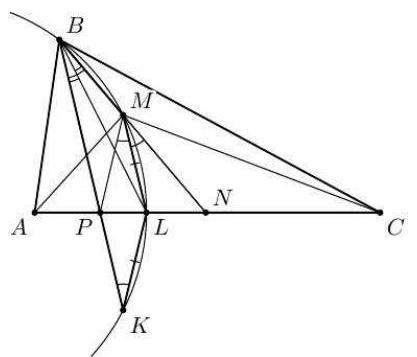
Problem 2. Inside the triangle $A B C$ a point $M$ is given. The line $B M$ meets the side $A C$ at $N$. The point $K$ is symmetrical to $M$ with respect to $A C$. The line $B K$ meets $A C$ at $P$. If $\angle A M P=\angle C M N$, prove that $\angle A B P=\angle C B N$.
Problem 3. Determine all the functions $f: \mathbb{R} \rightarrow \mathbb{R}$ such that
$$
f\left(x^{3}+y^{3}+x y\right)=x^{2} f(x)+y^{2} f(y)+f(x y)
$$
for all $x, y \in \mathbb{R}$.
(Uzbekistan) Sh. IsmaILOV
Prezentarea problemelor din cadrul secţiunii matematice a concursului Zhautykov din acest an este făcută şi popularizată cu scopul de a vedea încă un alt concurs internaţional, pentru a putea cântări dificultatea probelor, în comparaţie cu propriile noastre concursuri, de selecţie sau de palmares. Deoarece concursul este internaţional, am preferat a face prezentarea în limba engleză, dar comentariile vor fi făcute în limba română. Enunţurile prezentate pe primele două pagini sunt urmate de soluţii detaliate şi comentarii. Informaţii complete (printre care, la timpul cuvenit, şi rezultatele) la http://izho.kz/.
## Second Day (January 14, 2015) - Problems
Problem 4. Determine the maximum integer $n$ with the property that for each positive integer $k \leq \frac{n}{2}$ there exist two positive divisors of $n$ with difference $k$.
A. Golovanov
Problem 5. Let $A_{n}$ be the set of partitions of the sequence $(1,2, \ldots, n)$ into several subsequences such that every two neighbouring terms of each subsequence have different parity, and let $B_{n}$ be the set of partitions of the sequence $(1,2, \ldots, n)$ into several subsequences such that all the terms of each subsequence have the same parity
Prove that for every positive integer $n$ the sets $A_{n}$ and $B_{n+1}$ contain the same number of elements.
D. Eliusizov
Problem 6. The area of a convex pentagon $A B C D E$ is $S$, and the circumradii of the triangles $A B C, B C D, C D E, D E A, E A B$ are $R_{1}, R_{2}$, $R_{3}, R_{4}, R_{5}$. Prove the inequality
$$
R_{1}^{4}+R_{2}^{4}+R_{3}^{4}+R_{4}^{4}+R_{5}^{4} \geq \frac{4}{5 \sin ^{2} 108^{\circ}} S^{2}
$$
N. SedraKyan
$<$ spoiler $>$ Soluţii detaliate şi comentarii vin pe paginile următoare. Încercaţi să rezolvaţi problemele înainte de a merge mai departe.[^0]
## First Day - Solutions
Problem 1. Each point with integral coordinates in the plane is coloured white or blue. Prove that one can choose a colour so that for every positive integer $n$ there exists a triangle of area $n$ having its vertices of the chosen colour.
Solution. If there exists some $c$-monochromatic horizontal row $y=k$, then if both rows $y=k-1$ and $y=k+1$ are $\bar{c}$-monochromatic we can find $\bar{c}$-monochromatic triangles of any positive integer area, otherwise they must contain at least a $c$-point, and we can find $c$-monochromatic triangles of any positive integer area. So assume there exists no monochromatic horizontal row. Consider the horizontal row $y=0$. If it contains two $c$-points at distance 1 , then for any positive integer $n$, together with a $c$-point on row $y=2 n$ they will make a $c$-monochromatic triangle of area $n$. Otherwise it will contain two $\bar{c}$-points at distance 2 , which for any positive integer $n$, together with a $\bar{c}$-point on row $y=n$ will make a $\bar{c}$-monochromatic triangle of area $n$.
Comentarii. Extrem de puţin din întreaga diversitate de colorări este utilizat, ceea ce face problema oarecum trivială ... De remarcat că nu este adevărat că se pot întotdeauna obţine triunghiuri monocromatice de orice arie $n / 2$; de exemplu pentru colorarea "în tablă de şah" nu se vor obţine triunghiuri monocromatice de arie $1 / 2$. Iar dacă mărim numărul de culori la trei, există o (simplă) colorare fără triunghiuri monocromatice de arie 1. Presupun că întrebări mult mai interesante şi dificile pot fi imaginate ...
Problem 2. Inside the triangle $A B C$ a point $M$ is given. The line $B M$ meets the side $A C$ at $N$. The point $K$ is symmetrical to $M$ with respect to $A C$. The line $B K$ meets $A C$ at $P$. If $\angle A M P=\angle C M N$, prove that $\angle A B P=\angle C B N$.
Solution. (AoPS - user TelvCohl) Let $M^{*}$ be the isogonal conjugate of $M$ with respect to $\triangle A B C$.
LEMMA. Let $\ell$ be the isogonal conjugate of $A M$ with respect to $\angle B M C$, and let $\ell^{*}$ be the isogonal conjugate of $A M^{*}$ with respect to $\angle B M^{*} C$. The lines $\ell, \ell^{*}$ meet on $B C$ and are symmetrical with respect to $B C$.
Proof. Let $X$ be the meeting point of $B M^{*}$ and $C M$. Let $Y \in B C$ be a point such that $X A, X Y$ are isogonal conjugate with respect to $\angle B X C$.
Since $C A, C Y$ are isogonal conjugate with respect to $\angle M^{*} C M$, so $A$ and $Y$ are isogonal conjugate with respect to $\triangle C X M^{*}$, it follows that $M^{*} Y$, $M^{*} A$ are isogonal conjugate with respect to $\angle B M^{*} C$. Similarly, we can prove $M Y, M A$ are isogonal conjugate with respect to $\angle B M C$.
By easy angle chasing we get $\angle M Y B=\angle C Y M^{*}$, thus $M Y \equiv \ell$ and $M^{*} Y \equiv \ell^{*}$ are symmetrical with respect to $B C$.
From the LemmA we now get that $P K$ is the isogonal conjugate of $B M^{*}$ with respect to $\angle A M^{*} C$, thus from $B \in P K$ we get $P K$ to be the angle bisector of $\angle A M^{*} C$ and $M^{*} \in B K$, therefore $\angle A B P=\angle C B N$.
Alternative Solution. (Ştefan Tudose on AoPS) Notice that the thesis is equivalent (by Steiner's theorem) with $\frac{B C}{B A}=\frac{M C}{M A}$; stated in other words, that $B$ lies on the $M$-Apollonius circle of $\triangle M C A$.
Let $F$ be the foot of the angle bisector of $\angle C M A$. By dint of the above observation, it is enough to prove that $B \in \odot(M F K)$, which is trivial by simple angle chasing; suppose wlog that $M A>M C$, it then follows $\angle M F K=\pi+\angle M A C-\angle M C A=\pi-\angle K B M$.
Problem 3. Determine all functions $f: \mathbb{R} \rightarrow \mathbb{R}$ such that
$$
f\left(x^{3}+y^{3}+x y\right)=x^{2} f(x)+y^{2} f(y)+f(x y)
$$
for all $x, y \in \mathbb{R}$.
Solution. (Ştefan Tudose on AoPS) Let $P(x, y)$ be the assertion that $f\left(x^{3}+y^{3}+x y\right)=x^{2} f(x)+y^{2} f(y)+f(x y)$. From $P(1,0)$ we get that $f(0)=0$, hence from $P(x, 0)$ we get $f\left(x^{3}\right)=x^{2} f(x) . P(x,-x)$ yields $f(x)=-f(-x)$.
From $P(x, y)-P(x,-y)$ we get
$$
f\left(y^{3}\right)+f(x y)=\frac{1}{2}\left(f\left(x^{3}+y^{3}+x y\right)+f\left(y^{3}+x y-x^{3}\right)\right)
$$
Substituting back into $P(x, y)$ we get that
$$
f\left(x^{3}+y^{3}+x y\right)=2 f\left(x^{3}\right)+f\left(y^{3}+x y-x^{3}\right)
$$
Let $a, b$ be real numbers, and let $x=\sqrt[3]{a}$. The polynomial $P_{b}(\alpha)=\alpha^{3}+x \alpha-b$ has odd degree, hence at least one real root. Let $y$ be one of the real roots. Plugging $x$ and $y$ in $(*)$, we get that $f(a+b)=2 f(a)+f(b-a)$ for all $a, b \in \mathbb{R}$. Taking $a=b$, we get $f(2 a)=2 f(a)$, so
$$
f(x+y)=f(x)+f(y) \text { for all } x, y \in \mathbb{R}
$$
So $f(x+y)=f(x)+f(y)$ and
$$
f\left(x^{3}\right)=x^{2} f(x) \quad(* *)
$$
Taking $x+1$ and $x-1$ in $(* *)$ and summing up the two relations we get that $2 x^{2} f(x)+6 f(x)=f(x)\left(2 x^{2}+2\right)+4 x f(1)$, i.e. $f(x)=x f(1)$.
Alternative Solution. (AoPS - user pco) Under the notations of above we similarly get $f(0)=0, f\left(x^{3}\right)=x^{2} f(x)$, and $f(x)$ odd.
Let then $u, v$ be such that $u+v \leq 0$. It's easy to see that the system $x^{3}+y^{3}+x y=u,-x^{3}-y^{3}+x y=v$ always has a solution, and then
$$
\begin{aligned}
& P(x, y) \text { yields } f(u)=x^{2} f(x)+y^{2} f(y)+f\left(\frac{u+v}{2}\right) \\
& P(-x,-y) \text { yields } f(v)=-x^{2} f(x)-y^{2} f(y)+f\left(\frac{u+v}{2}\right)
\end{aligned}
$$
Just adding the two lines above gives $f\left(\frac{u+v}{2}\right)=\frac{f(u)+f(v)}{2}$ for all $u, v$ such that $u+v \leq 0$. If $u+v \geq 0$, we then have $-u-v \leq 0$ and so $f\left(\frac{-u-v}{2}\right)=\frac{f(-u)+f(-v)}{2}$ and, since the function $f(x)$ is odd, we also have $f\left(\frac{u+v}{2}\right)=\frac{f(u)+f(v)}{2}$ for all $u, v$ such that $u+v \geq 0$.
Then $f\left(\frac{2 u+0}{2}\right)=\frac{f(2 u)+f(0)}{2}$, and so $f(2 u)=2 f(u)$. Therefore $f\left(\frac{2 u+2 v}{2}\right)=\frac{f(2 u)+f(2 v)}{2}=f(u)+f(v)$, i.e. $f(x)$ is additive.
Let then be $n \in \mathbb{N} ; P(x+n, 0)$ yields $f\left((x+n)^{3}\right)=(x+n)^{2} f(x+n)$, whence $n(2 f(x)-2 x f(1))=-3 f\left(x^{2}\right)+2 x f(x)+x^{2} f(1)$ for all $n \in \mathbb{N}$. So $f(x)=x f(1)$ for all $x$, and so $f(x)=a x$ for all $x$, which indeed is a solution, whatever $a \in \mathbb{R}$.
## Second Day - Solutions
Problem 4. Determine the maximum integer $n$ with the property that for each positive integer $k \leq \frac{n}{2}$ there exist two positive divisors of $n$ with difference $k$.
Solution. If there exists a positive integer $p \leq\lfloor n / 6\rfloor$ such that $p \nmid n$, then we have $\lfloor n / 2\rfloor>\lfloor n / 6\rfloor$, and taking $k=\lfloor n / 2\rfloor-p \geq 2$ and two positive divisors $d, d+k$ of $n$, we need $d+(\lfloor n / 2\rfloor-p)$ to divide $n$. But $d+(\lfloor n / 2\rfloor-p) \geq d+\lfloor n / 2\rfloor-\lfloor n / 6\rfloor>d+(n / 2-1)-n / 6 \geq n / 3$, so $d+(\lfloor n / 2\rfloor-p) \in\{n / 2, n\}$, the only possible divisors of $n$ larger than $n / 3$. However, $d+(\lfloor n / 2\rfloor-p)=n / 2$ yields $d=p$, absurd (since $d \mid n$ but $p \nmid n$ ), while $d+(\lfloor n / 2\rfloor-p)=n$ yields $d>n / 2$, thus $d=n$ (since $d \mid n$ ), forcing $p=\lfloor n / 2\rfloor>\lfloor n / 6\rfloor$, again absurd. Therefore all positive integers not larger than $\lfloor n / 6\rfloor$ must divide $n$.
Denote $u=\lfloor n / 6\rfloor$. Since $\operatorname{gcd}(u, u-1)=1$, it follows $u(u-1) \mid n$, so $u(u-1) \leq n=6(n / 6)<6(u+1)$, forcing $u \leq 7$. For $u \geq 4$ we need $\operatorname{lcm}[1,2,3,4]=12 \mid n$, and we can see that $n=24$ satisfies, and moreover is an acceptable value. For $n=36$ we get $u=6$, but $\operatorname{lcm}[1,2,3,4,5,6]=60 \nmid n$. And for $n \geq 48$ we have $u \geq 8$, not acceptable. Thus the answer is $n=24$.
We may in fact quite easily exhibit the full set $\{1,2,4,6,8,12,18,24\}$ of such positive integers $n$ (for $n=1$ the condition is vacuously fulfilled). The related question of which are the positive integers satisfying the above property for all $1 \leq k \leq n-1$ can also easily be answered; the full set is $\{1,2,4,6\}$.
Comentarii. O problemă extrem de drăguţă, şi nu tocmai simplă dacă ne străduim să evităm discutarea a prea multe cazuri. Analiza numerelor $n$ mici ne sugerează imediat că $n>1$ nu poate să fie impar (ceea ce este trivial), şi prin faptul că singurul $k$ defect pentru $n=36$ este $k=13$, ideea pentru soluţia dată mai sus. Oricum, o idee proaspătă, şi care se implementează elegant şi cu calcule minime.
Problem 5. Let $A_{n}$ be the set of partitions of the sequence $(1,2, \ldots, n)$ into several subsequences such that every two neighbouring terms of each subsequence have different parity, and let $B_{n}$ be the set of partitions of the sequence $(1,2, \ldots, n)$ into several subsequences such that all the terms of each subsequence have the same parity. 2
Prove that for every positive integer $n$ the sets $A_{n}$ and $B_{n+1}$ contain the same number of elements.
Solution. For each partition $\pi$ of $\{1,2, \ldots, n\}$, with the elements within each block written in ascending order, denote by $k(\pi)$ the number of blocks of $\pi$ ending in an even number and by $\ell(\pi)$ the number of blocks of $\pi$ ending in an odd number.
Also denote $f_{n}(x, y)=\sum_{\pi \in A_{n}} x^{k(\pi)} y^{\ell(\pi)}$ and $g_{n}(x, y)=\sum_{\pi \in B_{n}} x^{k(\pi)} y^{\ell(\pi)}$.
We will have $\left|A_{n}\right|=f_{n}(1,1)$.
For example
$$
\begin{aligned}
& f_{1}(x, y)=y \\
& f_{2}(x, y)=x(y+1) \\
& f_{3}(x, y)=y(x y+y+x+1) \\
& f_{4}(x, y)=x\left(x y^{2}+y^{2}+3 x y+3 y+x+1\right)
\end{aligned}
$$
A moment of reflection will show us that
$$
\begin{aligned}
& f_{n+1}(x, y)=y\left(f_{n}(x, y)+\frac{\mathrm{d}}{\mathrm{d} x} f_{n}(x, y)\right) \text { for even } n \\
& f_{n+1}(x, y)=x\left(f_{n}(x, y)+\frac{\mathrm{d}}{\mathrm{d} y} f_{n}(x, y)\right) \text { for odd } n
\end{aligned}
$$
This comes from considering where the element $n+1$ may go, and how this affects the number of blocks.
We will also have $\left|B_{n}\right|=g_{n}(1,1) 3^{3}$[^1]
For example
$$
\begin{aligned}
& g_{1}(x, y)=y \\
& g_{2}(x, y)=x y \\
& g_{3}(x, y)=y x(y+1) \\
& g_{4}(x, y)=x y(x y+y+x+1) \\
& g_{5}(x, y)=y x\left(x y^{2}+y^{2}+3 x y+3 y+x+1\right)
\end{aligned}
$$
Another moment of reflection will show us that
$$
\begin{aligned}
& g_{n+1}(x, y)=y\left(g_{n}(x, y)+\frac{\mathrm{d}}{\mathrm{d} y} g_{n}(x, y)\right) \text { for even } n \\
& g_{n+1}(x, y)=x\left(g_{n}(x, y)+\frac{\mathrm{d}}{\mathrm{d} x} g_{n}(x, y)\right) \text { for odd } n
\end{aligned}
$$
This also comes from considering where the element $n+1$ may go, and how this affects the number of blocks.
It is not hard to check that $g_{n+1}(x, y)=y f_{n}(x, y)$ for even $n$ and that $g_{n+1}(x, y)=x f_{n}(x, y)$ for odd $n$. This is seen to hold true for small values of $n$. Henceforth, for even $n, g_{n+1}(x, y)=y\left(g_{n}(x, y)+\frac{\mathrm{d}}{\mathrm{d} y} g_{n}(x, y)\right)=$ $y x f_{n-1}(x, y)+y x \frac{\mathrm{d}}{\mathrm{d} y} f_{n-1}(x, y)$ by induction step on $g_{n}(x, y)=x f_{n-1}(x, y)$, while $y f_{n}(x, y)=y x\left(f_{n-1}(x, y)+\frac{\mathrm{d}}{\mathrm{d} y} f_{n-1}(x, y)\right)$. Alike computation holds for odd $n$. So $g_{n+1}(1,1)=f_{n}(1,1)$ in all cases, and so $\left|B_{n+1}\right|=\left|A_{n}\right|$.
Comentarii. De fapt o partiţie de unul din cele două tipuri poate fi privită şi ca scrierea în cicluri disjuncte a unei permutări convenabile din $\mathcal{S}_{n}$. Odată ce ideea (folosirea unui fel de funcţii generatoare) se iveşte, problema devine aproape trivială. Consideraţii asupra acestor partiţii din $A_{n}$, numite parity-alternating, sunt numeroase, relativ şi la numerele Stirling de a doua speţă $\left\{\begin{array}{l}n \\ k\end{array}\right\}$, legate de numerele Bell $\beta_{n}$ prin relaţia $\beta_{n}=\sum_{k=1}^{n}\left\{\begin{array}{l}n \\ k\end{array}\right\}$; de exemplu http://www.sciencedirect.com/science/article/pii/S0024379513004758
Problem 6. The area of a convex pentagon $A B C D E$ is $S$, and the circumradii of the triangles $A B C, B C D, C D E, D E A, E A B$ are $R_{1}, R_{2}$, $R_{3}, R_{4}, R_{5}$. Prove the inequality
$$
R_{1}^{4}+R_{2}^{4}+R_{3}^{4}+R_{4}^{4}+R_{5}^{4} \geq \frac{4}{5 \sin ^{2} 108^{\circ}} S^{2}
$$
Comentarii. De ce oare s-a preferat $108^{\circ}$, şi nu $3 \pi / 5$ ? sau $2 \pi / 5$ ? ca să vedem şi noi mai bine legătura cu pentagonul ... căci relaţia este evident o egalitate pentru cazul unui pentagon regulat. Nu mă prea interesează soluţia, probabil bazată pe anume identităţi trigonometrice, şi încununată printr-o inegalitate a mediilor, Cauchy-Schwarz, sau Jensen.
## Comentarii Finale.
Au participat 36 de echipe, cu 393 de participanţi din 15 ţări (pentru trei discipline; 174 participanţi la Matematică), printre care Bielorusia, Bulgaria, India, Indonezia, Kazahstan, Mongolia, România (C. N. Tudor Vianu), Rusia, Serbia, Ucraina (nu şi Turcia, cum anunţă site-ul liceului Vianu!?!).
| Rezultatele delegatiei din România (C. N. Tudor Vianu) | | | |
| :---: | :--- | :--- | :--- | :--- |
| Disciplina | Nume | $\begin{aligned} Rezultat \end{aligned}$ | Medalie |
| Matematică | Alex Valentin Dicilea | $14 / 42$ | Bronz |
| | Tudor Dimitrie Popescu | $9 / 42$ | Bronz |
| | Andreea Dima | $8 / 42$ | |
| Fizică | Monica Cristina Dobrinoiu | $16,9 / 40$ | Bronz |
| | Ioan Budea | $13,5 / 40$ | |
| Informatică | Teodor Stelian Ionescu | $263 / 600$ | Argint |
| | Paul Andrei Gramatovici | $228 / 600$ | Bronz |
| ${ } &{ } &{ } \\ {\hline}$ | | | |
Echipa s-a clasat pe locul 11/36, cu Menţiune (mulţumită rezultatelor de la Fizică şi mai ales Informatică - rezultatele de la Matematică au fost destul de slabe).
Marele Premiu a fost luat de o echipă din Kazahstan. Punctajul maxim realizat la Matematică a fost $35 / 42$. Nici problemele, şi cu atât mai puţin soluţiile oficiale, nu au fost afişate, dar liste complete de participanţi şi rezultate finale pot fi acum găsite la http://izho.kz/.
Următorul concurs internaţional este $7^{\text {th }}$ Master of Mathematics 2015 găzduit chiar de C. N. Tudor Vianu! în perioada 25 februarie - 1 martie 2015; site oficial http://rmms.lbi.ro/. Să ne mai bucurăm şi că $4^{\text {th }}$ EGMO 2015 este în bună stare de sănătate şi se va desfăşura în perioada 14 - 20 aprilie 2015 în capitala Minsk a Bielorusiei - site-ul oficial al competiţiei este https://www.egmo.org/egmos/egmo4/ (vezi şi anunţurile deja postate pe http://www.viitoriolimpici.ro/). Componenţa echipelor pentru aceste concursuri se decide în jurul momentului postării acestor comentarii.
Echipa de fete pentru $4^{\text {th }}$ EGMO 2015 (Bielorusia) a fost în fine aleasă;
http://ssmr.ro/files/olimpiade/egmo/egmo-2015.pdf
Nu mă pot abţine să nu prezint un comentariu. Au fost unele "probleme" în alegerea echipei, şi unele afirmaţii făcute în diverse medii. Astfel, s-a justificat ("ficat", "ficat",...) decizia prin faptul că acest concurs ar fi un concurs de "Seniori" ; vezi şi adăugarea acestui epitet la numele (de drept de copyright) al concursului, în chiar titlul documentului referit mai sus. Astfel de afirmaţii goale sunt periculoase, prin faptul că pot fi uşor verificate, şi dovedite a fi mincinoase. EGMO nu a fost niciodată dorit a se adresa unei grupe de vârstă, şi este deschis (open) tuturor fetelor încadrate în regim şcolar pre-universitar. De altfel, în istoria de trei ani a concursului, au participat 22 de fete la vârsta de 15 ani, 7 fete la vârsta de 14 ani (una primind medalie de aur), şi 3 fete la vârsta de 13 ani (una primind medalie de argint; printre ele, şi Ana Mustaţă din Irlanda!). Şi nu din chiar oricare ţări, ci printre ele, Turcia şi USA.
Desigur, este prerogativa decidenţilor din România să impună condiţia de seniorat (liceu), dar aceasta nu a fost astfel precizată nicăieri în trecut. Într-adevăr, în lipsa unei pregătiri speciale, cu lecţii, antrenamente şi teste specializate, ar fi incorect în primul rând faţă de tinerele fete să fie aruncate "în focul bătăliei" (concursul nu este uşor!). Până la urmă, componenţa echipei este finalmente cea mai bună posibilă, dar se putea ajunge acolo mai simplu, printr-o judecată de valoare bazată pe considerarea ponderată a tuturor rezultatelor lor.
În ultimul moment, am intrat atât în posesia rezultatelor, cât şi a soluţiilor "oficiale". Paginile următoare conţin comentarii suplimentare (generate de aceste soluţii), soluţia oficială la Problema 6, şi câteva statistici referitoare la rezultatele secţiunii Matematică a concursului.
Dan Schwarz, 26 ianuarie 2015
Statistici asupra punctajelor, pe probleme (numai pentru cei $72 \mathrm{de}$ medaliaţi, cu scoruri între 35 şi 9 puncte) 4
| Problema/Puncte | $\mathbf{7}$ | $\mathbf{6}$ | $\mathbf{5}$ | $\mathbf{4}$ | $\mathbf{3}$ | $\mathbf{2}$ | $\mathbf{1}$ | $\mathbf{0}$ | Medie |
| :---: | ---: | ---: | ---: | ---: | ---: | ---: | ---: | ---: | ---: |
| $\mathbf{P 1}$ | 49 | 0 | 2 | 1 | 1 | 3 | 5 | 11 | 5,0 |
| $\mathbf{P 2}$ | 38 | 2 | 0 | 0 | 0 | 6 | 9 | 17 | 4,0 |
| $\mathbf{P 3}$ | 9 | 0 | 3 | 2 | 1 | 0 | 12 | 45 | 1,2 |
| $\mathbf{P 4}$ | 44 | 7 | 5 | 3 | 2 | 5 | 6 | 0 | 5,5 |
| $\mathbf{P 5}$ | 12 | 0 | 1 | 0 | 1 | 0 | 5 | 53 | 1,2 |
| P6 | 0 | 0 | 0 | 0 | 0 | 0 | 0 | 72 | 0,0 |
| Combinat | 152 | 9 | 11 | 6 | 5 | 14 | 37 | 198 | 16,8 |
Problema 6 a condus la toate scorurile egale cu zero ... la ce bun astfel de probleme? Ziua a doua s-a dovedit a fi relativ mai grea decât prima. S-au acordat 12 medalii de aur (35-24 puncte), 25 medalii de argint (22-16 puncte) şi 35 medalii de bronz (15-9 puncte); în total 72 de medalii pentru 174 de participanţi, mult mai puţin decât proporţia de $50 \%$ aplicată de obicei, şi respectată întocmai la Fizică şi Informatică (iar "medal cut-offs" sunt extrem de joase faţă de cele de la OIM, probabil datorită nivelului scăzut al celor mai mulţi dintre concurenţi - comparativ cu nivelul problemelor date spre rezolvare, mai ales Problema 6).
## Comentarii Suplimentare. 5
Problema 1. Soluţia "oficială" pe care o citesc face cam acelaşi lucru, poate într-o altă ordine ...
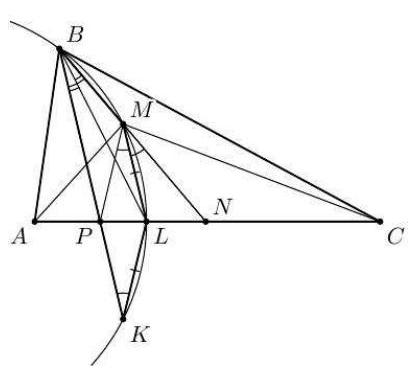
Problema 2. Let $L$ be the meeting point of the angle bisector of $M$ in the triangle $P M N$ with $P N$. Then the condition of the problem implies that $\angle A M L=\angle C M L$, therefore the points $M, L, K$ lie on the Apollonius circle $\omega$ relative to points $A$ and $C$. From the symmetry of $M$ and $K$ we derive that $\angle N M L=\angle L M P=\angle L K P$. Then $\angle B K L+\angle B M L=$ $\angle B L K+180^{\circ}-\angle N M L=180^{\circ}$, thus the quadrilateral $B M L K$ is cyclic. So the point $B$ also lies on $\omega$, whence $\angle A B L=\angle L B C$ and $\angle K B L=\angle L B M$, due to the fact that $K L=L M$. This yields the thesis of the problem.[^2]
Problema 3. Soluţia " oficială" recurge la manipulări asemănătoare celor din soluţiile deja prezentate.
Problema 4. Soluţia "oficială" ajunge şi ea cam la aceleaşi lucruri, mai ales la importanţa pe care o joacă pragul $\lfloor n / 6\rfloor$.
Problema 5. Cea mai simplă metodă.
To prove that $\left|A_{n}\right|=\left|B_{n+1}\right|$ we construct a bijection between these two sets of partitions. Let $A \in A_{n}$; we associate to this partition the partition $B \in B_{n+1}$ given by the following rule
Numbers $xx$, si $\tau(x)=$ începutul ciclului în care se află $x$ în $\tau$ dacă $\sigma(x) \leq x$ (în roşu mai jos).
Pentru exemplul dat de ei mai sus, din
$$
\begin{gathered}
\sigma=\left(\begin{array}{rrrrrrrrrr}
1 & 2 & 3 & 4 & 5 & 6 & 7 & 8 & 9 & 10 \\
4 & 5 & 6 & 7 & 10 & 3 & 8 & 1 & 9 & 2
\end{array}\right) \\
\sigma=(1,4,7,8)(2,5,10)(3,6)(9)
\end{gathered}
$$
obţinem
$$
\begin{gathered}
\tau=\left(\begin{array}{rrrrrrrrrrr}
1 & 2 & 3 & 4 & 5 & 6 & 7 & 8 & 9 & 10 & 11 \\
5 & 6 & 7 & 8 & 11 & 2 & 9 & 4 & 3 & 10 & 1
\end{array}\right) \\
\tau=(1,5,11)(2,6)(4,8)(3,7,9)(10)
\end{gathered}
$$
Procedura inversă, de a construi o permutare $\sigma \in \mathcal{S}_{n} \operatorname{din} \tau \in \mathcal{S}_{n+1}$ este deci astfel; $\sigma(x)=\tau(x)-1$ dacă $\tau(x)>x$, şi $\sigma(x)=$ începutul ciclului în care se află $x$ în $\sigma$ dacă $\tau(x) \leq x$ (în verde mai sus). De fapt, scriind deja în cicluri, după prima parte nu mai avem decât de "încheiat" ciclurile.
Un alt fel este de a vedea la început numerele din $\{1,2, \ldots, n, n+1\}$ drept "atomi" $\{1\},\{2\}, \ldots,\{n\},\{n+1\}$, şi de a "coagula" atomi în "molecule", şi apoi molecule între ele, după reguli evidente în lumina celor de mai sus.
Problema 6. We need a couple of lemmata.
Lemma 1. The area $S$ of a convex $n$-gon $A_{1} A_{2} \ldots A_{n}$ satisfies
$$
2 S \leq \frac{1}{2} \sum_{i=1}^{n} A_{i-1} A_{i+1} \cdot R_{i}=\sum_{i=1}^{n} R_{i}^{2} \sin A_{i}
$$
where $R_{i}$ is the radius of the circumcircle of $\triangle A_{i-1} A_{i} A_{i+1}$, and the indices are reduced modulo $n$ (thus $A_{0} \equiv A_{n}$ and $A_{n+1} \equiv A_{1}$ ).
Proof. Let $M_{i}$ be the midpoint of $A_{i} A_{i+1}$, for $1 \leq i \leq n$. For each $i$ consider the quadrilateral formed by the segments $A_{i} M_{i}$ and $A_{i} M_{i-1}$, and by the perpendiculars onto these segments at $M_{i}$ and $M_{i-1}$, respectively.
We shall prove that these $n$ quadrilaterals cover our $n$-gon. Indeed, let $P$ be a point inside the $n$-gon. Let $P A_{k}$ be the least of the distances $P A_{i}$, $1 \leq i \leq n$. Having $P A_{k} \leq P A_{k+1}$ and $P A_{k} \leq P A_{k-1}$ means $P$ lies inside the $n$-gon and in each of the two half-planes containing $A_{k}$ and limited by the perpendicular bisectors of $A_{k} A_{k+1}$ and $A_{k} A_{k-1}$, thus in the $k$-th quadrilateral. To complete the proof, it remains to notice that the area of the $i$-th quadrilateral does not exceed $\frac{A_{i-1} A_{i+1}}{2} \cdot \frac{R_{i}}{2}$, and also that of course $\frac{A_{i-1} A_{i+1}}{2}=R_{i} \sin A_{i}$.
LEMMA 2. If $\alpha_{1}, \alpha_{2}, \ldots, \alpha_{5}$ are the angles of a convex pentagon, then $\sin ^{2} \alpha_{1}+\sin ^{2} \alpha_{2}+\cdots+\sin ^{2} \alpha_{5} \leq 5 \sin ^{2} 108^{\circ}$.
Proof. Will be presented at the end.
In the context of our problem, it follows that $2 S \leq \sum_{i=1}^{5} R_{i}^{2} \sin A_{i}$. Using the Cauchy-Schwarz-Bunyakovsky inequality and LEMMA 2 we now obtain
$$
2 S \leq \sum_{i=1}^{5} R_{i}^{2} \sin A_{i} \leq \sqrt{\left(\sum_{i=1}^{5} R_{i}^{4}\right)\left(\sum_{i=1}^{5} \sin ^{2} A_{i}\right)} \leq \sqrt{5 \sin ^{2} 108^{\circ} \sum_{i=1}^{5} R_{i}^{4}}
$$
whence $\frac{4 S^{2}}{5 \sin ^{2} 108^{\circ}} \leq \sum_{i=1}^{5} R_{i}^{4}$.
Exact ceea ce bănuiam. LEMA 1 este drăguţă, dar probabil folclor, iar LEMA 2 este o inegalitate auxiliară, rezolvată în soluţia "oficială" prin metode Sturmiene de "mixing variables", axate în mod instrumental pe valoarea $n=5$ (ceea ce explică şi particularizarea din problemă la cazul unui pentagon). Apoi intervine un Cauchy-Schwarz ... Personal, voi utiliza metoda multiplicatorilor Lagrange pentru a obţine acest rezultat, cu valorile lui $n$ variind între 3 şi 5 , şi arăta că inegalitatea nu mai funcţionează pentru $n>5$.
Proof of LeMmA 2. We may assume $0<\alpha_{1} \leq \alpha_{2} \leq \cdots \leq \alpha_{5}<180^{\circ}$. By a well-known formula $\alpha_{1}+\alpha_{2}+\cdots+\alpha_{5}=540^{\circ}$. If $\alpha_{1}=108^{\circ}$, then $\alpha_{2}=\cdots=\alpha_{5}=108^{\circ}$, and the inequality becomes equality. If $\alpha_{1}<108^{\circ}$, then $\alpha_{5}>108^{\circ}$. Notice that $\alpha_{1}+\alpha_{5}<270^{\circ}$ (if $\alpha_{1}+\alpha_{5} \geq 270^{\circ}$, then $\alpha_{2}+\alpha_{3}+\alpha_{4} \leq 270^{\circ}$, so $\alpha_{2} \leq 90^{\circ}$, a fortiori $\alpha_{1} \leq 90^{\circ}$, and therefore $\alpha_{5} \geq 180^{\circ}$, a contradiction).
Therefore we arrive at $\sin ^{2} 108^{\circ}+\sin ^{2}\left(\alpha_{1}+\alpha_{5}-108^{\circ}\right)-\sin ^{2} \alpha_{1}-\sin ^{2} \alpha_{5}=$ $2 \cos \left(\alpha_{1}+\alpha_{5}\right) \sin \left(\alpha_{1}-108^{\circ}\right) \sin \left(\alpha_{5}-108^{\circ}\right)>0$. This means that by the replacement of $\alpha_{1}$ with $108^{\circ}$ and of $\alpha_{5}$ with $\alpha_{1}+\alpha_{5}-108^{\circ}$ we increase the sum of the squared sinuses. Repeating this operation, we will make all the angles equal to $108^{\circ}$, and the inequality is proved.
Soluţia dată mai sus profită din plin de faptul că sunt implicate doar 5 unghiuri. Să vedem ce important este să posedăm metode puternice, care să soluţioneze aceste inegalităţi "auxiliare" care pot apare în cursul rezolvării unei probleme.
Fie deci unghiurile $\alpha_{k} \in(0, \pi), 1 \leq k \leq n$, ale unui poligon convex cu $n$ laturi. Atunci, după un bine-cunoscut fapt, $\sum_{k=1}^{n} \alpha_{k}=(n-2) \pi$. Ne va interesa să determinăm maximul expresiei $\sum_{k=1}^{n} \sin ^{2} \alpha_{k}$, şi anume dacă acest maxim este $n \sin ^{2} \frac{n-2}{n} \pi$. Din păcate funcţia $f:(0, \pi) \rightarrow(0,1]$ dată prin $f(x)=\sin ^{2} x$ nu este concavă, căci derivata sa a doua $f^{\prime \prime}(x)=2 \cos 2 x$ este pozitivă pe $(0, \pi / 4) \cup(3 \pi / 4, \pi)$. Apelăm atunci la metoda multiplicatorilor Lagrange. Fie
$$
L_{n, M}\left(\alpha_{1}, \alpha_{2}, \ldots, \alpha_{n} ; \lambda\right)=\sum_{k=1}^{n} \sin ^{2} \alpha_{k}-\lambda\left(\sum_{k=1}^{n} \alpha_{k}-M \pi\right)
$$
definită pe domeniul $\mathcal{D}_{n, M}=\left\{\left(\alpha_{1}, \alpha_{2}, \ldots, \alpha_{n}\right) \in(0, \pi)^{n} \mid \sum_{k=1}^{n} \alpha_{k}-M \pi\right\}$, unde (pentru a păstra pentru viitor completa generalitate) lucrăm cu un $M$ fixat din intervalul $(0, n)$. Derivatele sale parţiale egalate cu zero sunt $\frac{\partial}{\partial \alpha_{k}} L_{n, M}\left(\alpha_{1}, \alpha_{2}, \ldots, \alpha_{n} ; \lambda\right)=\sin 2 \alpha_{k}-\lambda=0$, pentru $1 \leq k \leq n$. Scăzute în perechi, dau $\sin 2 \alpha_{i}=\sin 2 \alpha_{j}$, pentru toţi $1 \leq i5$ şi $M=n-2$ avem
$L_{n, n-2}=n \sin ^{2} \frac{n-2}{n} \pi4.5=g(6)$. Prin urmare rezultatul nu mai rămâne adevărat pentru poligoane convexe cu $n>5$ laturi.
Să observăm că dacă se cerea, în mod mai simplu, $\sum_{i=1}^{n} R_{i}^{2} \sin A_{i} \geq 2 S$, problema devenea mai unitară şi geometrică, redusă exclusiv la LEMA 1. Prezenţa inegalității din Lema 2 nu face decât să încarce problema (în mod inutil, după mine) cu o inegalitate auxiliară mai dificilă, şi în acest fel adaugă o complicaţie algebrică artificială.
[^0]: ${ }^{1}$ For example, the partition $\{(1,4,5,8),(2,3),(6,9),(7)\}$ is an element of $A_{9}$, and the partition $\{(1,3,5),(2,4),(6)\}$ is an element of $B_{6}$.
[^1]: ${ }^{2}$ For example, the partition $\{(1,4,5,8),(2,3),(6,9),(7)\}$ is an element of $A_{9}$, and the partition $\{(1,3,5),(2,4),(6)\}$ is an element of $B_{6}$.
${ }^{3}$ The sequence $\left(\left|B_{n}\right|\right)_{n \geq 0}$ that starts $1,1,1,2,4,10,25,75,225, \ldots$ is sequence A124419 from Sloane's Encyclopædia of Integer Sequences https://oeis.org/ listing the number of partitions of the set $\{1,2, \ldots, n\}$ having no blocks that contain both odd and even entries. No "elementary" closed form is available, but the general term can be expressed in terms of Bell numbers, since it's $\left|B_{n}\right|=\beta_{\lfloor n / 2\rfloor} \cdot \beta_{\lceil n / 2\rceil}$ (I used $\beta$ instead of the usual $B$ in order to avoid any confusion of notations; maybe that's why the notation $B_{n}$ was chosen in first place, ha ha).
[^2]: ${ }^{4}$ Detalii la http://matol.kz/results/269
${ }^{5}$ Soluţii la http://matol.kz/olympiads/269