# USA TSTST 2021 Solutions
United States of America - TST Selection Test
Andrew Gu and Evan Chen
$63^{\text {rd }}$ IMO 2022 Norway and $11^{\text {th }}$ EGMO 2022 Hungary
## Contents
0 Problems ..... 2
1 Solutions to Day 1 ..... 3
1.1 TSTST 2021/1, proposed by Holden Mui ..... 3
1.2 TSTST 2021/2, proposed by Merlijn Staps ..... 7
1.3 TSTST 2021/3, proposed by Merlijn Staps ..... 11
2 Solutions to Day 2 ..... 13
2.1 TSTST 2021/4, proposed by Holden Mui ..... 13
2.2 TSTST 2021/5, proposed by Vincent Huang ..... 15
2.3 TSTST 2021/6, proposed by Nikolai Beluhov ..... 17
3 Solutions to Day 3 ..... 23
3.1 TSTST 2021/7, proposed by Ankit Bisain, Holden Mui ..... 23
3.2 TSTST 2021/8, proposed by Fedir Yudin ..... 25
3.3 TSTST 2021/9, proposed by Victor Wang ..... 28
## §0 Problems
1. Let $A B C D$ be a quadrilateral inscribed in a circle with center $O$. Points $X$ and $Y$ lie on sides $A B$ and $C D$, respectively. Suppose the circumcircles of $A D X$ and $B C Y$ meet line $X Y$ again at $P$ and $Q$, respectively. Show that $O P=O Q$.
2. Let $a_{1}1$ for which there exists a positive integer $n$ such that $\binom{n}{k}$ is divisible by $n$, and $\binom{n}{m}$ is not divisible by $n$ for $2 \leq mi$.
First, each $i$ has finite degree - otherwise
$$
\frac{a_{x_{1}}}{x_{1}}=\frac{a_{x_{2}}}{x_{2}}=\cdots
$$
for an infinite increasing sequence of positive integers $x_{i}$, but then the $a_{x_{i}}$ are unbounded.
Now we use the following process to build a sequence of indices whose $a_{i}$ we can lower-bound:
- Start at $x_{1}=1$, which is good.
- If we're currently at good index $x_{i}$, then let $s_{i}$ be the largest positive integer such that $x_{i}$ has an edge to $x_{i}+s_{i}$. (This exists because the degrees are finite.)
- Let $t_{i}$ be the smallest positive integer for which $x_{i}+s_{i}+t_{i}$ is good, and let this be $x_{i+1}$. This exists because if all numbers $k \leq x \leq 2 k$ are bad, they must each connect to some number less than $k$ (if two connect to each other, the smaller one is good), but then two connect to the same number, and therefore to each other this is the idea we will use later to bound the $t_{i}$ as well.
Then $x_{i}=1+s_{1}+t_{1}+\cdots+s_{i-1}+t_{i-1}$, and we have
$$
a_{x_{i+1}}>a_{x_{i}+s_{i}}=\frac{x_{i}+s_{i}}{x_{i}} a_{x_{i}}=\frac{1+\left(s_{1}+\cdots+s_{i-1}+s_{i}\right)+\left(t_{1}+\cdots+t_{i-1}\right)}{1+\left(s_{1}+\cdots+s_{i-1}\right)+\left(t_{1}+\cdots+t_{i-1}\right)} a_{x_{i}}
$$
This means
$$
c_{n}:=\frac{a_{x_{n}}}{a_{1}}>\prod_{i=1}^{n-1} \frac{1+\left(s_{1}+\cdots+s_{i-1}+s_{i}\right)+\left(t_{1}+\cdots+t_{i-1}\right)}{1+\left(s_{1}+\cdots+s_{i-1}\right)+\left(t_{1}+\cdots+t_{i-1}\right)}
$$
## Lemma
$t_{1}+\cdots+t_{n} \leq s_{1}+\cdots+s_{n}$ for each $n$.
Proof. Consider $1 \leq i \leq n$. Note that for every $i$, the $t_{i}-1$ integers strictly between $x_{i}+s_{i}$ and $x_{i}+s_{i}+t_{i}$ are all bad, so each such index $x$ must have an edge to some $yx_{i}+s_{i} \geq x_{j}+s_{j}$, contradicting the fact that $x_{j}+s_{j}$ is the largest neighbor of $x_{j}$.
This also means $x$ doesn't have an edge to $x_{j}+s_{j}$ for any $j \leq i$, since if it did, it would have an edge to $x_{j}$.
Second, no two bad values of $x$ can have an edge, since then the smaller one is good. This also means no two bad $x$ can have an edge to the same $y$.
Then each of the $\sum\left(t_{i}-1\right)$ values in the intervals $\left(x_{i}+s_{i}, x_{i}+s_{i}+t_{i}\right)$ for $1 \leq i \leq n$ must have an edge to an unique $y$ in one of the intervals $\left(x_{i}, x_{i}+s_{i}\right)$ (not necessarily with the same $i$ ). Therefore
$$
\sum\left(t_{i}-1\right) \leq \sum\left(s_{i}-1\right) \Longrightarrow \sum t_{i} \leq \sum s_{i}
$$
Now note that if $a>b$, then $\frac{a+x}{b+x}=1+\frac{a-b}{b+x}$ is decreasing in $x$. This means
$$
c_{n}>\prod_{i=1}^{n-1} \frac{1+2 s_{1}+\cdots+2 s_{i-1}+s_{i}}{1+2 s_{1}+\cdots+2 s_{i-1}}>\prod_{i=1}^{n-1} \frac{1+2 s_{1}+\cdots+2 s_{i-1}+2 s_{i}}{1+2 s_{1}+\cdots+2 s_{i-1}+s_{i}}
$$
By multiplying both products, we have a telescoping product, which results in
$$
c_{n}^{2} \geq 1+2 s_{1}+\cdots+2 s_{n}+2 s_{n+1}
$$
The right hand side is unbounded since the $s_{i}$ are positive integers, while $c_{n}=a_{x_{n}} / a_{1}<$ $1 / a_{1}$ is bounded, contradiction.
【 Solution 3 (Gopal Goel). Suppose for sake of contradiction that the problem is false. Call an index $i$ a pin if
$$
\frac{a_{j}}{j}=\frac{a_{i}}{i} \Longrightarrow j \geq i
$$
## Lemma
There exists $k$ such that if we have $\frac{a_{i}}{i}=\frac{a_{j}}{j}$ with $j>i \geq k$, then $j \leq 1.1 i$.
Proof. Note that for any $i$, there are only finitely many $j$ with $\frac{a_{j}}{j}=\frac{a_{i}}{i}$, otherwise $a_{j}=\frac{j a_{i}}{i}$ is unbounded. Thus it suffices to find $k$ for which $j \leq 1.1 i$ when $j>i \geq k$.
Suppose no such $k$ exists. Then, take a pair $j_{1}>i_{1}$ such that $\frac{a_{j_{1}}}{j_{1}}=\frac{a_{i_{1}}}{i_{1}}$ and $j_{1}>1.1 i_{1}$, or $a_{j_{1}}>1.1 a_{i_{1}}$. Now, since $k=j_{1}$ can't work, there exists a pair $j_{2}>i_{2} \geq i_{1}$ such that $\frac{a_{j_{2}}}{j_{2}}=\frac{a_{i_{2}}}{i_{2}}$ and $j_{2}>1.1 i_{2}$, or $a_{j_{2}}>1.1 a_{i_{2}}$. Continuing in this fashion, we see that
$$
a_{j_{\ell}}>1.1 a_{i_{\ell}}>1.1 a_{j_{\ell-1}}
$$
so we have that $a_{j_{\ell}}>1.1^{\ell} a_{i_{1}}$. Taking $\ell>\log _{1.1}\left(1 / a_{1}\right)$ gives the desired contradiction.
## Lemma
For $N>k^{2}$, there are at most $0.8 N$ pins in $[\sqrt{N}, N)$.
Proof. By the first lemma, we see that the number of pins in $\left[\sqrt{N}, \frac{N}{1.1}\right)$ is at most the number of non-pins in $[\sqrt{N}, N)$. Therefore, if the number of pins in $[\sqrt{N}, N)$ is $p$, then we have
$$
p-N\left(1-\frac{1}{1.1}\right) \leq N-p
$$
so $p \leq 0.8 N$, as desired.
We say that $i$ is the pin of $j$ if it is the smallest index such that $\frac{a_{i}}{i}=\frac{a_{j}}{j}$. The pin of $j$ is always a pin.
Given an index $i$, let $f(i)$ denote the largest index less than $i$ that is not a pin (we leave the function undefined when no such index exists, as we are only interested in the behavior for large $i$ ). Then $f$ is weakly increasing and unbounded by the first lemma. Let $N_{0}$ be a positive integer such that $f\left(\sqrt{N_{0}}\right)>k$.
Take any $N>N_{0}$ such that $N$ is not a pin. Let $b_{0}=N$, and $b_{1}$ be the pin of $b_{0}$. Recursively define $b_{2 i}=f\left(b_{2 i-1}\right)$, and $b_{2 i+1}$ to be the pin of $b_{2 i}$.
Let $\ell$ be the largest odd index such that $b_{\ell} \geq \sqrt{N}$. We first show that $b_{\ell} \leq 100 \sqrt{N}$. Since $N>N_{0}$, we have $b_{\ell+1}>k$. By the choice of $\ell$ we have $b_{\ell+2}<\sqrt{N}$, so
$$
b_{\ell+1}<1.1 b_{\ell+2}<1.1 \sqrt{N}
$$
by the first lemma. We see that all the indices from $b_{\ell+1}+1$ to $b_{\ell}$ must be pins, so we have at least $b_{\ell}-1.1 \sqrt{N}$ pins in $\left[\sqrt{N}, b_{\ell}\right)$. Combined with the second lemma, this shows that $b_{\ell} \leq 100 \sqrt{N}$.
Now, we have that $a_{b_{2 i}}=\frac{b_{2 i}}{b_{2 i+1}} a_{b_{2 i+1}}$ and $a_{b_{2 i+1}}>a_{b_{2 i+2}}$, so combining gives us
$$
\frac{a_{b_{0}}}{a_{b_{\ell}}}>\frac{b_{0}}{b_{1}} \frac{b_{2}}{b_{3}} \cdots \frac{b_{\ell-1}}{b_{\ell}} .
$$
Note that there are at least
$$
\left(b_{1}-b_{2}\right)+\left(b_{3}-b_{4}\right)+\cdots+\left(b_{\ell-2}-b_{\ell-1}\right)
$$
pins in $[\sqrt{N}, N)$, so by the second lemma, that sum is at most $0.8 N$. Thus,
$$
\begin{aligned}
\left(b_{0}-b_{1}\right)+\left(b_{2}-b_{3}\right)+\cdots+\left(b_{\ell-1}-b_{\ell}\right) & =b_{0}-\left[\left(b_{1}-b_{2}\right)+\cdots+\left(b_{\ell-2}-b_{\ell-1}\right)\right]-b_{\ell} \\
& \geq 0.2 N-100 \sqrt{N} .
\end{aligned}
$$
Then
$$
\begin{aligned}
\frac{b_{0}}{b_{1}} \frac{b_{2}}{b_{3}} \cdots \frac{b_{\ell-1}}{b_{\ell}} & \geq 1+\frac{b_{0}-b_{1}}{b_{1}}+\cdots+\frac{b_{\ell-1}-b_{\ell}}{b_{\ell}} \\
& >1+\frac{b_{0}-b_{1}}{b_{0}}+\cdots+\frac{b_{\ell-1}-b_{\ell}}{b_{0}} \\
& \geq 1+\frac{0.2 N-100 \sqrt{N}}{N}
\end{aligned}
$$
which is at least 1.01 if $N_{0}$ is large enough. Thus, we see that
$$
a_{N}>1.01 a_{b_{\ell}} \geq 1.01 a_{\lfloor\sqrt{N}\rfloor}
$$
if $N>N_{0}$ is not a pin. Since there are arbitrarily large non-pins, this implies that the sequence $\left(a_{n}\right)$ is unbounded, which is the desired contradiction.
## §1.3 TSTST 2021/3, proposed by Merlijn Staps
Available online at https://aops.com/community/p23586679.
## Problem statement
Find all positive integers $k>1$ for which there exists a positive integer $n$ such that $\binom{n}{k}$ is divisible by $n$, and $\binom{n}{m}$ is not divisible by $n$ for $2 \leq mt_{p}$, so $\nu_{p}(n-i)=\nu_{p}(i)$;
- If $p \mid k$ and $i \neq k_{p}$, then we have $\nu_{p}(i), \nu_{p}(n-i) \leq t_{p}$ and $\nu_{p}(n) \geq t_{p}$, so again $\nu_{p}(n-i)=\nu_{p}(i) ;$
- If $p \mid k$ and $i=k_{p}$, then we have $\nu_{p}(n-i)=\nu_{p}(i)+\nu_{p}(k)$ by (2).
We conclude that $\nu_{p}(n-i)=\nu_{p}(i)$ always holds, except when $i=k_{p}$, when we have $\nu_{p}(n-i)=\nu_{p}(i)+\nu_{p}(k)$ (this formula holds irrespective of whether $p \mid k$ or $\left.p \nmid k\right)$.
We can now show that $\binom{n}{k}$ is divisible by $n$, which amounts to showing that $k$ ! divides $(n-1)(n-2) \cdots(n-k+1)$. Indeed, for each prime $p \leq k$ we have
$$
\begin{aligned}
\nu_{p}((n-1)(n-2) \ldots(n-k+1)) & =\nu_{p}\left(n-k_{p}\right)+\sum_{i\nu_{p}(k)$, then it follows that
$$
\begin{aligned}
\nu_{p}((n-1)(n-2) \ldots(n-m+1)) & =\nu_{p}(k)+\sum_{i=1}^{m-1} \nu_{p}(i) \\
& <\nu_{p}(m)+\sum_{i=1}^{m-1} \nu_{p}(i) \\
& =\nu_{p}(m!)
\end{aligned}
$$
so $m$ ! cannot divide $(n-1)(n-2) \ldots(n-m+1)$. On the other hand, suppose that $\nu_{p}(m) \leq \nu_{p}(k)$ for all $p \mid k$, which would mean that $m \mid k$ and hence $m \leq \frac{k}{2}$. Consider a prime $p$ dividing $m$. We have $k_{p} \geq \frac{k}{2}$, because otherwise $2 k_{p}$ could have been used instead of $k_{p}$. It follows that $m \leq \frac{k}{2} \leq k_{p}$. Therefore, we obtain
$$
\begin{aligned}
\nu_{p}((n-1)(n-2) \ldots(n-m+1)) & =\sum_{i=1}^{m-1} \nu_{p}(n-i) \\
& =\sum_{i=1}^{m-1} \nu_{p}(i) \\
& =\nu_{p}((m-1)!)<\nu_{p}(m!)
\end{aligned}
$$
showing that $(n-1)(n-2) \cdots(n-m+1)$ is not divisible by $m$ !. This shows that $\binom{n}{m}$ is not divisible by $n$ for $ma / 2$, then $(\dagger)$ forces $r^{2}+s^{2} \leq 2 b$, giving the last case.
Hence, there exists some particular pair $(r, s)$ for which there are infinitely many solutions $(m, n)$. Simplifying the system gives
$$
\begin{aligned}
& a n=2 r m+r^{2}-b \\
& 2 s n=a m+b-s^{2}
\end{aligned}
$$
Since the system is linear, for there to be infinitely many solutions $(m, n)$ the system must be dependent. This gives
$$
\frac{a}{2 s}=\frac{2 r}{a}=\frac{r^{2}-b}{b-s^{2}}
$$
so $a=2 \sqrt{r s}$ and $b=\frac{s^{2} \sqrt{r}+r^{2} \sqrt{s}}{\sqrt{r}+\sqrt{s}}$. Since $r s$ must be square, we can reparametrize as $r=k x^{2}, s=k y^{2}$, and $\operatorname{gcd}(x, y)=1$. This gives
$$
\begin{aligned}
a & =2 k x y \\
b & =k^{2} x y\left(x^{2}-x y+y^{2}\right)
\end{aligned}
$$
Thus, $a \mid 2 b$, as desired.
## §2.2 TSTST 2021/5, proposed by Vincent Huang
Available online at https://aops.com/community/p23864182.
## Problem statement
Let $T$ be a tree on $n$ vertices with exactly $k$ leaves. Suppose that there exists a subset of at least $\frac{n+k-1}{2}$ vertices of $T$, no two of which are adjacent. Show that the longest path in $T$ contains an even number of edges.
The longest path in $T$ must go between two leaves. The solutions presented here will solve the problem by showing that in the unique 2-coloring of $T$, all leaves are the same color.
## 【 Solution 1 (Ankan Bhattacharya, Jeffery Li).
## Lemma
If $S$ is an independent set of $T$, then
$$
\sum_{v \in S} \operatorname{deg}(v) \leq n-1
$$
Equality holds if and only if $S$ is one of the two components of the unique 2-coloring of $T$.
Proof. Each edge of $T$ is incident to at most one vertex of $S$, so we obtain the inequality by counting how many vertices of $S$ each edge is incident to. For equality to hold, each edge is incident to exactly one vertex of $S$, which implies the 2 -coloring.
We are given that there exists an independent set of at least $\frac{n+k-1}{2}$ vertices. By greedily choosing vertices of smallest degree, the sum of the degrees of these vertices is at least
$$
k+2 \cdot \frac{n-k-1}{2}=n-1
$$
Thus equality holds everywhere, which implies that the independent set contains every leaf and is one of the components of the 2 -coloring.
## 【 Solution 2 (Andrew Gu).
## Lemma
The vertices of $T$ can be partitioned into $k-1$ paths (i.e. the induced subgraph on each set of vertices is a path) such that all edges of $T$ which are not part of a path are incident to an endpoint of a path.
Proof. Repeatedly trim the tree by taking a leaf and removing the longest path containing that leaf such that the remaining graph is still a tree.
Now given a path of $a$ vertices, at most $\frac{a+1}{2}$ of those vertices can be in an independent set of $T$. By the lemma, $T$ can be partitioned into $k-1$ paths of $a_{1}, \ldots, a_{k-1}$ vertices, so the maximum size of an independent set of $T$ is
$$
\sum \frac{a_{i}+1}{2}=\frac{n+k-1}{2} .
$$
For equality to hold, each path in the partition must have an odd number of vertices, and has a unique 2 -coloring in red and blue where the endpoints are red. The unique independent set of $T$ of size $\frac{n+k-1}{2}$ is then the set of red vertices. By the lemma, the edges of $T$ which are not part of a path connect an endpoint of a path (which is colored red) to another vertex (which must be blue, because the red vertices are independent). Thus the coloring of the paths extends to the unique 2 -coloring of $T$. The leaves of $T$ are endpoints of paths, so they are all red.
## §2.3 TSTST 2021/6, proposed by Nikolai Beluhov
Available online at https://aops.com/community/p23864189.
## Problem statement
Triangles $A B C$ and $D E F$ share circumcircle $\Omega$ and incircle $\omega$ so that points $A, F$, $B, D, C$, and $E$ occur in this order along $\Omega$. Let $\Delta_{A}$ be the triangle formed by lines $A B, A C$, and $E F$, and define triangles $\Delta_{B}, \Delta_{C}, \ldots, \Delta_{F}$ similarly. Furthermore, let $\Omega_{A}$ and $\omega_{A}$ be the circumcircle and incircle of triangle $\Delta_{A}$, respectively, and define circles $\Omega_{B}, \omega_{B}, \ldots, \Omega_{F}, \omega_{F}$ similarly.
(a) Prove that the two common external tangents to circles $\Omega_{A}$ and $\Omega_{D}$ and the two common external tangents to circles $\omega_{A}$ and $\omega_{D}$ are either concurrent or pairwise parallel.
(b) Suppose that these four lines meet at point $T_{A}$, and define points $T_{B}$ and $T_{C}$ similarly. Prove that points $T_{A}, T_{B}$, and $T_{C}$ are collinear.
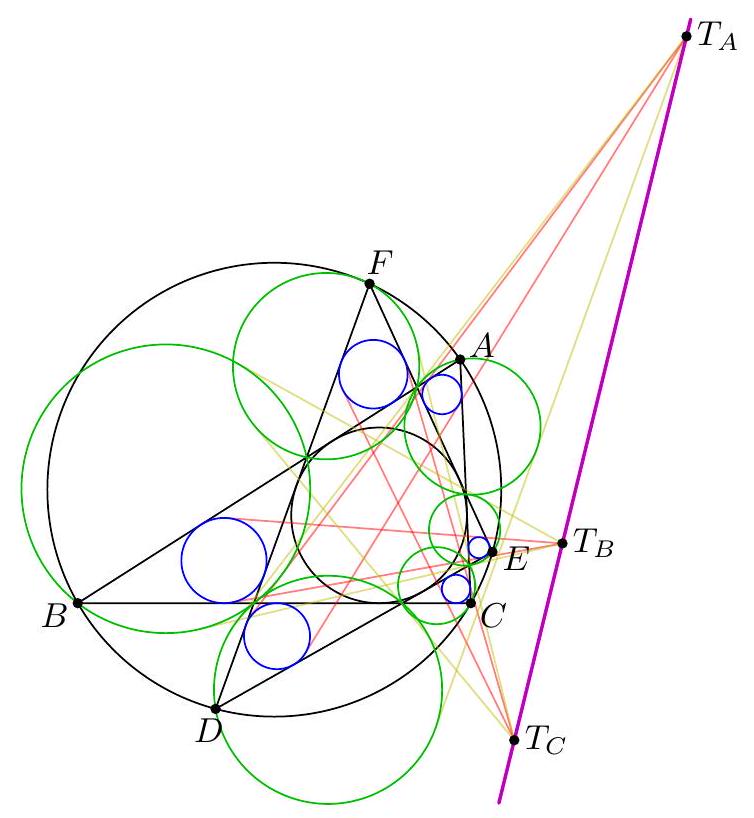
Let $I$ and $r$ be the center and radius of $\omega$, and let $O$ and $R$ be the center and radius of $\Omega$. Let $O_{A}$ and $I_{A}$ be the circumcenter and incenter of triangle $\Delta_{A}$, and define $O_{B}$, $I_{B}, \ldots, I_{F}$ similarly. Let $\omega$ touch $E F$ at $A_{1}$, and define $B_{1}, C_{1}, \ldots, F_{1}$ similarly.
I Part (a). All solutions to part (a) will prove the stronger claim that
$$
\left(\Omega_{A} \cup \omega_{A}\right) \sim\left(\Omega_{D} \cup \omega_{D}\right)
$$
The four lines will concur at the homothetic center of these figures (possibly at infinity).
Solution 1 (author) Let the second tangent to $\omega$ parallel to $E F$ meet lines $A B$ and $A C$ at $P$ and $Q$, respectively, and let the second tangent to $\omega$ parallel to $B C$ meet lines $D E$ and $D F$ at $R$ and $S$, respectively. Furthermore, let $\omega$ touch $P Q$ and $R S$ at $U$ and $V$, respectively.
Let $h$ be inversion with respect to $\omega$. Then $h$ maps $A, B$, and $C$ onto the midpoints of the sides of triangle $D_{1} E_{1} F_{1}$. So $h$ maps $k$ onto the Euler circle of triangle $D_{1} E_{1} F_{1}$.
Similarly, $h$ maps $k$ onto the Euler circle of triangle $A_{1} B_{1} C_{1}$. Therefore, triangles $A_{1} B_{1} C_{1}$ and $D_{1} E_{1} F_{1}$ share a common nine-point circle $\gamma$. Let $K$ be its center; its radius equals $\frac{1}{2} r$.
Let $H$ be the reflection of $I$ in $K$. Then $H$ is the common orthocenter of triangles $A_{1} B_{1} C_{1}$ and $D_{1} E_{1} F_{1}$.
Let $\gamma_{U}$ of center $K_{U}$ and radius $\frac{1}{2} r$ be the Euler circle of triangle $U E_{1} F_{1}$, and let $\gamma_{V}$ of center $K_{V}$ and radius $\frac{1}{2} r$ be the Euler circle of triangle $V B_{1} C_{1}$.
Let $H_{U}$ be the orthocenter of triangle $U E_{1} F_{1}$. Since quadrilateral $D_{1} E_{1} F_{1} U$ is cyclic, vectors $\overrightarrow{H H_{U}}$ and $\overrightarrow{D_{1} U}$ are equal. Consequently, $\overrightarrow{K K_{U}}=\frac{1}{2} \overrightarrow{D_{1} U}$. Similarly, $\overrightarrow{K K_{V}}=$ $\frac{1}{2} \overrightarrow{A_{1} V}$.
Since both of $A_{1} U$ and $D_{1} V$ are diameters in $\omega$, vectors $\overrightarrow{D_{1} U}$ and $\overrightarrow{A_{1} V}$ are equal. Therefore, $K_{U}$ and $K_{V}$ coincide, and so do $\gamma_{U}$ and $\gamma_{V}$.
As above, $h$ maps $\gamma_{U}$ onto the circumcircle of triangle $A P Q$ and $\gamma_{V}$ onto the circumcircle of triangle $D R S$. Therefore, triangles $A P Q$ and $D R S$ are inscribed inside the same circle $\Omega_{A D}$.
Since $E F$ and $P Q$ are parallel, triangles $\Delta_{A}$ and $A P Q$ are homothetic, and so are figures $\Omega_{A} \cup \omega_{A}$ and $\Omega_{A D} \cup \omega$. Consequently, we have
$$
\left(\Omega_{A} \cup \omega_{A}\right) \sim\left(\Omega_{A D} \cup \omega\right) \sim\left(\Omega_{D} \cup \omega_{D}\right),
$$
which solves part (a).
Solution 2 (Michael Ren) As in the previous solution, let the second tangent to $\omega$ parallel to $E F$ meet $A B$ and $A C$ at $P$ and $Q$, respectively. Let $(A P Q)$ meet $\Omega$ again at $D^{\prime}$, so that $D^{\prime}$ is the Miquel point of $\{A B, A C, B C, P Q\}$. Since the quadrilateral formed by these lines has incircle $\omega$, it is classical that $D^{\prime} I$ bisects $\angle P D^{\prime} C$ and $B D^{\prime} Q$ (e.g. by DDIT).
Let $\ell$ be the tangent to $\Omega$ at $D^{\prime}$ and $D^{\prime} I$ meet $\Omega$ again at $M$. We have
$$
\measuredangle\left(\ell, D^{\prime} B\right)=\measuredangle D^{\prime} C B=\measuredangle D^{\prime} Q P=\measuredangle\left(D^{\prime} Q, E F\right) .
$$
Therefore $D^{\prime} I$ also bisects the angle between $\ell$ and the line parallel to $E F$ through $D^{\prime}$. This means that $M$ is one of the arc midpoints of $E F$. Additionally, $D^{\prime}$ lies on $\operatorname{arc} B C$ not containing $A$, so $D^{\prime}=D$.
Similarly, letting the second tangent to $\omega$ parallel to $B C$ meet $D E$ and $D F$ again at $R$ and $S$, we have $A D R S$ cyclic.
## Lemma
There exists a circle $\Omega_{A D}$ tangent to $\Omega_{A}$ and $\Omega_{D}$ at $A$ and $D$, respectively.
Proof. (This step is due to Ankan Bhattacharya.) It is equivalent to have $\measuredangle O A O_{A}=$ $\measuredangle O_{D} D O$. Taking isogonals with respect to the shared angle of $\triangle A B C$ and $\Delta_{A}$, we see that
$$
\measuredangle O A O_{A}=\measuredangle(\perp E F, \perp B C)=\measuredangle(E F, B C) .
$$
(Here, $\perp E F$ means the direction perpendicular to $E F$.) By symmetry, this is equal to $\measuredangle O_{D} D O$.
The circle $(A D P Q)$ passes through $A$ and $D$, and is tangent to $\Omega_{A}$ by homothety. Therefore it coincides with $\Omega_{A D}$, as does ( $A D R S$ ). Like the previous solution, we finish with
$$
\left(\Omega_{A} \cup \omega_{A}\right) \sim\left(\Omega_{A D} \cup \omega\right) \sim\left(\Omega_{D} \cup \omega_{D}\right) .
$$
Solution 3 (Andrew Gu) Construct triangles homothetic to $\Delta_{A}$ and $\Delta_{D}$ (with positive ratio) which have the same circumcircle; it suffices to show that these copies have the same incircle as well. Let $O$ be the center of this common circumcircle, which we take to be the origin, and $M_{X Y}$ denote the point on the circle such that the tangent at that point is parallel to line $X Y$ (from the two possible choices, we make the choice that corresponds to the arc midpoint on $\Omega$, e.g. $M_{A B}$ should correspond to the arc midpoint on the internal angle bisector of $A C B$ ). The left diagram below shows the original triangles $A B C$ and $D E F$, while the right diagram shows the triangles homothetic to $\Delta_{A}$ and $\Delta_{D}$.
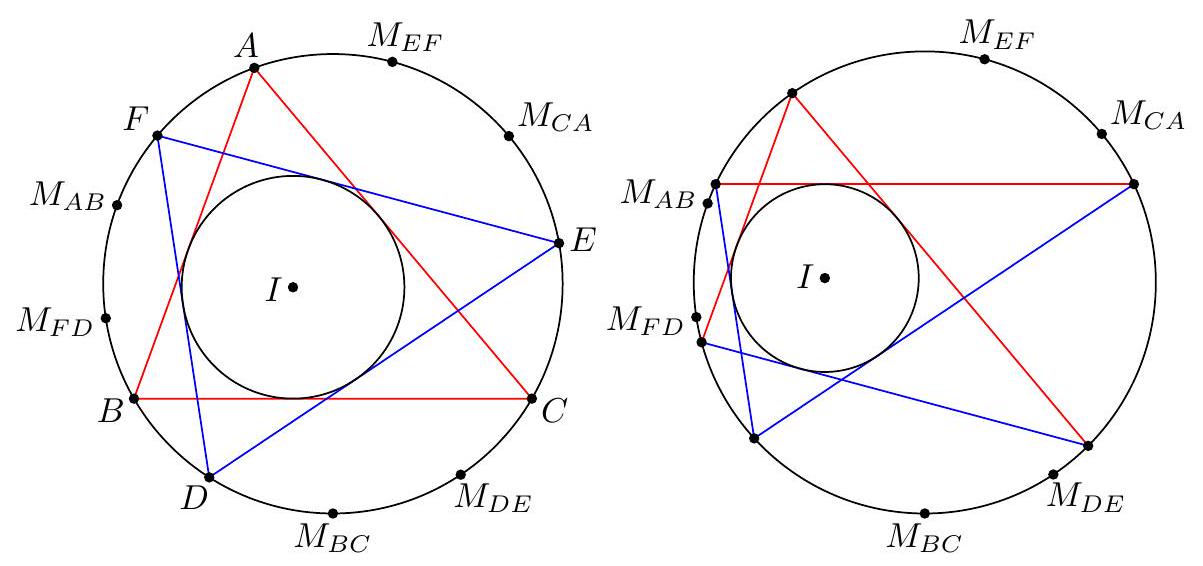
Using the fact that the incenter is the orthocenter of the arc midpoints, the incenter of $\Delta_{A}$ in this reference frame is $M_{A B}+M_{A C}-M_{E F}$ and the incenter of $\Delta_{D}$ in this reference frame is $M_{D E}+M_{D F}-M_{B C}$. Since $A B C$ and $D E F$ share a common incenter, we have
$$
M_{A B}+M_{B C}+M_{C A}=M_{D E}+M_{E F}+M_{F D}
$$
Thus the copies of $\Delta_{A}$ and $\Delta_{D}$ have the same incenter, and therefore the same incircle as well (Euler's theorem determines the inradius).
【 Part (b). We present several solutions for this part of the problem. Solutions 3 and 4 require solving part (a) first, while the others do not. Solutions 1,4 , and 5 define $T_{A}$ solely as the exsimilicenter of $\omega_{A}$ and $\omega_{D}$, whereas solutions 2 and 3 define $T_{A}$ solely as the exsimilicenter of $\Omega_{A}$ and $\Omega_{D}$.
Solution 1 (author) By Monge's theorem applied to $\omega, \omega_{A}$, and $\omega_{D}$, points $A, D$, and $T_{A}$ are collinear. Therefore, $T_{A}=A D \cap I_{A} I_{D}$.
Let $p$ be pole-and-polar correspondence with respect to $\omega$. Then $p$ maps $A$ onto line $E_{1} F_{1}$ and $D$ onto line $B_{1} C_{1}$. Consequently, $p$ maps line $A D$ onto $X_{A}=B_{1} C_{1} \cap E_{1} F_{1}$.
Furthermore, $p$ maps the line that bisects the angle formed by lines $A B$ and $E F$ and does not contain $I$ onto the midpoint of segment $A_{1} F_{1}$. Similarly, $p$ maps the line that bisects the angle formed by lines $A C$ and $E F$ and does not contain $I$ onto the midpoint of segment $A_{1} E_{1}$. So $p$ maps $I_{A}$ onto the midline of triangle $A_{1} E_{1} F_{1}$ opposite $A_{1}$. Similarly, $p$ maps $I_{D}$ onto the midline of triangle $D_{1} B_{1} C_{1}$ opposite $D_{1}$. Consequently, $p$ maps line
$I_{A} I_{D}$ onto the intersection point $Y_{A}$ of this pair of midlines, and $p$ maps $T_{A}$ onto line $X_{A} Y_{A}$.
As in the solution to part (a), let $H$ be the common orthocenter of triangles $A_{1} B_{1} C_{1}$ and $D_{1} E_{1} F_{1}$. Let $H_{A}$ be the foot of the altitude from $A_{1}$ in triangle $A_{1} B_{1} C_{1}$ and let $H_{D}$ be the foot of the altitude from $D_{1}$ in triangle $D_{1} E_{1} F_{1}$. Furthermore, let $L_{A}=H A_{1} \cap E_{1} F_{1}$ and $L_{D}=H D_{1} \cap B_{1} C_{1}$.
Since the reflection of $H$ in line $B_{1} C_{1}$ lies on $\omega, A_{1} H \cdot H H_{A}$ equals half the power of $H$ with respect to $\omega$. Similarly, $D_{1} H \cdot H H_{D}$ equals half the power of $H$ with respect to $\omega$.
Then $A_{1} H \cdot H H_{A}=D_{1} H \cdot H H_{D}$ and $A_{1} H H_{D} \sim D_{1} H H_{A}$. Since $\angle H H_{D} L_{A}=90^{\circ}=$ $\angle H H_{A} L_{D}$, figures $A_{1} H H_{D} L_{A}$ and $D_{1} H H_{A} L_{D}$ are similar as well. Consequently,
$$
\frac{H L_{A}}{L_{A} A_{1}}=\frac{H L_{D}}{L_{D} D_{1}}=s
$$
as a signed ratio.
Let the line through $A_{1}$ parallel to $E_{1} F_{1}$ and the line through $D_{1}$ parallel to $B_{1} C_{1}$ meet at $Z_{A}$. Then $H X_{A} / X_{A} Z_{A}=s$ and $Y_{A}$ is the midpoint of segment $X_{A} Z_{A}$. Therefore, $H$ lies on line $X_{A} Y_{A}$. This means that $T_{A}$ lies on the polar of $H$ with respect to $\omega$, and by symmetry so do $T_{B}$ and $T_{C}$.
Solution 2 (author) As in the first solution to part (a), let $h$ be inversion with respect to $\omega$, let $\gamma$ of center $K$ be the common Euler circle of triangles $A_{1} B_{1} C_{1}$ and $D_{1} E_{1} F_{1}$, and let $H$ be their common orthocenter.
Again as in the solution to part (a), $h$ maps $\Omega_{A}$ onto the nine-point circle $\gamma_{A}$ of triangle $A_{1} E_{1} F_{1}$ and $\Omega_{D}$ onto the nine-point circle $\gamma_{D}$ of triangle $D_{1} B_{1} C_{1}$.
Let $K_{A}$ and $K_{D}$ be the centers of $\gamma_{A}$ and $\gamma_{D}$, respectively, and let $\ell_{A}$ be the perpendicular bisector of segment $K_{A} K_{D}$. Since $\gamma_{A}$ and $\gamma_{D}$ are congruent (both of them are of radius $\left.\frac{1}{2} r\right)$, they are reflections of each other across $\ell_{A}$.
Inversion $h$ maps the two common external tangents of $\Omega_{A}$ and $\Omega_{D}$ onto the two circles $\alpha$ and $\beta$ through $I$ that are tangent to both of $\gamma_{A}$ and $\gamma_{D}$ in the same way. (That is, either internally to both or externally to both.) Consequently, $\alpha$ and $\beta$ are reflections of each other in $\ell_{A}$ and so their second point of intersection $S_{A}$, which $h$ maps $T_{A}$ onto, is the reflection of $I$ in $\ell_{A}$.
Define $\ell_{B}, \ell_{C}, S_{B}$, and $S_{C}$ similarly. Then $S_{B}$ is the reflection of $I$ in $\ell_{B}$ and $S_{C}$ is the reflection of $I$ in $\ell_{C}$.
As in the solution to part (a), $\overrightarrow{K K_{A}}=\frac{1}{2} \overrightarrow{D_{1} A_{1}}$ and $\overrightarrow{K K_{D}}=\frac{1}{2} \overrightarrow{A_{1} D_{1}}$. Consequently, $K$ is the midpoint of segment $K_{A} K_{D}$ and so $K$ lies on $\ell_{A}$. Similarly, $K$ lies on $\ell_{B}$ and $\ell_{C}$.
Therefore, all four points $I, S_{A}, S_{B}$, and $S_{C}$ lie on the circle of center $K$ that contains $I$. (This is also the circle on diameter $I H$.) Since points $S_{A}, S_{B}$, and $S_{C}$ are concyclic with $I$, their images $T_{A}, T_{B}$, and $T_{C}$ under $h$ are collinear, and the solution is complete.
Solution 3 (Ankan Bhattacharya) From either of the first two solutions to part (a), we know that there is a circle $\Omega_{A D}$ passing through $A$ and $D$ which is (internally) tangent to $\Omega_{A}$ and $\Omega_{D}$. By Monge's theorem applied to $\Omega_{A}, \Omega_{D}$, and $\Omega_{A D}$, it follows that $A, D$, and $T_{A}$ are collinear.
The inversion at $T_{A}$ swapping $\Omega_{A}$ with $\Omega_{D}$ also swaps $A$ with $D$ because $T_{A}$ lies on $A D$ and $A$ is not homologous to $D$. Let $\Omega_{A}$ and $\Omega_{D}$ meet $\Omega$ again at $L_{A}$ and $L_{D}$. Since $A D L_{A} L_{D}$ is cyclic, the same inversion at $T_{A}$ also swaps $L_{A}$ and $L_{D}$, so $T_{A}=A D \cap L_{A} L_{D}$.
By Taiwan TST 2014, $L_{A}$ and $L_{D}$ are the tangency points of the $A$-mixtilinear and $D$-mixtilinear incircles, respectively, with $\Omega$. Therefore $A L_{A} \cap D L_{D}$ is the exsimilicenter $X$ of $\Omega$ and $\omega$. Then $T_{A}, T_{B}$, and $T_{C}$ all lie on the polar of $X$ with respect to $\Omega$.
Solution 4 (Andrew Gu) We show that $T_{A}$ lies on the radical axis of the point circle at $I$ and $\Omega$, which will solve the problem. Let $I_{A}$ and $I_{D}$ be the centers of $\omega_{A}$ and $\omega_{D}$ respectively. By the Monge's theorem applied to $\omega, \omega_{A}$, and $\omega_{D}$, points $A, D$, and $T_{A}$ are collinear. Additionally, these other triples are collinear: $\left(A, I_{A}, I\right),\left(D, I_{D}, I\right),\left(I_{A}, I_{D}, T\right)$. By Menelaus's theorem, we have
$$
\frac{T_{A} D}{T_{A} A}=\frac{I_{A} I}{I_{A} A} \cdot \frac{I_{D} D}{I_{D} I} .
$$
If $s$ is the length of the side opposite $A$ in $\Delta_{A}$, then we compute
$$
\begin{aligned}
\frac{I_{A} I}{I_{A} A} & =\frac{s / \cos (A / 2)}{r_{A} / \sin (A / 2)} \\
& =\frac{2 R_{A} \sin (A) \sin (A / 2)}{\cos (A / 2)} \\
& =\frac{4 R_{A} \sin ^{2}(A / 2)}{r_{A}} \\
& =\frac{4 R_{A} r^{2}}{r_{A} A I^{2}} .
\end{aligned}
$$
From part (a), we know that $\frac{R_{A}}{r_{A}}=\frac{R_{D}}{r_{D}}$. Therefore, doing a similar calculation for $\frac{I_{D} D}{I_{D} I}$, we get
$$
\begin{aligned}
\frac{T_{A} D}{T_{A} A} & =\frac{I_{A} I}{I_{A} A} \cdot \frac{I_{D} D}{I_{D} I} \\
& =\frac{4 R_{A} r^{2}}{r_{A} A I^{2}} \cdot \frac{r_{D} D I^{2}}{4 R_{D} r^{2}} \\
& =\frac{D I^{2}}{A I^{2}}
\end{aligned}
$$
Thus $T_{A}$ is the point where the tangent to $(A I D)$ at $I$ meets $A D$ and $T_{A} I^{2}=T_{A} A \cdot T_{A} D$. This shows what we claimed at the start.
Solution 5 (Ankit Bisain) As in the previous solution, it suffices to show that $\frac{I_{A} I}{A I_{A}} \cdot \frac{D I_{D}}{I_{D} I}=\frac{D I^{2}}{A I^{2}}$. Let $A I$ and $D I$ meet $\Omega$ again at $M$ and $N$, respectively. Let $\ell$ be the line parallel to $B C$ and tangent to $\omega$ but different from $B C$. Then
$$
\frac{D I_{D}}{I_{D} I}=\frac{d(D, B C)}{d(B C, \ell)}=\frac{D B \cdot D C / 2 R}{2 r}=\frac{M I^{2}-M D^{2}}{4 R r}
$$
Since $I D M \sim I A N$, we have
$$
\frac{D I_{D}}{I_{D} I} \cdot \frac{I_{A} I}{A I_{A}}=\frac{M I^{2}-M D^{2}}{N I^{2}-N A^{2}}=\frac{D I^{2}}{A I^{2}}
$$
as desired.
Remark (Author comments on generalization of part (b) with a circumscribed hexagram). Let triangles $A B C$ and $D E F$ be circumscribed about the same circle $\omega$ so that they form a hexagram. However, we do not require anymore that they are inscribed in the same circle.
Define circles $\Omega_{A}, \omega_{A}, \ldots, \omega_{F}$ as in the problem. Let $T_{A}^{\text {Circ }}$ be the intersection point of the two common external tangents to circles $\Omega_{A}$ and $\Omega_{D}$, and define points $T_{B}^{\text {Circ }}$ and $T_{C}^{\text {Circ }}$ similarly. Also let $T_{A}^{\text {In }}$ be the intersection point of the two common external tangents to circles $\omega_{A}$ and $\omega_{D}$, and define points $T_{B}^{\mathrm{In}}$ and $T_{C}^{\mathrm{In}}$ similarly.
Then points $T_{A}^{\text {Circ }}, T_{B}^{\text {Circ }}$, and $T_{C}^{\mathrm{Circ}}$ are collinear and points $T_{A}^{\mathrm{In}}, T_{B}^{\mathrm{In}}$, and $T_{C}^{\mathrm{In}}$ are also collinear.
The second solution to part (b) of the problem works also for the circumcircles part of the generalisation. To see that segments $K_{A} K_{D}, K_{B} K_{E}$, and $K_{C} K_{F}$ still have a common midpoint, let $M$ be the centroid of points $A, B, C, D, E$, and $F$. Then the midpoint of segment $K_{A} K_{D}$ divides segment $O M$ externally in ratio $3: 1$, and so do the other two midpoints as well.
For the incircles part of the generalisation, we start out as in the first solution to part (b) of the problem, and eventually we reduce everything to the following:
Let points $A_{1}, B_{1}, C_{1}, D_{1}, E_{1}$, and $F_{1}$ lie on circle $\omega$. Let lines $B_{1} C_{1}$ and $E_{1} F_{1}$ meet at point $X_{A}$, let the line through $A_{1}$ parallel to $B_{1} C_{1}$ and the line through $D_{1}$ parallel to $E_{1} F_{1}$ meet at point $Z_{A}$, and define points $X_{B}, Z_{B}, X_{C}$, and $Z_{C}$ similarly. Then lines $X_{A} Z_{A}$, $X_{B} Z_{B}$, and $X_{C} Z_{C}$ are concurrent.
Take $\omega$ as the unit circle and assign complex numbers $u, v, w, x, y$, and $z$ to points $A_{1}$, $F_{1}, B_{1}, D_{1}, C_{1}$, and $E_{1}$, respectively, so that when we permute $u, v, w, x, y$, and $z$ cyclically the configuration remains unchanged. Then by standard complex bash formulas we obtain that each two out of our three lines meet at $\varphi / \psi$, where
$$
\varphi=\sum_{\mathrm{Cyc}} u^{2} v w(w x-w y+x y)(y-z)
$$
and
$$
\psi=-u^{2} w^{2} y^{2}-v^{2} x^{2} z^{2}-4 u v w x y z+\sum_{\mathrm{Cyc}} u^{2}(v w x y-v w x z+v w y z-v x y z+w x y z)
$$
(But the calculations were too difficult for me to do by hand, so I used SymPy.)
Remark (Author comments on generalization of part (b) with an inscribed hexagram). Let triangles $A B C$ and $D E F$ be inscribed inside the same circle $\Omega$ so that they form a hexagram. However, we do not require anymore that they are circumscribed about the same circle.
Define points $T_{A}^{\text {Circ }}, T_{B}^{\text {Circ }}, \ldots, T_{C}^{\mathrm{In}}$ as in the previous remark. It looks like once again points $T_{A}^{\text {Circ }}, T_{B}^{\text {Circ }}$, and $T_{C}^{\text {Circ }}$ are collinear and points $T_{A}^{\mathrm{In}}, T_{B}^{\mathrm{In}}$, and $T_{C}^{\mathrm{In}}$ are also collinear. However, I do not have proofs of these claims.
Remark (Further generalization from Andrew Gu). Let $A B C$ and $D E F$ be triangles which share an inconic, or equivalently share a circumconic. Define points $T_{A}^{\text {Circ }}, T_{B}^{\text {Circ }}, \ldots, T_{C}^{\mathrm{In}}$ as in the previous remarks. Then it is conjectured that points $T_{A}^{\text {Circ }}, T_{B}^{\text {Circ }}$, and $T_{C}^{\text {Circ }}$ are collinear and points $T_{A}^{\mathrm{In}}, T_{B}^{\mathrm{In}}$, and $T_{C}^{\mathrm{In}}$ are also collinear. (Note that extraversion may be required depending on the configuration of points, e.g. excircles instead of incircles.) Additionally, it appears that the insimilicenters of the circumcircles lie on a line perpendicular to the line through $T_{A}^{\text {Circ }}, T_{B}^{\text {Circ }}$, and $T_{C}^{\text {Circ }}$.
## §3 Solutions to Day 3
## §3.1 TSTST 2021/7, proposed by Ankit Bisain, Holden Mui
Available online at https://aops.com/community/p24130213.
## Problem statement
Let $M$ be a finite set of lattice points and $n$ be a positive integer. A mine-avoiding path is a path of lattice points with length $n$, beginning at $(0,0)$ and ending at a point on the line $x+y=n$, that does not contain any point in $M$. Prove that if there exists a mine-avoiding path, then there exist at least $2^{n-|M|}$ mine-avoiding paths.
We present two approaches.
【 Solution 1. We prove the statement by induction on $n$. We use $n=0$ as a base case, where the statement follows from $1 \geq 2^{-|M|}$. For the inductive step, let $n>0$. There exists at least one mine-avoiding path, which must pass through either $(0,1)$ or $(1,0)$. We consider two cases:
Case 1: there exist mine-avoiding paths starting at both $(1,0)$ and $(0,1)$.
By the inductive hypothesis, there are at least $2^{n-1-|M|}$ mine-avoiding paths starting from each of $(1,0)$ and $(0,1)$. Then the total number of mine-avoiding paths is at least $2^{n-1-|M|}+2^{n-1-|M|}=2^{n-|M|}$.
Case 2: only one of $(1,0)$ and $(0,1)$ is on a mine-avoiding path.
Without loss of generality, suppose no mine-avoiding path starts at $(0,1)$. Then some element of $M$ must be of the form $(0, k)$ for $1 \leq k \leq n$ in order to block the path along the $y$-axis. This element can be ignored for any mine-avoiding path starting at (1,0). By the inductive hypothesis, there are at least $2^{n-1-(|M|-1)}=2^{n-|M|}$ mine-avoiding paths.
This completes the induction step, which solves the problem.
## 【 Solution 2.
## Lemma
If $|M|d$, the pattern changes to
$$
S_{n}=\sum_{j=1}^{d}(-1)^{j+1} c_{j} S_{n-j}
$$
## Lemma
All of the $c_{i}$ are integers except for $c_{d}$. Furthermore, $c_{d}$ is $1 / p$ times an integer.
Proof. The $q$ th cyclotomic polynomial is
$$
\Phi_{q}(x)=1+x^{p^{r-1}}+x^{2 p^{r-1}}+\cdots+x^{(p-1) p^{r-1}}
$$
The polynomial
$$
Q(x)=1+(1+x)^{p^{r-1}}+(1+x)^{2 p^{r-1}}+\cdots+(1+x)^{(p-1) p^{r-1}}
$$
has roots $\omega-1$ for $\omega \in S_{q}$, so it is equal to $p(-x)^{d} P(-1 / x)$ by comparing constant coefficients. Comparing the remaining coefficients, we find that $c_{n}$ is $1 / p$ times the $x^{n}$ coefficient of $Q$.
Since $(x+y)^{p} \equiv x^{p}+y^{p}(\bmod p)$, we conclude that, modulo $p$,
$$
\begin{aligned}
Q(x) & \equiv 1+\left(1+x^{p^{r-1}}\right)+\left(1+x^{p^{r-1}}\right)^{2}+\cdots+\left(1+x^{p^{r-1}}\right)^{p-1} \\
& \equiv\left[\left(1+x^{p^{r-1}}\right)^{p}-1\right] / x^{p^{r-1}}
\end{aligned}
$$
Since $\binom{p}{j}$ is a multiple of $p$ when $0d$ :
- If $\nu_{p}\left(S_{n-j}\right) \geq \ell$ for all $1 \leq j \leq d$ and $\nu_{p}\left(S_{n-d}\right) \geq \ell+1$, then $\nu_{p}\left(S_{n}\right) \geq \ell$.
- If $\nu_{p}\left(S_{n-j}\right) \geq \ell$ for all $1 \leq j \leq d$ and $\nu_{p}\left(S_{n-d}\right)=\ell$, then $\nu_{p}\left(S_{n}\right)=\ell-1$.
Together, these prove the claim by induction.
By the claim, the smallest $n$ for which $\nu_{p}\left(S_{n}\right)<0$ (equivalent to $S_{n}$ not being an integer, by the recurrences) is
$$
n=(r-1) d+m+1=((p-1) r-1) p^{r-1}+1
$$
Remark. The original proposal was the following more general version:
Let $n$ be an integer with prime power factorization $q_{1} \cdots q_{m}$. Let $S_{n}$ denote the set of primitive $n$th roots of unity. Find all tuples of nonnegative integers $\left(z_{1}, \ldots, z_{m}\right)$ such that
$$
\sum_{\omega \in S_{n}} \frac{f(\omega)}{\left(1-\omega^{n / q_{1}}\right)^{z_{1}} \cdots\left(1-\omega^{n / q_{m}}\right)^{z_{m}}} \in \mathbb{Z}
$$
for all polynomials $f \in \mathbb{Z}[x]$.
The maximal $z_{i}$ are exponents in the prime ideal factorization of the different ideal of the cyclotomic extension $\mathbb{Q}\left(\zeta_{n}\right) / \mathbb{Q}$.
Remark. Let $F=\left(x^{p}-1\right) /(x-1)$ be the minimal polynomial of $\zeta_{p}=e^{2 \pi i / p}$ over $\mathbb{Q}$. A calculation of Euler shows that
$$
\left(\mathbb{Z}\left[\zeta_{p}\right]\right)^{*}:=\left\{\alpha=g\left(\zeta_{p}\right) \in \mathbb{Q}\left[\zeta_{p}\right]: \sum_{\omega \in S_{p}} f(\omega) g(\omega) \in \mathbb{Z} \forall f \in \mathbb{Z}[x]\right\}=\frac{1}{F^{\prime}\left(\zeta_{p}\right)} \cdot \mathbb{Z}\left[\zeta_{p}\right],
$$
where
$$
F^{\prime}\left(\zeta_{p}\right)=\frac{p \zeta_{p}^{p-1}-\left[1+\zeta_{p}+\cdots+\zeta_{p}^{p-1}\right]}{1-\zeta_{p}}=p\left(1-\zeta_{p}\right)^{-1} \zeta_{p}^{p-1}
$$
is $\left(1-\zeta_{p}\right)^{[p-1]-1}=\left(1-\zeta_{p}\right)^{p-2}$ times a unit of $\mathbb{Z}\left[\zeta_{p}\right]$. Here, $\left(\mathbb{Z}\left[\zeta_{p}\right]\right)^{*}$ is the dual lattice of $\mathbb{Z}\left[\zeta_{p}\right]$.
Remark. Let $K=\mathbb{Q}(\omega)$, so $(p)$ factors as $(1-\omega)^{p-1}$ in the ring of integers $\mathcal{O}_{K}$ (which, for cyclotomic fields, can be shown to be $\mathbb{Z}[\omega])$. In particular, the ramification index $e$ of $(1-\omega)$ over $p$ is the exponent, $p-1$. Since $e=p-1$ is not divisible by $p$, we have so-called tame ramification. Now by the ramification theory of Dedekind's different ideal, the exponent $z_{1}$ that works when $n=p$ is $e-1=p-2$.
Higher prime powers are more interesting because of wild ramification: $p$ divides $\phi\left(p^{r}\right)=$ $p^{r-1}(p-1)$ if and only if $r>1$. (This is a similar phenomena to how Hensel's lemma for $x^{2}-c$ is more interesting mod powers of 2 than mod odd prime powers.)
Remark. Let $F=\left(x^{q}-1\right) /\left(x^{q / p}-1\right)$ be the minimal polynomial of $\zeta_{q}=e^{2 \pi i / q}$ over $\mathbb{Q}$. The aforementioned calculation of Euler shows that
$$
\left(\mathbb{Z}\left[\zeta_{q}\right]\right)^{*}:=\left\{\alpha=g\left(\zeta_{q}\right) \in \mathbb{Q}\left[\zeta_{q}\right]: \sum_{\omega \in S_{q}} f(\omega) g(\omega) \in \mathbb{Z} \forall f \in \mathbb{Z}[x]\right\}=\frac{1}{F^{\prime}\left(\zeta_{q}\right)} \cdot \mathbb{Z}\left[\zeta_{q}\right]
$$
where the chain rule implies (using the computation from the prime case)
$$
F^{\prime}\left(\zeta_{q}\right)=\left[p\left(1-\zeta_{p}\right)^{-1} \zeta_{p}^{p-1}\right] \cdot \frac{q}{p} \zeta_{q}^{(q / p)-1}=q\left(1-\zeta_{p}\right)^{-1} \zeta_{q}^{-1}
$$
is $\left(1-\zeta_{q}\right)^{r \phi(q)-q / p}=\left(1-\zeta_{q}\right)^{z_{q}}$ times a unit of $\mathbb{Z}\left[\zeta_{q}\right]$.