# INMO-2000
Problems and Solutions
1. The in-circle of triangle $A B C$ touches the sides $B C, C A$ and $A B$ in $K, L$ and $M$ respectively. The line through $A$ and parallel to $L K$ meets $M K$ in $P$ and the line through $A$ and parallel to $M K$ meets $L K$ in $Q$. Show that the line $P Q$ bisects the sides $A B$ and $A C$ of triangle $A B C$.
Solution. : Let $A P, A Q$ produced meet $B C$ in $D, E$ respectively.
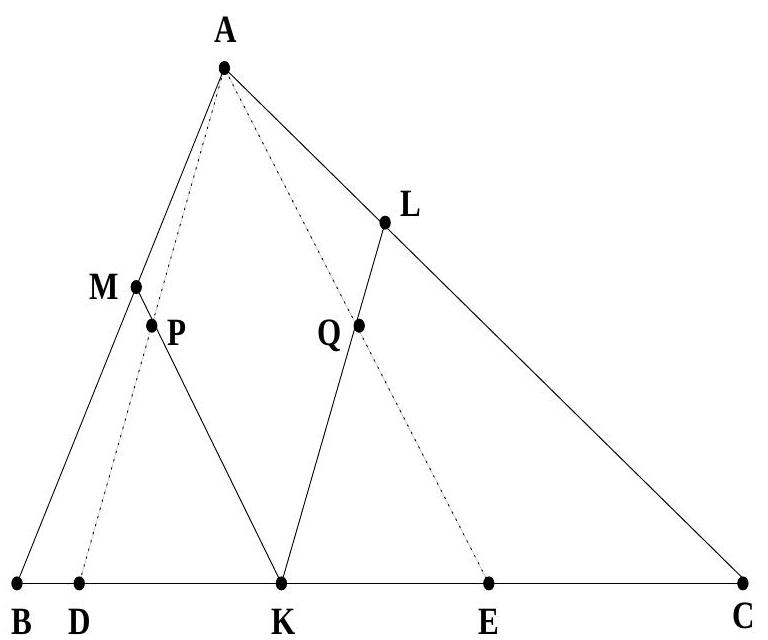
Since $M K$ is parallel to $A E$, we have $\angle A E K=\angle M K B$. Since $B K=B M$, both being tangents to the circle from $B, \angle M K B=\angle B M K$. This with the fact that $M K$ is parallel to $A E$ gives us $\angle A E K=\angle M A E$. This shows that $M A E K$ is an isosceles trapezoid. We conclude that $M A=K E$. Similarly, we can prove that $A L=D K$. But $A M=A L$. We get that $D K=K E$. Since $K P$ is parallel to $A E$, we get $D P=P A$ and similarly $E Q=Q A$. This implies that $P Q$ is parallel to $D E$ and hence bisects $A B, A C$ when produced.
[The same argument holds even if one or both of $P$ and $Q$ lie outside triangle $A B C$.]
2. Solve for integers $x, y, z$ :
$$
x+y=1-z, \quad x^{3}+y^{3}=1-z^{2}
$$
Sol. : Eliminating $z$ from the given set of equations, we get
$$
x^{3}+y^{3}+\{1-(x+y)\}^{2}=1
$$
This factors to
$$
(x+y)\left(x^{2}-x y+y^{2}+x+y-2\right)=0
$$
Case 1. Suppose $x+y=0$. Then $z=1$ and $(x, y, z)=(m,-m, 1)$, where $m$ is an integer give one family of solutions.
Case 2. Suppose $x+y \neq 0$. Then we must have
$$
x^{2}-x y+y^{2}+x+y-2=0 \text {. }
$$
This can be written in the form
$$
(2 x-y+1)^{2}+3(y+1)^{2}=12
$$
Here there are two possibilities:
$$
2 x-y+1=0, y+1= \pm 2 ; \quad 2 x-y+1= \pm 3, y+1= \pm 1
$$
Analysing all these cases we get
$$
(x, y, z)=(0,1,0),(-2,-3,6),(1,0,0),(0,-2,3),(-2,0,3),(-3,-2,6) .
$$
3. If $a, b, c, x$ are real numbers such that $a b c \neq 0$ and
$$
\frac{x b+(1-x) c}{a}=\frac{x c+(1-x) a}{b}=\frac{x a+(1-x) b}{c}
$$
then prove that either $a+b+c=0$ or $a=b=c$.
Sol. : Suppose $a+b+c \neq 0$ and let the common value be $\lambda$. Then
$$
\lambda=\frac{x b+(1-x) c+x c+(1-x) a+x a+(1-x) b}{a+b+c}=1
$$
We get two equations:
$$
-a+x b+(1-x) c=0, \quad(1-x) a-b+x c=0
$$
(The other equation is a linear combination of these two.) Using these two equations, we get the relations
$$
\frac{a}{1-x+x^{2}}=\frac{b}{x^{2}-x+1}=\frac{c}{(1-x)^{2}+x}
$$
Since $1-x+x^{2} \neq 0$, we get $a=b=c$.
4. In a convex quadrilateral $P Q R S, P Q=R S,(\sqrt{3}+1) Q R=S P$ and $\angle R S P-\angle S P Q=$ $30^{\circ}$. Prove that
$$
\angle P Q R-\angle Q R S=90^{\circ}
$$
Sol. : Let $[$ Fig $]$ denote the area of Fig. We have
$$
[P Q R S]=[P Q R]+[R S P]=[Q R S]+[S P Q]
$$
Let us write $P Q=p, Q R=q, R S=r, S P=s$. The above relations reduce to
$$
p q \sin \angle P Q R+r s \sin \angle R S P=q r \sin \angle Q R S+s p \sin \angle S P Q
$$
Using $p=r$ and $(\sqrt{3}+1) q=s$ and dividing by $p q$, we get
$$
\sin \angle P Q R+(\sqrt{3}+1) \sin \angle R S P=\sin \angle Q R S+(\sqrt{3}+1) \sin \angle S P Q
$$
Therefore, $\sin \angle P Q R-\sin \angle Q R S=(\sqrt{3}+1)(\sin \angle S P Q-\sin \angle R S P)$.
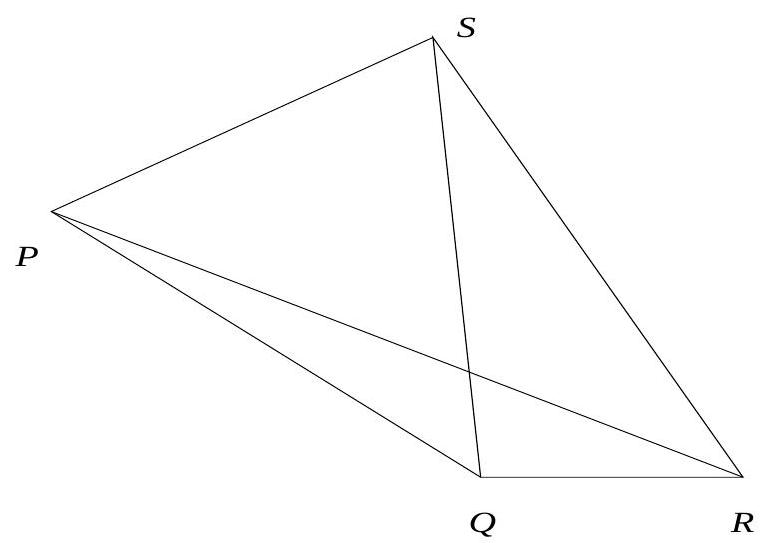
Fig. 2.
This can be written in the form
$$
\begin{aligned}
2 \sin & \frac{\angle P Q R-\angle Q R S}{2} \cos \frac{\angle P Q R+\angle Q R S}{2} \\
& =(\sqrt{3}+1) 2 \sin \frac{\angle S P Q-\angle R S P}{2} \cos \frac{\angle S P Q+\angle R S P}{2}
\end{aligned}
$$
Using the relations
$$
\cos \frac{\angle P Q R+\angle Q R S}{2}=-\cos \frac{\angle S P Q+\angle R S P}{2}
$$
and
$$
\sin \frac{\angle S P Q-\angle R S P}{2}=-\sin 15^{\circ}=-\frac{(\sqrt{3}-1)}{2 \sqrt{2}}
$$
we obtain
$$
\sin \frac{\angle P Q R-\angle Q R S}{2}=(\sqrt{3}+1)\left[-\frac{(\sqrt{3}-1)}{2 \sqrt{2}}\right]=\frac{1}{\sqrt{2}}
$$
This shows that
$$
\frac{\angle P Q R-\angle Q R S}{2}=\frac{\pi}{4} \quad \text { or } \quad \frac{3 \pi}{4}
$$
Using the convexity of $P Q R S$, we can rule out the latter alternative. We obtain
$$
\angle P Q R-\angle Q R S=\frac{\pi}{2}
$$
5. Let $a, b, c$ be three real numbers such that $1 \geq a \geq b \geq c \geq 0$. Prove that if $\lambda$ is a root of the cubic equation $x^{3}+a x^{2}+b x+c=0$ (real or complex), then $|\lambda| \leq 1$.
Sol. : Since $\lambda$ is a root of the equation $x^{3}+a x^{2}+b x+c=0$, we have
$$
\lambda^{3}=-a \lambda^{2}-b \lambda-c
$$
This implies that
$$
\begin{aligned}
\lambda^{4} & =-a \lambda^{3}-b \lambda^{2}-c \lambda \\
& =(1-a) \lambda^{3}+(a-b) \lambda^{2}+(b-c) \lambda+c
\end{aligned}
$$
where we have used again
$$
-\lambda^{3}-a \lambda^{2}-b \lambda-c=0
$$
Suppose $|\lambda| \geq 1$. Then we obtain
$$
\begin{aligned}
|\lambda|^{4} & \leq(1-a)|\lambda|^{3}+(a-b)|\lambda|^{2}+(b-c)|\lambda|+c \\
& \leq(1-a)|\lambda|^{3}+(a-b)|\lambda|^{3}+(b-c)|\lambda|^{3}+c|\lambda|^{3} \\
& \leq|\lambda|^{3}
\end{aligned}
$$
This shows that $|\lambda| \leq 1$. Hence the only possibility in this case is $|\lambda|=1$. We conclude that $|\lambda| \leq 1$ is always true.
6. For any natural number $n,(n \geq 3)$, let $f(n)$ denote the number of non-congruent integer-sided triangles with perimeter $n$ (e.g., $f(3)=1, f(4)=0, f(7)=2$ ). Show that
(a) $f(1999)>f(1996)$
(b) $f(2000)=f(1997)$.
Sol. :
(a) Let $a, b, c$ be the sides of a triangle with $a+b+c=1996$, and each being a positive integer. Then $a+1, b+1, c+1$ are also sides of a triangle with perimeter 1999 because
$$
af(1996)$.
(b) As in the case (a) we conclude that $f(2000) \geq f(1997)$. On the other hand, if $x, y, z$ are the integer sides of a triangle with $x+y+z=2000$, and say $x \geq y \geq z \geq 1$, then we cannot have $z=1$; for otherwise we would get $x+y=1999$ forcing $x, y$ to have opposite parity so that $x-y \geq 1=z$ violating triangle inequality for $x, y, z$. Hence $x \geq y \geq z>1$. This implies that $x-1 \geq y-1 \geq z-1>0$. We already have $x