# USA IMO TST 2021 Solutions
United States of America - IMO Team Selection Test
Andrew Gu, Ankan Bhattacharya and Evan Chen
$62^{\text {th }}$ IMO 2021 Russia
## Contents
0 Problems ..... 2
1 Solutions to Day 1 ..... 3
1.1 USA TST 2021/1, proposed by Ankan Bhattacharya, Michael Ren ..... 3
1.2 USA TST 2021/2, proposed by Andrew Gu, Frank Han ..... 4
1.3 USA TST 2021/3, proposed by Gabriel Carroll ..... 7
## §0 Problems
1. Determine all integers $s \geq 4$ for which there exist positive integers $a, b, c, d$ such that $s=a+b+c+d$ and $s$ divides $a b c+a b d+a c d+b c d$.
2. Points $A, V_{1}, V_{2}, B, U_{2}, U_{1}$ lie fixed on a circle $\Gamma$, in that order, and such that $B U_{2}>A U_{1}>B V_{2}>A V_{1}$.
Let $X$ be a variable point on the $\operatorname{arc} V_{1} V_{2}$ of $\Gamma$ not containing $A$ or $B$. Line $X A$ meets line $U_{1} V_{1}$ at $C$, while line $X B$ meets line $U_{2} V_{2}$ at $D$.
Prove there exists a fixed point $K$, independent of $X$, such that the power of $K$ to the circumcircle of $\triangle X C D$ is constant.
3. Find all functions $f: \mathbb{R} \rightarrow \mathbb{R}$ that satisfy the inequality
$$
f(y)-\left(\frac{z-y}{z-x} f(x)+\frac{y-x}{z-x} f(z)\right) \leq f\left(\frac{x+z}{2}\right)-\frac{f(x)+f(z)}{2}
$$
for all real numbers $xs$, contradiction.
## §1.2 USA TST 2021/2, proposed by Andrew Gu, Frank Han
Available online at https://aops.com/community/p20672623.
## Problem statement
Points $A, V_{1}, V_{2}, B, U_{2}, U_{1}$ lie fixed on a circle $\Gamma$, in that order, and such that $B U_{2}>A U_{1}>B V_{2}>A V_{1}$.
Let $X$ be a variable point on the $\operatorname{arc} V_{1} V_{2}$ of $\Gamma$ not containing $A$ or $B$. Line $X A$ meets line $U_{1} V_{1}$ at $C$, while line $X B$ meets line $U_{2} V_{2}$ at $D$.
Prove there exists a fixed point $K$, independent of $X$, such that the power of $K$ to the circumcircle of $\triangle X C D$ is constant.
For brevity, we let $\ell_{i}$ denote line $U_{i} V_{i}$ for $i=1,2$.
We first give an explicit description of the fixed point $K$. Let $E$ and $F$ be points on $\Gamma$ such that $\overline{A E} \| \ell_{1}$ and $\overline{B F} \| \ell_{2}$. The problem conditions imply that $E$ lies between $U_{1}$ and $A$ while $F$ lies between $U_{2}$ and $B$. Then we let
$$
K=\overline{A F} \cap \overline{B E}
$$
This point exists because $A E F B$ are the vertices of a convex quadrilateral.
Remark (How to identify the fixed point). If we drop the condition that $X$ lies on the arc, then the choice above is motivated by choosing $X \in\{E, F\}$. Essentially, when one chooses $X \rightarrow E$, the point $C$ approaches an infinity point. So in this degenerate case, the only points whose power is finite to $(X C D)$ are bounded are those on line $B E$. The same logic shows that $K$ must lie on line $A F$. Therefore, if the problem is going to work, the fixed point must be exactly $\overline{A F} \cap \overline{B E}$.
We give two possible approaches for proving the power of $K$ with respect to $(X C D)$ is fixed.
【 First approach by Vincent Huang. We need the following claim:
Claim - Suppose distinct lines $A C$ and $B D$ meet at $X$. Then for any point $K$
$$
\operatorname{pow}(K, X A B)+\operatorname{pow}(K, X C D)=\operatorname{pow}(K, X A D)+\operatorname{pow}(K, X B C)
$$
Proof. The difference between the left-hand side and right-hand side is a linear function in $K$, which vanishes at all of $A, B, C, D$.
Construct the points $P=\ell_{1} \cap \overline{B E}$ and $Q=\ell_{2} \cap \overline{A F}$, which do not depend on $X$.
Claim - Quadrilaterals $B P C X$ and $A Q D X$ are cyclic.
Proof. By Reim's theorem: $\measuredangle C P B=\measuredangle A E B=\measuredangle A X B=\measuredangle C X B$, etc.
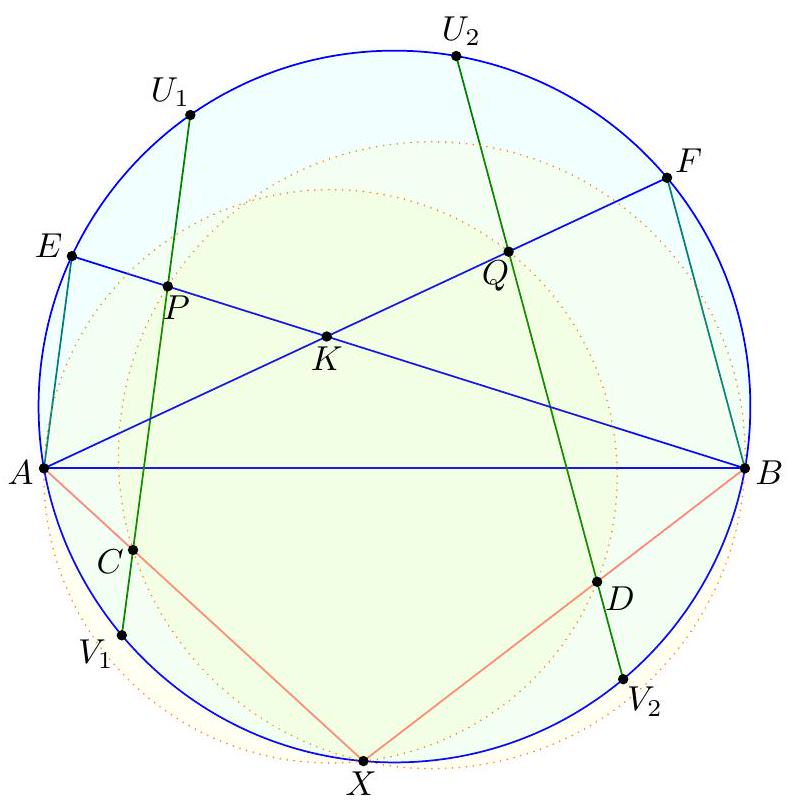
Now, for the particular $K$ we choose, we have
$$
\begin{aligned}
\operatorname{pow}(K, X C D) & =\operatorname{pow}(K, X A D)+\operatorname{pow}(K, X B C)-\operatorname{pow}(K, X A B) \\
& =K A \cdot K Q+K B \cdot K P-\operatorname{pow}(K, \Gamma) .
\end{aligned}
$$
This is fixed, so the proof is completed.
【 Second approach by authors. Let $Y$ be the second intersection of $(X C D)$ with $\Gamma$. Let $S=\overline{E Y} \cap \ell_{1}$ and $T=\overline{F Y} \cap \ell_{2}$.
Claim - Points $S$ and $T$ lies on ( $X C D)$ as well.
Proof. By Reim's theorem: $\measuredangle C S Y=\measuredangle A E Y=\measuredangle A X Y=\measuredangle C X Y$, etc.
Now let $X^{\prime}$ be any other choice of $X$, and define $C^{\prime}$ and $D^{\prime}$ in the obvious way. We are going to show that $K$ lies on the radical axis of $(X C D)$ and $\left(X^{\prime} C^{\prime} D^{\prime}\right)$.
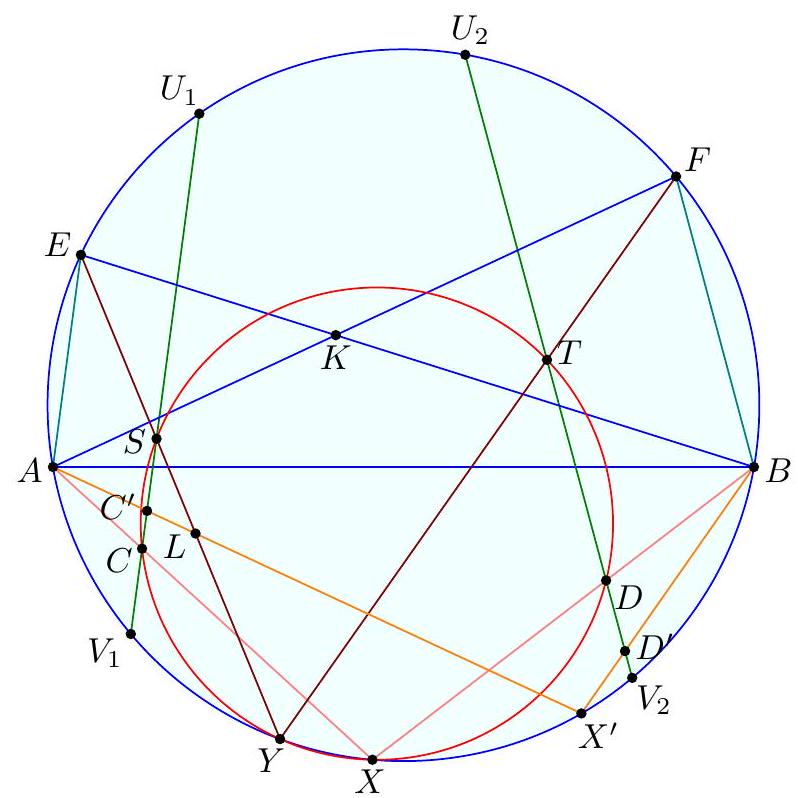
The main idea is as follows:
Claim - The point $L=\overline{E Y} \cap \overline{A X^{\prime}}$ lies on the radical axis. By symmetry, so does the point $M=\overline{F Y} \cap \overline{B X^{\prime}}$ (not pictured).
Proof. Again by Reim's theorem, $S C^{\prime} Y X^{\prime}$ is cyclic. Hence we have
$$
\operatorname{pow}\left(L, X^{\prime} C^{\prime} D^{\prime}\right)=L C^{\prime} \cdot L X^{\prime}=L S \cdot L Y=\operatorname{pow}(L, X C D)
$$
To conclude, note that by Pascal theorem on
$$
E Y F A X^{\prime} B
$$
it follows $K, L, M$ are collinear, as needed.
Remark. All the conditions about $U_{1}, V_{1}, U_{2}, V_{2}$ at the beginning are there to eliminate configuration issues, making the problem less obnoxious to the contestant.
In particular, without the various assumptions, there exist configurations in which the point $K$ is at infinity. In these cases, the center of $X C D$ moves along a fixed line.
## §1.3 USA TST 2021/3, proposed by Gabriel Carroll
Available online at https://aops.com/community/p20672681.
## Problem statement
Find all functions $f: \mathbb{R} \rightarrow \mathbb{R}$ that satisfy the inequality
$$
f(y)-\left(\frac{z-y}{z-x} f(x)+\frac{y-x}{z-x} f(z)\right) \leq f\left(\frac{x+z}{2}\right)-\frac{f(x)+f(z)}{2}
$$
for all real numbers $x\max \{z-y, y-x\}$. Since $f$ has a supergradient $\alpha$ at $y$ over the interval $(y-\Delta, y+\Delta)$, and this interval includes $x$ and $z$, we have
$$
\begin{aligned}
\frac{z-y}{z-x} f(x)+\frac{y-x}{z-x} f(z) & \leq \frac{z-y}{z-x}(f(y)+\alpha(x-y))+\frac{y-x}{z-x}(f(y)+\alpha(z-y)) \\
& =f(y)
\end{aligned}
$$
That is, $f$ is a concave function. Continuity follows from the fact that any concave function on $\mathbb{R}$ is automatically continuous.
Lemma (see e.g. https://math.stackexchange.com/a/615161 for picture)
Any concave function $f$ on $\mathbb{R}$ is continuous.
Proof. Suppose we wish to prove continuity at $p \in \mathbb{R}$. Choose any real numbers $a$ and $b$ with $a0$, let's define the function
$$
g(t)=\frac{f(y)-f(y-t)}{t}-\frac{f(y+t)-f(y)}{t} .
$$
We contend that $g(\varepsilon) \leq \frac{3}{5} g(3 \varepsilon)$ for any $\varepsilon>0$. Indeed by the problem condition,
$$
\begin{aligned}
& f(y) \leq f(y-\varepsilon)+\frac{f(y+\varepsilon)-f(y-3 \varepsilon)}{4} \\
& f(y) \leq f(y+\varepsilon)-\frac{f(y+3 \varepsilon)-f(y-\varepsilon)}{4} .
\end{aligned}
$$
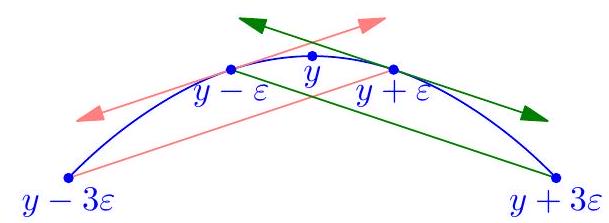
Summing gives the desired conclusion.
Now suppose that $f$ has two supergradients $\alpha<\alpha^{\prime}$ at point $y$. For small enough $\varepsilon$, we should have we have $f(y-\varepsilon) \leq f(y)-\alpha^{\prime} \varepsilon$ and $f(y+\varepsilon) \leq f(y)+\alpha \varepsilon$, hence
$$
g(\varepsilon)=\frac{f(y)-f(y-\varepsilon)}{\varepsilon}-\frac{f(y+\varepsilon)-f(y)}{\varepsilon} \geq \alpha^{\prime}-\alpha .
$$
This is impossible since $g(\varepsilon)$ may be arbitrarily small.
Claim - The function $f$ is quadratic on the rational numbers.
Proof. Consider any four-term arithmetic progression $x, x+d, x+2 d, x+3 d$. Because $(f(x+2 d)-f(x+d)) / d$ and $(f(x+3 d)-f(x)) / 3 d$ are both supergradients of $f$ at the point $x+3 d / 2$, they must be equal, hence
$$
f(x+3 d)-3 f(x+2 d)+3 f(x+d)-f(x)=0 .
$$
If we fix $d=1 / n$, it follows inductively that $f$ agrees with a quadratic function $\widetilde{f}_{n}$ on the set $\frac{1}{n} \mathbb{Z}$. On the other hand, for any $m \neq n$, we apparently have $\widetilde{f}_{n}=\widetilde{f}_{m n}=\widetilde{f}_{m}$, so the quadratic functions on each "layer" are all equal.
Since $f$ is continuous, it follows $f$ is quadratic, as needed.
Remark (Alternate finish using differentiability due to Michael Ren). In the proof of the main claim (about uniqueness of supergradients), we can actually notice the two terms $\frac{f(y)-f(y-t)}{t}$ and $\frac{f(y+t)-f(y)}{t}$ in the definition of $g(t)$ are both monotonic (by concavity). Since we supplied a proof that $\lim _{t \rightarrow 0} g(t)=0$, we find $f$ is differentiable.
Now, if the derivative at some point exists, it must coincide with all the supergradients; (informally, this is why "tangent line trick" always has the slope as the derivative, and formally, we use the mean value theorem). In other words, we must have
$$
f(x+y)-f(x-y)=2 f^{\prime}(x) \cdot y
$$
holds for all real numbers $x$ and $y$. By choosing $y=1$ we obtain that $f^{\prime}(x)=f(x+1)-f(x-1)$ which means $f^{\prime}$ is also continuous.
Finally differentiating both sides with respect to $y$ gives
$$
f^{\prime}(x+y)-f^{\prime}(x-y)=2 f^{\prime}(x)
$$
which means $f^{\prime}$ obeys Jensen's functional equation. Since $f^{\prime}$ is continuous, this means $f^{\prime}$ is linear. Thus $f$ is quadratic, as needed.