


File size: 14,851 Bytes
63c5bce | 1 2 3 4 5 6 7 8 9 10 11 12 13 14 15 16 17 18 19 20 21 22 23 24 25 26 27 28 29 30 31 32 33 34 35 36 37 38 39 40 41 42 43 44 45 46 47 48 49 50 51 52 53 54 55 56 57 58 59 60 61 62 63 64 65 66 67 68 69 70 71 72 73 74 75 76 77 78 79 80 81 82 83 84 85 86 87 88 89 90 91 92 93 94 95 96 97 98 99 100 101 102 103 104 105 106 107 108 109 110 111 112 113 114 115 116 117 118 119 120 121 122 123 124 125 126 127 128 129 130 131 132 133 134 135 136 137 138 139 140 141 142 143 144 145 146 147 148 149 150 151 152 153 154 155 156 157 158 159 160 161 162 163 164 165 166 167 168 169 170 171 172 173 174 175 176 177 178 179 180 181 182 183 184 185 186 187 188 189 190 191 192 193 194 195 196 197 198 199 200 201 202 203 204 205 206 207 208 209 210 211 212 213 214 215 216 217 218 219 220 221 222 223 224 225 226 227 228 229 230 231 232 233 234 235 236 237 238 239 240 241 242 243 244 245 246 247 248 249 250 251 252 253 254 255 256 257 258 259 260 261 262 263 264 265 266 267 268 269 270 271 272 273 274 275 276 277 278 279 280 281 282 283 284 285 286 287 288 289 290 291 292 293 294 295 296 297 298 299 300 301 302 303 304 305 306 307 308 309 310 311 312 313 314 315 316 317 318 319 320 321 322 323 324 325 | # USAMO 2004 Solution Notes
Evan Chen《陳誼廷》
15 April 2024
This is a compilation of solutions for the 2004 USAMO. The ideas of the solution are a mix of my own work, the solutions provided by the competition organizers, and solutions found by the community. However, all the writing is maintained by me.
These notes will tend to be a bit more advanced and terse than the "official" solutions from the organizers. In particular, if a theorem or technique is not known to beginners but is still considered "standard", then I often prefer to use this theory anyways, rather than try to work around or conceal it. For example, in geometry problems I typically use directed angles without further comment, rather than awkwardly work around configuration issues. Similarly, sentences like "let $\mathbb{R}$ denote the set of real numbers" are typically omitted entirely.
Corrections and comments are welcome!
## Contents
0 Problems ..... 2
1 Solutions to Day 1 ..... 3
1.1 USAMO 2004/1, proposed by Titu Andreescu ..... 3
1.2 USAMO 2004/2, proposed by Kiran Kedlaya ..... 4
1.3 USAMO 2004/3, proposed by Ricky Liu ..... 6
2 Solutions to Day 2 ..... 8
2.1 USAMO 2004/4, proposed by Melanie Wood ..... 8
2.2 USAMO 2004/5, proposed by Titu Andreescu ..... 9
2.3 USAMO 2004/6, proposed by Zuming Feng ..... 10
## §0 Problems
1. Let $A B C D$ be a quadrilateral circumscribed about a circle, whose interior and exterior angles are at least 60 degrees. Prove that
$$
\frac{1}{3}\left|A B^{3}-A D^{3}\right| \leq\left|B C^{3}-C D^{3}\right| \leq 3\left|A B^{3}-A D^{3}\right|
$$
When does equality hold?
2. Let $a_{1}, a_{2}, \ldots, a_{n}$ be integers whose greatest common divisor is 1 . Let $S$ be a set of integers with the following properties:
(a) $a_{i} \in S$ for $i=1, \ldots, n$.
(b) $a_{i}-a_{j} \in S$ for $i, j=1, \ldots, n$, not necessarily distinct.
(c) If $x, y \in S$ and $x+y \in S$, then $x-y \in S$ too.
Prove that $S=\mathbb{Z}$.
3. For what real values of $k>0$ is it possible to dissect a $1 \times k$ rectangle into two similar but noncongruent polygons?
4. Alice and Bob play a game on a 6 by 6 grid. On his turn, a player chooses a rational number not yet appearing in the grid and writes it in an empty square of the grid. Alice goes first and then the players alternate. When all squares have numbers written in them, in each row, the square with the greatest number in that row is colored black. Alice wins if he can then draw a line from the top of the grid to the bottom of the grid that stays in black squares, and Bob wins if he can't. (If two squares share a vertex, Alice can draw a line from one to the other that stays in those two squares.) Find, with proof, a winning strategy for one of the players.
5. Let $a, b, c$ be positive reals. Prove that
$$
\left(a^{5}-a^{2}+3\right)\left(b^{5}-b^{2}+3\right)\left(c^{5}-c^{2}+3\right) \geq(a+b+c)^{3} .
$$
6. A circle $\omega$ is inscribed in a quadrilateral $A B C D$. Let $I$ be the center of $\omega$. Suppose that
$$
(A I+D I)^{2}+(B I+C I)^{2}=(A B+C D)^{2}
$$
Prove that $A B C D$ is an isosceles trapezoid.
## §1 Solutions to Day 1
## §1.1 USAMO 2004/1, proposed by Titu Andreescu
Available online at https://aops.com/community/p17439.
## Problem statement
Let $A B C D$ be a quadrilateral circumscribed about a circle, whose interior and exterior angles are at least 60 degrees. Prove that
$$
\frac{1}{3}\left|A B^{3}-A D^{3}\right| \leq\left|B C^{3}-C D^{3}\right| \leq 3\left|A B^{3}-A D^{3}\right|
$$
When does equality hold?
Clearly it suffices to show the left inequality. Since $A B+C D=B C+A D \Longrightarrow$ $|A B-A D|=|B C-C D|$, it suffices to prove
$$
\frac{1}{3}\left(A B^{2}+A B \cdot A D+A D^{2}\right) \leq B C^{2}+B C \cdot C D+C D^{2}
$$
This follows by noting that
$$
\begin{aligned}
B C^{2}+B C \cdot C D+C D^{2} & \geq B C^{2}+C D^{2}-2(B C)(C D) \cos (\angle B C D) \\
& =B D^{2} \\
& =A B^{2}+A D^{2}-2(A B)(A D) \cos (\angle B A D) \\
& \geq A B^{2}+A D^{2}-A B \cdot A D \\
& \geq \frac{1}{3}\left(A B^{2}+A D^{2}+A B \cdot A D\right)
\end{aligned}
$$
the last line following by AM-GM.
The equality holds iff $A B C D$ is a kite with $A B=A D, C B=C D$.
## §1.2 USAMO 2004/2, proposed by Kiran Kedlaya
Available online at https://aops.com/community/p17440.
## Problem statement
Let $a_{1}, a_{2}, \ldots, a_{n}$ be integers whose greatest common divisor is 1 . Let $S$ be a set of integers with the following properties:
(a) $a_{i} \in S$ for $i=1, \ldots, n$.
(b) $a_{i}-a_{j} \in S$ for $i, j=1, \ldots, n$, not necessarily distinct.
(c) If $x, y \in S$ and $x+y \in S$, then $x-y \in S$ too.
Prove that $S=\mathbb{Z}$.
The idea is to show any linear combination of the $a_{i}$ are in $S$, which implies (by Bezout) that $S=\mathbb{Z}$. This is pretty intuitive, but the details require some care (in particular there is a parity obstruction at the second lemma).
First, we make the following simple observations:
- $0 \in S$, by putting $i=j=1$ in (b).
- $s \in S \Longleftrightarrow-s \in S$, by putting $x=0$ in (c).
Now, we prove that:
## Lemma
For any integers $c, d$, and indices $i, j$, we have $c a_{i}+d a_{j} \in S$.
Proof. We will assume $c, d>0$ since the other cases are analogous. In that case it follows by induction on $c+d$ for example $c a_{i}+(d-1) a_{j}, a_{j}, c a_{i}+d a_{j}$ in $S$ implies $c a_{i}+(d+1) a_{j} \in S$.
## Lemma
For any nonzero integers $c_{1}, c_{2}, \ldots, c_{m}$, and any distinct indices $\left\{i_{1}, i_{2}, \ldots, i_{m}\right\}$, we have
$$
\sum_{k} c_{k} a_{i_{k}} \in S
$$
Proof. By induction on $m$, with base case $m \leq 2$ already done.
For the inductive step, we will assume that $i_{1}=1, i_{2}=2$, et cetera, for notational convenience. The proof is then split into two cases.
First Case: some $c_{i}$ is even. WLOG $c_{1} \neq 0$ is even and note that
$$
\begin{aligned}
x & :=\frac{1}{2} c_{1} a_{1}+\sum_{k \geq 3} c_{k} a_{k} \in S \\
y & :=-\frac{1}{2} c_{1} a_{1}-c_{2} a_{2} \in S
\end{aligned}
$$
$$
\begin{aligned}
x+y & =-c_{2} a_{2}+\sum_{k \geq 3} c_{k} a_{k} \in S \\
\Longrightarrow x-y & =\sum_{k \geq 1} c_{k} a_{k} \in S .
\end{aligned}
$$
Second Case: all $c_{i}$ are odd. We reduce this to the first case as follows. Let $u=\frac{a_{1}}{\operatorname{gcd}\left(a_{1}, a_{2}\right)}$ and $v=\frac{a_{2}}{\operatorname{gcd}\left(a_{1}, a_{2}\right)}$. Then $\operatorname{gcd}(u, v)=1$ and so WLOG $u$ is odd. Then
$$
c_{1} a_{1}+c_{2} a_{2}=\left(c_{1}+v\right) a_{1}+\left(c_{2}-u\right) a_{2}
$$
and so we can replace our given combination by $\left(c_{1}+v\right) a_{1}+\left(c_{2}-u\right) a_{2}+c_{3} a_{3}+\ldots$ which now has an even coefficient for $a_{2}$.
We then apply the lemma at $m=n$; this implies the result since Bezout's lemma implies that $\sum c_{i} a_{i}=1$ for some choice of $c_{i} \in \mathbb{Z}$.
## §1.3 USAMO 2004/3, proposed by Ricky Liu
Available online at https://aops.com/community/p17441.
## Problem statement
For what real values of $k>0$ is it possible to dissect a $1 \times k$ rectangle into two similar but noncongruent polygons?
Answer: the dissection is possible for every $k>0$ except for $k=1$.
Construction. By symmetry it suffices to give a construction for $k>1$ (since otherwise we replace $k$ by $k^{-1}$ ). For every integer $n \geq 2$ and real number $r>1$, we define a shape $\mathcal{R}(n, r)$ as follows.
- We start with a rectangle of width 1 and height $r$. To its left, we glue a rectangle of height $r$ and width $r^{2}$ to its left.
- Then, we glue a rectangle of width $1+r^{2}$ and height $r^{3}$ below our figure, followed by a rectangle of height $r+r^{3}$ and width $r^{4}$ to the left of our figure.
- Next, we glue a rectangle of width $1+r^{2}+r^{4}$ and height $r^{5}$ below our figure, followed by a rectangle of height $r+r^{3}+r^{5}$ and width $r^{6}$ to the left of our figure.
. . and so on, up until we have put $2 n$ rectangles together. The picture $\mathcal{R}(3, r)$ is shown below as an example.
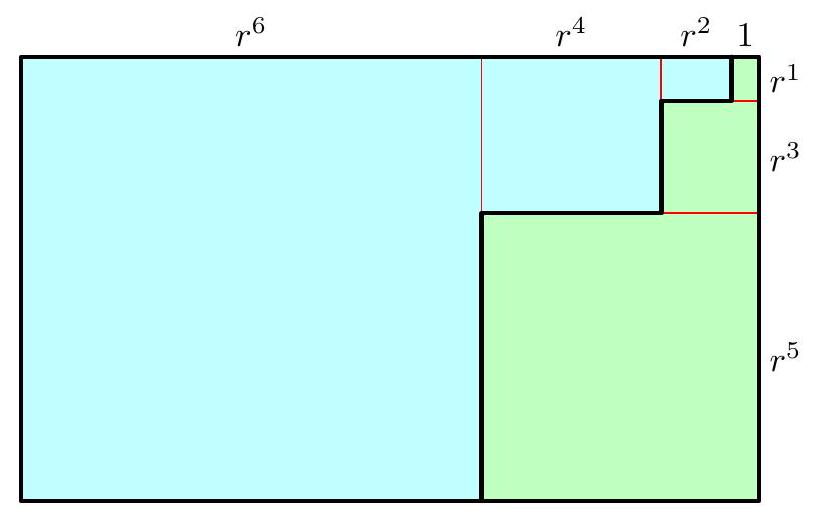
Observe that by construction, the entire shape $\mathcal{R}(n, r)$ is a rectangle which consists of two similar "staircase" polygons (which are not congruent, since $r>1$ ). Note that $\mathcal{R}(n, r)$ is similar to a $1 \times f_{n}(r)$ rectangle where $f_{n}(r)$ is the aspect ratio of $\mathcal{R}(n, r)$, defined by
$$
f_{n}(r)=\frac{1+r^{2}+\cdots+r^{2 n}}{r+r^{3}+\cdots+r^{2 n-1}}=r+\frac{1}{r+r^{3}+\cdots+r^{2 n-1}}
$$
We claim that this is enough. Indeed for each fixed $n$, note that
$$
\lim _{r \rightarrow 1^{+}} f_{n}(r)=1+\frac{1}{n} \text { and } \lim _{r \rightarrow \infty} f_{n}(r)=\infty
$$
Since $f_{n}$ is continuous, it achieves all values greater than $1+\frac{1}{n}$. Thus by taking sufficiently large $n$ (such that $k>1+\frac{1}{n}$ ), we obtain a valid construction for any $k>1$.
Proof of impossibility for a square. Now we show that $k=1$ is impossible (the tricky part!). Suppose we have a squared dissected into two similar polygons $\mathcal{P} \sim \mathcal{Q}$. Let
$\Gamma$ be their common boundary. By counting the number of sides of $\mathcal{P}$ and $\mathcal{Q}$ we see $\Gamma$ must run from one side of the square to an opposite side (possibly ending at a corner of the square). We orient the figure so $\Gamma$ runs from north to south, with $\mathcal{P}$ to the west and $\mathcal{Q}$ to the east.
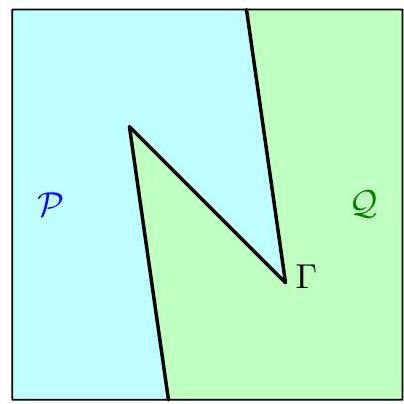
Let $s$ be the longest length of a segment in $\Gamma$.
Claim - The longest side length of $\mathcal{P}$ is $\max (s, 1)$. Similarly, the longest side length of $\mathcal{Q}$ is $\max (s, 1)$ as well.
Proof. The only edges of $\mathcal{P}$ not in $\Gamma$ are the west edge of our original square, which has length 1, and the north/south edges of $\mathcal{P}$ (if any), which have length at most 1. An identical argument works for $\mathcal{Q}$.
It follows the longest sides of $\mathcal{P}$ and $\mathcal{Q}$ have the same length! Hence the two polygons are in fact congruent, ending the proof.
## §2 Solutions to Day 2
## §2.1 USAMO 2004/4, proposed by Melanie Wood
Available online at https://aops.com/community/p17438.
## Problem statement
Alice and Bob play a game on a 6 by 6 grid. On his turn, a player chooses a rational number not yet appearing in the grid and writes it in an empty square of the grid. Alice goes first and then the players alternate. When all squares have numbers written in them, in each row, the square with the greatest number in that row is colored black. Alice wins if he can then draw a line from the top of the grid to the bottom of the grid that stays in black squares, and Bob wins if he can't. (If two squares share a vertex, Alice can draw a line from one to the other that stays in those two squares.) Find, with proof, a winning strategy for one of the players.
Bob can win. Label the first two rows as follows:
$$
\left[\begin{array}{cccccc}
a & b & c & d & e & f \\
d^{\prime} & e^{\prime} & f^{\prime} & a^{\prime} & b^{\prime} & c^{\prime}
\end{array}\right]
$$
These twelve boxes thus come in six pairs, $\left(a, a^{\prime}\right),\left(b, b^{\prime}\right)$ and so on.
Claim - Bob can ensure that the order relation of the labels is the same between the two rows, meaning that $a<b$ if and only if $a^{\prime}<b^{\prime}$, and so on.
Proof. If Alice plays $q$ in some box in the first two rows, then Bob can plays $q+\varepsilon$ in the corresponding box in the same pair, for some sufficiently small $\varepsilon$ (in terms of the existing numbers).
When Alice writes a number in any other row, Bob writes anywhere in rows 3 to 6 .
Under this strategy the black squares in the first two rows will be a pair and therefore will not touch, so Bob wins.
## §2.2 USAMO 2004/5, proposed by Titu Andreescu
Available online at https://aops.com/community/p17397.
Problem statement
Let $a, b, c$ be positive reals. Prove that
$$
\left(a^{5}-a^{2}+3\right)\left(b^{5}-b^{2}+3\right)\left(c^{5}-c^{2}+3\right) \geq(a+b+c)^{3} .
$$
Observe that for all real numbers $a$, the inequality
$$
a^{5}-a^{2}+3 \geq a^{3}+2
$$
holds. Then the problem follows by Hölder in the form
$$
\left(a^{3}+1+1\right)\left(1+b^{3}+1\right)\left(1+1+c^{3}\right) \geq(a+b+c)^{3} .
$$
## §2.3 USAMO 2004/6, proposed by Zuming Feng
Available online at https://aops.com/community/p17437.
## Problem statement
A circle $\omega$ is inscribed in a quadrilateral $A B C D$. Let $I$ be the center of $\omega$. Suppose that
$$
(A I+D I)^{2}+(B I+C I)^{2}=(A B+C D)^{2}
$$
Prove that $A B C D$ is an isosceles trapezoid.
Here's a completely algebraic solution. WLOG $\omega$ has radius 1 , and let $a, b, c, d$ be the lengths of the tangents from $A, B, C, D$ to $\omega$. It is known that
$$
a+b+c+d=a b c+b c d+c d a+d a b
$$
which can be proved by, say tan-addition formula. Then, the content of the problem is to show that
$$
\left(\sqrt{a^{2}+1}+\sqrt{d^{2}+1}\right)^{2}+\left(\sqrt{b^{2}+1}+\sqrt{c^{2}+1}\right)^{2} \leq(a+b+c+d)^{2}
$$
subject to $(\star)$, with equality only when $a=d=\frac{1}{b}=\frac{1}{c}$.
Let $S=a b+b c+c d+d a+a c+b d$. Then the inequality is
$$
\sqrt{\left(a^{2}+1\right)\left(d^{2}+1\right)}+\sqrt{\left(b^{2}+1\right)\left(c^{2}+1\right)} \leq S-2 .
$$
Now, by USAMO 2014 Problem 1 and the condition $(\star)$, we have that $\left(a^{2}+1\right)\left(b^{2}+\right.$ 1) $\left(c^{2}+1\right)\left(d^{2}+1\right)=(S-a b c d-1)^{2}$. So squaring both sides, the inequality becomes
$$
(a d)^{2}+(b c)^{2}+a^{2}+b^{2}+c^{2}+d^{2} \leq S^{2}-6 S+2 a b c d+4
$$
To simplify this, we use the identities
$$
\begin{aligned}
S^{2} & =6 a b c d+\sum_{\mathrm{sym}} a^{2} b c+\frac{1}{4} \sum_{\mathrm{sym}} a^{2} b^{2} \\
(a+b+c+d)^{2} & =(a b c+b c d+c d a+d a b)(a+b+c+d) \\
& =4 a b c d+\frac{1}{2} \sum_{\mathrm{sym}} a^{2} b c
\end{aligned}
$$
So $S^{2}+2 a b c d=\frac{1}{4} \sum_{\text {sym }} a^{2} b^{2}+2\left(a^{2}+b^{2}+c^{2}+d^{2}\right)+4 S$ and the inequality we want to prove reduces to
$$
2 S \leq(a b)^{2}+(a c)^{2}+(b d)^{2}+(c d)^{2}+4+a^{2}+b^{2}+c^{2}+d^{2}
$$
This follows by AM-GM since
$$
\begin{aligned}
(a b)^{2}+1 & \geq 2 a b \\
(a c)^{2}+1 & \geq 2 a c \\
(b d)^{2}+1 & \geq 2 b d \\
(c d)^{2}+1 & \geq 2 c d \\
a^{2}+d^{2} & \geq 2 a d \\
b^{2}+c^{2} & \geq 2 b c
\end{aligned}
$$
The equality case is when $a b=a c=b d=c d=1, a=d, b=c$, as needed to imply an isosceles trapezoid.
Remark. Note that a priori one expects an inequality. Indeed,
- Quadrilaterals with incircles have four degrees of freedom.
- There is one condition imposed.
- Isosceles trapezoid with incircles have two degrees of freedom.
|