


File size: 17,908 Bytes
63c5bce | 1 2 3 4 5 6 7 8 9 10 11 12 13 14 15 16 17 18 19 20 21 22 23 24 25 26 27 28 29 30 31 32 33 34 35 36 37 38 39 40 41 42 43 44 45 46 47 48 49 50 51 52 53 54 55 56 57 58 59 60 61 62 63 64 65 66 67 68 69 70 71 72 73 74 75 76 77 78 79 80 81 82 83 84 85 86 87 88 89 90 91 92 93 94 95 96 97 98 99 100 101 102 103 104 105 106 107 108 109 110 111 112 113 114 115 116 117 118 119 120 121 122 123 124 125 126 127 128 129 130 131 132 133 134 135 136 137 138 139 140 141 142 143 144 145 146 147 148 149 150 151 152 153 154 155 156 157 158 159 160 161 162 163 164 165 166 167 168 169 170 171 172 173 174 175 176 177 178 179 180 181 182 183 184 185 186 187 188 189 190 191 192 193 194 195 196 197 198 199 200 201 202 203 204 205 206 207 208 209 210 211 212 213 214 215 216 217 218 219 220 221 222 223 224 225 226 227 228 229 230 231 232 233 234 235 236 237 238 239 240 241 242 243 244 245 246 247 248 249 250 251 252 253 254 255 256 257 258 259 260 261 262 263 264 265 266 267 268 269 270 271 272 273 274 275 276 277 278 279 280 281 282 283 284 285 286 287 288 289 290 291 292 293 294 295 296 297 298 | # USAMO 2010 Solution Notes
Evan Chen《陳誼廷》
15 April 2024
This is a compilation of solutions for the 2010 USAMO. The ideas of the solution are a mix of my own work, the solutions provided by the competition organizers, and solutions found by the community. However, all the writing is maintained by me.
These notes will tend to be a bit more advanced and terse than the "official" solutions from the organizers. In particular, if a theorem or technique is not known to beginners but is still considered "standard", then I often prefer to use this theory anyways, rather than try to work around or conceal it. For example, in geometry problems I typically use directed angles without further comment, rather than awkwardly work around configuration issues. Similarly, sentences like "let $\mathbb{R}$ denote the set of real numbers" are typically omitted entirely.
Corrections and comments are welcome!
## Contents
0 Problems ..... 2
1 Solutions to Day 1 ..... 3
1.1 USAMO 2010/1, proposed by Titu Andreescu ..... 3
1.2 USAMO 2010/2, proposed by David Speyer ..... 5
1.3 USAMO 2010/3, proposed by Gabriel Carroll ..... 6
2 Solutions to Day 2 ..... 7
2.1 USAMO 2010/4, proposed by Zuming Feng ..... 7
2.2 USAMO 2010/5, proposed by Titu Andreescu ..... 8
2.3 USAMO 2010/6, proposed by Gerhard Woeginger ..... 9
## §0 Problems
1. Let $A X Y Z B$ be a convex pentagon inscribed in a semicircle of diameter $A B$. Denote by $P, Q, R, S$ the feet of the perpendiculars from $Y$ onto lines $A X, B X$, $A Z, B Z$, respectively. Prove that the acute angle formed by lines $P Q$ and $R S$ is half the size of $\angle X O Z$, where $O$ is the midpoint of segment $A B$.
2. There are $n$ students standing in a circle, one behind the other. The students have heights $h_{1}<h_{2}<\cdots<h_{n}$. If a student with height $h_{k}$ is standing directly behind a student with height $h_{k-2}$ or less, the two students are permitted to switch places. Prove that it is not possible to make more than $\binom{n}{3}$ such switches before reaching a position in which no further switches are possible.
3. The 2010 positive real numbers $a_{1}, a_{2}, \ldots, a_{2010}$ satisfy the inequality $a_{i} a_{j} \leq i+j$ for all $1 \leq i<j \leq 2010$. Determine, with proof, the largest possible value of the product $a_{1} a_{2} \ldots a_{2010}$.
4. Let $A B C$ be a triangle with $\angle A=90^{\circ}$. Points $D$ and $E$ lie on sides $A C$ and $A B$, respectively, such that $\angle A B D=\angle D B C$ and $\angle A C E=\angle E C B$. Segments $B D$ and $C E$ meet at $I$. Determine whether or not it is possible for segments $A B, A C, B I$, $I D, C I, I E$ to all have integer lengths.
5. Let $q=\frac{3 p-5}{2}$ where $p$ is an odd prime, and let
$$
S_{q}=\frac{1}{2 \cdot 3 \cdot 4}+\frac{1}{5 \cdot 6 \cdot 7}+\cdots+\frac{1}{q(q+1)(q+2)}
$$
Prove that if $\frac{1}{p}-2 S_{q}=\frac{m}{n}$ for integers $m$ and $n$, then $m-n$ is divisible by $p$.
6. There are 68 ordered pairs (not necessarily distinct) of nonzero integers on a blackboard. It's known that for no integer $k$ does both $(k, k)$ and $(-k,-k)$ appear. A student erases some of the 136 integers such that no two erased integers have sum zero, and scores one point for each ordered pair with at least one erased integer. What is the maximum possible score the student can guarantee?
## §1 Solutions to Day 1
## §1.1 USAMO 2010/1, proposed by Titu Andreescu
Available online at https://aops.com/community/p1860802.
## Problem statement
Let $A X Y Z B$ be a convex pentagon inscribed in a semicircle of diameter $A B$. Denote by $P, Q, R, S$ the feet of the perpendiculars from $Y$ onto lines $A X, B X, A Z, B Z$, respectively. Prove that the acute angle formed by lines $P Q$ and $R S$ is half the size of $\angle X O Z$, where $O$ is the midpoint of segment $A B$.
We present two possible approaches. The first approach is just "bare-hands" angle chasing. The second approach requires more insight but makes it clearer what is going on; it shows the intersection point of lines $P Q$ and $R S$ is the foot from the altitude from $Y$ to $A B$ using Simson lines. The second approach also has the advantage that it works even if $\overline{A B}$ is not a diameter of the circle.
【 First approach using angle chasing. Define $T=\overline{P Q} \cap \overline{R S}$. Also, let $2 \alpha, 2 \beta, 2 \gamma, 2 \delta$ denote the measures of $\operatorname{arcs} \widehat{A X}, \widehat{X Y}, \widehat{Y Z}, \widehat{Z B}$, respectively, so that $\alpha+\beta+\gamma+\delta=90^{\circ}$.
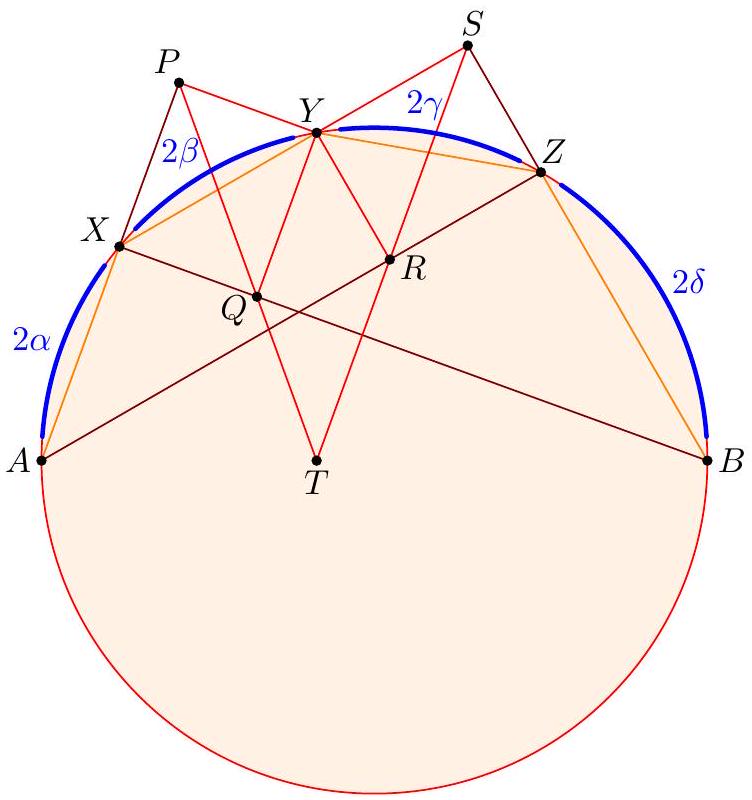
We now compute the following angles:
$$
\begin{aligned}
& \angle S R Y=\angle S Z Y=90^{\circ}-\angle Y Z A=90^{\circ}-(\alpha+\beta) \\
& \angle Y Q P=\angle Y X P=90^{\circ}-\angle B X Y=90^{\circ}-(\gamma+\delta) \\
& \angle Q Y R=180^{\circ}-\angle(\overline{Z R}, \overline{Q X})=180^{\circ}-\frac{2 \beta+2 \gamma+180^{\circ}}{2}=90^{\circ}-(\beta+\gamma)
\end{aligned}
$$
Hence, we can then compute
$$
\begin{aligned}
\angle R T Q & =360^{\circ}-\left(\angle Q Y R+\left(180^{\circ}-\angle S R Y\right)+\left(180^{\circ}-\angle Y Q P\right)\right) \\
& =\angle S R Y+\angle Y Q P-\angle Q Y R
\end{aligned}
$$
$$
\begin{aligned}
& =\left(90^{\circ}-(\alpha+\beta)\right)+\left(90^{\circ}-(\gamma+\delta)\right)-\left(90^{\circ}-(\beta+\gamma)\right) \\
& =90^{\circ}-(\alpha+\delta) \\
& =\beta+\gamma .
\end{aligned}
$$
Since $\angle X O Z=\frac{2 \beta+2 \gamma}{2}=\beta+\gamma$, the proof is complete.
【 Second approach using Simson lines, ignoring the diameter condition. In this solution, we will ignore the condition that $\overline{A B}$ is a diameter; the solution works equally well without it, as long as $O$ is redefined as the center of $(A X Y Z B)$ instead. We will again show the angle formed by lines $P Q$ and $R S$ is half the measure of $\widehat{X Z}$.
Unlike the previous solution, we instead define $T$ to be the foot from $Y$ to $\overline{A B}$. Then the Simson line of $Y$ with respect to $\triangle X A B$ passes through $P, Q, T$. Similarly, the Simson line of $Y$ with respect to $\triangle Z A B$ passes through $R, S, T$. Therefore, point $T$ coincides with $\overline{P Q} \cap \overline{R S}$.
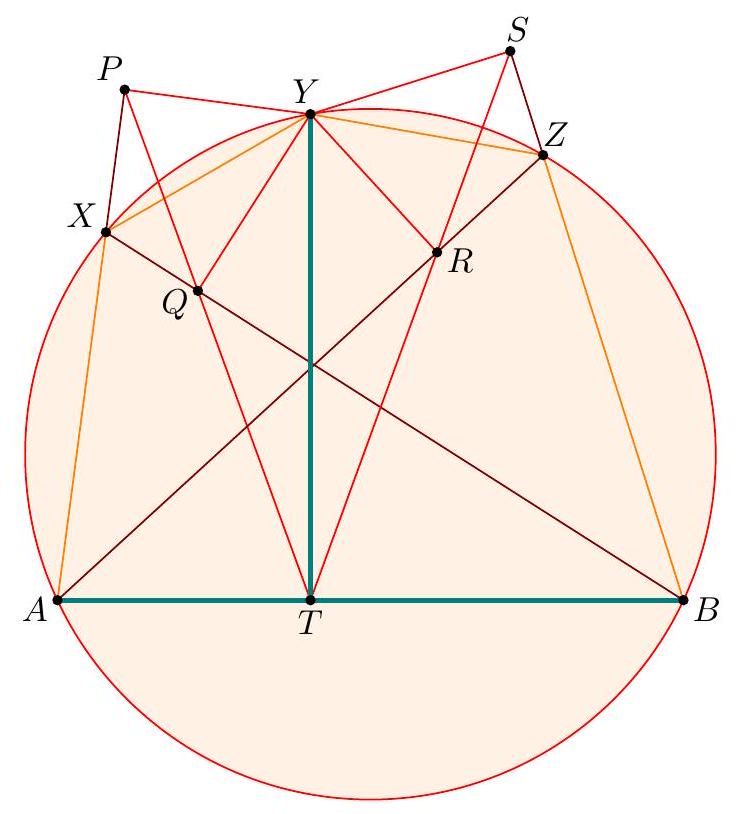
Now it's straightforward to see $A P Y R T$ is cyclic (in the circle with diameter $\overline{A Y}$ ), and therefore
$$
\angle R T Y=\angle R A Y=\angle Z A Y
$$
Similarly,
$$
\angle Y T Q=\angle Y B Q=\angle Y B X
$$
Summing these gives $\angle R T Q$ is equal to half the measure of $\operatorname{arc} \widehat{X Z}$ as needed.
## §1.2 USAMO 2010/2, proposed by David Speyer
Available online at https://aops.com/community/p1860777.
## Problem statement
There are $n$ students standing in a circle, one behind the other. The students have heights $h_{1}<h_{2}<\cdots<h_{n}$. If a student with height $h_{k}$ is standing directly behind a student with height $h_{k-2}$ or less, the two students are permitted to switch places. Prove that it is not possible to make more than $\binom{n}{3}$ such switches before reaching a position in which no further switches are possible.
The main claim is the following observation, which is most motivated in the situation $j-i=2$.
Claim - The students with heights $h_{i}$ and $h_{j}$ switch at most $|j-i|-1$ times.
Proof. By induction on $d=|j-i|$, assuming $j>i$. For $d=1$ there is nothing to prove.
For $d \geq 2$, look at only students $h_{j}, h_{i+1}$ and $h_{i}$ ignoring all other students. After $h_{j}$ and $h_{i}$ switch the first time, the relative ordering of the students must be $h_{i} \rightarrow h_{j} \rightarrow h_{i+1}$. Thereafter $h_{j}$ must always switch with $h_{i+1}$ before switching with $h_{i}$, so the inductive hypothesis applies to give the bound $1+j-(i+1)-1=j-i-1$.
Hence, the number of switches is at most
$$
\sum_{1 \leq i<j \leq n}(|j-i|-1)=\binom{n}{3}
$$
## §1.3 USAMO 2010/3, proposed by Gabriel Carroll
Available online at https://aops.com/community/p1860806.
## Problem statement
The 2010 positive real numbers $a_{1}, a_{2}, \ldots, a_{2010}$ satisfy the inequality $a_{i} a_{j} \leq i+j$ for all $1 \leq i<j \leq 2010$. Determine, with proof, the largest possible value of the product $a_{1} a_{2} \ldots a_{2010}$.
The answer is $3 \times 7 \times 11 \times \cdots \times 4019$, which is clearly an upper bound (and it's not too hard to show this is the lowest number we may obtain by multiplying 1005 equalities together; this is essentially the rearrangement inequality). The tricky part is the construction. Intuitively we want $a_{i} \approx \sqrt{2 i}$, but the details require significant care.
Note that if this is achievable, we will require $a_{n} a_{n+1}=2 n+1$ for all odd $n$. Here are two constructions:
- One can take the sequence such that $a_{2008} a_{2010}=4018$ and $a_{n} a_{n+1}=2 n+1$ for all $n=1,2, \ldots, 2009$. This can be shown to work by some calculation. As an illustrative example,
$$
a_{1} a_{4}=\frac{a_{1} a_{2} \cdot a_{3} a_{4}}{a_{2} a_{3}}=\frac{3 \cdot 7}{5}<5 .
$$
- In fact one can also take $a_{n}=\sqrt{2 n}$ for all even $n$ (and hence $a_{n-1}=\sqrt{2 n}-\frac{1}{\sqrt{2 n}}$ for such even $n$ ).
Remark. This is a chief example of an "abstract" restriction-based approach. One can motivate it in three steps:
- The bound $3 \cdot 7 \cdots \cdot 4019$ is provably best possible upper bound by pairing the inequalities; also the situation with 2010 replaced by 4 is constructible with bound 21 .
- We have $a_{n} \approx \sqrt{2 n}$ heuristically; in fact $a_{n}=\sqrt{2 n}$ satisfies inequalities by AM-GM.
- So we are most worried about $a_{i} a_{j} \leq i+j$ when $|i-j|$ is small, like $|i-j|=1$.
I then proceeded to spend five hours on various constructions, but it turns out that the right thing to do was just require $a_{k} a_{k+1}=2 k+1$, to make sure these pass: and the problem almost solves itself.
Remark. When 2010 is replaced by 4 it is not too hard to manually write an explicit example: say $a_{1}=\frac{\sqrt{3}}{1.1}, a_{2}=1.1 \sqrt{3}, a_{3}=\frac{\sqrt{7}}{1.1}$ and $a_{4}=1.1 \sqrt{7}$. So this is a reason one might guess that $3 \times 7 \times \cdots \times 4019$ can actually be achieved in the large case.
Remark. Victor Wang says: I believe we can actually prove that WLOG (!) assume $a_{i} a_{i+1}=2 i+1$ for all $i$ (but there are other ways to motivate that as well, like linear programming after taking logs), which makes things a bit simpler to think about.
## §2 Solutions to Day 2
## §2.1 USAMO 2010/4, proposed by Zuming Feng
Available online at https://aops.com/community/p1860753.
## Problem statement
Let $A B C$ be a triangle with $\angle A=90^{\circ}$. Points $D$ and $E$ lie on sides $A C$ and $A B$, respectively, such that $\angle A B D=\angle D B C$ and $\angle A C E=\angle E C B$. Segments $B D$ and $C E$ meet at $I$. Determine whether or not it is possible for segments $A B, A C, B I$, $I D, C I, I E$ to all have integer lengths.
The answer is no. We prove that it is not even possible that $A B, A C, C I, I B$ are all integers.

First, we claim that $\angle B I C=135^{\circ}$. To see why, note that
$$
\angle I B C+\angle I C B=\frac{\angle B}{2}+\frac{\angle C}{2}=\frac{90^{\circ}}{2}=45^{\circ} .
$$
So, $\angle B I C=180^{\circ}-(\angle I B C+\angle I C B)=135^{\circ}$, as desired.
We now proceed by contradiction. The Pythagorean theorem implies
$$
B C^{2}=A B^{2}+A C^{2}
$$
and so $B C^{2}$ is an integer. However, the law of cosines gives
$$
\begin{aligned}
B C^{2} & =B I^{2}+C I^{2}-2 B I \cdot C I \cos \angle B I C \\
& =B I^{2}+C I^{2}+B I \cdot C I \cdot \sqrt{2}
\end{aligned}
$$
which is irrational, and this produces the desired contradiction.
## §2.2 USAMO 2010/5, proposed by Titu Andreescu
Available online at https://aops.com/community/p1860791.
## Problem statement
Let $q=\frac{3 p-5}{2}$ where $p$ is an odd prime, and let
$$
S_{q}=\frac{1}{2 \cdot 3 \cdot 4}+\frac{1}{5 \cdot 6 \cdot 7}+\cdots+\frac{1}{q(q+1)(q+2)}
$$
Prove that if $\frac{1}{p}-2 S_{q}=\frac{m}{n}$ for integers $m$ and $n$, then $m-n$ is divisible by $p$.
By partial fractions, we have
$$
\frac{2}{(3 k-1)(3 k)(3 k+1)}=\frac{1}{3 k-1}-\frac{2}{3 k}+\frac{1}{3 k+1}
$$
Thus
$$
\begin{aligned}
2 S_{q} & =\left(\frac{1}{2}-\frac{2}{3}+\frac{1}{4}\right)+\left(\frac{1}{5}-\frac{2}{6}+\frac{1}{7}\right)+\cdots+\left(\frac{1}{q}-\frac{2}{q+1}+\frac{1}{q+2}\right) \\
& =\left(\frac{1}{2}+\frac{1}{3}+\frac{1}{4}+\cdots+\frac{1}{q+2}\right)-3\left(\frac{1}{3}+\frac{1}{6}+\cdots+\frac{1}{q+1}\right) \\
& =\left(\frac{1}{2}+\frac{1}{3}+\frac{1}{4}+\cdots+\frac{1}{q+2}\right)-\left(\frac{1}{1}+\frac{1}{2}+\cdots+\frac{1}{\frac{q+1}{3}}\right) \\
\Longrightarrow 2 S_{q}-\frac{1}{p}+1 & =\left(\frac{1}{1}+\frac{1}{2}+\cdots+\frac{1}{p-1}\right)+\left(\frac{1}{p+1}+\frac{1}{p+2} \cdots+\frac{1}{q+2}\right)-\left(\frac{1}{1}+\frac{1}{2}+\cdots+\frac{1}{\frac{q+1}{3}}\right)
\end{aligned}
$$
Now we are ready to take modulo $p$. The given says that $q-p+2=\frac{q+1}{3}$, so
$$
\begin{aligned}
2 S_{q}-\frac{1}{p}+1 & =\left(\frac{1}{1}+\frac{1}{2}+\cdots+\frac{1}{p-1}\right)+\left(\frac{1}{p+1}+\frac{1}{p+2}+\cdots+\frac{1}{q+2}\right)-\left(\frac{1}{1}+\frac{1}{2}+\cdots+\frac{1}{\frac{q+1}{3}}\right) \\
& \equiv\left(\frac{1}{1}+\frac{1}{2}+\cdots+\frac{1}{p-1}\right)+\left(\frac{1}{1}+\frac{1}{2}+\cdots+\frac{1}{q-p+2}\right)-\left(\frac{1}{1}+\frac{1}{2}+\cdots+\frac{1}{\frac{q+1}{3}}\right) \\
& =\frac{1}{1}+\frac{1}{2}+\cdots+\frac{1}{p-1} \\
& \equiv 0 \quad(\bmod p) .
\end{aligned}
$$
So $\frac{1}{p}-2 S_{q} \equiv 1(\bmod p)$ which is the desired.
## §2.3 USAMO 2010/6, proposed by Gerhard Woeginger
Available online at https://aops.com/community/p1860794.
## Problem statement
There are 68 ordered pairs (not necessarily distinct) of nonzero integers on a blackboard. It's known that for no integer $k$ does both $(k, k)$ and $(-k,-k)$ appear. A student erases some of the 136 integers such that no two erased integers have sum zero, and scores one point for each ordered pair with at least one erased integer. What is the maximum possible score the student can guarantee?
The answer is 43.
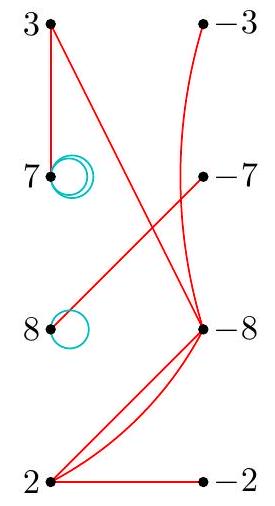
The structure of this problem is better understood as follows: we construct a multigraph whose vertices are the entries, and the edges are the 68 ordered pairs on the blackboard. To be precise, construct a multigraph $G$ with vertices $a_{1}, b_{1}, \ldots, a_{n}, b_{n}$, with $a_{i}=-b_{i}$ for each $i$. The ordered pairs then correspond to 68 edges in $G$, with self-loops allowed (WLOG) only for vertices $a_{i}$. The student may then choose one of $\left\{a_{i}, b_{i}\right\}$ for each $i$ and wishes to maximize the number of edges adjacent to the set of chosen vertices.
First we use the probabilistic method to show $N \geq 43$. We select the real number $p=\frac{\sqrt{5}-1}{2} \approx 0.618$ satisfying $p=1-p^{2}$. For each $i$ we then select $a_{i}$ with probability $p$ and $b_{i}$ with probability $1-p$. Then
- Every self-loop $\left(a_{i}, a_{i}\right)$ is chosen with probability $p$.
- Any edge $\left(b_{i}, b_{j}\right)$ is chosen with probability $1-p^{2}$.
All other edges are selected with probability at least $p$, so in expectation we have $68 p \approx 42.024$ edges scored. Hence $N \geq 43$.
For a construction showing 43 is optimal, we let $n=8$, and put five self-loops on each $a_{i}$, while taking a single $K_{8}$ on the $b_{i}$ 's. The score achieved for selecting $m$ of the $a_{i}$ 's and $8-m$ of the $b_{i}$ 's is
$$
5 m+\left(\binom{8}{2}-\binom{m}{2}\right) \leq 43
$$
with equality when either $m=5$ and $m=6$.
Remark (Colin Tang). Here is one possible motivation for finding the construction. In equality case we probably want all the edges to either be $a_{i}$ loops or $b_{i} b_{j}$ edges. Now if $b_{i}$ and $b_{j}$ are not joined by an edge, one can "merge them together", also combining the corresponding $a_{i}$ 's, to get another multigraph with 68 edges whose optimal score is at most the original ones. So by using this smoothing algorithm, we can reduce to a situation where the $b_{i}$ and $b_{j}$ are all connected to each other.
It's not unnatural to assume it's a clique then, at which point fiddling with parameters gives the construction. Also, there is a construction for $\lceil 2 / 3 n\rceil$ which is not too difficult to find, and applying this smoothing operation to this construction could suggest a clique of at least 8 vertices too.
Remark (David Lee). One could consider changing the probability $p(n)$ to be a function of the number $n$ of non-loops (hence there are $68-n$ loops); we would then have
$$
\mathbb{E}[\text { points }] \geq(68-n) p(n)+n\left(1-p(n)^{2}\right)
$$
The optimal value of $p(n)$ is then
$$
p(n)= \begin{cases}\frac{68-n}{2 n}=\frac{34}{n}-\frac{1}{2} & n \geq 23 \\ 1 & n<22\end{cases}
$$
For $n>23$ we then have
$$
\begin{aligned}
E(n)= & (68-n)\left(\frac{34}{n}-\frac{1}{2}\right)+n\left(1-\left(\frac{34}{n}-\frac{1}{2}\right)^{2}\right) \\
& =\frac{5 n}{4}+\frac{34^{2}}{n}-34
\end{aligned}
$$
which has its worst case at around $5 n^{2}=68^{2}$, so at $n=30$ and $n=31$. Indeed, one can find
$$
\begin{aligned}
& E(30)=42.033 \\
& E(31)=42.040
\end{aligned}
$$
This gives another way to get the lower bound 43, and gives a hint about approximately how many non-loops one would want in order to achieve such a bound.
|