


File size: 18,178 Bytes
63c5bce | 1 2 3 4 5 6 7 8 9 10 11 12 13 14 15 16 17 18 19 20 21 22 23 24 25 26 27 28 29 30 31 32 33 34 35 36 37 38 39 40 41 42 43 44 45 46 47 48 49 50 51 52 53 54 55 56 57 58 59 60 61 62 63 64 65 66 67 68 69 70 71 72 73 74 75 76 77 78 79 80 81 82 83 84 85 86 87 88 89 90 91 92 93 94 95 96 97 98 99 100 101 102 103 104 105 106 107 108 109 110 111 112 113 114 115 116 117 118 119 120 121 122 123 124 125 126 127 128 129 130 131 132 133 134 135 136 137 138 139 140 141 142 143 144 145 146 147 148 149 150 151 152 153 154 155 156 157 158 159 160 161 162 163 164 165 166 167 168 169 170 171 172 173 174 175 176 177 178 179 180 181 182 183 184 185 186 187 188 189 190 191 192 193 194 195 196 197 198 199 200 201 202 203 204 205 206 207 208 209 210 211 212 213 214 215 216 217 218 219 220 221 222 223 224 225 226 227 228 229 230 231 232 233 234 235 236 237 238 239 240 241 242 243 244 245 246 247 248 249 250 251 252 253 254 255 256 257 258 259 260 261 262 263 264 265 266 267 268 269 270 271 272 273 274 275 276 277 278 279 280 281 282 283 284 285 286 287 288 289 290 291 292 293 294 295 296 297 298 299 300 301 302 303 304 305 306 307 308 309 310 311 312 313 314 315 316 317 318 319 320 321 322 323 324 325 326 327 328 329 330 331 332 333 334 335 336 337 338 339 340 341 342 343 344 345 346 347 348 349 350 351 352 353 354 355 356 357 358 359 360 361 362 363 364 | # USAMO 2012 Solution Notes
Evan ChEn《陳誼廷》
15 April 2024
This is a compilation of solutions for the 2012 USAMO. The ideas of the solution are a mix of my own work, the solutions provided by the competition organizers, and solutions found by the community. However, all the writing is maintained by me.
These notes will tend to be a bit more advanced and terse than the "official" solutions from the organizers. In particular, if a theorem or technique is not known to beginners but is still considered "standard", then I often prefer to use this theory anyways, rather than try to work around or conceal it. For example, in geometry problems I typically use directed angles without further comment, rather than awkwardly work around configuration issues. Similarly, sentences like "let $\mathbb{R}$ denote the set of real numbers" are typically omitted entirely.
Corrections and comments are welcome!
## Contents
0 Problems ..... 2
1 Solutions to Day 1 ..... 3
1.1 USAMO 2012/1, proposed by Titu Andreescu ..... 3
1.2 USAMO 2012/2, proposed by Gregory Galperin ..... 5
1.3 USAMO 2012/3, proposed by Gabriel Carroll ..... 6
2 Solutions to Day 2 ..... 8
2.1 USAMO 2012/4, proposed by Gabriel Dospinescu ..... 8
2.2 USAMO 2012/5, proposed by Titu Andreescu, Cosmin Pohoata ..... 9
2.3 USAMO 2012/6, proposed by Gabriel Carroll ..... 11
## §0 Problems
1. Find all integers $n \geq 3$ such that among any $n$ positive real numbers $a_{1}, a_{2}, \ldots$, $a_{n}$ with
$$
\max \left(a_{1}, a_{2}, \ldots, a_{n}\right) \leq n \cdot \min \left(a_{1}, a_{2}, \ldots, a_{n}\right),
$$
there exist three that are the side lengths of an acute triangle.
2. A circle is divided into congruent arcs by 432 points. The points are colored in four colors such that some 108 points are colored red, some 108 points are colored green, some 108 points are colored blue, and the remaining 108 points are colored yellow. Prove that one can choose three points of each color in such a way that the four triangles formed by the chosen points of the same color are congruent.
3. Determine which integers $n>1$ have the property that there exists an infinite sequence $a_{1}, a_{2}, a_{3}, \ldots$ of nonzero integers such that the equality
$$
a_{k}+2 a_{2 k}+\cdots+n a_{n k}=0
$$
holds for every positive integer $k$.
4. Find all functions $f: \mathbb{N} \rightarrow \mathbb{N}$ such that $f(n!)=f(n)$ ! for all positive integers $n$ and such that $m-n$ divides $f(m)-f(n)$ for all distinct positive integers $m, n$.
5. Let $P$ be a point in the plane of $\triangle A B C$, and $\gamma$ a line through $P$. Let $A^{\prime}, B^{\prime}, C^{\prime}$ be the points where the reflections of lines $P A, P B, P C$ with respect to $\gamma$ intersect lines $B C, C A, A B$ respectively. Prove that $A^{\prime}, B^{\prime}, C^{\prime}$ are collinear.
6. For integer $n \geq 2$, let $x_{1}, x_{2}, \ldots, x_{n}$ be real numbers satisfying
$$
x_{1}+x_{2}+\cdots+x_{n}=0 \quad \text { and } \quad x_{1}^{2}+x_{2}^{2}+\cdots+x_{n}^{2}=1
$$
For each subset $A \subseteq\{1,2, \ldots, n\}$, define $S_{A}=\sum_{i \in A} x_{i}$. (If $A$ is the empty set, then $S_{A}=0$.) Prove that for any positive number $\lambda$, the number of sets $A$ satisfying $S_{A} \geq \lambda$ is at most $2^{n-3} / \lambda^{2}$. For which choices of $x_{1}, x_{2}, \ldots, x_{n}, \lambda$ does equality hold?
## §1 Solutions to Day 1
## §1.1 USAMO 2012/1, proposed by Titu Andreescu
Available online at https://aops.com/community/p2669112.
## Problem statement
Find all integers $n \geq 3$ such that among any $n$ positive real numbers $a_{1}, a_{2}, \ldots, a_{n}$ with
$$
\max \left(a_{1}, a_{2}, \ldots, a_{n}\right) \leq n \cdot \min \left(a_{1}, a_{2}, \ldots, a_{n}\right)
$$
there exist three that are the side lengths of an acute triangle.
The answer is all $n \geq 13$.
Define $\left(F_{n}\right)$ as the sequence of Fibonacci numbers, by $F_{1}=F_{2}=1$ and $F_{n+1}=$ $F_{n}+F_{n-1}$. We will find that Fibonacci numbers show up naturally when we work through the main proof, so we will isolate the following calculation now to make the subsequent solution easier to read.
Claim - For positive integers $m$, we have $F_{m} \leq m^{2}$ if and only if $m \leq 12$.
Proof. A table of the first 14 Fibonacci numbers is given below.
$$
\begin{array}{rrrrrrrrrrrrrr}
F_{1} & F_{2} & F_{3} & F_{4} & F_{5} & F_{6} & F_{7} & F_{8} & F_{9} & F_{10} & F_{11} & F_{12} & F_{13} & F_{14} \\
\hline 1 & 1 & 2 & 3 & 5 & 8 & 13 & 21 & 34 & 55 & 89 & 144 & 233 & 377
\end{array}
$$
By examining the table, we see that $F_{m} \leq m^{2}$ is true for $m=1,2, \ldots 12$, and in fact $F_{12}=12^{2}=144$. However, $F_{m}>m^{2}$ for $m=13$ and $m=14$.
Now it remains to prove that $F_{m}>m^{2}$ for $m \geq 15$. The proof is by induction with base cases $m=13$ and $m=14$ being checked already. For the inductive step, if $m \geq 15$ then we have
$$
\begin{aligned}
F_{m} & =F_{m-1}+F_{m-2}>(m-1)^{2}+(m-2)^{2} \\
& =2 m^{2}-6 m+5=m^{2}+(m-1)(m-5)>m^{2}
\end{aligned}
$$
as desired.
We now proceed to the main problem. The hypothesis $\max \left(a_{1}, a_{2}, \ldots, a_{n}\right) \leq n$. $\min \left(a_{1}, a_{2}, \ldots, a_{n}\right)$ will be denoted by $(\dagger)$.
Proof that all $n \geq 13$ have the property. We first show now that every $n \geq 13$ has the desired property. Suppose for contradiction that no three numbers are the sides of an acute triangle. Assume without loss of generality (by sorting the numbers) that $a_{1} \leq a_{2} \leq \cdots \leq a_{n}$. Then since $a_{i-1}, a_{i}, a_{i+1}$ are not the sides of an acute triangle for each $i \geq 2$, we have that $a_{i+1}^{2} \geq a_{i}^{2}+a_{i-1}^{2}$; writing this out gives
$$
\begin{aligned}
& a_{3}^{2} \geq a_{2}^{2}+a_{1}^{2} \geq 2 a_{1}^{2} \\
& a_{4}^{2} \geq a_{3}^{2}+a_{2}^{2} \geq 2 a_{1}^{2}+a_{1}^{2}=3 a_{1}^{2} \\
& a_{5}^{2} \geq a_{4}^{2}+a_{3}^{2} \geq 3 a_{1}^{2}+2 a_{1}^{2}=5 a_{1}^{2} \\
& a_{6}^{2} \geq a_{5}^{2}+a_{4}^{2} \geq 5 a_{1}^{2}+3 a_{1}^{2}=8 a_{1}^{2}
\end{aligned}
$$
and so on. The Fibonacci numbers appear naturally and by induction, we conclude that $a_{i}^{2} \geq F_{i} a_{1}^{2}$. In particular, $a_{n}^{2} \geq F_{n} a_{1}^{2}$.
However, we know $\max \left(a_{1}, \ldots, a_{n}\right)=a_{n}$ and $\min \left(a_{1}, \ldots, a_{n}\right)=a_{1}$, so ( $\dagger$ ) reads $a_{n} \leq n \cdot a_{1}$. Therefore we have $F_{n} \leq n^{2}$, and so $n \leq 12$, contradiction!
Proof that no $n \leq 12$ have the property. Assume that $n \leq 12$. The above calculation also suggests a way to pick the counterexample: we choose $a_{i}=\sqrt{F_{i}}$ for every $i$. Then $\min \left(a_{1}, \ldots, a_{n}\right)=a_{1}=1$ and $\max \left(a_{1}, \ldots, a_{n}\right)=\sqrt{F_{n}}$, so ( $\dagger$ ) is true as long as $n \leq 12$. And indeed no three numbers form the sides of an acute triangle: if $i<j<k$, then $a_{k}^{2}=F_{k}=F_{k-1}+F_{k-2} \geq F_{j}+F_{i}=a_{j}^{2}+a_{i}^{2}$.
## §1.2 USAMO 2012/2, proposed by Gregory Galperin
Available online at https://aops.com/community/p2669115.
## Problem statement
A circle is divided into congruent arcs by 432 points. The points are colored in four colors such that some 108 points are colored red, some 108 points are colored green, some 108 points are colored blue, and the remaining 108 points are colored yellow. Prove that one can choose three points of each color in such a way that the four triangles formed by the chosen points of the same color are congruent.
First, consider the 431 possible non-identity rotations of the red points, and count overlaps with green points. If we select a rotation randomly, then each red point lies over a green point with probability $\frac{108}{431}$; hence the expected number of red-green incidences is
$$
\frac{108}{431} \cdot 108>27
$$
and so by pigeonhole, we can find a red 28 -gon and a green 28 -gon which are rotations of each other.
Now, look at the 430 rotations of this 28 -gon (that do not give the all-red or all-green configuration) and compare it with the blue points. The same approach gives
$$
\frac{108}{430} \cdot 28>7
$$
incidences, so we can find red, green, blue 8 -gons which are similar under rotation.
Finally, the 429 nontrivial rotations of this 8 -gon expect
$$
\frac{108}{429} \cdot 8>2
$$
incidences with yellow. So finally we have four monochromatic 3 -gons, one of each color, which are rotations of each other.
## §1.3 USAMO 2012/3, proposed by Gabriel Carroll
Available online at https://aops.com/community/p2669119.
## Problem statement
Determine which integers $n>1$ have the property that there exists an infinite sequence $a_{1}, a_{2}, a_{3}, \ldots$ of nonzero integers such that the equality
$$
a_{k}+2 a_{2 k}+\cdots+n a_{n k}=0
$$
holds for every positive integer $k$.
Answer: all $n>2$.
For $n=2$, we have $a_{k}+2 a_{2 k}=0$, which is clearly not possible, since it implies $a_{2^{k}}=\frac{a_{1}}{2^{k-1}}$ for all $k \geq 1$.
For $n \geq 3$ we will construct a completely multiplicative sequence (meaning $a_{i j}=a_{i} a_{j}$ for all $i$ and $j$ ). Thus $\left(a_{i}\right)$ is determined by its value on primes, and satisfies the condition as long as $a_{1}+2 a_{2}+\cdots+n a_{n}=0$. The idea is to take two large primes and use Bezout's theorem, but the details require significant care.
We start by solving the case where $n \geq 9$. In that case, by Bertrand postulate there exists primes $p$ and $q$ such that
$$
\lceil n / 2\rceil<q<2\lceil n / 2\rceil \quad \text { and } \quad \frac{1}{2}(q-1)<p<q-1
$$
Clearly $p \neq q$, and $q \geq 7$, so $p>3$. Also, $p<q<n$ but $2 q>n$, and $4 p \geq 4\left(\frac{1}{2}(q+1)\right)>$ $n$. We now stipulate that $a_{r}=1$ for any prime $r \neq p, q$ (in particular including $r=2$ and $r=3$ ). There are now three cases, identical in substance.
- If $p, 2 p, 3 p \in[1, n]$ then we would like to choose nonzero $a_{p}$ and $a_{q}$ such that
$$
6 p \cdot a_{p}+q \cdot a_{q}=6 p+q-\frac{1}{2} n(n+1)
$$
which is possible by Bézout lemma, since $\operatorname{gcd}(6 p, q)=1$.
- Else if $p, 2 p \in[1, n]$ then we would like to choose nonzero $a_{p}$ and $a_{q}$ such that
$$
3 p \cdot a_{p}+q \cdot a_{q}=3 p+q-\frac{1}{2} n(n+1)
$$
which is possible by Bézout lemma, since $\operatorname{gcd}(3 p, q)=1$.
- Else if $p \in[1, n]$ then we would like to choose nonzero $a_{p}$ and $a_{q}$ such that
$$
p \cdot a_{p}+q \cdot a_{q}=p+q-\frac{1}{2} n(n+1)
$$
which is possible by Bézout lemma, since $\operatorname{gcd}(p, q)=1$. (This case is actually possible in a few edge cases, for example when $n=9, q=7, p=5$.)
It remains to resolve the cases where $3 \leq n \leq 8$. We enumerate these cases manually:
- For $n=3$, let $a_{n}=(-1)^{\nu_{3}(n)}$.
- For $n=4$, let $a_{n}=(-1)^{\nu_{2}(n)+\nu_{3}(n)}$.
- For $n=5$, let $a_{n}=(-2)^{\nu_{5}(n)}$.
- For $n=6$, let $a_{n}=5^{\nu_{2}(n)} \cdot 3^{\nu_{3}(n)} \cdot(-42)^{\nu_{5}(n)}$.
- For $n=7$, let $a_{n}=(-3)^{\nu_{7}(n)}$.
- For $n=8$, we can choose $(p, q)=(5,7)$ in the prior construction.
This completes the constructions for all $n>2$.
## §2 Solutions to Day 2
## §2.1 USAMO 2012/4, proposed by Gabriel Dospinescu
Available online at https://aops.com/community/p2669997.
## Problem statement
Find all functions $f: \mathbb{N} \rightarrow \mathbb{N}$ such that $f(n!)=f(n)$ ! for all positive integers $n$ and such that $m-n$ divides $f(m)-f(n)$ for all distinct positive integers $m, n$.
Answer: $f \equiv 1, f \equiv 2$, and $f$ the identity. As these obviously work, we prove these are the only ones.
By putting $n=1$ and $n=2$ we give $f(1), f(2) \in\{1,2\}$. Also, we will use the condition
$$
m!-n!\text { divides } f(m)!-f(n)!
$$
We consider four cases on $f(1)$ and $f(2)$, and dispense with three of them.
- If $f(2)=1$ then for all $m \geq 3$ we have $m!$ - 2 divides $f(m)!-1$, so $f(m)=1$ for modulo 2 reasons. Then clearly $f(1)=1$.
- If $f(1)=f(2)=2$ we first obtain $3!-1 \mid f(3)!-2$, which implies $f(3)=2$. Then $m!-3 \mid f(m)!-2$ for $m \geq 4$ implies $f(m)=2$ for modulo 3 reasons.
Hence we are left with the case where $f(1)=1$ and $f(2)=2$. Continuing, we have
$$
3!-1 \mid f(3)!-1 \quad \text { and } \quad 3!-2 \mid f(3)!-2 \Longrightarrow f(3)=3
$$
Continuing by induction, suppose $f(1)=1, \ldots, f(k)=k$.
$$
k!\cdot k=(k+1)!-k!\mid f(k+1)!-k!
$$
and thus we deduce that $f(k+1) \geq k$, and hence
$$
k \left\lvert\, \frac{f(k+1)!}{k!}-1\right.
$$
Then plainly $f(k+1) \leq 2 k$ for $\bmod k$ reasons, but also $f(k+1) \equiv 1(\bmod k)$ so we conclude $f(k+1)=k+1$.
Remark. Shankar Padmanabhan gives the following way to finish after verifying that $f(3)=3$. Note that if
$$
M=((((3!)!)!)!\ldots)!
$$
for any number of iterated factorials then $f(M)=M$. Thus for any $n$, we have
$$
M-n|f(M)-f(n)=M-f(n) \Longrightarrow M-n| n-f(n)
$$
and so taking $M$ large enough implies $f(n)=n$.
## §2.2 USAMO 2012/5, proposed by Titu Andreescu, Cosmin Pohoata
Available online at https://aops.com/community/p2669960.
## Problem statement
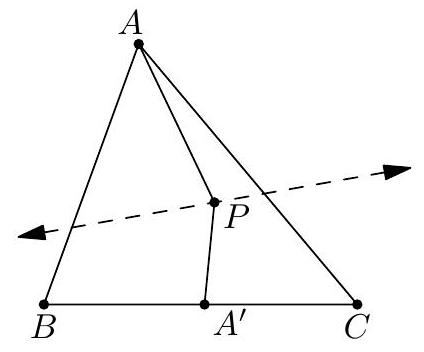
Let $P$ be a point in the plane of $\triangle A B C$, and $\gamma$ a line through $P$. Let $A^{\prime}, B^{\prime}, C^{\prime}$ be the points where the reflections of lines $P A, P B, P C$ with respect to $\gamma$ intersect lines $B C, C A, A B$ respectively. Prove that $A^{\prime}, B^{\prime}, C^{\prime}$ are collinear.
We present three solutions.
【 First solution (complex numbers). Let $p=0$ and set $\gamma$ as the real line. Then $A^{\prime}$ is the intersection of $b c$ and $p \bar{a}$. So, we get
$$
a^{\prime}=\frac{\bar{a}(\bar{b} c-b \bar{c})}{(\bar{b}-\bar{c}) \bar{a}-(b-c) a} .
$$
Note that
$$
\bar{a}^{\prime}=\frac{a(b \bar{c}-\bar{b} c)}{(b-c) a-(\bar{b}-\bar{c}) \bar{a}} .
$$
Thus it suffices to prove
This is equivalent to
$$
0=\operatorname{det}\left[\begin{array}{lll}
\bar{a}(\bar{b} c-b \bar{c}) & a(\bar{b} c-b \bar{c}) & (\bar{b}-\bar{c}) \bar{a}-(b-c) a \\
\bar{b}(\bar{c} a-c \bar{a}) & b(\bar{c} a-c \bar{a}) & (\bar{c}-\bar{a}) \bar{b}-(c-a) b \\
\bar{c}(\bar{a} b-a \bar{b}) & c(\bar{a} b-a \bar{b}) & (\bar{a}-\bar{b}) \bar{c}-(a-b) c
\end{array}\right] .
$$
This determinant has the property that the rows sum to zero, and we're done.
Remark. Alternatively, if you don't notice that you could just blindly expand:
$$
\begin{aligned}
& \sum_{\mathrm{cyc}}((\bar{b}-\bar{c}) \bar{a}-(b-c) a) \cdot-\operatorname{det}\left[\begin{array}{ll}
b & \bar{b} \\
c & \bar{c}
\end{array}\right](\bar{c} a-c \bar{a})(\bar{a} b-a \bar{b}) \\
= & (\bar{b} c-c \bar{b})(\bar{c} a-c \bar{a})(\bar{a} b-a \bar{b}) \sum_{\mathrm{cyc}}(a b-a c+\overline{c a}-\bar{b} \bar{a})=0 .
\end{aligned}
$$
\I Second solution (Desargues involution). We let $C^{\prime \prime}=\overline{A^{\prime} B^{\prime}} \cap \overline{A B}$. Consider complete quadrilateral $A B C A^{\prime} B^{\prime} C^{\prime \prime} C$. We see that there is an involutive pairing $\tau$ at $P$ swapping $\left(P A, P A^{\prime}\right),\left(P B, P B^{\prime}\right),\left(P C, P C^{\prime \prime}\right)$. From the first two, we see $\tau$ coincides with reflection about $\ell$, hence conclude $C^{\prime \prime}=C$.
ब Third solution (barycentric), by Catherine $\mathbf{X u}$. We will perform barycentric coordinates on the triangle $P C C^{\prime}$, with $P=(1,0,0), C^{\prime}=(0,1,0)$, and $C=(0,0,1)$. Set $a=C C^{\prime}, b=C P, c=C^{\prime} P$ as usual. Since $A, B, C^{\prime}$ are collinear, we will define $A=(p: k: q)$ and $B=(p: \ell: q)$.
Claim - Line $\gamma$ is the angle bisector of $\angle A P A^{\prime}, \angle B P B^{\prime}$, and $\angle C P C^{\prime}$.
Proof. Since $A^{\prime} P$ is the reflection of $A P$ across $\gamma$, etc.
Thus $B^{\prime}$ is the intersection of the isogonal of $B$ with respect to $\angle P$ with the line $C A$; that is,
$$
B^{\prime}=\left(\frac{p}{k} \frac{b^{2}}{\ell}: \frac{b^{2}}{\ell}: \frac{c^{2}}{q}\right)
$$
Analogously, $A^{\prime}$ is the intersection of the isogonal of $A$ with respect to $\angle P$ with the line $C B$; that is,
$$
A^{\prime}=\left(\frac{p}{\ell} \frac{b^{2}}{k}: \frac{b^{2}}{k}: \frac{c^{2}}{q}\right) .
$$
The ratio of the first to third coordinate in these two points is both $b^{2} p q: c^{2} k \ell$, so it follows $A^{\prime}, B^{\prime}$, and $C^{\prime}$ are collinear.
Remark (Problem reference). The converse of this problem appears as problem 1052 attributed S. V. Markelov in the book Geometriya: 9-11 Klassy: Ot Uchebnoy Zadachi k Tvorcheskoy, 1996, by I. F. Sharygin.
## §2.3 USAMO 2012/6, proposed by Gabriel Carroll
Available online at https://aops.com/community/p2670037.
## Problem statement
For integer $n \geq 2$, let $x_{1}, x_{2}, \ldots, x_{n}$ be real numbers satisfying
$$
x_{1}+x_{2}+\cdots+x_{n}=0 \quad \text { and } \quad x_{1}^{2}+x_{2}^{2}+\cdots+x_{n}^{2}=1
$$
For each subset $A \subseteq\{1,2, \ldots, n\}$, define $S_{A}=\sum_{i \in A} x_{i}$. (If $A$ is the empty set, then $S_{A}=0$.) Prove that for any positive number $\lambda$, the number of sets $A$ satisfying $S_{A} \geq \lambda$ is at most $2^{n-3} / \lambda^{2}$. For which choices of $x_{1}, x_{2}, \ldots, x_{n}, \lambda$ does equality hold?
Let $\varepsilon_{i}$ be a coin flip of 0 or 1 . Then we have
$$
\begin{aligned}
\mathbb{E}\left[S_{A}^{2}\right] & =\mathbb{E}\left[\left(\sum \varepsilon_{i} x_{i}\right)^{2}\right]=\sum_{i} \mathbb{E}\left[\varepsilon_{i}^{2}\right] x_{i}^{2}+\sum_{i<j} \mathbb{E}\left[\varepsilon_{i} \varepsilon_{j}\right] 2 x_{i} x_{j} \\
& =\frac{1}{2} \sum x_{i}^{2}+\frac{1}{2} \sum x_{i} x_{j}=\frac{1}{2}+\frac{1}{2} \sum_{i<j} x_{i} x_{j}=\frac{1}{2}+\frac{1}{2}\left(-\frac{1}{2}\right)=\frac{1}{4}
\end{aligned}
$$
In other words, $\sum_{A} S_{A}^{2}=2^{n-2}$. Since can always pair $A$ with its complement, we conclude
$$
\sum_{S_{A}>0} S_{A}^{2}=2^{n-3}
$$
Equality holds iff $S_{A} \in\{ \pm \lambda, 0\}$ for every $A$. This occurs when $x_{1}=1 / \sqrt{2}, x_{2}=-1 / \sqrt{2}$, $x_{3}=\cdots=0$ (or permutations), and $\lambda=1 / \sqrt{2}$.
|