| {"year": "2007", "tier": "T4", "problem_label": "1", "problem_type": null, "exam": "HMMT", "problem": "Evaluate the functions $\\phi(n), \\sigma(n)$, and $\\tau(n)$ for $n=12, n=2007$, and $n=2^{2007}$.", "solution": "For $n=12=2^{2} \\cdot 3^{1}$,\n\n$$\n\\phi(12)=2(2-1)(3-1)=4, \\quad \\sigma(12)=(1+2+4)(1+3)=28, \\quad \\tau(12)=(2+1)(1+1)=6\n$$\n\nfor $n=2007=3^{2} \\cdot 223$,\n$\\phi(2007)=3(3-1)(223-1)=1332, \\quad \\sigma(2007)=(1+3+9)(1+223)=2912, \\quad \\tau(2007)=(2+1)(1+1)=6 ;$\nand for $n=2^{2007}$,\n\n$$\n\\phi\\left(2^{2007}\\right)=2^{2006}, \\quad \\sigma\\left(2^{2007}\\right)=\\left(1+2+\\cdots+2^{2007}\\right)=2^{2008}-1, \\quad \\tau\\left(2^{2007}\\right)=2007+1=2008\n$$", "metadata": {"resource_path": "HarvardMIT/segmented/en-102-2007-feb-team1-solutions.jsonl", "problem_match": "\n1. [15]", "solution_match": "\nSolution. "}} |
| {"year": "2007", "tier": "T4", "problem_label": "2", "problem_type": null, "exam": "HMMT", "problem": "Solve for the positive integer(s) $n$ such that $\\phi\\left(n^{2}\\right)=1000 \\phi(n)$.", "solution": "1000.", "metadata": {"resource_path": "HarvardMIT/segmented/en-102-2007-feb-team1-solutions.jsonl", "problem_match": "\n2. [20]", "solution_match": "\nAnswer: "}} |
| {"year": "2007", "tier": "T4", "problem_label": "2", "problem_type": null, "exam": "HMMT", "problem": "Solve for the positive integer(s) $n$ such that $\\phi\\left(n^{2}\\right)=1000 \\phi(n)$.", "solution": "The unique solution is $n=1000$. For, $\\phi(p n)=p \\phi(n)$ for every prime $p$ dividing $n$, so that $\\phi\\left(n^{2}\\right)=n \\phi(n)$ for all positive integers $n$.", "metadata": {"resource_path": "HarvardMIT/segmented/en-102-2007-feb-team1-solutions.jsonl", "problem_match": "\n2. [20]", "solution_match": "\nSolution. "}} |
| {"year": "2007", "tier": "T4", "problem_label": "3", "problem_type": null, "exam": "HMMT", "problem": "Prove that for every integer $n$ greater than 1 ,\n\n$$\n\\sigma(n) \\phi(n) \\leq n^{2}-1\n$$\n\nWhen does equality hold?", "solution": "Note that\n\n$$\n\\sigma(m n) \\phi(m n)=\\sigma(m) \\phi(m) \\sigma(n) \\phi(n) \\leq\\left(m^{2}-1\\right)\\left(n^{2}-1\\right)=(m n)^{2}-\\left(m^{2}+n^{2}-1\\right)<(m n)^{2}-1\n$$\n\nfor any pair of relatively prime positive integers $(m, n)$ other than $(1,1)$. Now, for $p$ a prime and $k$ a positive integer, $\\sigma\\left(p^{k}\\right)=1+p+\\cdots+p^{k}=\\frac{p^{k+1}-1}{p-1}$ and $\\phi\\left(p^{k}\\right)=p^{k}-\\frac{1}{p} \\cdot p^{k}=(p-1) p^{k-1}$. Thus,\n\n$$\n\\sigma\\left(p^{k}\\right) \\phi\\left(p^{k}\\right)=\\frac{p^{k+1}-1}{p-1} \\cdot(p-1) p^{k-1}=\\left(p^{k+1}-1\\right) p^{k-1}=p^{2 k}-p^{k-1} \\leq p^{2 k}-1\n$$\n\nwith equality where $k=1$. It follows that equality holds in the given inequality if and only if $n$ is prime.", "metadata": {"resource_path": "HarvardMIT/segmented/en-102-2007-feb-team1-solutions.jsonl", "problem_match": "\n3. [25]", "solution_match": "\nSolution. "}} |
| {"year": "2007", "tier": "T4", "problem_label": "5", "problem_type": null, "exam": "HMMT", "problem": "Prove the identity\n\n$$\n\\sum_{d \\mid n} \\tau(d)^{3}=\\left(\\sum_{d \\mid n} \\tau(d)\\right)^{2}\n$$", "solution": "Note that $\\tau^{3}$ is multiplicative; in light of the convolution property just shown, it follows that both sides of the posed equality are multiplicative. Thus, it would suffice to prove the claim for $n$ a power of a prime. So, write $n=p^{k}$ where $p$ is a prime and $k$ is a nonnegative integer. Then\n\n$$\n\\begin{aligned}\n& \\sum_{d \\mid n} \\tau(d)^{3}=\\sum_{i=0}^{k} \\tau\\left(p^{i}\\right)^{3}=\\sum_{i=0}^{k}(i+1)^{3} \\\\\n& \\quad=1^{3}+\\cdots+(k+1)^{3}=\\frac{(k+1)^{2}(k+2)^{2}}{4}=\\left(\\frac{(k+1)(k+2)}{2}\\right)^{2} \\\\\n& \\quad=\\left(\\sum_{i=0}^{k} \\tau\\left(p^{i}\\right)\\right)^{2}=\\left(\\sum_{d \\mid n} \\tau(d)\\right)^{2}\n\\end{aligned}\n$$\n\nas required.", "metadata": {"resource_path": "HarvardMIT/segmented/en-102-2007-feb-team1-solutions.jsonl", "problem_match": "\n5. [30]", "solution_match": "\nSolution. "}} |
| {"year": "2007", "tier": "T4", "problem_label": "6", "problem_type": null, "exam": "HMMT", "problem": "Show that for positive integers $n$,\n\n$$\n\\sum_{d \\mid n} \\phi(d)=n\n$$", "solution": "Both sides are multiplicative functions of $n$, the right side trivially and the left because for relatively prime positive integers $n$ and $n^{\\prime}$,\n\n$$\n\\left(\\sum_{d \\mid n} \\phi(d)\\right)\\left(\\sum_{d^{\\prime} \\mid n^{\\prime}} \\phi\\left(d^{\\prime}\\right)\\right)=\\sum_{d\\left|n, d^{\\prime}\\right| n^{\\prime}} \\phi(d) \\phi\\left(d^{\\prime}\\right),\n$$\n\nand $\\phi(d) \\phi\\left(d^{\\prime}\\right)=\\phi\\left(d d^{\\prime}\\right)$. The identity is then easy to check; since $\\phi\\left(p^{k}\\right)=p^{k-1}(p-1)$ for positive integers $k$ and $\\phi(1)=1$, we have $\\phi(1)+\\phi(p)+\\cdots+\\phi\\left(p^{k}\\right)=1+(p-1)+\\left(p^{2}-p\\right)+\\cdots+\\left(p^{k}-p^{k-1}\\right)=p^{k}$, as desired.", "metadata": {"resource_path": "HarvardMIT/segmented/en-102-2007-feb-team1-solutions.jsonl", "problem_match": "\n6. [25]", "solution_match": "\nSolution. "}} |
| {"year": "2007", "tier": "T4", "problem_label": "7", "problem_type": null, "exam": "HMMT", "problem": "Show that for positive integers $n$,\n\n$$\n\\sum_{d \\mid n} \\frac{\\mu(d)}{d}=\\frac{\\phi(n)}{n}\n$$", "solution": "On the grounds of the previous problem, Möbius inversion with $f(k)=\\phi(k)$ and $g(k)=k$ gives:\n\n$$\n\\phi(n)=f(n)=\\sum_{d \\mid n} g(d) \\mu\\left(\\frac{n}{d}\\right)=\\sum_{d^{\\prime} \\mid n} g\\left(\\frac{n}{d^{\\prime}}\\right) \\mu\\left(d^{\\prime}\\right)=\\sum_{d^{\\prime} \\mid n} \\frac{n}{d^{\\prime}} \\mu\\left(d^{\\prime}\\right)\n$$\n\nAlternatively, one uses the convolution of the functions $f(k)=n$ and $g(k)=\\frac{\\mu(d)}{d}$. The strategy is the same as the previous convolution proof. For $n=p^{k}$ with $k$ a positive integer, we have $\\phi(n)=p^{k}-p^{k-1}$, while the series reduces to $p^{k} \\cdot \\mu(1)+p^{k} \\cdot \\mu(p) / p=p^{k}-p^{k-1}$.", "metadata": {"resource_path": "HarvardMIT/segmented/en-102-2007-feb-team1-solutions.jsonl", "problem_match": "\n7. [25]", "solution_match": "\nSolution. "}} |
| {"year": "2007", "tier": "T4", "problem_label": "8", "problem_type": null, "exam": "HMMT", "problem": "Determine with proof, a simple closed form expression for\n\n$$\n\\sum_{d \\mid n} \\phi(d) \\tau\\left(\\frac{n}{d}\\right)\n$$", "solution": "We claim the series reduces to $\\sigma(n)$. The series counts the ordered triples $(d, x, y)$ with $d|n ; x| d ; 0<y \\leq n / d ;$ and $(y, n / d)=1$. To see this, write\n\n$$\n\\sum_{d \\mid n} \\phi(d) \\tau\\left(\\frac{n}{d}\\right)=\\sum_{d^{\\prime} \\mid n} \\phi\\left(\\frac{n}{d^{\\prime}}\\right) \\tau\\left(d^{\\prime}\\right)\n$$\n\nso that for a given $d^{\\prime} \\mid n$ we may choose $x$ and $y$ as described above. On the other hand, we can count these triples by groups sharing a given $x$. Fixing $x$ as a divisor of $n$ fixes an integer $\\frac{n}{x}$. Then $d$ varies such that $\\frac{n}{d}$ is a divisor of $\\frac{n}{x}$. For each divisor $\\frac{n}{d}$ of $\\frac{n}{x}$ there are precisely $\\phi\\left(\\frac{n}{d}\\right)$ choices $y$, so that by the lemma from the previous problem, there are $\\frac{n}{x}$ triples $(d, x, y)$ for a given $x$. It follows that there are precisely $\\sigma(n)$ such triples $(d, x, y)$.\nAgain, an alternative is to use the multiplicativity of the convolution, although it is now a little more difficult. Write $n=p^{k}$ so that\n\n$$\n\\begin{aligned}\n\\sum_{d \\mid n} & \\phi(d) \\tau\\left(\\frac{n}{d}\\right)=\\sum_{m=0}^{k} \\phi\\left(p^{m}\\right) \\tau\\left(p^{k-m}\\right)=k+1+\\sum_{m=1}^{k} p^{m-1}(p-1)(k-m+1) \\\\\n& =k+1+\\left(\\sum_{m=1}^{k} p^{m}(k-m+1)\\right)-\\left(\\sum_{m=1}^{k} p^{m-1}(k-m+1)\\right)=k+1+p^{k}-k+\\sum_{m^{\\prime}=1}^{k-1} p^{m^{\\prime}} \\\\\n& =1+p+\\cdots+p^{k}=\\sigma\\left(p^{k}\\right)\n\\end{aligned}\n$$", "metadata": {"resource_path": "HarvardMIT/segmented/en-102-2007-feb-team1-solutions.jsonl", "problem_match": "\n8. [30]", "solution_match": "\nSolution. "}} |
| {"year": "2007", "tier": "T4", "problem_label": "9", "problem_type": null, "exam": "HMMT", "problem": "Find all positive integers $n$ such that\n\n$$\n\\sum_{k=1}^{n} \\phi(k)=\\frac{3 n^{2}+5}{8}\n$$", "solution": "1, 3,5.", "metadata": {"resource_path": "HarvardMIT/segmented/en-102-2007-feb-team1-solutions.jsonl", "problem_match": "\n9. [35]", "solution_match": "\nAnswer: "}} |
| {"year": "2007", "tier": "T4", "problem_label": "9", "problem_type": null, "exam": "HMMT", "problem": "Find all positive integers $n$ such that\n\n$$\n\\sum_{k=1}^{n} \\phi(k)=\\frac{3 n^{2}+5}{8}\n$$", "solution": "We contend that the proper relation is\n\n$$\n\\sum_{k=1}^{n} \\phi(k) \\leq \\frac{3 n^{2}+5}{8}\n$$\n\nLet $\\Phi(k)$ denote the left hand side of $(*)$. It is trivial to see that for $n \\leq 7$ the posed inequality holds, has equality where $n=1,3,5$, and holds strictly for $n=7$. Note that $\\phi(2 k) \\leq k$ and $\\phi(2 k+1) \\leq 2 k$, the former because $2,4, \\ldots, 2 k$ share a common divisor. It follows that $\\phi(2 k)+\\phi(2 k+1) \\leq 3 k$. Suppose for the sake of induction that $\\Phi(2 k-1)<\\frac{3(2 k-1)^{2}+5}{8}$. Then\n\n$$\n\\Phi(2 k+1)=\\Phi(2 k-1)+\\phi(2 k)+\\phi(2 k+1)<\\frac{3(2 k-1)^{2}+5}{8}+3 k=\\frac{3(2 k+1)^{2}+5}{8}\n$$\n\nTo complete the proof, it is enough to note that for a positive integer $k$,\n\n$$\n\\frac{3(2 k-1)^{2}+5}{8}+k<\\frac{3(2 k)^{2}+5}{8}\n$$", "metadata": {"resource_path": "HarvardMIT/segmented/en-102-2007-feb-team1-solutions.jsonl", "problem_match": "\n9. [35]", "solution_match": "\nSolution. "}} |
| {"year": "2007", "tier": "T4", "problem_label": "10", "problem_type": null, "exam": "HMMT", "problem": "Find all pairs $(n, k)$ of positive integers such that\n\n$$\n\\sigma(n) \\phi(n)=\\frac{n^{2}}{k}\n$$", "solution": "(1, 1).", "metadata": {"resource_path": "HarvardMIT/segmented/en-102-2007-feb-team1-solutions.jsonl", "problem_match": "\n10. [40]", "solution_match": "\nAnswer: "}} |
| {"year": "2007", "tier": "T4", "problem_label": "10", "problem_type": null, "exam": "HMMT", "problem": "Find all pairs $(n, k)$ of positive integers such that\n\n$$\n\\sigma(n) \\phi(n)=\\frac{n^{2}}{k}\n$$", "solution": "It is clear that for a given integer $n$, there is at most one integer $k$ for which the equation holds. For $n=1$ this is $k=1$. But, for $n>1$, problem 1 asserts that $\\sigma(n) \\phi(n) \\leq n^{2}-1<n^{2}$, so that $k \\geq 2$. We now claim that $2>\\frac{n^{2}}{\\sigma(n) \\phi(n)}$. Write $n=p_{1}^{e_{1}} \\cdots p_{k}^{e_{k}}$, where the $p_{i}$ are distinct primes and $e_{i} \\geq 1$ for all $i$, and let $q_{1}<q_{2}<\\cdots$ be the primes in ascending order. Then\n\n$$\n\\begin{aligned}\n& \\frac{n^{2}}{\\sigma(n) \\phi(n)}=\\prod_{i=1}^{k} \\frac{p_{i}^{2 e_{i}}}{\\frac{p_{i}^{e_{i}+1}-1}{p_{i}-1} \\cdot\\left(p_{i}-1\\right) p_{i}^{e_{i}-1}}=\\prod_{i=1}^{k} \\frac{p_{i}^{2 e_{i}}}{p_{i}^{2 e_{i}}-p_{i}^{e_{i}-1}} \\\\\n& \\quad=\\prod_{i=1}^{k} \\frac{1}{1-p_{i}^{-1-e_{i}}} \\leq \\prod_{i=1}^{k} \\frac{1}{1-p_{i}^{-2}}<\\prod_{i=1}^{\\infty} \\frac{1}{1-q_{i}^{-2}} \\\\\n& \\quad=\\prod_{i=1}^{\\infty}\\left(\\sum_{j=0}^{\\infty} \\frac{1}{q_{i}^{2 j}}\\right)=\\sum_{n=1}^{\\infty} \\frac{1}{n^{2}} \\\\\n& \\quad<1+\\sum_{n=2}^{\\infty} \\frac{1}{n^{2}-1}=1+\\frac{1}{2}\\left(\\left(\\frac{1}{1}-\\frac{1}{3}\\right)+\\left(\\frac{1}{2}-\\frac{1}{4}\\right)+\\left(\\frac{1}{3}-\\frac{1}{5}\\right)+\\cdots\\right)=\\frac{7}{4}<2 .\n\\end{aligned}\n$$\n\nIt follows that there can be no solutions to $k=\\frac{n^{2}}{\\sigma(n) \\phi(n)}$ other than $n=k=1$.\n\n## Grab Bag - Miscellaneous Problems [130]", "metadata": {"resource_path": "HarvardMIT/segmented/en-102-2007-feb-team1-solutions.jsonl", "problem_match": "\n10. [40]", "solution_match": "\nSolution. "}} |
| {"year": "2007", "tier": "T4", "problem_label": "11", "problem_type": null, "exam": "HMMT", "problem": "Find all functions $f: \\mathbb{Q} \\rightarrow \\mathbb{Q}$ such that\n\n$$\n\\begin{aligned}\nf(x) f(y) & =f(x)+f(y)-f(x y) \\\\\n1+f(x+y) & =f(x y)+f(x) f(y)\n\\end{aligned}\n$$\n\nfor all rational numbers $x, y$.", "solution": "$\\mathbf{f}(\\mathbf{x})=\\mathbf{1} \\forall \\mathbf{x}$, and $\\mathbf{f}(\\mathbf{x})=\\mathbf{1}-\\mathbf{x} \\forall \\mathbf{x}$.", "metadata": {"resource_path": "HarvardMIT/segmented/en-102-2007-feb-team1-solutions.jsonl", "problem_match": "\n11. $[30]$", "solution_match": "\nAnswer: "}} |
| {"year": "2007", "tier": "T4", "problem_label": "11", "problem_type": null, "exam": "HMMT", "problem": "Find all functions $f: \\mathbb{Q} \\rightarrow \\mathbb{Q}$ such that\n\n$$\n\\begin{aligned}\nf(x) f(y) & =f(x)+f(y)-f(x y) \\\\\n1+f(x+y) & =f(x y)+f(x) f(y)\n\\end{aligned}\n$$\n\nfor all rational numbers $x, y$.", "solution": "Considering the first equation, either side of the second equation is equal to $f(x)+f(y)$. Now write $g(x)=1-f(x)$, so that\n\n$$\n\\begin{aligned}\n& g(x y)=1-f(x y)=1-f(x)-f(y)+f(x) f(y)=(1-f(x))(1-f(y))=g(x) g(y) \\\\\n& g(x+y)=1-f(x+y)=1-f(x)+1-f(y)=g(x)+g(y)\n\\end{aligned}\n$$\n\nBy induction, $g(n x)=n g(x)$ for all integers $n$, so that $g(p / q)=(p / q) g(1)$ for integers $p$ and $q$ with $q$ nonzero; i.e., $g(x)=x g(1)$. As $g$ is multiplicative, $g(1)=g(1)^{2}$, so the only possibilities are $g(1)=1$ and $g(1)=0$. These give $g(x)=x$ and $g(x)=0$, or $f(x)=1-x$ and $f(x)=1$, respectively. One easily checks that these functions are satisfactory.", "metadata": {"resource_path": "HarvardMIT/segmented/en-102-2007-feb-team1-solutions.jsonl", "problem_match": "\n11. $[30]$", "solution_match": "\nSolution. "}} |
| {"year": "2007", "tier": "T4", "problem_label": "12", "problem_type": null, "exam": "HMMT", "problem": "Let $A B C D$ be a cyclic quadrilateral, and let $P$ be the intersection of its two diagonals. Points $R, S, T$, and $U$ are feet of the perpendiculars from $P$ to sides $A B, B C, C D$, and $A D$, respectively. Show that quadrilateral $R S T U$ is bicentric if and only if $A C \\perp B D$. (Note that a quadrilateral is called inscriptible if it has an incircle; a quadrilateral is called bicentric if it is both cyclic and inscriptible.)\n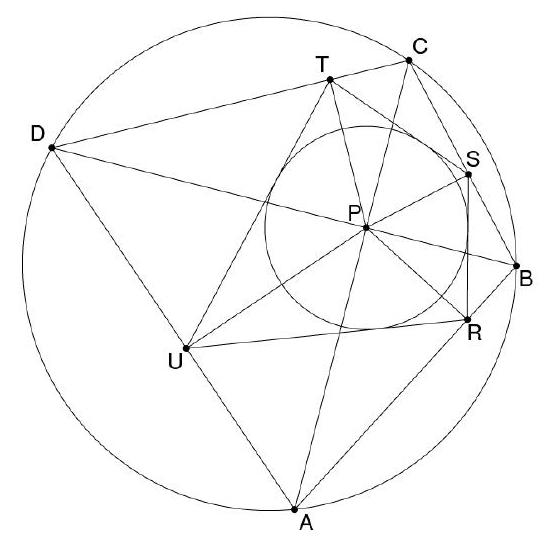", "solution": "First we show that $R S T U$ is always inscriptible. Note that in addition to $A B C D$, we have cyclic quadrilaterals $A R P U$ and $B S P R$. Thus,\n\n$$\n\\angle P R U=\\angle P A U=\\angle C A D=\\angle C B D=\\angle S B P=\\angle S R P\n$$\n\nand it follows that $P$ lies on the bisector of $\\angle S R U$. Analogously, $P$ lies on the bisectors of $\\angle T S R$ and $\\angle U T S$, so is equidistant from lines $U R, R S, S T$, and $T U$, and $R S T U$ is inscriptible having incenter $P$. Now we show that $R S T U$ is cyclic if and only if the diagonals of $A B C D$ are orthogonal. We have\n\n$$\n\\begin{aligned}\n& \\angle A P B=\\pi-\\angle B A P-\\angle P B A=\\pi-\\angle R A P-\\angle P B R=\\pi-\\angle R U P-\\angle P S R \\\\\n& \\quad=\\pi-\\frac{1}{2}(\\angle R U T+\\angle T S R)\n\\end{aligned}\n$$\n\nIt follows that $\\angle A P B=\\frac{\\pi}{2}$ if and only if $\\angle R U T+\\angle T S R=\\pi$, as desired.", "metadata": {"resource_path": "HarvardMIT/segmented/en-102-2007-feb-team1-solutions.jsonl", "problem_match": "\n12. [30]", "solution_match": "\nSolution. "}} |
| {"year": "2007", "tier": "T4", "problem_label": "13", "problem_type": null, "exam": "HMMT", "problem": "Find all nonconstant polynomials $P(x)$, with real coefficients and having only real zeros, such that $P(x+1) P\\left(x^{2}-x+1\\right)=P\\left(x^{3}+1\\right)$ for all real numbers $x$.", "solution": "$\\left\\{\\mathbf{P}(\\mathbf{x})=\\mathbf{x}^{\\mathbf{k}} \\mid \\mathbf{k} \\in \\mathbb{Z}^{+}\\right\\}$.", "metadata": {"resource_path": "HarvardMIT/segmented/en-102-2007-feb-team1-solutions.jsonl", "problem_match": "\n13. [30]", "solution_match": "\nAnswer: "}} |
| {"year": "2007", "tier": "T4", "problem_label": "13", "problem_type": null, "exam": "HMMT", "problem": "Find all nonconstant polynomials $P(x)$, with real coefficients and having only real zeros, such that $P(x+1) P\\left(x^{2}-x+1\\right)=P\\left(x^{3}+1\\right)$ for all real numbers $x$.", "solution": "Note that if $P(\\alpha)=0$, then by setting $x=\\alpha-1$ in the given equation, we find $0=P\\left(x^{3}+\\right.$ $1)=P\\left(\\alpha^{3}-3 \\alpha^{2}+3 \\alpha\\right)$. Because $P$ is nonconstant, it has at least one zero. Because $P$ has finite degree, there exist minimal and maximal roots of $P$. Writing $\\alpha^{3}-3 \\alpha^{2}+3 \\alpha \\geq \\alpha \\Longleftrightarrow \\alpha(\\alpha-1)(\\alpha-2) \\geq 0$, we see that the largest zero of $P$ cannot exceed 2 . Likewise, the smallest zero cannot be negative, so all of the zeroes of $P$ lie in [0,2]. Moreover, if $\\alpha \\notin\\{0,1,2\\}$ is a zero of $P$, then $\\alpha^{\\prime}=\\alpha^{3}-3 \\alpha^{2}+3 \\alpha$ is another zero of $P$ that lies strictly between $\\alpha$ and 1. Because $P$ has only finitely many zeroes, all of its zeroes must lie in $\\{0,1,2\\}$. Now write $P(x)=k x^{p}(x-1)^{q}(x-2)^{r}$ for nonnegative integers $p, q$ and $r$ having a positive sum. The given equation becomes\n\n$$\n\\begin{aligned}\n& k^{2}(x+1)^{p} x^{q}(x-1)^{r}\\left(x^{2}-x+1\\right)^{p}\\left(x^{2}-x\\right)^{q}\\left(x^{2}-x-1\\right)^{r}=P(x+1) P\\left(x^{2}-x+1\\right) \\\\\n& \\quad=P\\left(x^{3}+1\\right)=k\\left(x^{3}+1\\right)^{p} x^{3 q}\\left(x^{3}-1\\right)^{r}\n\\end{aligned}\n$$\n\nFor the leading coefficients to agree, we require $k=k^{2}$. Because the leading coefficient is nonzero, $P$ must be monic. In $(*), r$ must be zero lest $P\\left(x^{3}+1\\right)=0$ have complex roots. Then $q$ must be zero as well. For, if $q$ is positive, then $P\\left(x^{2}-x+1\\right)=0$ has 1 as a root while $P\\left(x^{3}+1\\right)$ does not. Finally, the remaining possibilities are $P(x)=x^{p}$ for $p$ an arbitrary positive integer. It is easily seen that these polynomials are satisfactory.", "metadata": {"resource_path": "HarvardMIT/segmented/en-102-2007-feb-team1-solutions.jsonl", "problem_match": "\n13. [30]", "solution_match": "\nSolution. "}} |
| {"year": "2007", "tier": "T4", "problem_label": "14", "problem_type": null, "exam": "HMMT", "problem": "Find an explicit, closed form formula for\n\n$$\n\\sum_{k=1}^{n} \\frac{k \\cdot(-1)^{k} \\cdot\\binom{n}{k}}{n+k+1}\n$$", "solution": "$\\frac{-\\mathbf{1}}{\\binom{2 \\mathbf{1}+1}{\\mathbf{n}}}$ or $-\\frac{\\mathbf{n}!(\\mathbf{n}+\\mathbf{1})!}{(\\mathbf{2 n}+\\mathbf{1})!}$ or obvious equivalent.", "metadata": {"resource_path": "HarvardMIT/segmented/en-102-2007-feb-team1-solutions.jsonl", "problem_match": "\n14. [40]", "solution_match": "\nAnswer: "}} |
| {"year": "2007", "tier": "T4", "problem_label": "14", "problem_type": null, "exam": "HMMT", "problem": "Find an explicit, closed form formula for\n\n$$\n\\sum_{k=1}^{n} \\frac{k \\cdot(-1)^{k} \\cdot\\binom{n}{k}}{n+k+1}\n$$", "solution": "Consider the interpolation of the polynomial $P(x)=x \\cdot n!$ at $x=0,1, \\ldots, n$. We obtain the identity\n\n$$\n\\begin{aligned}\nP(x) & =x \\cdot n!=\\sum_{k=0}^{n} k \\cdot n!\\prod_{j \\neq k} \\frac{x-j}{k-j} \\\\\n& =\\sum_{k=0}^{n} k \\cdot n!\\cdot \\frac{x(x-1) \\cdots(x-k+1)(x-k-1) \\cdots(x-n)}{k!(n-k)!(-1)^{n-k}} \\\\\n& =\\sum_{k=1}^{n} k \\cdot(-1)^{n-k} \\cdot\\binom{n}{k} \\cdot x(x-1) \\cdots(x-k+1)(x-k-1) \\cdots(x-n)\n\\end{aligned}\n$$\n\nThis identity is valid for all complex numbers $x$, but, to extract a factor $\\frac{1}{n+k+1}$ from the valid product of each summand, we set $x=-n-1$, so that\n$-(n+1)!=\\sum_{k=1}^{n} k(-1)^{n-k}\\binom{n}{k}(-n-1) \\cdots(-n-k)(-n-k-2) \\cdots(-2 n-1)=\\sum_{k=1}^{n} \\frac{k(-1)^{k}\\binom{n}{k}(2 n+1)!}{n!(n+k+1)}$.\nFinally,\n\n$$\n\\sum_{k=1}^{n} \\frac{k \\cdot(-1)^{k} \\cdot\\binom{n}{k}}{n+k+1}=\\frac{-n!(n+1)!}{(2 n+1)!}=\\frac{-1}{\\binom{2 n+1}{n}} \\cdot \\square\n$$", "metadata": {"resource_path": "HarvardMIT/segmented/en-102-2007-feb-team1-solutions.jsonl", "problem_match": "\n14. [40]", "solution_match": "\nSolution. "}} |
|
|