# $13^{\text {th }}$ Annual Harvard-MIT Mathematics Tournament
Saturday 20 February 2010
General Test, Part 1
General Test, Part 1}
1. [3] Suppose that $x$ and $y$ are positive reals such that
$$
x-y^{2}=3, \quad x^{2}+y^{4}=13
$$
Find $x$.
Answer: $\frac{3+\sqrt{17}}{2}$ Squaring both sides of $x-y^{2}=3$ gives $x^{2}+y^{4}-2 x y^{2}=9$. Subtract this equation from twice the second given to get $x^{2}+2 x y^{2}+y^{4}=17 \Longrightarrow x+y^{2}= \pm 17$. Combining this equation with the first given, we see that $x=\frac{3 \pm \sqrt{17}}{2}$. Since $x$ is a positive real, $x$ must be $\frac{3+\sqrt{17}}{2}$.
2. [3] Let $S=\{1,2,3,4,5,6,7,8,9,10\}$. How many (potentially empty) subsets $T$ of $S$ are there such that, for all $x$, if $x$ is in $T$ and $2 x$ is in $S$ then $2 x$ is also in $T$ ?
Answer: 180 We partition the elements of $S$ into the following subsets: $\{1,2,4,8\},\{3,6\},\{5,10\}$, $\{7\},\{9\}$. Consider the first subset, $\{1,2,4,8\}$. Say 2 is an element of $T$. Because $2 \cdot 2=4$ is in $S, 4$ must also be in $T$. Furthermore, since $4 \cdot 2=8$ is in $S, 8$ must also be in $T$. So if $T$ contains 2 , it must also contain 4 and 8 . Similarly, if $T$ contains 1 , it must also contain 2,4 , and 8 . So $T$ can contain the following subsets of the subset $\{1,2,4,8\}$ : the empty set, $\{8\},\{4,8\},\{2,4,8\}$, or $\{1,2,4,8\}$. This gives 5 possibilities for the first subset. In general, we see that if $T$ contains an element $q$ of one of these subsets, it must also contain the elements in that subset that are larger than $q$, because we created the subsets for this to be true. So there are 3 possibilities for $\{3,6\}, 3$ for $\{5,10\}, 2$ for $\{7\}$, and 2 for $\{9\}$. This gives a total of $5 \cdot 3 \cdot 3 \cdot 2 \cdot 2=180$ possible subsets $T$.
3. [4] A rectangular piece of paper is folded along its diagonal (as depicted below) to form a non-convex pentagon that has an area of $\frac{7}{10}$ of the area of the original rectangle. Find the ratio of the longer side of the rectangle to the shorter side of the rectangle.
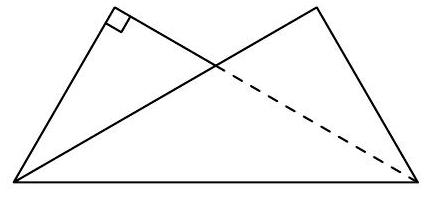
Answer: $\sqrt{5}$
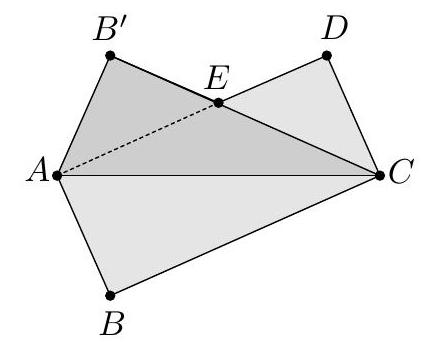
Given a polygon $P_{1} P_{2} \cdots P_{k}$, let $\left[P_{1} P_{2} \cdots P_{k}\right]$ denote its area. Let $A B C D$ be the rectangle. Suppose we fold $B$ across $\overline{A C}$, and let $E$ be the intersection of $\overline{A D}$ and $\overline{B^{\prime} C}$. Then we end up with the pentagon $A C D E B^{\prime}$, depicted above. Let's suppose, without loss of generality, that $A B C D$ has area 1. Then $\triangle A E C$ must have area $\frac{3}{10}$, since
$$
\begin{aligned}
{[A B C D] } & =[A B C]+[A C D] \\
& =\left[A B^{\prime} C\right]+[A C D] \\
& =\left[A B^{\prime} E\right]+2[A E C]+[E D C] \\
& =\left[A C D E B^{\prime}\right]+[A E C] \\
& =\frac{7}{10}[A B C D]+[A E C],
\end{aligned}
$$
That is, $[A E C]=\frac{3}{10}[A B C D]=\frac{3}{10}$.
Since $\triangle E C D$ is congruent to $\triangle E A B^{\prime}$, both triangles have area $\frac{1}{5}$. Note that $\triangle A B^{\prime} C, \triangle A B C$, and $\triangle C D A$ are all congruent, and all have area $\frac{1}{2}$. Since $\triangle A E C$ and $\triangle E D C$ share altitude $\overline{D C}$, $\frac{D E}{E A}=\frac{[D E C]}{[A E C]}=\frac{2}{3}$. Because $\triangle C A E$ is isosceles, $C E=E A$. Let $A E=3 x$. The $C E=3 x, D E=2 x$, and $C D=x \sqrt{9-4}=x \sqrt{5}$. Then $\frac{A D}{D C}=\frac{A E+E D}{D C}=\frac{3+2}{\sqrt{5}}=\sqrt{5}$.
4. [4] Let $S_{0}=0$ and let $S_{k}$ equal $a_{1}+2 a_{2}+\ldots+k a_{k}$ for $k \geq 1$. Define $a_{i}$ to be 1 if $S_{i-1}1$, because we may hold all but one of the $\pm$ choices constant, and change the remaining one).
9. [7] Three unit circles $\omega_{1}, \omega_{2}$, and $\omega_{3}$ in the plane have the property that each circle passes through the centers of the other two. A square $S$ surrounds the three circles in such a way that each of its four sides is tangent to at least one of $\omega_{1}, \omega_{2}$ and $\omega_{3}$. Find the side length of the square $S$.
Answer: $\frac{\sqrt{6}+\sqrt{2}+8}{4}$
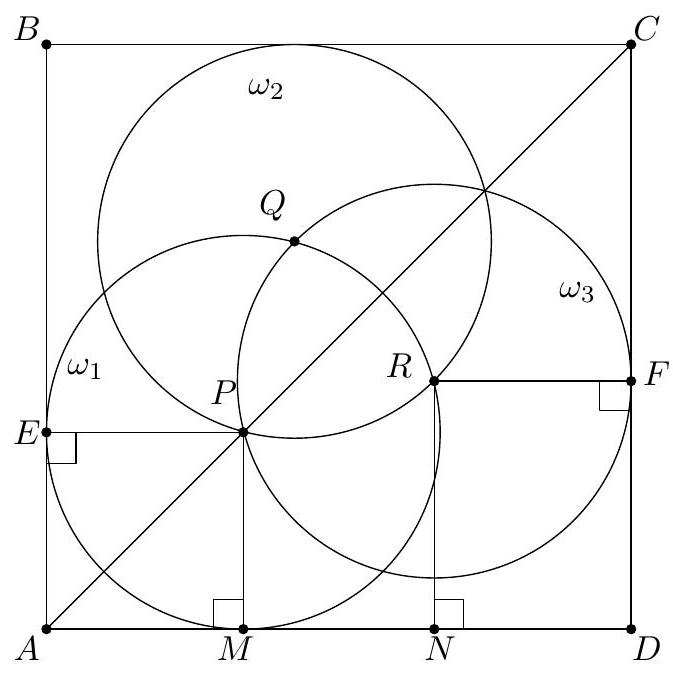
By the Pigeonhole Principle, two of the sides must be tangent to the same circle, say $\omega_{1}$. Since $S$ surrounds the circles, these two sides must be adjacent, so we can let $A$ denote the common vertex of the two sides tangent to $\omega_{1}$. Let $B, C$, and $D$ be the other vertices of $S$ in clockwise order, and let $P, Q$, and $R$ be the centers of $\omega_{1}, \omega_{2}$, and $\omega_{3}$ respectively, and suppose WLOG that they are also in clockwise order. Then $A C$ passes through the center of $\omega_{1}$, and by symmetry ( since $A B=A D$ ) it
must also pass through the other intersection point of $\omega_{2}$ and $\omega_{3}$. That is, $A C$ is the radical axis of $\omega_{2}$ and $\omega_{3}$.
Now, let $M$ and $N$ be the feet of the perpendiculars from $P$ and $R$, respectively, to side $A D$. Let $E$ and $F$ be the feet of the perpendiculars from $P$ to $A B$ and from $R$ to $D C$, respectively. Then $P E A M$ and $N R F D$ are rectangles, and $P E$ and $R F$ are radii of $\omega_{1}$ and $\omega_{2}$ respectively. Thus $A M=E P=1$ and $N D=R F=1$. Finally, we have
$$
\begin{aligned}
M N & =P R \cdot \cos \left(180^{\circ}-\angle E P R\right) \\
& =\cos \left(180^{\circ}-E P Q-R P Q\right) \\
& =-\cos \left(\left(270^{\circ}-60^{\circ}\right) / 2+60^{\circ}\right) \\
& =-\cos \left(165^{\circ}\right) \\
& =\cos \left(15^{\circ}\right) \\
& =\frac{\sqrt{6}+\sqrt{2}}{4} .
\end{aligned}
$$
Thus $A D=A M+M N+N D=1+\frac{\sqrt{6}+\sqrt{2}}{4}+1=\frac{\sqrt{6}+\sqrt{2}+8}{4}$ as claimed.
10. [8] Let $a, b, c, x, y$, and $z$ be complex numbers such that
$$
a=\frac{b+c}{x-2}, \quad b=\frac{c+a}{y-2}, \quad c=\frac{a+b}{z-2} .
$$
If $x y+y z+z x=67$ and $x+y+z=2010$, find the value of $x y z$.
Answer: -5892 Manipulate the equations to get a common denominator: $a=\frac{b+c}{x-2} \Longrightarrow x-2=$ $\frac{b+c}{a} \Longrightarrow x-1=\frac{a+b+c}{a} \Longrightarrow \frac{1}{x-1}=\frac{a}{a+b+c}$; similarly, $\frac{1}{y-1}=\frac{b}{a+b+c}$ and $\frac{1}{z-1}=\frac{c}{a+b+c}$. Thus
$$
\begin{aligned}
\frac{1}{x-1}+\frac{1}{y-1}+\frac{1}{z-1} & =1 \\
(y-1)(z-1)+(x-1)(z-1)+(x-1)(y-1) & =(x-1)(y-1)(z-1) \\
x y+y z+z x-2(x+y+z)+3 & =x y z-(x y+y z+z x)+(x+y+z)-1 \\
x y z-2(x y+y z+z x)+3(x+y+z)-4 & =0 \\
x y z-2(67)+3(2010)-4 & =0 \\
x y z & =-5892
\end{aligned}
$$