

Qwen 3.6 — AEON Ultimate Uncensored & Heretic
Collection
Lossless abliteration of Qwen3.6-27B with full multimodal preservation. NVFP4 + MTP/MTP-XS variants. DGX Spark production-validated. • 13 items • Updated • 14

✅ Validated on the unified AEON vLLM Ultimate image
ghcr.io/aeon-7/aeon-vllm-ultimate:latest(=:2026-06-18-v0.23.0-dflashfix; rollback:2026-06-11-pr41703) — vLLM 0.23.0 built from source for GB10 / sm_121a + the AEON DFlash stack. Loads + serves cleanly (compressed-tensors MoE) — including working multimodal image understanding (a vision tensor-prefix bug was fixed 2026-06-18 — see the Vision fix section below) — and with DFlashnum_speculative_tokens: 11now scales to c=64 with up to ~740 tok/s aggregate and no concurrency crash. This single image supersedes the oldervllm-spark-omni-q36:v1.2container. Recommended container base.
🚀 PRODUCTION DEPLOYMENT GUIDE: github.com/AEON-7/Qwen3.6-35B-A3B-heretic-NVFP4-DFlash
The GitHub repo is the definitive turn-key setup for DGX Spark — end-to-end deployment guide, validated OpenClaw config, and a concurrency-sweep benchmark harness.
- Image:
ghcr.io/aeon-7/aeon-vllm-ultimate:latest(vLLM 0.23.0 source-built for sm_121a + the AEON speculative-decoding stack — see What we fixed for the DGX Spark)- Pairs with
z-lab/Qwen3.6-35B-A3B-DFlashdrafter (must be post 2026-04-19 revision)- Production-stable under sustained chat load and concurrent agent fleets up to c=64 on DGX Spark
v1 of this checkpoint had model.language_model.layers.X.* keys remapped to
model.layers.X.* so vLLM's text-only Qwen3_5MoeForCausalLM loader would pick them up.
That layout was unstable in production — intermittent NaN/crash in the prefix-strip
codepath during real chat sessions.
v2 re-quantizes the same source (tvall43/Qwen3.6-35B-A3B-heretic) with
AutoModelForImageTextToText, restoring the canonical multimodal architecture (the text path):
Qwen3_5MoeForConditionalGeneration (vLLM's canonical class — no registry hack required)model.language_model.layers.X.* retained natively (no post-quantization key rewriting)model.language_model.visual.* and silently skip-loaded until the 2026-06-18 vision fix below; image inputs did not work in v2 until that renamevLLM serves it via the canonical multimodal class with no prefix-strip code path in the inference hot loop. Result: rock-solid text stability where v1 was crashing on virtually every interaction. (Vision, however, was not yet functional in v2 — the ViT was mis-nested and skip-loaded; see the Vision fix section below, which corrected this on 2026-06-18.)
⚠️ If you cloned v1 of this repo, delete and re-pull. Same URL — v2 commits replaced v1.
v2 (above) preserved the vision tower's BF16 weights, but a quantization-time ignore-regex
defect nested the 27-block ViT one level too deep: the 333 vision tensors were written as
model.language_model.visual.* instead of the sibling model.visual.* that vLLM's
Qwen3_5MoeForConditionalGeneration expects (it builds self.visual at model.visual — a
sibling of self.language_model, not a child). vLLM therefore silently skip-loaded the
entire vision tower (WARNING … Parameter visual.* not found in params_dict, skip loading)
and ran it uninitialized — text was perfect, but any image input produced !!!! garbage.
This revision renames those 333 vision tensors to model.visual.* — a header-only edit, so
the NVFP4/BF16 weight data is byte-for-byte identical (no re-quantization; same file size,
same data offsets). vLLM now loads the full ViT (0 skip-loads) and image understanding
works, validated on aeon-vllm-ultimate:latest: a shapes/colors probe scored 7/7 (all
shapes + colors + on-image text) and a richer scene 5/7, with LLM text unchanged. The
AEON-7 27B multimodal siblings already used the correct model.visual.* layout and were
unaffected by this defect.
If you pulled this repo before 2026-06-18 and saw
!!!!on image prompts, re-pull — the correctedmodel.safetensorsis live at the same URL (weight data identical; only the vision tensor names changed).
NVFP4-quantized version of tvall43/Qwen3.6-35B-A3B-heretic — an abliterated (decensored, 5/100 refusal rate) Qwen 3.6 35B-A3B Mixture-of-Experts multimodal model with thinking/reasoning capabilities.
Quantized using llmcompressor with the compressed-tensors nvfp4-pack-quantized format. Calibrated with 256 samples from open-platypus over 40 sequential decoder-layer stages. Vision encoder, linear-attention (Mamba/GDN) layers, MoE routers, gates, norms, and lm_head/embed_tokens preserved in BF16.
Designed for deployment on NVIDIA DGX Spark (GB10, Blackwell SM 12.0+) with native FP4 tensor-core support. Pairs with z-lab/Qwen3.6-35B-A3B-DFlash for spec-decode acceptance of 2.7-4.4 mean accepted tokens per target step on greedy workloads.
Complete recipe for a DGX Spark / Blackwell box: pull the container, pull this NVFP4 model, pull the DFlash drafter (fresh), then serve with the vetted flags + DFlash spec-decode. No --mamba-block-size is needed for this 35B-A3B body.
# 1. Pull the unified AEON vLLM image (anonymous public GHCR pull)
docker pull ghcr.io/aeon-7/aeon-vllm-ultimate:latest

# 2. Pull THIS NVFP4 model (fresh — v2 commits replaced v1 at the same URL)
huggingface-cli download AEON-7/Qwen3.6-35B-A3B-heretic-NVFP4 --local-dir ./aeon-model

# 3. Pull the DFlash drafter, fresh (must be a post 2026-04-19 revision)
huggingface-cli download z-lab/Qwen3.6-35B-A3B-DFlash --local-dir ./aeon-drafter

# 4. Serve (NVFP4 body + DFlash drafter, n=11)
docker run --gpus all --ipc host --network host \
  -e VLLM_TEST_FORCE_FP8_MARLIN=1 \
  -v ./aeon-model:/model:ro \
  -v ./aeon-drafter:/drafter:ro \
  --entrypoint vllm \
  ghcr.io/aeon-7/aeon-vllm-ultimate:latest \
  serve /model \
  --quantization compressed-tensors \
  --attention-backend flash_attn \
  --reasoning-parser qwen3 \
  --tool-call-parser qwen3_coder \
  --enable-auto-tool-choice \
  --gpu-memory-utilization 0.65 \
  --enable-chunked-prefill \
  --enable-prefix-caching \
  --trust-remote-code \
  --max-model-len 40960 \
  --max-num-seqs 64 \
  --max-num-batched-tokens 32768 \
  --speculative-config '{"method":"dflash","model":"/drafter","num_speculative_tokens":11}'
Required with DFlash:
--max-num-seqsand--max-num-batched-tokensmust be set (as above) — without them the speculative-decoding scheduler can compute a negative token budget and the server fails to boot (max_num_scheduled_tokens is set to -512…). Raise--max-model-len(e.g.262144) for full long-context once running; see the production compose below.
Lower
--gpu-memory-utilizationto0.70if you co-locate ASR/TTS/embedding services on the Spark's unified memory — on GB10 keep it 0.6-0.7, since above ~0.8 the shared CPU+GPU pool page-thrashes and stalls the box (even 0.85 stalls); go lower for co-located services, high concurrency, fp16 KV, or DFlash. For the full production setup (docker-compose, served-model aliases, 256K--max-model-len, systemd, OpenClaw integration) see the Quick Start (DGX Spark) and Production docker-compose sections below.
These are the current measured numbers on ghcr.io/aeon-7/aeon-vllm-ultimate:latest (vLLM 0.23.0 + AEON sm_121a build + DFlash num_speculative_tokens: 11 via z-lab/Qwen3.6-35B-A3B-DFlash), on NVIDIA DGX Spark (GB10, sm_121a, 128 GB unified memory).
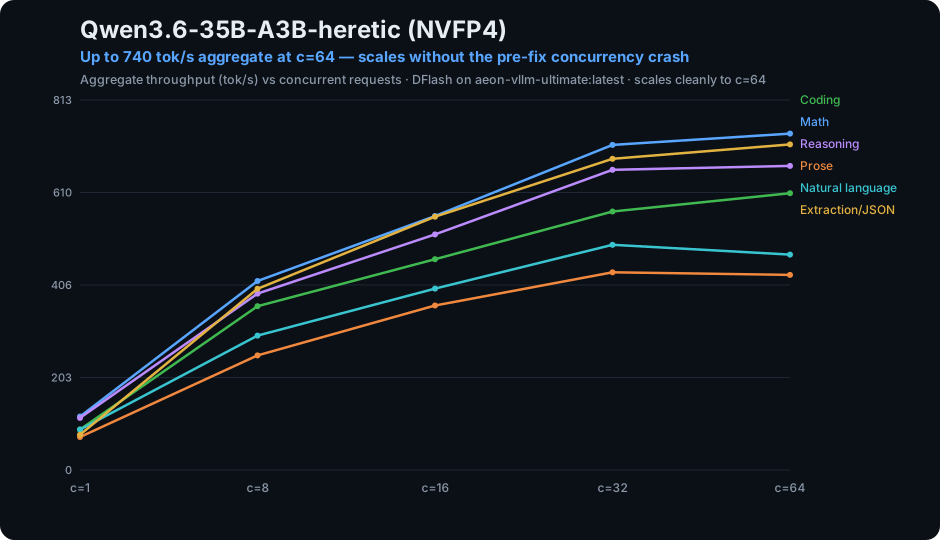
The unified image's specific win on this 35B-A3B MoE is clean concurrency scaling to c=64 with no crash (the pre-fix image crashed under concurrent speculative decoding at c≥32 — see What we fixed for the DGX Spark), plus long-context DFlash acceptance that holds ~42–58% out to 32K-token prompts. Aggregate throughput rises from 75–124 tok/s single-stream to **430–740 tok/s at c=64 depending on category** — DFlash-acceptance-driven: ~610–740 tok/s on structured code/math/reasoning/extraction (which draft well) and ~430–475 tok/s on creative prose/natural-language (lower draft acceptance).
Greedy (T=0), 256-token output, mixed-domain prompt set. decode_tok_s_p50 / ttft_p50_ms / tpot_p50_ms / prefill (pp_tok_s_p50) / DFlash position-0 acceptance.
| Category | 🟢 Decode tok/s | TTFT p50 | TPOT p50 | Prefill (PP) | DFlash accept |
|---|---|---|---|---|---|
| Coding | 91.7 | 88 ms | 10.9 ms | 509 tok/s | 32% |
| Math | 123.6 | 113 ms | 8.1 ms | 494 tok/s | 48% |
| Reasoning | 120.6 | 120 ms | 8.3 ms | 359 tok/s | 46% |
| Prose | 75.2 | 137 ms | 13.3 ms | 234 tok/s | 24% |
| Natural language | 91.8 | 104 ms | 10.9 ms | 326 tok/s | 32% |
| Extraction / JSON | 79.8 | 103 ms | 12.5 ms | 468 tok/s | 28% |
Aggregate tok/s across all active streams (median of the per-category levels), 256-token output:
| Concurrency | Coding | Math | Reasoning | Prose | Natural language | Extraction / JSON |
|---|---|---|---|---|---|---|
| 1 | 89 | 118 | 115 | 73 | 89 | 78 |
| 8 | 360 | 416 | 388 | 252 | 296 | 399 |
| 16 | 464 | 559 | 518 | 362 | 399 | 557 |
| 32 | 569 | 715 | 660 | 435 | 495 | 685 |
| 64 | 609 | 740 | 669 | 429 | 474 | 716 |
Scales cleanly through c=64 with zero errors at every level (the pre-fix image died at c≥32 under speculative decoding). Aggregate is compute-bound on this 35B-active-3B MoE — per-request decode falls as streams divide the GPU, but no stream stalls or crashes.
Re-validated 2026-06-19 on the exact published recipe (a fresh pull of
aeon-vllm-ultimate:latest+ the corrected weights, DFlashn=11): multimodal vision works end-to-end (7/7 on an image probe, 0 vision skip-loads) and the throughput spread reproduced with zero errors at c=64 — structured categories 705–781 tok/s @ c=64 (peak ~800 tok/s @ c=32, Reasoning), creative-text 430–474 tok/s @ c=64; DFlash acceptance46–55% (structured) / ~22–27% (creative) at short context, holding **40–45% at 16–20K-token** context.
Measured at ~16K and ~32K input tokens (median prompt_tokens_p50), greedy, 256-token output. The point of the AEON DFlash patches (PR #40898 SWA + PR #41703 prefix-cache safety) is that draft acceptance does not collapse as context grows:
| Context tier | Measured prompt (p50) | Decode tok/s (c=1) | TTFT (c=1) | DFlash accept |
|---|---|---|---|---|
| ~16K | 16.2K – 20.3K | 90.8 – 106.1 | 3.3 – 4.1 s | 41 – 52% |
| ~32K | 32.6K – 40.8K | 73.0 – 94.4 | 7.1 – 9.5 s | 43 – 58% |
Acceptance at 32K (43–58%) is on par with — and on the Extraction/JSON class, above — short-context acceptance, confirming the drafter's sliding-window layers are running as true SWA rather than collapsing past ~2K tokens.
Stock baseline note: there is no stock vanilla-vLLM baseline for this 35B-A3B checkpoint yet. A fresh fully-vanilla re-benchmark (default vLLM, no DFlash, no AEON/sm_121a optimizations) is pending; when it lands, a stock-vs-optimized contrast will be added here. The figures above are all measured on the optimized
aeon-vllm-ultimate:latest(vLLM 0.23.0) build. The earlier v1.2-image figures retained below for reference are likewise optimized-path numbers (different image, DFlash k=15), not a vanilla baseline.
⚠️ DFlash speedup is workload-dependent. Greedy reasoning workloads (math, code, extraction) hit the highest acceptance (≥40%); creative / open-ended / sampled prose is lower (~24%) and more variable. Use T=0 for maximum DFlash speedup.
vllm-spark-omni-q36:v1.2 reference (DFlash k=15)
The detailed single-stream / concurrent tables below were measured on the earlier
ghcr.io/aeon-7/vllm-spark-omni-q36:v1.2image at DFlash k=15, not on the currentaeon-vllm-ultimate:latestat n=11. They are retained as a representative reference for the Spark DFlash path; the current production numbers are the v0.23.0 section above. The unified image's specific gain is clean c=64 concurrency scaling and held long-context acceptance, not these short-context single-stream tok/s.
Best for interactive chat and agentic UX. All measurements greedy (T=0) unless noted.
| Statistic | tok/s |
|---|---|
| Median | 83.9 |
| p95 | 127.5 |
| Min | 41.1 |
| Max | 127.5 |
Variance reflects DFlash acceptance differences across prompt classes — math/code prompts hit ~125 tok/s with high drafter agreement, more open-ended prompts settle around 60-90 tok/s.
| Prompt class | Approx. input tokens | TTFT p50 | TTFT p95 | TTFT min | Effective prefill |
|---|---|---|---|---|---|
| Tiny | 2 | 99 ms | 102 ms | 98 ms | 20 tok/s |
| Short | 7 | 114 ms | 115 ms | 110 ms | 62 tok/s |
| Medium | 50 | 123 ms | 128 ms | 121 ms | 407 tok/s |
| Long | 465 | 259 ms | 314 ms | 257 ms | 1,797 tok/s |
Sub-130ms TTFT for any prompt under ~50 tokens — fixed kernel-launch overhead dominates short prefill.
| Max tokens | Actual tokens (median) | TTFT | Decode rate | Total latency |
|---|---|---|---|---|
| 50 | 50 | 113 ms | 70.1 tok/s | 0.82 s |
| 200 | 200 | 112 ms | 88.4 tok/s | 2.37 s |
| 500 | 331* | 116 ms | 115.6 tok/s | 4.44 s |
| 1000 | 330* | 113 ms | 118.3 tok/s | 6.28 s |
* model emitted EOS naturally before hitting max_tokens.
Decode rate increases with output length — DFlash steady-state amortization improves over the first 100-200 tokens once the drafter and target lock into a stable acceptance pattern.
| Mode | Decode p50 | Decode p95 | TTFT p50 |
|---|---|---|---|
| Greedy (T=0) | 76.5 tok/s | 123.0 tok/s | 115 ms |
| Stochastic (T=0.7) | 64.8 tok/s | 125.4 tok/s | 113 ms |
15% degradation T=0 → T=0.7. Less dramatic than typical for spec-decode systems — DFlash's drafter remains useful even at moderate sampling. Use T=0 for max DFlash speedup; T=0.7 for diversity.
| Input tokens | TTFT (≈ prefill) | Prefill rate | Decode rate after prefill |
|---|---|---|---|
| 1K | 519 ms | 1,973 tok/s | 48.8 tok/s |
| 4K | 2,594 ms | 1,579 tok/s | 41.1 tok/s |
| 16K | 8,007 ms | 2,046 tok/s | 34.6 tok/s |
| 32K | 19,368 ms | 1,692 tok/s | 23.0 tok/s |
Prefill rate plateaus around 2K tok/s due to (a) the drafter prefilling the same context in parallel and (b) Qwen3.6's 30 linear-attention (Mamba/GDN) layers having higher prefill constant factor than parallel softmax attention. Decode-after-prefill drops gracefully (~50% from 1K → 32K context).
| Metric | Value |
|---|---|
| Single-stream decode (200-tok output) | 83.9 tok/s median |
| Decode @ 500-1000 tok output (DFlash steady state) | 115-118 tok/s |
| Short-prompt TTFT | 99-128 ms |
| 16K-prompt TTFT | 8.0 s |
| 32K-prompt TTFT | 19.4 s |
| Peak prefill throughput | ~2,046 tok/s @ 16K prompt |
| Decode rate with 32K context | 23.0 tok/s (53% drop vs short context) |
Best for agent fleets and multi-user serving. 3 trials per level, median run reported (sorted by aggregate throughput). Mixed prompts, 200-token output, T=0.7 (stochastic — production-realistic), SSE streaming.
| Concurrent | Errors | Agg tok/s (median of 3) | Per-req decode p50 | Per-req decode min | TTFT p50 | TTFT p95 |
|---|---|---|---|---|---|---|
| 1 | 0 | 102.9 | 109.1 | 109.1 | 111 ms | 111 ms |
| 2 | 0 | 131.3 | 94.0 | 68.9 | 144 ms | 144 ms |
| 4 | 0 | 128.1 | 48.5 | 38.9 | 191 ms | 191 ms |
| 8 | 0 | 163.3 | 29.2 | 14.2 | 355 ms | 356 ms |
| 16 | 0 | 227.6 | 19.3 | 8.6 | 501 ms | 503 ms |
| 32 | 0 | 275.5 | 11.6 | 5.2 | 701 ms | 703 ms |
| 64 | 0 | 310.8 | 6.9 | 3.3 | 1.07 s | 11.2 s |
| 128 | 0 | 313.6 | 6.5 | 3.0 | 14.1 s | 46.7 s |
Zero errors across all 384 requests in the concurrent sweep (3 runs × 128-conc top level alone = 384, plus all lower levels = 1,200+ total).
Aggregate throughput plateaus at ~313 tok/s from 64 concurrent onward — that's the GPU's compute wall on this 35B-active-3B MoE with linear-attention KV reads + DFlash drafter overhead. TTFT spikes severely at 128 concurrent (14s p50, 47s p95) because all 128 sequences fit in the scheduler but compute is fully saturated, so each token's worth of work is divided across 128 streams. For latency-sensitive UX, target 16-32 concurrent; for max throughput, use the full 128.
Measures pure scheduler queue contention — critical for agent UX:
| Concurrent | TTFT p50 | TTFT p95 | TTFT min | TTFT max |
|---|---|---|---|---|
| 1 | 74 ms | 75 ms | 72 ms | 75 ms |
| 4 | 99 ms | 100 ms | 97 ms | 100 ms |
| 16 | 249 ms | 263 ms | 238 ms | 263 ms |
| 64 | 560 ms | 698 ms | 451 ms | 707 ms |
TTFT stays sub-700ms through 64 concurrent — smooth UX for small agent fleets. Beyond 64, TTFT accumulates queue-wait time as compute is fully consumed.
50-token output with 1,024-token prompts — simulates agents doing document QA or retrieval-augmented responses. Median of 2 runs.
| Concurrent | Errors | Agg tok/s | TTFT p50 | TTFT p95 | Decode p50 |
|---|---|---|---|---|---|
| 1 | 0 | 23.1 | 494 ms | 494 ms | 44.1 |
| 4 | 0 | 39.5 | 1,673 ms | 1,720 ms | 24.6 |
| 16 | 0 | 47.1 | 6,179 ms | 6,180 ms | 10.6 |
| 64 | 0 | 49.8 | 19,297 ms | 33,352 ms | 2.5 |
RAG throughput peaks around 50 tok/s at 16-64 concurrent. The aggregate is lower than the short-prompt sweep because each request spends most of its wall-clock in prefill (1K tokens) rather than decode. Use prefix caching if your RAG workload has repeated context blocks — the production compose enables --enable-prefix-caching which can give 5-10× speedup on shared-prefix RAG.
| Metric | Value |
|---|---|
| Peak aggregate throughput | 313.6 tok/s @ 128 concurrent (median of 3 trials) |
| Scaling from 1 → 128 | 3.05× throughput (compute-bound — DFlash + 35B MoE saturates GB10 around 64 streams) |
| Per-request decode @ 128 | 6.5 tok/s p50, 3.0 min |
| TTFT @ 64 concurrent | 1.07 s p50 (acceptable for agent fleets) |
| TTFT @ 128 concurrent | 14.1 s p50 (queue-bound — useful for batch only) |
| Error rate across full bench | 0.0% (1,200+ requests, conc 1 → 128) |
| Best concurrency for chat UX | 4-16 (per-req 19-48 tok/s, TTFT < 500 ms) |
| Best concurrency for max throughput | 64-128 (saturated compute, TTFT trade-off) |
| Metric | Value |
|---|---|
| Single-stream decode (200-tok output) | 83.9 tok/s median |
| Single-stream decode @ DFlash steady state | 118 tok/s (1000-tok output) |
| Short-prompt TTFT | 99-128 ms |
| Peak aggregate throughput | 313.6 tok/s @ 128 concurrent |
| TTFT @ 16 concurrent (smooth UX) | 501 ms p50 |
| TTFT @ 64 concurrent (still usable) | 1.07 s p50 |
| Greedy vs stochastic decode penalty | 15% (76.5 → 64.8 tok/s) |
| DFlash position-0 acceptance (greedy workloads) | 62-78% |
| Mean accepted tokens per target step | 2.7-4.4 |
| Long-context decode @ 32K prompt | 23.0 tok/s |
| Total bench wall-clock | 11 minutes (1,200+ requests, 0 errors) |
| Concurrency | Throughput gain vs 1-req |
|---|---|
| 1 | 1.0× |
| 4 | 1.2× |
| 16 | 2.2× |
| 64 | 3.0× |
| 128 | 3.05× |
Scaling is GPU-compute-bound rather than memory-bound — DFlash on a 35B MoE with hybrid linear+full attention saturates the GB10's compute around 64 concurrent. Per-request throughput degrades from 109 tok/s (1-req) to 6.5 tok/s (128-req). For comparison, a non-spec-decode setup would scale much more linearly but lose the ~2-4× single-stream speedup DFlash provides.
enable_thinking=false — bench disables Qwen3.6's thinking tag for clean decode-rate measurement. Production with thinking on adds reasoning-token overhead before content emission (use max_tokens ≥ 2048 for thinking-enabled requests).scripts/bench_full.py; raw JSON results at bench/qwen36_v2_2026-04-20.json.| # | Requirement | Why |
|---|---|---|
| 1 | Native Blackwell GPU (SM 10.0+ — B200, GB10, RTX PRO 6000 Blackwell, RTX 5090) | NVFP4 needs hardware FP4 tensor cores |
| 2 | vLLM with sm_121a NVFP4 kernels — use ghcr.io/aeon-7/aeon-vllm-ultimate:latest (vLLM 0.23.0 source-built for sm_121a + the AEON DFlash stack) |
Stock vLLM wheels don't compile FP4 kernels for SM 12.x; the SM121 workarounds aren't all upstream yet |
| 3 | --quantization compressed-tensors (NOT modelopt) |
This checkpoint uses llmcompressor's compressed-tensors NVFP4 format |
| 4 | --trust-remote-code |
Qwen3.6 ships custom modeling code |
| 5 | --attention-backend flash_attn (when using DFlash) |
DFlash spec decode requires flash_attn backend |
| 6 | VLLM_TEST_FORCE_FP8_MARLIN=1 env (defensive pin) |
Pins NVFP4 MoE backend to MARLIN. As of 2026-04-21, vLLM's auto-selector arrives at MARLIN anyway because every other MoE backend rejects our 256-expert × 512-intermediate shape — this env defends against future vLLM versions adding a half-broken backend. The linear NVFP4 path is unaffected and uses native FP4 tensor cores (FlashInferCutlassNvFp4Linear). |
| 7 | DFlash drafter from post 2026-04-19 revision | Earlier z-lab drafter had a long-context crash bug |
| 8 | Latest transformers (≥5.5.4) |
qwen3_5_moe model_type registration |
# 1. Pull the image (anonymous public GHCR pull — anyone can run this)
docker pull ghcr.io/aeon-7/aeon-vllm-ultimate:latest

# 2. Pull both models
sudo mkdir -p /opt/qwen36 && sudo chown $USER:$USER /opt/qwen36
cd /opt/qwen36
export HF_HUB_ENABLE_HF_TRANSFER=1
hf download AEON-7/Qwen3.6-35B-A3B-heretic-NVFP4 --local-dir ./qwen36-nvfp4 &
hf download z-lab/Qwen3.6-35B-A3B-DFlash         --local-dir ./qwen36-dflash &
wait

# 3. Get the production compose file
curl -fsSL \
  https://raw.githubusercontent.com/AEON-7/Qwen3.6-35B-A3B-heretic-NVFP4-DFlash/main/examples/docker-compose.yml \
  -o docker-compose.yml

# 4. Start
docker compose up -d
docker compose logs -f   # wait for "Application startup complete" (~3-5 min)

# 5. Test (use temperature=0 + ≥2048 max_tokens for thinking-enabled requests)
curl http://localhost:8000/v1/chat/completions \
  -H 'Content-Type: application/json' \
  -d '{
    "model": "qwen36-fast",
    "messages": [{"role":"user","content":"What is 17 × 23? Show your work."}],
    "max_tokens": 2048,
    "temperature": 0
  }'
Full step-by-step (with pre-flight checks, smoke tests, systemd service, OpenClaw integration): github.com/AEON-7/Qwen3.6-35B-A3B-heretic-NVFP4-DFlash/blob/main/docs/dgx-spark-setup.md
services:
  vllm:
    image: ghcr.io/aeon-7/aeon-vllm-ultimate:latest   # = :2026-06-18-v0.23.0-dflashfix; rollback :2026-06-11-pr41703
    container_name: vllm-qwen36-heretic
    restart: unless-stopped
    network_mode: host
    # The image ENTRYPOINT is /bin/bash, so use entrypoint: vllm + command: serve ...
    entrypoint: vllm
    environment:
      - VLLM_ALLOW_LONG_MAX_MODEL_LEN=1
      - TORCH_CUDA_ARCH_LIST=12.1a
      - ENABLE_NVFP4_SM100=0
      - PYTORCH_CUDA_ALLOC_CONF=expandable_segments:True
      - NVIDIA_FORWARD_COMPAT=1
      - VLLM_TEST_FORCE_FP8_MARLIN=1     # pins the NVFP4 MoE backend to MARLIN (256×512 expert shape)
    volumes:
      - /opt/qwen36/qwen36-nvfp4:/models/qwen36
      - /opt/qwen36/qwen36-dflash:/models/qwen36-dflash
    command:
      - serve
      - /models/qwen36
      - --served-model-name
      - qwen36-35b-heretic
      - qwen36-fast
      - qwen36-deep
      - --host
      - 0.0.0.0
      - --port
      - "8000"
      - --tensor-parallel-size
      - "1"
      - --dtype
      - auto
      - --quantization
      - compressed-tensors
      - --max-model-len
      - "262144"
      - --max-num-seqs
      - "64"
      - --max-num-batched-tokens
      - "32768"
      - --gpu-memory-utilization
      - "0.70"
      - --enable-chunked-prefill
      - --enable-prefix-caching
      - --trust-remote-code
      - --enable-auto-tool-choice
      - --tool-call-parser
      - qwen3_coder
      - --reasoning-parser
      - qwen3
      - --speculative-config
      - '{"method":"dflash","model":"/models/qwen36-dflash","num_speculative_tokens":11}'
      - --attention-backend
      - flash_attn
    ipc: host
    deploy:
      resources:
        reservations:
          devices:
            - driver: nvidia
              count: all
              capabilities: [gpu]
Recipe notes (current build):
--quantization compressed-tensors(NOTmodelopt) — this checkpoint uses llmcompressor's NVFP4 format.--attention-backend flash_attnis required for the DFlash drafter on the body.num_speculative_tokens: 11is the validated production default for this 35B-A3B body — acceptance and long-context hold peak around n≈10–11, above which they fall off. Do not set--kv-cache-dtype(the non-causal DFlash drafter requires BF16 KV).- No
--mamba-block-sizeis needed on the v0.23.0 image (block_sizeis now an int upstream; the priorpatch_kv_cache_utilscarry was dropped).--enforce-eageris NOT required — CUDA graphs run cleanly with the unified image's spec-decode CUDA-graph capture-size alignment patch + the post-2026-04-19 DFlash drafter. Cudagraphs on give ~30% over eager.--gpu-memory-utilization 0.70leaves headroom for co-located ASR/TTS/embedding services on the Spark's unified memory; keep it 0.6-0.7 even when the LLM is the only major GPU service — above ~0.8 the shared CPU+GPU pool page-thrashes and stalls the box (even 0.85 stalls). Go lower for co-located services, high concurrency, fp16 KV, or DFlash.
All AEON models run on one unified container — ghcr.io/aeon-7/aeon-vllm-ultimate:latest (= :2026-06-18-v0.23.0-dflashfix; rollback :2026-06-11-pr41703) — vLLM v0.23.0 built from source for GB10 / sm_121a and merged with the AEON speculative-decoding stack.
| Fix | What it does | Why it matters on GB10 |
|---|---|---|
| DFlash high-concurrency fix (new) | Slices the speculative drafter's KV block-table to the unpadded batch (block_table[:num_reqs]) |
The drafter previously crashed at ≥32 concurrent requests (padded-vs-unpadded block-table shape mismatch in FlashAttention). Now scales cleanly to c=64. A port of upstream PR #43982, which fixed this for MTP but never for DFlash — present and unfixed even in the prior image. |
| Triton NVFP4 KV cache (PR #44389) | Software NVFP4 KV-cache path | The only 4-bit KV path on sm_121a (upstream's is hard-gated to B200) → ~3× KV capacity / longer context per GB of unified memory. |
| DFlash sliding-window attention (PR #40898) | Runs the drafter's SWA layers as true sliding-window | Long-context draft acceptance holds as agent histories grow (43–58% out to 32K tokens here) instead of collapsing past ~2k tokens. |
| Prefix-cache-safe DFlash (PR #41703) | Makes --enable-prefix-caching corruption-immune with the DFlash drafter |
Lets shared-prefix agent/RAG workloads use prefix caching without garbled output under speculative decoding. |
| sm_121a-native build | TORCH_CUDA_ARCH_LIST=12.1a, ENABLE_NVFP4_SM100=0 |
Compiles the SM120-family CUTLASS NVFP4/FP8 kernels GB10 actually dispatches to — true 4-bit tensor-core throughput, no dead B200-only kernels. |
| sm_121a boot + CUDA-graph patches | RTLD-lazy _C_stable_libtorch load; spec-decode CUDA-graph capture-size alignment |
Boots past MXFP4 (SM100-only) symbols absent on GB10; prevents cudaErrorIllegalAddress on partial-acceptance decode steps under speculative decoding. |
| Unified-memory tuning | --gpu-memory-utilization ≤0.70, FULL CUDA graphs, async scheduling, z-lab DFlash drafter |
GB10 shares one LPDDR5X pool across CPU + GPU; conservative KV headroom avoids page-thrash while keeping FULL-graph + speculative-decode throughput. |
| Property | Value |
|---|---|
| Architecture | qwen3_5_moe (multimodal — Qwen3_5MoeForConditionalGeneration) |
| Total params | ~35B |
| Active params | ~3B / token |
| Layers | 40 (3× Gated DeltaNet + 1× Gated Attention, repeating ×10) |
| Hidden | 2048 |
| Experts | 256 routed + 1 shared, top-8 per token |
| Vocabulary | 248,320 |
| Native context | 262,144 (256K) |
| Extended context (YaRN) | 1,010,000 (1M+) |
| Multimodal | 27-block ViT vision encoder (preserved BF16) |
| Attention type | Layers | Q/K/V heads | Head dim |
|---|---|---|---|
| Gated DeltaNet (linear, BF16) | 30 (3 of every 4) | QK 16, V 32 | 128 |
| Gated Attention (NVFP4) | 10 (1 of every 4) | Q 16, KV 2 | 256 (rotary 64) |
| Parameter | Value |
|---|---|
| Tool | llmcompressor |
| Format | compressed-tensors nvfp4-pack-quantized |
| Scheme | NVFP4 (FP4 E2M1 + per-block FP8 e4m3 scales + per-tensor FP32 scales) |
| Block size | 16 |
| Calibration data | open-platypus (256 samples) |
| Calibration seq_len | 2048 |
| Pipeline | Sequential (Qwen3_5MoeDecoderLayer, layer-by-layer to GPU) |
| Hardware | NVIDIA RTX PRO 6000 Blackwell (96 GB) |
| Calibration wall-clock | ~3 hours (40 decoder layers × ~3-4 min each) |
| Output | 9 safetensors shards, ~22 GB total |
| Expert keys (NVFP4) | 122,880 (40 × 256 × 3 × 4) |
| Visual keys (BF16) | ~333 |
| Linear-attn keys (BF16) | ~270 |
q_proj, k_proj, v_proj, o_proj (10 layers)gate_proj, up_proj, down_projlm_head, embed_tokens — accuracy-critical token projections*.mlp.gate, *.shared_expert_gate — MoE routing (sparsity-critical)*.norm.* — all RMSNorm layers*.visual.* — 27-block ViT vision tower*.linear_attn.* — 30 Gated DeltaNet (Mamba) layers (small relative to MoE; quantizing them tanks accuracy)The exact recipe + script that produced this checkpoint is at scripts/qwen36_requant_v2.py.
From the Qwen3.6 model card:
| Mode | General | Coding | Math/Reasoning |
|---|---|---|---|
| Thinking | T=1.0, P=0.95, K=20, PP=1.5 | T=0.6, P=0.95, K=20, PP=0.0 | T=1.0, P=1.0, K=40, PP=2.0 |
| Instruct (no think) | T=0.7, P=0.8, K=20, PP=1.5 | — | T=1.0, P=0.95, K=20, PP=1.5 |
For maximum DFlash speedup: use T=0 (greedy). The drafter ↔ target agreement rate collapses with sampling — at T=0.7 you typically see ~10-20% acceptance vs. 60-78% at T=0.
The production compose registers 3 served-model aliases for the same backend so chat clients can route greedy vs sampled requests separately:
qwen36-fast → intended for greedy/agentic (T=0)qwen36-deep → intended for creative/sampled (T=0.7)qwen36-35b-heretic → canonical nameDisable thinking per-request:
{"chat_template_kwargs": {"enable_thinking": false}}
Preserve thinking across multi-turn:
{"chat_template_kwargs": {"preserve_thinking": true}}
Common gotcha: with thinking enabled (default), Qwen3.6 spends most of its
max_tokensbudget on<think>reasoning before emittingcontent. Usemax_tokens≥ 2048 for thinking-enabled requests — lower budgets often producecontent: nullwithfinish_reason: "length".
| Tier | GPU | Notes |
|---|---|---|
| Target — production-validated | NVIDIA DGX Spark (128 GB unified, GB10 sm_121a) | Full 256K context, validated to c=64 concurrent on aeon-vllm-ultimate:latest |
| Compatible | RTX PRO 6000 Blackwell (96 GB) | What v2 was calibrated on. Same MoE-shape constraint applies (Marlin is still the only NVFP4 MoE backend that accepts 256×512 grouped GEMM regardless of chip); linear NVFP4 path uses CUTLASS native. |
| Compatible | B200 / GB200 | Image rebuild required (SM 10.0, not SM 12.x) |
| Compatible | RTX 5090 (32 GB) | Reduced context, low concurrency |
| Minimum | Any Blackwell GPU (SM 10.0+) | Required for native FP4; sub-Blackwell can run via Marlin W4A16 fallback but with reduced throughput |
| File | Size | Description |
|---|---|---|
model-00001-of-00009.safetensors … model-00009-of-00009.safetensors |
~22 GB total | NVFP4 quantized weights (~123,724 tensors across 9 shards) |
model.safetensors.index.json |
~5 MB | shard index |
config.json |
~7 KB | Model + quantization config (Qwen3_5MoeForConditionalGeneration) |
tokenizer.json |
~20 MB | Qwen tokenizer (248K vocab) |
tokenizer_config.json |
~1 KB | |
chat_template.jinja |
~8 KB | Qwen3.6 chat template (thinking + tool calling) |
preprocessor_config.json |
~500 B | Image preprocessor (kept for multimodal compat) |
generation_config.json |
~213 B | |
recipe.yaml |
~500 B | llmcompressor recipe used |
THIS IS AN UNCENSORED MODEL. By downloading, accessing, or using this model you expressly assume full and sole responsibility for all outputs generated, all actions taken based on outputs, and compliance with applicable laws. The authors are not responsible for any harmful, illegal, or objectionable content. These tools serve legitimate purposes including security research, red-teaming, content analysis, and creative work. Implement safeguards appropriate to your use case and jurisdiction.
Apache 2.0 (inherited from Qwen3.6 base).
If this release has been useful, tips are deeply appreciated — they go directly toward more compute, more models, and more open releases.
₿ Bitcoin (BTC) bc1q09xmzn00q4z3c5raene0f3pzn9d9pvawfm0py4
|
Ξ Ethereum (ETH) 0x1512667F6D61454ad531d2E45C0a5d1fd82D0500
|
◎ Solana (SOL) DgQsjHdAnT5PNLQTNpJdpLS3tYGpVcsHQCkpoiAKsw8t
|
ⓜ Monero (XMR) 836XrSKw4R76vNi3QPJ5Fa9ugcyvE2cWmKSPv3AhpTNNKvqP8v5ba9JRL4Vh7UnFNjDz3E2GXZDVVenu3rkZaNdUFhjAvgd
|
Ethereum L2s (Base, Arbitrum, Optimism, Polygon, etc.) and EVM-compatible tokens can be sent to the same Ethereum address.