

Parable
Collection
Open models trained on real Claude Fable 5 and GPT-5.5 agent traces. Eval-gated releases. Also on Ollama: ollama run parable/fable • 11 items • Updated • 2

Qwen3-8B trained on real Claude Fable 5 and GPT-5.5 agent traces: 67% lower held-out test loss than its base, and the strongest strictly-graded qualitative score in the Parable series: 23 of 34 fully correct.
Parable-Qwen3-8B is a Qwen/Qwen3-8B fine-tune trained on real multi-step agent sessions: planning, tool use, and <think> reasoning captured from actual Claude Fable 5 and GPT-5.5 agent work, not synthetic Q&A. Highest strict-qual release in the Parable series, alongside the Granite 8B line.
from transformers import AutoModelForCausalLM, AutoTokenizer

model = AutoModelForCausalLM.from_pretrained(
    "AnkitAI/Parable-Qwen3-8B-Claude-Fable-5",
    torch_dtype="auto", device_map="auto")
tok = AutoTokenizer.from_pretrained("AnkitAI/Parable-Qwen3-8B-Claude-Fable-5")

msgs = [{"role": "user", "content": "Write a Python function that retries an HTTP request with exponential backoff."}]
ids = tok.apply_chat_template(msgs, add_generation_prompt=True, return_tensors="pt").to(model.device)
out = model.generate(ids, max_new_tokens=3000, temperature=0.7, top_p=0.95, do_sample=True)
text = tok.decode(out[0][ids.shape[1]:], skip_special_tokens=True)
answer = text.split("</think>")[-1].strip()  # response opens with a <think> block
print(answer)
GGUF quants for llama.cpp / Ollama / LM Studio: Parable-Qwen3-8B-Claude-Fable-5-GGUF.
Sampling: temperature 0.7, top_p 0.95, generous max_new_tokens (at least 2500).
<think> reasoning and tool calls (AGPL-3.0)Every example passed a quality gate (schema validation, secrets scrub, length filtering) before training. QLoRA fine-tune (NF4, sequence length 1024) trained on a single 16 GB GPU, quantized with llama.cpp.
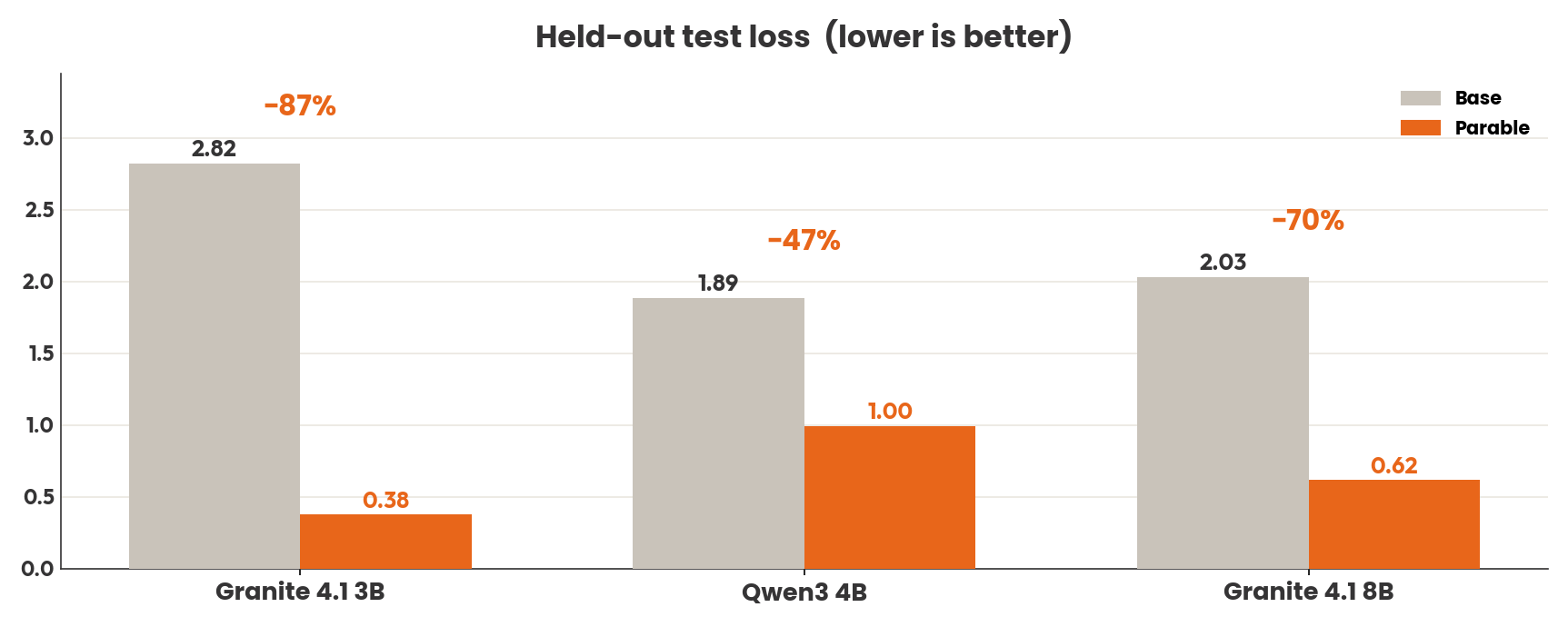
Held-out test split, identical evaluation code and context length for base and fine-tune:
| Metric | Base Qwen3-8B | Parable | Δ |
|---|---|---|---|
| Test loss | 2.162 | 0.712 | −67% |
Qualitative review (34 coding/terminal/debugging prompts, strictly graded by mentally executing every answer): 23/34 fully correct, 30/34 correct or partially correct — the highest fully-correct score in the series. We publish these numbers because strict qualitative grading is rare in this niche; judge accordingly.
For reference, the strongest published fine-tune on this data family (a 9B) reports 0.71 validation loss. Cross-repo numbers are indicative only: splits, tokenizers, and context lengths differ (ours is measured at 1,024 tokens).
Measured 2026-07-29: bfcl-eval at gorilla main, prompting mode, Q4_K_M
GGUFs served by llama.cpp on a T4, base and Parable under the identical
harness. Categories: simple_python / multiple / parallel /
parallel_multiple (400/200/200/200 items). Raw generations and score
files: parable-v2-artifacts
under verify/bfcl/.
| simple_python | multiple | parallel | parallel_multiple | |
|---|---|---|---|---|
| Qwen3-8B base | 0.953 | 0.945 | 0.935 | 0.900 |
| Parable-Qwen3-8B | 0.930 | 0.900 | 0.905 | 0.850 |
A 2.3 to 5.0 point trade per category: prose-trace SFT costs a little function-calling sharpness, as this card's evaluation note predicts. If you need maximum tool-calling accuracy, use the base; this variant buys the reasoning voice.
As a fine-tune it inherits Qwen3-8B's base behaviors and knowledge cutoff. As with any local model, treat generated commands and code as drafts to review.
Model weights: Apache-2.0 (inherited from Qwen3-8B). Training data licenses: Fable-5-traces AGPL-3.0, gpt5.5-terminal MIT. Because those traces originate from third-party assistants, the providers' terms may apply to downstream training and distillation. If you plan to build on this model commercially, confirm your use aligns with those terms.
| Platform | Command / Link |
|---|---|
| Ollama | ollama run parable/qwen3-fable:8b |
| Ollama (family flagship, best per size) | ollama run parable/fable |
| Hugging Face | GGUF quants, full weights, eval reports |
| LM Studio | lms get parable/qwen3-fable (parable on LM Studio Hub) |
The recipe, evaluation methodology and failure analysis behind this model are documented in the tech report:
Aglawe, A. (2026). Agent-Trace Fine-Tuning of Small Language Models under Constrained Compute. Zenodo. doi:10.5281/zenodo.21676407
@misc{aglawe2026agenttrace,
  author    = {Aglawe, Ankit},
  title     = {Agent-Trace Fine-Tuning of Small Language Models under Constrained Compute},
  year      = {2026},
  publisher = {Zenodo},
  doi       = {10.5281/zenodo.21676407},
  url       = {https://doi.org/10.5281/zenodo.21676407}
}
More on the Parable models: ankitaglawe.com/parable