

LongBEL
Collection
Huggingface collection for the paper LongBEL: Long-Context and Document-Consistent Biomedical Entity Linking • 9 items • Updated
LongBEL is a novel document-level framework for biomedical entity linking (BEL). Instead of normalizing each mention independently, LongBEL conditions each prediction on the document context and on previous normalizations produced in the same document. This design enforces document-level consistency and is enhanced by our robust memory mechanism. The method is introduced in our paper, currently under review.
This is a finetuned version of LLaMA-3-1B trained on MedMentions, applying the LongBEL framework to enable long context and robust memory predictions.
| Field | Value |
|---|---|
| Base model | meta-llama/Llama-3.2-1B-Instruct |
| Task | Biomedical Entity Linking |
| Dataset | MedMentions-ST21pv |
| Knowledge base | UMLS 2017AA, ST21pv subset |
| Input | BigBio-like documents with mention spans and semantic groups |
| Output | Ranked UMLS concept predictions |
| Decoding | Semantic-guided constrained decoding |
| Main metric | Recall@1 |
This model is intended for research on biomedical entity linking and document-level consistency.
It assumes that mention spans and semantic groups are already provided. It does not perform named entity recognition. In a full pipeline, a NER model should first detect mentions and assign semantic groups, then LongBEL can normalize these mentions to UMLS concepts.
import torch
from transformers import AutoModelForCausalLM

model = AutoModelForCausalLM.from_pretrained(
    "AnonymousARR42/LongBEL_1B_MedMentions_st21pv",
    trust_remote_code=True,
    torch_dtype=torch.bfloat16,
    device_map="auto",
)
The model expects BigBio-like documents. Each entity should include a mention text, character offsets, and a semantic group in the type field.
num_beams = 5

bigbio_pages = [
    {
        "id": "001",
        "document_id": "doc_001",
        "passages": [
            {
                "id": "0",
                "type": "paragraph",
                "text": [
                    "A 29-year-old pregnant woman presented with severe-range hypertension, "
                    "headache, and epigastric pain. Laboratory testing showed proteinuria "
                    "and mildly elevated liver enzymes. She was admitted overnight with "
                    "suspected PET and was started on urgent treatment."
                ],
                "offsets": [[0, 257]],
            }
        ],
        "entities": [
            {
                "id": "T1",
                "type": "Living Beings",
                "text": ["pregnant woman"],
                "offsets": [[14, 28]],
            },
            {
                "id": "T2",
                "type": "Disorders",
                "text": ["severe-range hypertension"],
                "offsets": [[44, 69]],
            },
            {
                "id": "T3",
                "type": "Disorders",
                "text": ["proteinuria"],
                "offsets": [[128, 139]],
            },
            {
                "id": "T4",
                "type": "Disorders",
                "text": ["PET"],
                "offsets": [[217, 220]],
            },
        ],
        "events": [],
        "coreferences": [],
        "relations": [],
    }
]

predictions = model.sample(
    bigbio_pages=bigbio_pages,
    num_beams=num_beams,
)

for i in range(0, len(predictions), num_beams):
    mention = predictions[i]["mention"]
    print(f"## Mention {(i // num_beams) + 1}: {mention}")

    for j in range(num_beams):
        pred = predictions[i + j]
        print(
            f"   - Beam {j + 1}:\n"
            f"     Predicted concept name: {pred['pred_concept_name']}\n"
            f"     Predicted code: {pred['pred_concept_code']}\n"
            f"     Beam score: {pred['beam_score']:.3f}\n"
        )
Example Output:
## Mention 1: pregnant woman
   - Beam 1:
     Predicted concept name: Pregnant Woman
     Predicted code: C0033011
     Beam score: 0.997

   - Beam 2:
     Predicted concept name: Pregnant Women
     Predicted code: C0033011
     Beam score: 0.024

   - Beam 3:
     Predicted concept name: Pregnancy Partner
     Predicted code: C3538996
     Beam score: 0.000

   - Beam 4:
     Predicted concept name: Pregnant Woman
     Predicted code: C0033011
     Beam score: 0.000

   - Beam 5:
     Predicted concept name: Pregnant Women
     Predicted code: C0033011
     Beam score: 0.000

## Mention 2: severe-range hypertension
   - Beam 1:
     Predicted concept name: Hypertensive crisis
     Predicted code: C0020546
     Beam score: 0.312

   - Beam 2:
     Predicted concept name: Hypertensive crisis (disorder)
     Predicted code: C0020546
     Beam score: 0.235

   - Beam 3:
     Predicted concept name: Hypertensive disease (disorder)
     Predicted code: C0020538
     Beam score: 0.203

   - Beam 4:
     Predicted concept name: Hypertensive disease
     Predicted code: C0020538
     Beam score: 0.168

   - Beam 5:
     Predicted concept name: Hypertension arterial
     Predicted code: C0020538
     Beam score: 0.114

## Mention 3: proteinuria
   - Beam 1:
     Predicted concept name: Proteinurias
     Predicted code: C0033687
     Beam score: 0.999

   - Beam 2:
     Predicted concept name: Proteinuric diabetic nephropathy (disorder)
     Predicted code: C0403519
     Beam score: 0.030

   - Beam 3:
     Predicted concept name: Proteinuria
     Predicted code: C0033687
     Beam score: 0.012

   - Beam 4:
     Predicted concept name: Proteinuria (disorder)
     Predicted code: C0033687
     Beam score: 0.006

   - Beam 5:
     Predicted concept name: Proteinuric diabetic nephropathy
     Predicted code: C0403519
     Beam score: 0.006

## Mention 4: PET
   - Beam 1:
     Predicted concept name: Investigation Finding
     Predicted code: C0243095
     Beam score: 0.081

   - Beam 2:
     Predicted concept name: PET - Pre-eclamptic toxemia
     Predicted code: C0032914
     Beam score: 0.017

   - Beam 3:
     Predicted concept name: PET - Pre-eclamptic toxaemia
     Predicted code: C0032914
     Beam score: 0.010

   - Beam 4:
     Predicted concept name: PET - Severe pre-eclamptic toxemia
     Predicted code: C0341950
     Beam score: 0.005

   - Beam 5:
     Predicted concept name: PET - Severe pre-eclamptic toxaemia
     Predicted code: C0341950
     Beam score: 0.004
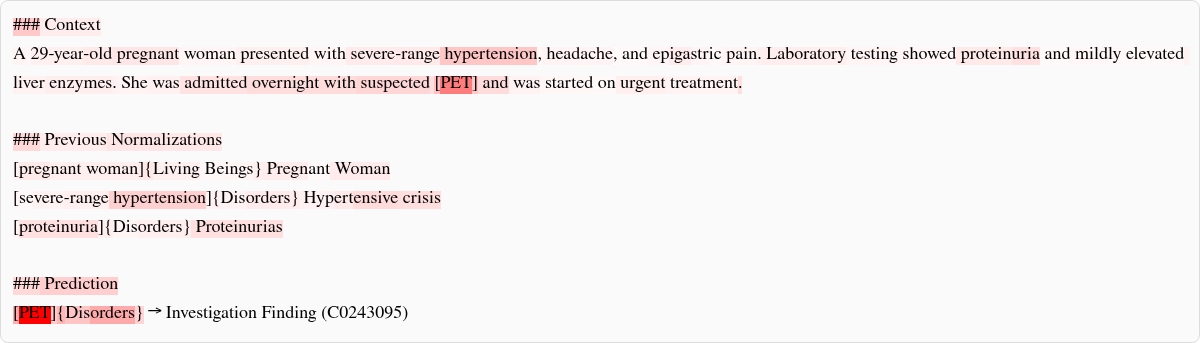
The model can also return token-level saliency maps during inference.
predictions, saliency_maps = model.sample(
    bigbio_pages=bigbio_pages,
    num_beams=num_beams,
    with_saliency_maps=True,
)

model.display_saliency_map(saliency_maps[3])
Example saliency map for the mention PET:
Entity linking performance is reported using Recall@1 with bootstrap confidence intervals. The best result is shown in bold, and the second-best result is underlined and ⭐ marks the main LongBEL-1B model.
| Model | MM-ST21PV (English) |
QUAERO-EMEA (French) |
SympTEMIST (Spanish) |
DisTEMIST (Spanish) |
MedProcNER (Spanish) |
|---|---|---|---|---|---|
| Context-Free BEL | |||||
| SciSpacy | 53.8 ± 1.0 | 37.1 ± 4.3 | 9.8 ± 1.3 | 21.1 ± 1.9 | 10.3 ± 1.2 |
| SapBERT | 65.6 ± 1.0 | 59.7 ± 3.8 | 34.2 ± 2.0 | 38.6 ± 2.6 | 30.4 ± 2.1 |
| CODER-all | 62.9 ± 1.1 | 66.9 ± 4.0 | 42.2 ± 2.2 | 47.0 ± 2.6 | 42.7 ± 2.1 |
| SapBERT-all | 64.6 ± 1.1 | 67.9 ± 3.9 | 49.8 ± 2.4 | 49.6 ± 2.6 | 45.1 ± 2.2 |
| BERGAMOT | 60.9 ± 1.1 | 63.8 ± 4.9 | 48.0 ± 2.7 | 48.9 ± 2.4 | 42.3 ± 2.2 |
| Local-Context BEL | |||||
| ArboEL | 76.9 ± 0.9 | 63.0 ± 3.9 | 55.4 ± 2.5 | 54.7 ± 2.6 | 59.7 ± 2.6 |
| GENRE / mBART-large | 69.6 ± 1.0 | 69.3 ± 5.4 | 59.8 ± 2.7 | 58.7 ± 2.7 | 66.0 ± 2.3 |
| GENRE / Llama-1B | 73.1 ± 1.0 | 75.1 ± 3.6 | 60.5 ± 2.4 | 62.5 ± 2.3 | 67.4 ± 2.1 |
| GENRE / Llama-8B | 75.0 ± 0.9 | 73.8 ± 4.0 | 61.7 ± 2.5 | 63.2 ± 2.5 | 68.3 ± 2.2 |
| Global-Context BEL: LongBEL | |||||
| ⭐ LongBEL-1B | 77.6 ± 0.9 | 74.5 ± 3.7 | 59.8 ± 2.5 | 61.9 ± 2.4 | 66.6 ± 2.1 |
| LongBEL-1B + Ensemble | 78.6 ± 0.8 | 77.2 ± 3.0 | 61.8 ± 2.5 | 64.3 ± 2.2 | 69.0 ± 2.0 |
| LongBEL-8B | 79.3 ± 0.8 | 75.4 ± 3.4 | 62.0 ± 2.6 | 63.6 ± 2.1 | 69.0 ± 2.1 |
| LongBEL-8B + Ensemble | 80.0 ± 0.8 | 77.6 ± 3.0 | 63.3 ± 2.5 | 65.8 ± 2.2 | 71.0 ± 2.0 |
The score reported for this checkpoint is the single LongBEL-1B model. The ensemble result requires fusing several LongBEL input configurations and is not produced by this checkpoint alone.
Measured on a single NVIDIA H100 80GB GPU.
| Model | Model memory | Candidate memory | Speed |
|---|---|---|---|
| GENRE-Llama-1B baseline | 2.4 GB | 5.4 GB | 69.6 mentions/s |
| LongBEL-1B | 2.4 GB | 5.4 GB | 48.5 mentions/s |
LongBEL has the same model memory footprint as the sentence-level Llama-1B baseline, but it is slower because it processes longer contexts and updates document-level memory during inference.
This model assumes that mention spans and semantic groups are given. It does not perform mention detection.
LongBEL is most useful when concepts recur within a document. When most concepts appear only once, the memory mechanism has less information to exploit.
Because LongBEL uses previous predictions as memory, early mistakes can still influence later predictions. Robust memory training reduces this risk but does not remove it completely.
This model is intended for research use. It should not be used for clinical decision-making without additional validation and human oversight.
Code and evaluation scripts are available in this GitHub repository.
Trained model checkpoints and processed datasets are available in the anonymous Hugging Face collection associated with LongBEL.
Base model
meta-llama/Llama-3.2-1B-Instruct