

DFlash: Block Diffusion for Flash Speculative Decoding
Paper • 2602.06036 • Published • 93

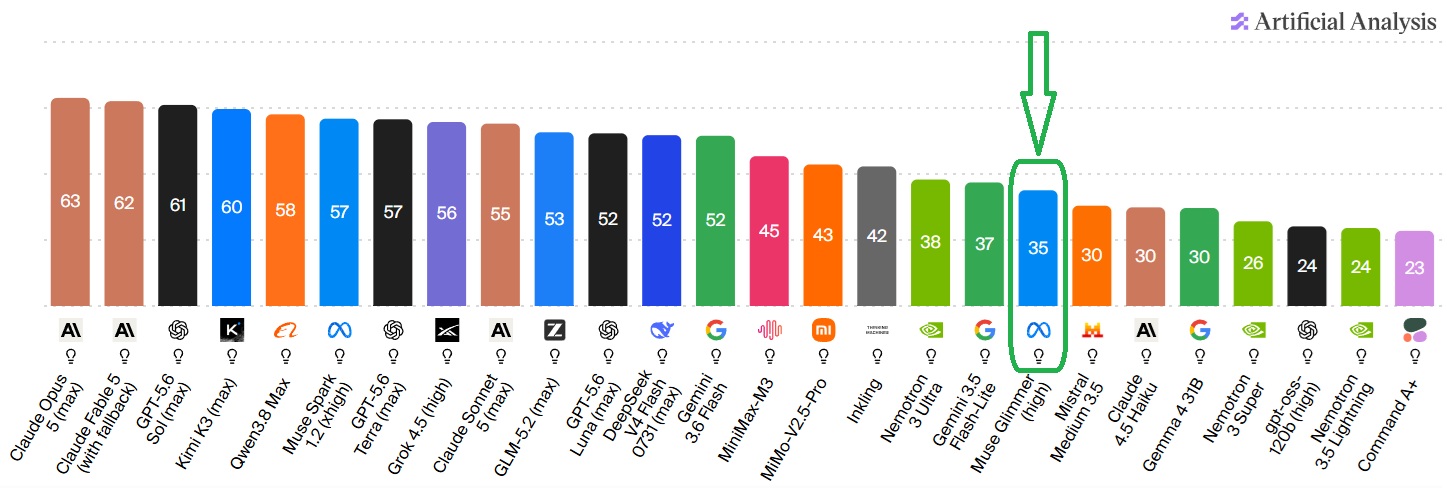
Quantized from unsloth/Muse-Glimmer-30B-GGUF (BF16) using the Infiniteon Algebra associator to guide mixed-precision allocation: 20% of the weights (the shared expert and attention tensors) are quantized to 4-bit (Q4_K), and the remaining 80% to 3-bit (Q3_K). This achieves Q4-level generation quality at near-Q3 size, fitting a 30B-parameter model inside 16 GB VRAM, and the Q2Q3 format inside a 12 GB VRAM.
Why this works: The associator of the Infiniteon algebra identifies which weight tensors carry structural "gap-crossing" information — the tensors that connect diverse token neighborhoods. By allocating 4-bit precision to these structurally critical tensors and 3-bit to the rest, the model preserves the directional diversity needed for coherent generation while keeping the overall size near Q3.
Research and credits: This research was conducted by TNT.Chat (https://ai.tnt.chat) as part of our LOCAL AI effort to bring larger models onto consumer hardware. The target is a capable model running on 12 GB VRAM for Agentic usage with a large context window. Try the Q2Q3 version of this model with only 10 GB in size.
Theory references:
Pinto Martins, C. F. (2026). Ramsey Statistics And Infiniteons Theory, Volume I. Zenodo. DOI: https://doi.org/10.5281/zenodo.19329589
Pinto Martins, C. F. (2026). Ramsey Statistics And Infiniteons Theory, Volume II. Zenodo. DOI: https://doi.org/10.5281/zenodo.19330373
The mmproj GGUF has BF16 format only.
The Q2Q3 format follows the same 20% Q3 and 80% Q2 structure ← Smallest size. The Q2Q4 format follows the same 20% Q4 and 80% Q2 structure.
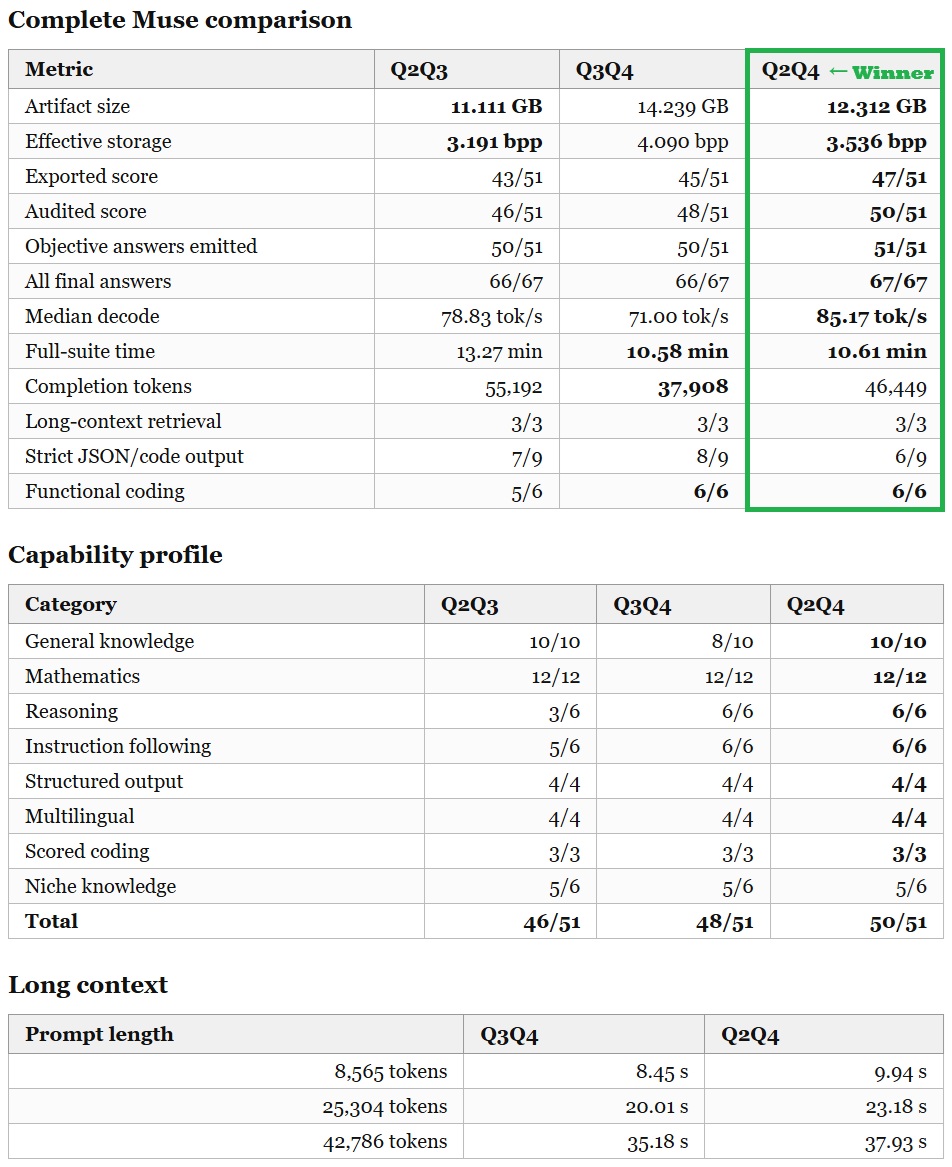
We tested the three MIX20 formats on our tnt-bench, a 51-question benchmark created to evaluate human interaction through direct questions to the models. The goal is to provide a first glance at how each model behaves before diving deeper into long-horizon tasks.
That distinction is important because Muse Glimmer Q2Q4 is the clear winner here, scoring at the same level as GLM-5.2 and well above GPT OSS 120B. It’s punching far above its weight class. The MIX20 quantization, using a mix of Q4 and Q2 weights, also produces a compact 12 GB artifact that is fast, smart, and practical for a standard 16 GB VRAM GPU such as the RTX 5060 Ti.
Our overall pick for a large context window on a 16 GB GPU is the Q2Q4 format, with the mmproj offloaded to the CPU.
For more details about tnt-bench please check our website.
Unsloth Dynamic 2.0 achieves superior accuracy & outperforms other leading quants.




Authors: Meta Superintelligence Lab
Model Release Date: August 2026
License: Apache 2.0
Muse Glimmer is a 30-billion-parameter causal language model with a dedicated perception encoder, distilled from Muse Spark and purpose-built for autonomous agentic tasks on consumer hardware. The model integrates multi-step reasoning, reliable tool use, multimodal understanding, and failure recovery into a single model that runs locally without requiring cloud infrastructure or network access.
Building effective agents requires key capabilities working together to achieve the user’s goals. Muse Glimmer is trained and evaluated on these capabilities:
| Model Architecture | Dense Causal Transformer with Perception Encoder |
|---|---|
| Total Parameters | ~29.6B |
| Language Model | |
| Architecture | Dense Causal Transformer |
| Number of Parameters | 29.6B (including vision encoder) |
| Hidden dimension | 6656 |
| Layers | 52 |
| Attention pattern | [Local, Local, Local, Global] repeating |
| Sliding window size | 2048 |
| Gated attention | Yes |
| Attention heads (Q / KV) | 32 / 2 (GQA ratio 16:1) |
| Head dimension | 128 |
| FFN type | SwiGLU |
| FFN intermediate dimension | 19,968 |
| Position encoding | RoPE (θ = 500,000), local layers only |
| Perception encoder | ~1.8B param ViT-G/14, 50 layers, width 1536, patch size 14 |
| Vocabulary size | 202,048 |
| Tokenizer | 200,000 BPE tokens + 2,048 special tokens |
| Max visual tokens per image | 4,096 |
| Context length | 131,072+ |
| Supported modalities | Input: text + image, Output: text |
| Training Data | Multimodal content sourced from publicly available data, data provided by third parties and information from Meta's products and services, curated and enriched by external vendor networks and Meta personnel. |
| Knowledge cutoff | January 4, 2026 |
Muse Glimmer was optimized for local deployment, and designed to run at practical speeds on consumer hardware without sacrificing quality.
Fitting the Model on Your Device. We use quantization techniques to compress the model's weights to approximately 4-bit precision, shrinking the language model to under 20 GB. This leaves enough headroom for the model's KV cache, the perception encoder for image understanding, and the speculative decoding drafter to run simultaneously within a 24 GB or 32 GB envelope. Critically, we validated that this compression introduces minimum to no degradation on agentic tasks.
| Full Precision | K-Quant-Dynamic | K-Quant-17GB | |
|---|---|---|---|
| % Degradation* | - | 0.2% | 1.0% |
| Target Hardware | 64GB VRAM | 32GB VRAM | 24GB VRAM |
* Degradation measured using an average on accuracy metrics across 15 common benchmarks
Faster Generation Through Speculative Decoding Muse Glimmer ships with a lightweight "drafter" model based on DFlash, a small companion network that proposes entire blocks of tokens at once. The DFlash block-diffusion model predicts entire blocks of 16 tokens in a single forward pass. The main model then verifies these proposals in parallel, accepting correct tokens and correcting wrong ones. This technique lets Muse Glimmer generate text significantly faster than standard token-by-token generation while producing identical output quality. We provide quantized drafter versions to incur a smaller memory overhead in the release.
| Component | Setting |
|---|---|
| Draft layers | 5 |
| Block size | 16 |
| Attention | Sliding-window, 2048, all layers |
| Attention heads | 32 query / 8 KV (GQA) |
| Sequence length | 131,072 |
| Hidden-feature layers | 5, uniform over target: {1, 13, 25, 37, 49} of 52 |
We measure the speed of our K-Quant-17GB model alongside the quantized DFlash drafter on MacBook M4-Max, M5-Max and on an Nvidia RTX-5090. The model is fast enough for fluid conversation and real-time agent interaction, all running entirely on your device.
| GPU | Baseline No-speculation (tok/s) | Avg* with DFlash Speculation (tok/s) | Speedup |
|---|---|---|---|
| Nvidia RTX 5090 | 74.9 | 233.4 | 3.1x |
| Apple M4 Max | 23.7 | 37.8 | 1.5x |
| Apple M5 Max | 26.6 | 50.2 | 1.8x |
* Average across a diverse prompt set. Measurements done with batch size 1 and greedy decoding. M4/M5 measurements were done using ExecuTorch, and RTX using llama.cpp.
We evaluated Muse Glimmer across a broad range of benchmarks to assess the diverse capabilities required for effective autonomous agent behavior. Compared with Gemma4-31B and Qwen3.6-27B, Muse Glimmer performs strongly for its size class on several widely used LLM benchmarks.
| Category | Benchmark | Muse Glimmer-30B
High Reasoning | Gemma4-31B Thinking Mode | Qwen3.6-27B Thinking Mode |
| :---- | :---- | :---: | :---: | :---: |
| General Agentic | MCP Atlas (Public) | 75.5 | 54.2 | 62.5 |
| | DeepSearch QA | 74.6 | 61.7 | 71.1 |
| | 𝛕3-Banking | 23.5 | 15.1 | 16.7 |
| | WildClawBench | 47.6 | 37.6 | 43.2 |
| | GDPVal-AA v2 | 953 | 811 | 1141 |
| | Gaia2 | 43.3 | 36.4 | 40.0 |
| | SkillsBench (with skills) | 44.3 | 32.4 | 46.6 |
| | OSWorld-Verified | 65.9 | 58.5 | 75.6 |
| Agentic Coding | SWE-Bench Pro | 51.2 | 36.9 | 50.2 |
| | SWE-Bench Verified | 76.0 | 66.6 | 77.2 |
| | TerminalBench 2.1 (with terminus2) | 51.7 | 43.4 | 60.7 |
| | SciCode | 43.6 | 43.4 | 39.8 |
| Multimodal | Charxiv Reasoning | 78.8 | 77.7 | 78.4 |
| | ScreenSpot Pro | 75.4 | 75.9 | 76.1 |
| | OmniDocBench v1.5 | 75.8 | 72.5 | 77.8 |
| | MMMU Pro | 74 | 73 | 75 |
| | | | | |
| Safety | CI Memories | Violation (↓): 26.4
Coverage: 64.8 | Violation (↓): 12.1
Coverage: 53.0 | Violation (↓): 53.4
Coverage: 66.9 |
| | Siren AgentDojo | Attack Success Rate (↓): 28.4
Utility: 94.2 | Attack Success Rate (↓): 25.6
Utility: 90.8 | Attack Success Rate (↓): 40.3
Utility: 92.7 |
| | | | | |
| General Capabilities and Reasoning | IFBench | 77.0 | 76.0 | 70.8 |
| | AIME 2026 | 94.7 | 89.2 | 94.1 |
| | GPQA Diamond (AA) | 83.5 | 85.7 | 84.2 |
| | HLE Text (AA) | 22.0 | 23.6 | 23.1 |
| | AA-LCR | 80.0 | 68.3 | 73.3 |
| | Beam128K | 65.1 | 58.2 | 63.0 |
For more detail about our evaluations, see our report.
To achieve best performance, we recommend the following settings:
Sampling Parameters: Use the following configuration:
Reasoning Strength: Reasoning strength controls how much the model thinks before responding to the prompt. Reasoning strength can be defined as part of the system prompt as Reasoning strength: <value>. Muse Glimmer supports the following levels: low / medium / high / xhigh. Use high or xhigh for complex problem solving, coding, and agentic tasks.
As we would for other large language models, we strongly recommend that Muse Glimmer be deployed not as an endpoint in itself but as part of an overall AI system with additional guardrails as required or appropriate for the use cases and context of its deployment. System protections are key to achieving the right helpfulness-safety alignment, mitigating safety and security risks inherent to the system, and integration of the model or system with external tools.
Evaluations
We evaluated Muse Glimmer for common use cases as well as specific capabilities. Common use cases evaluations measure safety risks of systems for most commonly built applications including chat bot and visual, QA. We built dedicated, adversarial evaluation datasets and evaluated systems composed of Muse Glimmer models and those safeguards to filter input prompt and output response. It is important to evaluate applications in context, and we recommend building dedicated evaluation datasets for your use case.
Capability evaluations measure vulnerabilities of models inherent to specific capabilities, for which were crafted dedicated benchmarks. We also used industry standard safety and capability benchmarks where appropriate.
Muse Glimmer was primarily evaluated across four risk axes:
Muse Glimmer does not fall under the definition of “Frontier AI” in Meta’s Advanced AI Scaling Framework (AAISF), since it is generally less capable than Muse Spark. However, as a matter of prudence, our Preparedness Team assessed Muse Glimmer’s risk profile and determined that it would receive the following designations:
Cyber and Loss of Control risk levels are inferred to be Moderate or lower since Muse Glimmer is broadly weaker than Muse Spark 1.0, which received the same risk designation in these domains.
In the chem/bio domain, we evaluated Muse Glimmer on a range of benchmarks for scientific knowledge and wet-lab debugging (most performant in Muse Glimmer’s size class are bolded; second most performant is underlined — Kimi K3 is also included for context):
| Benchmark | Muse Glimmer-30B | Gemma4-31B | Qwen3.6-27B | Kimi K3 | | MBCT | 41.5% | 50.6% | 45.9% | 58.9% | | HPCT | 52.3% | 54.0% | 48.7% | 59.6% | | VCT | 37.0% | 43.5% | 33.7% | 48.0% | | WMDP (Bio) | 86.5% | 85.9% | 84.8% | 89.1% | | WMDP (Chem) | 75.2% | 80.5% | 74.8% | 84.2% | | Lab Bench (ProtocolQA) | 80.2% | 75.8% | 69.1% | 81.9% |
We find that Muse Glimmer’s abilities are approximately in line with other models in its size class, while showing strictly lower capabilities than larger open-weight models, suggesting that it is unlikely to materially enable new threats upon release. We also evaluated it on our suite that focuses on the unique set of bottlenecks that would otherwise deter or limit the success of real-world threat actors; here, our evaluation rated its risk rating at moderate or lower as well. See the Muse Spark Safety & Preparedness Report for a detailed description of the above evaluations and our methodology.
Intended Use Cases: Muse Glimmer is intended for commercial and research use. The model is optimized for autonomous agentic tasks including:
Out-of-scope: Use in any manner that violates applicable laws or regulations (including trade compliance laws). Use in any other way that is prohibited by the Apache 2.0 License terms. Audio input/output is not supported.
Muse Glimmer is a technology that carries known and unknown risks. Testing conducted to date has not, and could not, cover all scenarios.
Limitations:
Responsible Use: Developers should perform their own safety testing and tuning tailored to their specific applications and proposed languages. Our Usage Policy can be found here [link]. We recommend implementing additional guardrails (such as human-in-the-loop confirmation for irreversible actions) when deploying the model in agentic contexts where it can take real-world actions.
All artifacts are released under Apache 2.0:
| Artifact | Description |
|---|---|
| Full-precision weights (BF16) | Complete model weights for fine-tuning and research |
| 4-bit quantized weights (2 variants) | Optimized for inference on 24/32 GB consumer hardware |
| DFlash drafter head | Speculative decoding companion for faster generation |
| Perception encoder | Frozen ViT-G/14 vision encoder (~1.8B params) |
Where to send questions or comments about the model: Please provide any feedback, comments or bug reports on the model through the Hugging Face page at https://huggingface.co/meta-models/. For more technical information about generation parameters and recipes for how to use Muse Glimmer in applications, please see the developer documentation.
We're not able to determine the quantization variants.
Base model
meta-models/Muse-Glimmer-30B