| # $10^{\text {th }}$ Annual Harvard-MIT Mathematics Tournament Saturday 24 February 2007 |
|
|
| ## Individual Round: Geometry Test |
|
|
| 1. [3] A cube of edge length $s>0$ has the property that its surface area is equal to the sum of its volume and five times its edge length. Compute all possible values of $s$. |
| Answer: 1,5. The volume of the cube is $s^{3}$ and its surface area is $6 s^{2}$, so we have $6 s^{2}=s^{3}+5 s$, or $0=s^{3}-6 s^{2}+5 s=s(s-1)(s-5)$. |
| 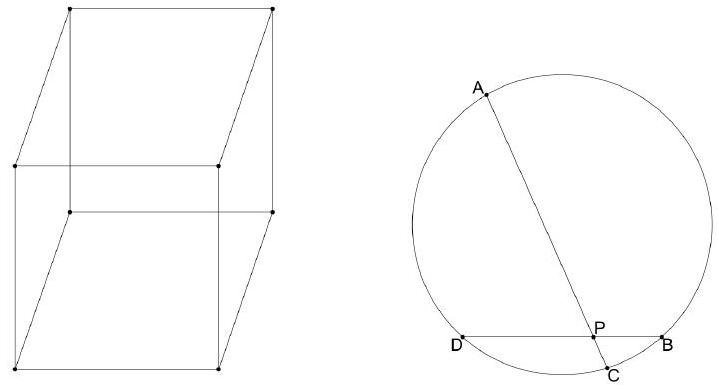 |
| 2. [3] $A, B, C$, and $D$ are points on a circle, and segments $\overline{A C}$ and $\overline{B D}$ intersect at $P$, such that $A P=8$, $P C=1$, and $B D=6$. Find $B P$, given that $B P<D P$. |
| Answer: 2. Writing $B P=x$ and $P D=6-x$, we have that $B P<3$. Power of a point at $P$ gives $A P \cdot P C=B P \cdot P D$ or $8=x(6-x)$. This can be solved for $x=2$ and $x=4$, and we discard the latter. |
| 3. [4] Circles $\omega_{1}, \omega_{2}$, and $\omega_{3}$ are centered at $M, N$, and $O$, respectively. The points of tangency between $\omega_{2}$ and $\omega_{3}, \omega_{3}$ and $\omega_{1}$, and $\omega_{1}$ and $\omega_{2}$ are tangent at $A, B$, and $C$, respectively. Line $M O$ intersects $\omega_{3}$ and $\omega_{1}$ again at $P$ and $Q$ respectively, and line $A P$ intersects $\omega_{2}$ again at $R$. Given that $A B C$ is an equilateral triangle of side length 1 , compute the area of $P Q R$. |
| Answer: $\mathbf{2 \sqrt { 3 }}$. Note that $O N M$ is an equilateral triangle of side length 2, so $m \angle B P A=m \angle B O A / 2=$ $\pi / 6$. Now $B P A$ is a $30-60-90$ triangle with short side length 1 , so $A P=\sqrt{3}$. Now $A$ and $B$ are the midpoints of segments $P R$ and $P Q$, so $[P Q R]=\frac{P R}{P A} \cdot \frac{P Q}{P B}[P B A]=2 \cdot 2[P B A]=2 \sqrt{3}$. |
|  |
| 4. [4] Circle $\omega$ has radius 5 and is centered at $O$. Point $A$ lies outside $\omega$ such that $O A=13$. The two tangents to $\omega$ passing through $A$ are drawn, and points $B$ and $C$ are chosen on them (one on each tangent), such that line $B C$ is tangent to $\omega$ and $\omega$ lies outside triangle $A B C$. Compute $A B+A C$ given that $B C=7$. |
| |
| Answer: 17. Let $T_{1}, T_{2}$, and $T_{3}$ denote the points of tangency of $A B, A C$, and $B C$ with $\omega$, respectively. Then $7=B C=B T_{3}+T_{3} C=B T_{1}+C T_{2}$. By Pythagoras, $A T_{1}=A T_{2}=\sqrt{13^{2}-5^{2}}=12$. Now note that $24=A T_{1}+A T_{2}=A B+B T_{1}+A C+C T_{2}=A B+A C+7$. |
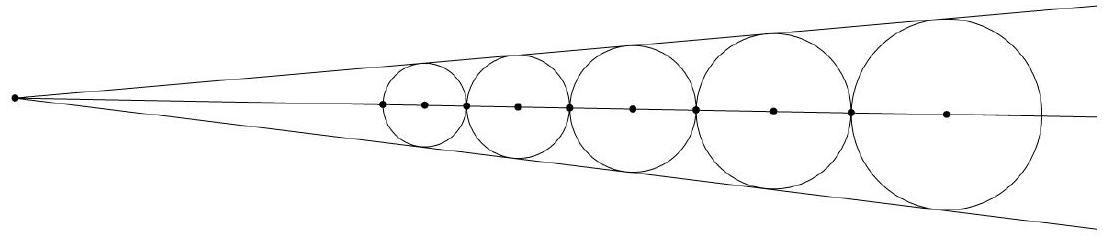
| 5. [5] Five marbles of various sizes are placed in a conical funnel. Each marble is in contact with the adjacent marble(s). Also, each marble is in contact all around the funnel wall. The smallest marble has a radius of 8 , and the largest marble has a radius of 18 . What is the radius of the middle marble? |
| Answer: 12. One can either go through all of the algebra, find the slope of the funnel wall and go from there to figure out the radius of the middle marble. Or one can notice that the answer will just be the geometric mean of 18 and 8 which is 12 . |
|  |
| 6. [5] Triangle $A B C$ has $\angle A=90^{\circ}$, side $B C=25, A B>A C$, and area 150. Circle $\omega$ is inscribed in $A B C$, with $M$ its point of tangency on $A C$. Line $B M$ meets $\omega$ a second time at point $L$. Find the length of segment $B L$. |
|
|
| Answer: $4 \mathbf{4 5} \sqrt{\mathbf{1 7} / 17}$. Let $D$ be the foot of the altitude from $A$ to side $B C$. The length of $A D$ is $2 \cdot 150 / 25=12$. Triangles $A D C$ and $B D A$ are similar, so $C D \cdot D B=A D^{2}=144 \Rightarrow B D=16$ and $C D=9 \Rightarrow A B=20$ and $A C=15$. Using equal tangents or the formula inradius as area divided by semiperimeter, we can find the radius of $\omega$ to be 5 . Now, let $N$ be the tangency point of $\omega$ on $A B$. By power of a point, we have $B L \cdot B M=B N^{2}$. Since the center of $\omega$ together with $M, A$, and $N$ determines a square, $B N=15$ and $B M=5 \sqrt{17}$, and we have $B L=45 \sqrt{17} / 17$. |
|  |
| 7. [5] Convex quadrilateral $A B C D$ has sides $A B=B C=7, C D=5$, and $A D=3$. Given additionally that $m \angle A B C=60^{\circ}$, find $B D$. |
| Answer: 8. Triangle $A B C$ is equilateral, so $A C=7$ as well. Now the law of cosines shows that $m \angle C D A=120^{\circ}$; i.e., $A B C D$ is cyclic. Ptolemy's theorem now gives $A C \cdot B D=A B \cdot C D+A D \cdot B C$, or simply $B D=C D+A D=8$. |
| 8. [6] $A B C D$ is a convex quadrilateral such that $A B<A D$. The diagonal $\overline{A C}$ bisects $\angle B A D$, and $m \angle A B D=130^{\circ}$. Let $E$ be a point on the interior of $\overline{A D}$, and $m \angle B A D=40^{\circ}$. Given that $B C=$ $C D=D E$, determine $m \angle A C E$ in degrees. |
| |
| Answer: 55 ${ }^{\circ}$. First, we check that $A B C D$ is cyclic. Reflect $B$ over $\overline{A C}$ to $B^{\prime}$ on $\overline{A D}$, and note that $B^{\prime} C=C D$. Therefore, $m \angle A D C=m \angle B^{\prime} D C=m \angle C B^{\prime} D=180^{\circ}-m \angle A B^{\prime} C=180^{\circ}-m \angle C B A$. Now $m \angle C B D=m \angle C A D=20^{\circ}$ and $m \angle A D C=180^{\circ}-m \angle C B A=30^{\circ}$. Triangle $C D E$ is isosceles, so $m \angle C E D=75^{\circ}$ and $m \angle A E C=105^{\circ}$. It follows that $m \angle E C A=180^{\circ}-m \angle A E C-m \angle C A E=55^{\circ}$. |
| 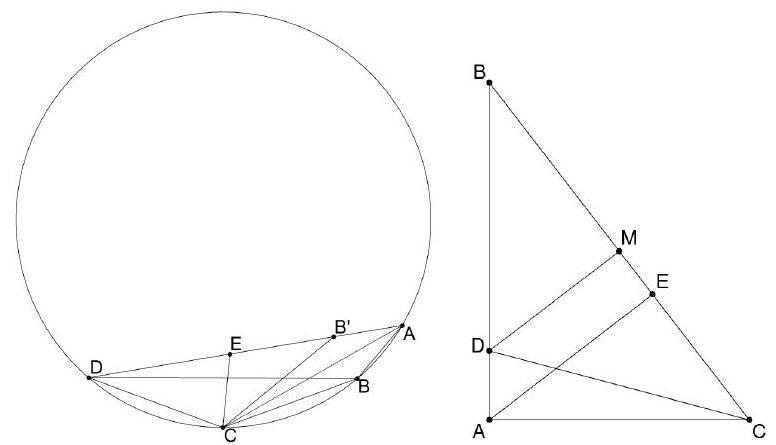 |
| 9. [7] $\triangle A B C$ is right angled at $A . D$ is a point on $A B$ such that $C D=1 . A E$ is the altitude from $A$ to $B C$. If $B D=B E=1$, what is the length of $A D$ ? |
| Answer: $\sqrt[3]{2}-1$. Let $A D=x$, angle $A B C=t$. We also have $\angle B C A=90-t$ and $\angle D C A=90-2 t$ so that $\angle A D C=2 t$. Considering triangles $A B E$ and $A D C$, we obtain, respectively, |
| $\cos (t)=1 /(1+x)$ and $\cos (2 t)=x$. By the double angle formula we get, $(1+x)^{3}=2$. |
| Alternatively, construct $M$, the midpoint of segment $B C$, and note that triangles $A B C, E B A$, and $M B D$ are similar. Thus, $A B^{2}=B C \cdot B E=B C$. In particular, |
| |
| $$ |
| A B=\frac{B C}{A B}=\frac{A B}{B E}=\frac{B D}{B M}=\frac{2 B D}{B C}=\frac{2}{A B^{2}} |
| $$ |
| |
| from which $A B=\sqrt[3]{2}$ and $A D=\sqrt[3]{2}-1$. |
| 10. [8] $A B C D$ is a convex quadrilateral such that $A B=2, B C=3, C D=7$, and $A D=6$. It also has an incircle. Given that $\angle A B C$ is right, determine the radius of this incircle. |
|  |
| |
| Answer: $\frac{1+\sqrt{13}}{\mathbf{3}}$. Note that $A C^{2}=A B^{2}+B C^{2}=13=C D^{2}-D A^{2}$. It follows that $\angle D A C$ is right, and so |
| |
| $$ |
| [A B C D]=[A B C]+[D A C]=2 \cdot 3 / 2+6 \cdot \sqrt{13} / 2=3+3 \sqrt{13} |
| $$ |
| |
| On the other hand, if $I$ denotes the incenter and $r$ denotes the inradius, |
| |
| $$ |
| [A B C D]=[A I B]+[B I C]+[C I D]+[D I A]=A B \cdot r / 2+B C \cdot r / 2+C D \cdot r / 2+D A \cdot r / 2=9 r |
| $$ |
| |
| Therefore, $r=(3+3 \sqrt{13}) / 9=\frac{1+\sqrt{13}}{3}$. |
| |
| |