


$10^{\text {th }}$ Annual Harvard-MIT Mathematics Tournament
Saturday 24 February 2007
Saturday 24 February 2007}
Team Round: A Division
$\Sigma, \tau$, and You: Fun at Fraternities? [270]
A number theoretic function is a function whose domain is the set of positive integers. A multiplicative number theoretic function is a number theoretic function $f$ such that $f(m n)=f(m) f(n)$ for all pairs of relatively prime positive integers $m$ and $n$. Examples of multiplicative number theoretic functions include $\sigma, \tau, \phi$, and $\mu$, defined as follows. For each positive integer $n$,
- The sum-of-divisors function, $\sigma(n)$, is the sum of all positive integer divisors of $n$. If $p_{1}, \ldots, p_{i}$ are distinct primes and $e_{1}, \ldots, e_{i}$ are positive integers,
- The divisor function, $\tau(n)$, is the number of positive integer divisors of $n$. It can be computed by the formula
where $p_{1}, \ldots, p_{i}$ and $e_{1}, \ldots, e_{i}$ are as above.
- Euler's totient function, $\phi(n)$, is the number of positive integers $k \leq n$ such that $k$ and $n$ are relatively prime. For $p_{1}, \ldots, p_{i}$ and $e_{1}, \ldots, e_{i}$ as above, the phi function satisfies
- The Möbius function, $\mu(n)$, is equal to either $1,-1$, or 0 . An integer is called square-free if it is not divisible by the square of any prime. If $n$ is a square-free positive integer having an even number of distinct prime divisors, $\mu(n)=1$. If $n$ is a square-free positive integer having an odd number of distinct prime divisors, $\mu(n)=-1$. Otherwise, $\mu(n)=0$.
The Möbius function has a number of peculiar properties. For example, if $f$ and $g$ are number theoretic functions such that
for all positive integers $n$, then
This is known as Möbius inversion. In proving the following problems, you may use any of the preceding assertions without proving them. You may also cite the results of previous problems, even if you were unable to prove them.
- [15] Evaluate the functions $\phi(n), \sigma(n)$, and $\tau(n)$ for $n=12, n=2007$, and $n=2^{2007}$.
Solution. For $n=12=2^{2} \cdot 3^{1}$,
for $n=2007=3^{2} \cdot 223$, $\phi(2007)=3(3-1)(223-1)=1332, \quad \sigma(2007)=(1+3+9)(1+223)=2912, \quad \tau(2007)=(2+1)(1+1)=6 ;$ and for $n=2^{2007}$,
- [20] Solve for the positive integer(s) $n$ such that $\phi\left(n^{2}\right)=1000 \phi(n)$.
Answer: 1000. Solution. The unique solution is $n=1000$. For, $\phi(p n)=p \phi(n)$ for every prime $p$ dividing $n$, so that $\phi\left(n^{2}\right)=n \phi(n)$ for all positive integers $n$. 3. [25] Prove that for every integer $n$ greater than 1 ,
When does equality hold? Solution. Note that
for any pair of relatively prime positive integers $(m, n)$ other than $(1,1)$. Now, for $p$ a prime and $k$ a positive integer, $\sigma\left(p^{k}\right)=1+p+\cdots+p^{k}=\frac{p^{k+1}-1}{p-1}$ and $\phi\left(p^{k}\right)=p^{k}-\frac{1}{p} \cdot p^{k}=(p-1) p^{k-1}$. Thus,
with equality where $k=1$. It follows that equality holds in the given inequality if and only if $n$ is prime. 4. [25] Let $F$ and $G$ be two multiplicative functions, and define for positive integers $n$,
The number theoretic function $H$ is called the convolution of $F$ and $G$. Prove that $H$ is multiplicative. Solution. Let $m$ and $n$ be relatively prime positive integers. We have
- [30] Prove the identity
Solution. Note that $\tau^{3}$ is multiplicative; in light of the convolution property just shown, it follows that both sides of the posed equality are multiplicative. Thus, it would suffice to prove the claim for $n$ a power of a prime. So, write $n=p^{k}$ where $p$ is a prime and $k$ is a nonnegative integer. Then
as required. 6. [25] Show that for positive integers $n$,
Solution. Both sides are multiplicative functions of $n$, the right side trivially and the left because for relatively prime positive integers $n$ and $n^{\prime}$,
and $\phi(d) \phi\left(d^{\prime}\right)=\phi\left(d d^{\prime}\right)$. The identity is then easy to check; since $\phi\left(p^{k}\right)=p^{k-1}(p-1)$ for positive integers $k$ and $\phi(1)=1$, we have $\phi(1)+\phi(p)+\cdots+\phi\left(p^{k}\right)=1+(p-1)+\left(p^{2}-p\right)+\cdots+\left(p^{k}-p^{k-1}\right)=p^{k}$, as desired. 7. [25] Show that for positive integers $n$,
Solution. On the grounds of the previous problem, Möbius inversion with $f(k)=\phi(k)$ and $g(k)=k$ gives:
Alternatively, one uses the convolution of the functions $f(k)=n$ and $g(k)=\frac{\mu(d)}{d}$. The strategy is the same as the previous convolution proof. For $n=p^{k}$ with $k$ a positive integer, we have $\phi(n)=p^{k}-p^{k-1}$, while the series reduces to $p^{k} \cdot \mu(1)+p^{k} \cdot \mu(p) / p=p^{k}-p^{k-1}$. 8. [30] Determine with proof, a simple closed form expression for
Solution. We claim the series reduces to $\sigma(n)$. The series counts the ordered triples $(d, x, y)$ with $d|n ; x| d ; 0<y \leq n / d ;$ and $(y, n / d)=1$. To see this, write
so that for a given $d^{\prime} \mid n$ we may choose $x$ and $y$ as described above. On the other hand, we can count these triples by groups sharing a given $x$. Fixing $x$ as a divisor of $n$ fixes an integer $\frac{n}{x}$. Then $d$ varies such that $\frac{n}{d}$ is a divisor of $\frac{n}{x}$. For each divisor $\frac{n}{d}$ of $\frac{n}{x}$ there are precisely $\phi\left(\frac{n}{d}\right)$ choices $y$, so that by the lemma from the previous problem, there are $\frac{n}{x}$ triples $(d, x, y)$ for a given $x$. It follows that there are precisely $\sigma(n)$ such triples $(d, x, y)$. Again, an alternative is to use the multiplicativity of the convolution, although it is now a little more difficult. Write $n=p^{k}$ so that
- [35] Find all positive integers $n$ such that
Answer: 1, 3,5. Solution. We contend that the proper relation is
Let $\Phi(k)$ denote the left hand side of $(*)$. It is trivial to see that for $n \leq 7$ the posed inequality holds, has equality where $n=1,3,5$, and holds strictly for $n=7$. Note that $\phi(2 k) \leq k$ and $\phi(2 k+1) \leq 2 k$, the former because $2,4, \ldots, 2 k$ share a common divisor. It follows that $\phi(2 k)+\phi(2 k+1) \leq 3 k$. Suppose for the sake of induction that $\Phi(2 k-1)<\frac{3(2 k-1)^{2}+5}{8}$. Then
To complete the proof, it is enough to note that for a positive integer $k$,
- [40] Find all pairs $(n, k)$ of positive integers such that
Answer: (1, 1). Solution. It is clear that for a given integer $n$, there is at most one integer $k$ for which the equation holds. For $n=1$ this is $k=1$. But, for $n>1$, problem 1 asserts that $\sigma(n) \phi(n) \leq n^{2}-1<n^{2}$, so that $k \geq 2$. We now claim that $2>\frac{n^{2}}{\sigma(n) \phi(n)}$. Write $n=p_{1}^{e_{1}} \cdots p_{k}^{e_{k}}$, where the $p_{i}$ are distinct primes and $e_{i} \geq 1$ for all $i$, and let $q_{1}<q_{2}<\cdots$ be the primes in ascending order. Then
It follows that there can be no solutions to $k=\frac{n^{2}}{\sigma(n) \phi(n)}$ other than $n=k=1$.
Grab Bag - Miscellaneous Problems [130]
- $[30]$ Find all functions $f: \mathbb{Q} \rightarrow \mathbb{Q}$ such that
for all rational numbers $x, y$. Answer: $\mathbf{f}(\mathbf{x})=\mathbf{1} \forall \mathbf{x}$, and $\mathbf{f}(\mathbf{x})=\mathbf{1}-\mathbf{x} \forall \mathbf{x}$. Solution. Considering the first equation, either side of the second equation is equal to $f(x)+f(y)$. Now write $g(x)=1-f(x)$, so that
By induction, $g(n x)=n g(x)$ for all integers $n$, so that $g(p / q)=(p / q) g(1)$ for integers $p$ and $q$ with $q$ nonzero; i.e., $g(x)=x g(1)$. As $g$ is multiplicative, $g(1)=g(1)^{2}$, so the only possibilities are $g(1)=1$ and $g(1)=0$. These give $g(x)=x$ and $g(x)=0$, or $f(x)=1-x$ and $f(x)=1$, respectively. One easily checks that these functions are satisfactory.
12. [30] Let $A B C D$ be a cyclic quadrilateral, and let $P$ be the intersection of its two diagonals. Points $R, S, T$, and $U$ are feet of the perpendiculars from $P$ to sides $A B, B C, C D$, and $A D$, respectively. Show that quadrilateral $R S T U$ is bicentric if and only if $A C \perp B D$. (Note that a quadrilateral is called inscriptible if it has an incircle; a quadrilateral is called bicentric if it is both cyclic and inscriptible.)
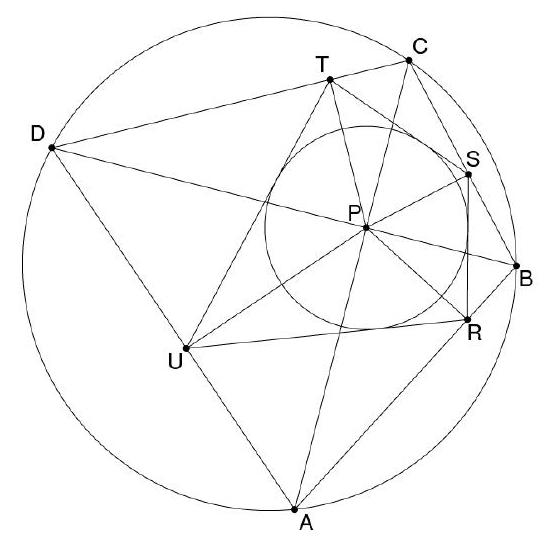
Solution. First we show that $R S T U$ is always inscriptible. Note that in addition to $A B C D$, we have cyclic quadrilaterals $A R P U$ and $B S P R$. Thus,
and it follows that $P$ lies on the bisector of $\angle S R U$. Analogously, $P$ lies on the bisectors of $\angle T S R$ and $\angle U T S$, so is equidistant from lines $U R, R S, S T$, and $T U$, and $R S T U$ is inscriptible having incenter $P$. Now we show that $R S T U$ is cyclic if and only if the diagonals of $A B C D$ are orthogonal. We have
It follows that $\angle A P B=\frac{\pi}{2}$ if and only if $\angle R U T+\angle T S R=\pi$, as desired. 13. [30] Find all nonconstant polynomials $P(x)$, with real coefficients and having only real zeros, such that $P(x+1) P\left(x^{2}-x+1\right)=P\left(x^{3}+1\right)$ for all real numbers $x$.
Answer: $\left{\mathbf{P}(\mathbf{x})=\mathbf{x}^{\mathbf{k}} \mid \mathbf{k} \in \mathbb{Z}^{+}\right}$. Solution. Note that if $P(\alpha)=0$, then by setting $x=\alpha-1$ in the given equation, we find $0=P\left(x^{3}+\right.$ $1)=P\left(\alpha^{3}-3 \alpha^{2}+3 \alpha\right)$. Because $P$ is nonconstant, it has at least one zero. Because $P$ has finite degree, there exist minimal and maximal roots of $P$. Writing $\alpha^{3}-3 \alpha^{2}+3 \alpha \geq \alpha \Longleftrightarrow \alpha(\alpha-1)(\alpha-2) \geq 0$, we see that the largest zero of $P$ cannot exceed 2 . Likewise, the smallest zero cannot be negative, so all of the zeroes of $P$ lie in [0,2]. Moreover, if $\alpha \notin{0,1,2}$ is a zero of $P$, then $\alpha^{\prime}=\alpha^{3}-3 \alpha^{2}+3 \alpha$ is another zero of $P$ that lies strictly between $\alpha$ and 1. Because $P$ has only finitely many zeroes, all of its zeroes must lie in ${0,1,2}$. Now write $P(x)=k x^{p}(x-1)^{q}(x-2)^{r}$ for nonnegative integers $p, q$ and $r$ having a positive sum. The given equation becomes
For the leading coefficients to agree, we require $k=k^{2}$. Because the leading coefficient is nonzero, $P$ must be monic. In $(*), r$ must be zero lest $P\left(x^{3}+1\right)=0$ have complex roots. Then $q$ must be zero as well. For, if $q$ is positive, then $P\left(x^{2}-x+1\right)=0$ has 1 as a root while $P\left(x^{3}+1\right)$ does not. Finally, the remaining possibilities are $P(x)=x^{p}$ for $p$ an arbitrary positive integer. It is easily seen that these polynomials are satisfactory. 14. [40] Find an explicit, closed form formula for
Answer: $\frac{-\mathbf{1}}{\binom{2 \mathbf{1}+1}{\mathbf{n}}}$ or $-\frac{\mathbf{n}!(\mathbf{n}+\mathbf{1})!}{(\mathbf{2 n}+\mathbf{1})!}$ or obvious equivalent. Solution. Consider the interpolation of the polynomial $P(x)=x \cdot n!$ at $x=0,1, \ldots, n$. We obtain the identity
This identity is valid for all complex numbers $x$, but, to extract a factor $\frac{1}{n+k+1}$ from the valid product of each summand, we set $x=-n-1$, so that $-(n+1)!=\sum_{k=1}^{n} k(-1)^{n-k}\binom{n}{k}(-n-1) \cdots(-n-k)(-n-k-2) \cdots(-2 n-1)=\sum_{k=1}^{n} \frac{k(-1)^{k}\binom{n}{k}(2 n+1)!}{n!(n+k+1)}$. Finally,