


The $6^{\text {th }}$ Romanian Master of Mathematics Competition
Solutions for the Day 2
Problem 4. Let $P$ and $P^{\prime}$ be two convex quadrilateral regions in the plane (regions contain their boundary). Let them intersect, with $O$ a point in the intersection. Suppose that for every line $\ell$ through $O$ the segment $\ell \cap P$ is strictly longer than the segment $\ell \cap P^{\prime}$. Is it possible that the ratio of the area of $P^{\prime}$ to the area of $P$ is greater than 1.9? (Bulgaria) Nikolai Beluhov Solution. The answer is in the affirmative: Given a positive $\epsilon<2$, the ratio in question may indeed be greater than $2-\epsilon$.
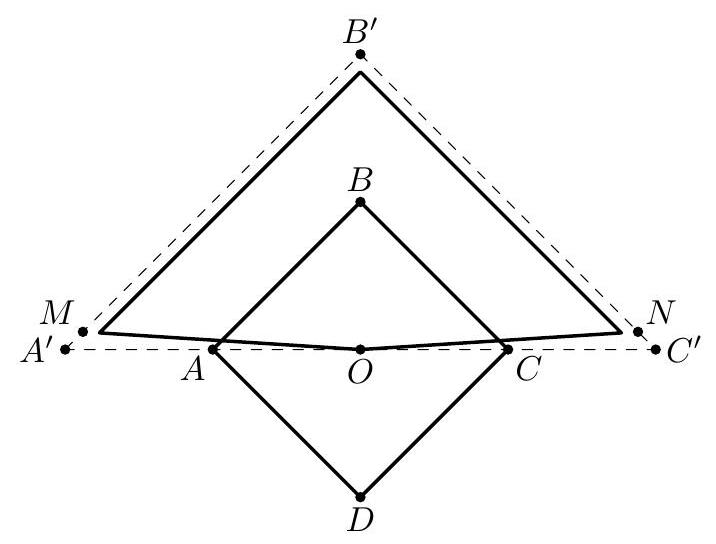
To show this, consider a square $A B C D$ centred at $O$, and let $A^{\prime}, B^{\prime}$, and $C^{\prime}$ be the reflections of $O$ in $A, B$, and $C$, respectively. Notice that, if $\ell$ is a line through $O$, then the segments $\ell \cap A B C D$ and $\ell \cap A^{\prime} B^{\prime} C^{\prime}$ have equal lengths, unless $\ell$ is the line $A C$.
Next, consider the points $M$ and $N$ on the segments $B^{\prime} A^{\prime}$ and $B^{\prime} C^{\prime}$, respectively, such that $B^{\prime} M / B^{\prime} A^{\prime}=B^{\prime} N / B^{\prime} C^{\prime}=(1-\epsilon / 4)^{1 / 2}$. Finally, let $P^{\prime}$ be the image of the convex quadrangle $B^{\prime} M O N$ under the homothety of ratio $(1-\epsilon / 4)^{1 / 4}$ centred at $O$. Clearly, the quadrangles $P \equiv A B C D$ and $P^{\prime}$ satisfy the conditions in the statement, and the ratio of the area of $P^{\prime}$ to the area of $P$ is exactly $2-\epsilon / 2$.
Remarks. (1) With some care, one may also construct such example with a point $O$ being interior for both $P$ and $P^{\prime}$. In our example, it is enough to replace vertex $O$ of $P^{\prime}$ by a point on the segment $O D$ close enough to $O$. The details are left to the reader. (2) On the other hand, one may show that the ratio of areas of $P^{\prime}$ and $P$ cannot exceed 2 (even if $P$ and $P^{\prime}$ are arbitrary convex polygons rather than quadrilaterals). Further on, we denote by $[S]$ the area of $S$.
In order to see that $\left[P^{\prime}\right]<2[P]$, let us fix some ray $r$ from $O$, and let $r_{\alpha}$ be the ray from $O$ making an (oriented) angle $\alpha$ with $r$. Denote by $X_{\alpha}$ and $Y_{\alpha}$ the points of $P$ and $P^{\prime}$, respectively, lying on $r_{\alpha}$ farthest from $O$, and denote by $f(\alpha)$ and $g(\alpha)$ the lengths of the segments $O X_{\alpha}$ and $O Y_{\alpha}$, respectively. Then
and similarly
But $X_{\alpha} X_{\pi+\alpha}>Y_{\alpha} Y_{\pi+\alpha}$ yields $2 \cdot \frac{1}{2}\left(f^{2}(\alpha)+f^{2}(\pi+\alpha)\right)=O X_{\alpha}^{2}+O X_{\pi+\alpha}^{2} \geq \frac{1}{2} X_{\alpha} X_{\pi+\alpha}^{2}>$ $\frac{1}{2} Y_{\alpha} Y_{\pi+\alpha}^{2} \geq \frac{1}{2}\left(O Y_{\alpha}^{2}+O Y_{\pi+\alpha}^{2}\right)=\frac{1}{2}\left(g^{2}(\alpha)+g^{2}(\pi+\alpha)\right)$. Integration then gives us $2[P]>\left[P^{\prime}\right]$, as needed.
This can also be proved via elementary methods. Actually, we will establish the following more general fact.
Fact. Let $P=A_{1} A_{2} A_{3} A_{4}$ and $P^{\prime}=B_{1} B_{2} B_{3} B_{4}$ be two convex quadrangles in the plane, and let $O$ be one of their common points different from the vertices of $P^{\prime}$. Denote by $\ell_{i}$ the line $O B_{i}$, and assume that for every $i=1,2,3,4$ the length of segment $\ell_{i} \cap P$ is greater than the length of segment $\ell_{i} \cap P^{\prime}$. Then $\left[P^{\prime}\right]<2[P]$. Proof. One of (possibly degenerate) quadrilaterals $O B_{1} B_{2} B_{3}$ and $O B_{1} B_{4} B_{3}$ is convex; the same holds for $O B_{2} B_{3} B_{4}$ and $O B_{2} B_{1} B_{4}$. Without loss of generality, we may (and will) assume that the quadrilaterals $O B_{1} B_{2} B_{3}$ and $O B_{2} B_{3} B_{4}$ are convex.
Denote by $C_{i}$ such a point that $\ell_{i} \cap P^{\prime}$ is the segment $B_{i} C_{i}$; let $a_{i}$ be the length of $\ell_{i} \cap P$, and let $\alpha_{i}$ be the angle between $\ell_{i}$ and $\ell_{i+1}$ (hereafter, we use the cyclic notation, thus $\ell_{5}=\ell_{1}$ and so on). Thus $C_{2}$ and $C_{3}$ belong to the segment $B_{1} B_{4}, C_{1}$ lies on $B_{3} B_{4}$, and $C_{4}$ lies on $B_{1} B_{2}$. Assume that there exists an index $i$ such that the area of $B_{i} B_{i+1} C_{i} C_{i+1}$ is at least $\left[P^{\prime}\right] / 2$; then we have
as desired. Assume, to the contrary, that such index does not exist. Two cases are possible.
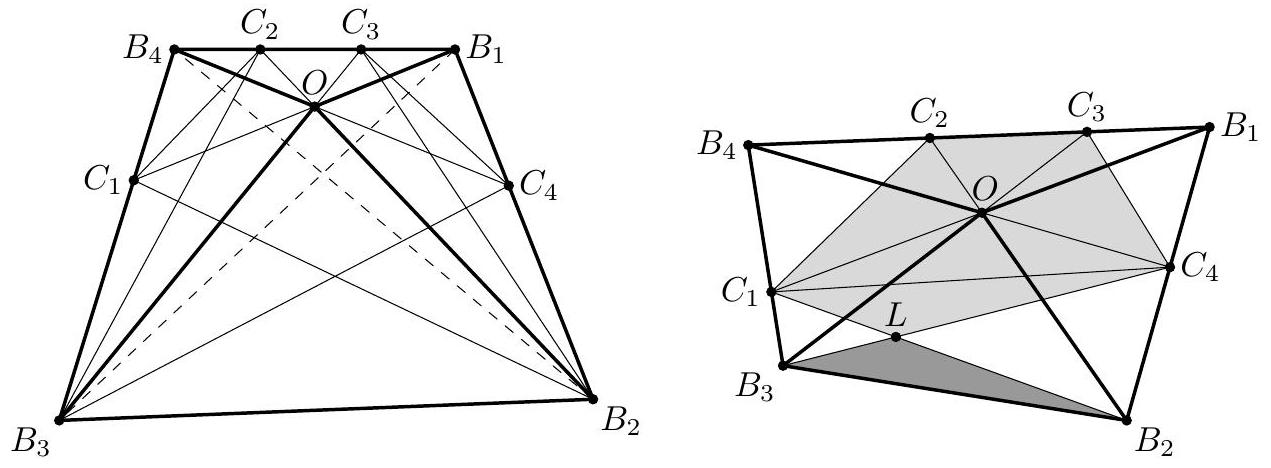
Case 1. Assume that the rays $B_{1} B_{2}$ and $B_{4} B_{3}$ do not intersect (see the left figure above). This means, in particular, that $d\left(B_{1}, B_{3} B_{4}\right) \leq d\left(B_{2}, B_{3} B_{4}\right)$.
Since the ray $B_{3} O$ lies in the angle $B_{1} B_{3} B_{4}$, we obtain $d\left(B_{1}, B_{3} C_{3}\right) \leq d\left(C_{4}, B_{3} C_{3}\right)$; hence $\left[B_{3} B_{4} B_{1}\right] \leq\left[B_{3} B_{4} C_{3} C_{4}\right]<\left[P^{\prime}\right] / 2$. Similarly, $\left[B_{1} B_{2} B_{4}\right] \leq\left[B_{1} B_{2} C_{1} C_{2}\right]<\left[P^{\prime}\right] / 2$. Thus,
A contradiction. Case 2. Assume now that the rays $B_{1} B_{2}$ and $B_{4} B_{3}$ intersect at some point (see the right figure above). Denote by $L$ the common point of $B_{2} C_{1}$ and $B_{3} C_{4}$. We have $\left[B_{2} C_{4} C_{1}\right] \geq\left[B_{2} C_{4} B_{3}\right]$, hence $\left[C_{1} C_{4} L\right] \geq\left[B_{2} B_{3} L\right]$. Thus we have
A final contradiction.
Problem 5. Given an integer $k \geq 2$, set $a_{1}=1$ and, for every integer $n \geq 2$, let $a_{n}$ be the smallest $x>a_{n-1}$ such that:
Prove that every prime occurs in the sequence $a_{1}, a_{2}, \ldots$. (Bulgaria) Alexander Ivanov Solution 1. We prove that the $a_{n}$ are precisely the $k$ th-power-free positive integers, that is, those divisible by the $k$ th power of no prime. The conclusion then follows.
Let $B$ denote the set of all $k$ th-power-free positive integers. We first show that, given a positive integer $c$,
To this end, notice that every positive integer has a unique representation as a product of an element in $B$ and a $k$ th power. Consequently, the set of all positive integers less than or equal to $c$ splits into
Clearly, $\left|C_{b}\right|=\lfloor\sqrt[k]{c / b}\rfloor$, whence the desired equality. Finally, enumerate $B$ according to the natural order: $1=b_{1}<b_{2}<\cdots<b_{n}<\cdots$. We prove by induction on $n$ that $a_{n}=b_{n}$. Clearly, $a_{1}=b_{1}=1$, so let $n \geq 2$ and assume $a_{m}=b_{m}$ for all indices $m<n$. Since $b_{n}>b_{n-1}=a_{n-1}$ and
the definition of $a_{n}$ forces $a_{n} \leq b_{n}$. Were $a_{n}<b_{n}$, a contradiction would follow:
Consequently, $a_{n}=b_{n}$. This completes the proof. Solution 2. (Ilya Bogdanov) For every $n=1,2,3, \ldots$, introduce the function
Denote also by $g_{n}(x)$ the number of the indices $i \leq n$ such that $x / a_{i}$ is the $k$ th power of an integer. Then $f_{n}(x+1)-f_{n}(x)=1-g_{n}(x)$ for every integer $x \geq a_{n}$; hence $f_{n}(x)+1 \geq f_{n}(x+1)$. Moreover, $f_{n}\left(a_{n-1}\right)=-1$ (since $f_{n-1}\left(a_{n-1}\right)=0$ ). Now a straightforward induction shows that $f_{n}(x)<0$ for all integers $x \in\left[a_{n-1}, a_{n}\right)$.
Next, if $g_{n}(x)>0$ then $f_{n}(x) \leq f_{n}(x-1)$; this means that such an $x$ cannot equal $a_{n}$. Thus $a_{j} / a_{i}$ is never the $k$ th power of an integer if $j>i$.
Now we are prepared to prove by induction on $n$ that $a_{1}, a_{2}, \ldots, a_{n}$ are exactly all $k$ th-power-free integers in $\left[1, a_{n}\right]$. The base case $n=1$ is trivial.
Assume that all the $k$ th-power-free integers on $\left[1, a_{n}\right]$ are exactly $a_{1}, \ldots, a_{n}$. Let $b$ be the least integer larger than $a_{n}$ such that $g_{n}(b)=0$. We claim that: (1) $b=a_{n+1}$; and (2) $b$ is the least $k$ th-power-free number greater than $a_{n}$.
To prove (1), notice first that all the numbers of the form $a_{j} / a_{i}$ with $1 \leq i<j \leq n$ are not $k$ th powers of rational numbers since $a_{i}$ and $a_{j}$ are $k$ th-power-free. This means that for every integer $x \in\left(a_{n}, b\right)$ there exists exactly one index $i \leq n$ such that $x / a_{i}$ is the $k$ th power of an integer (certainly, $x$ is not $k$ th-power-free). Hence $f_{n+1}(x)=f_{n+1}(x-1)$ for each such $x$, so $f_{n+1}(b-1)=f_{n+1}\left(a_{n}\right)=-1$. Next, since $b / a_{i}$ is not the $k$ th power of an integer, we have $f_{n+1}(b)=f_{n+1}(b-1)+1=0$, thus $b=a_{n+1}$. This establishes (1).
Finally, since all integers in $\left(a_{n}, b\right)$ are not $k$ th-power-free, we are left to prove that $b$ is $k$ th-power-free to establish (2). Otherwise, let $y>1$ be the greatest integer such that $y^{k} \mid b$; then $b / y^{k}$ is $k$ th-power-free and hence $b / y^{k}=a_{i}$ for some $i \leq n$. So $b / a_{i}$ is the $k$ th power of an integer, which contradicts the definition of $b$.
Thus $a_{1}, a_{2}, \ldots$ are exactly all $k$ th-power-free positive integers; consequently all primes are contained in this sequence.
Problem 6. $2 n$ distinct tokens are placed at the vertices of a regular $2 n$-gon, with one token placed at each vertex. A move consists of choosing an edge of the $2 n$-gon and interchanging the two tokens at the endpoints of that edge. Suppose that after a finite number of moves, every pair of tokens have been interchanged exactly once. Prove that some edge has never been chosen. (Russia) Alexander Gribalko Solution. Step 1. Enumerate all the tokens in the initial arrangement in clockwise circular order; also enumerate the vertices of the $2 n$-gon accordingly. Consider any three tokens $i<j<k$. At each moment, their cyclic order may be either $i, j, k$ or $i, k, j$, counted clockwise. This order changes exactly when two of these three tokens have been switched. Hence the order has been reversed thrice, and in the final arrangement token $k$ stands on the arc passing clockwise from token $i$ to token $j$. Thus, at the end, token $i+1$ is a counter-clockwise neighbor of token $i$ for all $i=1,2, \ldots, 2 n-1$, so the tokens in the final arrangement are numbered successively in counter-clockwise circular order.
This means that the final arrangement of tokens can be obtained from the initial one by reflection in some line $\ell$.
Step 2. Notice that each token was involved into $2 n-1$ switchings, so its initial and final vertices have different parity. Hence $\ell$ passes through the midpoints of two opposite sides of a $2 n$-gon; we may assume that these are the sides $a$ and $b$ connecting $2 n$ with 1 and $n$ with $n+1$, respectively.
During the process, each token $x$ has crossed $\ell$ at least once; thus one of its switchings has been made at edge $a$ or at edge $b$. Assume that some two its switchings were performed at $a$ and at $b$; we may (and will) assume that the one at $a$ was earlier, and $x \leq n$. Then the total movement of token $x$ consisted at least of: (i) moving from vertex $x$ to $a$ and crossing $\ell$ along $a$; (ii) moving from $a$ to $b$ and crossing $\ell$ along $b$; (iii) coming to vertex $2 n+1-x$. This tales at least $x+n+(n-x)=2 n$ switchings, which is impossible.
Thus, each token had a switching at exactly one of the edges $a$ and $b$. Step 3. Finally, let us show that either each token has been switched at $a$, or each token has been switched at $b$ (then the other edge has never been used, as desired). To the contrary, assume that there were switchings at both $a$ and at $b$. Consider the first such switchings, and let $x$ and $y$ be the tokens which were moved clockwise during these switchings and crossed $\ell$ at $a$ and $b$, respectively. By Step $2, x \neq y$. Then tokens $x$ and $y$ initially were on opposite sides of $\ell$.
Now consider the switching of tokens $x$ and $y$; there was exactly one such switching, and we assume that it has been made on the same side of $\ell$ as vertex $y$. Then this switching has been made after token $x$ had traced $a$. From this point on, token $x$ is on the clockwise arc from token $y$ to $b$, and it has no way to leave out from this arc. But this is impossible, since token $y$ should trace $b$ after that moment. A contradiction.
Remark. The same statement for $(2 n-1)$-gon is also valid. The problem is stated for a polygon with an even number of sides only to avoid case consideration.
Let us outline the solution in the case of a $(2 n-1)$-gon. We prove the existence of line $\ell$ as in Step 1. This line passes through some vertex $x$, and through the midpoint of the opposite edge $a$. Then each token either passes through $x$, or crosses $\ell$ along $a$ (but not both; this can be shown as in Step 2). Finally, since a token is involved into an even number of moves, it passes through $x$ but not through $a$, and $a$ is never used.