


USAMO 2024 Solution Notes
Evan ChEn《陳誼廷》
25 April 2024
This is a compilation of solutions for the 2024 USAMO. The ideas of the solution are a mix of my own work, the solutions provided by the competition organizers, and solutions found by the community. However, all the writing is maintained by me.
These notes will tend to be a bit more advanced and terse than the "official" solutions from the organizers. In particular, if a theorem or technique is not known to beginners but is still considered "standard", then I often prefer to use this theory anyways, rather than try to work around or conceal it. For example, in geometry problems I typically use directed angles without further comment, rather than awkwardly work around configuration issues. Similarly, sentences like "let $\mathbb{R}$ denote the set of real numbers" are typically omitted entirely.
Corrections and comments are welcome!
Contents
0 Problems ..... 2 1 Solutions to Day 1 ..... 3 1.1 USAMO 2024/1, proposed by Luke Robitaille ..... 3 1.2 USAMO 2024/2, proposed by Rishabh Das ..... 4 1.3 USAMO 2024/3, proposed by Krit Boonsiriseth ..... 7 2 Solutions to Day 2 ..... 9 2.1 USAMO 2024/4, proposed by Rishabh Das ..... 9 2.2 USAMO 2024/5, proposed by Anton Trygub ..... 11 2.3 USAMO 2024/6, proposed by Titu Andreescu and Gabriel Dospinescu ..... 16
§0 Problems
- Find all integers $n \geq 3$ such that the following property holds: if we list the divisors of $n$ ! in increasing order as $1=d_{1}<d_{2}<\cdots<d_{k}=n$ !, then we have
- Let $S_{1}, S_{2}, \ldots, S_{100}$ be finite sets of integers whose intersection is not empty. For each non-empty $T \subseteq\left{S_{1}, S_{2}, \ldots, S_{100}\right}$, the size of the intersection of the sets in $T$ is a multiple of $|T|$. What is the smallest possible number of elements which are in at least 50 sets?
- Let $(m, n)$ be positive integers with $n \geq 3$ and draw a regular $n$-gon. We wish to triangulate this $n$-gon into $n-2$ triangles, each colored one of $m$ colors, so that each color has an equal sum of areas. For which $(m, n)$ is such a triangulation and coloring possible?
- Let $m$ and $n$ be positive integers. A circular necklace contains $m n$ beads, each either red or blue. It turned out that no matter how the necklace was cut into $m$ blocks of $n$ consecutive beads, each block had a distinct number of red beads. Determine, with proof, all possible values of the ordered pair $(m, n)$.
- Point $D$ is selected inside acute triangle $A B C$ so that $\angle D A C=\angle A C B$ and $\angle B D C=90^{\circ}+\angle B A C$. Point $E$ is chosen on ray $B D$ so that $A E=E C$. Let $M$ be the midpoint of $B C$. Show that line $A B$ is tangent to the circumcircle of triangle $B E M$.
- Let $n>2$ be an integer and let $\ell \in{1,2, \ldots, n}$. A collection $A_{1}, \ldots, A_{k}$ of (not necessarily distinct) subsets of ${1,2, \ldots, n}$ is called $\ell$-large if $\left|A_{i}\right| \geq \ell$ for all $1 \leq i \leq k$. Find, in terms of $n$ and $\ell$, the largest real number $c$ such that the inequality
holds for all positive integer $k$, all nonnegative real numbers $x_{1}, x_{2}, \ldots, x_{k}$, and all $\ell$-large collections $A_{1}, A_{2}, \ldots, A_{k}$ of subsets of ${1,2, \ldots, n}$.
§1 Solutions to Day 1
§1.1 USAMO 2024/1, proposed by Luke Robitaille
Available online at https://aops.com/community/p30216459.
Problem statement
Find all integers $n \geq 3$ such that the following property holds: if we list the divisors of $n$ ! in increasing order as $1=d_{1}<d_{2}<\cdots<d_{k}=n$ !, then we have
The answer is $n \in{3,4}$. These can be checked by listing all the divisors:
- For $n=3$ we have $(1,2,3,6)$.
- For $n=4$ we have $(1,2,3,4,6,8,12,24)$.
We prove these are the only ones. The numbers $5 \leq n \leq 12$ all fail because:
- For $n=5$ we have $20-15>24-20$.
- For $n=6$ we have $18-15>20-18$.
- For $7 \leq n \leq 12$ we have because $14-12>15-14$ (and $13 \nmid n!$ ).
Now assume $n \geq 13$. In that case, we have
So by Bertrand postulate, we can find a prime $p$ such that
However, note that
are consecutive integers both dividing $n$ ! (the latter number divides $\left\lfloor\frac{n}{2}\right\rfloor \cdot\left(2\left\lfloor\frac{n}{2}\right\rfloor\right)$ ). So the prime $p$ causes the desired contradiction.
§1.2 USAMO 2024/2, proposed by Rishabh Das
Available online at https://aops.com/community/p30216494.
Problem statement
Let $S_{1}, S_{2}, \ldots, S_{100}$ be finite sets of integers whose intersection is not empty. For each non-empty $T \subseteq\left{S_{1}, S_{2}, \ldots, S_{100}\right}$, the size of the intersection of the sets in $T$ is a multiple of $|T|$. What is the smallest possible number of elements which are in at least 50 sets?
The answer is $50\binom{100}{50}$. ब Rephrasing (cosmetic translation only, nothing happens yet). We encode with binary strings $v \in \mathbb{F}{2}^{100}$ of length 100 . Write $v \subseteq w$ if $w$ has 1 's in every component $v$ does, and let $|v|$ denote the number of 1 's in $v$. Then for each $v$, we let $f(v)$ denote the number of elements $x \in \bigcup S{i}$ such that $x \in S_{i} \Longleftrightarrow v_{i}=1$. For example,
- $f(1 \ldots 1)$ denotes $\left|\bigcap_{1}^{100} S_{i}\right|$, so we know $f(1 \ldots 1) \equiv 0(\bmod 100)$.
- $f(1 \ldots 10)$ denotes the number of elements in $S_{1}$ through $S_{99}$ but not $S_{100}$ so we know that $f(1 \ldots 1)+f(1 \ldots 10) \equiv 0(\bmod 99)$.
- . . And so on.
So the problem condition means that $f(v)$ translates to the statement
for any $u \neq 0 \ldots 0$, plus one extra condition $f(1 \ldots 1)>0$. And the objective function is to minimize the quantity
So the problem is transformed into an system of equations over $\mathbb{Z}{\geq 0}$ (it's clear any assignment of values of $f(v)$ can be translated to a sequence ( $S{1}, \ldots, S_{100}$ ) in the original notation).
Note already that: Claim - It suffices to assign $f(v)$ for $|v| \geq 50$. Proof. If we have found a valid assignment of values to $f(v)$ for $|v| \geq 50$, then we can always arbitrarily assign values of $f(v)$ for $|v|<50$ by downwards induction on $|v|$ to satisfy the divisibility condition (without changing $M$ ).
Thus, for the rest of the solution, we altogether ignore $f(v)$ for $|v|<50$ and only consider $P(u)$ for $|u| \geq 50$.
I Construction. Consider the construction
This construction is valid since if $|u|=100-k$ for $k \leq 50$ then
is indeed a multiple of $|u|$, hence $P(u)$ is true. In that case, the objective function is
as needed. Remark. This construction is the "easy" half of the problem because it coincides with what you get from a greedy algorithm by downwards induction on $|u|$ (equivalently, induction on $k=100-|u| \geq 0)$. To spell out the first three steps,
- We know $f(1 \ldots 1)$ is a nonzero multiple of 100 , so it makes sense to guess $f(1 \ldots 1)=$ 100.
- Then we have $f(1 \ldots 10)+100 \equiv 0(\bmod 99)$, and the smallest multiple of 99 which is at least 100 is 198 . So it makes sense to guess $f(1 \ldots 10)=98$, and similarly guess $f(v)=98$ whenever $|v|=99$.
- Now when we consider, say $v=1 \ldots 100$ with $|v|=98$, we get
we obtain $f(1 \ldots 100) \equiv 96(\bmod 98)$. That makes $f(1 \ldots 100)=96$ a reasonable guess. Continuing in this way gives the construction above.
I Proof of bound. We are going to use a smoothing argument: if we have a general working assignment $f$, we will mold it into $f_{0}$.
We define a push-down on $v$ as the following operation:
- Pick any $v$ such that $|v| \geq 50$ and $f(v) \geq|v|$.
- Decrease $f(v)$ by $|v|$.
- For every $w$ such that $w \subseteq v$ and $|w|=|v|-1$, increase $f(w)$ by 1 .
Claim - Apply a push-down preserves the main divisibility condition. Moreover, it doesn't change $A$ unless $|v|=50$, where it decreases $A$ by 50 instead.
Proof. The statement $P(u)$ is only affected when $u \subseteq v$ : to be precise, one term on the right-hand side of $P(u)$ increases by $|v|$, while $|v|-|u|$ terms decrease by 1 , for a net change of $+|u|$. So $P(u)$ still holds.
To see $A$ doesn't change for $|v|>50$, note $|v|$ terms increase by 1 while one term decreases by $-|v|$. When $|v|=50$, only $f(v)$ decreases by 50 .
Now, given a valid assignment, we can modify it as follows:
- First apply pushdowns on $1 \ldots 1$ until $f(1 \ldots 1)=100$;
- Then we may apply pushdowns on each $v$ with $|v|=99$ until $f(v)<99$;
- Then we may apply pushdowns on each $v$ with $|v|=98$ until $f(v)<98$;
- . . .and so on, until we have $f(v)<50$ for $|v|=50$.
Hence we get $f(1 \ldots 1)=100$ and $0 \leq f(v)<|v|$ for all $50 \leq|v| \leq 100$. However, by downwards induction on $|v|=99,98, \ldots, 50$, we also have
since $f_{0}(v)$ and $f(v)$ are both strictly less than $|v|$. So in fact $f=f_{0}$, and we're done. Remark. The fact that push-downs actually don't change $A$ shows that the equality case we described is far from unique: in fact, we could have made nearly arbitrary sub-optimal decisions during the greedy algorithm and still ended up with an equality case. For a concrete example, the construction
works fine as well (where we arbitrarily chose 500 at the start, then used the greedy algorithm thereafter).
§1.3 USAMO 2024/3, proposed by Krit Boonsiriseth
Available online at https://aops.com/community/p30216513.
Problem statement
Let $(m, n)$ be positive integers with $n \geq 3$ and draw a regular $n$-gon. We wish to triangulate this $n$-gon into $n-2$ triangles, each colored one of $m$ colors, so that each color has an equal sum of areas. For which $(m, n)$ is such a triangulation and coloring possible?
The answer is if and only if $m$ is a proper divisor of $n$. Throughout this solution, we let $\omega=\exp (2 \pi i / n)$ and let the regular $n$-gon have vertices $1, \omega, \ldots, \omega^{n-1}$. We cache the following frequent calculation:
Lemma
The triangle with vertices $\omega^{k}, \omega^{k+a}, \omega^{k+b}$ has signed area
Proof. Rotate by $\omega^{-k}$ to assume WLOG that $k=0$. Apply complex shoelace to the triangles with vertices $1, \omega^{a}, \omega^{b}$ to get
which equals the above.
【 Construction. It suffices to actually just take all the diagonals from the vertex 1 , and then color the triangles with the $m$ colors in cyclic order. For example, when $n=9$ and $m=3$, a coloring with red, green, blue would be:

To see this works one can just do the shoelace calculation: for a given residue $r \bmod m$, we get an area
(We allow degenerate triangles where $j \in{-1,0}$ with area zero.) However, if $m$ is a proper divisor of $m$, then $\sum_{j \equiv r \bmod m} \omega^{j}=\omega^{r}\left(1+\omega^{m}+\omega^{2 m}+\cdots+\omega^{n-m}\right)=0$. Similarly, $\sum_{j \equiv r \bmod m} \omega^{-j}=0$. So the inner sum vanishes, and the total area of the $m$ th color equals
which does not depend on the residue $r$, proving the coloring works. 【 Proof of necessity. It's obvious that $m<n$ (in fact $m \leq n-2$ ). So we focus on just showing $m \mid n$.
Repeating the same calculation as above, we find that if there was a valid triangulation and coloring, the total area of each color would equal
However:
Claim — The number $2 i \cdot S$ is not an algebraic integer when $m \nmid n$. Proof. This is easiest to see if one knows the advanced result that $K:=\mathbb{Q}(\omega)$ is a number field whose ring of integers is known to be $\mathcal{O}{K}=\mathbb{Z}[\omega]$. Hence if one takes $\left(\omega^{-1}, \omega^{0}, \omega^{1}, \ldots, \omega^{n-2}\right)$ as a $\mathbb{Q}$-basis of $K$, then $\mathcal{O}{K}$ is the subset where each coefficient is integer.
However, each of the quantities $T(a, b)$ is $\frac{1}{2 i}$ times an algebraic integer. Since a finite sum of algebraic integers is also an algebraic integer, such areas can never sum to $S$.
Remark. If one wants to avoid citing the fact that $\mathcal{O}_{K}=\mathbb{Z}[\omega]$, then one can instead note that $T(a, b)$ is actually always divisible by $(\omega-1)\left(\omega^{-1}+1\right)$ over the algebraic integers (at least one of $\left{\omega^{a}-1, \omega^{b}-1, \omega^{-a}-\omega^{-b}\right}$ is a multiple of $\omega+1$, by casework on $a, b \bmod 2$ ). Then one using $\frac{2 i}{(\omega-1)\left(\omega^{-1}+1\right)}$ as the scaling factor instead of $2 i$, one sees that we actually need $\frac{n}{m}$ to be an algebraic integer, which happens only when $m$ divides $n$.
§2 Solutions to Day 2
§2.1 USAMO 2024/4, proposed by Rishabh Das
Available online at https://aops.com/community/p30227198.
Problem statement
Let $m$ and $n$ be positive integers. A circular necklace contains $m n$ beads, each either red or blue. It turned out that no matter how the necklace was cut into $m$ blocks of $n$ consecutive beads, each block had a distinct number of red beads. Determine, with proof, all possible values of the ordered pair $(m, n)$.
The answer is $m \leq n+1$ only. \ Proof the task requires $m \leq n+1$. Each of the $m$ blocks has a red bead count between 0 and $n$, each of which appears at most once, so $m \leq n+1$ is needed.
Construction when $m=n+1$. For concreteness, here is the construction for $n=4$, which obviously generalizes. The beads are listed in reading order as an array with $n+1$ rows and $n$ columns. Four of the blue beads have been labeled $B_{1}, \ldots, B_{n}$ to make them easier to track as they move.
To prove this construction works, it suffices to consider the $n$ cuts $T_{0}, T_{1}, T_{2}, \ldots, T_{n-1}$ made where $T_{i}$ differs from $T_{i-1}$ by having the cuts one bead later also have the property each row has a distinct red count:
We can construct a table showing for each $1 \leq k \leq n+1$ the number of red beads which are in the $(k+1)$ st row of $T_{i}$ from the bottom:
| $k$ | $T_{0}$ | $T_{1}$ | $T_{2}$ | $T_{3}$ |
|---|---|---|---|---|
| $k=4$ | 4 | 4 | 4 | 4 |
| $k=3$ | 3 | 3 | 3 | 2 |
| $k=2$ | 2 | 2 | 1 | 1 |
| $k=1$ | 1 | 0 | 0 | 0 |
| $k=0$ | 0 | 1 | 2 | 3 |
This suggests following explicit formula for the entry of the $(i, k)$ th cell which can then be checked straightforwardly:
And one can see for each $i$, the counts are all distinct (they are ( $i, 0,1, \ldots, k-1, k+1, \ldots, k)$ from bottom to top). This completes the construction.
Construction when $m<n+1$. Fix $m$. Take the construction for $(m, m-1)$ and add $n+1-m$ cyan beads to the start of each row; for example, if $n=7$ and $m=5$ then the new construction is
This construction still works for the same reason (the cyan beads do nothing for the first $n+1-m$ shifts, then one reduces to the previous case). If we treat cyan as a shade of blue, this finishes the problem.
§2.2 USAMO 2024/5, proposed by Anton Trygub
Available online at https://aops.com/community/p30227196.
Problem statement
Point $D$ is selected inside acute triangle $A B C$ so that $\angle D A C=\angle A C B$ and $\angle B D C=$ $90^{\circ}+\angle B A C$. Point $E$ is chosen on ray $B D$ so that $A E=E C$. Let $M$ be the midpoint of $B C$. Show that line $A B$ is tangent to the circumcircle of triangle $B E M$.
This problem has several approaches and we showcase a collection of them.
【 The author's original solution. Complete isosceles trapezoid $A B Q C$ (so $D \in \overline{A Q}$ ). Reflect $B$ across $E$ to point $F$.
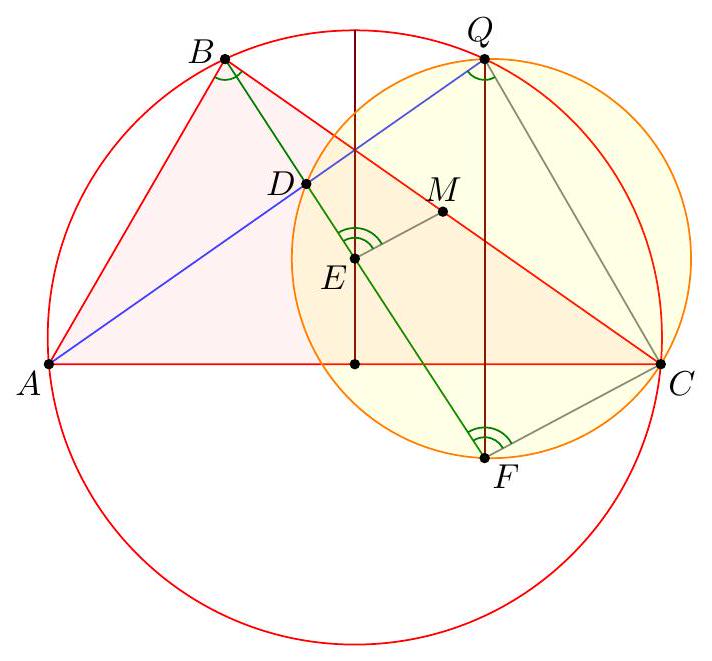
Claim - We have DQCF is cyclic. Proof. Since $E A=E C$, we have $\overline{Q F} \perp \overline{A C}$ as line $Q F$ is the image of the perpendicular bisector of $\overline{A C}$ under a homothety from $B$ with scale factor 2 . Then
To conclude, note that
Remark (Motivation). Here is one possible way to come up with the construction of point $F$ (at least this is what led Evan to find it). If one directs all the angles in the obvious way, there are really two points $D$ and $D^{\prime}$ that are possible, although one is outside the triangle; they give corresponding points $E$ and $E^{\prime}$. The circles $B E M$ and $B E^{\prime} M$ must then actually coincide since they are both alleged to be tangent to line $A B$. See the figure below.
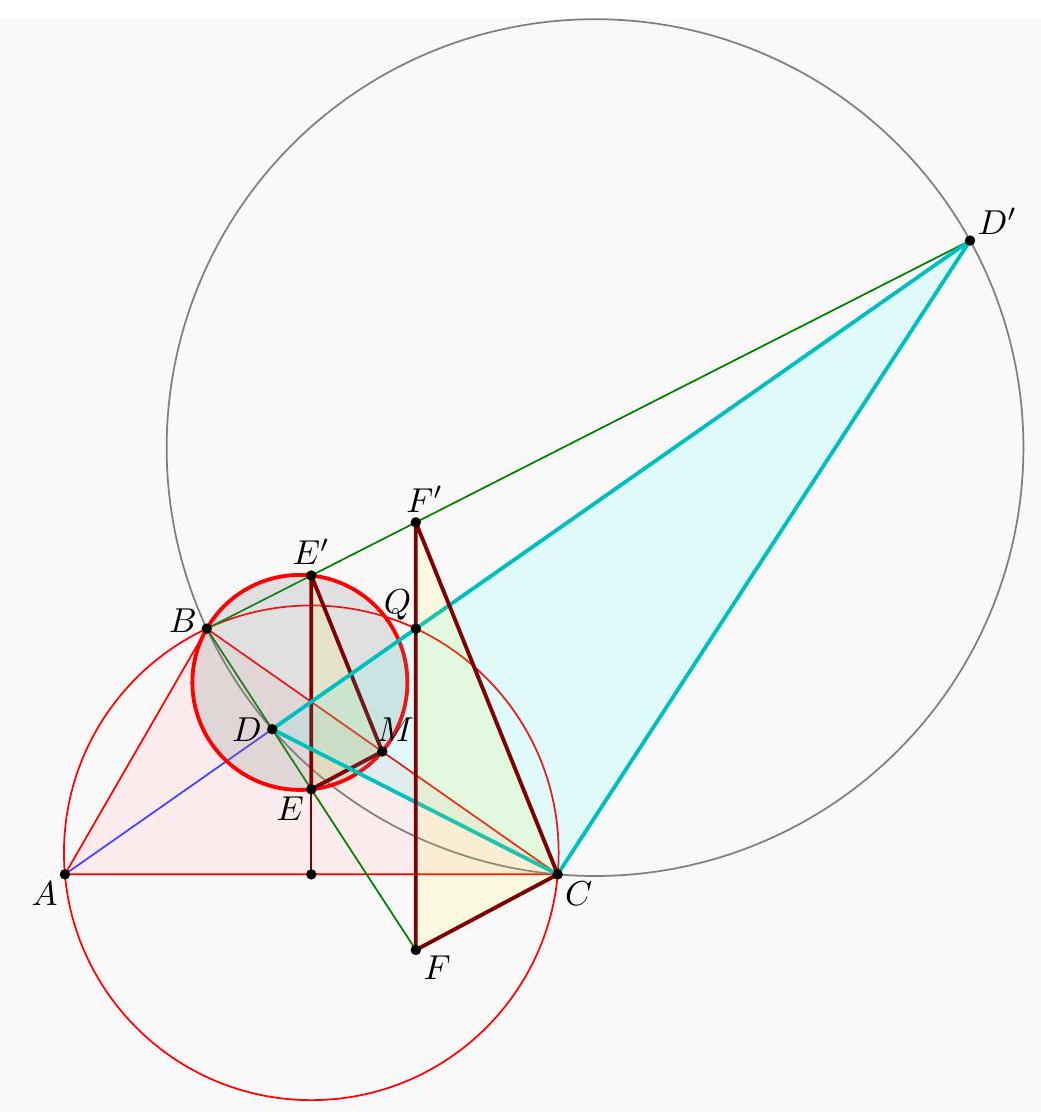
One can already prove using angle chasing that $\overline{A B}$ is tangent to $\left(B E E^{\prime}\right)$. So the point of the problem is to show that $M$ lies on this circle too. However, from looking at the diagram, one may realize that in fact it seems
is going to be true from just those marked in the figure (and this would certainly imply the desired concyclic conclusion). Since $M$ is a midpoint, it makes sense to dilate $\triangle E M E^{\prime}$ from $B$ by a factor of 2 to get $\triangle F C F^{\prime}$ so that the desired similarity is actually a spiral similarity at $C$. Then the spiral similarity lemma says that the desired similarity is equivalent to requiring $\overline{D D^{\prime}} \cap \overline{F F^{\prime}}=Q$ to lie on both $(C D F)$ and $\left(C D^{\prime} F^{\prime}\right)$. Hence the key construction and claim from the solution are both discovered naturally, and we find the solution above. (The points $D^{\prime}, E^{\prime}, F^{\prime}$ can then be deleted to hide the motivation.)
Another short solution. Let $Z$ be on line $B D E$ such that $\angle B A Z=90^{\circ}$. This lets us interpret the angle condition as follows:
Claim - Points $A, D, Z, C$ are cyclic.
Proof. Because $\measuredangle Z A C=90^{\circ}-A=180^{\circ}-\measuredangle C D B=\measuredangle Z D C$.
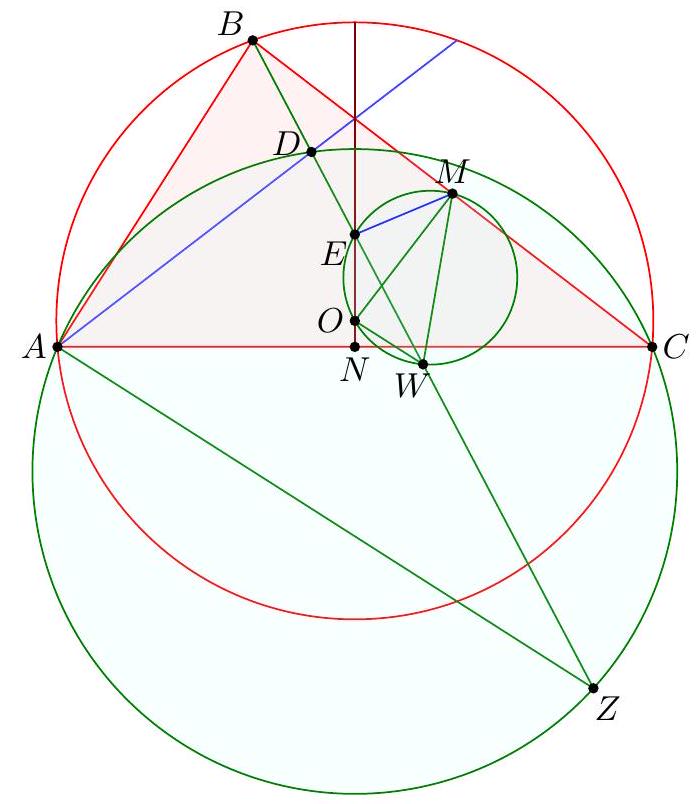
Define $W$ as the midpoint of $\overline{B Z}$, so $\overline{M W} | \overline{C Z}$. And let $O$ denote the center of $(A B C)$.
Claim - Points $M, E, O, W$ are cyclic.
Proof. Note that
To finish, note
This implies the desired tangency.
I A Menelaus-based approach (Kevin Ren). Let $P$ be on $\overline{B C}$ with $A P=P C$. Let $Y$ be the point on line $A B$ such that $\angle A C Y=90^{\circ}$; as $\angle A Y C=90^{\circ}-A$ it follows $B D Y C$ is cyclic. Let $K=\overline{A P} \cap \overline{C Y}$, so $\triangle A C K$ is a right triangle with $P$ the midpoint of its hypotenuse.
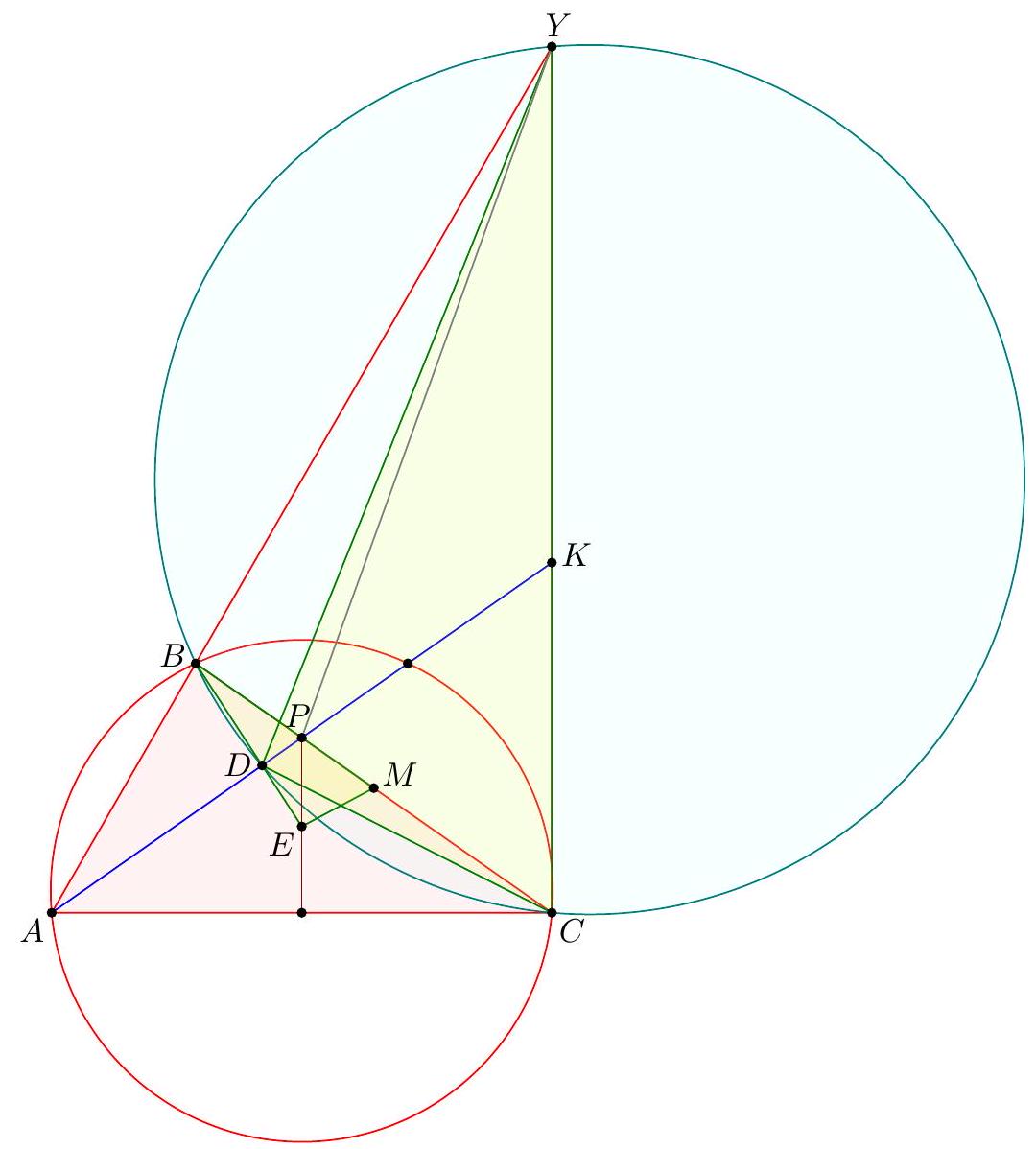
Claim - Triangles $B P E$ and $D Y K$ are similar.
Proof. We have $\measuredangle M P E=\measuredangle C P E=\measuredangle K C P=\measuredangle P K C$ and $\measuredangle E B P=\measuredangle D B C=$ $\measuredangle D Y C=\measuredangle D Y K$.
Claim - Triangles $B E M$ and $Y D C$ are similar.
Proof. By Menelaus $\triangle P C K$ with respect to collinear points $A, B, Y$ that
Since $A K / A P=2$ (note that $P$ is the midpoint of the hypotenuse of right triangle $A C K)$ and $B C=2 B M$, this simplifies to
To finish, note that
implying the desired tangency.
I A spiral similarity approach (Hans Yu). As in the previous solution, let $Y$ be the point on line $A B$ such that $\angle A C Y=90^{\circ}$; so $B D Y C$ is cyclic. Let $\Gamma$ be the circle through $B$ and $M$ tangent to $\overline{A B}$, and let $\Omega:=(B C Y D)$. We need to show $E \in \Gamma$.
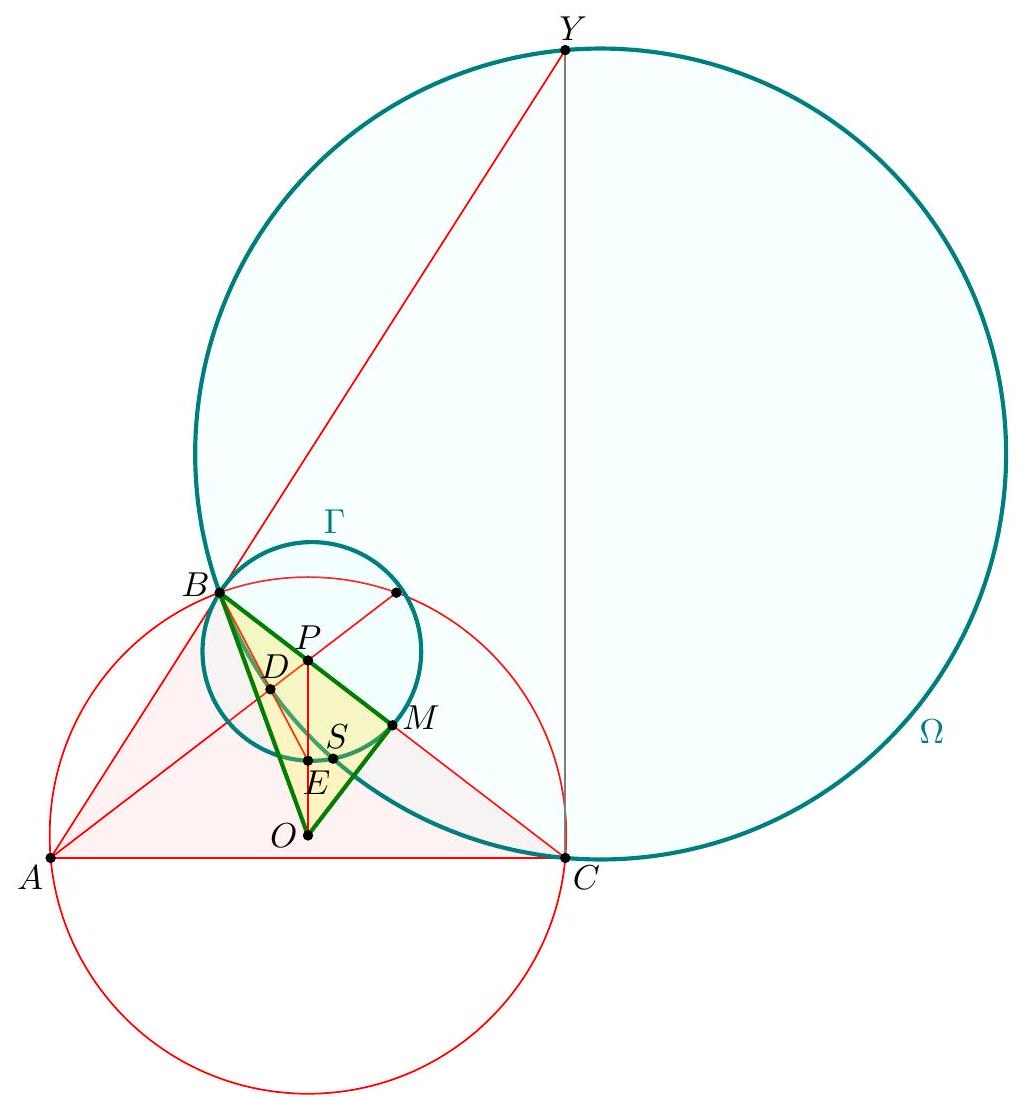
Denote by $S$ the second intersection of $\Gamma$ and $\Omega$. The main idea behind is to consider the spiral similarity
centered at $S$ (due to the spiral similarity lemma), and show that $\Psi(D)=E$. The spiral similarity lemma already promises $\Psi(D)$ lies on line $B D$.
Claim - We have $\Psi(A)=O$, the circumcenter of $A B C$.
Proof. Note $\triangle O B M \stackrel{+}{\sim} \triangle A Y C$; both are right triangles with $\measuredangle B A C=\measuredangle B O M$.
Claim - $\Psi$ maps line $A D$ to line $O P$.
Proof. If we let $P$ be on $\overline{B C}$ with $A P=P C$ as before,
As $\Psi$ maps line $Y C$ to line $B M$ and $\Psi(A)=O$, we're done. Hence $\Psi(D)$ should not only lie on $B D$ but also line $O P$. This proves $\Psi(D)=E$, so $E \in \Gamma$ as needed.
§2.3 USAMO 2024/6, proposed by Titu Andreescu and Gabriel Dospinescu
Problem statement
Let $n>2$ be an integer and let $\ell \in{1,2, \ldots, n}$. A collection $A_{1}, \ldots, A_{k}$ of (not necessarily distinct) subsets of ${1,2, \ldots, n}$ is called $\ell$-large if $\left|A_{i}\right| \geq \ell$ for all $1 \leq i \leq k$. Find, in terms of $n$ and $\ell$, the largest real number $c$ such that the inequality
holds for all positive integer $k$, all nonnegative real numbers $x_{1}, x_{2}, \ldots, x_{k}$, and all $\ell$-large collections $A_{1}, A_{2}, \ldots, A_{k}$ of subsets of ${1,2, \ldots, n}$.
The answer turns out to be
Throughout this solution, we work with vectors in $\mathbb{R}^{n^{2}}$. The entries will be indexed by ordered pairs $(p, q) \in{1, \ldots, n}^{2}$; the notation $\langle\bullet, \bullet\rangle$ denotes dot product, and $|\bullet|$ the vector norm.
【 Rewriting as a dot product. For $i=1, \ldots, n$ define $\mathbf{v}_{i}$ by
Then
【 Proof of the inequality for the claimed value of $c$. We define two more vectors $\mathbf{e}$ and $\mathbf{1}$; the vector $\mathbf{e}$ has 1 in the $(p, q)^{\text {th }}$ component if $p=q$, and 0 otherwise, while $\mathbf{1}$ has all-ones. In that case, note that
That means for any positive real constants $\alpha$ and $\beta$, by Cauchy-Schwarz for vectors, we should have
Set $\mathbf{w}:=\alpha \mathbf{e}+\beta \mathbf{1}$ for brevity. Then
SO
Therefore, we get an lower bound
Letting $\alpha=n-\ell$ and $\beta=\ell-1$ gives a proof that the constant
makes the original inequality always true. (The choice of $\alpha: \beta$ is suggested by the example below.)
【 Example showing this $c$ is best possible. Let $k=\binom{n}{\ell}$, let $A_{i}$ run over all $\binom{n}{\ell}$ subsets of ${1, \ldots, n}$ of size $\ell$, and let $x_{i}=1$ for all $i$. We claim this construction works.
To verify this, it would be sufficient to show that $\mathbf{w}$ and $\mathbf{v}$ are scalar multiples, so that the above Cauchy-Schwarz is equality. However, we can compute
which are indeed scalar multiples, finishing the proof.