


TSTST 2015 Solution Notes
Pittsburgh, PA
Evan Chen《陳誼廷》
15 April 2024
This is a compilation of solutions for the 2015 TSTST. The ideas of the solution are a mix of my own work, the solutions provided by the competition organizers, and solutions found by the community. However, all the writing is maintained by me.
These notes will tend to be a bit more advanced and terse than the "official" solutions from the organizers. In particular, if a theorem or technique is not known to beginners but is still considered "standard", then I often prefer to use this theory anyways, rather than try to work around or conceal it. For example, in geometry problems I typically use directed angles without further comment, rather than awkwardly work around configuration issues. Similarly, sentences like "let $\mathbb{R}$ denote the set of real numbers" are typically omitted entirely.
Corrections and comments are welcome!
Contents
0 Problems ..... 2 1 Solutions to Day 1 ..... 3 1.1 TSTST 2015/1, proposed by Mark Sellke ..... 3 1.2 TSTST 2015/2, proposed by Ivan Borsenco 1.3 TSTST 2015/3, proposed by Alex Zhai 2 Solutions to Day 2 ..... 6 2.1 TSTST 2015/4, proposed by Alyazeed Basyoni ..... 6 2.2 TSTST 2015/5 2.3 TSTST 2015/6, proposed by Linus Hamilton
§0 Problems
- Let $a_{1}, a_{2}, \ldots, a_{n}$ be a sequence of real numbers, and let $m$ be a fixed positive integer less than $n$. We say an index $k$ with $1 \leq k \leq n$ is good if there exists some $\ell$ with $1 \leq \ell \leq m$ such that
where the indices are taken modulo $n$. Let $T$ be the set of all good indices. Prove that
- Let $A B C$ be a scalene triangle. Let $K_{a}, L_{a}$, and $M_{a}$ be the respective intersections with $B C$ of the internal angle bisector, external angle bisector, and the median from $A$. The circumcircle of $A K_{a} L_{a}$ intersects $A M_{a}$ a second time at a point $X_{a}$ different from $A$. Define $X_{b}$ and $X_{c}$ analogously. Prove that the circumcenter of $X_{a} X_{b} X_{c}$ lies on the Euler line of $A B C$.
- Let $P$ be the set of all primes, and let $M$ be a non-empty subset of $P$. Suppose that for any non-empty subset $\left{p_{1}, p_{2}, \ldots, p_{k}\right}$ of $M$, all prime factors of $p_{1} p_{2} \ldots p_{k}+1$ are also in $M$. Prove that $M=P$.
- Let $x, y, z$ be real numbers (not necessarily positive) such that $x^{4}+y^{4}+z^{4}+x y z=4$. Prove that $x \leq 2$ and
- Let $\varphi(n)$ denote the number of positive integers less than $n$ that are relatively prime to $n$. Prove that there exists a positive integer $m$ for which the equation $\varphi(n)=m$ has at least 2015 solutions in $n$.
- A Nim-style game is defined as follows. Two positive integers $k$ and $n$ are specified, along with a finite set $S$ of $k$-tuples of integers (not necessarily positive). At the start of the game, the $k$-tuple $(~ n, 0,0, \ldots, 0)$ is written on the blackboard. A legal move consists of erasing the tuple $\left(a_{1}, a_{2}, \ldots, a_{k}\right)$ which is written on the blackboard and replacing it with $\left(a_{1}+b_{1}, a_{2}+b_{2}, \ldots, a_{k}+b_{k}\right)$, where $\left(b_{1}, b_{2}, \ldots, b_{k}\right)$ is an element of the set $S$. Two players take turns making legal moves, and the first to write a negative integer loses. In the event that neither player is ever forced to write a negative integer, the game is a draw. Prove that there is a choice of $k$ and $S$ with the following property: the first player has a winning strategy if $n$ is a power of 2 , and otherwise the second player has a winning strategy.
§1 Solutions to Day 1
§1.1 TSTST 2015/1, proposed by Mark Sellke
Available online at https://aops.com/community/p5017901.
Problem statement
Let $a_{1}, a_{2}, \ldots, a_{n}$ be a sequence of real numbers, and let $m$ be a fixed positive integer less than $n$. We say an index $k$ with $1 \leq k \leq n$ is good if there exists some $\ell$ with $1 \leq \ell \leq m$ such that
where the indices are taken modulo $n$. Let $T$ be the set of all good indices. Prove that
First we prove the result if the indices are not taken modulo $n$. Call a number $\ell$-good if $\ell$ is the smallest number such that $a_{k}+a_{k+1}+\cdots+a_{k+\ell-1} \geq 0$, and $\ell \leq m$. Then if $a_{k}$ is $\ell$-good, the numbers $a_{k+1}, \ldots, a_{k+\ell-1}$ are good as well.
Then by greedy from left to right, we can group all the good numbers into blocks with nonnegative sums. Repeatedly take the first good number, if $\ell$-good, group it with the next $\ell$ numbers. An example for $m=3$ :
We can now return to the original problem. Let $N$ be a large integer; applying the algorithm to $N$ copies of the sequence, we deduce that
where $c_{N}$ represents some "error" from left-over terms. As $\left|c_{N}\right| \leq \sum\left|a_{i}\right|$, by taking $N$ large enough we deduce the problem.
Remark. This solution was motivated by looking at the case $m=1$, realizing how dumb it was, then looking at $m=2$, and realizing it was equally dumb.
§1.2 TSTST 2015/2, proposed by Ivan Borsenco
Available online at https://aops.com/community/p5017915.
Problem statement
Let $A B C$ be a scalene triangle. Let $K_{a}, L_{a}$, and $M_{a}$ be the respective intersections with $B C$ of the internal angle bisector, external angle bisector, and the median from $A$. The circumcircle of $A K_{a} L_{a}$ intersects $A M_{a}$ a second time at a point $X_{a}$ different from $A$. Define $X_{b}$ and $X_{c}$ analogously. Prove that the circumcenter of $X_{a} X_{b} X_{c}$ lies on the Euler line of $A B C$.
The main content of the problem:
Claim - $\angle H X_{a} G=90^{\circ}$.
This implies the result, since then the desired circumcenter is the midpoint of $\overline{G H}$. (This is the main difficulty; the Euler line is a red herring.)
In what follows, we abbreviate $K_{a} L_{a}, M_{a}, X_{a}$ to $K, L, M, X$.
First proof by Brokard. To do this, it suffices to show that $M$ has the same power with respect to the circle with diameter $\overline{A H}$ and the circle with diameter $\overline{K L}$. In fact I claim both circles are orthogonal to the circle with diameter $\overline{B C}$ ! The former follows from Brokard's theorem, noting that $A$ is on the polar of $H$, and the latter follows from the harmonic bundle.
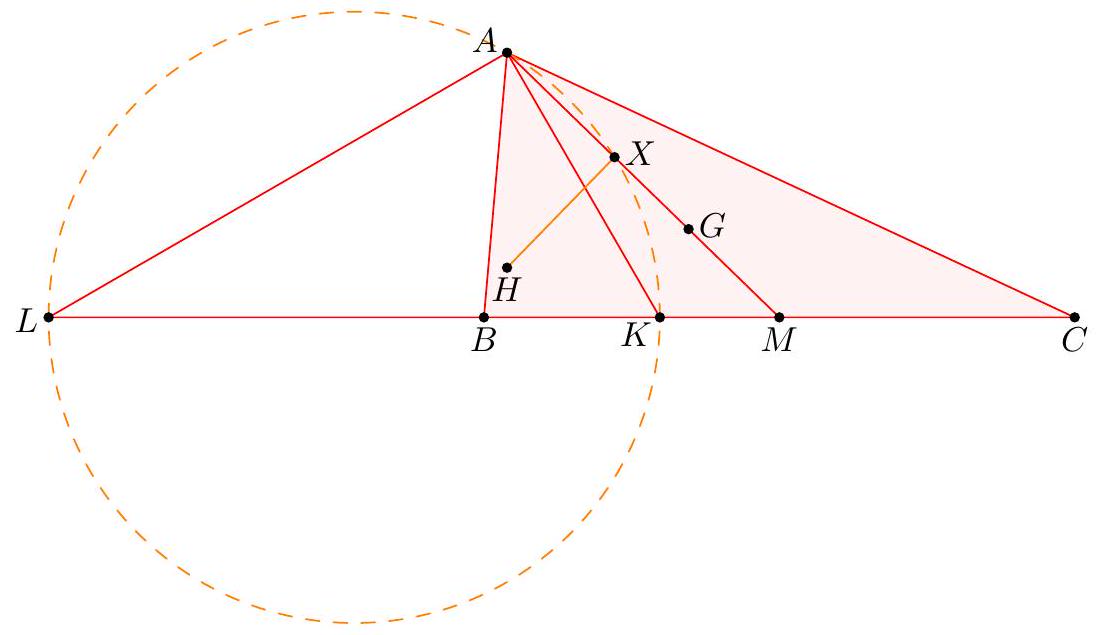
Then $\overline{A M}$ is the radical axis, so $X$ lies on both circles. Second proof by orthocenter reflection, Bendit Chan. As before, we know $M X \cdot M A=$ $M K \cdot M L=M B \cdot M C$, but $X$ lies inside segment $A M$. Construct parallelogram $A B A^{\prime} C$. Then $M X \cdot M A^{\prime}=M B \cdot M C$, so $X B A^{\prime} C$ is concyclic.
However, it is well-known the circumcircle of $\triangle B A^{\prime} C$ (which is the reflection of $(A B C)$ across $\overline{B C}$ ) passes through $H$ and in fact has diameter $\overline{A^{\prime} H}$. So this gives $\angle H X A^{\prime}=90^{\circ}$ as needed. Third proof by barycentric coordinates. Alternatively we may just compute $X=\left(a^{2}\right.$ : $\left.2 S_{A}: 2 S_{A}\right)$. Let $F=\left(0: S_{C}: S_{B}\right)$ be the foot from $H$. Then we check that $X H F M$ is cyclic, which is power of a point from $A$.
§1.3 TSTST 2015/3, proposed by Alex Zhai
Available online at https://aops.com/community/p5017928.
Problem statement
Let $P$ be the set of all primes, and let $M$ be a non-empty subset of $P$. Suppose that for any non-empty subset $\left{p_{1}, p_{2}, \ldots, p_{k}\right}$ of $M$, all prime factors of $p_{1} p_{2} \ldots p_{k}+1$ are also in $M$. Prove that $M=P$.
The following solution was found by user Aiscrim on AOPS. Obviously $|M|=\infty$. Assume for contradiction $p \notin M$. We say a prime $q \in M$ is sparse if there are only finitely many elements of $M$ which are $q(\bmod p)$ (in particular there are finitely many sparse primes).
Now let $C$ be the product of all sparse primes (note $p \nmid C$ ). First, set $a_{0}=1$. For $k \geq 0$, consider then the prime factorization of the number
No prime in its factorization is sparse, so consider the number $a_{k+1}$ obtained by replacing each prime in its factorization with some arbitrary representative of that prime's residue class. In this way we select a number $a_{k+1}$ such that
- $a_{k+1} \equiv C a_{k}+1(\bmod p)$, and
- $a_{k+1}$ is a product of distinct primes in $M$.
In particular, $a_{k} \equiv C^{k}+C^{k-1}+\cdots+1(\bmod p)$ But since $C \not \equiv 0(\bmod p)$, we can find a $k$ such that $a_{k} \equiv 0(\bmod p)($ namely, $k=p-1$ if $C \equiv 1$ and $k=p-2$ else) which is clearly impossible since $a_{k}$ is a product of primes in $M$ !
§2 Solutions to Day 2
§2.1 TSTST 2015/4, proposed by Alyazeed Basyoni
Available online at https://aops.com/community/p5017801.
Problem statement
Let $x, y, z$ be real numbers (not necessarily positive) such that $x^{4}+y^{4}+z^{4}+x y z=4$. Prove that $x \leq 2$ and
We prove that the condition $x^{4}+y^{4}+z^{4}+x y z=4$ implies
We first prove the easy part. Claim - We have $x \leq 2$. Proof. Indeed, AM-GM gives that
We evidently have that $x^{2} y^{2}+2 z^{2}+x y z \geq 0$ because the quadratic form $a^{2}+a b+2 b^{2}$ is positive definite, so $x^{4} \leq \frac{20}{3} \Longrightarrow x \leq 2$.
Now, the desired statement is implied by its square, so it suffices to show that
We are going to proceed by contradiction (it seems that many solutions do this) and assume that
By AM-GM,
which yields that
If we replace $x^{4}=4-\left(y^{4}+z^{4}+x y z\right)$ now, this gives
Since $2-x$ and the right-hand side are positive, we have $y z \geq 0$. Now
This is clearly false by AM-GM, so we have a contradiction.
§2.2 TSTST 2015/5
Available online at https://aops.com/community/p5017821.
Problem statement
Let $\varphi(n)$ denote the number of positive integers less than $n$ that are relatively prime to $n$. Prove that there exists a positive integer $m$ for which the equation $\varphi(n)=m$ has at least 2015 solutions in $n$.
Here are two explicit solutions. 『 First solution with ad-hoc subsets, by Evan Chen. I consider the following eleven prime numbers:
This has the property that for any $p \in S$, all prime factors of $p-1$ are one digit. Let $N=(210)^{\text {billion }}$, and consider $M=\varphi(N)$. For any subset $T \subset S$, we have
Since $2^{|S|}>2015$ we're done. Remark. This solution is motivated by the deep fact that $\varphi(11 \cdot 1000)=\varphi(10 \cdot 1000)$, for example.
【 Second solution with smallest primes, by Yang Liu. Let $2=p_{1}<p_{2}<\cdots<p_{2015}$ be the smallest 2015 primes. Then the 2015 numbers
all have the same phi value, namely
§2.3 TSTST 2015/6, proposed by Linus Hamilton
Available online at https://aops.com/community/p5017871.
Problem statement
A Nim-style game is defined as follows. Two positive integers $k$ and $n$ are specified, along with a finite set $S$ of $k$-tuples of integers (not necessarily positive). At the start of the game, the $k$-tuple $(n, 0,0, \ldots, 0)$ is written on the blackboard. A legal move consists of erasing the tuple $\left(a_{1}, a_{2}, \ldots, a_{k}\right)$ which is written on the blackboard and replacing it with $\left(a_{1}+b_{1}, a_{2}+b_{2}, \ldots, a_{k}+b_{k}\right)$, where $\left(b_{1}, b_{2}, \ldots, b_{k}\right)$ is an element of the set $S$. Two players take turns making legal moves, and the first to write a negative integer loses. In the event that neither player is ever forced to write a negative integer, the game is a draw.
Prove that there is a choice of $k$ and $S$ with the following property: the first player has a winning strategy if $n$ is a power of 2 , and otherwise the second player has a winning strategy.
Here we present a solution with 14 registers and 22 moves. Initially $X=n$ and all other variables are zero.
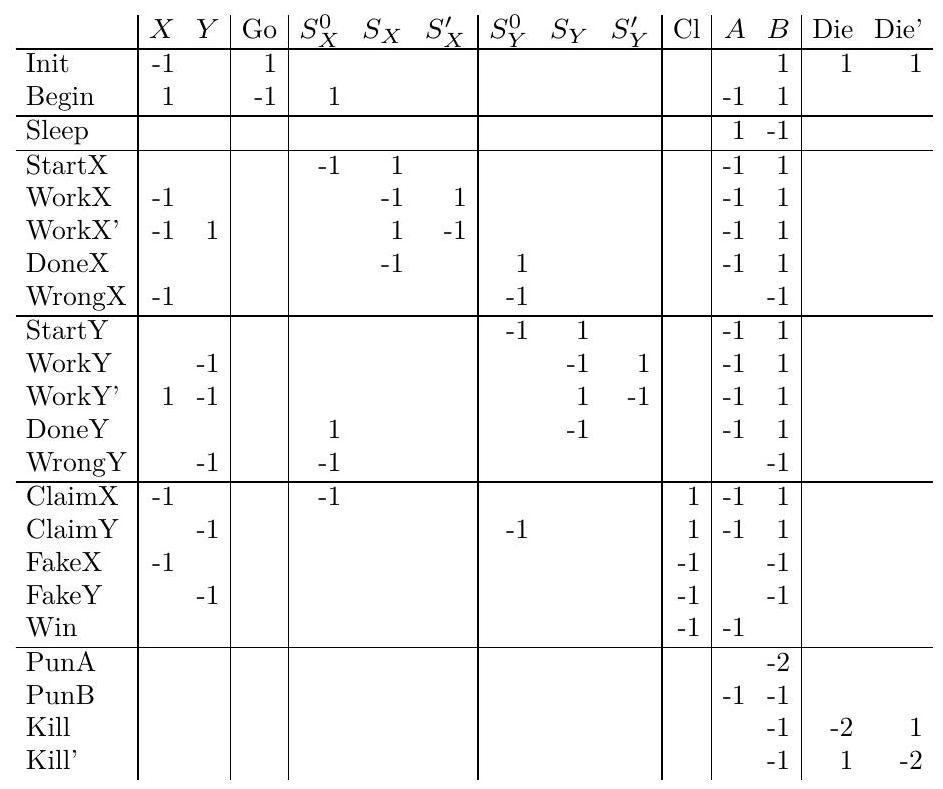
Now, the "game" is played as follows. The mechanics are controlled by the turn counters $A$ and $B$.
Observe the game starts with Alice playing Init. Thereafter, we say that the game is
- In the main part if $A+B=1$, and no one has played Init a second time.
- In the death part otherwise.
Observe that in the main state, on Alice's turn we always have $(A, B)=(1,0)$ and on Bob's turn we always have $(A, B)=(0,1)$.
Claim - A player who plays Init a second time must lose. In particular, a player who makes a move when $A=B=0$ must lose.
Proof. Situations with $A+B \geq 2$ cannot occur during main part, so there are only a few possibilities.
- Suppose the offending player is in a situation where $A=B=0$. Then he/she must play Init. At this point, the opposing player can respond by playing Kill. Then the offending player must play Init again. The opposing player now responds with Kill'. This iteration continues until $X$ reaches a negative number and the offending player loses.
- Suppose Alice has $(A, B)=(1,0)$ but plays Init again anyways. Then Bob responds with PunB to punish her; he then wins as in the first case.
- Suppose Bob has $(A, B)=(0,1)$ but plays Init again anyways. Alice responds with PunA in the same way.
Thus we may assume that players avoid the death part at all costs. Hence the second moves consist of Bob playing Sleep, and then Alice playing Begin (thus restoring the value of $n$ in $X$ ), then Bob playing Sleep.
Now we return to analysis of the main part. We say the game is in state $S$ for $S \in$ $\left{S_{X}^{0}, S_{X}, S_{X}^{\prime}, S_{Y}^{0}, S_{Y}, S_{Y}^{\prime}, \mathrm{Cl}\right}$ if $S=1$ and all other variables are zero. By construction, this is always the case. From then on the main part is divided into several phases:
- An $X$-phase: this begins with Alice at $S_{X}^{0}$, and ends when the game is in a state other than $S_{X}$ and $S_{X}^{\prime}$. (She can never return to $S_{X}^{0}$ during an $X$-phase.)
- A $Y$-phase: this begins with Alice at $S_{Y}^{0}$, and ends when the game is in a state other than $S_{Y}$ and $S_{Y}^{\prime}$. (She can never return to $S_{Y}^{0}$ during a $Y$-phase.)
Claim - Consider an $X$-phase in which $(X, Y)=(x, 0), x>1$. Then Alice can complete the phase without losing if and only if $x$ is even; if so she begins a $Y$-phase with $(X, Y)=(0, x / 2)$.
Proof. As $x>1$, Alice cannot play ClaimX since Bob will respond with FakeX and win. Now by alternating between WorkX and WorkX', Alice can repeatedly deduct 2 from $X$ and add 1 to $Y$, leading to $(x-2, y+1),(x-4, y+2)$, and so on. (During this time, Bob can only play Sleep.) Eventually, she must stop this process by playing DoneX, which begins a $Y$-phase.
Now note that unless $X=0$, Bob now has a winning move WrongX. Conversely he may only play Sleep if $X=0$.
We have an analogous claim for $Y$-phases. Thus if $n$ is not a power of 2 , we see that Alice eventually loses.
Now suppose $n=2^{k}$; then Alice reaches $(X, Y)=\left(0,2^{k-1}\right),\left(2^{k-2}, 0\right), \ldots$ until either reaching $(1,0)$ or $(0,1)$. At this point she can play ClaimX or ClaimY, respectively; the game is now in state Cl. Bob cannot play either FakeX or FakeY, so he must play Sleep, and then Alice wins by playing Win. Thus Alice has a winning strategy when $n=2^{k}$.