| # USA TSTST 2019 Solutions <br> United States of America - TST Selection Test <br> Ankan Bhattacharya and Evan Chen <br> $61^{\text {st }}$ IMO 2020 Russia and $9^{\text {th }}$ EGMO 2020 Netherlands |
|
|
| ## Contents |
|
|
| 0 Problems ..... 2 |
| 1 Solutions to Day 1 ..... 3 |
| 1.1 TSTST 2019/1, proposed by Evan Chen ..... 3 |
| 1.2 TSTST 2019/2, proposed by Merlijn Staps ..... 6 |
| 1.3 TSTST 2019/3, proposed by Nikolai Beluhov ..... 9 |
| 2 Solutions to Day 2 ..... 11 |
| 2.1 TSTST 2019/4, proposed by Merlijn Staps ..... 11 |
| 2.2 TSTST 2019/5, proposed by Gunmay Handa ..... 13 |
| 2.3 TSTST 2019/6, proposed by Nikolai Beluhov ..... 19 |
| 3 Solutions to Day 3 ..... 21 |
| 3.1 TSTST 2019/7, proposed by Ankan Bhattacharya ..... 21 |
| 3.2 TSTST 2019/8, proposed by Ankan Bhattacharya ..... 23 |
| 3.3 TSTST 2019/9, proposed by Ankan Bhattacharya ..... 25 |
|
|
| ## §0 Problems |
|
|
| 1. Find all binary operations $\diamond: \mathbb{R}_{>0} \times \mathbb{R}_{>0} \rightarrow \mathbb{R}_{>0}$ (meaning $\diamond$ takes pairs of positive real numbers to positive real numbers) such that for any real numbers $a, b, c>0$, |
| |
| - the equation $a \diamond(b \diamond c)=(a \diamond b) \cdot c$ holds; and |
| - if $a \geq 1$ then $a \diamond a \geq 1$. |
| |
| 2. Let $A B C$ be an acute triangle with circumcircle $\Omega$ and orthocenter $H$. Points $D$ and $E$ lie on segments $A B$ and $A C$ respectively, such that $A D=A E$. The lines through $B$ and $C$ parallel to $\overline{D E}$ intersect $\Omega$ again at $P$ and $Q$, respectively. Denote by $\omega$ the circumcircle of $\triangle A D E$. |
| (a) Show that lines $P E$ and $Q D$ meet on $\omega$. |
| (b) Prove that if $\omega$ passes through $H$, then lines $P D$ and $Q E$ meet on $\omega$ as well. |
| 3. On an infinite square grid we place finitely many cars, which each occupy a single cell and face in one of the four cardinal directions. Cars may never occupy the same cell. It is given that the cell immediately in front of each car is empty, and moreover no two cars face towards each other (no right-facing car is to the left of a left-facing car within a row, etc.). In a move, one chooses a car and shifts it one cell forward to a vacant cell. Prove that there exists an infinite sequence of valid moves using each car infinitely many times. |
| 4. Consider coins with positive real denominations not exceeding 1. Find the smallest $C>0$ such that the following holds: if we are given any 100 such coins with total value 50 , then we can always split them into two stacks of 50 coins each such that the absolute difference between the total values of the two stacks is at most $C$. |
| 5. Let $A B C$ be an acute triangle with orthocenter $H$ and circumcircle $\Gamma$. A line through $H$ intersects segments $A B$ and $A C$ at $E$ and $F$, respectively. Let $K$ be the circumcenter of $\triangle A E F$, and suppose line $A K$ intersects $\Gamma$ again at a point $D$. Prove that line $H K$ and the line through $D$ perpendicular to $\overline{B C}$ meet on $\Gamma$. |
| 6. Suppose $P$ is a polynomial with integer coefficients such that for every positive integer $n$, the sum of the decimal digits of $|P(n)|$ is not a Fibonacci number. Must $P$ be constant? |
| 7. Let $f: \mathbb{Z} \rightarrow\left\{1,2, \ldots, 10^{100}\right\}$ be a function satisfying |
| |
| $$ |
| \operatorname{gcd}(f(x), f(y))=\operatorname{gcd}(f(x), x-y) |
| $$ |
| |
| for all integers $x$ and $y$. Show that there exist positive integers $m$ and $n$ such that $f(x)=\operatorname{gcd}(m+x, n)$ for all integers $x$. |
| 8. Let $\mathcal{S}$ be a set of 16 points in the plane, no three collinear. Let $\chi(\mathcal{S})$ denote the number of ways to draw 8 line segments with endpoints in $\mathcal{S}$, such that no two drawn segments intersect, even at endpoints. Find the smallest possible value of $\chi(\mathcal{S})$ across all such $\mathcal{S}$. |
| 9. Let $A B C$ be a triangle with incenter $I$. Points $K$ and $L$ are chosen on segment $B C$ such that the incircles of $\triangle A B K$ and $\triangle A B L$ are tangent at $P$, and the incircles of $\triangle A C K$ and $\triangle A C L$ are tangent at $Q$. Prove that $I P=I Q$. |
| |
| ## §1 Solutions to Day 1 |
| |
| ## §1.1 TSTST 2019/1, proposed by Evan Chen |
| |
| Available online at https://aops.com/community/p12608849. |
| |
| ## Problem statement |
| |
| Find all binary operations $\diamond: \mathbb{R}_{>0} \times \mathbb{R}_{>0} \rightarrow \mathbb{R}_{>0}$ (meaning $\diamond$ takes pairs of positive real numbers to positive real numbers) such that for any real numbers $a, b, c>0$, |
|
|
| - the equation $a \diamond(b \diamond c)=(a \diamond b) \cdot c$ holds; and |
| - if $a \geq 1$ then $a \diamond a \geq 1$. |
|
|
| The answer is only multiplication and division, which both obviously work. |
| We present two approaches, one appealing to theorems on Cauchy's functional equation, and one which avoids it. |
|
|
| 【 First solution using Cauchy FE. We prove: |
| Claim - We have $a \diamond b=a f(b)$ where $f$ is some involutive and totally multiplicative function. (In fact, this classifies all functions satisfying the first condition completely.) |
|
|
| Proof. Let $P(a, b, c)$ denote the assertion $a \diamond(b \diamond c)=(a \diamond b) \cdot c$. |
|
|
| - Note that for any $x$, the function $y \mapsto x \diamond y$ is injective, because if $x \diamond y_{1}=x \diamond y_{2}$ then take $P\left(1, x, y_{i}\right)$ to get $y_{1}=y_{2}$. |
| - Take $P(1, x, 1)$ and injectivity to get $x \diamond 1=x$. |
| - Take $P(1,1, y)$ to get $1 \diamond(1 \diamond y)=y$. |
| - Take $P(x, 1,1 \diamond y)$ to get |
| |
| $$ |
| x \diamond y=x \cdot(1 \diamond y) |
| $$ |
| |
| Henceforth let us define $f(y)=1 \diamond y$, so $f(1)=1, f$ is involutive and |
| |
| $$ |
| x \diamond y=x f(y) |
| $$ |
| |
| Plugging this into the original condition now gives $f(b f(c))=f(b) c$, which (since $f$ is an involution) gives $f$ completely multiplicative. |
| |
| In particular, $f(1)=1$. We are now interested only in the second condition, which reads $f(x) \geq 1 / x$ for $x \geq 1$. |
| |
| Define the function |
| |
| $$ |
| g(t)=\log f\left(e^{t}\right) |
| $$ |
| |
| so that $g$ is additive, and also $g(t) \geq-t$ for all $t \geq 0$. We appeal to the following theorem: |
| |
| ## Lemma |
| |
| If $h: \mathbb{R} \rightarrow \mathbb{R}$ is an additive function which is not linear, then it is dense in the plane: for any point $\left(x_{0}, y_{0}\right)$ and $\varepsilon>0$ there exists $(x, y)$ such that $h(x)=y$ and $\sqrt{\left(x-x_{0}\right)^{2}+\left(y-y_{0}\right)^{2}}<\varepsilon$. |
| |
| Applying this lemma with the fact that $g(t) \geq-t$ implies readily that $g$ is linear. In other words, $f$ is of the form $f(x)=x^{r}$ for some fixed real number $r$. It is easy to check $r= \pm 1$ which finishes. |
| |
| 【 Second solution manually. As before we arrive at $a \diamond b=a f(b)$, with $f$ an involutive and totally multiplicative function. |
| |
| We prove that: |
| Claim - For any $a>0$, we have $f(a) \in\{1 / a, a\}$. |
| |
| Proof. WLOG $b>1$, and suppose $f(b)=a \geq 1 / b$ hence $f(a)=b$. |
| Assume that $a b>1$; we show $a=b$. Note that for integers $m$ and $n$ with $a^{n} b^{m} \geq 1$, we must have |
| |
| $$ |
| a^{m} b^{n}=f(b)^{m} f(a)^{n}=f\left(a^{n} b^{m}\right) \geq \frac{1}{a^{n} b^{m}} \Longrightarrow(a b)^{m+n} \geq 1 |
| $$ |
| |
| and thus we have arrived at the proposition |
| |
| $$ |
| m+n<0 \Longrightarrow n \log _{b} a+m<0 |
| $$ |
|
|
| for all integers $m$ and $n$. Due to the density of $\mathbb{Q}$ in the real numbers, this can only happen if $\log _{b} a=1$ or $a=b$. |
| |
| Claim - The function $f$ is continuous. |
| |
| Proof. Indeed, it's equivalent to show $g(t)=\log f\left(e^{t}\right)$ is continuous, and we have that |
| |
| $$ |
| |g(t)-g(s)|=\left|\log f\left(e^{t-s}\right)\right|=|t-s| |
| $$ |
| |
| since $f\left(e^{t-s}\right)=e^{ \pm|t-s|}$. Therefore $g$ is Lipschitz. Hence $g$ continuous, and $f$ is too. |
| Finally, we have from $f$ multiplicative that |
| |
| $$ |
| f\left(2^{q}\right)=f(2)^{q} |
| $$ |
| |
| for every rational number $q$, say. As $f$ is continuous this implies $f(x) \equiv x$ or $f(x) \equiv 1 / x$ identically (depending on whether $f(2)=2$ or $f(2)=1 / 2$, respectively). |
| |
| Therefore, $a \diamond b=a b$ or $a \diamond b=a \div b$, as needed. |
| Remark. The Lipschitz condition is one of several other ways to proceed. The point is that if $f(2)=2$ (say), and $x / 2^{q}$ is close to 1 , then $f(x) / 2^{q}=f\left(x / 2^{q}\right)$ is close to 1 , which is enough to force $f(x)=x$ rather than $f(x)=1 / x$. |
| |
| Remark. Compare to AMC 10A 2016 \#23, where the second condition is $a \diamond a=1$. |
| |
| ## §1.2 TSTST 2019/2, proposed by Merlijn Staps |
| |
| Available online at https://aops.com/community/p12608478. |
| |
| ## Problem statement |
| |
| Let $A B C$ be an acute triangle with circumcircle $\Omega$ and orthocenter $H$. Points $D$ and $E$ lie on segments $A B$ and $A C$ respectively, such that $A D=A E$. The lines through $B$ and $C$ parallel to $\overline{D E}$ intersect $\Omega$ again at $P$ and $Q$, respectively. Denote by $\omega$ the circumcircle of $\triangle A D E$. |
| (a) Show that lines $P E$ and $Q D$ meet on $\omega$. |
| (b) Prove that if $\omega$ passes through $H$, then lines $P D$ and $Q E$ meet on $\omega$ as well. |
| |
| We will give one solution to (a), then several solutions to (b). |
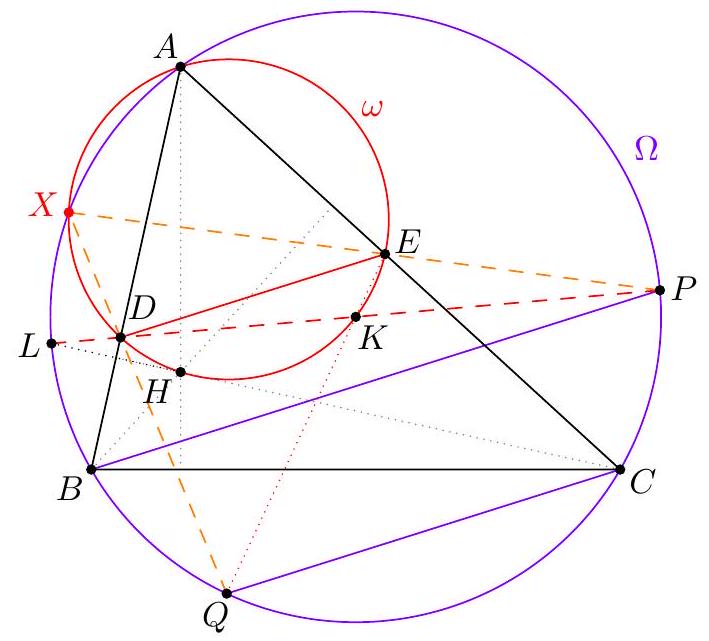
| 【 Solution to (a). Note that $\measuredangle A Q P=\measuredangle A B P=\measuredangle A D E$ and $\measuredangle A P Q=\measuredangle A C Q=$ $\measuredangle A E D$, so we have a spiral similarity $\triangle A D E \sim \triangle A Q P$. Therefore, lines $P E$ and $Q D$ meet at the second intersection of $\omega$ and $\Omega$ other than $A$. Call this point $X$. |
| |
| 【 Solution to (b) using angle chasing. Let $L$ be the reflection of $H$ across $\overline{A B}$, which lies on $\Omega$. |
| |
| Claim - Points $L, D, P$ are collinear. |
| Proof. This is just angle chasing: |
| |
| $$ |
| \begin{aligned} |
| \measuredangle C L D & =\measuredangle D H L=\measuredangle D H A+\measuredangle A H L=\measuredangle D E A+\measuredangle A H C \\ |
| & =\measuredangle A D E+\measuredangle C B A=\measuredangle A B P+\measuredangle C B A=\measuredangle C B P=\measuredangle C L P . |
| \end{aligned} |
| $$ |
| |
|  |
| |
| Now let $K \in \omega$ such that $D H K E$ is an isosceles trapezoid, i.e. $\measuredangle B A H=\measuredangle K A E$. |
| |
| Claim - Points $D, K, P$ are collinear. |
| |
| Proof. Using the previous claim, |
| |
| $$ |
| \measuredangle K D E=\measuredangle K A E=\measuredangle B A H=\measuredangle L A B=\measuredangle L P B=\measuredangle D P B=\measuredangle P D E . |
| $$ |
| |
| By symmetry, $\overline{Q E}$ will then pass through the same $K$, as needed. |
| Remark. These two claims imply each other, so guessing one of them allows one to realize the other. It is likely the latter is easiest to guess from the diagram, since it does not need any additional points. |
| |
| 【 Solution to (b) by orthogonal circles (found by contestants). We define $K$ as in the previous solution, but do not claim that $K$ is the desired intersection. Instead, we note that: |
| |
| Claim - Point $K$ is the orthocenter of isosceles triangle $A P Q$. |
| Proof. Notice that $A H=A K$ and $B C=P Q$. Moreover from $\overline{A H} \perp \overline{B C}$ we deduce $\overline{A K} \perp \overline{P Q}$ by reflection across the angle bisector. |
| |
| In light of the formula " $A H^{2}=4 R^{2}-a^{2}$ ", this implies the conclusion. |
| Let $M$ be the midpoint of $\overline{P Q}$. Since $\triangle A P Q$ is isosceles, |
| |
| $$ |
| \overline{A K M} \perp \overline{P Q} \Longrightarrow M K \cdot M A=M P^{2} |
| $$ |
| |
| by orthocenter properties. |
| So to summarize |
| |
| - The circle with diameter $\overline{P Q}$ is orthogonal to $\omega$. In other words, point $P$ lies on the polar of $Q$ with respect to $\omega$. |
| - The point $X=\overline{Q D} \cap \overline{P E}$ is on $\omega$. |
| |
| On the other hand, if we let $K^{\prime}=\overline{Q E} \cap \omega$, then by Brokard theorem on $X D K^{\prime} E$, the polar of $Q=\overline{X D} \cap \overline{K^{\prime} E}$ pass through $\overline{D K^{\prime}} \cap \overline{X E}$; this point must therefore be $P$ and $K^{\prime}=K$ as desired. |
| |
| 『 S Solution to (b) by complex numbers (Yang Liu and Michael Ma). Let $M$ be the arc midpoint of $\widehat{B C}$. We use the standard arc midpoint configuration. We have that |
| |
| $$ |
| A=a^{2}, B=b^{2}, C=c^{2}, M=-b c, H=a^{2}+b^{2}+c^{2}, P=\frac{a^{2} c}{b}, Q=\frac{a^{2} b}{c} |
| $$ |
| |
| where $M$ is the arc midpoint of $\widehat{B C}$. By direct angle chasing we can verify that $\overline{M B} \| \overline{D H}$. Also, $D \in \overline{A B}$. Therefore, we can compute $D$ as follows. |
| |
| $$ |
| d+a^{2} b^{2} \bar{d}=a^{2}+b^{2} \text { and } \frac{d-h}{\bar{d}-\bar{h}}=-m b^{2}=b^{3} c \Longrightarrow d=\frac{a^{2}\left(a^{2} c+b^{2} c+c^{3}-b^{3}\right)}{c\left(b c+a^{2}\right)} . |
| $$ |
| |
| By symmetry, we have that |
| |
| $$ |
| e=\frac{a^{2}\left(a^{2} b+b c^{2}+b^{3}-c^{3}\right)}{b\left(b c+a^{2}\right)} . |
| $$ |
| |
| To finish, we want to show that the angle between $\overline{D P}$ and $\overline{E Q}$ is angle $A$. To show this, we compute $\frac{d-p}{e-q} / \overline{\frac{d-p}{e-q}}$. First, we compute |
| |
| $$ |
| \begin{aligned} |
| d-p & =\frac{a^{2}\left(a^{2} c+b^{2} c+c^{3}-b^{3}\right)}{c\left(b c+a^{2}\right)}-\frac{a^{2} c}{b} \\ |
| & =a^{2}\left(\frac{a^{2} c+b^{2} c+c^{3}-b^{3}}{c\left(b c+a^{2}\right)}-\frac{c}{b}\right)=\frac{a^{2}\left(a^{2} c-b^{3}\right)(b-c)}{b c\left(b c+a^{2}\right)} |
| \end{aligned} |
| $$ |
| |
| By symmetry, |
| |
| $$ |
| \frac{d-p}{e-q}=-\frac{a^{2} c-b^{3}}{a^{2} b-c^{3}} \Longrightarrow \frac{d-p}{e-q} / \overline{\frac{d-p}{e-q}}=\frac{a^{2} b^{3} c}{a^{2} b c^{3}}=\frac{b^{2}}{c^{2}} |
| $$ |
| |
| as desired. |
| \I Solution to (b) using untethered moving points (Zack Chroman). We work in the real projective plane $\mathbb{R P}^{2}$, and animate $C$ linearly on a fixed line through $A$. |
| |
| Recall: |
| |
| ## Lemma (Zack's lemma) |
| |
| Suppose points $A, B$ have degree $d_{1}, d_{2}$, and there are $k$ values of $t$ for which $A=B$. Then line $A B$ has degree at most $d_{1}+d_{2}-k$. Similarly, if lines $\ell_{1}, \ell_{2}$ have degrees $d_{1}, d_{2}$, and there are $k$ values of $t$ for which $\ell_{1}=\ell_{2}$, then the intersection $\ell_{1} \cap \ell_{2}$ has degree at most $d_{1}+d_{2}-k$. |
| |
| Now, note that $H$ moves linearly in $C$ on line $B H$. Furthermore, angles $\angle A H E$, $\angle A H F$ are fixed, we get that $D$ and $E$ have degree 2 . One way to see this is using the lemma; $D$ lies on line $A B$, which is fixed, and line $H D$ passes through a point at infinity which is a constant rotation of the point at infinity on line $A H$, and therefore has degree 1. Then $D, E$ have degree at most $1+1-0=2$. |
| |
| Now, note that $P, Q$ move linearly in $C$. Both of these are because the circumcenter $O$ moves linearly in $C$, and $P, Q$ are reflections of $B, C$ in a line through $O$ with fixed direction, which also moves linearly. |
| |
| So by the lemma, the lines $P D, Q E$ have degree at most 3 . I claim they actually have degree 2; to show this it suffices to give an example of a choice of $C$ for which $P=D$ and one for which $Q=E$. But an easy angle chase shows that in the unique case when $P=B$, we get $D=B$ as well and thus $P=D$. Similarly when $Q=C, E=C$. It follows from the lemma that lines $P D, Q E$ have degree at most 2 . |
| |
| Let $\ell_{\infty}$ denote the line at infinity. I claim that the points $P_{1}=P D \cap \ell_{\infty}, P_{2}=Q E \cap \ell_{\infty}$ are projective in $C$. Since $\ell_{\infty}$ is fixed, it suffices to show by the lemma that there exists some value of $C$ for which $Q E=\ell_{\infty}$ and $P D=\ell_{\infty}$. But note that as $C \rightarrow \infty$, all four points $P, D, Q, E$ go to infinity. It follows that $P_{1}, P_{2}$ are projective in $C$. |
| |
| Then to finish, recall that we want to show that $\angle(P D, Q E)$ is constant. It suffices then to show that there's a constant rotation sending $P_{1}$ to $P_{2}$. Since $P_{1}, P_{2}$ are projective, it suffices to verify this for 3 values of $C$. |
| |
| We can take $C$ such that $\angle A B C=90, \angle A C B=90$, or $A B=A C$, and all three cases are easy to check. |
| |
| ## §1.3 TSTST 2019/3, proposed by Nikolai Beluhov |
| |
| Available online at https://aops.com/community/p12608769. |
| |
| ## Problem statement |
| |
| On an infinite square grid we place finitely many cars, which each occupy a single cell and face in one of the four cardinal directions. Cars may never occupy the same cell. It is given that the cell immediately in front of each car is empty, and moreover no two cars face towards each other (no right-facing car is to the left of a left-facing car within a row, etc.). In a move, one chooses a car and shifts it one cell forward to a vacant cell. Prove that there exists an infinite sequence of valid moves using each car infinitely many times. |
| |
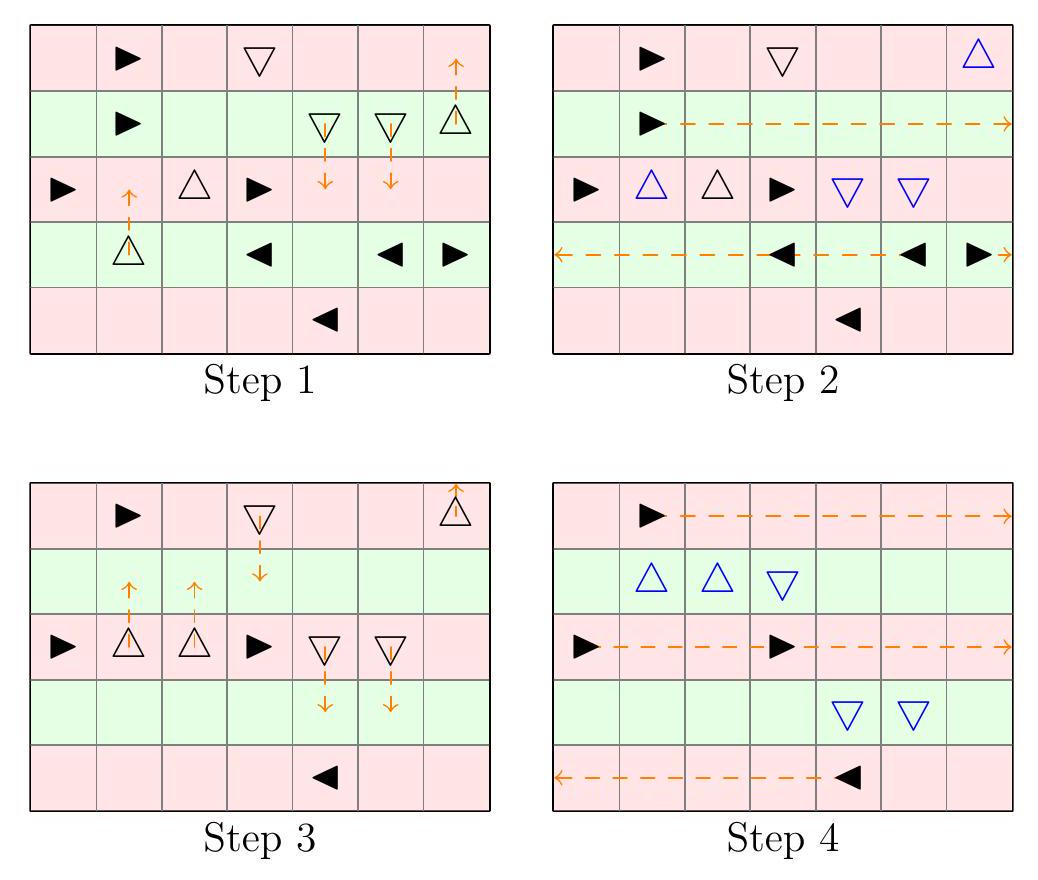
| Let $S$ be any rectangle containing all the cars. Partition $S$ into horizontal strips of height 1 , and color them red and green in an alternating fashion. It is enough to prove all the cars may exit $S$. |
|  |
| |
| To do so, we outline a five-stage plan for the cars. |
| |
| 1. All vertical cars in a green cell may advance one cell into a red cell (or exit $S$ altogether), by the given condition. (This is the only place where the hypothesis about empty space is used!) |
| 2. All horizontal cars on green cells may exit $S$, as no vertical cars occupy green cells. |
| 3. All vertical cars in a red cell may advance one cell into a green cell (or exit $S$ altogether), as all green cells are empty. |
| 4. All horizontal cars within red cells may exit $S$, as no vertical car occupy red cells. |
| 5. The remaining cars exit $S$, as they are all vertical. The solution is complete. |
| |
| Remark (Author's comments). The solution I've given for this problem is so short and simple that it might appear at first to be about IMO 1 difficulty. I don't believe that's true! There are very many approaches that look perfectly plausible at first, and then fall apart in this or that twisted special case. |
| |
| Remark (Higher-dimensional generalization by author). The natural higher-dimensional generalization is true, and can be proved in largely the same fashion. For example, in three dimensions, one may let $S$ be a rectangular prism and partition $S$ into horizontal slabs and color them red and green in an alternating fashion. Stages 1, 3, and 5 generalize immediately, and stages 2 and 4 reduce to an application of the two-dimensional problem. In the same way, the general problem is handled by induction on the dimension. |
| |
| Remark (Historical comments). For $k>1$, we could consider a variant of the problem where cars are $1 \times k$ rectangles (moving parallel to the longer edge) instead of occupying single cells. In that case, if there are $2 k-1$ empty spaces in front of each car, the above proof works (with the red and green strips having height $k$ instead). On the other hand, at least $k$ empty spaces are necessary. We don't know the best constant in this case. |
| |
| ## §2 Solutions to Day 2 |
| |
| ## §2.1 TSTST 2019/4, proposed by Merlijn Staps |
| |
| Available online at https://aops.com/community/p12608513. |
| |
| ## Problem statement |
| |
| Consider coins with positive real denominations not exceeding 1. Find the smallest $C>0$ such that the following holds: if we are given any 100 such coins with total value 50 , then we can always split them into two stacks of 50 coins each such that the absolute difference between the total values of the two stacks is at most $C$. |
| |
| The answer is $C=\frac{50}{51}$. The lower bound is obtained if we have 51 coins of value $\frac{1}{51}$ and 49 coins of value 1. (Alternatively, 51 coins of value $1-\frac{\varepsilon}{51}$ and 49 coins of value $\frac{\varepsilon}{49}$ works fine for $\varepsilon>0$.) We now present two (similar) proofs that this $C=\frac{50}{51}$ suffices. |
| |
| 【 First proof (original). Let $a_{1} \leq \cdots \leq a_{100}$ denote the values of the coins in ascending order. Since the 51 coins $a_{50}, \ldots, a_{100}$ are worth at least $51 a_{50}$, it follows that $a_{50} \leq \frac{50}{51}$; likewise $a_{51} \geq \frac{1}{51}$. |
|
|
| We claim that choosing the stacks with coin values |
|
|
| $$ |
| a_{1}, a_{3}, \ldots, a_{49}, \quad a_{52}, a_{54}, \ldots, a_{100} |
| $$ |
|
|
| and |
|
|
| $$ |
| a_{2}, a_{4}, \ldots, a_{50}, \quad a_{51}, a_{53}, \ldots, a_{99} |
| $$ |
|
|
| works. Let $D$ denote the (possibly negative) difference between the two total values. Then |
|
|
| $$ |
| \begin{aligned} |
| D & =\left(a_{1}-a_{2}\right)+\cdots+\left(a_{49}-a_{50}\right)-a_{51}+\left(a_{52}-a_{53}\right)+\cdots+\left(a_{98}-a_{99}\right)+a_{100} \\ |
| & \leq 25 \cdot 0-\frac{1}{51}+24 \cdot 0+1=\frac{50}{51} |
| \end{aligned} |
| $$ |
|
|
| Similarly, we have |
|
|
| $$ |
| \begin{aligned} |
| D & =a_{1}+\left(a_{3}-a_{2}\right)+\cdots+\left(a_{49}-a_{48}\right)-a_{50}+\left(a_{52}-a_{51}\right)+\cdots+\left(a_{100}-a_{99}\right) \\ |
| & \geq 0+24 \cdot 0-\frac{50}{51}+25 \cdot 0=-\frac{50}{51} |
| \end{aligned} |
| $$ |
|
|
| It follows that $|D| \leq \frac{50}{51}$, as required. |
|
|
| 【 Second proof (Evan Chen). Again we sort the coins in increasing order $0<a_{1} \leq$ $a_{2} \leq \cdots \leq a_{100} \leq 1$. A large gap is an index $i \geq 2$ such that $a_{i}>a_{i-1}+\frac{50}{51}$; obviously there is at most one such large gap. |
| |
| Claim - If there is a large gap, it must be $a_{51}>a_{50}+\frac{50}{51}$. |
| |
| Proof. If $i<50$ then we get $a_{50}, \ldots, a_{100}>\frac{50}{51}$ and the sum $\sum_{1}^{100} a_{i}>50$ is too large. Conversely if $i>50$ then we get $a_{1}, \ldots, a_{i-1}<\frac{1}{51}$ and the sum $\sum_{1}^{100} a_{i}<1 / 51 \cdot 51+49$ is too small. |
| |
| Now imagine starting with the coins $a_{1}, a_{3}, \ldots, a_{99}$, which have total value $S \leq 25$. We replace $a_{1}$ by $a_{2}$, then $a_{3}$ by $a_{4}$, and so on, until we replace $a_{99}$ by $a_{100}$. At the end of the process we have $S \geq 25$. Moreover, since we did not cross a large gap at any point, the quantity $S$ changed by at most $C=\frac{50}{51}$ at each step. So at some point in the process we need to have $25-C / 2 \leq S \leq 25+C / 2$, which proves $C$ works. |
|
|
| ## §2.2 TSTST 2019/5, proposed by Gunmay Handa |
|
|
| Available online at https://aops.com/community/p12608496. |
|
|
| ## Problem statement |
|
|
| Let $A B C$ be an acute triangle with orthocenter $H$ and circumcircle $\Gamma$. A line through $H$ intersects segments $A B$ and $A C$ at $E$ and $F$, respectively. Let $K$ be the circumcenter of $\triangle A E F$, and suppose line $A K$ intersects $\Gamma$ again at a point $D$. Prove that line $H K$ and the line through $D$ perpendicular to $\overline{B C}$ meet on $\Gamma$. |
|
|
| We present several solutions. (There are more in the official packet; some are omitted here, which explains the numbering.) |
|
|
| 『 First solution (Andrew Gu). We begin with the following two observations. |
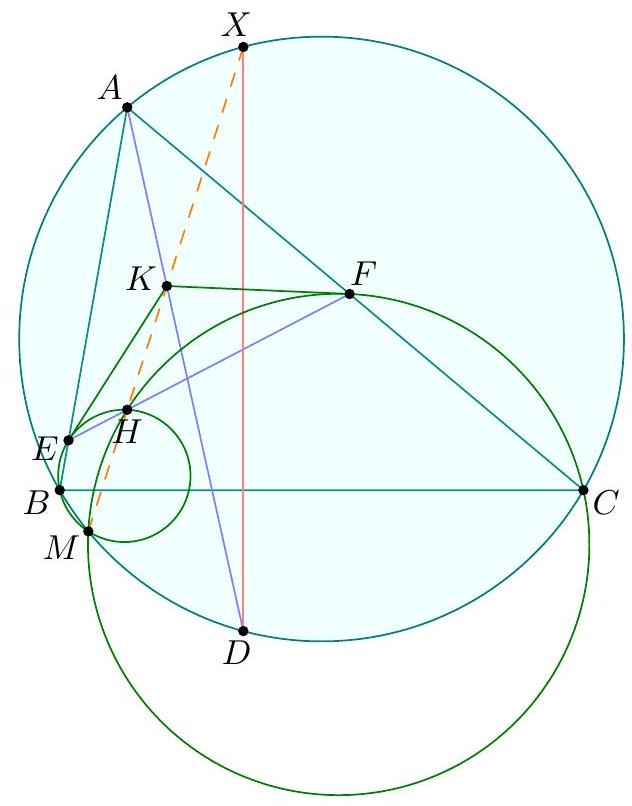
| Claim - Point $K$ lies on the radical axis of $(B E H)$ and $(C F H)$. |
| Proof. Actually we claim $\overline{K E}$ and $\overline{K F}$ are tangents. Indeed, |
|
|
| $$ |
| \measuredangle H E K=90^{\circ}-\measuredangle E A F=90^{\circ}-\measuredangle B A C=\measuredangle H B E |
| $$ |
|
|
| implying the result. Since $K E=K F$, this implies the result. |
|
|
| Claim - The second intersection $M$ of $(B E H)$ and $(C F H)$ lies on $\Gamma$. |
| Proof. By Miquel's theorem on $\triangle A E F$ with $H \in \overline{E F}, B \in \overline{A E}, C \in \overline{A F}$. |
|  |
|
|
| In particular, $M, H, K$ are collinear. Let $X$ be on $\Gamma$ with $\overline{D X} \perp \overline{B C}$; we then wish to show $X$ lies on the line $M H K$ we found. This is angle chasing: compute |
|
|
| $$ |
| \measuredangle X M B=\measuredangle X D B=90^{\circ}-\measuredangle D B C=90^{\circ}-\measuredangle D A C |
| $$ |
|
|
| $$ |
| =90^{\circ}-\measuredangle K A F=\measuredangle F E A=\measuredangle H E B=\measuredangle H M B |
| $$ |
|
|
| as needed. |
|
|
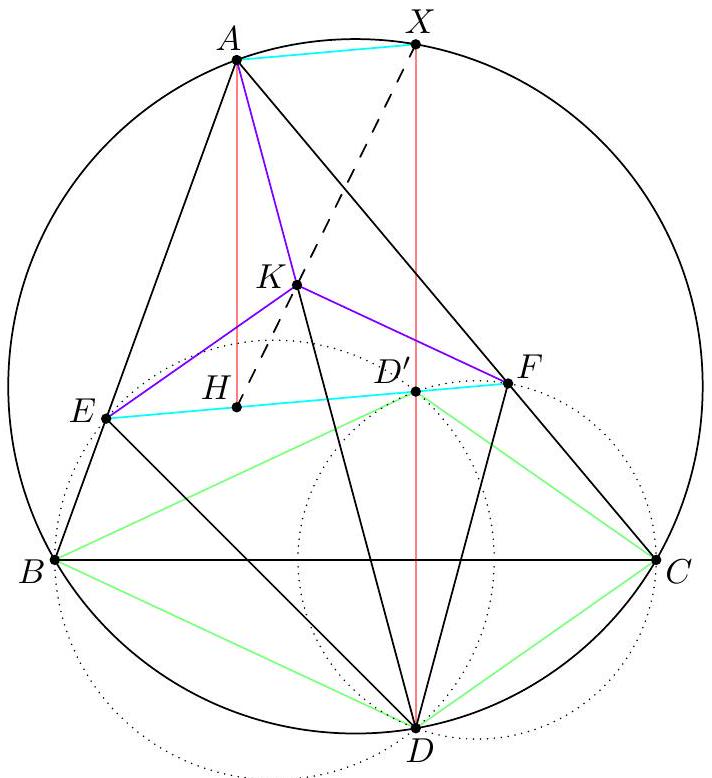
| II Second solution (Ankan Bhattacharya). We let $D^{\prime}$ be the second intersection of $\overline{E F}$ with $(B H C)$ and redefine $D$ as the reflection of $D^{\prime}$ across $\overline{B C}$. We will first prove that this point $D$ coincides with the point $D$ given in the problem statement. The idea is that: |
|
|
| Claim - $A$ is the $D$-excenter of $\triangle D E F$. |
|
|
| Proof. We contend $B E D^{\prime} D$ is cyclic. This follows by angle chasing: |
|
|
| $$ |
| \begin{aligned} |
| \measuredangle D^{\prime} D B & =\measuredangle B D^{\prime} D=\measuredangle D^{\prime} B C+90^{\circ}=\measuredangle D^{\prime} H C+90^{\circ} \\ |
| & =\measuredangle D^{\prime} H C+\measuredangle(H C, A B)=\measuredangle\left(D^{\prime} H, A B\right)=\measuredangle D^{\prime} E B |
| \end{aligned} |
| $$ |
|
|
| Now as $B D=B D^{\prime}$, we obtain $\overline{B E A}$ externally bisects $\angle D E D^{\prime} \cong \angle D E F$. Likewise $\overline{F A}$ externally bisects $\angle D F E$, so $A$ is the $D$-excenter of $\triangle D E F$. |
|
|
| Hence, by the so-called "Fact 5 ", point $K$ lies on $\overline{D A}$, so this point $D$ is the one given in the problem statement. |
|  |
|
|
| Now choose point $X$ on $(A B C)$ satisfying $\overline{D X} \perp \overline{B C}$. |
| Claim - Point $K$ lies on line $H X$. |
|
|
| Proof. Clearly $A H D^{\prime} X$ is a parallelogram. By Ptolemy on $D E K F$, |
|
|
| $$ |
| \frac{K D}{K A}=\frac{K D}{K E}=\frac{D E+D F}{E F} |
| $$ |
|
|
| On the other hand, if we let $r_{D}$ denote the $D$-exradius of $\triangle D E F$ then |
| |
| $$ |
| \frac{X D}{X D^{\prime}}=\frac{[D E X]+[D F X]}{[X E F]}=\frac{[D E X]+[D F X]}{[A E F]}=\frac{D E \cdot r_{D}+D F \cdot r_{D}}{E F \cdot r_{D}}=\frac{D E+D F}{E F} |
| $$ |
|
|
| Thus |
|
|
| $$ |
| [A K X]=\frac{K A}{K D} \cdot[D K X]=\frac{K A}{K D} \cdot \frac{X D}{X D^{\prime}} \cdot\left[K D^{\prime} X\right]=\left[D^{\prime} K X\right] |
| $$ |
|
|
| This is sufficient to prove $K$ lies on $\overline{H X}$. |
| The solution is complete: $X$ is the desired concurrency point. |
|
|
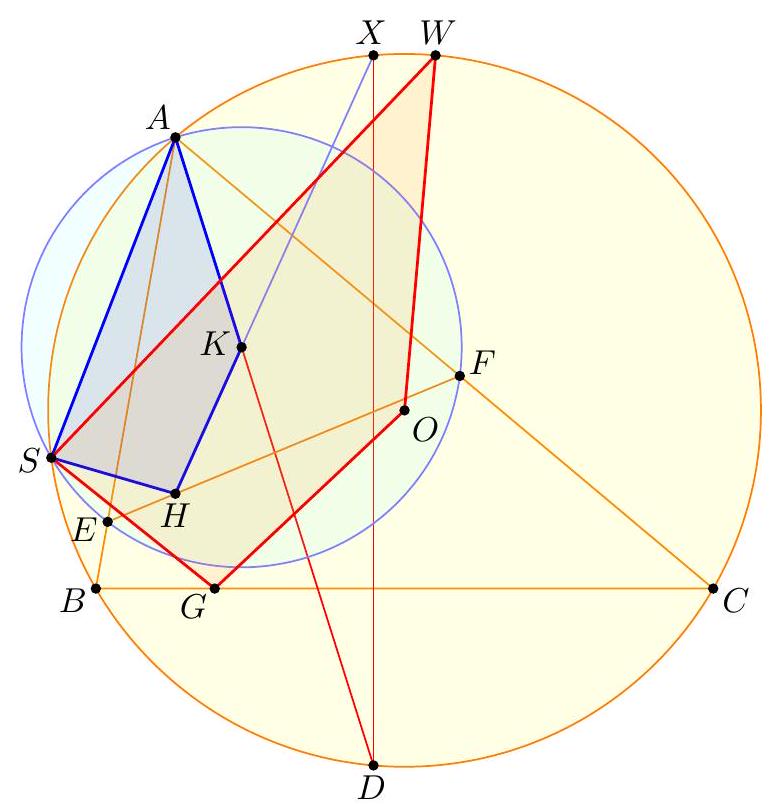
| I Fourth solution, complex numbers with spiral similarity (Evan Chen). First if $\overline{A D} \perp \overline{B C}$ there is nothing to prove, so we assume this is not the case. Let $W$ be the antipode of $D$. Let $S$ denote the second intersection of $(A E F)$ and $(A B C)$. Consider the spiral similarity sending $\triangle S E F$ to $\triangle S B C$ : |
|
|
| - It maps $H$ to a point $G$ on line $B C$, |
| - It maps $K$ to $O$. |
| - It maps the $A$-antipode of $\triangle A E F$ to $D$. |
| - Hence (by previous two observations) it maps $A$ to $W$. |
| - Also, the image of line $A D$ is line $W O$, which does not coincide with line $B C$ (as $O$ does not lie on line $B C$ ). |
|
|
| Therefore, $K$ is the unique point on line $\overline{A D}$ for one can get a direct similarity |
|
|
| $$ |
| \triangle A K H \sim \triangle W O G |
| $$ |
|
|
| for some point $G$ lying on line $\overline{B C}$. |
|  |
|
|
| On the other hand, let us re-define $K$ as $\overline{X H} \cap \overline{A D}$. We will show that the corresponding $G$ making $(\triangle)$ true lies on line $B C$. |
|
|
| We apply complex numbers with $\Gamma$ the unit circle, with $a, b, c, d$ taking their usual meanings, $H=a+b+c, X=-b c / d$, and $W=-d$. Then point $K$ is supposed to satisfy |
|
|
| $$ |
| k+a d \bar{k}=a+d |
| $$ |
|
|
| $$ |
| \begin{aligned} |
| \frac{k+\frac{b c}{d}}{a+b+c+\frac{b c}{d}} & =\frac{\bar{k}+\frac{d}{b c}}{\frac{1}{a}+\frac{1}{b}+\frac{1}{c}+\frac{d}{b c}} \\ |
| \Longleftrightarrow \frac{\frac{1}{a}+\frac{1}{b}+\frac{1}{c}+\frac{d}{b c}}{a+b+c+\frac{b c}{d}}\left(k+\frac{b c}{d}\right) & =\bar{k}+\frac{d}{b c} |
| \end{aligned} |
| $$ |
|
|
| Adding $a d$ times the last line to the first line and cancelling $a d \bar{k}$ now gives |
|
|
| $$ |
| \left(a d \cdot \frac{\frac{1}{a}+\frac{1}{b}+\frac{1}{c}+\frac{d}{b c}}{a+b+c+\frac{b c}{d}}+1\right) k=a+d+\frac{a d^{2}}{b c}-a b c \cdot \frac{\frac{1}{a}+\frac{1}{b}+\frac{1}{c}+\frac{d}{b c}}{a+b+c+\frac{b c}{d}} |
| $$ |
|
|
| or |
|
|
| $$ |
| \begin{aligned} |
| \left(a d\left(\frac{1}{a}+\frac{1}{b}+\frac{1}{c}+\frac{d}{b c}\right)+a+b+c+\frac{b c}{d}\right) k & =\left(a+b+c+\frac{b c}{d}\right)\left(a+d+\frac{a d^{2}}{b c}\right) \\ |
| & -a b c \cdot\left(\frac{1}{a}+\frac{1}{b}+\frac{1}{c}+\frac{d}{b c}\right) . |
| \end{aligned} |
| $$ |
|
|
| We begin by simplifying the coefficient of $k$ : |
|
|
| $$ |
| \begin{aligned} |
| a d\left(\frac{1}{a}+\frac{1}{b}+\frac{1}{c}+\frac{d}{b c}\right)+a+b+c+\frac{b c}{d} & =a+b+c+d+\frac{b c}{d}+\frac{a d}{b}+\frac{a d}{c}+\frac{a d^{2}}{b c} \\ |
| & =a+\frac{b c}{d}+\left(1+\frac{a d}{b c}\right)(b+c+d) \\ |
| & =\frac{a d+b c}{b c d}[b c+d(b+c+d)] \\ |
| & =\frac{(a d+b c)(d+b)(d+c)}{b c d} |
| \end{aligned} |
| $$ |
|
|
| Meanwhile, the right-hand side expands to |
|
|
| $$ |
| \begin{aligned} |
| \mathrm{RHS}= & \left(a+b+c+\frac{b c}{d}\right)\left(a+d+\frac{a d^{2}}{b c}\right)-a b c \cdot\left(\frac{1}{a}+\frac{1}{b}+\frac{1}{c}+\frac{d}{b c}\right) \\ |
| = & \left(a^{2}+a b+a c+\frac{a b c}{d}\right)+(d a+d b+d c+b c) \\ |
| & +\left(\frac{a^{2} d^{2}}{b c}+\frac{a d^{2}}{c}+\frac{a d^{2}}{b}+a d\right)-(a b+b c+c a+a d) \\ |
| = & a^{2}+d(a+b+c)+\frac{a b c}{d}+\frac{a^{2} d^{2}}{b c}+\frac{a d^{2}}{b}+\frac{a d^{2}}{c} \\ |
| = & a^{2}+\frac{a b c}{d}+d(a+b+c) \cdot \frac{a d+b c}{b c} \\ |
| = & \frac{a d+b c}{b c d}\left[a b c+d^{2}(a+b+c)\right] . |
| \end{aligned} |
| $$ |
|
|
| Therefore, we get |
|
|
| $$ |
| k=\frac{a b c+d^{2}(a+b+c)}{(d+b)(d+c)} |
| $$ |
|
|
| In particular, |
|
|
| $$ |
| \begin{aligned} |
| k-a & =\frac{a b c+d^{2}(a+b+c)-a(d+b)(d+c)}{(d+b)(d+c)} \\ |
| & =\frac{d^{2}(b+c)-d a(b+c)}{(d+b)(d+c)}=\frac{d(b+c)(d-a)}{(d+b)(d+c)} |
| \end{aligned} |
| $$ |
|
|
| Now the corresponding point $G$ obeying $(\Omega)$ satisfies |
|
|
| $$ |
| \begin{aligned} |
| \frac{g-(-d)}{0-(-d)} & =\frac{(a+b+c)-a}{k-a} \\ |
| \Longrightarrow g & =-d+\frac{d(b+c)}{k-a} \\ |
| & =-d+\frac{(d+b)(d+c)}{d-a}=\frac{d b+d c+b c+a d}{d-a} . \\ |
| \Longrightarrow b c \bar{g} & =\frac{b c \cdot \frac{a c+a b+a d+b c}{a b c d}}{\frac{a-d}{a d}}=-\frac{a b+a c+a d+b c}{d-a} . \\ |
| \Longrightarrow g+b c \bar{g} & =\frac{(d-a)(b+c)}{d-a}=b+c . |
| \end{aligned} |
| $$ |
|
|
| Hence $G$ lies on $B C$ and this completes the proof. |
|
|
| 【 Seventh solution using moving points (Zack Chroman). We state the converse of the problem as follows: |
|
|
| Take a point $D$ on $\Gamma$, and let $G \in \Gamma$ such that $\overline{D G} \perp \overline{B C}$. Then define $K$ to lie on $\overline{G H}, \overline{A D}$, and take $L \in \overline{A D}$ such that $K$ is the midpoint of $\overline{A L}$. Then if we define $E$ and $F$ as the projections of $L$ onto $\overline{A B}$ and $\overline{A C}$ we want to show that $E, H, F$ are collinear. |
|
|
| It's clear that solving this problem will solve the original. In fact we will show later that each line $E F$ through $H$ corresponds bijectively to the point $D$. |
|
|
| We animate $D$ projectively on $\Gamma$ (hence $\operatorname{deg} D=2$ ). Since $D \mapsto G$ is a projective map $\Gamma \rightarrow \Gamma$, it follows $\operatorname{deg} G=2$. By Zack's lemma, $\operatorname{deg}(\overline{A D}) \leq 0+2-1=1$ (since $D$ can coincide with $A$ ), and $\operatorname{deg}(\overline{H G}) \leq 0+2-0=2$. So again by Zack's lemma, $\operatorname{deg} K \leq 1+2-1=2$, since lines $A D$ and $G H$ can coincide once if $D$ is the reflection of $H$ over $\overline{B C}$. It follows $\operatorname{deg} L=2$, since it is obtained by dilating $K$ by a factor of 2 across the fixed point $A$. |
|
|
| Let $\infty_{C}$ be the point at infinity on the line perpendicular to $A C$, and similarly $\infty_{B}$. Then |
|
|
| $$ |
| F=\overline{A C} \cap \overline{\infty_{C} L}, \quad E=\overline{A B} \cap \overline{\infty_{B} L} . |
| $$ |
|
|
| We want to use Zack's lemma again on line $\overline{\infty_{B} L}$. Consider the case $G=B$; we get $\overline{H G} \| \overline{A D}$, so $A D G H$ is a parallelogram, and then $K=L=\infty_{B}$. Thus there is at least one $t$ where $L=\infty_{B}$ and by Zack's lemma we get $\operatorname{deg}\left(\overline{\infty_{B} L}\right) \leq 0+2-1=1$. Again by Zack's lemma, we conclude $\operatorname{deg} E \leq 0+1-0=1$. Similarly, $\operatorname{deg} F \leq 1$. |
|
|
| We were aiming to show $E, F, H$ collinear which is a condition of degree at most $1+1+0=2$. So it suffices to verify the problem for three distinct choices of $D$. |
|
|
| - If $D=A$, then line $G H$ is line $A H$, and $L=\overline{A D} \cap \overline{A H}=A$. So $E=F=A$ and the statement is true. |
| - If $D=B, G$ is the antipode of $C$ on $\Gamma$. Then $K=\overline{H G} \cap \overline{A D}$ is the midpoint of $\overline{A B}$, so $L=B$. Then $E=B$ and $F$ is the projection of $B$ onto $A C$, so $E, H, F$ collinear. |
| - We finish similarly when $D=C$. |
|
|
| This completes the proof. |
|
|
| Remark. Less careful approaches are possible which give a worse bound on the degrees, requiring to check (say) five choices of $D$ instead. We present the most careful one showing $\operatorname{deg} D=2$ for instructional reasons, but the others may be easier to find. |
|
|
| ## §2.3 TSTST 2019/6, proposed by Nikolai Beluhov |
|
|
| Available online at https://aops.com/community/p12608536. |
|
|
| ## Problem statement |
|
|
| Suppose $P$ is a polynomial with integer coefficients such that for every positive integer $n$, the sum of the decimal digits of $|P(n)|$ is not a Fibonacci number. Must $P$ be constant? |
|
|
| The answer is yes, $P$ must be constant. By $S(n)$ we mean the sum of the decimal digits of $|n|$. |
|
|
| We need two claims. |
| Claim - If $P(x) \in \mathbb{Z}[x]$ is nonconstant with positive leading coefficient, then there exists an integer polynomial $F(x)$ such that all coefficients of $P \circ F$ are positive except for the second one, which is negative. |
|
|
| Proof. We will actually construct a cubic $F$. We call a polynomial good if it has the property. |
|
|
| First, consider $T_{0}(x)=x^{3}+x+1$. Observe that in $T_{0}^{\operatorname{deg} P}$, every coefficient is strictly positive, except for the second one, which is zero. |
|
|
| Then, let $T_{1}(x)=x^{3}-\frac{1}{D} x^{2}+x+1$. Using continuity as $D \rightarrow \infty$, it follows that if $D$ is large enough (in terms of $\operatorname{deg} P$ ), then $T_{1}^{\operatorname{deg} P}$ is good, with $-\frac{3}{D} x^{3 \operatorname{deg} P-1}$ being the only negative coefficient. |
|
|
| Finally, we can let $F(x)=C T_{1}(x)$ where $C$ is a sufficiently large multiple of $D$ (in terms of the coefficients of $P$ ); thus the coefficients of $\left(C T_{1}(x)\right)^{\operatorname{deg} P}$ dominate (and are integers), as needed. |
|
|
| Claim - There are infinitely many Fibonacci numbers in each residue class modulo 9. |
|
|
| Proof. Note the Fibonacci sequence is periodic modulo 9 (indeed it is periodic modulo any integer). Moreover (allowing negative indices), |
|
|
| $$ |
| \begin{aligned} |
| F_{0}=0 & \equiv 0 \quad(\bmod 9) \\ |
| F_{1}=1 & \equiv 1 \quad(\bmod 9) \\ |
| F_{3}=2 & \equiv 2 \quad(\bmod 9) \\ |
| F_{4}=3 & \equiv 3 \quad(\bmod 9) \\ |
| F_{7}=13 & \equiv 4 \quad(\bmod 9) \\ |
| F_{5}=5 & \equiv 5 \quad(\bmod 9) \\ |
| F_{-4}=-3 & \equiv 6 \quad(\bmod 9) \\ |
| F_{9}=34 & \equiv 7 \quad(\bmod 9) \\ |
| F_{6}=8 & \equiv 8 \quad(\bmod 9) . |
| \end{aligned} |
| $$ |
| |
| We now show how to solve the problem with the two claims. WLOG $P$ satisfies the conditions of the first claim, and choose $F$ as above. Let |
| |
| $$ |
| P(F(x))=c_{N} x^{N}-c_{N-1} x^{N-1}+c_{N-2} x^{N-2}+\cdots+c_{0} |
| $$ |
| |
| where $c_{i}>0$ (and $N=3 \operatorname{deg} P$ ). Then if we select $x=10^{e}$ for $e$ large enough (say $\left.x>10 \max _{i} c_{i}\right)$, the decimal representation $P\left(F\left(10^{e}\right)\right)$ consists of the concatenation of |
|
|
| - the decimal representation of $c_{N}-1$, |
| - the decimal representation of $10^{e}-c_{N-1}$ |
| - the decimal representation of $c_{N-2}$, with several leading zeros, |
| - the decimal representation of $c_{N-3}$, with several leading zeros, |
| - ... |
| - the decimal representation of $c_{0}$, with several leading zeros. |
| (For example, if $P(F(x))=15 x^{3}-7 x^{2}+4 x+19$, then $P(F(1000))=14,993,004,019$.) Thus, the sum of the digits of this expression is equal to |
| |
| $$ |
| S\left(P\left(F\left(10^{e}\right)\right)\right)=9 e+k |
| $$ |
| |
| for some constant $k$ depending only on $P$ and $F$, independent of $e$. But this will eventually hit a Fibonacci number by the second claim, contradiction. |
| |
| Remark. It is important to control the number of negative coefficients in the created polynomial. If one tries to use this approach on a polynomial $P$ with $m>0$ negative coefficients, then one would require that the Fibonacci sequence is surjective modulo $9 m$ for any $m>1$, which is not true: for example the Fibonacci sequence avoids all numbers congruent to $4 \bmod 11($ and thus $4 \bmod 99)$. |
| |
| In bases $b$ for which surjectivity modulo $b-1$ fails, the problem is false. For example, $P(x)=11 x+4$ will avoid all Fibonacci numbers if we take sum of digits in base 12, since that base-12 sum is necessarily $4(\bmod 11)$, hence not a Fibonacci number. |
| |
| ## §3 Solutions to Day 3 |
| |
| ## §3.1 TSTST 2019/7, proposed by Ankan Bhattacharya |
| |
| Available online at https://aops.com/community/p12608512. |
| |
| ## Problem statement |
| |
| Let $f: \mathbb{Z} \rightarrow\left\{1,2, \ldots, 10^{100}\right\}$ be a function satisfying |
| |
| $$ |
| \operatorname{gcd}(f(x), f(y))=\operatorname{gcd}(f(x), x-y) |
| $$ |
| |
| for all integers $x$ and $y$. Show that there exist positive integers $m$ and $n$ such that $f(x)=\operatorname{gcd}(m+x, n)$ for all integers $x$. |
| |
| Let $\mathcal{P}$ be the set of primes not exceeding $10^{100}$. For each $p \in \mathcal{P}$, let $e_{p}=\max _{x} \nu_{p}(f(x))$ and let $c_{p} \in \operatorname{argmax}_{x} \nu_{p}(f(x))$. |
| |
| We show that this is good enough to compute all values of $x$, by looking at the exponent at each individual prime. |
| |
| Claim - For any $p \in \mathcal{P}$, we have |
| |
| $$ |
| \nu_{p}(f(x))=\min \left(\nu_{p}\left(x-c_{p}\right), e_{p}\right) |
| $$ |
| |
| Proof. Note that for any $x$, we have |
| |
| $$ |
| \operatorname{gcd}\left(f\left(c_{p}\right), f(x)\right)=\operatorname{gcd}\left(f\left(c_{p}\right), x-c_{p}\right) |
| $$ |
|
|
| We then take $\nu_{p}$ of both sides and recall $\nu_{p}(f(x)) \leq \nu_{p}\left(f\left(c_{p}\right)\right)=e_{p}$; this implies the result. |
| |
| This essentially determines $f$, and so now we just follow through. Choose $n$ and $m$ such that |
| |
| $$ |
| \begin{aligned} |
| n & =\prod_{p \in \mathcal{P}} p^{e_{p}} \\ |
| m & \equiv-c_{p} \quad\left(\bmod p^{e_{p}}\right) \quad \forall p \in \mathcal{P} |
| \end{aligned} |
| $$ |
| |
| the latter being possible by Chinese remainder theorem. Then, from the claim we have |
| |
| $$ |
| \begin{aligned} |
| f(x) & =\prod_{p \in \mathcal{P}} p^{\nu_{p}(f(x))}=\prod_{p \mid n} p^{\min \left(\nu_{p}\left(x-c_{p}\right), e_{p}\right)} \\ |
| & =\prod_{p \mid n} p^{\min \left(\nu_{p}(x+m), \nu_{p}(n)\right)}=\operatorname{gcd}(x+m, n) |
| \end{aligned} |
| $$ |
|
|
| for every $x \in \mathbb{Z}$, as desired. |
| Remark. The functions $f(x)=x$ and $f(x)=|2 x-1|$ are examples satisfying the gcd equation (the latter always being strictly positive). Hence the hypothesis $f$ bounded cannot be dropped. |
|
|
| Remark. The pair $(m, n)$ is essentially unique: every other pair is obtained by shifting $m$ by a multiple of $n$. Hence there is not really any choice in choosing $m$ and $n$. |
|
|
| ## §3.2 TSTST 2019/8, proposed by Ankan Bhattacharya |
|
|
| Available online at https://aops.com/community/p12608780. |
|
|
| ## Problem statement |
|
|
| Let $\mathcal{S}$ be a set of 16 points in the plane, no three collinear. Let $\chi(\mathcal{S})$ denote the number of ways to draw 8 line segments with endpoints in $\mathcal{S}$, such that no two drawn segments intersect, even at endpoints. Find the smallest possible value of $\chi(\mathcal{S})$ across all such $\mathcal{S}$. |
|
|
| The answer is 1430 . In general, we prove that with $2 n$ points the answer is the $n^{\text {th }}$ Catalan number $C_{n}=\frac{1}{n+1}\binom{2 n}{n}$. |
| |
| First of all, it is well-known that if $\mathcal{S}$ is a convex $2 n$-gon, then $\chi(\mathcal{S})=C_{n}$. |
| It remains to prove the lower bound. We proceed by (strong) induction on $n$, with the base case $n=0$ and $n=1$ clear. Suppose the statement is proven for $0,1, \ldots, n$ and consider a set $\mathcal{S}$ with $2(n+1)$ points. |
|
|
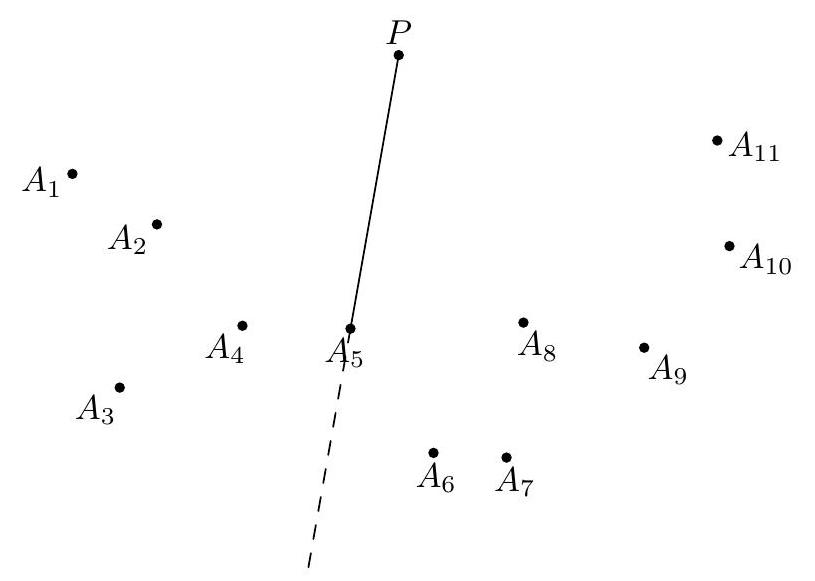
| Let $P$ be a point on the convex hull of $\mathcal{S}$, and label the other $2 n+1$ points $A_{1}, \ldots, A_{2 n+1}$ in order of angle from $P$. |
|
|
| Consider drawing a segment $\overline{P A_{2 k+1}}$. This splits the $2 n$ remaining points into two halves $\mathcal{U}$ and $\mathcal{V}$, with $2 k$ and $2(n-k)$ points respectively. |
|  |
| |
| Note that by choice of $P$, no segment in $\mathcal{U}$ can intersect a segment in $\mathcal{V}$. By the inductive hypothesis, |
| |
| $$ |
| \chi(\mathcal{U}) \geq C_{k} \quad \text { and } \quad \chi(\mathcal{V}) \geq C_{n-k} |
| $$ |
| |
| Thus, drawing $\overline{P A_{2 k+1}}$, we have at least $C_{k} C_{n-k}$ ways to complete the drawing. Over all choices of $k$, we obtain |
|
|
| $$ |
| \chi(\mathcal{S}) \geq C_{0} C_{n}+\cdots+C_{n} C_{0}=C_{n+1} |
| $$ |
| |
| as desired. |
| Remark. It is possible to show directly from the lower bound proof that convex $2 n$-gons achieve the minimum: indeed, every inequality is sharp, and no segment $\overline{P A_{2 k}}$ can be drawn (since this splits the rest of the points into two halves with an odd number of points, and no crossing segment can be drawn). |
|
|
| Bobby Shen points out that in the case of 6 points, a regular pentagon with its center also achieves equality, so this is not the only equality case. |
|
|
| Remark. The result that $\chi(S) \geq 1$ for all $S$ is known (consider the choice of 8 segments with smallest sum), and appeared on Putnam 1979. However, it does not seem that knowing this gives an advantage for this problem, since the answer is much larger than 1. |
|
|
| ## §3.3 TSTST 2019/9, proposed by Ankan Bhattacharya |
|
|
| Available online at https://aops.com/community/p12608472. |
|
|
| ## Problem statement |
|
|
| Let $A B C$ be a triangle with incenter $I$. Points $K$ and $L$ are chosen on segment $B C$ such that the incircles of $\triangle A B K$ and $\triangle A B L$ are tangent at $P$, and the incircles of $\triangle A C K$ and $\triangle A C L$ are tangent at $Q$. Prove that $I P=I Q$. |
|
|
| We present two solutions. |
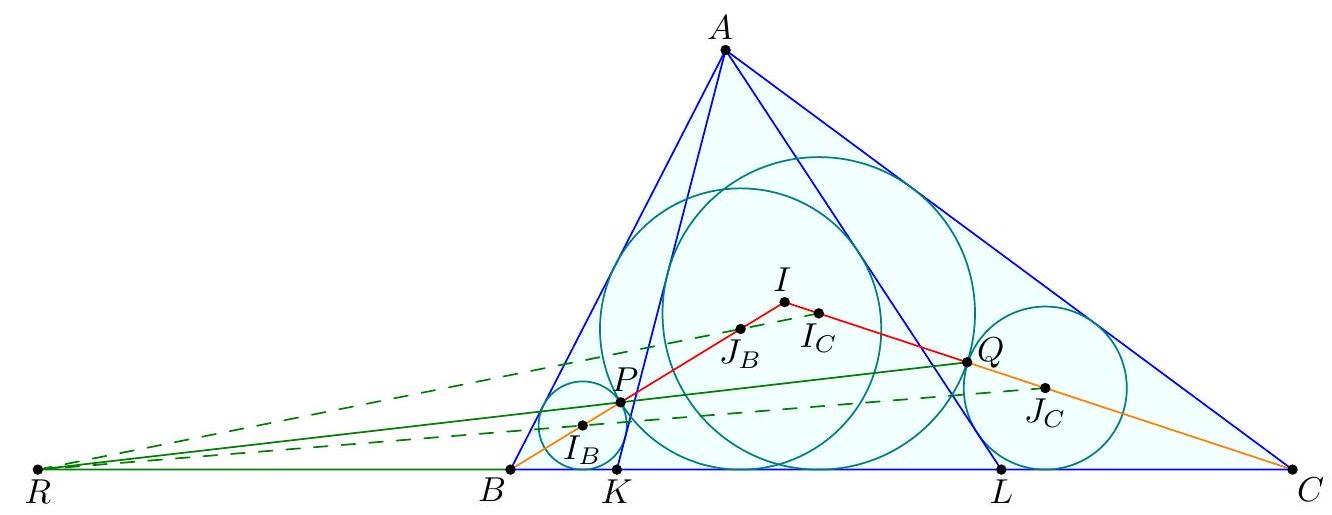
| 【 First solution, mostly elementary (original). Let $I_{B}, J_{B}, I_{C}, J_{C}$ be the incenters of $\triangle A B K, \triangle A B L, \triangle A C K, \triangle A C L$ respectively. |
|  |
|
|
| We begin with the following claim which does not depend on the existence of tangency points $P$ and $Q$. |
|
|
| Claim - Lines $B C, I_{B} J_{C}, J_{B} I_{C}$ meet at a point $R$ (possibly at infinity). |
|
|
| Proof. By rotating by $\frac{1}{2} \angle A$ we have the equality |
|
|
| $$ |
| A\left(B I ; I_{B} J_{B}\right)=A\left(I C ; I_{C} J_{C}\right) . |
| $$ |
|
|
| It follows $\left(B I ; I_{B} J_{B}\right)=\left(I C ; I_{C} J_{C}\right)=\left(C I ; J_{C} I_{C}\right)$. (One could also check directly that both cross ratios equal $\frac{\sin \angle B A K / 2}{\sin \angle C A K / 2} \div \frac{\sin \angle B A L / 2}{\sin \angle C A L / 2}$, rather than using rotation.) |
|
|
| Therefore, the concurrence follows from the so-called prism lemma on $\overline{I B I_{B} J_{B}}$ and $\overline{I C J_{C} I_{C}}$. |
|
|
| Remark (Nikolai Beluhov). This result is known; it appears as 4.5.32 in Akopyan's Geometry in Figures. The cross ratio is not necessary to prove this claim: it can be proven by length chasing with circumscribed quadrilaterals. (The generalization mentioned later also admits a trig-free proof for the analogous step.) |
|
|
| We now bring $P$ and $Q$ into the problem. |
| Claim - Line $P Q$ also passes through $R$. |
|
|
| Proof. Note $\left(B P ; I_{B} J_{B}\right)=-1=\left(C Q ; J_{C} I_{C}\right)$, so the conclusion again follows by prism lemma. |
|
|
| We are now ready to complete the proof. Point $R$ is the exsimilicenter of the incircles of $\triangle A B K$ and $\triangle A C L$, so $\frac{P I_{B}}{R I_{B}}=\frac{Q J_{C}}{R J_{C}}$. Now by Menelaus, |
|
|
| $$ |
| \frac{I_{B} P}{P I} \cdot \frac{I Q}{Q J_{C}} \cdot \frac{J_{C} R}{R I_{B}}=-1 \Longrightarrow I P=I Q |
| $$ |
|
|
| Remark (Author's comments on drawing the diagram). Drawing the diagram directly is quite difficult. If one draws $\triangle A B C$ first, they must locate both $K$ and $L$, which likely involves some trial and error due to the complex interplay between the two points. |
|
|
| There are alternative simpler ways. For example, one may draw $\triangle A K L$ first; then the remaining points $B$ and $C$ are not related and the task is much simpler (though some trial and error is still required). |
|
|
| In fact, by breaking symmetry, we may only require one application of guesswork. Start by drawing $\triangle A B K$ and its incircle; then the incircle of $\triangle A B L$ may be constructed, and so point $L$ may be drawn. Thus only the location of point $C$ needs to be guessed. I would be interested in a method to create a general diagram without any trial and error. |
|
|
| 【 Second solution, inversion (Nikolai Beluhov). As above, the lines $B C, I_{B} J_{C}, J_{B} I_{C}$ meet at some point $R$ (possibly at infinity). Let $\omega_{1}, \omega_{2}, \omega_{3}, \omega_{4}$ be the incircles of $\triangle A B K$, $\triangle A C L, \triangle A B L$, and $\triangle A C K$. |
|
|
| Claim - There exists an inversion $\iota$ at $R$ swapping $\left\{\omega_{1}, \omega_{2}\right\}$ and $\left\{\omega_{3}, \omega_{4}\right\}$. |
|
|
| Proof. Consider the inversion at $R$ swapping $\omega_{1}$ and $\omega_{2}$. Since $\omega_{1}$ and $\omega_{3}$ are tangent, the image of $\omega_{3}$ is tangent to $\omega_{2}$ and is also tangent to $B C$. The circle $\omega_{4}$ is on the correct side of $\omega_{3}$ to be this image. |
|
|
| Claim - Circles $\omega_{1}, \omega_{2}, \omega_{3}, \omega_{4}$ share a common radical center. |
|
|
| Proof. Let $\Omega$ be the circle with center $R$ fixed under $\iota$, and let $k$ be the circle through $P$ centered at the radical center of $\Omega, \omega_{1}, \omega_{3}$. |
|
|
| Then $k$ is actually orthogonal to $\Omega, \omega_{1}, \omega_{3}$, so $k$ is fixed under $\iota$ and $k$ is also orthogonal to $\omega_{2}$ and $\omega_{4}$. Thus the center of $k$ is the desired radical center. |
|
|
| The desired statement immediately follows. Indeed, letting $S$ be the radical center, it follows that $\overline{S P}$ and $\overline{S Q}$ are the common internal tangents to $\left\{\omega_{1}, \omega_{3}\right\}$ and $\left\{\omega_{2}, \omega_{4}\right\}$. |
|
|
| Since $S$ is the radical center, $S P=S Q$. In light of $\angle S P I=\angle S Q I=90^{\circ}$, it follows that $I P=I Q$, as desired. |
|
|
| Remark (Nikolai Beluhov). There exists a circle tangent to all four incircles, because circle $k$ is orthogonal to all four, and line $B C$ is tangent to all four; thus the inverse of line $B C$ in $k$ is a circle tangent to all four incircles. |
|
|
| The amusing thing here is that Casey's theorem is completely unhelpful for proving this fact: all it can tell us is that there is a line or circle tangent to these incircles, and line $B C$ already satisfies this property. |
|
|
| Remark (Generalization by Nikolai Beluhov). The following generalization holds: |
| Let $A B C D$ be a quadrilateral circumscribed about a circle with center $I$. A line through $A$ meets $\overrightarrow{B C}$ and $\overrightarrow{D C}$ at $K$ and $L$; another line through $A$ meets $\overrightarrow{B C}$ and $\overrightarrow{D C}$ at $M$ and $N$. Suppose that the incircles of $\triangle A B K$ and $\triangle A B M$ are tangent at $P$, and the incircles of $\triangle A C L$ and $\triangle A C N$ are tangent at $Q$. Prove that $I P=I Q$. |
|
|
| The first approach can be modified to the generalization. There is an extra initial step required: by Monge, the exsimilicenter of the incircles of $\triangle A B K$ and $\triangle A D N$ lies on line $B D$; likewise for the incircles of $\triangle A B L$ and $\triangle A D M$. Now one may prove using the same trig approach that these pairs of incircles have a common exsimilicenter, and the rest of the solution plays out similarly. The second approach can also be modified in the same way, once we obtain that a common exsimilicenter exists. (Thus in the generalization, it seems we also get there exists a circle tangent to all four incircles.) |
|
|
|
|


