| # The $6^{\text {th }}$ Romanian Master of Mathematics Competition |
|
|
| ## Solutions for the Day 2 |
|
|
| Problem 4. Let $P$ and $P^{\prime}$ be two convex quadrilateral regions in the plane (regions contain their boundary). Let them intersect, with $O$ a point in the intersection. Suppose that for every line $\ell$ through $O$ the segment $\ell \cap P$ is strictly longer than the segment $\ell \cap P^{\prime}$. Is it possible that the ratio of the area of $P^{\prime}$ to the area of $P$ is greater than 1.9? |
| (Bulgaria) Nikolai Beluhov |
| Solution. The answer is in the affirmative: Given a positive $\epsilon<2$, the ratio in question may indeed be greater than $2-\epsilon$. |
|
|
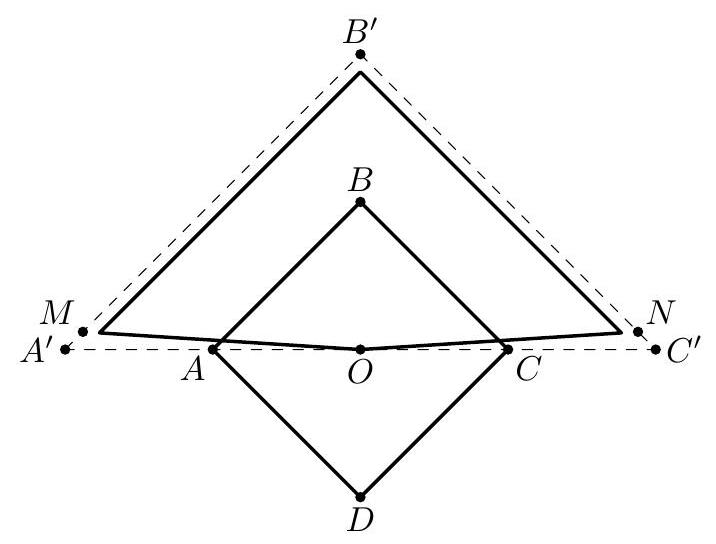
| To show this, consider a square $A B C D$ centred at $O$, and let $A^{\prime}, B^{\prime}$, and $C^{\prime}$ be the reflections of $O$ in $A, B$, and $C$, respectively. Notice that, if $\ell$ is a line through $O$, then the segments $\ell \cap A B C D$ and $\ell \cap A^{\prime} B^{\prime} C^{\prime}$ have equal lengths, unless $\ell$ is the line $A C$. |
|
|
| Next, consider the points $M$ and $N$ on the segments $B^{\prime} A^{\prime}$ and $B^{\prime} C^{\prime}$, respectively, such that $B^{\prime} M / B^{\prime} A^{\prime}=B^{\prime} N / B^{\prime} C^{\prime}=(1-\epsilon / 4)^{1 / 2}$. Finally, let $P^{\prime}$ be the image of the convex quadrangle $B^{\prime} M O N$ under the homothety of ratio $(1-\epsilon / 4)^{1 / 4}$ centred at $O$. Clearly, the quadrangles $P \equiv A B C D$ and $P^{\prime}$ satisfy the conditions in the statement, and the ratio of the area of $P^{\prime}$ to the area of $P$ is exactly $2-\epsilon / 2$. |
|  |
|
|
| Remarks. (1) With some care, one may also construct such example with a point $O$ being interior for both $P$ and $P^{\prime}$. In our example, it is enough to replace vertex $O$ of $P^{\prime}$ by a point on the segment $O D$ close enough to $O$. The details are left to the reader. |
| (2) On the other hand, one may show that the ratio of areas of $P^{\prime}$ and $P$ cannot exceed 2 (even if $P$ and $P^{\prime}$ are arbitrary convex polygons rather than quadrilaterals). Further on, we denote by $[S]$ the area of $S$. |
|
|
| In order to see that $\left[P^{\prime}\right]<2[P]$, let us fix some ray $r$ from $O$, and let $r_{\alpha}$ be the ray from $O$ making an (oriented) angle $\alpha$ with $r$. Denote by $X_{\alpha}$ and $Y_{\alpha}$ the points of $P$ and $P^{\prime}$, respectively, lying on $r_{\alpha}$ farthest from $O$, and denote by $f(\alpha)$ and $g(\alpha)$ the lengths of the segments $O X_{\alpha}$ and $O Y_{\alpha}$, respectively. Then |
|
|
| $$ |
| [P]=\frac{1}{2} \int_{0}^{2 \pi} f^{2}(\alpha) d \alpha=\frac{1}{2} \int_{0}^{\pi}\left(f^{2}(\alpha)+f^{2}(\pi+\alpha)\right) d \alpha |
| $$ |
|
|
| and similarly |
|
|
| $$ |
| \left[P^{\prime}\right]=\frac{1}{2} \int_{0}^{\pi}\left(g^{2}(\alpha)+g^{2}(\pi+\alpha)\right) d \alpha |
| $$ |
| |
| But $X_{\alpha} X_{\pi+\alpha}>Y_{\alpha} Y_{\pi+\alpha}$ yields $2 \cdot \frac{1}{2}\left(f^{2}(\alpha)+f^{2}(\pi+\alpha)\right)=O X_{\alpha}^{2}+O X_{\pi+\alpha}^{2} \geq \frac{1}{2} X_{\alpha} X_{\pi+\alpha}^{2}>$ $\frac{1}{2} Y_{\alpha} Y_{\pi+\alpha}^{2} \geq \frac{1}{2}\left(O Y_{\alpha}^{2}+O Y_{\pi+\alpha}^{2}\right)=\frac{1}{2}\left(g^{2}(\alpha)+g^{2}(\pi+\alpha)\right)$. Integration then gives us $2[P]>\left[P^{\prime}\right]$, as needed. |
| |
| This can also be proved via elementary methods. Actually, we will establish the following more general fact. |
| |
| Fact. Let $P=A_{1} A_{2} A_{3} A_{4}$ and $P^{\prime}=B_{1} B_{2} B_{3} B_{4}$ be two convex quadrangles in the plane, and let $O$ be one of their common points different from the vertices of $P^{\prime}$. Denote by $\ell_{i}$ the line $O B_{i}$, and assume that for every $i=1,2,3,4$ the length of segment $\ell_{i} \cap P$ is greater than the length of segment $\ell_{i} \cap P^{\prime}$. Then $\left[P^{\prime}\right]<2[P]$. |
| Proof. One of (possibly degenerate) quadrilaterals $O B_{1} B_{2} B_{3}$ and $O B_{1} B_{4} B_{3}$ is convex; the same holds for $O B_{2} B_{3} B_{4}$ and $O B_{2} B_{1} B_{4}$. Without loss of generality, we may (and will) assume that the quadrilaterals $O B_{1} B_{2} B_{3}$ and $O B_{2} B_{3} B_{4}$ are convex. |
| |
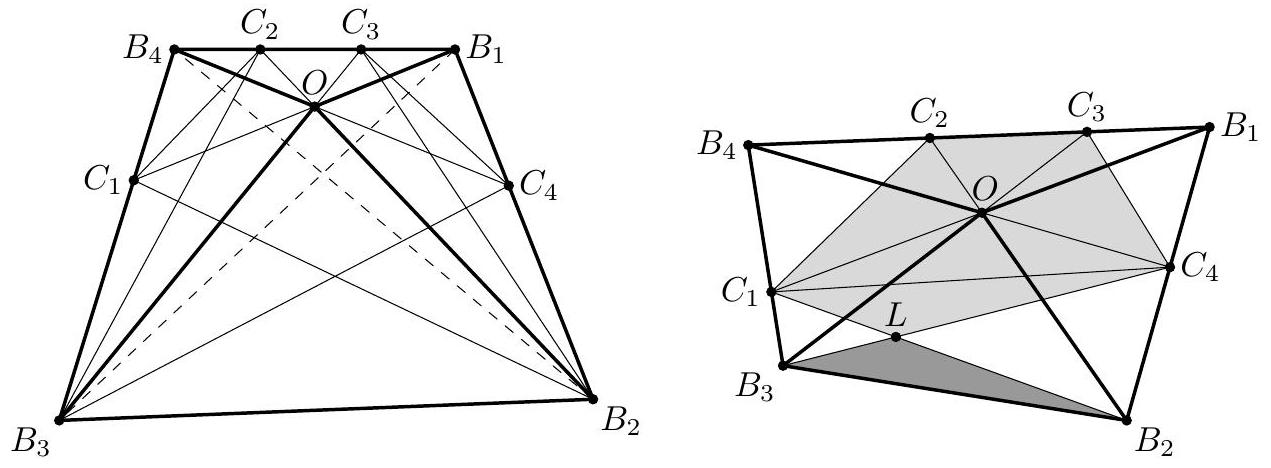
| Denote by $C_{i}$ such a point that $\ell_{i} \cap P^{\prime}$ is the segment $B_{i} C_{i}$; let $a_{i}$ be the length of $\ell_{i} \cap P$, and let $\alpha_{i}$ be the angle between $\ell_{i}$ and $\ell_{i+1}$ (hereafter, we use the cyclic notation, thus $\ell_{5}=\ell_{1}$ and so on). Thus $C_{2}$ and $C_{3}$ belong to the segment $B_{1} B_{4}, C_{1}$ lies on $B_{3} B_{4}$, and $C_{4}$ lies on $B_{1} B_{2}$. Assume that there exists an index $i$ such that the area of $B_{i} B_{i+1} C_{i} C_{i+1}$ is at least $\left[P^{\prime}\right] / 2$; then we have |
|
|
| $$ |
| \frac{\left[P^{\prime}\right]}{2} \leq\left[B_{i} B_{i+1} C_{i} C_{i+1}\right]=\frac{B_{i} C_{i} \cdot B_{i+1} C_{i+1} \cdot \sin \alpha_{i}}{2}<\frac{a_{i} a_{i+1} \sin \alpha_{i}}{2} \leq[P] |
| $$ |
|
|
| as desired. Assume, to the contrary, that such index does not exist. Two cases are possible. |
|  |
|
|
| Case 1. Assume that the rays $B_{1} B_{2}$ and $B_{4} B_{3}$ do not intersect (see the left figure above). This means, in particular, that $d\left(B_{1}, B_{3} B_{4}\right) \leq d\left(B_{2}, B_{3} B_{4}\right)$. |
|
|
| Since the ray $B_{3} O$ lies in the angle $B_{1} B_{3} B_{4}$, we obtain $d\left(B_{1}, B_{3} C_{3}\right) \leq d\left(C_{4}, B_{3} C_{3}\right)$; hence $\left[B_{3} B_{4} B_{1}\right] \leq\left[B_{3} B_{4} C_{3} C_{4}\right]<\left[P^{\prime}\right] / 2$. Similarly, $\left[B_{1} B_{2} B_{4}\right] \leq\left[B_{1} B_{2} C_{1} C_{2}\right]<\left[P^{\prime}\right] / 2$. Thus, |
|
|
| $$ |
| \begin{aligned} |
| {\left[B_{2} B_{3} C_{2} C_{3}\right] } & =\left[P^{\prime}\right]-\left[B_{1} B_{2} C_{3}\right]-\left[B_{3} B_{4} C_{2}\right]=\left[P^{\prime}\right]-\frac{B_{1} C_{3}}{B_{1} B_{4}} \cdot\left[B_{1} B_{2} B_{4}\right]-\frac{B_{4} C_{2}}{B_{1} B_{4}} \cdot\left[B_{3} B_{4} B_{1}\right] \\ |
| & >\left[P^{\prime}\right]\left(1-\frac{B_{1} C_{3}+B_{4} C_{2}}{2 B_{1} B_{4}}\right) \geq \frac{\left[P^{\prime}\right]}{2} . |
| \end{aligned} |
| $$ |
|
|
| A contradiction. |
| Case 2. Assume now that the rays $B_{1} B_{2}$ and $B_{4} B_{3}$ intersect at some point (see the right figure above). Denote by $L$ the common point of $B_{2} C_{1}$ and $B_{3} C_{4}$. We have $\left[B_{2} C_{4} C_{1}\right] \geq\left[B_{2} C_{4} B_{3}\right]$, hence $\left[C_{1} C_{4} L\right] \geq\left[B_{2} B_{3} L\right]$. Thus we have |
|
|
| $$ |
| \begin{aligned} |
| {\left[P^{\prime}\right]>\left[B_{1} B_{2} C_{1} C_{2}\right]+\left[B_{3} B_{4} C_{3} C_{4}\right] } & =\left[P^{\prime}\right]+\left[L C_{1} C_{2} C_{3} C_{4}\right]-\left[B_{2} B_{3} L\right] \\ |
| & \geq\left[P^{\prime}\right]+\left[C_{1} C_{4} L\right]-\left[B_{2} B_{3} L\right] \geq\left[P^{\prime}\right] . |
| \end{aligned} |
| $$ |
|
|
| A final contradiction. |
|
|
| Problem 5. Given an integer $k \geq 2$, set $a_{1}=1$ and, for every integer $n \geq 2$, let $a_{n}$ be the smallest $x>a_{n-1}$ such that: |
| |
| $$ |
| x=1+\sum_{i=1}^{n-1}\left\lfloor\sqrt[k]{\frac{x}{a_{i}}}\right\rfloor . |
| $$ |
| |
| Prove that every prime occurs in the sequence $a_{1}, a_{2}, \ldots$. |
| (Bulgaria) Alexander Ivanov |
| Solution 1. We prove that the $a_{n}$ are precisely the $k$ th-power-free positive integers, that is, those divisible by the $k$ th power of no prime. The conclusion then follows. |
|
|
| Let $B$ denote the set of all $k$ th-power-free positive integers. We first show that, given a positive integer $c$, |
|
|
| $$ |
| \sum_{b \in B, b \leq c}\left\lfloor\sqrt[k]{\frac{c}{b}}\right\rfloor=c |
| $$ |
| |
| To this end, notice that every positive integer has a unique representation as a product of an element in $B$ and a $k$ th power. Consequently, the set of all positive integers less than or equal to $c$ splits into |
| |
| $$ |
| C_{b}=\left\{x: x \in \mathbb{Z}_{>0}, x \leq c, \text { and } x / b \text { is a } k \text { th power }\right\}, \quad b \in B, b \leq c . |
| $$ |
| |
| Clearly, $\left|C_{b}\right|=\lfloor\sqrt[k]{c / b}\rfloor$, whence the desired equality. |
| Finally, enumerate $B$ according to the natural order: $1=b_{1}<b_{2}<\cdots<b_{n}<\cdots$. We prove by induction on $n$ that $a_{n}=b_{n}$. Clearly, $a_{1}=b_{1}=1$, so let $n \geq 2$ and assume $a_{m}=b_{m}$ for all indices $m<n$. Since $b_{n}>b_{n-1}=a_{n-1}$ and |
| |
| $$ |
| b_{n}=\sum_{i=1}^{n}\left\lfloor\sqrt[k]{\frac{b_{n}}{b_{i}}}\right\rfloor=\sum_{i=1}^{n-1}\left\lfloor\sqrt[k]{\frac{b_{n}}{b_{i}}}\right\rfloor+1=\sum_{i=1}^{n-1}\left\lfloor\sqrt[k]{\frac{b_{n}}{a_{i}}}\right\rfloor+1 |
| $$ |
| |
| the definition of $a_{n}$ forces $a_{n} \leq b_{n}$. Were $a_{n}<b_{n}$, a contradiction would follow: |
| |
| $$ |
| a_{n}=\sum_{i=1}^{n-1}\left\lfloor\sqrt[k]{\frac{a_{n}}{b_{i}}}\right\rfloor=\sum_{i=1}^{n-1}\left\lfloor\sqrt[k]{\frac{a_{n}}{a_{i}}}\right\rfloor=a_{n}-1 |
| $$ |
| |
| Consequently, $a_{n}=b_{n}$. This completes the proof. |
| Solution 2. (Ilya Bogdanov) For every $n=1,2,3, \ldots$, introduce the function |
| |
| $$ |
| f_{n}(x)=x-1-\sum_{i=1}^{n-1}\left\lfloor\sqrt[k]{\frac{x}{a_{i}}}\right\rfloor |
| $$ |
| |
| Denote also by $g_{n}(x)$ the number of the indices $i \leq n$ such that $x / a_{i}$ is the $k$ th power of an integer. Then $f_{n}(x+1)-f_{n}(x)=1-g_{n}(x)$ for every integer $x \geq a_{n}$; hence $f_{n}(x)+1 \geq f_{n}(x+1)$. Moreover, $f_{n}\left(a_{n-1}\right)=-1$ (since $f_{n-1}\left(a_{n-1}\right)=0$ ). Now a straightforward induction shows that $f_{n}(x)<0$ for all integers $x \in\left[a_{n-1}, a_{n}\right)$. |
| |
| Next, if $g_{n}(x)>0$ then $f_{n}(x) \leq f_{n}(x-1)$; this means that such an $x$ cannot equal $a_{n}$. Thus $a_{j} / a_{i}$ is never the $k$ th power of an integer if $j>i$. |
|
|
| Now we are prepared to prove by induction on $n$ that $a_{1}, a_{2}, \ldots, a_{n}$ are exactly all $k$ th-power-free integers in $\left[1, a_{n}\right]$. The base case $n=1$ is trivial. |
|
|
| Assume that all the $k$ th-power-free integers on $\left[1, a_{n}\right]$ are exactly $a_{1}, \ldots, a_{n}$. Let $b$ be the least integer larger than $a_{n}$ such that $g_{n}(b)=0$. We claim that: (1) $b=a_{n+1}$; and (2) $b$ is the least $k$ th-power-free number greater than $a_{n}$. |
| |
| To prove (1), notice first that all the numbers of the form $a_{j} / a_{i}$ with $1 \leq i<j \leq n$ are not $k$ th powers of rational numbers since $a_{i}$ and $a_{j}$ are $k$ th-power-free. This means that for every integer $x \in\left(a_{n}, b\right)$ there exists exactly one index $i \leq n$ such that $x / a_{i}$ is the $k$ th power of an integer (certainly, $x$ is not $k$ th-power-free). Hence $f_{n+1}(x)=f_{n+1}(x-1)$ for each such $x$, so $f_{n+1}(b-1)=f_{n+1}\left(a_{n}\right)=-1$. Next, since $b / a_{i}$ is not the $k$ th power of an integer, we have $f_{n+1}(b)=f_{n+1}(b-1)+1=0$, thus $b=a_{n+1}$. This establishes (1). |
| |
| Finally, since all integers in $\left(a_{n}, b\right)$ are not $k$ th-power-free, we are left to prove that $b$ is $k$ th-power-free to establish (2). Otherwise, let $y>1$ be the greatest integer such that $y^{k} \mid b$; then $b / y^{k}$ is $k$ th-power-free and hence $b / y^{k}=a_{i}$ for some $i \leq n$. So $b / a_{i}$ is the $k$ th power of an integer, which contradicts the definition of $b$. |
| |
| Thus $a_{1}, a_{2}, \ldots$ are exactly all $k$ th-power-free positive integers; consequently all primes are contained in this sequence. |
| |
| Problem 6. $2 n$ distinct tokens are placed at the vertices of a regular $2 n$-gon, with one token placed at each vertex. A move consists of choosing an edge of the $2 n$-gon and interchanging the two tokens at the endpoints of that edge. Suppose that after a finite number of moves, every pair of tokens have been interchanged exactly once. Prove that some edge has never been chosen. |
| (Russia) Alexander Gribalko |
| Solution. Step 1. Enumerate all the tokens in the initial arrangement in clockwise circular order; also enumerate the vertices of the $2 n$-gon accordingly. Consider any three tokens $i<j<k$. At each moment, their cyclic order may be either $i, j, k$ or $i, k, j$, counted clockwise. This order changes exactly when two of these three tokens have been switched. Hence the order has been reversed thrice, and in the final arrangement token $k$ stands on the arc passing clockwise from token $i$ to token $j$. Thus, at the end, token $i+1$ is a counter-clockwise neighbor of token $i$ for all $i=1,2, \ldots, 2 n-1$, so the tokens in the final arrangement are numbered successively in counter-clockwise circular order. |
| |
| This means that the final arrangement of tokens can be obtained from the initial one by reflection in some line $\ell$. |
| |
| Step 2. Notice that each token was involved into $2 n-1$ switchings, so its initial and final vertices have different parity. Hence $\ell$ passes through the midpoints of two opposite sides of a $2 n$-gon; we may assume that these are the sides $a$ and $b$ connecting $2 n$ with 1 and $n$ with $n+1$, respectively. |
| |
| During the process, each token $x$ has crossed $\ell$ at least once; thus one of its switchings has been made at edge $a$ or at edge $b$. Assume that some two its switchings were performed at $a$ and at $b$; we may (and will) assume that the one at $a$ was earlier, and $x \leq n$. Then the total movement of token $x$ consisted at least of: (i) moving from vertex $x$ to $a$ and crossing $\ell$ along $a$; (ii) moving from $a$ to $b$ and crossing $\ell$ along $b$; (iii) coming to vertex $2 n+1-x$. This tales at least $x+n+(n-x)=2 n$ switchings, which is impossible. |
| |
| Thus, each token had a switching at exactly one of the edges $a$ and $b$. |
| Step 3. Finally, let us show that either each token has been switched at $a$, or each token has been switched at $b$ (then the other edge has never been used, as desired). To the contrary, assume that there were switchings at both $a$ and at $b$. Consider the first such switchings, and let $x$ and $y$ be the tokens which were moved clockwise during these switchings and crossed $\ell$ at $a$ and $b$, respectively. By Step $2, x \neq y$. Then tokens $x$ and $y$ initially were on opposite sides of $\ell$. |
| |
| Now consider the switching of tokens $x$ and $y$; there was exactly one such switching, and we assume that it has been made on the same side of $\ell$ as vertex $y$. Then this switching has been made after token $x$ had traced $a$. From this point on, token $x$ is on the clockwise arc from token $y$ to $b$, and it has no way to leave out from this arc. But this is impossible, since token $y$ should trace $b$ after that moment. A contradiction. |
| |
| Remark. The same statement for $(2 n-1)$-gon is also valid. The problem is stated for a polygon with an even number of sides only to avoid case consideration. |
| |
| Let us outline the solution in the case of a $(2 n-1)$-gon. We prove the existence of line $\ell$ as in Step 1. This line passes through some vertex $x$, and through the midpoint of the opposite edge $a$. Then each token either passes through $x$, or crosses $\ell$ along $a$ (but not both; this can be shown as in Step 2). Finally, since a token is involved into an even number of moves, it passes through $x$ but not through $a$, and $a$ is never used. |
| |
| |