


The $7^{\text {th }}$ Romanian Master of Mathematics Competition
Solutions for the Day 2
Problem 4. Let $A B C$ be a triangle, let $D$ be the touchpoint of the side $B C$ and the incircle of the triangle $A B C$, and let $J_{b}$ and $J_{c}$ be the incentres of the triangles $A B D$ and $A C D$, respectively. Prove that the circumcentre of the triangle $A J_{b} J_{c}$ lies on the bisectrix of the angle $B A C$. (Russia) Fedor Ivlev Solution. Let the incircle of the triangle $A B C$ meet $C A$ and $A B$ at points $E$ and $F$, respectively. Let the incircles of the triangles $A B D$ and $A C D$ meet $A D$ at points $X$ and $Y$, respectively. Then $2 D X=D A+D B-A B=D A+D B-B F-A F=D A-A F$; similarly, $2 D Y=D A-A E=2 D X$. Hence the points $X$ and $Y$ coincide, so $J_{b} J_{c} \perp A D$.
Now let $O$ be the circumcentre of the triangle $A J_{b} J_{c}$. Then $\angle J_{b} A O=\pi / 2-\angle A O J_{b} / 2=$ $\pi / 2-\angle A J_{c} J_{b}=\angle X A J_{c}=\frac{1}{2} \angle D A C$. Therefore, $\angle B A O=\angle B A J_{b}+\angle J_{b} A O=\frac{1}{2} \angle B A D+$ $\frac{1}{2} \angle D A C=\frac{1}{2} \angle B A C$, and the conclusion follows.
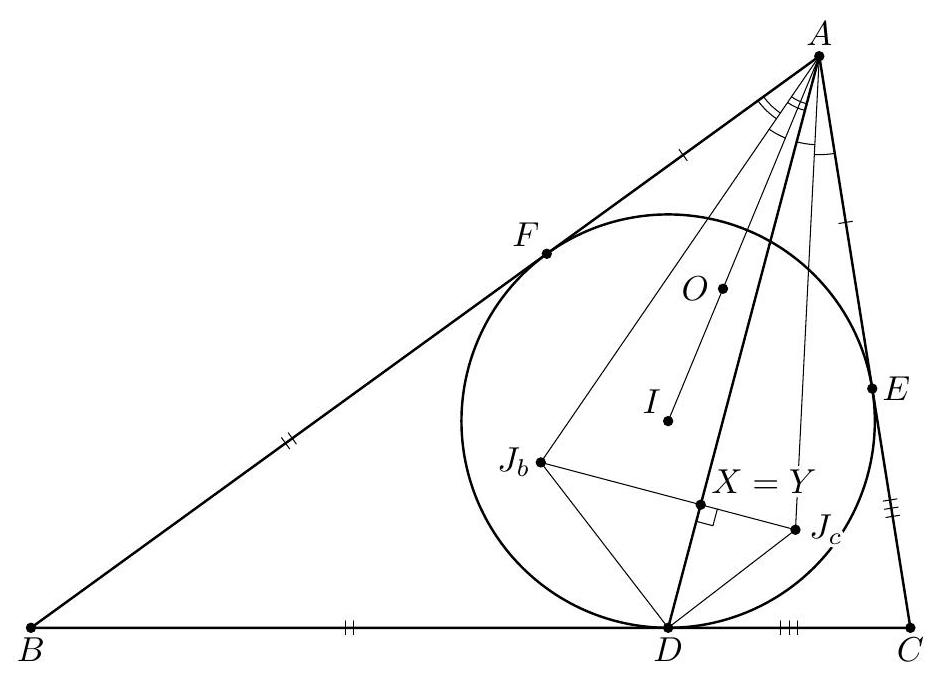
Fig. 1
Problem 5. Let $p \geq 5$ be a prime number. For a positive integer $k$ we denote by $R(k)$ the remainder of $k$ when divided by $p$. Determine all positive integers $a<p$ such that
for every $m=1,2, \ldots, p-1$. (Bulgaria) Alexander Ivanov Solution. The required integers are $p-1$ along with all the numbers of the form $\lfloor p / q\rfloor, q=$ $2, \ldots, p-1$. In other words, these are $p-1$, along with the numbers $1,2, \ldots,\lfloor\sqrt{p}\rfloor$, and also the (distinct) numbers $\lfloor p / q\rfloor, q=2, \ldots,\left\lfloor\sqrt{p}-\frac{1}{2}\right\rfloor$.
We begin by showing that these numbers satisfy the conditions in the statement. It is readily checked that $p-1$ satisfies the required inequalities, since $m+R(m(p-1))=m+(p-m)=$ $p>p-1$ for all $m=1, \ldots, p-1$.
Now, consider any number $a$ of the form $a=\lfloor p / q\rfloor$, where $q$ is an integer greater than 1 but less than $p$; then $p=a q+r$ with $0<r<q$. Choose any integer $m \in(0, p)$ and write $m=x q+y$ with $x, y \in \mathbb{Z}, 0<y \leq q$ (notice that $x$ is nonnegative). Then
Since $a y-x r \leq a y \leq a q<p$, we obtain $R(a y-x r) \geq a y-x r$ and hence
by $q>r$ and $y \geq 1$. Thus $a$ satisfies the required condition. Finally, we show that if an integer $a \in(0, p-1)$ satisfies the required condition then $a$ is indeed of the form $a=\lfloor p / q\rfloor$ for some integer $q \in(0, p)$. This is clear for $a=1$, so we may (and will) assume that $a \geq 2$.
Write $p=a q+r$ with $q, r \in \mathbb{Z}$ and $0<r<a$; since $a \geq 2$ we have $q<p / 2$. Choose $m=q+1<p$; we have $R(m a)=R(a q+a)=R(p+(a-r))=a-r$, so
which yields $r<q+1$. Moreover, if $r=q$, then $p=q(a+1)$ which is impossible by $1<a+1<p$. Thus $r<q$, and we have
which proves $a=\lfloor p / q\rfloor$.
Problem 6. Given a positive integer $n$, determine the largest real number $\mu$ satisfying the following condition: for every $4 n$-point configuration $C$ in an open unit square $U$, there exists an open rectangle in $U$, whose sides are parallel to those of $U$, which contains exactly one point of $C$, and has an area greater than or equal to $\mu$. (Bulgaria) Nikolai Beluhov Solution. The required maximum is $\frac{1}{2 n+2}$. To show that the condition in the statement is not met if $\mu>\frac{1}{2 n+2}$, let $U=(0,1) \times(0,1)$, choose a small enough positive $\epsilon$, and consider the configuration $C$ consisting of the $n$ four-element clusters of points $\left(\frac{i}{n+1} \pm \epsilon\right) \times\left(\frac{1}{2} \pm \epsilon\right), i=1, \ldots, n$, the four possible sign combinations being considered for each $i$. Clearly, every open rectangle in $U$, whose sides are parallel to those of $U$, which contains exactly one point of $C$, has area at $\operatorname{most}\left(\frac{1}{n+1}+\epsilon\right) \cdot\left(\frac{1}{2}+\epsilon\right)<\mu$ if $\epsilon$ is small enough.
We now show that, given a finite configuration $C$ of points in an open unit square $U$, there always exists an open rectangle in $U$, whose sides are parallel to those of $U$, which contains exactly one point of $C$, and has an area greater than or equal to $\mu_{0}=\frac{2}{|C|+4}$.
To prove this, usage will be made of the following two lemmas whose proofs are left at the end of the solution. Lemma 1. Let $k$ be a positive integer, and let $\lambda<\frac{1}{\lfloor k / 2\rfloor+1}$ be a positive real number. If $t_{1}, \ldots, t_{k}$ are pairwise distinct points in the open unit interval $(0,1)$, then some $t_{i}$ is isolated from the other $t_{j}$ by an open subinterval of $(0,1)$ whose length is greater than or equal to $\lambda$. Lemma 2. Given an integer $k \geq 2$ and positive integers $m_{1}, \ldots, m_{k}$,
Back to the problem, let $U=(0,1) \times(0,1)$, project $C$ orthogonally on the $x$-axis to obtain the points $x_{1}<\cdots<x_{k}$ in the open unit interval $(0,1)$, let $\ell_{i}$ be the vertical through $x_{i}$, and let $m_{i}=\left|C \cap \ell_{i}\right|, i=1, \ldots, k$.
Setting $x_{0}=0$ and $x_{k+1}=1$, assume that $x_{i+1}-x_{i-1}>\left(\left\lfloor m_{i} / 2\right\rfloor+1\right) \mu_{0}$ for some index $i$, and apply Lemma 1 to isolate one of the points in $C \cap \ell_{i}$ from the other ones by an open subinterval $x_{i} \times J$ of $x_{i} \times(0,1)$ whose length is greater than or equal to $\mu_{0} /\left(x_{i+1}-x_{i-1}\right)$. Consequently, $\left(x_{i-1}, x_{i+1}\right) \times J$ is an open rectangle in $U$, whose sides are parallel to those of $U$, which contains exactly one point of $C$ and has an area greater than or equal to $\mu_{0}$.
Next, we rule out the case $x_{i+1}-x_{i-1} \leq\left(\left\lfloor m_{i} / 2\right\rfloor+1\right) \mu_{0}$ for all indices $i$. If this were the case, notice that necessarily $k>1$; also, $x_{1}-x_{0}<x_{2}-x_{0} \leq\left(\left\lfloor m_{1} / 2\right\rfloor+1\right) \mu_{0}$ and $x_{k+1}-x_{k}<$ $x_{k+1}-x_{k-1} \leq\left(\left\lfloor m_{k} / 2\right\rfloor+1\right) \mu_{0}$. With reference to Lemma 2, write
and thereby reach a contradiction.
Finally, we prove the two lemmas. Proof of Lemma 1. Suppose, if possible, that no $t_{i}$ is isolated from the other $t_{j}$ by an open subinterval of $(0,1)$ whose length is greater than or equal to $\lambda$. Without loss of generality, we may (and will) assume that $0=t_{0}<t_{1}<\cdots<t_{k}<t_{k+1}=1$. Since the open interval $\left(t_{i-1}, t_{i+1}\right)$ isolates $t_{i}$ from the other $t_{j}$, its length, $t_{i+1}-t_{i-1}$, is less than $\lambda$. Consequently, if $k$ is odd we have $1=\sum_{i=0}^{(k-1) / 2}\left(t_{2 i+2}-t_{2 i}\right)<\lambda\left(1+\frac{k-1}{2}\right)<1$; if $k$ is even, we have $1<1+t_{k}-t_{k-1}=$ $\sum_{i=0}^{k / 2-1}\left(t_{2 i+2}-t_{2 i}\right)+\left(t_{k+1}-t_{k-1}\right)<\lambda\left(1+\frac{k}{2}\right)<1$. A contradiction in either case. Proof of Lemma 2. Let $I_{0}$, respectively $I_{1}$, be the set of all indices $i$ in the range $2, \ldots, k-1$ such that $m_{i}$ is even, respectively odd. Clearly, $I_{0}$ and $I_{1}$ form a partition of that range. Since $m_{i} \geq 2$ if $i$ is in $I_{0}$, and $m_{i} \geq 1$ if $i$ is in $I_{1}$ (recall that the $m_{i}$ are positive integers),
Therefore,
Remark. In case $4 n$ is replaced by a positive integer $k$ not divisible by 4 , we do not yet know the maximal $\mu$ satisfying the corresponding condition.