| # The $13^{\text {th }}$ Romanian Master of Mathematics Competition |
|
|
| Day 1 - Solutions |
|
|
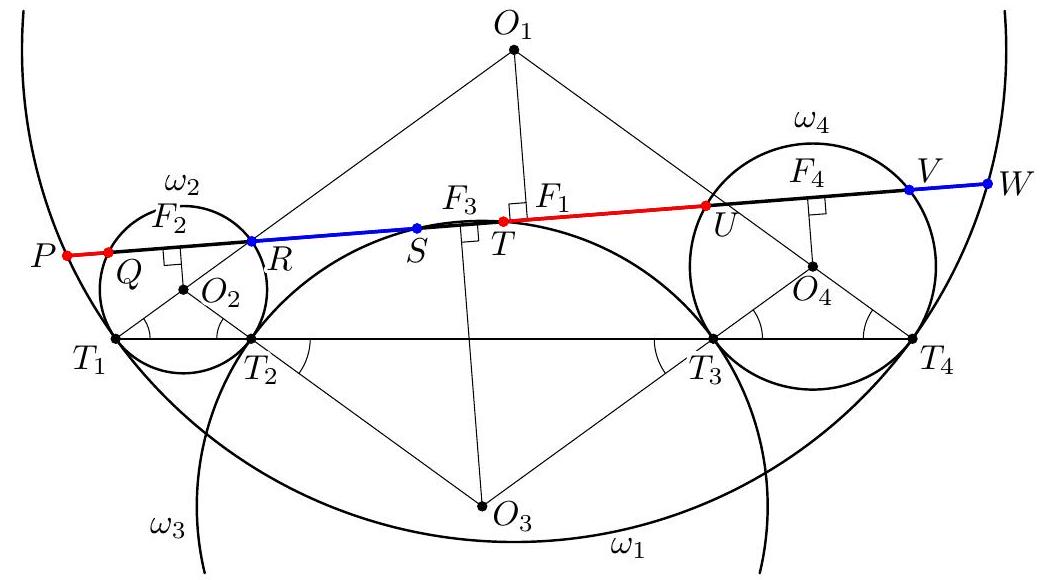
| Problem 1. Let $T_{1}, T_{2}, T_{3}, T_{4}$ be pairwise distinct collinear points such that $T_{2}$ lies between $T_{1}$ and $T_{3}$, and $T_{3}$ lies between $T_{2}$ and $T_{4}$. Let $\omega_{1}$ be a circle through $T_{1}$ and $T_{4}$; let $\omega_{2}$ be the circle through $T_{2}$ and internally tangent to $\omega_{1}$ at $T_{1}$; let $\omega_{3}$ be the circle through $T_{3}$ and externally tangent to $\omega_{2}$ at $T_{2}$; and let $\omega_{4}$ be the circle through $T_{4}$ and externally tangent to $\omega_{3}$ at $T_{3}$. A line crosses $\omega_{1}$ at $P$ and $W, \omega_{2}$ at $Q$ and $R, \omega_{3}$ at $S$ and $T$, and $\omega_{4}$ at $U$ and $V$, the order of these points along the line being $P, Q, R, S, T, U, V, W$. Prove that $P Q+T U=R S+V W$. |
| |
| Hungary, Geza Kos |
| |
| Solution. Let $O_{i}$ be the centre of $\omega_{i}, i=1,2,3,4$. Notice that the isosceles triangles $O_{i} T_{i} T_{i-1}$ are similar (indices are reduced modulo 4 ), to infer that $\omega_{4}$ is internally tangent to $\omega_{1}$ at $T_{4}$, and $O_{1} O_{2} O_{3} O_{4}$ is a (possibly degenerate) parallelogram. |
| |
| Let $F_{i}$ be the foot of the perpendicular from $O_{i}$ to $P W$. The $F_{i}$ clearly bisect the segments $P W, Q R, S T$ and $U V$, respectively. |
|
|
| The proof can now be concluded in two similar ways. |
|  |
|
|
| First Approach. Since $O_{1} O_{2} O_{3} O_{4}$ is a parallelogram, $\overrightarrow{F_{1} F_{2}}+\overrightarrow{F_{3} F_{4}}=\mathbf{0}$ and $\overrightarrow{F_{2} F_{3}}+\overrightarrow{F_{4} F_{1}}=\mathbf{0}$; this still holds in the degenerate case, for if the $O_{i}$ are collinear, then they all lie on the line $T_{1} T_{4}$, and each $O_{i}$ is the midpoint of the segment $T_{i} T_{i+1}$. Consequently, |
|
|
| $$ |
| \begin{aligned} |
| \overrightarrow{P Q}-\overrightarrow{R S}+\overrightarrow{T U}-\overrightarrow{V W}= & \left(\overrightarrow{P F_{1}}+\overrightarrow{F_{1} F_{2}}+\overrightarrow{F_{2} Q}\right)-\left(\overrightarrow{R F_{2}}+\overrightarrow{F_{2} F_{3}}+\overrightarrow{F_{3} S}\right) \\ |
| & +\left(\overrightarrow{T F_{3}}+\overrightarrow{F_{3} F_{4}}+\overrightarrow{F_{4} U}\right)-\left(\overrightarrow{V F_{4}}+\overrightarrow{F_{4} F_{1}}+\overrightarrow{F_{1} W}\right) \\ |
| = & \left(\overrightarrow{P F_{1}}-\overrightarrow{F_{1} W}\right)-\left(\overrightarrow{R F_{2}}-\overrightarrow{F_{2} Q}\right)+\left(\overrightarrow{T F_{3}}-\overrightarrow{F_{3} S}\right)-\left(\overrightarrow{V F_{4}}-\overrightarrow{F_{4} U}\right) \\ |
| & +\left(\overrightarrow{F_{1} F_{2}}+\overrightarrow{F_{3} F_{4}}\right)-\left(\overrightarrow{F_{2} F_{3}}+\overrightarrow{F_{4} F_{1}}\right)=\mathbf{0} |
| \end{aligned} |
| $$ |
|
|
| Alternatively, but equivalently, $\overrightarrow{P Q}+\overrightarrow{T U}=\overrightarrow{R S}+\overrightarrow{V W}$, as required. |
| Second Approach. This is merely another way of reading the previous argument. Fix an orientation of the line $P W$, say, from $P$ towards $W$, and use a lower case letter to denote the coordinate of a point labelled by the corresponding upper case letter. |
|
|
| Since the diagonals of a parallelogram bisect one another, $f_{1}+f_{3}=f_{2}+f_{4}$, the common value being twice the coordinate of the projection to $P W$ of the point where $O_{1} O_{3}$ and $O_{2} O_{4}$ cross; the relation clearly holds in the degenerate case as well. |
|
|
| Plug $f_{1}=\frac{1}{2}(p+w), f_{2}=\frac{1}{2}(q+r), f_{3}=\frac{1}{2}(s+t)$ and $f_{4}=\frac{1}{2}(u+v)$ into the above equality to get $p+w+s+t=q+r+u+v$. Alternatively, but equivalently, $(q-p)+(u-t)=(s-r)+(w-v)$, that is, $P Q+T U=R Q+V W$, as required. |
|
|
| Problem 2. Xenia and Sergey play the following game. Xenia thinks of a positive integer $N$ not exceeding 5000. Then she fixes 20 distinct positive integers $a_{1}, a_{2}, \ldots, a_{20}$ such that, for each $k=1,2, \ldots, 20$, the numbers $N$ and $a_{k}$ are congruent modulo $k$. By a move, Sergey tells Xenia a set $S$ of positive integers not exceeding 20, and she tells him back the set $\left\{a_{k}: k \in S\right\}$ without spelling out which number corresponds to which index. How many moves does Sergey need to determine for sure the number Xenia thought of? |
| |
| Russia, Sergey Kudrya |
| Solution. Sergey can determine Xenia's number in 2 but not fewer moves. |
| We first show that 2 moves are sufficient. Let Sergey provide the set $\{17,18\}$ on his first move, and the set $\{18,19\}$ on the second move. In Xenia's two responses, exactly one number occurs twice, namely, $a_{18}$. Thus, Sergey is able to identify $a_{17}, a_{18}$, and $a_{19}$, and thence the residue of $N$ modulo $17 \cdot 18 \cdot 19=5814>5000$, by the Chinese Remainder Theorem. This means that the given range contains a single number satisfying all congruences, and Sergey achieves his goal. |
| |
| To show that 1 move is not sufficient, let $M=\operatorname{lcm}(1,2, \ldots, 10)=2^{3} \cdot 3^{2} \cdot 5 \cdot 7=2520$. Notice that $M$ is divisible by the greatest common divisor of every pair of distinct positive integers not exceeding 20. Let Sergey provide the set $S=\left\{s_{1}, s_{2}, \ldots, s_{k}\right\}$. We show that there exist pairwise distinct positive integers $b_{1}, b_{2}, \ldots, b_{k}$ such that $1 \equiv b_{i}\left(\bmod s_{i}\right)$ and $M+1 \equiv b_{i-1}\left(\bmod s_{i}\right)$ (indices are reduced modulo $k$ ). Thus, if in response Xenia provides the set $\left\{b_{1}, b_{2}, \ldots, b_{k}\right\}$, then Sergey will be unable to distinguish 1 from $M+1$, as desired. |
|
|
| To this end, notice that, for each $i$, the numbers of the form $1+m s_{i}, m \in \mathbb{Z}$, cover all residues modulo $s_{i+1}$ which are congruent to $1(\equiv M+1)$ modulo $\operatorname{gcd}\left(s_{i}, s_{i+1}\right) \mid M$. Xenia can therefore choose a positive integer $b_{i}$ such that $b_{i} \equiv 1\left(\bmod s_{i}\right)$ and $b_{i} \equiv M+1\left(\bmod s_{i+1}\right)$. Clearly, such choices can be performed so as to make the $b_{i}$ pairwise distinct, as required. |
|
|
| Problem 3. A number of 17 workers stand in a row. Every contiguous group of at least 2 workers is a brigade. The chief wants to assign each brigade a leader (which is a member of the brigade) so that each worker's number of assignments is divisible by 4. Prove that the number of such ways to assign the leaders is divisible by 17 . |
|
|
| Russia, Mikhail Antipov |
|
|
| Solution. Assume that every single worker also forms a brigade (with a unique possible leader). In this modified setting, we are interested in the number $N$ of ways to assign leadership so that each worker's number of assignments is congruent to 1 modulo 4. |
|
|
| Consider the variables $x_{1}, x_{2}, \ldots, x_{17}$ corresponding to the workers. Assign each brigade (from the $i$-th through the $j$-th worker) the polynomial $f_{i j}=x_{i}+x_{i+1}+\cdots+x_{j}$, and form the product $f=\prod_{1 \leq i \leq j \leq 17} f_{i j}$. The number $N$ is the sum $\Sigma(f)$ of the coefficients of all monomials $x_{1}^{\alpha_{1}} x_{2}^{\alpha_{2}} \ldots x_{17}^{\alpha_{17}}$ in the expansion of $f$, where the $\alpha_{i}$ are all congruent to 1 modulo 4 . For any polynomial $P$, let $\Sigma(P)$ denote the corresponding sum. From now on, all polynomials are considered with coefficients in the finite field $\mathbb{F}_{17}$. |
| |
| Recall that for any positive integer $n$, and any integers $a_{1}, a_{2}, \ldots, a_{n}$, there exist indices $i \leq j$ such that $a_{i}+a_{i+1}+\cdots+a_{j}$ is divisible by $n$. Consequently, $f\left(a_{1}, a_{2}, \ldots, a_{17}\right)=0$ for all $a_{1}, a_{2}, \ldots, a_{17}$ in $\mathbb{F}_{17}$. |
|
|
| Now, if some monomial in the expansion of $f$ is divisible by $x_{i}^{17}$, replace that $x_{i}^{17}$ by $x_{i}$; this does not alter the above overall vanishing property (by Fermat's Little Theorem), and preserves $\Sigma(f)$. After several such changes, $f$ transforms into a polynomial $g$ whose degree in each variable does not exceed 16 , and $g\left(a_{1}, a_{2}, \ldots, a_{17}\right)=0$ for all $a_{1}, a_{2}, \ldots, a_{17}$ in $\mathbb{F}_{17}$. For such a polynomial, an easy induction on the number of variables shows that it is identically zero. Consequently, $\Sigma(g)=0$, so $\Sigma(f)=0$ as well, as desired. |
|
|
|
|


