| # TSTST 2014 Solution Notes |
|
|
| ## Lincoln, Nebraska |
|
|
| ## Evan Chen《陳誼廷》 |
|
|
| 15 April 2024 |
|
|
| This is a compilation of solutions for the 2014 TSTST. The ideas of the solution are a mix of my own work, the solutions provided by the competition organizers, and solutions found by the community. However, all the writing is maintained by me. |
|
|
| These notes will tend to be a bit more advanced and terse than the "official" solutions from the organizers. In particular, if a theorem or technique is not known to beginners but is still considered "standard", then I often prefer to use this theory anyways, rather than try to work around or conceal it. For example, in geometry problems I typically use directed angles without further comment, rather than awkwardly work around configuration issues. Similarly, sentences like "let $\mathbb{R}$ denote the set of real numbers" are typically omitted entirely. |
|
|
| Corrections and comments are welcome! |
|
|
| ## Contents |
|
|
| 0 Problems ..... 2 |
| 1 Solutions to Day 1 ..... 3 |
| 1.1 TSTST 2014/1 ..... 3 |
| 1.2 TSTST 2014/2 ..... 4 |
| 1.3 TSTST 2014/3 ..... 5 |
| 2 Solutions to Day 2 ..... 6 |
| 2.1 TSTST 2014/4 ..... 6 |
| 2.2 TSTST 2014/5 ..... 7 |
| 2.3 TSTST 2014/6 ..... 8 |
|
|
| ## §0 Problems |
|
|
| 1. Let $\leftarrow$ denote the left arrow key on a standard keyboard. If one opens a text editor and types the keys "ab $\leftarrow \mathrm{cd} \leftarrow \leftarrow \mathrm{e} \leftarrow \leftarrow \mathrm{f}$ ", the result is "faecdb". We say that a string $B$ is reachable from a string $A$ if it is possible to insert some amount of $\leftarrow$ 's in $A$, such that typing the resulting characters produces $B$. So, our example shows that "faecdb" is reachable from "abcdef". |
|
|
| Prove that for any two strings $A$ and $B, A$ is reachable from $B$ if and only if $B$ is reachable from $A$. |
| 2. Consider a convex pentagon circumscribed about a circle. We name the lines that connect vertices of the pentagon with the opposite points of tangency with the circle gergonnians. |
| (a) Prove that if four gergonnians are concurrent, then all five of them are concurrent. |
| (b) Prove that if there is a triple of gergonnians that are concurrent, then there is another triple of gergonnians that are concurrent. |
| 3. Find all polynomials $P(x)$ with real coefficients that satisfy |
|
|
| $$ |
| P(x \sqrt{2})=P\left(x+\sqrt{1-x^{2}}\right) |
| $$ |
|
|
| for all real numbers $x$ with $|x| \leq 1$. |
| 4. Let $P(x)$ and $Q(x)$ be arbitrary polynomials with real coefficients, with $P \neq 0$, and let $d=\operatorname{deg} P$. Prove that there exist polynomials $A(x)$ and $B(x)$, not both zero, such that $\max \{\operatorname{deg} A, \operatorname{deg} B\} \leq d / 2$ and $P(x) \mid A(x)+Q(x) \cdot B(x)$. |
| 5. Find the maximum number $E$ such that the following holds: there is an edge-colored graph with 60 vertices and $E$ edges, with each edge colored either red or blue, such that in that coloring, there is no monochromatic cycles of length 3 and no monochromatic cycles of length 5 . |
| 6. Suppose we have distinct positive integers $a, b, c, d$ and an odd prime $p$ not dividing any of them, and an integer $M$ such that if one considers the infinite sequence |
|
|
| $$ |
| \begin{gathered} |
| c a-d b \\ |
| c a^{2}-d b^{2} \\ |
| c a^{3}-d b^{3} \\ |
| c a^{4}-d b^{4} |
| \end{gathered} |
| $$ |
|
|
| and looks at the highest power of $p$ that divides each of them, these powers are not all zero, and are all at most $M$. Prove that there exists some $T$ (which may depend on $a, b, c, d, p, M)$ such that whenever $p$ divides an element of this sequence, the maximum power of $p$ that divides that element is exactly $p^{T}$. |
|
|
| ## §1 Solutions to Day 1 |
|
|
| ## §1.1 TSTST 2014/1 |
|
|
| Available online at https://aops.com/community/p3549404. |
|
|
| ## Problem statement |
|
|
| Let $\leftarrow$ denote the left arrow key on a standard keyboard. If one opens a text editor and types the keys "ab $\leftarrow \mathrm{cd} \leftarrow \leftarrow \mathrm{e} \leftarrow \leftarrow \mathrm{f}$ ", the result is "faecdb". We say that a string $B$ is reachable from a string $A$ if it is possible to insert some amount of $\leftarrow$ 's in $A$, such that typing the resulting characters produces $B$. So, our example shows that "faecdb" is reachable from "abcdef". |
|
|
| Prove that for any two strings $A$ and $B, A$ is reachable from $B$ if and only if $B$ is reachable from $A$. |
|
|
| Obviously $A$ and $B$ should have the same multiset of characters, and we focus only on that situation. |
|
|
| Claim - If $A=123 \ldots n$ and $B=\sigma(1) \sigma(2) \ldots \sigma(n)$ is a permutation of $A$, then $B$ is reachable if and only if it is $\mathbf{2 1 3}$-avoiding, i.e. there are no indices $i<j<k$ such that $\sigma(j)<\sigma(i)<\sigma(k)$. |
| |
| Proof. This is clearly necessary. To see its sufficient, one can just type $B$ inductively: after typing $k$, the only way to get stuck is if $k+1$ is to the right of $k$ and there is some character in the way; this gives a 213 pattern. |
| |
| Claim - A permutation $\sigma$ on $\{1, \ldots, n\}$ is 213 -avoiding if and only if the inverse $\sigma^{-1}$ is. |
| |
| Proof. Suppose $i<j<k$ and $\sigma(j)<\sigma(i)<\sigma(k)$. Let $i^{\prime}=\sigma(j), j^{\prime}=\sigma(i), k^{\prime}=\sigma(k)$; then $i^{\prime}<j^{\prime}<k^{\prime}$ and $\sigma^{-1}\left(j^{\prime}\right)<\sigma^{-1}\left(i^{\prime}\right)<\sigma^{-1}\left(k^{\prime}\right)$. |
| |
| This essentially finishes the problem. Suppose $B$ is reachable from $A$. By using the typing pattern, we get some permutation $\sigma:\{1, \ldots, n\}$ such that the $i$ th character of $A$ is the $\sigma(i)$ th character of $B$, and which is 213 -avoiding by the claim. (The permutation is unique if $A$ has all distinct characters, but there could be multiple if $A$ has repeated ones.) Then $\sigma^{-1}$ is 213 -avoiding too and gives us a way to change $B$ into $A$. |
| |
| ## §1.2 TSTST 2014/2 |
| |
| Available online at https://aops.com/community/p3549405. |
| |
| ## Problem statement |
| |
| Consider a convex pentagon circumscribed about a circle. We name the lines that connect vertices of the pentagon with the opposite points of tangency with the circle gergonnians. |
| (a) Prove that if four gergonnians are concurrent, then all five of them are concurrent. |
| (b) Prove that if there is a triple of gergonnians that are concurrent, then there is another triple of gergonnians that are concurrent. |
| |
| This problem is insta-killed by taking a homography sending the concurrency point (in either part) to the center of the circle while fixing the incircle. Alternatively, one may send any four of the tangency points to a rectangle. |
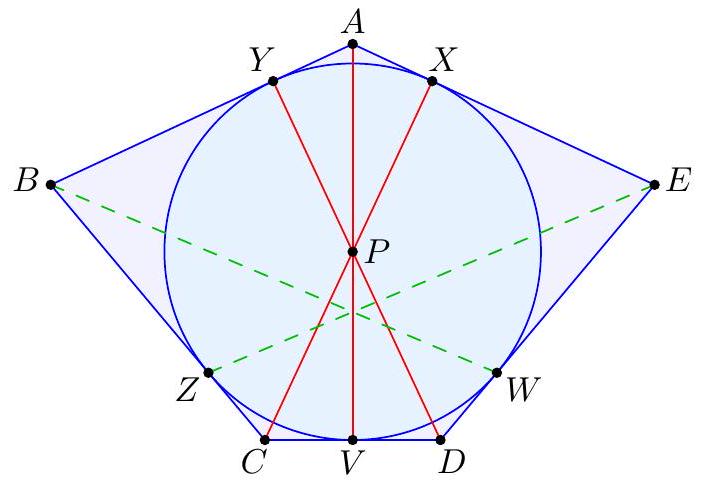
| Here are the details. Let $A B C D E$ be a pentagon with gergonnians $\overline{A V}, \overline{B W}, \overline{C X}$, $\overline{D Y}, \overline{E Z}$. We prove the following lemma, which (up to a suitable permutation of point names) solves both parts (a) and (b). |
| |
| ## Lemma |
| |
| The gergonnians $\overline{A V}, \overline{C X}, \overline{D Y}$ are concurrent if and only if the gergonnians $\overline{A V}$, $\overline{B W}, \overline{E Z}$ are concurrent. |
| |
| Proof. We prove the first set implies the second (the converse direction being identical). Suppose $\overline{A V}, \overline{C X}, \overline{D Y}$ intersect at $P$ and take a homography fixing the circle and moving $P$ to its center. |
|  |
| |
| Then $X$ and $Y$ are symmetric around $\overline{A P V}$ by hypothesis. Since $D=\overline{V V} \cap \overline{P Y}$, $C=\overline{V V} \cap \overline{P X}$, it follows that $C$ and $D$, and hence $Z$ and $W$, are also symmetric around $\overline{A P V}$. Consequently $B$ and $E$ are symmetric too. So $\overline{B W}$ and $\overline{E Z}$ meet on $\overline{A V}$. |
| |
| ## §1.3 TSTST 2014/3 |
| |
| Available online at https://aops.com/community/p3549407. |
| |
| ## Problem statement |
| |
| Find all polynomials $P(x)$ with real coefficients that satisfy |
| |
| $$ |
| P(x \sqrt{2})=P\left(x+\sqrt{1-x^{2}}\right) |
| $$ |
| |
| for all real numbers $x$ with $|x| \leq 1$. |
| |
| The answer is any polynomial of the form $P(x)=f(U(x / \sqrt{2}))$, where $f \in \mathbb{R}[x]$ and $U$ is the unique polynomial satisfying $U(\cos \theta)=\cos (8 \theta)$. |
| |
| Let $Q(x)=P(x \sqrt{2})$, then the condition reads |
| |
| $$ |
| Q(\cos \theta)=Q\left(\frac{1}{\sqrt{2}}(\cos \theta+\sin \theta)\right)=Q\left(\cos \left(\theta-45^{\circ}\right)\right) \quad \forall 0 \leq \theta \leq 180^{\circ} . |
| $$ |
| |
| We call a polynomial good if it satisfies this functional equation. |
| |
| ## Lemma |
| |
| The minimal (by degree) good nonconstant polynomial is $U$. |
| |
| Proof. Since $U$ works, it suffices to show that $\operatorname{deg} Q \geq 8$. Note that: |
| |
| $$ |
| \begin{aligned} |
| Q\left(\cos 136^{\circ}\right) & =Q\left(\cos 91^{\circ}\right)=Q\left(\cos 46^{\circ}\right)=Q\left(\cos 1^{\circ}\right)=Q\left(\cos -44^{\circ}\right) \\ |
| & =Q\left(\cos 44^{\circ}\right)=Q\left(\cos 89^{\circ}\right)=Q\left(\cos 134^{\circ}\right)=Q\left(\cos 179^{\circ}\right) |
| \end{aligned} |
| $$ |
| |
| Hence $Q$ is equal at eight distinct values (not nine since $\cos -44^{\circ}=\cos 44^{\circ}$ is repeated), so $\operatorname{deg} Q \geq 8$ (unless $Q$ is constant). |
| |
| Now, we claim $Q(x) \equiv f(U(x))$ for some $f \in \mathbb{R}[x]$. Indeed, if $Q$ is good, then by minimality the quotient $Q \bmod U$ must be constant, so $Q(x)=\widetilde{Q}(x) \cdot U(x)+c$ for some constant $c$, but then $\widetilde{Q}(x)$ is good too and we finish iteratively. |
| |
| ## §2 Solutions to Day 2 |
| |
| ## §2.1 TSTST 2014/4 |
| |
| Available online at https://aops.com/community/p3549409. |
| |
| ## Problem statement |
| |
| Let $P(x)$ and $Q(x)$ be arbitrary polynomials with real coefficients, with $P \neq 0$, and let $d=\operatorname{deg} P$. Prove that there exist polynomials $A(x)$ and $B(x)$, not both zero, such that $\max \{\operatorname{deg} A, \operatorname{deg} B\} \leq d / 2$ and $P(x) \mid A(x)+Q(x) \cdot B(x)$. |
| |
| Let $V$ be the vector space of real polynomials with degree at most $d / 2$. Consider maps of linear spaces |
| |
| $$ |
| \begin{aligned} |
| V^{\oplus 2} & \rightarrow \mathbb{R}[x] /(P(x)) \\ |
| \text { by } \quad(A, B) & \mapsto A+Q B \quad(\bmod P) . |
| \end{aligned} |
| $$ |
| |
| The domain has dimension |
| |
| $$ |
| 2(\lfloor d / 2\rfloor+1) |
| $$ |
| |
| while the codomain has dimension $d$. For dimension reasons it has nontrivial kernel. |
| |
| ## §2.2 TSTST 2014/5 |
| |
| Available online at https://aops.com/community/p3549412. |
| |
| ## Problem statement |
| |
| Find the maximum number $E$ such that the following holds: there is an edge-colored graph with 60 vertices and $E$ edges, with each edge colored either red or blue, such that in that coloring, there is no monochromatic cycles of length 3 and no monochromatic cycles of length 5 . |
| |
| The answer is $E=30^{2}+2 \cdot 15^{2}=6 \cdot 15^{2}=1350$. |
| First, we prove $E \leq 1350$. Observe that: |
| Claim - $G$ contains no $K_{5}$. |
| Proof. It's a standard fact that the only triangle-free two-coloring of the edges of $K_{5}$ is the union of two monochromatic $C_{5}$ 's. |
| |
| Hence by Turán theorem we have $E \leq\binom{ 4}{2} \cdot 15^{2}=1350$. |
| To show this is achievable, take a red $K_{30,30}$, and on each side draw a blue $K_{15,15}$. This graph has no monochromatic odd cycles at all as desired. |
| |
| ## §2.3 TSTST 2014/6 |
| |
| Available online at https://aops.com/community/p3549417. |
| |
| ## Problem statement |
| |
| Suppose we have distinct positive integers $a, b, c, d$ and an odd prime $p$ not dividing any of them, and an integer $M$ such that if one considers the infinite sequence |
| |
| $$ |
| \begin{gathered} |
| c a-d b \\ |
| c a^{2}-d b^{2} \\ |
| c a^{3}-d b^{3} \\ |
| c a^{4}-d b^{4} |
| \end{gathered} |
| $$ |
| |
| and looks at the highest power of $p$ that divides each of them, these powers are not all zero, and are all at most $M$. Prove that there exists some $T$ (which may depend on $a, b, c, d, p, M)$ such that whenever $p$ divides an element of this sequence, the maximum power of $p$ that divides that element is exactly $p^{T}$. |
| |
| By orders, the indices of terms divisible by $p$ is an arithmetic subsequence of $\mathbb{N}$ : say they are $\kappa, \kappa+\lambda, \kappa+2 \lambda, \ldots$, where $\lambda$ is the order of $a / b$. That means we want |
| |
| $$ |
| \nu_{p}\left(c a^{\kappa+n \lambda}-d b^{\kappa+n \lambda}\right)=\nu_{p}\left(\left(\frac{a^{\lambda}}{b^{\lambda}}\right)^{n}-\frac{d a^{\kappa}}{c b^{\kappa}}\right) |
| $$ |
| |
| to be constant. Thus, we have reduced the problem to the following proposition: |
| |
| ## Proposition |
| |
| Let $p$ be an odd prime. Let $x, y \in \mathbb{Q}_{>0}$ such that $x \equiv y \equiv 1(\bmod p)$. If the sequence $\nu_{p}\left(x^{n}-y\right)$ of positive integers is nonconstant, then it is unbounded. |
| |
| For this it would be sufficient to prove the following claim. |
| Claim - Let $p$ be an odd prime. Let $x, y \in \mathbb{Q}>0$ such that $x \equiv y \equiv 1(\bmod p)$. Suppose $m$ and $n$ are positive integers such that |
| |
| $$ |
| d=\nu_{p}\left(x^{n}-y\right)<\nu_{p}\left(x^{m}-y\right)=e . |
| $$ |
| |
| Then there exists $\ell$ such that $\nu_{p}\left(x^{\ell}-y\right) \geq e+1$. |
| Proof. First, note that $\nu_{p}\left(x^{m}-x^{n}\right)=\nu_{p}\left(\left(x^{m}-y\right)-\left(x^{n}-y\right)\right)=d$ and so by exponent lifting we can find some $k$ such that |
|
|
| $$ |
| \nu_{p}\left(x^{k}-1\right)=e |
| $$ |
| |
| namely $k=p^{e-d}|m-n|$. (In fact, one could also choose more carefully $k=p^{e-d} \cdot \operatorname{gcd}(m-$ $\left.n, p^{\infty}\right)$, so that $k$ is a power of $p$.) |
| |
| Suppose we set $x^{k}=p^{e} u+1$ and $x^{m}=p^{e} v+y$ where $u, v \in \mathbb{Q}$ aren't divisible by $p$. Now for any integer $1 \leq r \leq p-1$ we consider |
| |
| $$ |
| \begin{aligned} |
| x^{k r+m}-y & =\left(p^{e} u+1\right)^{r} \cdot\left(p^{e} v+y\right)-y \\ |
| & =p^{e}(v+y u \cdot r)+p^{2 e}(\ldots) |
| \end{aligned} |
| $$ |
| |
| By selecting $r$ with $r \equiv-v / u(\bmod p)$, we ensure $p^{e+1} \mid x^{k r+m}-y$, hence $\ell=k r+m$ is as desired. |
| |
| Remark. One way to motivate the proof of the claim is as follows. Suppose we are given $\nu_{p}\left(x^{m}-y\right)=e$, and we wish to find $\ell$ such that $\nu_{p}\left(x^{\ell}-y\right)>e$. Then, it is necessary (albeit insufficient) that |
| |
| $$ |
| x^{\ell-m} \equiv 1 \quad\left(\bmod p^{e}\right) \text { but } x^{\ell-m} \not \equiv 1 \quad\left(\bmod p^{e+1}\right) |
| $$ |
| |
| In particular, we need $\nu_{p}\left(x^{\ell-m}-1\right)=e$ exactly. So the $k$ in the claim must exist if we are going to succeed. |
|
|
| On the other hand, if $k$ is some integer for which $\nu_{p}\left(x^{k}-1\right)=e$, then by choosing $\ell-m$ to be some multiple of $k$ with no extra factors of $p$, we hope that we can get $\nu_{p}\left(x^{\ell}-y\right)=e+1$. That's why we write $\ell=k r+m$ and see what happens when we expand. |
|
|
|
|


