| # JMO 2011 Solution Notes |
|
|
| Evan Chen《陳誼廷》 |
|
|
| 15 April 2024 |
|
|
|
|
| #### Abstract |
|
|
| This is a compilation of solutions for the 2011 JMO. The ideas of the solution are a mix of my own work, the solutions provided by the competition organizers, and solutions found by the community. However, all the writing is maintained by me. |
|
|
| These notes will tend to be a bit more advanced and terse than the "official" solutions from the organizers. In particular, if a theorem or technique is not known to beginners but is still considered "standard", then I often prefer to use this theory anyways, rather than try to work around or conceal it. For example, in geometry problems I typically use directed angles without further comment, rather than awkwardly work around configuration issues. Similarly, sentences like "let $\mathbb{R}$ denote the set of real numbers" are typically omitted entirely. |
|
|
| Corrections and comments are welcome! |
|
|
|
|
| ## Contents |
|
|
| 0 Problems |
| 1 Solutions to Day 1 |
| 1.1 JMO 2011/1, proposed by Titu Andreescu ..... 3 |
| 1.2 JMO 2011/2, proposed by Titu Andreescu ..... 4 |
| 1.3 JMO 2011/3, proposed by Zuming Feng |
| 2 Solutions to Day 2 ..... 7 |
| 2.1 JMO 2011/4, proposed by Gabriel Carroll ..... 7 |
| 2.2 JMO 2011/5, proposed by Zuming Feng ..... 8 |
| 2.3 JMO 2011/6, proposed by Sam Vandervelde ..... 9 |
|
|
| ## §0 Problems |
|
|
| 1. Find all positive integers $n$ such that $2^{n}+12^{n}+2011^{n}$ is a perfect square. |
| 2. Let $a, b, c$ be positive real numbers such that $a^{2}+b^{2}+c^{2}+(a+b+c)^{2} \leq 4$. Prove that |
|
|
| $$ |
| \frac{a b+1}{(a+b)^{2}}+\frac{b c+1}{(b+c)^{2}}+\frac{c a+1}{(c+a)^{2}} \geq 3 |
| $$ |
|
|
| 3. For a point $P=\left(a, a^{2}\right)$ in the coordinate plane, let $\ell(P)$ denote the line passing through $P$ with slope $2 a$. Consider the set of triangles with vertices of the form $P_{1}=\left(a_{1}, a_{1}^{2}\right), P_{2}=\left(a_{2}, a_{2}^{2}\right), P_{3}=\left(a_{3}, a_{3}^{2}\right)$, such that the intersection of the lines $\ell\left(P_{1}\right), \ell\left(P_{2}\right), \ell\left(P_{3}\right)$ form an equilateral triangle $\Delta$. Find the locus of the center of $\Delta$ as $P_{1} P_{2} P_{3}$ ranges over all such triangles. |
| 4. A word is defined as any finite string of letters. A word is a palindrome if it reads the same backwards and forwards. Let a sequence of words $W_{0}, W_{1}, W_{2}, \ldots$ be defined as follows: $W_{0}=a, W_{1}=b$, and for $n \geq 2, W_{n}$ is the word formed by writing $W_{n-2}$ followed by $W_{n-1}$. Prove that for any $n \geq 1$, the word formed by writing $W_{1}, W_{2}, W_{3}, \ldots, W_{n}$ in succession is a palindrome. |
| 5. Points $A, B, C, D, E$ lie on a circle $\omega$ and point $P$ lies outside the circle. The given points are such that (i) lines $P B$ and $P D$ are tangent to $\omega$, (ii) $P, A, C$ are collinear, and (iii) $\overline{D E} \| \overline{A C}$. Prove that $\overline{B E}$ bisects $\overline{A C}$. |
| 6. Consider the assertion that for each positive integer $n \geq 2$, the remainder upon dividing $2^{2^{n}}$ by $2^{n}-1$ is a power of 4 . Either prove the assertion or find (with proof) a counterexample. |
| |
| ## §1 Solutions to Day 1 |
| |
| ## §1.1 JMO 2011/1, proposed by Titu Andreescu |
| |
| Available online at https://aops.com/community/p2254778. |
| |
| ## Problem statement |
| |
| Find all positive integers $n$ such that $2^{n}+12^{n}+2011^{n}$ is a perfect square. |
| |
| The answer $n=1$ works, because $2^{1}+12^{1}+2011^{1}=45^{2}$. We prove it's the only one. |
| |
| - If $n \geq 2$ is even, then modulo 3 we have $2^{n}+12^{n}+2011^{n} \equiv 1+0+1 \equiv 2(\bmod 3)$ so it is not a square. |
| - If $n \geq 3$ is odd, then modulo 4 we have $2^{n}+12^{n}+2011^{n} \equiv 0+0+3 \equiv 3(\bmod 4)$ so it is not a square. |
| |
| This completes the proof. |
| |
| ## §1.2 JMO 2011/2, proposed by Titu Andreescu |
| |
| Available online at https://aops.com/community/p2254758. |
| |
| ## Problem statement |
| |
| Let $a, b, c$ be positive real numbers such that $a^{2}+b^{2}+c^{2}+(a+b+c)^{2} \leq 4$. Prove that |
| |
| $$ |
| \frac{a b+1}{(a+b)^{2}}+\frac{b c+1}{(b+c)^{2}}+\frac{c a+1}{(c+a)^{2}} \geq 3 |
| $$ |
| |
| The condition becomes $2 \geq a^{2}+b^{2}+c^{2}+a b+b c+c a$. Therefore, |
| |
| $$ |
| \begin{aligned} |
| \sum_{\text {cyc }} \frac{2 a b+2}{(a+b)^{2}} & \geq \sum_{\text {cyc }} \frac{2 a b+\left(a^{2}+b^{2}+c^{2}+a b+b c+c a\right)}{(a+b)^{2}} \\ |
| & =\sum_{\text {cyc }} \frac{(a+b)^{2}+(c+a)(c+b)}{(a+b)^{2}} \\ |
| & =3+\sum_{\text {cyc }} \frac{(c+a)(c+b)}{(a+b)^{2}} \\ |
| & \geq 3+3 \sqrt[3]{\prod_{\text {cyc }} \frac{(c+a)(c+b)}{(a+b)^{2}}}=3+3=6 |
| \end{aligned} |
| $$ |
|
|
| with the last line by AM-GM. This completes the proof. |
|
|
| ## §1.3 JMO 2011/3, proposed by Zuming Feng |
|
|
| Available online at https://aops.com/community/p2254823. |
|
|
| ## Problem statement |
|
|
| For a point $P=\left(a, a^{2}\right)$ in the coordinate plane, let $\ell(P)$ denote the line passing through $P$ with slope $2 a$. Consider the set of triangles with vertices of the form $P_{1}=\left(a_{1}, a_{1}^{2}\right), P_{2}=\left(a_{2}, a_{2}^{2}\right), P_{3}=\left(a_{3}, a_{3}^{2}\right)$, such that the intersection of the lines $\ell\left(P_{1}\right), \ell\left(P_{2}\right), \ell\left(P_{3}\right)$ form an equilateral triangle $\Delta$. Find the locus of the center of $\Delta$ as $P_{1} P_{2} P_{3}$ ranges over all such triangles. |
| |
| The answer is the line $y=-1 / 4$. I did not find this problem inspiring, so I will not write out most of the boring calculations since most solutions are just going to be "use Cartesian coordinates and grind all the way through". |
| |
| The "nice" form of the main claim is as follows (which is certainly overkill for the present task, but is too good to resist including): |
| |
| Claim (Naoki Sato) - In general, the orthocenter of $\Delta$ lies on the directrix $y=-1 / 4$ of the parabola (even if the triangle $\Delta$ is not equilateral). |
| |
| Proof. By writing out the equation $y=2 a_{i} x-a_{i}^{2}$ for $\ell\left(P_{i}\right)$, we find the vertices of the triangle are located at |
|
|
| $$ |
| \left(\frac{a_{1}+a_{2}}{2}, a_{1} a_{2}\right) ; \quad\left(\frac{a_{2}+a_{3}}{2}, a_{2} a_{3}\right) ; \quad\left(\frac{a_{3}+a_{1}}{2}, a_{3} a_{1}\right) . |
| $$ |
|
|
| The coordinates of the orthocenter can be checked explicitly to be |
|
|
| $$ |
| H=\left(\frac{a_{1}+a_{2}+a_{3}+4 a_{1} a_{2} a_{3}}{2},-\frac{1}{4}\right) . |
| $$ |
|
|
| An advanced synthetic proof of this fact is given at https://aops.com/community/ p2255814. |
| This claim already shows that every point lies on $y=-1 / 4$. We now turn to showing that, even when restricted to equilateral triangles, we can achieve every point on $y=-1 / 4$. In what follows $a=a_{1}, b=a_{2}, c=a_{3}$ for legibility. |
| |
| Claim - Lines $\ell(a), \ell(b), \ell(c)$ form an equilateral triangle if and only if |
| |
| $$ |
| \begin{aligned} |
| a+b+c & =-12 a b c \\ |
| a b+b c+c a & =-\frac{3}{4} . |
| \end{aligned} |
| $$ |
| |
| Moreover, the $x$-coordinate of the equilateral triangle is $\frac{1}{3}(a+b+c)$. |
| Proof. The triangle is equilateral if and only if the centroid and orthocenter coincide, i.e. |
| |
| $$ |
| \left(\frac{a+b+c}{3}, \frac{a b+b c+c a}{3}\right)=G=H=\left(\frac{a+b+c+4 a b c}{2},-\frac{1}{4}\right) . |
| $$ |
| |
| Setting the $x$ and $y$ coordinates equal, we derive the claimed equations. |
| |
| Let $\lambda$ be any real number. We are tasked to show that |
| |
| $$ |
| P(X)=X^{3}-3 \lambda \cdot X^{2}-\frac{3}{4} X+\frac{\lambda}{4} |
| $$ |
| |
| has three real roots (with multiplicity); then taking those roots as $(a, b, c)$ yields a valid equilateral-triangle triple whose $x$-coordinate is exactly $\lambda$, be the previous claim. |
| |
| To prove that, pick the values |
| |
| $$ |
| \begin{aligned} |
| P(-\sqrt{3} / 2) & =-2 \lambda \\ |
| P(0) & =\frac{1}{4} \lambda \\ |
| P(\sqrt{3} / 2) & =-2 \lambda . |
| \end{aligned} |
| $$ |
| |
| The intermediate value theorem (at least for $\lambda \neq 0$ ) implies that $P$ should have at least two real roots now, and since $P$ has degree 3, it has all real roots. That's all. |
| |
| ## §2 Solutions to Day 2 |
| |
| ## §2.1 JMO 2011/4, proposed by Gabriel Carroll |
| |
| Available online at https://aops.com/community/p2254808. |
| |
| ## Problem statement |
| |
| A word is defined as any finite string of letters. A word is a palindrome if it reads the same backwards and forwards. Let a sequence of words $W_{0}, W_{1}, W_{2}, \ldots$ be defined as follows: $W_{0}=a, W_{1}=b$, and for $n \geq 2, W_{n}$ is the word formed by writing $W_{n-2}$ followed by $W_{n-1}$. Prove that for any $n \geq 1$, the word formed by writing $W_{1}, W_{2}$, $W_{3}, \ldots, W_{n}$ in succession is a palindrome. |
| |
| To aid in following the solution, here are the first several words: |
| |
| $$ |
| \begin{aligned} |
| & W_{0}=a \\ |
| & W_{1}=b \\ |
| & W_{2}=a b \\ |
| & W_{3}=b a b \\ |
| & W_{4}=a b b a b \\ |
| & W_{5}=b a b a b b a b \\ |
| & W_{6}=a b b a b b a b a b b a b \\ |
| & W_{7}=b a b a b b a b a b b a b b a b a b b a b |
| \end{aligned} |
| $$ |
| |
| We prove that $W_{1} W_{2} \ldots W_{n}$ is a palindrome by induction on $n$. The base cases $n=$ $1,2,3,4$ can be verified by hand. |
|
|
| For the inductive step, we let $\bar{X}$ denote the word $X$ written backwards. Then |
|
|
| $$ |
| \begin{aligned} |
| W_{1} W_{2} \ldots W_{n-3} W_{n-2} W_{n-1} W_{n} & \stackrel{\mathrm{IH}}{=}\left(\overline{W_{n-1} W_{n-2} W_{n-3}} \ldots \overline{W_{2} W_{1}}\right) W_{n} \\ |
| & =\left(\overline{W_{n-1} W_{n-2} W_{n-3}} \ldots \overline{W_{2} W_{1}}\right) W_{n-2} W_{n-1} \\ |
| & =\overline{W_{n-1} W_{n-2}}\left(\overline{W_{n-3}} \ldots \overline{W_{2} W_{1}}\right) W_{n-2} W_{n-1} |
| \end{aligned} |
| $$ |
|
|
| with the first equality being by the induction hypothesis. By induction hypothesis again the inner parenthesized term is also a palindrome, and so this completes the proof. |
|
|
| ## §2.2 JMO 2011/5, proposed by Zuming Feng |
|
|
| Available online at https://aops.com/community/p2254813. |
|
|
| ## Problem statement |
|
|
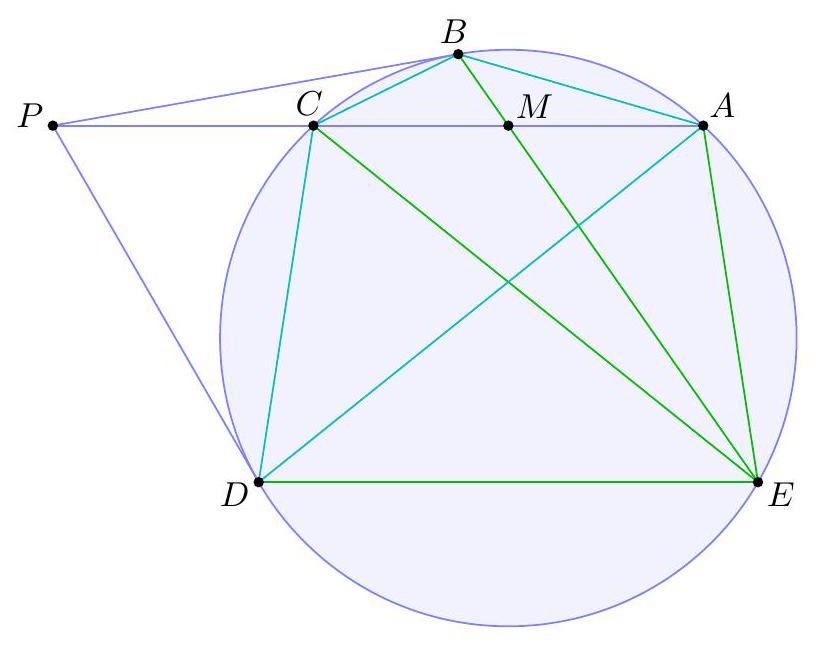
| Points $A, B, C, D, E$ lie on a circle $\omega$ and point $P$ lies outside the circle. The given points are such that (i) lines $P B$ and $P D$ are tangent to $\omega$, (ii) $P, A, C$ are collinear, and (iii) $\overline{D E} \| \overline{A C}$. Prove that $\overline{B E}$ bisects $\overline{A C}$. |
|
|
| We present two solutions. |
| 【 First solution using harmonic bundles. Let $M=\overline{B E} \cap \overline{A C}$ and let $\infty$ be the point at infinity along $\overline{D E} \| \overline{A C}$. |
|  |
|
|
| Note that $A B C D$ is harmonic, so |
|
|
| $$ |
| -1=(A C ; B D) \stackrel{E}{=}(A C ; M \infty) |
| $$ |
|
|
| implying $M$ is the midpoint of $\overline{A C}$. |
| I Second solution using complex numbers (Cynthia Du). Suppose we let $b, d, e$ be free on unit circle, so $p=\frac{2 b d}{b+d}$. Then $d / c=a / e$, and $a+c=p+a c \bar{p}$. Consequently, |
|
|
| $$ |
| \begin{aligned} |
| a c & =d e \\ |
| \frac{1}{2}(a+c) & =\frac{b d}{b+d}+d e \cdot \frac{1}{b+d}=\frac{d(b+e)}{b+d} \\ |
| \frac{a+c}{2 a c} & =\frac{(b+e)}{e(b+d)} |
| \end{aligned} |
| $$ |
|
|
| From here it's easy to see |
|
|
| $$ |
| \frac{a+c}{2}+\frac{a+c}{2 a c} \cdot b e=b+e |
| $$ |
|
|
| which is what we wanted to prove. |
|
|
| ## §2.3 JMO 2011/6, proposed by Sam Vandervelde |
|
|
| Available online at https://aops.com/community/p2254810. |
|
|
| ## Problem statement |
|
|
| Consider the assertion that for each positive integer $n \geq 2$, the remainder upon dividing $2^{2^{n}}$ by $2^{n}-1$ is a power of 4 . Either prove the assertion or find (with proof) a counterexample. |
|
|
| We claim $n=25$ is a counterexample. Since $2^{25} \equiv 2^{0}\left(\bmod 2^{25}-1\right)$, we have |
|
|
| $$ |
| 2^{2^{25}} \equiv 2^{2^{25} \bmod 25} \equiv 2^{7} \bmod 2^{25}-1 |
| $$ |
|
|
| and the right-hand side is actually the remainder, since $0<2^{7}<2^{25}$. But $2^{7}$ is not a power of 4. |
|
|
| Remark. Really, the problem is just equivalent for asking $2^{n}$ to have odd remainder when divided by $n$. |
|
|
|
|


