| # JMO 2016 Solution Notes |
|
|
| Evan Chen《陳誼廷》 |
|
|
| 15 April 2024 |
|
|
|
|
| #### Abstract |
|
|
| This is a compilation of solutions for the 2016 JMO. The ideas of the solution are a mix of my own work, the solutions provided by the competition organizers, and solutions found by the community. However, all the writing is maintained by me. |
|
|
| These notes will tend to be a bit more advanced and terse than the "official" solutions from the organizers. In particular, if a theorem or technique is not known to beginners but is still considered "standard", then I often prefer to use this theory anyways, rather than try to work around or conceal it. For example, in geometry problems I typically use directed angles without further comment, rather than awkwardly work around configuration issues. Similarly, sentences like "let $\mathbb{R}$ denote the set of real numbers" are typically omitted entirely. |
|
|
| Corrections and comments are welcome! |
|
|
|
|
| ## Contents |
|
|
| 0 Problems |
| 1 Solutions to Day 1 |
| 1.1 JMO 2016/1, proposed by Ivan Borsenco, Zuming Feng ..... 3 |
| 1.2 JMO 2016/2, proposed by Evan Chen ..... 5 |
| 1.3 JMO 2016/3, proposed by Iurie Boreico |
| 2 Solutions to Day 2 ..... 8 |
| 2.1 JMO 2016/4, proposed by Gregory Galperin ..... 8 |
| 2.2 JMO 2016/5, proposed by Zuming Feng, Jacek Fabrykowski ..... 9 |
| 2.3 JMO 2016/6, proposed by Titu Andreescu ..... 11 |
|
|
| ## §0 Problems |
|
|
| 1. The isosceles triangle $\triangle A B C$, with $A B=A C$, is inscribed in the circle $\omega$. Let $P$ be a variable point on the arc $B C$ that does not contain $A$, and let $I_{B}$ and $I_{C}$ denote the incenters of triangles $\triangle A B P$ and $\triangle A C P$, respectively. Prove that as $P$ varies, the circumcircle of triangle $\triangle P I_{B} I_{C}$ passes through a fixed point. |
| 2. Prove that there exists a positive integer $n<10^{6}$ such that $5^{n}$ has six consecutive zeros in its decimal representation. |
| 3. Let $X_{1}, X_{2}, \ldots, X_{100}$ be a sequence of mutually distinct nonempty subsets of a set $S$. Any two sets $X_{i}$ and $X_{i+1}$ are disjoint and their union is not the whole set $S$, that is, $X_{i} \cap X_{i+1}=\emptyset$ and $X_{i} \cup X_{i+1} \neq S$, for all $i \in\{1, \ldots, 99\}$. Find the smallest possible number of elements in $S$. |
| 4. Find, with proof, the least integer $N$ such that if any 2016 elements are removed from the set $\{1,2, \ldots, N\}$, one can still find 2016 distinct numbers among the remaining elements with sum $N$. |
| 5. Let $\triangle A B C$ be an acute triangle, with $O$ as its circumcenter. Point $H$ is the foot of the perpendicular from $A$ to line $B C$, and points $P$ and $Q$ are the feet of the perpendiculars from $H$ to the lines $A B$ and $A C$, respectively. |
| Given that |
| |
| $$ |
| A H^{2}=2 A O^{2} |
| $$ |
| |
| prove that the points $O, P$, and $Q$ are collinear. |
| 6. Find all functions $f: \mathbb{R} \rightarrow \mathbb{R}$ such that for all real numbers $x$ and $y$, |
| |
| $$ |
| (f(x)+x y) \cdot f(x-3 y)+(f(y)+x y) \cdot f(3 x-y)=(f(x+y))^{2} . |
| $$ |
| |
| ## §1 Solutions to Day 1 |
| |
| ## §1.1 JMO 2016/1, proposed by Ivan Borsenco, Zuming Feng |
| |
| Available online at https://aops.com/community/p6213607. |
| |
| ## Problem statement |
| |
| The isosceles triangle $\triangle A B C$, with $A B=A C$, is inscribed in the circle $\omega$. Let $P$ be a variable point on the arc $B C$ that does not contain $A$, and let $I_{B}$ and $I_{C}$ denote the incenters of triangles $\triangle A B P$ and $\triangle A C P$, respectively. Prove that as $P$ varies, the circumcircle of triangle $\triangle P I_{B} I_{C}$ passes through a fixed point. |
| |
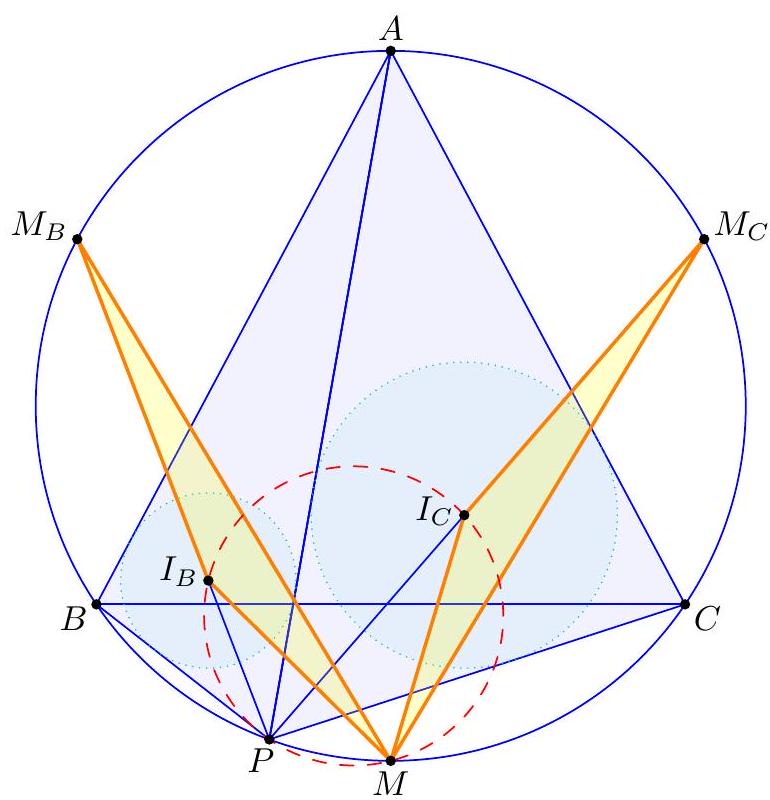
| Let $M$ be the midpoint of arc $B C$ not containing $A$. We claim $M$ is the desired fixed point. |
|  |
| |
| Let $M_{B}, M_{C}$ be the second intersections of $P I_{B}$ and $P I_{C}$ with circumcircle. |
| Claim - We have $\triangle I_{B} M_{B} M \cong \triangle I_{C} M_{C} M$. |
| |
| Proof. Note that |
| |
| $$ |
| \begin{aligned} |
| M_{B} I_{B} & =M_{B} B=M_{C} C=M_{C} I_{C} \\ |
| M M_{B} & =M M_{C} \\ |
| \angle I_{B} M_{B} M & =\frac{1}{2} \widehat{P M}=\angle I_{C} M_{C} M |
| \end{aligned} |
| $$ |
| |
| This implies the desired congruence. |
| Since $\angle M P A=90^{\circ}$ and ray $P A$ bisects $\angle I_{B} P I_{C}$, the conclusion $M I_{B}=M I_{C}$ finishes the problem. |
| |
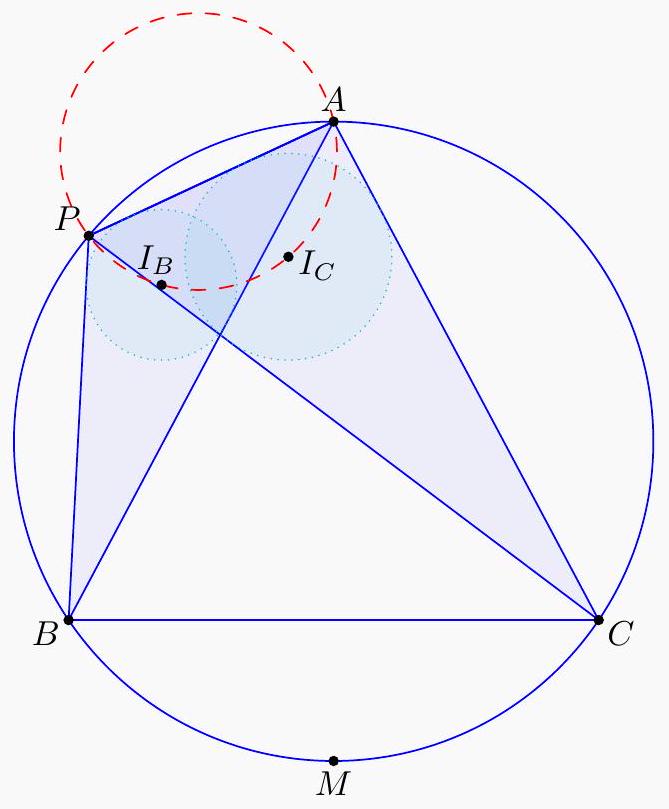
| Remark 1.1. Complex in the obvious way DOES NOT WORK, because the usual claim ("the fixed point is arc midpoint") is FALSE if the hypothesis that $P$ lies in the interior of the arc is dropped. See figure below. |
|  |
| |
| Fun story, I pointed this out to Zuming during grading; I was the only one that realized the subtlety. |
| |
| ## §1.2 JMO 2016/2, proposed by Evan Chen |
| |
| Available online at https://aops.com/community/p6213569. |
| |
| ## Problem statement |
| |
| Prove that there exists a positive integer $n<10^{6}$ such that $5^{n}$ has six consecutive zeros in its decimal representation. |
| |
| We will prove that $n=20+2^{19}=524308$ fits the bill. |
| First, we claim that |
| |
| $$ |
| 5^{n} \equiv 5^{20} \quad\left(\bmod 5^{20}\right) \quad \text { and } \quad 5^{n} \equiv 5^{20} \quad\left(\bmod 2^{20}\right) |
| $$ |
| |
| Indeed, the first equality holds since both sides are $0\left(\bmod 5^{20}\right)$, and the second by $\varphi\left(2^{20}\right)=2^{19}$ and Euler's theorem. Hence |
| |
| $$ |
| 5^{n} \equiv 5^{20} \quad\left(\bmod 10^{20}\right) |
| $$ |
| |
| In other words, the last 20 digits of $5^{n}$ will match the decimal representation of $5^{20}$, with leading zeros. However, we have |
| |
| $$ |
| 5^{20}=\frac{1}{2^{20}} \cdot 10^{20}<\frac{1}{1000^{2}} \cdot 10^{20}=10^{-6} \cdot 10^{20} |
| $$ |
| |
| and hence those first six of those 20 digits will all be zero. This completes the proof! (To be concrete, it turns out that $5^{20}=95367431640625$ and so the last 20 digits of $5^{n}$ will be 00000095367431640625.$)$ |
| |
| Remark. Many of the first posts in the JMO 2016 discussion thread (see https://aops. com/community/c5h1230514) claimed that the problem was "super easy". In fact, the problem was solved by only about $10 \%$ of contestants. |
| |
| ब Authorship comments. This problem was inspired by the observation $5^{8} \equiv 5^{4}$ $\left(\bmod 10^{4}\right)$, i.e. that $5^{8}$ ended with 0625. |
| |
| I noticed this one day back in November, when I was lying on my bed after a long afternoon and was mindlessly computing powers of 5 in my head because I was too tired to do much else. When I reached $5^{8}$ I noticed for the first time that the ending 0625 was actually induced by $5^{4}$. (Given how much MathCounts I did, I really should have known this earlier!) |
| |
| Thinking about this for a few more seconds, I realized one could obtain arbitrarily long strings of 0 's by using a similar trick modulo larger powers of 10 . This surprised me, because I would have thought that if this was true, then I would have learned about it back in my contest days. However, I could not find any references, and I thought the result was quite nice, so I submitted it as a proposal for the JMO, where I thought it might be appreciated. |
| |
| The joke about six consecutive zeros is due to Zuming Feng. |
| |
| ## §1.3 JMO 2016/3, proposed by lurie Boreico |
| |
| Available online at https://aops.com/community/p6213589. |
| |
| ## Problem statement |
| |
| Let $X_{1}, X_{2}, \ldots, X_{100}$ be a sequence of mutually distinct nonempty subsets of a set $S$. Any two sets $X_{i}$ and $X_{i+1}$ are disjoint and their union is not the whole set $S$, that is, $X_{i} \cap X_{i+1}=\emptyset$ and $X_{i} \cup X_{i+1} \neq S$, for all $i \in\{1, \ldots, 99\}$. Find the smallest possible number of elements in $S$. |
|
|
| Solution with Danielle Wang: the answer is that $|S| \geq 8$. |
| 【 Proof that $|S| \geq 8$ is necessary. Since we must have $2^{|S|} \geq 100$, we must have $|S| \geq 7$. |
| To see that $|S|=8$ is the minimum possible size, consider a chain on the set $S=$ $\{1,2, \ldots, 7\}$ satisfying $X_{i} \cap X_{i+1}=\emptyset$ and $X_{i} \cup X_{i+1} \neq S$. Because of these requirements any subset of size 4 or more can only be neighbored by sets of size 2 or less, of which there are $\binom{7}{1}+\binom{7}{2}=28$ available. Thus, the chain can contain no more than 29 sets of size 4 or more and no more than 28 sets of size 2 or less. Finally, since there are only $\binom{7}{3}=35$ sets of size 3 available, the total number of sets in such a chain can be at most $29+28+35=92<100$, contradiction. |
|
|
| ब Construction. We will provide an inductive construction for a chain of subsets $X_{1}, X_{2}, \ldots, X_{2^{n-1}+1}$ of $S=\{1, \ldots, n\}$ satisfying $X_{i} \cap X_{i+1}=\varnothing$ and $X_{i} \cup X_{i+1} \neq S$ for each $n \geq 4$. |
| |
| For $S=\{1,2,3,4\}$, the following chain of length $2^{3}+1=9$ will work: |
| |
| $$ |
| \begin{array}{lllllllll} |
| 34 & 1 & 23 & 4 & 12 & 3 & 14 & 2 & 13 . |
| \end{array} |
| $$ |
| |
| Now, given a chain of subsets of $\{1,2, \ldots, n\}$ the following procedure produces a chain of subsets of $\{1,2, \ldots, n+1\}$ : |
| |
| 1. take the original chain, delete any element, and make two copies of this chain, which now has even length; |
| 2. glue the two copies together, joined by $\varnothing$ in between; and then |
| 3. insert the element $n+1$ into the sets in alternating positions of the chain starting with the first. |
| |
| For example, the first iteration of this construction gives: |
| |
| $$ |
| \begin{array}{ccccccccc} |
| 345 & 1 & 235 & 4 & 125 & 3 & 145 & 2 & 5 \\ |
| 34 & 15 & 23 & 45 & 12 & 35 & 14 & 25 & |
| \end{array} |
| $$ |
| |
| It can be easily checked that if the original chain satisfies the requirements, then so does the new chain, and if the original chain has length $2^{n-1}+1$, then the new chain has length $2^{n}+1$, as desired. This construction yields a chain of length 129 when $S=\{1,2, \ldots, 8\}$. |
| |
| Remark. Here is the construction for $n=8$ in its full glory. |
| |
| | 345678 | 1 | 235678 | 4 | 125678 | 3 | 145678 | 2 | 5678 | |
| | :---: | :---: | :---: | :---: | :---: | :---: | :---: | :---: | :---: | |
| | 34 | 15678 | 23 | 45678 | 12 | 35678 | 14 | 678 | | |
| | 345 | 1678 | 235 | 4678 | 125 | 3678 | 145 | 2678 | 5 | |
| | 34678 | 15 | 23678 | 45 | 12678 | 35 | 78 | | | |
| | 3456 | 178 | 2356 | 478 | 1256 | 378 | 1456 | 278 | 56 | |
| | 3478 | 156 | 2378 | 456 | 1278 | 356 | 1478 | 6 | | |
| | 34578 | 16 | 23578 | 46 | 12578 | 36 | 14578 | 26 | 578 | |
| | 346 | 1578 | 236 | 4578 | 126 | 8 | | | | |
| | 34567 | 18 | 23567 | 48 | 12567 | 38 | 14567 | 28 | 567 | |
| | 348 | 1567 | 238 | 4567 | 128 | 3567 | 148 | 67 | | |
| | 3458 | 167 | 2358 | 467 | 1258 | 367 | 1458 | 267 | 58 | |
| | 3467 | 158 | 2367 | 458 | 1267 | 358 | 7 | | | |
| | 34568 | 17 | 23568 | 47 | 12568 | 37 | 14568 | 27 | 568 | |
| | 347 | 1568 | 237 | 4568 | 127 | 3568 | 147 | 68 | | |
| | 3457 | 168 | 2357 | 468 | 1257 | 368 | 1457 | 268 | 57 | |
| | 3468 | 157 | 2368 | 457 | 1268 | | | | | |
| |
| ## §2 Solutions to Day 2 |
| |
| ## §2.1 JMO 2016/4, proposed by Gregory Galperin |
| |
| Available online at https://aops.com/community/p6220314. |
| |
| ## Problem statement |
| |
| Find, with proof, the least integer $N$ such that if any 2016 elements are removed from the set $\{1,2, \ldots, N\}$, one can still find 2016 distinct numbers among the remaining elements with sum $N$. |
| |
| The answer is |
| |
| $$ |
| N=2017+2018+\cdots+4032=1008 \cdot 6049=6097392 |
| $$ |
| |
| \ Proof that $N \geq 6097392$ is necessary. To see that $N$ must be at least this large, consider the situation when $1,2, \ldots, 2016$ are removed. Among the remaining elements, any sum of 2016 elements is certainly at least $2017+2018+\cdots+4032$. |
| \ा Proof that $N=6097392$ does in fact work. Consider the 3024 pairs of numbers $(1,6048),(2,6047), \ldots,(3024,3025)$. Regardless of which 2016 elements of $\{1,2, \ldots, N\}$ are deleted, at least $3024-2016=1008$ of these pairs have both elements remaining. Since each pair has sum 6049, we can take these pairs to be the desired numbers. |
| |
| ## §2.2 JMO 2016/5, proposed by Zuming Feng, Jacek Fabrykowski |
| |
| Available online at https://aops.com/community/p6220305. |
| |
| ## Problem statement |
| |
| Let $\triangle A B C$ be an acute triangle, with $O$ as its circumcenter. Point $H$ is the foot of the perpendicular from $A$ to line $B C$, and points $P$ and $Q$ are the feet of the perpendiculars from $H$ to the lines $A B$ and $A C$, respectively. |
| |
| Given that |
| |
| $$ |
| A H^{2}=2 A O^{2} |
| $$ |
| |
| prove that the points $O, P$, and $Q$ are collinear. |
| |
| We present two approaches. |
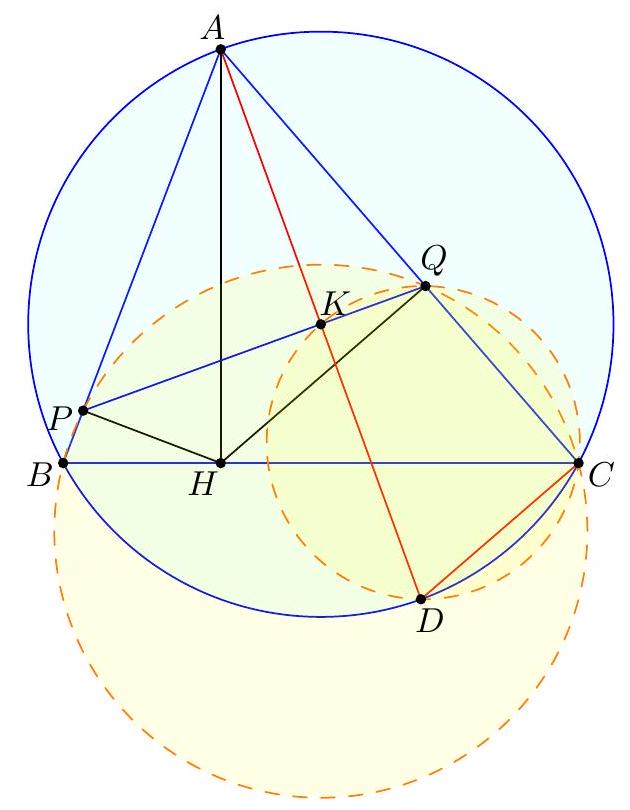
| 【 First approach (synthetic). First, since $A P \cdot A B=A H^{2}=A Q \cdot A C$, it follows that $P Q C B$ is cyclic. Consequently, we have $A O \perp P Q$. |
|  |
| |
| Let $K$ be the foot of $A$ onto $P Q$, and let $D$ be the point diametrically opposite $A$. Thus $A, K, O, D$ are collinear. |
| |
| Since quadrilateral $K Q C D$ is cyclic $\left(~ \angle Q K D=\angle Q C D=90^{\circ}\right)$, we have |
| |
| $$ |
| A K \cdot A D=A Q \cdot A C=A H^{2} \Longrightarrow A K=\frac{A H^{2}}{A D}=\frac{A H^{2}}{2 A O}=A O |
| $$ |
| |
| so $K=O$. |
| |
| ब Second approach (coordinates), with Joshua Hsieh. We impose coordinates with $H$ at the origin and $A=(0, a), B=(-b, 0), C=(c, 0)$, for $a, b, c>0$. |
| |
| Claim - The circumcenter has coordinates $\left(\frac{c-b}{2}, \frac{a}{2}-\frac{b c}{2 a}\right)$. |
| |
| Proof. This is a known lemma but but we reproduce its proof for completeness. It uses the following steps: |
| |
| - By power of a point, the second intersection of line $A H$ with the circumcircle is $\left(0,-\frac{b c}{a}\right)$. |
| - Since the orthocenter is the reflection of this point across line $B C$, the orthocenter is given exactly by $\left(0, \frac{b c}{a}\right)$. |
| - The centroid is is $\frac{\vec{A}+\vec{B}+\vec{C}}{3}=\left(\frac{c-b}{3}, \frac{a}{3}\right)$. |
| - Since $\vec{H}-\vec{O}=3(\vec{G}-\vec{O})$ according to the Euler line, we have $\vec{O}=\frac{3}{2} \vec{G}-\frac{1}{2} \vec{H}$. This gives the desired formula. |
| |
| Note that $H Q=\frac{H A \cdot H C}{A C}=\frac{a c}{\sqrt{a^{2}+c^{2}}}$. If we let $T$ be the foot from $Q$ to $B C$, then $\triangle H Q T \tilde{+} \triangle A H C$ and so the $x$-coordinate of $Q$ is given by $H Q \cdot \frac{A H}{A C}=\frac{a^{2} c}{a^{2}+c^{2}}$. Repeating the analogous calculation for $Q$ and $P$ gives |
| |
| $$ |
| \begin{aligned} |
| Q & =\left(\frac{a^{2} c}{a^{2}+c^{2}}, \frac{a c^{2}}{a^{2}+c^{2}}\right) \\ |
| P & =\left(-\frac{a^{2} b}{a^{2}+b^{2}}, \frac{a b^{2}}{a^{2}+b^{2}}\right) . |
| \end{aligned} |
| $$ |
| |
| Then, $O, P, Q$ are collinear if and only if the following shoelace determinant vanishes (with denominators cleared out): |
| |
| $$ |
| \begin{aligned} |
| 0 & =\operatorname{det}\left[\begin{array}{ccc} |
| -a^{2} b & a b^{2} & a^{2}+b^{2} \\ |
| a^{2} c & a c^{2} & a^{2}+c^{2} \\ |
| a(c-b) & a^{2}-b c & 2 a |
| \end{array}\right]=a \operatorname{det}\left[\begin{array}{ccc} |
| -a b & a b^{2} & a^{2}+b^{2} \\ |
| a c & a c^{2} & a^{2}+c^{2} \\ |
| c-b & a^{2}-b c & 2 a |
| \end{array}\right] \\ |
| & =a \operatorname{det}\left[\begin{array}{ccc} |
| -a(b+c) & a\left(b^{2}-c^{2}\right) & b^{2}-c^{2} \\ |
| a c & a c^{2} & a^{2}+c^{2} \\ |
| c-b & a^{2}-b c & 2 a |
| \end{array}\right]=a(b+c) \operatorname{det}\left[\begin{array}{ccc} |
| -a & a(b-c) & b-c \\ |
| a c & a c^{2} & a^{2}+c^{2} \\ |
| c-b & a^{2}-b c & 2 a |
| \end{array}\right] \\ |
| & =a(b+c) \cdot\left[-a\left(a^{2} c^{2}-a^{4}+b c\left(a^{2}+c^{2}\right)\right)+a c(b-c)\left(-a^{2}-b c\right)-(b-c)^{2} \cdot a^{3}\right] \\ |
| & =a^{2}(b+c)\left(a^{4}-a^{2} b^{2}-b^{2} c^{2}-c^{2} a^{2}\right) . |
| \end{aligned} |
| $$ |
| |
| On the other hand, |
| |
| $$ |
| \begin{aligned} |
| A H^{2} & =a^{2} \\ |
| 2 A O^{2} & =2\left[\left(\frac{c-b}{2}\right)^{2}+\left(-\frac{a}{2}-\frac{b c}{2 a}\right)^{2}\right]=\frac{a^{2}+b^{2}+c^{2}+\frac{b^{2} c^{2}}{a^{2}}}{2} \\ |
| \Longrightarrow A H^{2}-2 A O^{2} & =\frac{1}{2}\left(a^{2}-b^{2}-c^{2}-\frac{b^{2} c^{2}}{a^{2}}\right) . |
| \end{aligned} |
| $$ |
| |
| So the conditions are equivalent. |
| |
| ## §2.3 JMO 2016/6, proposed by Titu Andreescu |
| |
| Available online at https://aops.com/community/p6220308. |
| |
| ## Problem statement |
| |
| Find all functions $f: \mathbb{R} \rightarrow \mathbb{R}$ such that for all real numbers $x$ and $y$, |
| |
| $$ |
| (f(x)+x y) \cdot f(x-3 y)+(f(y)+x y) \cdot f(3 x-y)=(f(x+y))^{2} . |
| $$ |
| |
| We claim that the only two functions satisfying the requirements are $f(x) \equiv 0$ and $f(x) \equiv x^{2}$. These work. |
| |
| First, taking $x=y=0$ in the given yields $f(0)=0$, and then taking $x=0$ gives $f(y) f(-y)=f(y)^{2}$. So also $f(-y)^{2}=f(y) f(-y)$, from which we conclude $f$ is even. Then taking $x=-y$ gives |
| |
| $$ |
| \forall x \in \mathbb{R}: \quad f(x)=x^{2} \quad \text { or } \quad f(4 x)=0 |
| $$ |
| |
| for all $x$. |
| Remark. Note that an example of a function satisfying $(\boldsymbol{\star})$ is |
| |
| $$ |
| f(x)= \begin{cases}x^{2} & \text { if }|x|<1 \\ 1-\cos \left(\frac{\pi}{2} \cdot x^{1337}\right) & \text { if } 1 \leq|x|<4 \\ 0 & \text { if }|x| \geq 4\end{cases} |
| $$ |
| |
| So, yes, we are currently in a world of trouble, still. (This function is even continuous; I bring this up to emphasize that "continuity" is completely unrelated to the issue at hand.) |
| |
| Now we claim |
| |
| $$ |
| \text { Claim }-f(z)=0 \Longleftrightarrow f(2 z)=0 |
| $$ |
| |
| Proof. Let $(x, y)=(3 t, t)$ in the given to get |
| |
| $$ |
| \left(f(t)+3 t^{2}\right) f(8 t)=f(4 t)^{2} |
| $$ |
| |
| Now if $f(4 t) \neq 0$ (in particular, $t \neq 0$ ), then $f(8 t) \neq 0$. Thus we have $(\boldsymbol{\phi})$ in the reverse direction. |
| |
| Then $f(4 t) \neq 0 \xlongequal{(\star)} f(t)=t^{2} \neq 0 \xlongequal{(\bullet)} f(2 t) \neq 0$ implies the forwards direction, the last step being the reverse direction |
| |
| By putting together $(\boldsymbol{\star})$ and $(\boldsymbol{\leftrightarrow})$ we finally get |
| |
| $$ |
| \forall x \in \mathbb{R}: \quad f(x)=x^{2} \quad \text { or } \quad f(x)=0 |
| $$ |
| |
| We are now ready to approach the main problem. Assume there's an $a \neq 0$ for which $f(a)=0$; we show that $f \equiv 0$. |
| |
| Let $b \in \mathbb{R}$ be given. Since $f$ is even, we can assume without loss of generality that $a, b>0$. Also, note that $f(x) \geq 0$ for all $x$ by ( $($ ). By using ( $\boldsymbol{\sim}$ ) we can generate $c>b$ such that $f(c)=0$ by taking $c=2^{n} a$ for a large enough integer $n$. Now, select $x, y>0$ such that $x-3 y=b$ and $x+y=c$. That is, |
| |
| $$ |
| (x, y)=\left(\frac{3 c+b}{4}, \frac{c-b}{4}\right) . |
| $$ |
| |
| Substitution into the original equation gives |
| |
| $$ |
| 0=(f(x)+x y) f(b)+(f(y)+x y) f(3 x-y) \geq(f(x)+x y) f(b) |
| $$ |
| |
| But since $f(b) \geq 0$, it follows $f(b)=0$, as desired. |
| |
| |


