| # JMO 2017 Solution Notes |
|
|
| Evan Chen《陳誼廷》 |
|
|
| 15 April 2024 |
|
|
|
|
| #### Abstract |
|
|
| This is a compilation of solutions for the 2017 JMO. The ideas of the solution are a mix of my own work, the solutions provided by the competition organizers, and solutions found by the community. However, all the writing is maintained by me. |
|
|
| These notes will tend to be a bit more advanced and terse than the "official" solutions from the organizers. In particular, if a theorem or technique is not known to beginners but is still considered "standard", then I often prefer to use this theory anyways, rather than try to work around or conceal it. For example, in geometry problems I typically use directed angles without further comment, rather than awkwardly work around configuration issues. Similarly, sentences like "let $\mathbb{R}$ denote the set of real numbers" are typically omitted entirely. |
|
|
| Corrections and comments are welcome! |
|
|
|
|
| ## Contents |
|
|
| 0 Problems |
| 1 Solutions to Day 1 |
| 1.1 JMO 2017/1, proposed by Gregory Galperin ..... 3 |
| 1.2 JMO 2017/2, proposed by Titu Andreescu ..... 4 |
| 1.3 JMO 2017/3, proposed by Titu Andreescu, Luis Gonzalez, Cosmin Pohoata |
| 2 Solutions to Day 2 ..... 6 |
| 2.1 JMO 2017/4, proposed by Titu Andreescu |
| 2.2 JMO 2017/5, proposed by Ivan Borsenco |
| 2.3 JMO 2017/6, proposed by Maria Monks |
|
|
| ## §0 Problems |
|
|
| 1. Prove that there exist infinitely many pairs of relatively prime positive integers $a, b>1$ for which $a+b$ divides $a^{b}+b^{a}$. |
| 2. Show that the Diophantine equation |
|
|
| $$ |
| \left(3 x^{3}+x y^{2}\right)\left(x^{2} y+3 y^{3}\right)=(x-y)^{7} |
| $$ |
|
|
| has infinitely many solutions in positive integers, and characterize all the solutions. |
| 3. Let $A B C$ be an equilateral triangle and $P$ a point on its circumcircle. Set $D=$ $\overline{P A} \cap \overline{B C}, E=\overline{P B} \cap \overline{C A}, F=\overline{P C} \cap \overline{A B}$. Prove that the area of triangle $D E F$ is twice the area of triangle $A B C$. |
| 4. Are there any triples $(a, b, c)$ of positive integers such that $(a-2)(b-2)(c-2)+12$ is a prime number that properly divides the positive number $a^{2}+b^{2}+c^{2}+a b c-2017$ ? |
| 5. Let $O$ and $H$ be the circumcenter and the orthocenter of an acute triangle $A B C$. Points $M$ and $D$ lie on side $B C$ such that $B M=C M$ and $\angle B A D=\angle C A D$. Ray $M O$ intersects the circumcircle of triangle $B H C$ in point $N$. Prove that $\angle A D O=\angle H A N$. |
| 6. Let $P_{1}, P_{2}, \ldots, P_{2 n}$ be $2 n$ distinct points on the unit circle $x^{2}+y^{2}=1$, other than $(1,0)$. Each point is colored either red or blue, with exactly $n$ red points and $n$ blue points. Let $R_{1}, R_{2}, \ldots, R_{n}$ be any ordering of the red points. Let $B_{1}$ be the nearest blue point to $R_{1}$ traveling counterclockwise around the circle starting from $R_{1}$. Then let $B_{2}$ be the nearest of the remaining blue points to $R_{2}$ travelling counterclockwise around the circle from $R_{2}$, and so on, until we have labeled all of the blue points $B_{1}, \ldots, B_{n}$. Show that the number of counterclockwise arcs of the form $R_{i} \rightarrow B_{i}$ that contain the point $(1,0)$ is independent of the way we chose the ordering $R_{1}, \ldots, R_{n}$ of the red points. |
|
|
| ## §1 Solutions to Day 1 |
|
|
| ## §1.1 JMO 2017/1, proposed by Gregory Galperin |
|
|
| Available online at https://aops.com/community/p8108366. |
|
|
| ## Problem statement |
|
|
| Prove that there exist infinitely many pairs of relatively prime positive integers $a, b>1$ for which $a+b$ divides $a^{b}+b^{a}$. |
|
|
| One construction: let $d \equiv 1(\bmod 4), d>1$. Let $x=\frac{d^{d}+2^{d}}{d+2}$. Then set |
|
|
| $$ |
| a=\frac{x+d}{2}, \quad b=\frac{x-d}{2} |
| $$ |
|
|
| To see this works, first check that $b$ is odd and $a$ is even. Let $d=a-b$ be odd. Then: |
|
|
| $$ |
| \begin{aligned} |
| a+b \mid a^{b}+b^{a} & \Longleftrightarrow(-b)^{b}+b^{a} \equiv 0 \quad(\bmod a+b) \\ |
| & \Longleftrightarrow b^{a-b} \equiv 1 \quad(\bmod a+b) \\ |
| & \Longleftrightarrow b^{d} \equiv 1 \quad(\bmod d+2 b) \\ |
| & \Longleftrightarrow(-2)^{d} \equiv d^{d} \quad(\bmod d+2 b) \\ |
| & \Longleftrightarrow d+2 b \mid d^{d}+2^{d} . |
| \end{aligned} |
| $$ |
|
|
| So it would be enough that |
|
|
| $$ |
| d+2 b=\frac{d^{d}+2^{d}}{d+2} \Longrightarrow b=\frac{1}{2}\left(\frac{d^{d}+2^{d}}{d+2}-d\right) |
| $$ |
|
|
| which is what we constructed. Also, since $\operatorname{gcd}(x, d)=1$ it follows $\operatorname{gcd}(a, b)=\operatorname{gcd}(d, b)=$ 1. |
|
|
| Remark. Ryan Kim points out that in fact, $(a, b)=(2 n-1,2 n+1)$ is always a solution. |
|
|
| ## §1.2 JMO 2017/2, proposed by Titu Andreescu |
|
|
| Available online at https://aops.com/community/p8108503. |
|
|
| ## Problem statement |
|
|
| Show that the Diophantine equation |
|
|
| $$ |
| \left(3 x^{3}+x y^{2}\right)\left(x^{2} y+3 y^{3}\right)=(x-y)^{7} |
| $$ |
|
|
| has infinitely many solutions in positive integers, and characterize all the solutions. |
|
|
| Let $x=d a, y=d b$, where $\operatorname{gcd}(a, b)=1$ and $a>b$. The equation is equivalent to |
|
|
| $$ |
| (a-b)^{7} \mid a b\left(a^{2}+3 b^{2}\right)\left(3 a^{2}+b^{2}\right) |
| $$ |
|
|
| with the ratio of the two becoming $d$. |
| Claim - The equation ( $\star$ ) holds if and only if $a-b=1$. |
| Proof. Obviously if $a-b=1$ then $(\star)$ is true. Conversely, suppose $(\star)$ holds. |
|
|
| - If $a$ and $b$ are both odd, then $a^{2}+3 b^{2} \equiv 4(\bmod 8)$. Similarly $3 a^{2}+b^{2} \equiv 4(\bmod 8)$. Hence $2^{4}$ exactly divides right-hand side, contradiction. |
| - Now suppose $a-b$ is odd. We have $\operatorname{gcd}(a-b, a)=\operatorname{gcd}(a-b, b)=1$ by Euclid, but also |
|
|
| $$ |
| \operatorname{gcd}\left(a-b, a^{2}+3 b^{2}\right)=\operatorname{gcd}\left(a-b, 4 b^{2}\right)=1 |
| $$ |
|
|
| and similarly $\operatorname{gcd}\left(a-b, 3 a^{2}+b^{2}\right)=1$. Thus $a-b$ is coprime to each of $a, b, a^{2}+3 b^{2}$, $3 a^{2}+b^{2}$ and this forces $a-b=1$. |
|
|
| This therefore describes all solutions: namely, for any $b \geq 1$, if we set $a=b+1$ and $d=a b\left(a^{2}+3 b^{2}\right)\left(3 a^{2}+b\right)$ then $(x, y)=(d a, d b)$ works and any solution is of this form. |
|
|
| Remark. One can give different cosmetic representations of the same solution set. For example, we could write $b=\frac{1}{2}(n-1)$ and $a=\frac{1}{2}(n+1)$ with $n>1$ any odd integer. Then $d=a b\left(a^{2}+3 b^{2}\right)\left(3 a^{2}+b^{2}\right)=\frac{(n-1)(n+1)\left(n^{2}+n+1\right)\left(n^{2}-n+1\right)}{4}=\frac{n^{6}-1}{4}$, and hence the solution is |
|
|
| $$ |
| (x, y)=(d a, d b)=\left(\frac{(n+1)\left(n^{6}-1\right)}{8}, \frac{(n-1)\left(n^{6}-1\right)}{8}\right) |
| $$ |
|
|
| which is a little simpler to write. The smallest solutions are $(364,182),(11718,7812), \ldots$ |
|
|
| ## §1.3 JMO 2017/3, proposed by Titu Andreescu, Luis Gonzalez, Cosmin Pohoata |
|
|
| Available online at https://aops.com/community/p8108450. |
|
|
| ## Problem statement |
|
|
| Let $A B C$ be an equilateral triangle and $P$ a point on its circumcircle. Set $D=$ $\overline{P A} \cap \overline{B C}, E=\overline{P B} \cap \overline{C A}, F=\overline{P C} \cap \overline{A B}$. Prove that the area of triangle $D E F$ is twice the area of triangle $A B C$. |
| \ First solution (barycentric). We invoke barycentric coordinates on $A B C$. Let $P=(u: v: w)$, with $u v+v w+w u=0$ (circumcircle equation with $a=b=c$ ). Then $D=(0: v: w), E=(u: 0: w), F=(u: v: 0)$. Hence |
|
|
| $$ |
| \begin{aligned} |
| \frac{[D E F]}{[A B C]} & =\frac{1}{(u+v)(v+w)(w+u)} \operatorname{det}\left[\begin{array}{lll} |
| 0 & v & w \\ |
| u & 0 & w \\ |
| u & v & 0 |
| \end{array}\right] \\ |
| & =\frac{2 u v w}{(u+v)(v+w)(w+u)} \\ |
| & =\frac{2 u v w}{(u+v+w)(u v+v w+w u)-u v w} \\ |
| & =\frac{2 u v w}{-u v w}=-2 |
| \end{aligned} |
| $$ |
|
|
| as desired (areas signed). |
| 『 Second solution ("nice" lengths). WLOG $A B P C$ is convex. Let $x=A B=B C=$ $C A$. By Ptolemy's theorem and strong Ptolemy, |
|
|
| $$ |
| \begin{aligned} |
| P A & =P B+P C \\ |
| P A^{2} & =P B \cdot P C+A B \cdot A C=P B \cdot P C+x^{2} \\ |
| \Longrightarrow x^{2} & +P B^{2}+P B \cdot P C+P C^{2} . |
| \end{aligned} |
| $$ |
|
|
| Also, $P D \cdot P A=P B \cdot P C$ and similarly since $\overline{P A}$ bisects $\angle B P C$ (causing $\triangle B P D \sim$ $\triangle A P C)$. |
|
|
| Now $P$ is the Fermat point of $\triangle D E F$, since $\angle D P F=\angle F P E=\angle E P D=120^{\circ}$. Thus |
|
|
| $$ |
| \begin{aligned} |
| {[D E F] } & =\frac{\sqrt{3}}{4} \sum_{\mathrm{cyc}} P E \cdot P F \\ |
| & =\frac{\sqrt{3}}{4} \sum_{\mathrm{cyc}}\left(\frac{P A \cdot P C}{P B}\right)\left(\frac{P A \cdot P B}{P C}\right) \\ |
| & =\frac{\sqrt{3}}{4} \sum_{\mathrm{cyc}} P A^{2} \\ |
| & =\frac{\sqrt{3}}{4}\left((P B+P C)^{2}+P B^{2}+P C^{2}\right) \\ |
| & =\frac{\sqrt{3}}{4} \cdot 2 x^{2}=2[A B C] . |
| \end{aligned} |
| $$ |
| |
| ## §2 Solutions to Day 2 |
| |
| ## §2.1 JMO 2017/4, proposed by Titu Andreescu |
| |
| Available online at https://aops.com/community/p8117256. |
| |
| ## Problem statement |
| |
| Are there any triples $(a, b, c)$ of positive integers such that $(a-2)(b-2)(c-2)+12$ is a prime number that properly divides the positive number $a^{2}+b^{2}+c^{2}+a b c-2017 ?$ |
| |
| No such $(a, b, c)$. |
| Assume not. Let $x=a-2, y=b-2, z=c-2$, hence $x, y, z \geq-1$. |
| |
| $$ |
| \begin{aligned} |
| a^{2}+b^{2}+c^{2}+a b c-2017 & =(x+2)^{2}+(y+2)^{2}+(z+2)^{2} \\ |
| & +(x+2)(y+2)(z+2)-2017 \\ |
| & =(x+y+z+4)^{2}+(x y z+12)-45^{2} |
| \end{aligned} |
| $$ |
| |
| Thus the divisibility relation becomes |
| |
| $$ |
| p=x y z+12 \mid(x+y+z+4)^{2}-45^{2}>0 |
| $$ |
| |
| so either |
| |
| $$ |
| \begin{aligned} |
| & p=x y z+12 \mid x+y+z-41 \\ |
| & p=x y z+12 \mid x+y+z+49 |
| \end{aligned} |
| $$ |
| |
| Assume $x \geq y \geq z$, hence $x \geq 14$ (since $x+y+z \geq 41$ ). We now eliminate several edge cases to get $x, y, z \neq-1$ and a little more: |
| |
| Claim - We have $x \geq 17, y \geq 5, z \geq 1$, and $\operatorname{gcd}(x y z, 6)=1$. |
| |
| Proof. First, we check that neither $y$ nor $z$ is negative. |
| |
| - If $x>0$ and $y=z=-1$, then we want $p=x+12$ to divide either $x-43$ or $x+47$. We would have $0 \equiv x-43 \equiv-55(\bmod p)$ or $0 \equiv x+47 \equiv 35(\bmod p)$, but $p>11$ contradiction. |
| - If $x, y>0$, and $z=-1$, then $p=12-x y>0$. However, this is clearly incompatible with $x \geq 14$. |
| |
| Finally, obviously $x y z \neq 0$ (else $p=12$ ). So $p=x y z+12 \geq 14 \cdot 1^{2}+12=26$ or $p \geq 29$. Thus $\operatorname{gcd}(6, p)=1$ hence $\operatorname{gcd}(6, x y z)=1$. |
| |
| We finally check that $y=1$ is impossible, which forces $y \geq 5$. If $y=1$ and hence $z=1$ then $p=x+12$ should divide either $x+51$ or $x-39$. These give $39 \equiv 0(\bmod p)$ or $25 \equiv 0(\bmod p)$, but we are supposed to have $p \geq 29$. |
| |
| In that situation $x+y+z-41$ and $x+y+z+49$ are both even, so whichever one is divisible by $p$ is actually divisible by $2 p$. Now we deduce that: |
| |
| $$ |
| x+y+z+49 \geq 2 p=2 x y z+24 \Longrightarrow 25 \geq 2 x y z-x-y-z |
| $$ |
| |
| But $x \geq 17$ and $y \geq 5$ thus |
| |
| $$ |
| \begin{aligned} |
| 2 x y z-x-y-z & =z(2 x y-1)-x-y \\ |
| & \geq 2 x y-1-x-y \\ |
| & >(x-1)(y-1)>60 |
| \end{aligned} |
| $$ |
| |
| which is a contradiction. Having exhausted all the cases we conclude no solutions exist. |
| Remark. The condition that $x+y+z-41>0$ (which comes from "properly divides") cannot be dropped. Examples of solutions in which $x+y+z-41=0$ include $(x, y, z)=(31,5,5)$ and $(x, y, z)=(29,11,1)$. |
| |
| ## §2.2 JMO 2017/5, proposed by Ivan Borsenco |
| |
| Available online at https://aops.com/community/p8117237. |
| |
| ## Problem statement |
| |
| Let $O$ and $H$ be the circumcenter and the orthocenter of an acute triangle $A B C$. Points $M$ and $D$ lie on side $B C$ such that $B M=C M$ and $\angle B A D=\angle C A D$. Ray $M O$ intersects the circumcircle of triangle $B H C$ in point $N$. Prove that $\angle A D O=\angle H A N$. |
| |
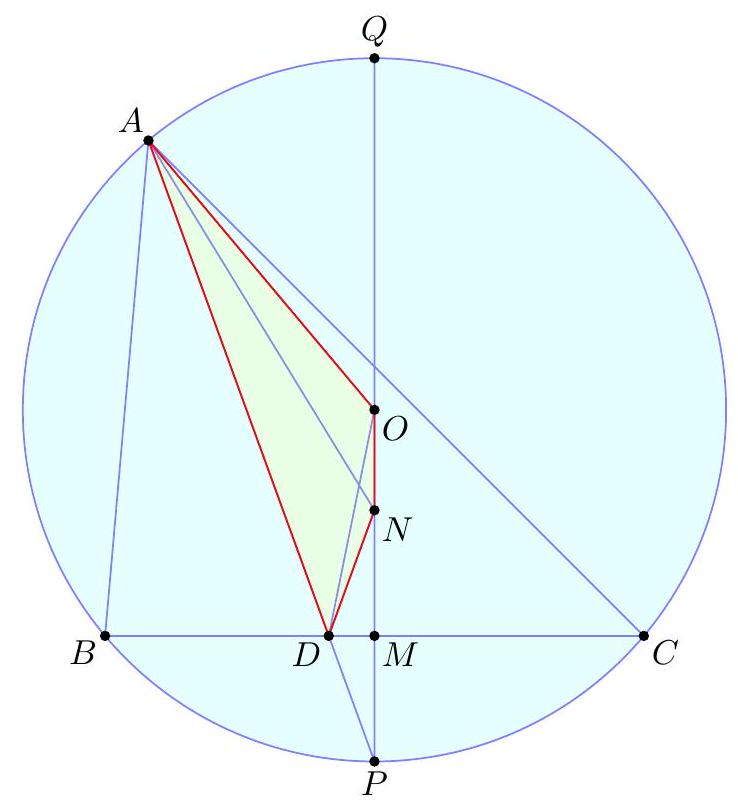
| Let $P$ and $Q$ be the arc midpoints of $\widehat{B C}$, so that $A D M Q$ is cyclic (as $\measuredangle Q A D=$ $\measuredangle Q M D=90^{\circ}$ ). Since it's known that $(B H C)$ and $(A B C)$ are reflections across line $B C$, it follows $N$ is the reflection of the arc midpoint $P$ across $M$. |
| |
| Claim - Quadrilateral $A D N O$ is cyclic. |
| |
| Proof. Since $P N \cdot P O=\frac{1}{2} P N \cdot 2 P O=P M \cdot P Q=P D \cdot P A$. |
|  |
| |
| To finish, note that $\measuredangle H A N=\measuredangle O N A=\measuredangle O D A$. |
| Remark. The orthocenter $H$ is superficial and can be deleted basically immediately. One can reverse-engineer the fact that $A D N O$ is cyclic from the truth of the problem statement. |
| |
| Remark. One can also show $A D N O$ concyclic by just computing $\measuredangle D A O=\measuredangle P A O$ and $\measuredangle D N O=\measuredangle D P N=\measuredangle A P Q$ in terms of the angles of the triangle, or even more directly just because |
| |
| $$ |
| \measuredangle D N O=\measuredangle D N P=\measuredangle N P D=\measuredangle O P D=\measuredangle O N A=\measuredangle H A N |
| $$ |
| |
| ## §2.3 JMO 2017/6, proposed by Maria Monks |
| |
| Available online at https://aops.com/community/p8117190. |
| |
| ## Problem statement |
| |
| Let $P_{1}, P_{2}, \ldots, P_{2 n}$ be $2 n$ distinct points on the unit circle $x^{2}+y^{2}=1$, other than $(1,0)$. Each point is colored either red or blue, with exactly $n$ red points and $n$ blue points. Let $R_{1}, R_{2}, \ldots, R_{n}$ be any ordering of the red points. Let $B_{1}$ be the nearest blue point to $R_{1}$ traveling counterclockwise around the circle starting from $R_{1}$. Then let $B_{2}$ be the nearest of the remaining blue points to $R_{2}$ travelling counterclockwise around the circle from $R_{2}$, and so on, until we have labeled all of the blue points $B_{1}$, $\ldots, B_{n}$. Show that the number of counterclockwise arcs of the form $R_{i} \rightarrow B_{i}$ that contain the point $(1,0)$ is independent of the way we chose the ordering $R_{1}, \ldots, R_{n}$ of the red points. |
| |
| We present two solutions, one based on swapping and one based on an invariant. |
| \ First "local" solution by swapping two points. Let $1 \leq i<n$ be any index and consider the two red points $R_{i}$ and $R_{i+1}$. There are two blue points $B_{i}$ and $B_{i+1}$ associated with them. |
| |
| Claim - If we swap the locations of points $R_{i}$ and $R_{i+1}$ then the new $\operatorname{arcs} R_{i} \rightarrow B_{i}$ and $R_{i+1} \rightarrow B_{i+1}$ will cover the same points. |
| |
| Proof. Delete all the points $R_{1}, \ldots, R_{i-1}$ and $B_{1}, \ldots, B_{i-1}$; instead focus on the positions of $R_{i}$ and $R_{i+1}$. |
| |
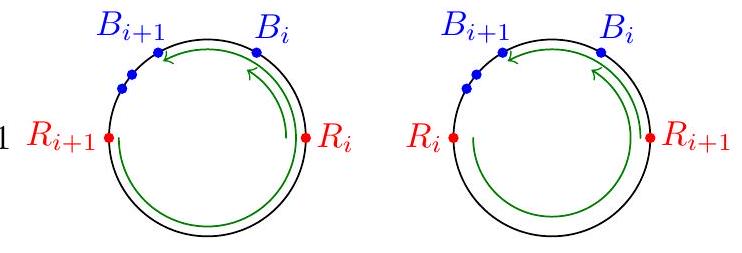
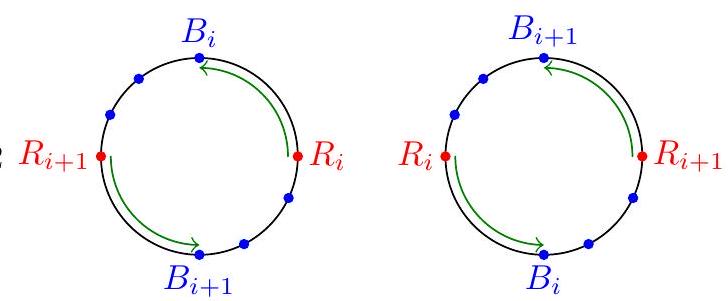
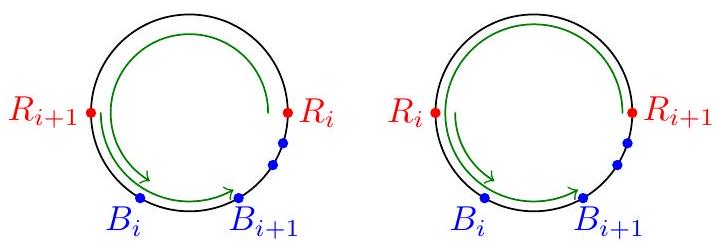
| The two blue points can then be located in three possible ways: either 0,1 , or 2 of them lie on the arc $R_{i} \rightarrow R_{i+1}$. For each of the cases below, we illustrate on the left the locations of $B_{i}$ and $B_{i+1}$ and the corresponding arcs in green; then on the right we show the modified picture where $R_{i}$ and $R_{i+1}$ have swapped. (Note that by hypothesis there are no other blue points in the green arcs). |
| |
| Case 1 |
|  |
| |
| Case 2 |
|  |
| |
| Case $3 R_{i+1}{ }^{\prime}$ |
|  |
| |
| Observe that in all cases, the number of arcs covering any given point on the circumference is not changed. Consequently, this proves the claim. |
| |
| Finally, it is enough to recall that any permutation of the red points can be achieved by swapping consecutive points (put another way: $(i i+1)$ generates the permutation group $S_{n}$ ). This solves the problem. |
| |
| Remark. This proof does not work if one tries to swap $R_{i}$ and $R_{j}$ if $|i-j| \neq 1$. For example if we swapped $R_{i}$ and $R_{i+2}$ then there are some issues caused by the possible presence of the blue point $B_{i+1}$ in the green $\operatorname{arc} R_{i+2} \rightarrow B_{i+2}$. |
| |
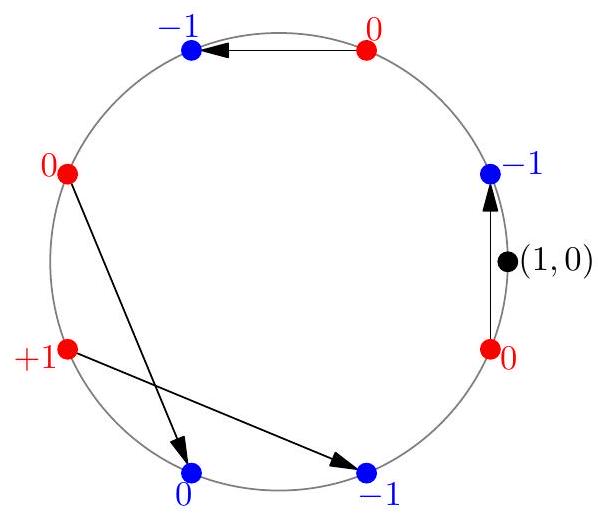
| II Second longer solution using an invariant. Visually, if we draw all the segments $R_{i} \rightarrow B_{i}$ then we obtain a set of $n$ chords. Say a chord is inverted if satisfies the problem condition, and stable otherwise. The problem contends that the number of stable/inverted chords depends only on the layout of the points and not on the choice of chords. |
|  |
| |
| In fact we'll describe the number of inverted chords explicitly. Starting from $(1,0)$ we keep a running tally of $R-B$; in other words we start the counter at 0 and decrement |
| by 1 at each blue point and increment by 1 at each red point. Let $x \leq 0$ be the lowest number ever recorded. Then: |
| |
| Claim - The number of inverted chords is $-x$ (and hence independent of the choice of chords). |
| |
| This is by induction on $n$. I think the easiest thing is to delete chord $R_{1} B_{1}$; note that the arc cut out by this chord contains no blue points. So if the chord was stable certainly no change to $x$. On the other hand, if the chord is inverted, then in particular the last point before $(1,0)$ was red, and so $x<0$. In this situation one sees that deleting the chord changes $x$ to $x+1$, as desired. |
| |
| |


