| # JMO 2018 Solution Notes |
|
|
| Evan Chen《陳誼廷》 |
|
|
| 15 April 2024 |
|
|
|
|
| #### Abstract |
|
|
| This is a compilation of solutions for the 2018 JMO. The ideas of the solution are a mix of my own work, the solutions provided by the competition organizers, and solutions found by the community. However, all the writing is maintained by me. |
|
|
| These notes will tend to be a bit more advanced and terse than the "official" solutions from the organizers. In particular, if a theorem or technique is not known to beginners but is still considered "standard", then I often prefer to use this theory anyways, rather than try to work around or conceal it. For example, in geometry problems I typically use directed angles without further comment, rather than awkwardly work around configuration issues. Similarly, sentences like "let $\mathbb{R}$ denote the set of real numbers" are typically omitted entirely. |
|
|
| Corrections and comments are welcome! |
|
|
|
|
| ## Contents |
|
|
| 0 Problems ..... 2 |
| 1 Solutions to Day 1 |
| 1.1 JMO 2018/1, proposed by Zachary Franco, Zuming Feng ..... 3 |
| 1.2 JMO 2018/2, proposed by Titu Andreescu ..... 4 |
| 1.3 JMO 2018/3, proposed by Ray Li |
| 2 Solutions to Day 2 ..... 7 |
| 2.1 JMO 2018/4, proposed by Titu Andreescu ..... 7 |
| 2.2 JMO 2018/5, proposed by Ankan Bhattacharya ..... 8 |
| 2.3 JMO 2018/6, proposed by Maria Monks Gillespie |
|
|
| ## §0 Problems |
|
|
| 1. For each positive integer $n$, find the number of $n$-digit positive integers for which no two consecutive digits are equal, and the last digit is a prime. |
| 2. Let $a, b, c$ be positive real numbers such that $a+b+c=4 \sqrt[3]{a b c}$. Prove that |
|
|
| $$ |
| 2(a b+b c+c a)+4 \min \left(a^{2}, b^{2}, c^{2}\right) \geq a^{2}+b^{2}+c^{2} |
| $$ |
|
|
| 3. Let $A B C D$ be a quadrilateral inscribed in circle $\omega$ with $\overline{A C} \perp \overline{B D}$. Let $E$ and $F$ be the reflections of $D$ over $\overline{B A}$ and $\overline{B C}$, respectively, and let $P$ be the intersection of $\overline{B D}$ and $\overline{E F}$. Suppose that the circumcircles of $E P D$ and $F P D$ meet $\omega$ at $Q$ and $R$ different from $D$. Show that $E Q=F R$. |
| 4. Find all real numbers $x$ for which there exists a triangle $A B C$ with circumradius 2 , such that $\angle A B C \geq 90^{\circ}$, and |
|
|
| $$ |
| x^{4}+a x^{3}+b x^{2}+c x+1=0 |
| $$ |
|
|
| where $a=B C, b=C A, c=A B$. |
| 5. Let $p$ be a prime, and let $a_{1}, \ldots, a_{p}$ be integers. Show that there exists an integer $k$ such that the numbers |
|
|
| $$ |
| a_{1}+k, a_{2}+2 k, \ldots, a_{p}+p k |
| $$ |
| |
| produce at least $\frac{1}{2} p$ distinct remainders upon division by $p$. |
| 6. Karl starts with $n$ cards labeled $1,2, \ldots, n$ lined up in random order on his desk. He calls a pair $(a, b)$ of cards swapped if $a>b$ and the card labeled $a$ is to the left of the card labeled $b$. |
| Karl picks up the card labeled 1 and inserts it back into the sequence in the opposite position: if the card labeled 1 had $i$ cards to its left, then it now has $i$ cards to its right. He then picks up the card labeled 2 and reinserts it in the same manner, and so on, until he has picked up and put back each of the cards $1, \ldots, n$ exactly once in that order. |
| For example, if $n=4$, then one example of a process is |
| |
| $$ |
| 3142 \longrightarrow 3412 \longrightarrow 2341 \longrightarrow 2431 \longrightarrow 2341 |
| $$ |
| |
| which has three swapped pairs both before and after. |
| Show that, no matter what lineup of cards Karl started with, his final lineup has the same number of swapped pairs as the starting lineup. |
| |
| ## §1 Solutions to Day 1 |
| |
| ## §1.1 JMO 2018/1, proposed by Zachary Franco, Zuming Feng |
| |
| Available online at https://aops.com/community/p10226138. |
| |
| ## Problem statement |
| |
| For each positive integer $n$, find the number of $n$-digit positive integers for which no two consecutive digits are equal, and the last digit is a prime. |
| |
| Almost trivial. Let $a_{n}$ be the desired answer. We have |
|
|
| $$ |
| a_{n}+a_{n-1}=4 \cdot 9^{n-1} |
| $$ |
|
|
| for all $n$, by padding the $(n-1)$ digit numbers with a leading zero. |
| Since $a_{0}=0, a_{1}=4$, solving the recursion gives |
|
|
| $$ |
| a_{n}=\frac{2}{5}\left(9^{n}-(-1)^{n}\right) |
| $$ |
| |
| The end. |
| Remark. For concreteness, the first few terms are $0,4,32,292, \ldots$. |
| |
| ## §1.2 JMO 2018/2, proposed by Titu Andreescu |
| |
| Available online at https://aops.com/community/p10226140. |
| |
| ## Problem statement |
| |
| Let $a, b, c$ be positive real numbers such that $a+b+c=4 \sqrt[3]{a b c}$. Prove that |
| |
| $$ |
| 2(a b+b c+c a)+4 \min \left(a^{2}, b^{2}, c^{2}\right) \geq a^{2}+b^{2}+c^{2} |
| $$ |
| |
| WLOG let $c=\min (a, b, c)=1$ by scaling. The given inequality becomes equivalent to |
| |
| $$ |
| 4 a b+2 a+2 b+3 \geq(a+b)^{2} \quad \forall a+b=4(a b)^{1 / 3}-1 |
| $$ |
| |
| Now, let $t=(a b)^{1 / 3}$ and eliminate $a+b$ using the condition, to get |
| |
| $$ |
| 4 t^{3}+2(4 t-1)+3 \geq(4 t-1)^{2} \Longleftrightarrow 0 \leq 4 t^{3}-16 t^{2}+16 t=4 t(t-2)^{2} |
| $$ |
| |
| which solves the problem. |
| Equality occurs only if $t=2$, meaning $a b=8$ and $a+b=7$, which gives |
| |
| $$ |
| \{a, b\}=\left\{\frac{7 \pm \sqrt{17}}{2}\right\} |
| $$ |
| |
| with the assumption $c=1$. Scaling gives the curve of equality cases. |
| |
| ## §1.3 JMO 2018/3, proposed by Ray Li |
| |
| Available online at https://aops.com/community/p10226149. |
| |
| ## Problem statement |
| |
| Let $A B C D$ be a quadrilateral inscribed in circle $\omega$ with $\overline{A C} \perp \overline{B D}$. Let $E$ and $F$ be the reflections of $D$ over $\overline{B A}$ and $\overline{B C}$, respectively, and let $P$ be the intersection of $\overline{B D}$ and $\overline{E F}$. Suppose that the circumcircles of $E P D$ and $F P D$ meet $\omega$ at $Q$ and $R$ different from $D$. Show that $E Q=F R$. |
| |
| Most of this problem is about realizing where the points $P, Q, R$ are. |
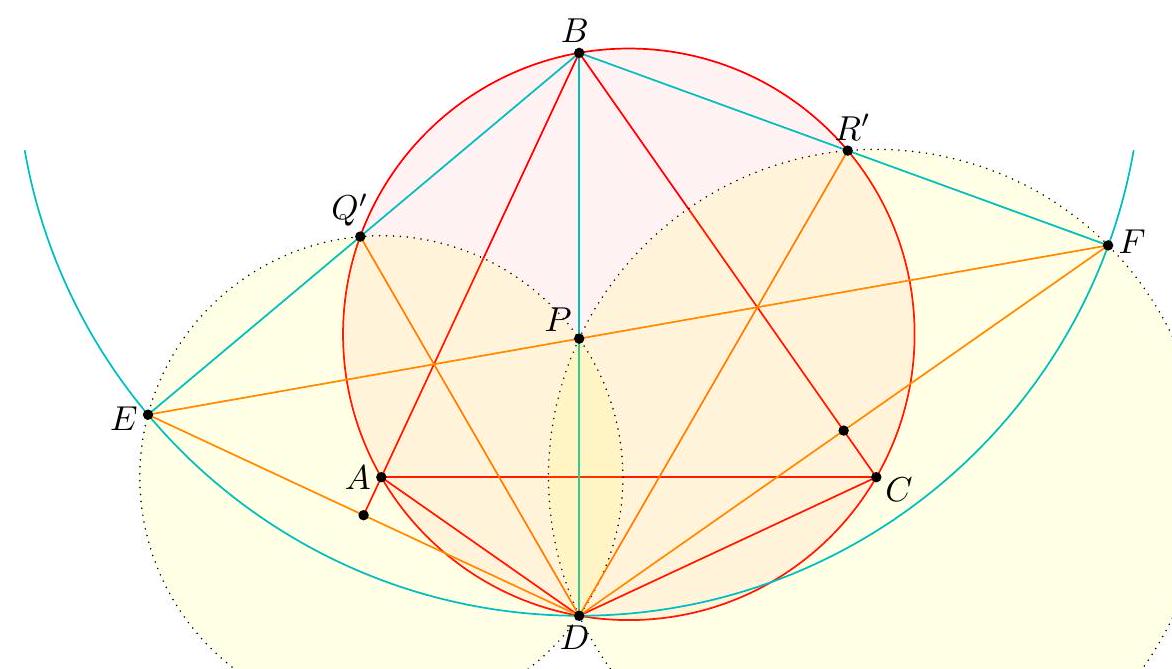
| 【 First solution (Evan Chen). Let $X, Y$, be the feet from $D$ to $\overline{B A}, \overline{B C}$, and let $Z=\overline{B D} \cap \overline{A C}$. By Simson theorem, the points $X, Y, Z$ are collinear. Consequently, the point $P$ is the reflection of $D$ over $Z$, and so we conclude $P$ is the orthocenter of $\triangle A B C$. |
|  |
| |
| Suppose now we extend ray $C P$ to meet $\omega$ again at $Q^{\prime}$. Then $\overline{B A}$ is the perpendicular bisector of both $\overline{P Q^{\prime}}$ and $\overline{D E}$; consequently, $P Q^{\prime} E D$ is an isosceles trapezoid. In particular, it is cyclic, and so $Q^{\prime}=Q$. In the same way $R$ is the second intersection of ray $\overline{A P}$ with $\omega$. |
| |
| Now, because of the two isosceles trapezoids we have found, we conclude |
| |
| $$ |
| E Q=P D=F R |
| $$ |
| |
| as desired. |
| Remark. Alternatively, after identifying $P$, one can note $\overline{B Q E}$ and $\overline{B R F}$ are collinear. Since $B E=B D=B F$, upon noticing $B Q=B P=B R$ we are also done. |
| |
| 【I Second solution (Danielle Wang). Here is a solution which does not identify the point $P$ at all. We know that $B E=B D=B F$, by construction. |
|  |
| |
| Claim - The points $B, Q, E$ are collinear. Similarly the points $B, R, F$ are collinear. |
| |
| Proof. Work directed modulo $180^{\circ}$. Let $Q^{\prime}$ be the intersection of $\overline{B E}$ with $(A B C D)$. Let $\alpha=\measuredangle D E B=\measuredangle B D E$ and $\beta=\measuredangle B F D=\measuredangle F D B$. |
| |
| Observe that $B E=B D=B F$, so $B$ is the circumcenter of $\triangle D E F$. Thus, $\measuredangle D E P=$ $\measuredangle D E F=90^{\circ}-\beta$. Then |
| |
| $$ |
| \begin{aligned} |
| \measuredangle D P E & =\measuredangle D E P+\measuredangle P D E=\left(90^{\circ}-\beta\right)+\alpha \\ |
| & =\alpha-\beta+90^{\circ} \\ |
| \measuredangle D Q^{\prime} B & =\measuredangle D C B=\measuredangle D C A+\measuredangle A C B \\ |
| & =\measuredangle D B A-\left(90^{\circ}-\measuredangle D B C\right)=-\left(90^{\circ}-\alpha\right)-\left(90^{\circ}-\left(90^{\circ}-\beta\right)\right) \\ |
| & =\alpha-\beta+90^{\circ} . |
| \end{aligned} |
| $$ |
| |
| Thus $Q^{\prime}$ lies on the desired circle, so $Q^{\prime}=Q$. |
| Now, by power of a point we have $B Q \cdot B E=B P \cdot B D=B R \cdot B F$, so $B Q=B P=B R$. Hence $E Q=P D=F R$. |
| |
| ## §2 Solutions to Day 2 |
| |
| ## §2.1 JMO 2018/4, proposed by Titu Andreescu |
| |
| Available online at https://aops.com/community/p10232384. |
| |
| ## Problem statement |
| |
| Find all real numbers $x$ for which there exists a triangle $A B C$ with circumradius 2 , such that $\angle A B C \geq 90^{\circ}$, and |
| |
| $$ |
| x^{4}+a x^{3}+b x^{2}+c x+1=0 |
| $$ |
| |
| where $a=B C, b=C A, c=A B$. |
| |
| The answer is $x=-\frac{1}{2}(\sqrt{6} \pm \sqrt{2})$. |
| We prove this the only possible answer. Evidently $x<0$. Now, note that |
| |
| $$ |
| a^{2}+c^{2} \leq b^{2} \leq 4 b |
| $$ |
| |
| since $b \leq 4$ (the diameter of its circumcircle). Then, |
| |
| $$ |
| \begin{aligned} |
| 0 & =x^{4}+a x^{3}+b x^{2}+c x+1 \\ |
| & =x^{2}\left[\left(x+\frac{1}{2} a\right)^{2}+\left(\frac{1}{x}+\frac{1}{2} c\right)^{2}+\left(b-\frac{a^{2}+c^{2}}{4}\right)\right] \\ |
| & \geq 0+0+0=0 |
| \end{aligned} |
| $$ |
| |
| In order for equality to hold, we must have $x=-\frac{1}{2} a, 1 / x=-\frac{1}{2} c$, and $a^{2}+c^{2}=b^{2}=4 b$. This gives us $b=4, a c=4, a^{2}+c^{2}=16$. Solving for $a, c>0$ implies |
| |
| $$ |
| \{a, c\}=\{\sqrt{6} \pm \sqrt{2}\} |
| $$ |
| |
| This gives the $x$ values claimed above; by taking $a, b, c$ as deduced here, we find they work too. |
| |
| Remark. Note that by perturbing $\triangle A B C$ slightly, we see $a$ priori that the set of possible $x$ should consist of unions of intervals (possibly trivial). So it makes sense to try inequalities no matter what. |
| |
| ## §2.2 JMO 2018/5, proposed by Ankan Bhattacharya |
| |
| Available online at https://aops.com/community/p10232389. |
| |
| ## Problem statement |
| |
| Let $p$ be a prime, and let $a_{1}, \ldots, a_{p}$ be integers. Show that there exists an integer $k$ such that the numbers |
| |
| $$ |
| a_{1}+k, a_{2}+2 k, \ldots, a_{p}+p k |
| $$ |
|
|
| produce at least $\frac{1}{2} p$ distinct remainders upon division by $p$. |
|
|
| For each $k=0, \ldots, p-1$ let $G_{k}$ be the graph on $\{1, \ldots, p\}$ where we join $\{i, j\}$ if and only if |
| |
| $$ |
| a_{i}+i k \equiv a_{j}+j k \quad(\bmod p) \Longleftrightarrow k \equiv-\frac{a_{i}-a_{j}}{i-j} \quad(\bmod p) |
| $$ |
| |
| So we want a graph $G_{k}$ with at least $\frac{1}{2} p$ connected components. |
| However, each $\{i, j\}$ appears in exactly one graph $G_{k}$, so some graph has at most $\frac{1}{p}\binom{p}{2}=\frac{1}{2}(p-1)$ edges (by "pigeonhole"). This graph has at least $\frac{1}{2}(p+1)$ connected components, as desired. |
| |
| Remark. Here is an example for $p=5$ showing equality can occur: |
| |
| $$ |
| \left[\begin{array}{lllll} |
| 0 & 0 & 3 & 4 & 3 \\ |
| 0 & 1 & 0 & 2 & 2 \\ |
| 0 & 2 & 2 & 0 & 1 \\ |
| 0 & 3 & 4 & 3 & 0 \\ |
| 0 & 4 & 1 & 1 & 4 |
| \end{array}\right] . |
| $$ |
| |
| Ankan Bhattacharya points out more generally that $a_{i}=i^{2}$ is sharp in general. |
|
|
| ## §2.3 JMO 2018/6, proposed by Maria Monks Gillespie |
|
|
| Available online at https://aops.com/community/p10232393. |
|
|
| ## Problem statement |
|
|
| Karl starts with $n$ cards labeled $1,2, \ldots, n$ lined up in random order on his desk. He calls a pair $(a, b)$ of cards swapped if $a>b$ and the card labeled $a$ is to the left of the card labeled $b$. |
|
|
| Karl picks up the card labeled 1 and inserts it back into the sequence in the opposite position: if the card labeled 1 had $i$ cards to its left, then it now has $i$ cards to its right. He then picks up the card labeled 2 and reinserts it in the same manner, and so on, until he has picked up and put back each of the cards $1, \ldots, n$ exactly once in that order. |
|
|
| For example, if $n=4$, then one example of a process is |
|
|
| $$ |
| 3142 \longrightarrow 3412 \longrightarrow 2341 \longrightarrow 2431 \longrightarrow 2341 |
| $$ |
|
|
| which has three swapped pairs both before and after. |
| Show that, no matter what lineup of cards Karl started with, his final lineup has the same number of swapped pairs as the starting lineup. |
|
|
| The official solution is really tricky. Call the process $P$. |
| We define a new process $P^{\prime}$ where, when re-inserting card $i$, we additionally change its label from $i$ to $n+i$. An example of $P^{\prime}$ also starting with 3142 is: |
|
|
| $$ |
| 3142 \longrightarrow 3452 \longrightarrow 6345 \longrightarrow 6475 \longrightarrow 6785 . |
| $$ |
|
|
| Note that now, each step of $P^{\prime}$ preserves the number of inversions. Moreover, the final configuration of $P^{\prime}$ is the same as the final configuration of $P$ with all cards incremented by $n$, and of course thus has the same number of inversions. Boom. |
|
|
|
|


