| # JMO 2019 Solution Notes |
|
|
| Evan Chen《陳誼廷》 |
|
|
| 15 April 2024 |
|
|
|
|
| #### Abstract |
|
|
| This is a compilation of solutions for the 2019 JMO. The ideas of the solution are a mix of my own work, the solutions provided by the competition organizers, and solutions found by the community. However, all the writing is maintained by me. |
|
|
| These notes will tend to be a bit more advanced and terse than the "official" solutions from the organizers. In particular, if a theorem or technique is not known to beginners but is still considered "standard", then I often prefer to use this theory anyways, rather than try to work around or conceal it. For example, in geometry problems I typically use directed angles without further comment, rather than awkwardly work around configuration issues. Similarly, sentences like "let $\mathbb{R}$ denote the set of real numbers" are typically omitted entirely. |
|
|
| Corrections and comments are welcome! |
|
|
|
|
| ## Contents |
|
|
| 0 Problems |
| 1 Solutions to Day 1 |
| 1.1 JMO 2019/1, proposed by Jim Propp ..... 3 |
| 1.2 JMO 2019/2, proposed by Ankan Bhattacharya ..... 5 |
| 1.3 JMO 2019/3, proposed by Ankan Bhattacharya ..... 7 |
| 2 Solutions to Day 2 ..... 10 |
| 2.1 JMO 2019/4, proposed by Ankan Bhattacharya, Zack Chroman, Anant Mudgal ..... 10 |
| 2.2 JMO 2019/5, proposed by Ricky Liu ..... 14 |
| 2.3 JMO 2019/6, proposed by Yannick Yao ..... 15 |
|
|
| ## §0 Problems |
|
|
| 1. There are $a+b$ bowls arranged in a row, numbered 1 through $a+b$, where $a$ and $b$ are given positive integers. Initially, each of the first $a$ bowls contains an apple, and each of the last $b$ bowls contains a pear. A legal move consists of moving an apple from bowl $i$ to bowl $i+1$ and a pear from bowl $j$ to bowl $j-1$, provided that the difference $i-j$ is even. We permit multiple fruits in the same bowl at the same time. The goal is to end up with the first $b$ bowls each containing a pear and the last $a$ bowls each containing an apple. Show that this is possible if and only if the product $a b$ is even. |
| 2. For which pairs of integers $(a, b)$ do there exist functions $f: \mathbb{Z} \rightarrow \mathbb{Z}$ and $g: \mathbb{Z} \rightarrow \mathbb{Z}$ obeying |
|
|
| $$ |
| f(g(x))=x+a \quad \text { and } \quad g(f(x))=x+b |
| $$ |
|
|
| for all integers $x$ ? |
| 3. Let $A B C D$ be a cyclic quadrilateral satisfying $A D^{2}+B C^{2}=A B^{2}$. The diagonals of $A B C D$ intersect at $E$. Let $P$ be a point on side $\overline{A B}$ satisfying $\angle A P D=\angle B P C$. Show that line $P E$ bisects $\overline{C D}$. |
| 4. Let $A B C$ be a triangle with $\angle B>90^{\circ}$ and let $E$ and $F$ be the feet of the altitudes from $B$ and $C$. Can line $E F$ be tangent to the $A$-excircle? |
| 5. Let $n$ be a nonnegative integer. Determine the number of ways to choose sets $S_{i j} \subseteq\{1,2, \ldots, 2 n\}$, for all $0 \leq i \leq n$ and $0 \leq j \leq n$ (not necessarily distinct), such that |
| |
| - $\left|S_{i j}\right|=i+j$, and |
| - $S_{i j} \subseteq S_{k l}$ if $0 \leq i \leq k \leq n$ and $0 \leq j \leq l \leq n$. |
|
|
| 6. Let $m$ and $n$ be relatively prime positive integers. The numbers $\frac{m}{n}$ and $\frac{n}{m}$ are written on a blackboard. At any point, Evan may pick two of the numbers $x$ and $y$ written on the board and write either their arithmetic mean $\frac{1}{2}(x+y)$ or their harmonic mean $\frac{2 x y}{x+y}$. For which $(m, n)$ can Evan write 1 on the board in finitely many steps? |
|
|
| ## §1 Solutions to Day 1 |
|
|
| ## §1.1 JMO 2019/1, proposed by Jim Propp |
|
|
| Available online at https://aops.com/community/p12189456. |
|
|
| ## Problem statement |
|
|
| There are $a+b$ bowls arranged in a row, numbered 1 through $a+b$, where $a$ and $b$ are given positive integers. Initially, each of the first $a$ bowls contains an apple, and each of the last $b$ bowls contains a pear. A legal move consists of moving an apple from bowl $i$ to bowl $i+1$ and a pear from bowl $j$ to bowl $j-1$, provided that the difference $i-j$ is even. We permit multiple fruits in the same bowl at the same time. The goal is to end up with the first $b$ bowls each containing a pear and the last $a$ bowls each containing an apple. Show that this is possible if and only if the product $a b$ is even. |
|
|
| First we show that if $a b$ is even then the goal is possible. We prove the result by induction on $a+b$. |
|
|
| - If $\min (a, b)=0$ there is nothing to check. |
| - If $\min (a, b)=1$, say $a=1$, then $b$ is even, and we can swap the (only) leftmost apple with the rightmost pear by working only with those fruits. |
| - Now assume $\min (a, b) \geq 2$ and $a+b$ is odd. Then we can swap the leftmost apple with rightmost pear by working only with those fruits, reducing to the situation of $(a-1, b-1)$ which is possible by induction (at least one of them is even). |
| - Finally assume $\min (a, b) \geq 2$ and $a+b$ is even (i.e. $a$ and $b$ are both even). Then we can swap the apple in position 1 with the pear in position $a+b-1$, and the apple in position 2 with the pear in position $a+b$. This reduces to the situation of $(a-2, b-2)$ which is also possible by induction. |
|
|
| Now we show that the result is impossible if $a b$ is odd. Define |
|
|
| $$ |
| \begin{aligned} |
| & X=\text { number apples in odd-numbered bowls } \\ |
| & Y=\text { number pears in odd-numbered bowls. } |
| \end{aligned} |
| $$ |
|
|
| Note that $X-Y$ does not change under this operation. However, if $a$ and $b$ are odd, then we initially have $X=\frac{1}{2}(a+1)$ and $Y=\frac{1}{2}(b-1)$, while the target position has $X=\frac{1}{2}(a-1)$ and $Y=\frac{1}{2}(b+1)$. So when $a b$ is odd this is not possible. |
|
|
| Remark. Another proof that $a b$ must be even is as follows. |
| First, note that apples only move right and pears only move left, a successful operation must take exactly $a b$ moves. So it is enough to prove that the number of moves made must be even. |
|
|
| However, the number of fruits in odd-numbered bowls either increases by +2 or -2 in each move (according to whether $i$ and $j$ are both even or both odd), and since it ends up being the same at the end, the number of moves must be even. |
|
|
| Alternatively, as pointed out in the official solutions, one can consider the sums of squares of positions of fruits. The quantity changes by |
|
|
| $$ |
| \left[(i+1)^{2}+(j-1)^{2}\right]-\left(i^{2}+j^{2}\right)=2(i-j)+2 \equiv 2(\bmod 4) |
| $$ |
|
|
| at each step, and eventually the sums of squares returns to zero, as needed. |
|
|
| ## §1.2 JMO 2019/2, proposed by Ankan Bhattacharya |
|
|
| Available online at https://aops.com/community/p12189493. |
|
|
| ## Problem statement |
|
|
| For which pairs of integers $(a, b)$ do there exist functions $f: \mathbb{Z} \rightarrow \mathbb{Z}$ and $g: \mathbb{Z} \rightarrow \mathbb{Z}$ obeying |
|
|
| $$ |
| f(g(x))=x+a \quad \text { and } \quad g(f(x))=x+b |
| $$ |
|
|
| for all integers $x$ ? |
|
|
| The answer is if $a=b$ or $a=-b$. In the former case, one can take $f(x) \equiv x+a$ and $g(x) \equiv x$. In the latter case, one can take $f(x) \equiv-x+a$ and $g(x)=-x$. |
|
|
| Now we prove these are the only possibilities. First: |
| Claim - The functions $f$ and $g$ are bijections. |
| Proof. Surjectivity is obvious. To see injective, note that if $f(u)=f(v)$ then $g(f(u))=$ $g(f(v)) \Longrightarrow u+b=v+b \Longrightarrow u=v$, and similarly for $g$. |
|
|
| Note also that for any $x$, we have |
|
|
| $$ |
| \begin{aligned} |
| & f(x+b)=f(g(f(x)))=f(x)+a \\ |
| & g(x+a)=g(f(g(x)))=g(x)+b . |
| \end{aligned} |
| $$ |
|
|
| If either $a$ is zero or $b$ is zero, we immediately get the other is zero, and hence done. So assume $a b \neq 0$. |
|
|
| If $|b|>|a|$, then two of |
|
|
| $$ |
| \{f(0), f(1), \ldots, f(b-1)\} \quad(\bmod |a|) |
| $$ |
|
|
| coincide, which together with repeatedly applying the first equation above will then give a contradiction to injectivity of $f$. Similarly, if $|a|>|b|$ swapping the roles of $f$ and $g$ (and $a$ and $b$ ) will give a contradiction to injectivity of $g$. This completes the proof. |
|
|
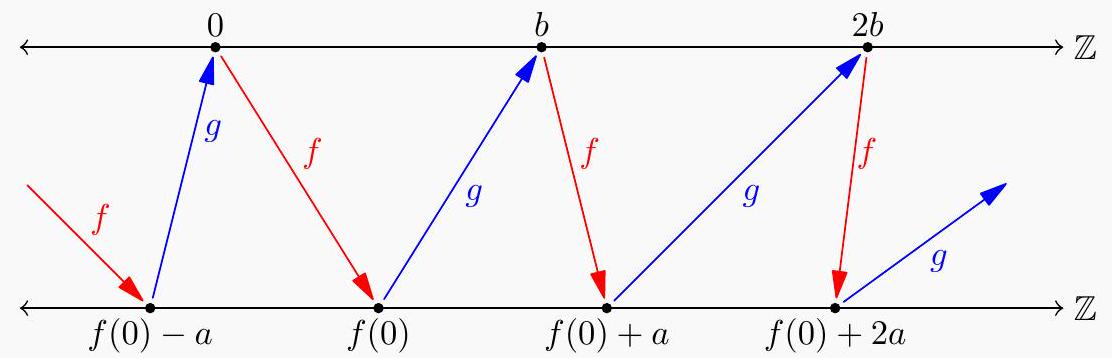
| Remark. Here is a way to visualize the argument, so one can see pictorially what is going on. We draw two parallel number lines indexed by $\mathbb{Z}$. Starting from 0 , we draw red arrow from 0 to $f(0)$, and then a blue arrow from $f(0)$ to $g(f(0))=b$, and then a red arrow from $b$ to $g(b)=f(0)+a$, and so on. These arrows can be extended both directions, leading to an infinite "squaretooth" wave. The following is a picture of an example with $a, b>0$. |
|  |
|
|
| The problem is essentially trying to decompose our two copies of $\mathbb{Z}$ into multiple squaretooth |
| waves. For this to be possible, we expect the "width" of the waves on the top and bottom must be the same - i.e., that $|a|=|b|$. |
|
|
| Remark. This also suggests how to classify all functions $f$ and $g$ satisfying the condition. If $a=b=0$ then any pair of functions $f$ and $g$ which are inverses to each other is okay. There are thus uncountably many pairs of functions $(f, g)$ here. |
|
|
| If $a=b>0$, then one sets $f(0), f(1), \ldots, f(a-1)$ as any values which are distinct modulo $b$, at which point $f$ and $g$ are uniquely determined. An example for $a=b=3$ is |
|
|
| $$ |
| f(x)=\left\{\begin{array}{lll} |
| x+42 & x \equiv 0 & (\bmod 3) \\ |
| x+13 & x \equiv 1 & (\bmod 3) \\ |
| x-37 & x \equiv 2 & (\bmod 3), |
| \end{array} \quad g(x)=\left\{\begin{array}{lll} |
| x-39 & x \equiv 0 & (\bmod 3) \\ |
| x+40 & x \equiv 1 & (\bmod 3) \\ |
| x-10 & x \equiv 2 & (\bmod 3) |
| \end{array}\right.\right. |
| $$ |
|
|
| The analysis for $a=b<0$ and $a=-b$ are similar, but we don't include the details here. |
|
|
| ## §1.3 JMO 2019/3, proposed by Ankan Bhattacharya |
|
|
| Available online at https://aops.com/community/p12189455. |
|
|
| ## Problem statement |
|
|
| Let $A B C D$ be a cyclic quadrilateral satisfying $A D^{2}+B C^{2}=A B^{2}$. The diagonals of $A B C D$ intersect at $E$. Let $P$ be a point on side $\overline{A B}$ satisfying $\angle A P D=\angle B P C$. Show that line $P E$ bisects $\overline{C D}$. |
|
|
| Here are three solutions. The first two are similar although the first one makes use of symmedians. The last solution by inversion is more advanced. |
|
|
| 【 First solution using symmedians. We define point $P$ to obey |
|
|
| $$ |
| \frac{A P}{B P}=\frac{A D^{2}}{B C^{2}}=\frac{A E^{2}}{B E^{2}} |
| $$ |
|
|
| so that $\overline{P E}$ is the $E$-symmedian of $\triangle E A B$, therefore the $E$-median of $\triangle E C D$. |
| Now, note that |
|
|
| $$ |
| A D^{2}=A P \cdot A B \quad \text { and } \quad B C^{2}=B P \cdot B A |
| $$ |
|
|
| This implies $\triangle A P D \sim \triangle A D B$ and $\triangle B P C \sim \triangle B C A$. Thus |
|
|
| $$ |
| \measuredangle D P A=\measuredangle A D B=\measuredangle A C B=\measuredangle B C P |
| $$ |
|
|
| and so $P$ satisfies the condition as in the statement (and is the unique point to do so), as needed. |
|
|
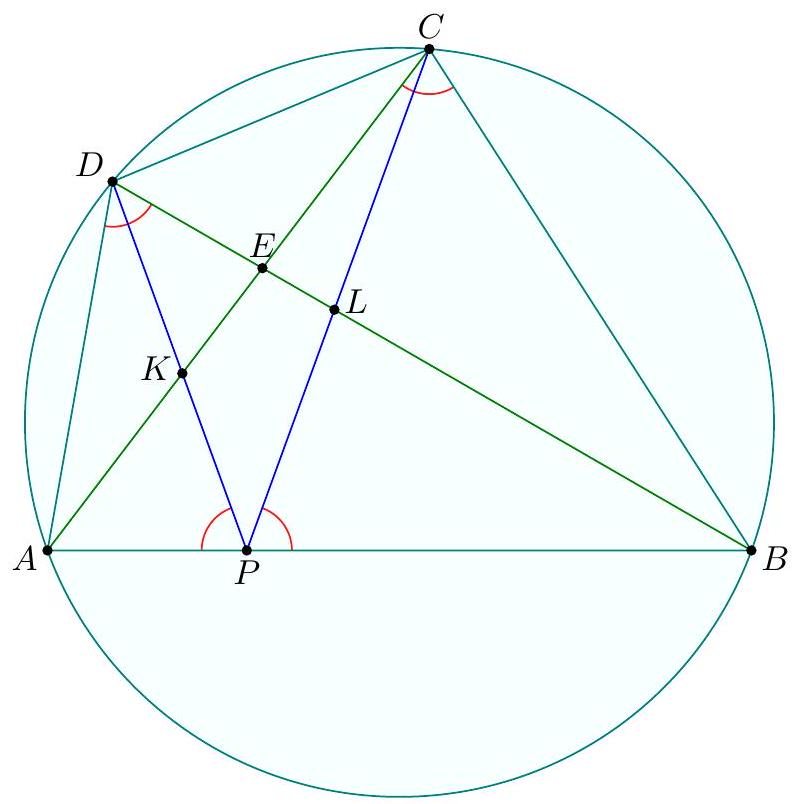
| 【 Second solution using only angle chasing (by proposer). We again re-define $P$ to obey $A D^{2}=A P \cdot A B$ and $B C^{2}=B P \cdot B A$. As before, this gives $\triangle A P D \sim \triangle A B D$ and $\triangle B P C \sim \triangle B D P$ and so we let |
|
|
| $$ |
| \theta:=\measuredangle D P A=\measuredangle A D B=\measuredangle A C B=\measuredangle B C P . |
| $$ |
|
|
| Our goal is to now show $\overline{P E}$ bisects $\overline{C D}$. |
| Let $K=\overline{A C} \cap \overline{P D}$ and $L=\overline{A D} \cap \overline{P C}$. Since $\measuredangle K P A=\theta=\measuredangle A C B$, quadrilateral $B P K C$ is cyclic. Similarly, so is $A P L D$. |
|  |
|
|
| Finally $A K L B$ is cyclic since |
|
|
| $$ |
| \measuredangle B K A=\measuredangle B K C=\measuredangle B P C=\theta=\measuredangle D P A=\measuredangle D L A=\measuredangle B L A . |
| $$ |
|
|
| This implies $\measuredangle C K L=\measuredangle L B A=\measuredangle D C K$, so $\overline{K L} \| \overline{B C}$. Then $P E$ bisects $\overline{B C}$ by Ceva's theorem on $\triangle P C D$. |
|
|
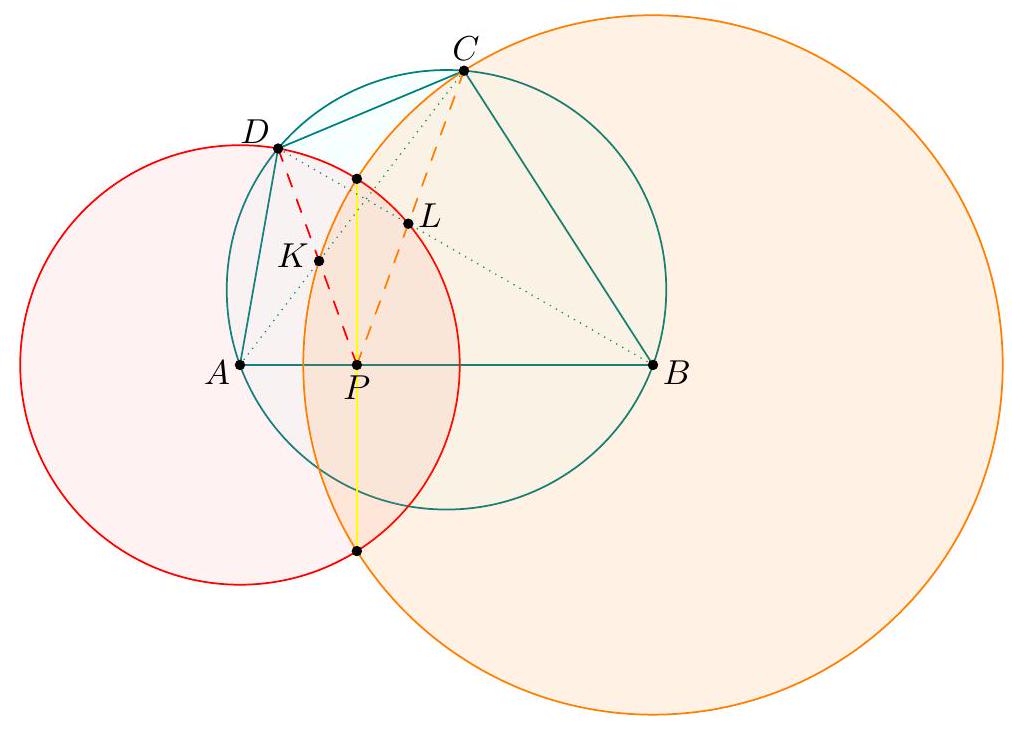
| 【 Third solution (using inversion). By hypothesis, the circle $\omega_{a}$ centered at $A$ with radius $A D$ is orthogonal to the circle $\omega_{b}$ centered at $B$ with radius $B C$. For brevity, we let $\mathbf{I}_{a}$ and $\mathbf{I}_{b}$ denote inversion with respect to $\omega_{a}$ and $\omega_{b}$. |
| We let $P$ denote the intersection of $\overline{A B}$ with the radical axis of $\omega_{a}$ and $\omega_{b}$; hence $P=\mathbf{I}_{a}(B)=\mathbf{I}_{b}(A)$. This already implies that |
|
|
| $$ |
| \measuredangle D P A \stackrel{\mathbf{I}_{a}}{=} \measuredangle A D B=\measuredangle A C B \stackrel{\mathbf{I}_{b}}{=} \measuredangle B P C |
| $$ |
|
|
| so $P$ satisfies the angle condition. |
|  |
|
|
| Claim - The point $K=\mathbf{I}_{a}(C)$ lies on $\omega_{b}$ and $\overline{D P}$. Similarly $L=\mathbf{I}_{b}(D)$ lies on $\omega_{a}$ and $\overline{C P}$. |
|
|
| Proof. The first assertion follows from the fact that $\omega_{b}$ is orthogonal to $\omega_{a}$. For the other, since $(B C D)$ passes through $A$, it follows $P=\mathbf{I}_{a}(B), K=\mathbf{I}_{a}(C)$, and $D=\mathbf{I}_{a}(D)$ are collinear. |
| |
| Finally, since $C, L, P$ are collinear, we get $A$ is concyclic with $K=\mathbf{I}_{a}(C), L=\mathbf{I}_{a}(L)$, $B=\mathbf{I}_{a}(P)$, i.e. that $A K L B$ is cyclic. So $\overline{K L} \| \overline{C D}$ by Reim's theorem, and hence $\overline{P E}$ bisects $\overline{C D}$ by Ceva's theorem. |
|
|
| ## §2 Solutions to Day 2 |
|
|
| ## §2.1 JMO 2019/4, proposed by Ankan Bhattacharya, Zack Chroman, Anant Mudgal |
|
|
| Available online at https://aops.com/community/p12195848. |
|
|
| ## Problem statement |
|
|
| Let $A B C$ be a triangle with $\angle B>90^{\circ}$ and let $E$ and $F$ be the feet of the altitudes from $B$ and $C$. Can line $E F$ be tangent to the $A$-excircle? |
|
|
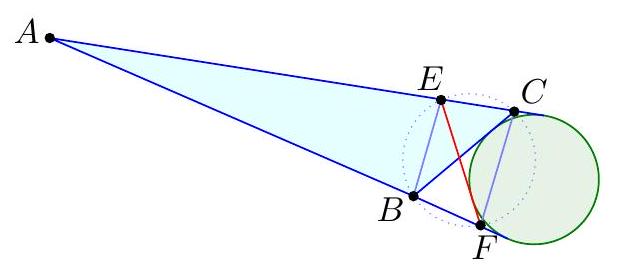
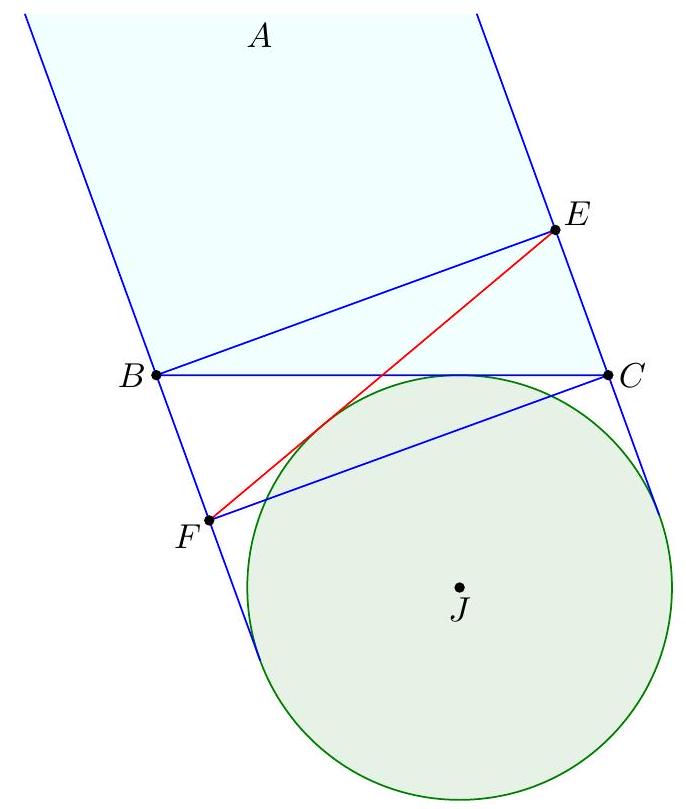
| We show it is not possible, by contradiction (assuming $E F$ is indeed tangent). Thus $B E C F$ is a convex cyclic quadrilateral inscribed in a circle with diameter $\overline{B C}$. Note also that the $A$-excircle lies on the opposite side from $A$ as line $E F$, since $A, E, C$ are collinear in that order. |
|
|
| 【 First solution by similarity. Note that $\triangle A E F$ is similar to $\triangle A B C$ (and oppositely oriented). However, since they have the same $A$-exradius, it follows they are congruent. |
|  |
|
|
| Consequently we get $E F=B C$. But this implies $B F C E$ is a rectangle, contradiction. |
| 【 Second length solution by tangent lengths. By $t(\bullet)$ we mean the length of the tangent from $P$ to the $A$-excircle. It is a classical fact for example that $t(A)=s$. The main idea is to use the fact that |
|
|
| $$ |
| a \cos A=E F=t(E)+t(F) . |
| $$ |
|
|
| Here $E F=a \cos A$ follows from the extended law of sines applied to the circle with diameter $\overline{B C}$, since there we have $E F=B C \sin \angle E C F=a \sin \angle A C F=a \cos A$. We may now compute |
|
|
| $$ |
| \begin{aligned} |
| & t(E)=t(A)-A E=s-c \cos A \\ |
| & t(F)=t(A)-A F=s-b \cos A |
| \end{aligned} |
| $$ |
|
|
| Therefore, |
|
|
| $$ |
| \begin{aligned} |
| a \cos A=2 s-(b+c) \cos A \Longrightarrow \quad(a+b+c) \cos A & =2 s \\ |
| \Longrightarrow \cos A & =1 . |
| \end{aligned} |
| $$ |
|
|
| This is an obvious contradiction. |
| Remark. On the other hand, there really is an equality case with $A$ being some point at infinity (meaning $\cos A=1$ ). So, this problem is "sharper" than one might expect; the answer is not "obviously no". |
|
|
| I Third solution by Pitot and trigonometry. In fact, the $t(\bullet)$ notation from the previous solution gives us a classical theorem once we note the $A$-excircle is tangent to all four lines $E F, B C, B F$ and $C E$ : |
|
|
| Claim (Pitot theorem) - We have $B F+E F=B C+C E$. |
|
|
| Proof. Here is a proof for completeness. By $t(B)$ we mean the length of the tangent from $B$ to the $A$-excircle, and define $t(C), t(E), t(F)$ similarly. Then |
|
|
| $$ |
| \begin{array}{ll} |
| B F=t(B)-t(F) & E F=t(E)+t(F) \\ |
| B C=t(B)+t(C) & C E=t(E)-t(C) |
| \end{array} |
| $$ |
|
|
| and summing gives the result. |
|  |
|
|
| We now calculate all the lengths using trigonometry: |
|
|
| $$ |
| \begin{aligned} |
| & B C=a \\ |
| & B F=a \cos \left(180^{\circ}-B\right)=a \cos (A+C) \\ |
| & C E=a \cos C \\ |
| & E F=B C \sin \angle E C F=a \sin \angle A C F=a \cos A |
| \end{aligned} |
| $$ |
|
|
| Thus, we apparently have |
|
|
| $$ |
| \cos (A+C)+\cos A=1+\cos C |
| $$ |
|
|
| but this is impossible since $\cos (A+C)<\cos C$ (since $A+C=180-B<90^{\circ}$ ) and $\cos A<1$. |
|
|
| 【 Fourth solution by Pitot and Ptolemy (Evan Chen). We give a trig-free way to finish from Pitot's theorem |
|
|
| $$ |
| B F+E F=B C+C E . |
| $$ |
|
|
| Assume that $x=B F, y=C E$, and $B C=1$; then the above relation becomes |
|
|
| $$ |
| 1+y-x=B C+C E-B F=E F=E F \cdot 1=x y+\sqrt{\left(1-x^{2}\right)\left(1-y^{2}\right)} |
| $$ |
|
|
| with the last step by Ptolemy's theorem. This rearranges to give |
|
|
| $$ |
| (1+y)(1-x)=\sqrt{\left(1-x^{2}\right)\left(1-y^{2}\right)} \Longrightarrow \frac{1+y}{1-y}=\frac{1+x}{1-x} \Longrightarrow x=y |
| $$ |
|
|
| but that means $B E C F$ is a rectangle: contradicting the fact that lines $B E$ and $C F$ meet at a point $A$. |
|
|
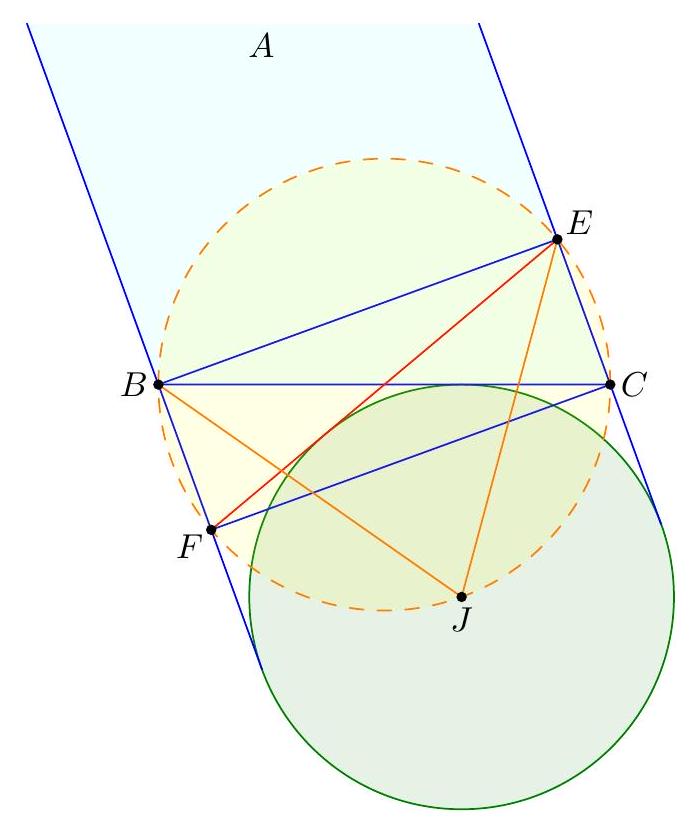
| 『 Fifth solution, by angle chasing only! Let $J$ denote the $A$-excenter. Then $J$ should be the intersection of the internal bisectors of $\angle F E C$ and $\angle F B C$, so it is the midpoint of arc $\widehat{F C}$ on the circle with diameter $\overline{B C}$. |
|  |
|
|
| But now we get $\angle B J C=90^{\circ}$ from $J$ lying on this circle. Yet $\angle B J C=90^{\circ}-\frac{1}{2} \angle A$ in general, so $\angle A=0^{\circ}$ which is impossible. |
|
|
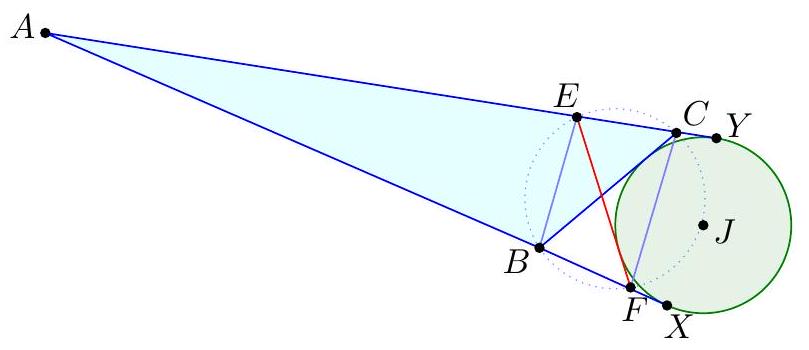
| 【 Sixth solution (Zuming Feng). This is similar to the preceding solution, but phrased using contradiction and inequalities. We let $X$ and $Y$ denote the tangency points of the $A$-excircle on lines $A B$ and $A C$. Moreover, let $J$ denote the $A$-excenter. |
|  |
|
|
| Note that $A B>A E$ and $A X=A Y$, therefore $B X<E Y$. By considering the right triangles $X B J$ and $Y E J$ (which both have $J X=J Y$ ), we conclude $\tan \angle X B J>$ $\tan \angle Y E J$, thus |
|
|
| $$ |
| \angle X B J>\angle Y E J |
| $$ |
|
|
| However, if line $E F$ was actually tangent to the $A$-excircle, we would have |
|
|
| $$ |
| 2 \angle X B J=\angle X B C=\angle F B C=\angle F E C=\angle F E Y=2 \angle J E Y |
| $$ |
|
|
| which is a contradiction. |
|
|
| 【 Seventh solution, by complex numbers, for comedic effect (Evan Chen). Let us denote the tangency points of the $A$-excircle with sides $B C, C A, A B$ as $x, y, z$. Assume moreover that line $E F$ is tangent to the $A$-excircle at a point $P$. |
|
|
| Also, for brevity let $s=x y+y z+z x$. Then, we have |
|
|
| $$ |
| \begin{aligned} |
| & E=\frac{2 p y}{p+y}=\frac{1}{2}\left(b+y+y-y^{2} \bar{b}\right)=\frac{z x}{z+x}+y-\frac{y^{2}}{z+x} \\ |
| & \Longrightarrow \frac{2}{\frac{1}{p}+\frac{1}{y}}=\frac{x y+x z+z x-y^{2}}{z+x} \Longrightarrow \frac{\frac{1}{p}+\frac{1}{y}}{2}=\frac{x+z}{s-y^{2}} |
| \end{aligned} |
| $$ |
|
|
| Similarly by considering the point $F$, |
|
|
| $$ |
| \frac{\frac{1}{p}+\frac{1}{z}}{2}=\frac{x+y}{s-z^{2}} |
| $$ |
|
|
| Thus we can eliminate $P$ and obtain |
|
|
| $$ |
| \begin{aligned} |
| \Longrightarrow \frac{\frac{1}{y}-\frac{1}{z}}{2} & =\frac{x+z}{s-y^{2}}-\frac{x+y}{s-z^{2}}=\frac{-s(y-z)+x\left(y^{2}-z^{2}\right)+\left(y^{3}-z^{3}\right)}{\left(s-y^{2}\right)\left(s-z^{2}\right)} \\ |
| \Longleftrightarrow \frac{1}{2 y z} & =\frac{s-x(y+z)-\left(y^{2}+y z+z^{2}\right)}{\left(s-y^{2}\right)\left(s-z^{2}\right)}=\frac{-\left(y^{2}+z^{2}\right)}{\left(s-y^{2}\right)\left(s-z^{2}\right)} \\ |
| \Longleftrightarrow 0 & =\left(s-y^{2}\right)\left(s-z^{2}\right)+2 y z\left(y^{2}+z^{2}\right) \\ |
| & =[x(y+z)+y(z-y)][x(y+z)+z(y-z)]+2 y z\left(y^{2}+z^{2}\right) \\ |
| & =x^{2}(y+z)^{2}-(y-z)^{2} \cdot x(y+z)+y z\left(2 y^{2}+2 z^{2}-(y-z)^{2}\right) \\ |
| & =x^{2}(y+z)^{2}-(y-z)^{2} \cdot x(y+z)+y z(y+z)^{2} \\ |
| & =x y z(y+z)\left[\frac{x}{y}+\frac{x}{z}-\frac{y}{z}-\frac{z}{y}+2+\frac{y}{x}+\frac{z}{x}\right] |
| \end{aligned} |
| $$ |
|
|
| However, $\triangle X Y Z$ is obtuse with $\angle X>90^{\circ}$, we have $y+z \neq 0$. Note that |
|
|
| $$ |
| \begin{aligned} |
| & \frac{x}{y}+\frac{y}{x}=2 \operatorname{Re} \frac{x}{y}=2 \cos (2 \angle X Z Y) \\ |
| & \frac{x}{z}+\frac{z}{x}=2 \operatorname{Re} \frac{x}{z}=2 \cos (2 \angle X Y Z) \\ |
| & \frac{y}{z}+\frac{z}{y}=2 \operatorname{Re} \frac{y}{z}<2 |
| \end{aligned} |
| $$ |
|
|
| and since $\cos (2 \angle X Z Y)+\cos (2 \angle X Y Z)>0$ (say by sum-to-product), we are done. |
|
|
| ## §2.2 JMO 2019/5, proposed by Ricky Liu |
|
|
| Available online at https://aops.com/community/p12195861. |
|
|
| ## Problem statement |
|
|
| Let $n$ be a nonnegative integer. Determine the number of ways to choose sets $S_{i j} \subseteq\{1,2, \ldots, 2 n\}$, for all $0 \leq i \leq n$ and $0 \leq j \leq n$ (not necessarily distinct), such that |
| |
| - $\left|S_{i j}\right|=i+j$, and |
| - $S_{i j} \subseteq S_{k l}$ if $0 \leq i \leq k \leq n$ and $0 \leq j \leq l \leq n$. |
|
|
| The answer is $(2 n)!\cdot 2^{n^{2}}$. First, we note that $\varnothing=S_{00} \subsetneq S_{01} \subsetneq \cdots \subsetneq S_{n n}=\{1, \ldots, 2 n\}$ and thus multiplying by (2n)! we may as well assume $S_{0 i}=\{1, \ldots, i\}$ and $S_{i n}=\{1, \ldots, n+i\}$. We illustrate this situation by placing the sets in a grid, as below for $n=4$; our goal is to fill in the rest of the grid. |
| $\left[\begin{array}{ccccc}1234 & 12345 & 123456 & 1234567 & 12345678 \\ 123 & & & & \\ 12 & & & & \\ 1 & & & & \\ \varnothing & & & & \end{array}\right]$ |
| |
| We claim the number of ways to do so is $2^{n^{2}}$. In fact, more strongly even the partial fillings are given exactly by powers of 2 . |
| |
| Claim - Fix a choice $T$ of cells we wish to fill in, such that whenever a cell is in $T$, so are all the cells above and left of it. (In other words, $T$ is a Young tableau.) The number of ways to fill in these cells with sets satisfying the inclusion conditions is $2^{|T|}$. |
| |
| An example is shown below, with an indeterminate set marked in red (and the rest of $T$ marked in blue). |
| $\left[\begin{array}{ccccc}1234 & 12345 & 123456 & 1234567 & 12345678 \\ 123 & 1234 & 12346 & 123467 & \\ 12 & 124 & 1234 \text { or } 1246 & & \\ 1 & 12 & & & \\ \varnothing & 2 & & & \end{array}\right]$ |
| |
| Proof. The proof is by induction on $|T|$, with $|T|=0$ being vacuous. |
| Now suppose we have a corner $\left[\begin{array}{cc}B & C \\ A & S\end{array}\right]$ where $A, B, C$ are fixed and $S$ is to be chosen. Then we may write $B=A \cup\{x\}$ and $C=A \cup\{x, y\}$ for $x, y \notin A$. Then the two choices of $S$ are $A \cup\{x\}$ (i.e. $B$ ) and $A \cup\{y\}$, and both of them are seen to be valid. |
| |
| In this way, we gain a factor of 2 any time we add one cell as above to $T$. Since we can achieve any Young tableau in this way, the induction is complete. |
| |
| ## §2.3 JMO 2019/6, proposed by Yannick Yao |
| |
| Available online at https://aops.com/community/p12195834. |
| |
| ## Problem statement |
| |
| Let $m$ and $n$ be relatively prime positive integers. The numbers $\frac{m}{n}$ and $\frac{n}{m}$ are written on a blackboard. At any point, Evan may pick two of the numbers $x$ and $y$ written on the board and write either their arithmetic mean $\frac{1}{2}(x+y)$ or their harmonic mean $\frac{2 x y}{x+y}$. For which $(m, n)$ can Evan write 1 on the board in finitely many steps? |
| |
| We claim this is possible if and only $m+n$ is a power of 2 . Let $q=m / n$, so the numbers on the board are $q$ and $1 / q$. |
| \I Impossibility. The main idea is the following. |
| Claim - Suppose $p$ is an odd prime. Then if the initial numbers on the board are $-1(\bmod p)$, then all numbers on the board are $-1(\bmod p)$. |
| |
| Proof. Let $a \equiv b \equiv-1(\bmod p)$. Note that $2 \not \equiv 0(\bmod p)$ and $a+b \equiv-2 \not \equiv 0(\bmod p)$. Thus $\frac{a+b}{2}$ and $\frac{2 a b}{a+b}$ both make sense modulo $p$ and are equal to $-1(\bmod p)$. |
| |
| Thus if there exists any odd prime divisor $p$ of $m+n$ (implying $p \nmid m n$ ), then |
| |
| $$ |
| q \equiv \frac{1}{q} \equiv-1 \quad(\bmod p) . |
| $$ |
| |
| and hence all numbers will be $-1(\bmod p)$ forever. This implies that it's impossible to write 1 , whenever $m+n$ is divisible by some odd prime. |
| |
| 【 Construction. Conversely, suppose $m+n$ is a power of 2 . We will actually construct 1 without even using the harmonic mean. |
|  |
| |
| Note that |
| |
| $$ |
| \frac{n}{m+n} \cdot q+\frac{m}{m+n} \cdot \frac{1}{q}=1 |
| $$ |
| |
| and obviously by taking appropriate midpoints (in a binary fashion) we can achieve this using arithmetic mean alone. |
| |
| |


