| # JMO 2021 Solution Notes |
|
|
| Evan Chen《陳誼廷》 |
|
|
| 15 April 2024 |
|
|
|
|
| #### Abstract |
|
|
| This is a compilation of solutions for the 2021 JMO. The ideas of the solution are a mix of my own work, the solutions provided by the competition organizers, and solutions found by the community. However, all the writing is maintained by me. |
|
|
| These notes will tend to be a bit more advanced and terse than the "official" solutions from the organizers. In particular, if a theorem or technique is not known to beginners but is still considered "standard", then I often prefer to use this theory anyways, rather than try to work around or conceal it. For example, in geometry problems I typically use directed angles without further comment, rather than awkwardly work around configuration issues. Similarly, sentences like "let $\mathbb{R}$ denote the set of real numbers" are typically omitted entirely. |
|
|
| Corrections and comments are welcome! |
|
|
|
|
| ## Contents |
|
|
| 0 Problems |
| 1 Solutions to Day 1 |
| 1.1 JMO 2021/1, proposed by Vincent Huang ..... 3 |
| 1.2 JMO 2021/2, proposed by Ankan Bhattacharya ..... 4 |
| 1.3 JMO 2021/3, proposed by Alex Zhai |
| 2 Solutions to Day 2 ..... 6 |
| 2.1 JMO 2021/4, proposed by Brandon Wang ..... 6 |
| 2.2 JMO 2021/5, proposed by Carl Schildkraut ..... 8 |
| 2.3 JMO 2021/6, proposed by Mohsen Jamaali |
|
|
| ## §0 Problems |
|
|
| 1. Find all functions $f: \mathbb{N} \rightarrow \mathbb{N}$ which satisfy $f\left(a^{2}+b^{2}\right)=f(a) f(b)$ and $f\left(a^{2}\right)=f(a)^{2}$ for all positive integers $a$ and $b$. |
| 2. Rectangles $B C C_{1} B_{2}, C A A_{1} C_{2}$, and $A B B_{1} A_{2}$ are erected outside an acute triangle $A B C$. Suppose that |
|
|
| $$ |
| \angle B C_{1} C+\angle C A_{1} A+\angle A B_{1} B=180^{\circ} . |
| $$ |
| |
| Prove that lines $B_{1} C_{2}, C_{1} A_{2}$, and $A_{1} B_{2}$ are concurrent. |
| 3. An equilateral triangle $\Delta$ of side length $L>0$ is given. Suppose that $n$ equilateral triangles with side length 1 and with non-overlapping interiors are drawn inside $\Delta$, such that each unit equilateral triangle has sides parallel to $\Delta$, but with opposite orientation. Prove that |
| |
| $$ |
| n \leq \frac{2}{3} L^{2} . |
| $$ |
| |
| 4. Carina has three pins, labeled $A, B$, and $C$, respectively, located at the origin of the coordinate plane. In a move, Carina may move a pin to an adjacent lattice point at distance 1 away. What is the least number of moves that Carina can make in order for triangle $A B C$ to have area 2021? |
| 5. A finite set $S$ of positive integers has the property that, for each $s \in S$, and each positive integer divisor $d$ of $s$, there exists a unique element $t \in S$ satisfying $\operatorname{gcd}(s, t)=d$. (The elements $s$ and $t$ could be equal.) |
| Given this information, find all possible values for the number of elements of $S$. |
| 6. Let $n \geq 4$ be an integer. Find all positive real solutions to the following system of $2 n$ equations: |
| |
| $$ |
| \begin{array}{rlrl} |
| a_{1} & =\frac{1}{a_{2 n}}+\frac{1}{a_{2}}, & a_{2} & =a_{1}+a_{3}, \\ |
| a_{3} & =\frac{1}{a_{2}}+\frac{1}{a_{4}}, & a_{4} & =a_{3}+a_{5}, \\ |
| a_{5} & =\frac{1}{a_{4}}+\frac{1}{a_{6}}, & a_{6} & =a_{5}+a_{7}, \\ |
| & \vdots & \vdots \\ |
| a_{2 n-1} & =\frac{1}{a_{2 n-2}}+\frac{1}{a_{2 n}}, & a_{2 n} & =a_{2 n-1}+a_{1} . |
| \end{array} |
| $$ |
| |
| ## §1 Solutions to Day 1 |
| |
| ## §1.1 JMO 2021/1, proposed by Vincent Huang |
| |
| Available online at https://aops.com/community/p21498724. |
| |
| ## Problem statement |
| |
| Find all functions $f: \mathbb{N} \rightarrow \mathbb{N}$ which satisfy $f\left(a^{2}+b^{2}\right)=f(a) f(b)$ and $f\left(a^{2}\right)=f(a)^{2}$ for all positive integers $a$ and $b$. |
| |
| The answer is $f \equiv 1$ only, which works. We prove it's the only one. |
| The bulk of the problem is: |
| Claim - If $f(a)=f(b)=1$ and $a>b$, then $f\left(a^{2}-b^{2}\right)=f(2 a b)=1$. |
| |
| Proof. Write |
| |
| $$ |
| \begin{aligned} |
| 1=f(a) f(b) & =f\left(a^{2}+b^{2}\right)=\sqrt{f\left(\left(a^{2}+b^{2}\right)^{2}\right)} \\ |
| & =\sqrt{f\left(\left(a^{2}-b^{2}\right)^{2}+(2 a b)^{2}\right)} \\ |
| & =\sqrt{f\left(a^{2}-b^{2}\right) f(2 a b)} . |
| \end{aligned} |
| $$ |
| |
| By setting $a=b=1$ in the given statement we get $f(1)=f(2)=1$. Now a simple induction on $n$ shows $f(n)=1$ : |
| |
| - If $n=2 k$ take $(u, v)=(k, 1)$ hence $2 u v=n$. |
| - If $n=2 k+1$ take $(u, v)=(k+1, k)$ hence $u^{2}-v^{2}=n$. |
| |
| |
| ## §1.2 JMO 2021/2, proposed by Ankan Bhattacharya |
| |
| Available online at https://aops.com/community/p21498558. |
| |
| ## Problem statement |
| |
| Rectangles $B C C_{1} B_{2}, C A A_{1} C_{2}$, and $A B B_{1} A_{2}$ are erected outside an acute triangle $A B C$. Suppose that |
| |
| $$ |
| \angle B C_{1} C+\angle C A_{1} A+\angle A B_{1} B=180^{\circ} . |
| $$ |
|
|
| Prove that lines $B_{1} C_{2}, C_{1} A_{2}$, and $A_{1} B_{2}$ are concurrent. |
|
|
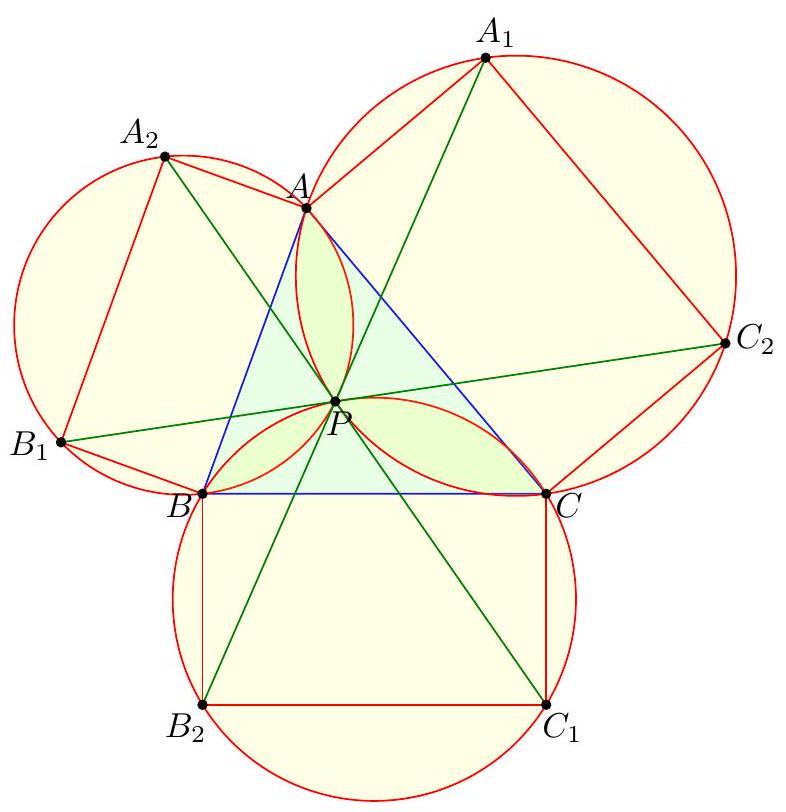
| The angle condition implies the circumcircles of the three rectangles concur at a single point $P$. |
|  |
|
|
| Then $\measuredangle C P B_{2}=\measuredangle C P A_{1}=90^{\circ}$, hence $P$ lies on $A_{1} B_{2}$ etc., so we're done. |
| Remark. As one might guess from the two-sentence solution, the entire difficulty of the problem is getting the characterization of the concurrence point. |
|
|
| ## §1.3 JMO 2021/3, proposed by Alex Zhai |
|
|
| Available online at https://aops.com/community/p21499596. |
|
|
| ## Problem statement |
|
|
| An equilateral triangle $\Delta$ of side length $L>0$ is given. Suppose that $n$ equilateral triangles with side length 1 and with non-overlapping interiors are drawn inside $\Delta$, such that each unit equilateral triangle has sides parallel to $\Delta$, but with opposite orientation. Prove that |
|
|
| $$ |
| n \leq \frac{2}{3} L^{2} |
| $$ |
|
|
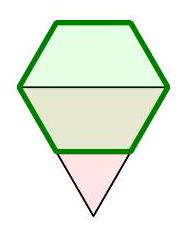
| We present the approach of Andrew Gu. For each triangle, we draw a green regular hexagon of side length $1 / 2$ as shown below. |
|  |
|
|
| Claim - All the hexagons are disjoint and lie inside $\Delta$. |
| Proof. Annoying casework. |
| Since each hexagon has area $\frac{3 \sqrt{3}}{8}$ and lies inside $\Delta$, we conclude |
|
|
| $$ |
| \frac{3 \sqrt{3}}{8} \cdot n \leq \frac{\sqrt{3}}{4} L^{2} \Longrightarrow n \leq \frac{2}{3} L^{2} |
| $$ |
|
|
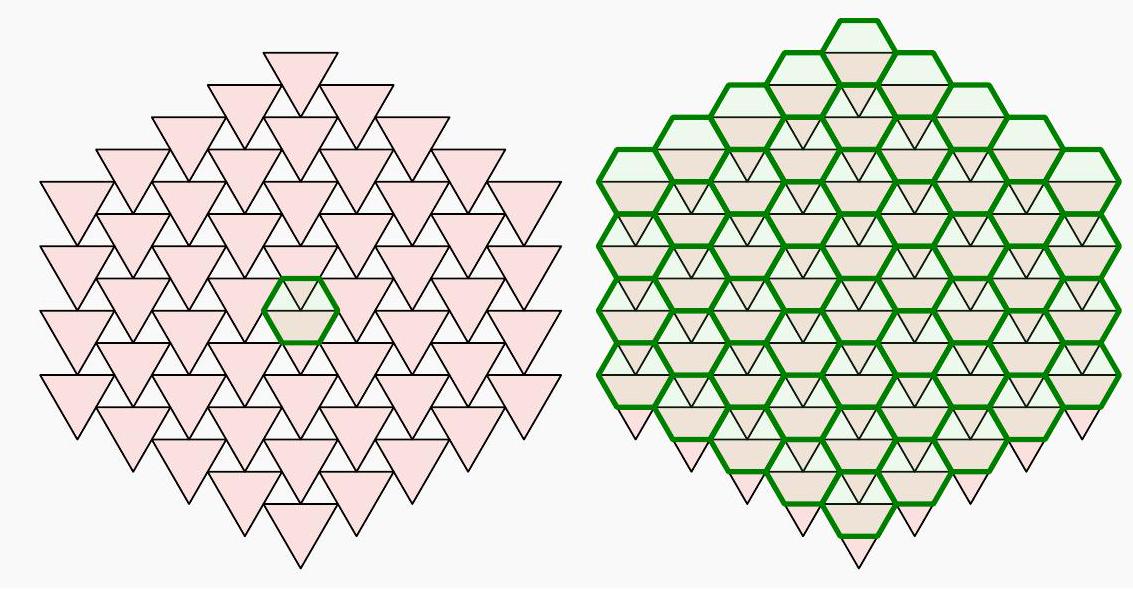
| Remark. The constant $\frac{2}{3}$ is sharp and cannot be improved. The following tessellation shows how to achieve the $\frac{2}{3}$ density. In the figure on the left, one of the green hexagons is drawn in for illustration. The version on the right has all the hexagons. |
|  |
|
|
| ## §2 Solutions to Day 2 |
|
|
| ## §2.1 JMO 2021/4, proposed by Brandon Wang |
|
|
| Available online at https://aops.com/community/p21498566. |
|
|
| ## Problem statement |
|
|
| Carina has three pins, labeled $A, B$, and $C$, respectively, located at the origin of the coordinate plane. In a move, Carina may move a pin to an adjacent lattice point at distance 1 away. What is the least number of moves that Carina can make in order for triangle $A B C$ to have area 2021? |
|
|
| The answer is 128 . |
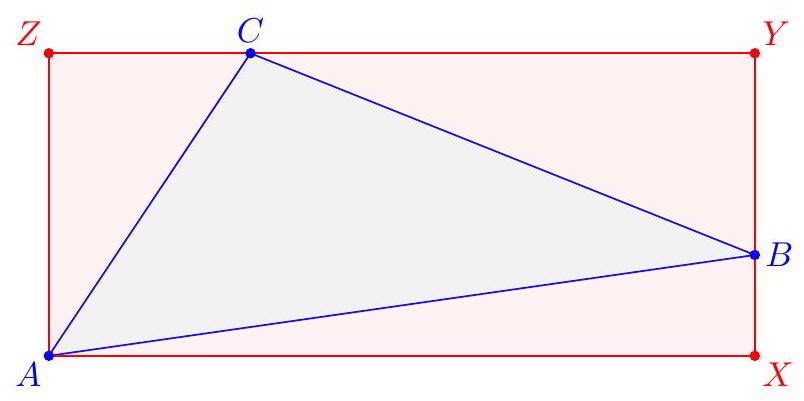
| Define the bounding box of triangle $A B C$ to be the smallest axis-parallel rectangle which contains all three of the vertices $A, B, C$. |
|  |
|
|
| ## Lemma |
|
|
| The area of a triangle $A B C$ is at most half the area of the bounding box. |
|
|
| Proof. This can be proven by explicit calculation in coordinates. Nonetheless, we outline a geometric approach. By considering the smallest/largest $x$ coordinate and the smallest/largest $y$ coordinate, one can check that some vertex of the triangle must coincide with a corner of the bounding box (there are four "extreme" coordinates across the $3 \cdot 2=6$ coordinates of our three points). |
|
|
| So, suppose the bounding box is $A X Y Z$. Imagine fixing $C$ and varying $B$ along the perimeter entire rectangle. The area is a linear function of $B$, so the maximal area should be achieved when $B$ coincides with one of the vertices $\{A, X, Y, Z\}$. But obviously the area of $\triangle A B C$ is |
|
|
| - exactly 0 if $B=A$, |
| - at most half the bounding box if $B \in\{X, Z\}$ by one-half-base-height, |
| - at most half the bounding box if $B=Y$, since $\triangle A B C$ is contained inside either $\triangle A Y Z$ or $\triangle A X Z$. |
|
|
| We now proceed to the main part of the proof. |
|
|
| Claim - If $n$ moves are made, the bounding box has area at most $(n / 2)^{2}$. (In other words, a bounding box of area $A$ requires at least $\lceil 2 \sqrt{A}\rceil$ moves.) |
|
|
| Proof. The sum of the width and height of the bounding box increases by at most 1 each move, hence the width and height have sum at most $n$. So, by AM-GM, their product is at most $(n / 2)^{2}$. |
|
|
| This immediately implies $n \geq 128$, since the bounding box needs to have area at least $4042>63.5^{2}$. |
|
|
| On the other hand, if we start all the pins at the point $(3,18)$ then we can reach the following three points in 128 moves: |
|
|
| $$ |
| \begin{aligned} |
| & A=(0,0) \\ |
| & B=(64,18) \\ |
| & C=(3,64) |
| \end{aligned} |
| $$ |
|
|
| and indeed triangle $A B C$ has area exactly 2021. |
| Remark. In fact, it can be shown that to obtain an area of $n / 2$, the bounding-box bound of $\lceil 2 \sqrt{n}\rceil$ moves is best possible, i.e. there will in fact exist a triangle with area $n / 2$. However, since this was supposed to be a JMO4 problem, the committee made a choice to choose $n=4042$ so that contestants only needed to give a single concrete triangle rather than a general construction for all integers $n$. |
|
|
| ## §2.2 JMO 2021/5, proposed by Carl Schildkraut |
|
|
| Available online at https://aops.com/community/p21498580. |
|
|
| ## Problem statement |
|
|
| A finite set $S$ of positive integers has the property that, for each $s \in S$, and each positive integer divisor $d$ of $s$, there exists a unique element $t \in S$ satisfying $\operatorname{gcd}(s, t)=d$. (The elements $s$ and $t$ could be equal.) |
| Given this information, find all possible values for the number of elements of $S$. |
|
|
| The answer is that $|S|$ must be a power of 2 (including 1 ), or $|S|=0$ (a trivial case we do not discuss further). |
|
|
| Construction. For any nonnegative integer $k$, a construction for $|S|=2^{k}$ is given by |
|
|
| $$ |
| S=\left\{\left(p_{1} \text { or } q_{1}\right) \times\left(p_{2} \text { or } q_{2}\right) \times \cdots \times\left(p_{k} \text { or } q_{k}\right)\right\} |
| $$ |
|
|
| for $2 k$ distinct primes $p_{1}, \ldots, p_{k}, q_{1}, \ldots, q_{k}$. |
| 【 Converse. The main claim is as follows. |
| Claim - In any valid set $S$, for any prime $p$ and $x \in S, \nu_{p}(x) \leq 1$. |
| Proof. Assume for contradiction $e=\nu_{p}(x) \geq 2$. |
|
|
| - On the one hand, by taking $x$ in the statement, we see $\frac{e}{e+1}$ of the elements of $S$ are divisible by $p$. |
| - On the other hand, consider a $y \in S$ such that $\nu_{p}(y)=1$ which must exist (say if $\operatorname{gcd}(x, y)=p)$. Taking $y$ in the statement, we see $\frac{1}{2}$ of the elements of $S$ are divisible by $p$. |
| |
| So $e=1$, contradiction. |
| Now since $|S|$ equals the number of divisors of any element of $S$, we are done. |
| |
| ## §2.3 JMO 2021/6, proposed by Mohsen Jamaali |
| |
| Available online at https://aops.com/community/p21498967. |
| |
| ## Problem statement |
| |
| Let $n \geq 4$ be an integer. Find all positive real solutions to the following system of $2 n$ equations: |
| |
| $$ |
| \begin{aligned} |
| a_{1} & =\frac{1}{a_{2 n}}+\frac{1}{a_{2}}, & a_{2} & =a_{1}+a_{3}, \\ |
| a_{3} & =\frac{1}{a_{2}}+\frac{1}{a_{4}}, & a_{4} & =a_{3}+a_{5} \\ |
| a_{5} & =\frac{1}{a_{4}}+\frac{1}{a_{6}}, & a_{6} & =a_{5}+a_{7}, \\ |
| & \vdots & & \vdots \\ |
| a_{2 n-1} & =\frac{1}{a_{2 n-2}}+\frac{1}{a_{2 n}}, & a_{2 n} & =a_{2 n-1}+a_{1} |
| \end{aligned} |
| $$ |
| |
| The answer is that the only solution is $(1,2,1,2, \ldots, 1,2)$ which works. |
| We will prove $a_{2 k}$ is a constant sequence, at which point the result is obvious. |
| \ा First approach (Andrew Gu). Apparently, with indices modulo 2n, we should have |
|
|
| $$ |
| a_{2 k}=\frac{1}{a_{2 k-2}}+\frac{2}{a_{2 k}}+\frac{1}{a_{2 k+2}} |
| $$ |
|
|
| for every index $k$ (this eliminates all $a_{\text {odd }}$ 's). Define |
| |
| $$ |
| m=\min _{k} a_{2 k} \quad \text { and } \quad M=\max _{k} a_{2 k} |
| $$ |
| |
| Look at the indices $i$ and $j$ achieving $m$ and $M$ to respectively get |
| |
| $$ |
| \begin{aligned} |
| & m=\frac{2}{m}+\frac{1}{a_{2 i-2}}+\frac{1}{a_{2 i+2}} \geq \frac{2}{m}+\frac{1}{M}+\frac{1}{M}=\frac{2}{m}+\frac{2}{M} \\ |
| & M=\frac{2}{M}+\frac{1}{a_{2 j-2}}+\frac{1}{a_{2 j+2}} \leq \frac{2}{M}+\frac{1}{m}+\frac{1}{m}=\frac{2}{m}+\frac{2}{M} |
| \end{aligned} |
| $$ |
| |
| Together this gives $m \geq M$, so $m=M$. That means $a_{2 i}$ is constant as $i$ varies, solving the problem. |
|
|
| ब Second approach (author's solution). As before, we have |
|
|
| $$ |
| a_{2 k}=\frac{1}{a_{2 k-2}}+\frac{2}{a_{2 k}}+\frac{1}{a_{2 k+2}} |
| $$ |
|
|
| The proof proceeds in three steps. |
|
|
| - Define |
|
|
| $$ |
| S=\sum_{k} a_{2 k}, \quad \text { and } \quad T=\sum_{k} \frac{1}{a_{2 k}} |
| $$ |
|
|
| Summing gives $S=4 T$. On the other hand, Cauchy-Schwarz says $S \cdot T \geq n^{2}$, so $T \geq \frac{1}{2} n$. |
|
|
| - On the other hand, |
|
|
| $$ |
| 1=\frac{1}{a_{2 k-2} a_{2 k}}+\frac{2}{a_{2 k}^{2}}+\frac{1}{a_{2 k} a_{2 k+2}} |
| $$ |
| |
| Sum this modified statement to obtain |
| |
| $$ |
| n=\sum_{k}\left(\frac{1}{a_{2 k}}+\frac{1}{a_{2 k+2}}\right)^{2} \stackrel{\text { QM-AM }}{\geq} \frac{1}{n}\left(\sum_{k} \frac{1}{a_{2 k}}+\frac{1}{a_{2 k+2}}\right)^{2}=\frac{1}{n}(2 T)^{2} |
| $$ |
| |
| So $T \leq \frac{1}{2} n$. |
| |
| - Since $T \leq \frac{1}{2} n$ and $T \geq \frac{1}{2} n$, we must have equality everywhere above. This means $a_{2 k}$ is a constant sequence. |
|
|
| Remark. The problem is likely intractable over $\mathbb{C}$, in the sense that one gets a high-degree polynomial which almost certainly has many complex roots. So it seems likely that most solutions must involve some sort of inequality, using the fact we are over $\mathbb{R}_{>0}$ instead. |
| |
| |


