| # JMO 2024 Solution Notes |
|
|
| Evan Chen《陳誼廷》 |
|
|
| 23 April 2024 |
|
|
|
|
| #### Abstract |
|
|
| This is a compilation of solutions for the 2024 JMO. The ideas of the solution are a mix of my own work, the solutions provided by the competition organizers, and solutions found by the community. However, all the writing is maintained by me. |
|
|
| These notes will tend to be a bit more advanced and terse than the "official" solutions from the organizers. In particular, if a theorem or technique is not known to beginners but is still considered "standard", then I often prefer to use this theory anyways, rather than try to work around or conceal it. For example, in geometry problems I typically use directed angles without further comment, rather than awkwardly work around configuration issues. Similarly, sentences like "let $\mathbb{R}$ denote the set of real numbers" are typically omitted entirely. |
|
|
| Corrections and comments are welcome! |
|
|
|
|
| ## Contents |
|
|
| 0 Problems ..... 2 |
| 1 Solutions to Day 1 ..... 3 |
| 1.1 JMO 2024/1, proposed by Evan o'Dorney ..... 3 |
| 1.2 JMO 2024/2, proposed by Serena An and Claire Zhang ..... 5 |
| 1.3 JMO 2024/3, proposed by John Berman ..... 8 |
| 2 Solutions to Day 2 ..... 10 |
| 2.1 JMO 2024/4, proposed by Alec Sun ..... 10 |
| 2.2 JMO 2024/5, proposed by Carl Schildkraut ..... 12 |
| 2.3 JMO 2024/6, proposed by Anton Trygub ..... 14 |
|
|
| ## §0 Problems |
|
|
| 1. Let $A B C D$ be a cyclic quadrilateral with $A B=7$ and $C D=8$. Points $P$ and $Q$ are selected on line segment $A B$ so that $A P=B Q=3$. Points $R$ and $S$ are selected on line segment $C D$ so that $C R=D S=2$. Prove that $P Q R S$ is a cyclic quadrilateral. |
| 2. Let $m$ and $n$ be positive integers. Let $S$ be the set of lattice points $(x, y)$ with $1 \leq x \leq 2 m$ and $1 \leq y \leq 2 n$. A configuration of $m n$ rectangles is called happy if each point of $S$ is the vertex of exactly one rectangle. Prove that the number of happy configurations is odd. |
| 3. A sequence $a_{1}, a_{2}, \ldots$ of positive integers is defined recursively by $a_{1}=2$ and |
| |
| $$ |
| a_{n+1}=a_{n}^{n+1}-1 \quad \text { for } n \geq 1 |
| $$ |
| |
| Prove that for every odd prime $p$ and integer $k$, some term of the sequence is divisible by $p^{k}$. |
| 4. Let $n \geq 3$ be an integer. Rowan and Colin play a game on an $n \times n$ grid of squares, where each square is colored either red or blue. Rowan is allowed to permute the rows of the grid and Colin is allowed to permute the columns. A grid coloring is orderly if: |
| |
| - no matter how Rowan permutes the rows of the coloring, Colin can then permute the columns to restore the original grid coloring; and |
| - no matter how Colin permutes the columns of the coloring, Rowan can then permute the rows to restore the original grid coloring. |
| In terms of $n$, how many orderly colorings are there? |
| |
| 5. Solve over $\mathbb{R}$ the functional equation $f\left(x^{2}-y\right)+2 y f(x)=f(f(x))+f(y)$. |
| 6. Point $D$ is selected inside acute triangle $A B C$ so that $\angle D A C=\angle A C B$ and $\angle B D C=90^{\circ}+\angle B A C$. Point $E$ is chosen on ray $B D$ so that $A E=E C$. Let $M$ be the midpoint of $B C$. Show that line $A B$ is tangent to the circumcircle of triangle $B E M$. |
| |
| ## §1 Solutions to Day 1 |
| |
| ## §1.1 JMO 2024/1, proposed by Evan o'Dorney |
| |
| Available online at https://aops.com/community/p30216434. |
| |
| ## Problem statement |
| |
| Let $A B C D$ be a cyclic quadrilateral with $A B=7$ and $C D=8$. Points $P$ and $Q$ are selected on line segment $A B$ so that $A P=B Q=3$. Points $R$ and $S$ are selected on line segment $C D$ so that $C R=D S=2$. Prove that $P Q R S$ is a cyclic quadrilateral. |
| |
| Here are two possible approaches. |
| \l The one-liner. The four points $P, Q, R, S$ have equal power -12 with respect to $(A B C D)$. So in fact they're on a circle concentric with $(A B C D)$. |
| \ The external power solution. We distinguish between two cases. |
| |
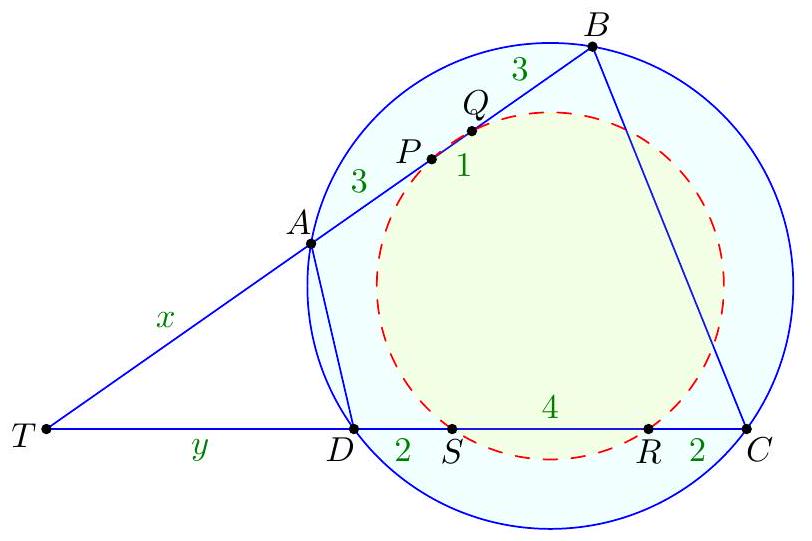
| Case where $A B$ and $C D$ are not parallel. We let lines $A B$ and $C D$ meet at $T$. Without loss of generality, $A$ lies between $B$ and $T$ and $D$ lies between $C$ and $T$. Let $x=T A$ and $y=T D$, as shown below. |
|  |
| |
| By power of a point, |
| |
| $$ |
| \begin{aligned} |
| A B C D \text { cyclic } \Longleftrightarrow x(x+7) & =y(y+8) \\ |
| P Q R S \text { cyclic } \Longleftrightarrow(x+3)(x+4) & =(y+2)(y+6) . |
| \end{aligned} |
| $$ |
| |
| However, the latter equation is just the former with 12 added to both sides. (That is, $(x+3)(x+4)=x(x+7)+12$ while $(y+2)(y+6)=y(y+8)+12$.$) So the conclusion is$ immediate. |
| |
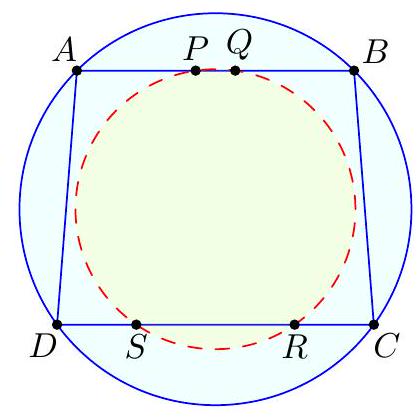
| Case where $A B$ and $C D$ are parallel. In that case $A B C D$ is an isosceles trapezoid. Then the entire picture is symmetric around the common perpendicular bisector of the lines $A B$ and $C D$. Now $P Q R S$ is also an isosceles trapezoid, so it's cyclic too. |
|  |
| |
| ## §1.2 JMO 2024/2, proposed by Serena An and Claire Zhang |
| |
| Available online at https://aops.com/community/p30216444. |
| |
| ## Problem statement |
| |
| Let $m$ and $n$ be positive integers. Let $S$ be the set of lattice points $(x, y)$ with $1 \leq x \leq 2 m$ and $1 \leq y \leq 2 n$. A configuration of $m n$ rectangles is called happy if each point of $S$ is the vertex of exactly one rectangle. Prove that the number of happy configurations is odd. |
| |
| There are several possible approaches to the problem; most of them involve pairing some of the happy configurations in various ways, leaving only a few configurations which remain fixed. We present the original proposer's solution and Evan's more complicated one. |
| |
| I Original proposer's solution. To this end, let's denote by $f(2 m, 2 n)$ the number of happy configurations for a $2 m \times 2 n$ grid of lattice points (not necessarily equally spaced - this doesn't change the count). We already have the following easy case. |
| |
| Claim - We have $f(2,2 n)=(2 n-1)!!=(2 n-1) \cdot(2 n-3) \cdots \cdots 3 \cdot 1$. |
| Proof. The top row is the top edge of some rectangle and there are $2 n-1$ choices for the bottom edge of that rectangle. It then follows $f(2,2 n)=(2 n-1) \cdot f(2,2 n-2)$ and the conclusion follows by induction on $n$, with $f(2,2)=1$. |
| |
| We will prove that: |
| Claim - Assume $m, n \geq 1$. When $f(2 m, 2 n) \equiv f(2 m-2,2 n)(\bmod 2)$. |
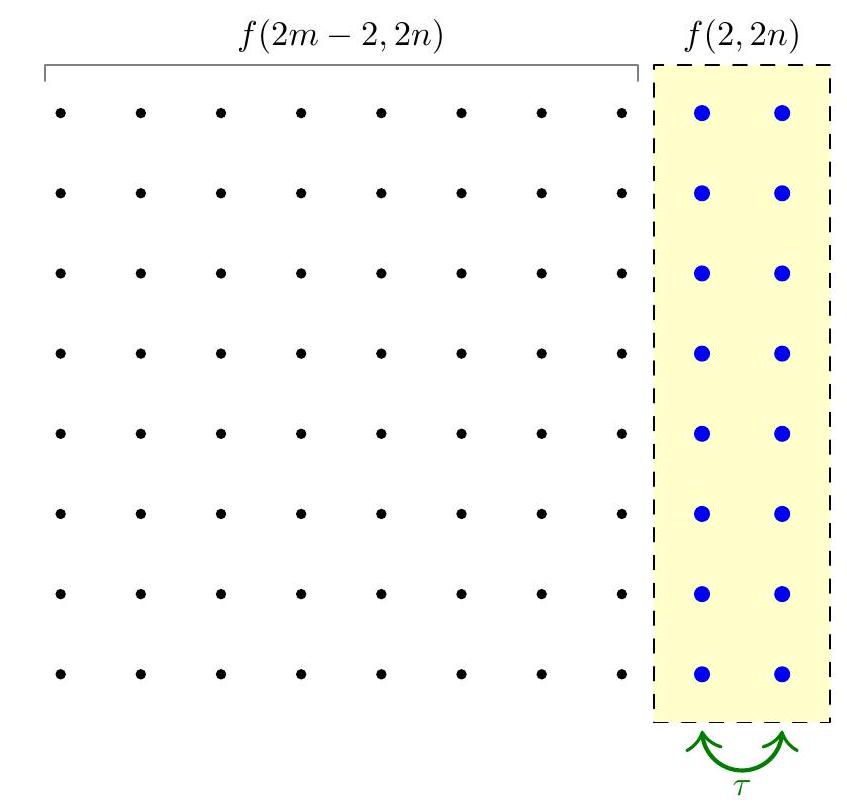
| Proof. Given a happy configuration $\mathcal{C}$, let $\tau(\mathcal{C})$ be the happy configuration obtained by swapping the last two columns. Obviously $\tau(\tau(\mathcal{C}))=\mathcal{C}$ for every happy $\mathcal{C}$. So in general, we can consider two different kinds of configurations $\mathcal{C}$, those for which $\tau(\mathcal{C}) \neq \mathcal{C}$, so we get pairs $\{\mathcal{C}, \tau(\mathcal{C})\}$, and those with $\tau(\mathcal{C})=\mathcal{C}$. |
| |
| Now configurations fixed by $\tau$ can be described readily: this occurs if and only if the last two columns are self-contained, meaning every rectangle with a vertex in these columns is completely contained in these two columns. |
|  |
| |
| Hence it follows that |
| |
| $$ |
| f(2 m, 2 n)=2(\text { number of pairs })+f(2 m-2,2 n) \cdot f(2,2 n) |
| $$ |
| |
| Taking modulo 2 gives the result. |
| By the same token $f(2 m, 2 n) \equiv f(2 m, 2 n-2)(\bmod 2)$. So all $f$-values have the same parity, and from $f(2,2)=1$ we're done. |
| |
| Remark. There are many variations of the solution using different kinds of $\tau$. The solution with $\tau$ swapping two rows seems to be the simplest. |
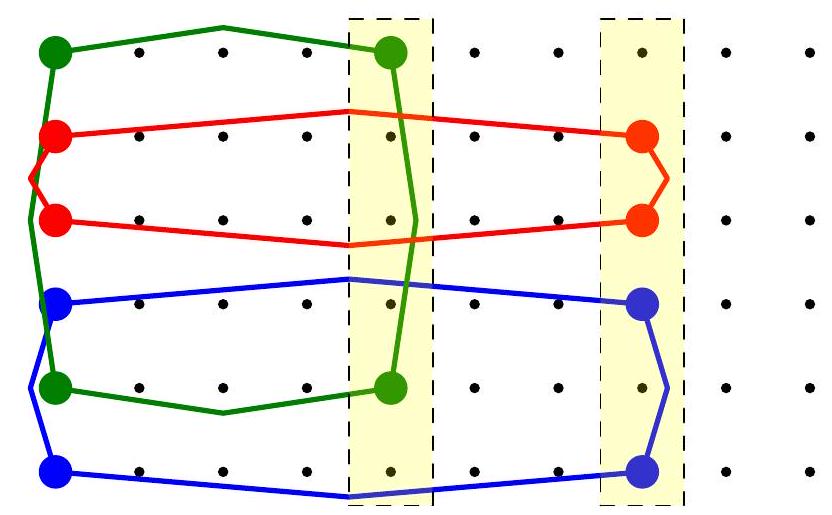
| \l Evan's permutation-based solution. Retain the notation $f(2 m, 2 n)$ from before. Given a happy configuration, consider all the rectangles whose left edge is in the first column. Highlight every column containing the right edge of such a rectangle. For example, in the figure below, there are two highlighted columns. (The rectangles are drawn crooked so one can tell them apart.) |
|  |
| |
| We organize happy configurations based on the set of highlighted columns. Specifically, define the relation $\sim$ on configurations by saying that $\mathcal{C} \sim \mathcal{C}^{\prime}$ if they differ by any permutation of the highlighted columns. This is an equivalence relation. And in general, if there are $k$ highlighted columns, its equivalence class under $\sim$ has $k$ ! elements. |
| |
| Then |
| |
| Claim - $f(2 m, 2 n)$ has the same parity as the number of happy configurations with exactly one highlighted column. |
| |
| Proof. Since $k$ ! is even for all $k \geq 2$, but odd when $k=1$. |
| There are $2 m-1$ ways to pick a single highlighted column, and then $f(2,2 n)=(2 n-1)!!$ ways to use the left column and highlighted column. So the count in the claim is exactly given by |
| |
| $$ |
| (2 m-1) \cdot(2 n-1)!!f(2 m-2,2 n) |
| $$ |
| |
| This implies $f(2 m, 2 n) \equiv f(2 m-2,2 n)(\bmod 2)$ and proceeding by induction as before solves the problem. |
| |
| ## §1.3 JMO 2024/3, proposed by John Berman |
| |
| Available online at https://aops.com/community/p30216450. |
| |
| ## Problem statement |
| |
| A sequence $a_{1}, a_{2}, \ldots$ of positive integers is defined recursively by $a_{1}=2$ and |
|
|
| $$ |
| a_{n+1}=a_{n}^{n+1}-1 \quad \text { for } n \geq 1 |
| $$ |
|
|
| Prove that for every odd prime $p$ and integer $k$, some term of the sequence is divisible by $p^{k}$. |
|
|
| We start with the following. |
| Claim - Assume $n$ is a positive integer divisible by $p-1$. Then either $a_{n-1} \equiv 0$ $(\bmod p)$ or $a_{n} \equiv 0(\bmod p)$. |
|
|
| Proof. Suppose that $a_{n-1} \not \equiv 0(\bmod p)$. Then by Fermat's little theorem, |
| |
| $$ |
| a_{n}=a_{n-1}^{n}-1 \equiv x^{p-1}-1 \equiv 0 \quad(\bmod p) |
| $$ |
| |
| where $x:=a_{n-1}^{\frac{n}{p-1}}$ is an integer not divisible by $p$. |
| Claim - If $n \geq 2$ is even, then |
|
|
| $$ |
| a_{n}^{n+1} \mid a_{n+2} |
| $$ |
|
|
| Proof. Note $a_{n+2}=a_{n+1}^{n+2}-1$. The right-hand side is a difference of $(n+2)^{\text {nd }}$ powers, which for even $n$ is divisible by $a_{n+1}+1=a_{n}^{n+1}$. |
|
|
| By considering multiples $n$ of $p-1$ which are larger than $k$, we see that if $a_{n} \equiv 0$ $(\bmod p)$ ever happens, we are done by combining the two previous claims. So the difficult case of the problem is the bad situation where $a_{n-1} \equiv 0(\bmod p)$ occurs for almost all $n \equiv 0(\bmod p-1)$. |
|
|
| To resolve the difficult case and finish the problem, we zoom in on specific $n$ that will let us use lifting the exponent on $a_{n-1}$. |
| |
| Claim - Suppose $n$ is an (even) integer satisfying |
| |
| $$ |
| \begin{aligned} |
| & n \equiv 0 \quad(\bmod p-1) \\ |
| & n \equiv 1 \quad\left(\bmod p^{k-1}\right) |
| \end{aligned} |
| $$ |
| |
| If $a_{n-1} \equiv 0(\bmod p)$, then in fact $p^{k} \mid a_{n-1}$. |
| Proof. Write $a_{n-1}=a_{n-2}^{n-1}-1$. We know $a_{n-2} \not \equiv 0(\bmod p)$, and so $a_{n-2}^{n} \equiv 1(\bmod p)$. Taking modulo $p$ gives |
| |
| $$ |
| 0 \equiv \frac{1}{a_{n-2}}-1 \quad(\bmod p) \Longrightarrow a_{n-2} \equiv 1 \quad(\bmod p) |
| $$ |
| |
| Hence lifting the exponent applies and we get |
| |
| $$ |
| \nu_{p}\left(a_{n-1}\right) \equiv \nu_{p}\left(a_{n-2}^{n-1}-1\right)=\nu_{p}\left(a_{n-2}-1\right)+\nu_{p}(n-1) \geq 1+(k-1)=k |
| $$ |
|
|
| as desired. |
|
|
| Remark. The first few terms are $a_{1}=2, a_{2}=3, a_{3}=26, a_{4}=456975$, and $a_{5}=$ 19927930852449199486318359374, ... No element of the sequence is divisible by 4: the residues modulo 4 alternate between 2 and 3 . |
| |
| Remark. The second claim is important for the solution to work once $k \geq 2$. One could imagine a variation of the first claim that states if $n$ is divisible by $\varphi\left(p^{k}\right)=p^{k-1}(p-1)$, then either $a_{n-1} \equiv 0(\bmod p)$ or $a_{n} \equiv 0\left(\bmod p^{k}\right)$. However this gives an obstruction (for $k \geq 2)$ where we are guaranteed to have $n-1 \not \equiv 0(\bmod p)$ now, so lifting the exponent will never give additional factors of $p$ we want. |
| |
| ## §2 Solutions to Day 2 |
| |
| ## §2.1 JMO 2024/4, proposed by Alec Sun |
| |
| Available online at https://aops.com/community/p30227193. |
| |
| ## Problem statement |
| |
| Let $n \geq 3$ be an integer. Rowan and Colin play a game on an $n \times n$ grid of squares, where each square is colored either red or blue. Rowan is allowed to permute the rows of the grid and Colin is allowed to permute the columns. A grid coloring is orderly if: |
| |
| - no matter how Rowan permutes the rows of the coloring, Colin can then permute the columns to restore the original grid coloring; and |
| - no matter how Colin permutes the columns of the coloring, Rowan can then permute the rows to restore the original grid coloring. |
| In terms of $n$, how many orderly colorings are there? |
| |
| The answer is $2 n!+2$. In fact, we can describe all the orderly colorings as follows: |
| |
| - The all-blue coloring. |
| - The all-red coloring. |
| - Each of the $n$ ! colorings where every row/column has exactly one red cell. |
| - Each of the $n$ ! colorings where every row/column has exactly one blue cell. |
| |
| These obviously work; we turn our attention to proving these are the only ones. |
| For the other direction, fix a orderly coloring $\mathcal{A}$. |
| Consider any particular column $C$ in $\mathcal{A}$ and let $m$ denote the number of red cells that $C$ has. Any row permutation (say $\sigma$ ) that Rowan chooses will transform $C$ into some column $\sigma(C)$, and our assumption requires $\sigma(C)$ has to appear somewhere in the original assignment $\mathcal{A}$. An example for $n=7, m=2$, and a random $\sigma$ is shown below. |
| 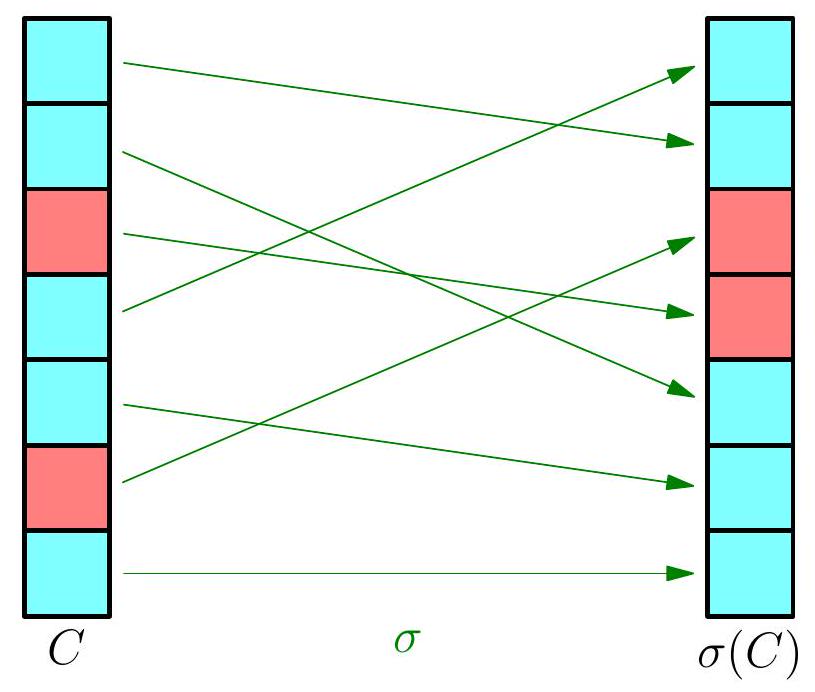 |
| |
| On the other hand, the number of possible patterns of $\sigma(C)$ is easily seen to be exactly ( $\binom{n}{m}$ - and they must all appear. In particular, if $m \notin\{0,1, n-1, n\}$, then we immediately get a contradiction because $\mathcal{A}$ would need too many columns (there are only $n$ columns in $\mathcal{A}$, which is fewer than $\binom{n}{m}$ ). Moreover, if either $m=1$ or $m=n-1$, these columns are all the columns of $\mathcal{A}$; these lead to the $2 n$ ! main cases we found before. |
| |
| The only remaining case is when $m \in\{0, n\}$ for every column, i.e. every column is monochromatic. It's easy to see in that case the columns must all be the same color. |
| |
| ## §2.2 JMO 2024/5, proposed by Carl Schildkraut |
| |
| Available online at https://aops.com/community/p30227204. |
| |
| ## Problem statement |
| |
| Solve over $\mathbb{R}$ the functional equation $f\left(x^{2}-y\right)+2 y f(x)=f(f(x))+f(y)$. |
| |
| The answer is $f(x) \equiv x^{2}, f(x) \equiv 0, f(x) \equiv-x^{2}$, which obviously work. |
| Let $P(x, y)$ be the usual assertion. |
| Claim - We have $f(0)=0$ and $f$ even. |
| |
| Proof. Combine $P(1,1 / 2)$ with $P(1,0)$ to get $f(0)=0$. Use $P(0, y)$ to deduce $f$ is even. |
| |
| Claim $-f(x) \in\left\{-x^{2}, 0, x^{2}\right\}$ for every $x \in \mathbb{R}$. |
| Proof. Note that $P\left(x, x^{2} / 2\right)$ and $P(x, 0)$ respectively give |
| |
| $$ |
| x^{2} f(x)=f\left(x^{2}\right)=f(f(x)) |
| $$ |
| |
| Repeating this key identity several times gives |
| |
| $$ |
| \begin{aligned} |
| f(f(f(x))) & =f\left(f\left(x^{2}\right)\right)=f\left(x^{4}\right)=x^{4} f\left(x^{2}\right) \\ |
| & =f(x)^{2} \cdot f(f(x))=f(x)^{2} f\left(x^{2}\right)=f(x)^{3} x^{2} |
| \end{aligned} |
| $$ |
| |
| Suppose $t \neq 0$ is such that $f\left(t^{2}\right) \neq 0$. Then the above equalities imply |
| |
| $$ |
| t^{4} f\left(t^{2}\right)=f(t)^{2} f\left(t^{2}\right) \Longrightarrow f(t)= \pm t^{2} |
| $$ |
| |
| and then |
| |
| $$ |
| f(t)^{2} f\left(t^{2}\right)=f(t)^{3} t^{2} \Longrightarrow f\left(t^{2}\right)= \pm t^{2} |
| $$ |
| |
| Together with $f$ even, we get the desired result. |
| |
| Remark. Another proof is possible here that doesn't use as iterations of $f$ : the idea is to "show $f$ is injective up to sign outside its kernel". Specifically, if $f(a)=f(b) \neq 0$, then $a^{2} f(a)=f(f(a))=f(f(b))=b^{2} f(b) \Longrightarrow a^{2}=b^{2}$. But we also have $f(f(x))=f\left(x^{2}\right)$, so we are done except in the case $f(f(x))=f\left(x^{2}\right)=0$. That would imply $x^{2} f(x)=0$, so the claim follows. |
| |
| Now, note that $P(1, y)$ gives |
| |
| $$ |
| f(1-y)+2 y \cdot f(1)=f(1)+f(y) |
| $$ |
| |
| We consider cases on $f(1)$ and show that $f$ matches the desired form. |
| |
| - If $f(1)=1$, then $f(1-y)+(2 y-1)=f(y)$. Consider the nine possibilities that arise: |
| |
| $$ |
| \begin{array}{lll} |
| (1-y)^{2}+(2 y-1)=y^{2} & 0+(2 y-1)=y^{2} & -(1-y)^{2}+(2 y-1)=y^{2} \\ |
| (1-y)^{2}+(2 y-1)=0 & 0+(2 y-1)=0 & -(1-y)^{2}+(2 y-1)=0 \\ |
| (1-y)^{2}+(2 y-1)=-y^{2} & 0+(2 y-1)=-y^{2} & -(1-y)^{2}+(2 y-1)=-y^{2} |
| \end{array} |
| $$ |
| |
| Each of the last eight equations is a nontrivial polynomial equation. Hence, there is some constant $C>100$ such that the latter eight equations are all false for any real number $y>C$. Consequently, $f(y)=y^{2}$ for $y>C$. |
| Finally, for any real number $z>0$, take $x, y>C$ such that $x^{2}-y=z$; then $P(x, y)$ proves $f(z)=z^{2}$ too. |
| |
| - Note that (as $f$ is even), $f$ works iff $-f$ works, so the case $f(1)=-1$ is analogous. |
| - If $f(1)=0$, then $f(1-y)=f(y)$. Hence for any $y$ such that $|1-y| \neq|y|$, we conclude $f(y)=0$. Then take $P(2,7 / 2) \Longrightarrow f(1 / 2)=0$. |
| |
| Remark. There is another clever symmetry approach possible after the main claim. The idea is to write |
| |
| $$ |
| P\left(x, y^{2}\right) \Longrightarrow f\left(x^{2}-y^{2}\right)+2 y^{2} f(x)=f(f(x))+f(f(y)) |
| $$ |
| |
| Since $f$ is even gives $f\left(x^{2}-y^{2}\right)=f\left(y^{2}-x^{2}\right)$, one can swap the roles of $x$ and $y$ to get $2 y^{2} f(x)=2 x^{2} f(y)$. Set $y=1$ to finish. |
| |
| ## §2.3 JMO 2024/6, proposed by Anton Trygub |
| |
| Available online at https://aops.com/community/p30227196. |
| |
| ## Problem statement |
| |
| Point $D$ is selected inside acute triangle $A B C$ so that $\angle D A C=\angle A C B$ and $\angle B D C=$ $90^{\circ}+\angle B A C$. Point $E$ is chosen on ray $B D$ so that $A E=E C$. Let $M$ be the midpoint of $B C$. Show that line $A B$ is tangent to the circumcircle of triangle $B E M$. |
| |
| This problem has several approaches and we showcase a collection of them. |
| ब The author's original solution. Complete isosceles trapezoid $A B Q C$ (so $D \in \overline{A Q}$ ). Reflect $B$ across $E$ to point $F$. |
| 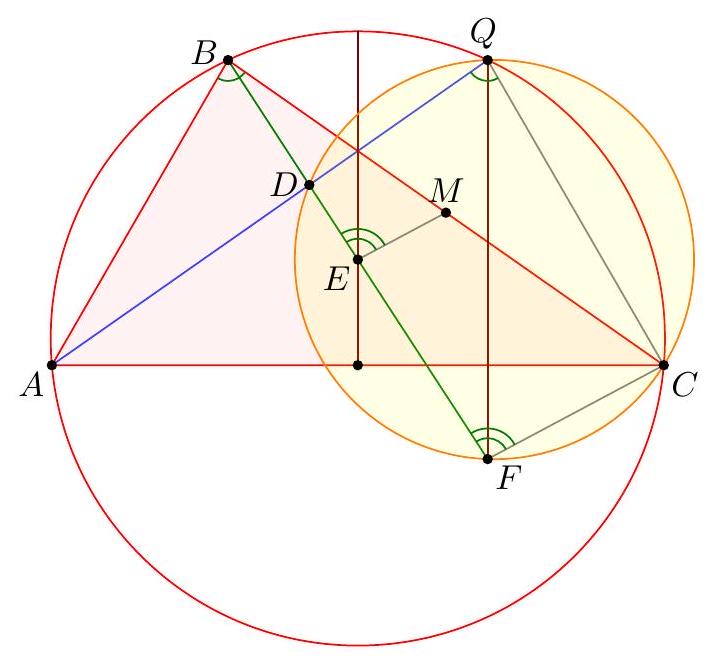 |
| |
| Claim - We have $D Q C F$ is cyclic. |
| Proof. Since $E A=E C$, we have $\overline{Q F} \perp \overline{A C}$ as line $Q F$ is the image of the perpendicular bisector of $\overline{A C}$ under a homothety from $B$ with scale factor 2 . Then |
| |
| $$ |
| \begin{aligned} |
| \measuredangle F D C & =-\measuredangle C D B=180^{\circ}-\left(90^{\circ}+\measuredangle C A B\right)=90^{\circ}-\measuredangle C A B \\ |
| & =90^{\circ}-\measuredangle Q C A=\measuredangle F Q C . |
| \end{aligned} |
| $$ |
| |
| To conclude, note that |
| |
| $$ |
| \measuredangle B E M=\measuredangle B F C=\measuredangle D F C=\measuredangle D Q C=\measuredangle A Q C=\measuredangle A B C=\measuredangle A B M |
| $$ |
| |
| Remark (Motivation). Here is one possible way to come up with the construction of point $F$ (at least this is what led Evan to find it). If one directs all the angles in the obvious way, there are really two points $D$ and $D^{\prime}$ that are possible, although one is outside the triangle; they give corresponding points $E$ and $E^{\prime}$. The circles $B E M$ and $B E^{\prime} M$ must then actually coincide since they are both alleged to be tangent to line $A B$. See the figure below. |
| 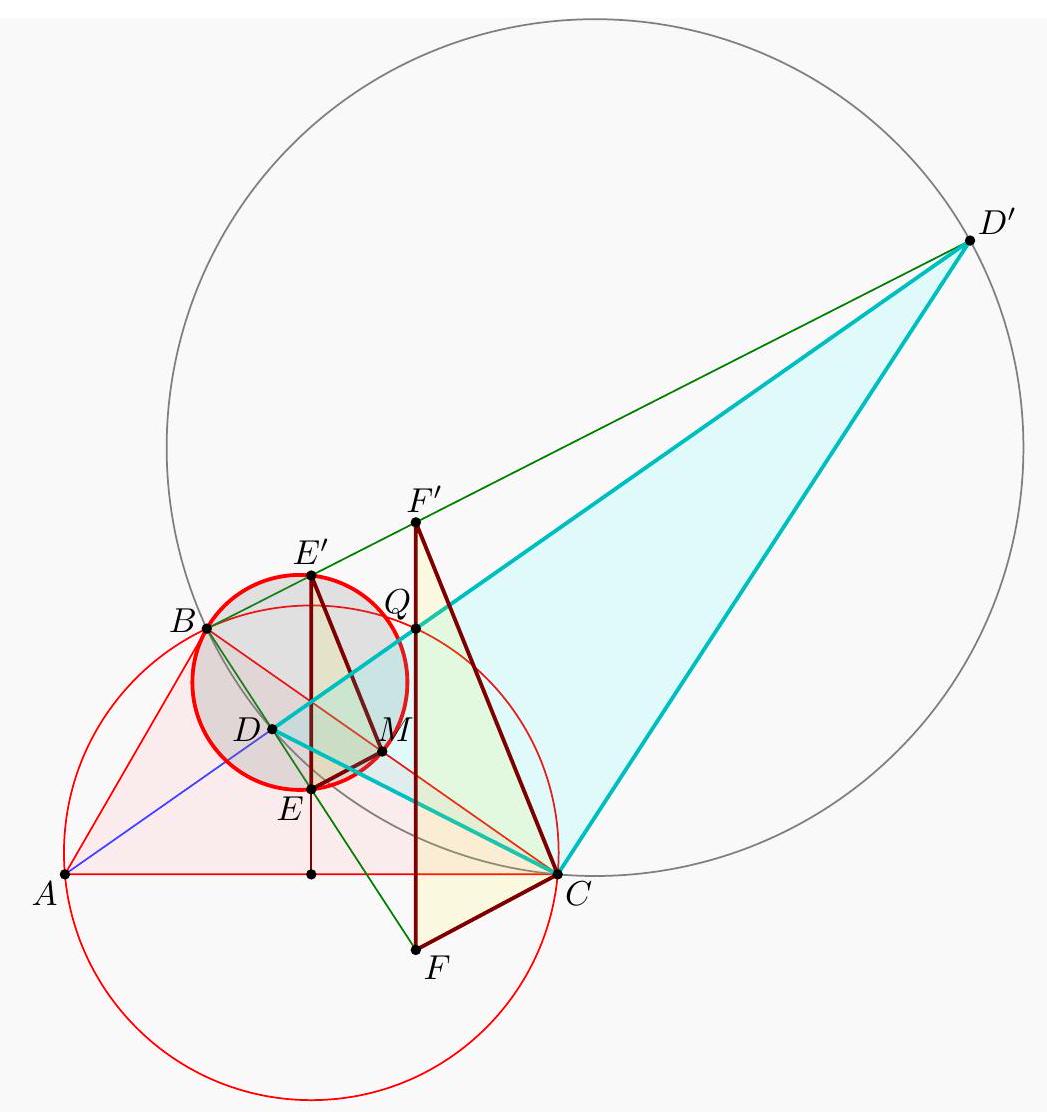 |
| |
| One can already prove using angle chasing that $\overline{A B}$ is tangent to $\left(B E E^{\prime}\right)$. So the point of the problem is to show that $M$ lies on this circle too. However, from looking at the diagram, one may realize that in fact it seems |
| |
| $$ |
| \triangle M E E^{\prime} \stackrel{ }{\sim} \triangle C D D^{\prime} |
| $$ |
| |
| is going to be true from just those marked in the figure (and this would certainly imply the desired concyclic conclusion). Since $M$ is a midpoint, it makes sense to dilate $\triangle E M E^{\prime}$ from $B$ by a factor of 2 to get $\triangle F C F^{\prime}$ so that the desired similarity is actually a spiral similarity at $C$. Then the spiral similarity lemma says that the desired similarity is equivalent to requiring $\overline{D D^{\prime}} \cap \overline{F F^{\prime}}=Q$ to lie on both $(C D F)$ and $\left(C D^{\prime} F^{\prime}\right)$. Hence the key construction and claim from the solution are both discovered naturally, and we find the solution above. (The points $D^{\prime}, E^{\prime}, F^{\prime}$ can then be deleted to hide the motivation.) |
| |
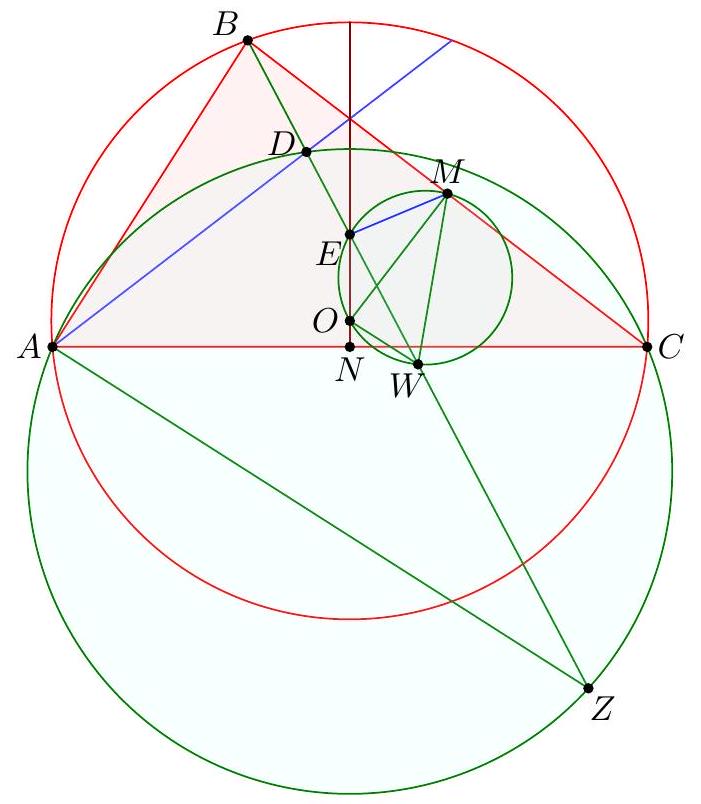
| Another short solution. Let $Z$ be on line $B D E$ such that $\angle B A Z=90^{\circ}$. This lets us interpret the angle condition as follows: |
| |
| $$ |
| \text { Claim - Points } A, D, Z, C \text { are cyclic. } |
| $$ |
| |
| Proof. Because $\measuredangle Z A C=90^{\circ}-A=180^{\circ}-\measuredangle C D B=\measuredangle Z D C$. |
|  |
| |
| Define $W$ as the midpoint of $\overline{B Z}$, so $\overline{M W} \| \overline{C Z}$. And let $O$ denote the center of $(A B C)$. |
| |
| Claim - Points $M, E, O, W$ are cyclic. |
| |
| Proof. Note that |
| |
| $$ |
| \begin{aligned} |
| \measuredangle M O E & =\measuredangle(\overline{O M}, \overline{B C})+\measuredangle(\overline{B C}, \overline{A C})+\measuredangle(\overline{A C}, \overline{O E}) \\ |
| & =90^{\circ}+\measuredangle B C A+90^{\circ} \\ |
| & =\measuredangle B C A=\measuredangle C A D=\measuredangle C Z D=\measuredangle M W D=\measuredangle M W E . |
| \end{aligned} |
| $$ |
| |
| To finish, note |
| |
| $$ |
| \begin{aligned} |
| \measuredangle M E B & =\measuredangle M E W=\measuredangle M O W \\ |
| & =\measuredangle(\overline{M O}, \overline{B C})+\measuredangle(\overline{B C}, \overline{A B})+\measuredangle(\overline{A B}, \overline{O W}) \\ |
| & =90^{\circ}+\measuredangle C B A+90^{\circ}=\measuredangle C B A=\measuredangle M B A . |
| \end{aligned} |
| $$ |
| |
| This implies the desired tangency. |
| |
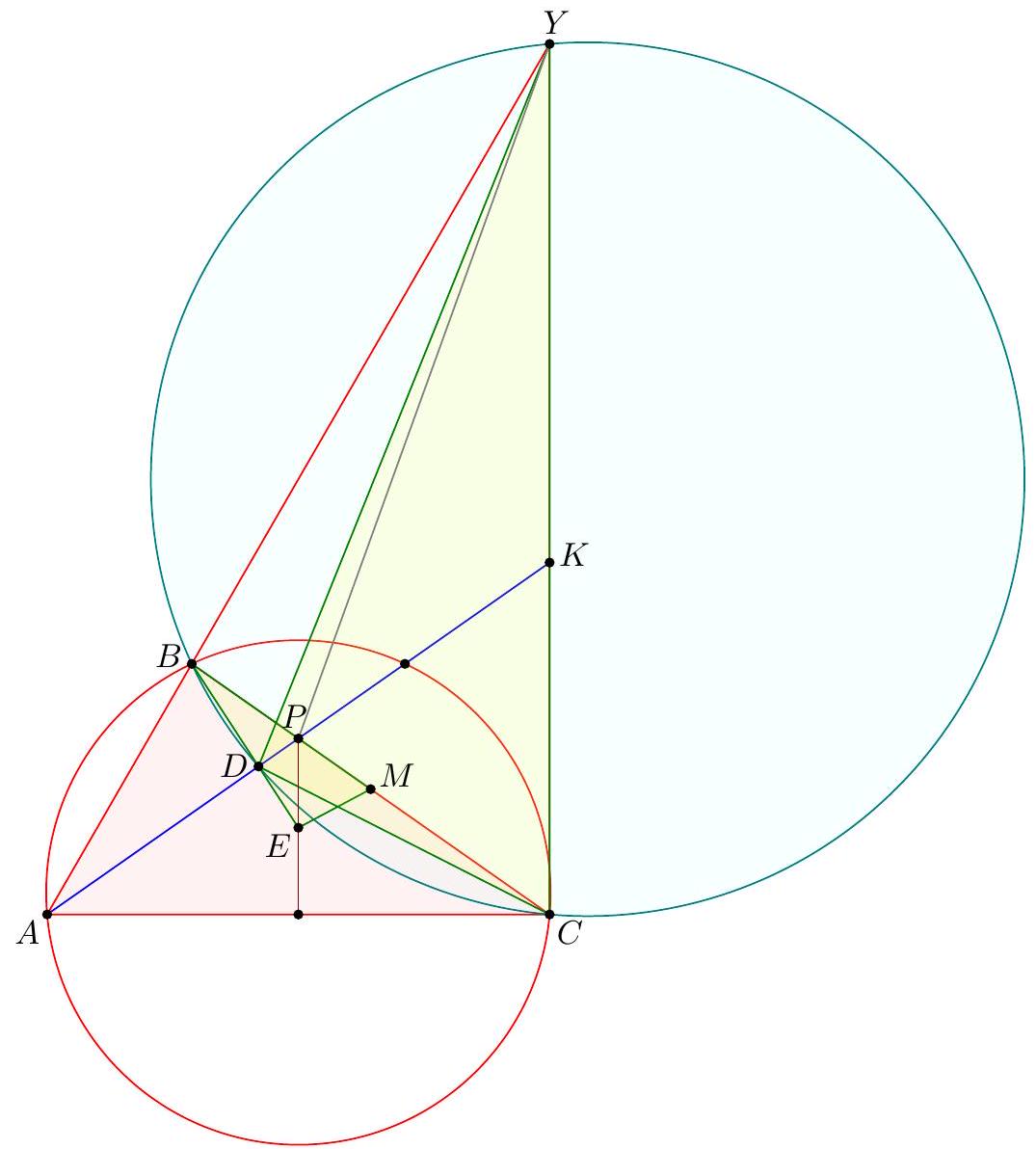
| I A Menelaus-based approach (Kevin Ren). Let $P$ be on $\overline{B C}$ with $A P=P C$. Let $Y$ be the point on line $A B$ such that $\angle A C Y=90^{\circ}$; as $\angle A Y C=90^{\circ}-A$ it follows $B D Y C$ is cyclic. Let $K=\overline{A P} \cap \overline{C Y}$, so $\triangle A C K$ is a right triangle with $P$ the midpoint of its hypotenuse. |
|  |
| |
| Claim - Triangles BPE and DYK are similar. |
| Proof. We have $\measuredangle M P E=\measuredangle C P E=\measuredangle K C P=\measuredangle P K C$ and $\measuredangle E B P=\measuredangle D B C=$ $\measuredangle D Y C=\measuredangle D Y K$. |
| |
| Claim - Triangles $B E M$ and $Y D C$ are similar. |
| |
| Proof. By Menelaus $\triangle P C K$ with respect to collinear points $A, B, Y$ that |
| |
| $$ |
| \frac{B P}{B C} \frac{Y C}{Y K} \frac{A K}{A P}=1 |
| $$ |
| |
| Since $A K / A P=2$ (note that $P$ is the midpoint of the hypotenuse of right triangle $A C K)$ and $B C=2 B M$, this simplifies to |
| |
| $$ |
| \frac{B P}{B M}=\frac{Y K}{Y C} |
| $$ |
| |
| To finish, note that |
| |
| $$ |
| \measuredangle D B A=\measuredangle D B Y=\measuredangle D C Y=\measuredangle B M E |
| $$ |
| |
| implying the desired tangency. |
| |
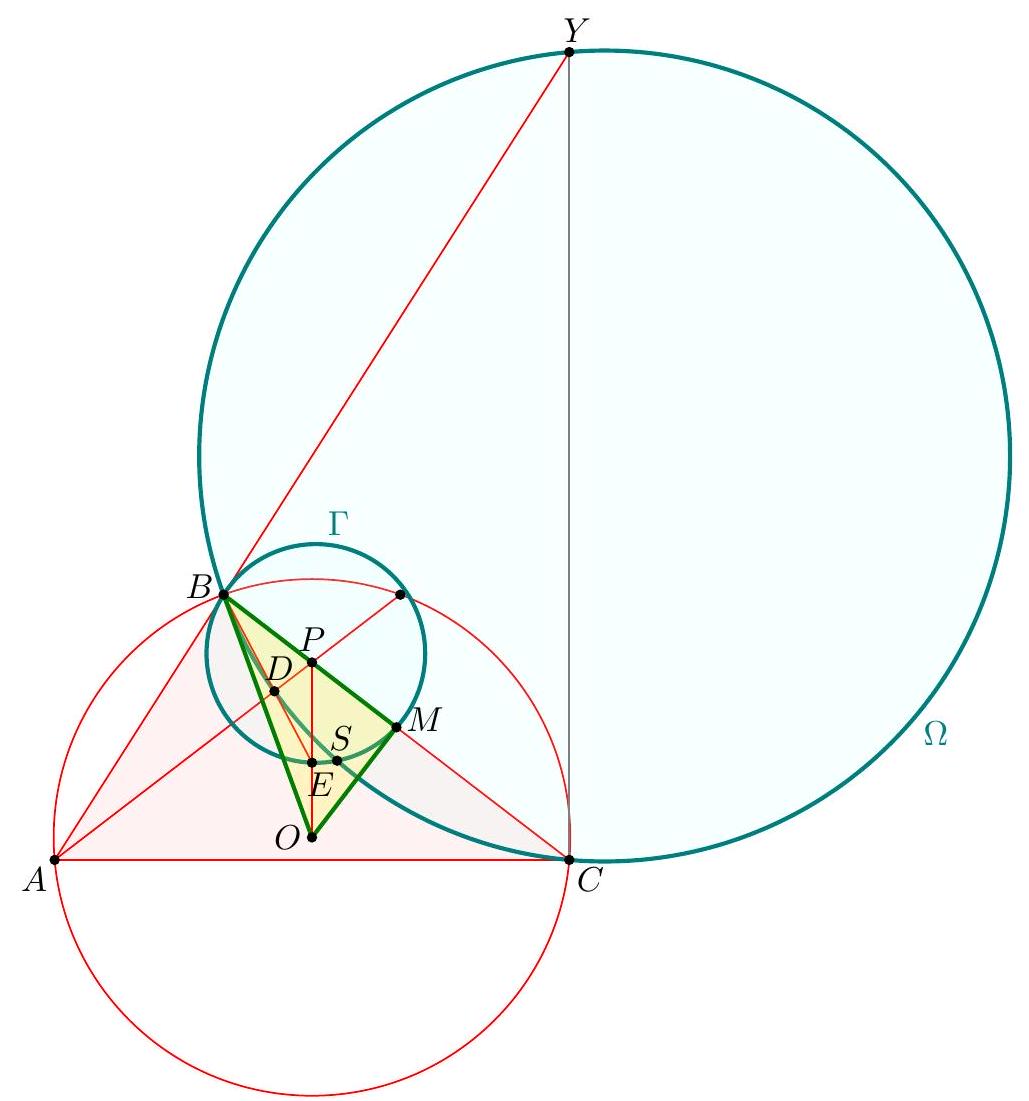
| 『 A spiral similarity approach (Hans $\mathbf{Y u}$ ). As in the previous solution, let $Y$ be the point on line $A B$ such that $\angle A C Y=90^{\circ}$; so $B D Y C$ is cyclic. Let $\Gamma$ be the circle through $B$ and $M$ tangent to $\overline{A B}$, and let $\Omega:=(B C Y D)$. We need to show $E \in \Gamma$. |
|  |
| |
| Denote by $S$ the second intersection of $\Gamma$ and $\Omega$. The main idea behind is to consider the spiral similarity |
| |
| $$ |
| \Psi: \Omega \rightarrow \Gamma \quad C \mapsto M \text { and } Y \mapsto B |
| $$ |
| |
| centered at $S$ (due to the spiral similarity lemma), and show that $\Psi(D)=E$. The spiral similarity lemma already promises $\Psi(D)$ lies on line $B D$. |
| |
| Claim - We have $\Psi(A)=O$, the circumcenter of $A B C$. |
| |
| Proof. Note $\triangle O B M \AA \triangle A Y C$; both are right triangles with $\measuredangle B A C=\measuredangle B O M$. |
| |
| Claim - $\Psi$ maps line $A D$ to line $O P$. |
| |
| Proof. If we let $P$ be on $\overline{B C}$ with $A P=P C$ as before, |
| |
| $$ |
| \measuredangle(\overline{A D}, \overline{O P})=\measuredangle A P O=\measuredangle O P C=\measuredangle Y C P=\measuredangle(\overline{Y C}, \overline{B M}) |
| $$ |
| |
| As $\Psi$ maps line $Y C$ to line $B M$ and $\Psi(A)=O$, we're done. |
| Hence $\Psi(D)$ should not only lie on $B D$ but also line $O P$. This proves $\Psi(D)=E$, so $E \in \Gamma$ as needed. |
| |
| |