| # NORDIC MATHEMATICAL CONTEST |
|
|
| ## PROBLEMS AND SOLUTIONS, 1987-2011 |
|
|
| ## PROBLEMS |
|
|
| The problems are identified as $x y . n$., whery $x$ and $y$ are the last digits of the competition year and $n$ is the $n$ :th problem of that year. |
|
|
| ## NMC 1, March 30, 1987 |
|
|
| 87.1. Nine journalists from different countries attend a press conference. None of these speaks more than three languages, and each pair of the journalists share a common language. Show that there are at least five journalists sharing a common language. |
|
|
| 87.2. Let $A B C D$ be a parallelogram in the plane. We draw two circles of radius $R$, one through the points $A$ and $B$, the other through $B$ and $C$. Let $E$ be the other point of intersection of the circles. We assume that $E$ is not a vertex of the parallelogram. Show that the circle passing through $A, D$, and $E$ also has radius $R$. |
|
|
| 87.3. Let $f$ be a strictly increasing function defined in the set of natural numbers satisfying the conditions $f(2)=a>2$ and $f(m n)=f(m) f(n)$ for all natural numbers $m$ and $n$. Determine the smallest possible value of $a$. |
|
|
| 87.4. Let $a, b$, and $c$ be positive real numbers. Prove: |
|
|
| $$ |
| \frac{a}{b}+\frac{b}{c}+\frac{c}{a} \leq \frac{a^{2}}{b^{2}}+\frac{b^{2}}{c^{2}}+\frac{c^{2}}{a^{2}} |
| $$ |
|
|
| ## NMC 2, April 4, 1988 |
|
|
| 88.1. The positive integer $n$ has the following property: if the three last digits of $n$ are removed, the number $\sqrt[3]{n}$ remains. Find $n$. |
|
|
| 88.2. Let $a, b$, and $c$ be non-zero real numbers and let $a \geq b \geq c$. Prove the inequality |
|
|
| $$ |
| \frac{a^{3}-c^{3}}{3} \geq a b c\left(\frac{a-b}{c}+\frac{b-c}{a}\right) |
| $$ |
|
|
| When does equality hold? |
|
|
| 88.3. Two concentric spheres have radii $r$ and $R, r<R$. We try to select points $A, B$ and $C$ on the surface of the larger sphere such that all sides of the triangle $A B C$ would be tangent to the surface of the smaller sphere. Show that the points can be selected if and only if $R \leq 2 r$. |
| |
| 88.4. Let $m_{n}$ be the smallest value of the function |
| |
| $$ |
| f_{n}(x)=\sum_{k=0}^{2 n} x^{k} |
| $$ |
| |
| Show that $m_{n} \rightarrow \frac{1}{2}$, as $n \rightarrow \infty$. |
| |
| ## NMC 3, April 10, 1989 |
| |
| 89.1. Find a polynomial $P$ of lowest possible degree such that |
| |
| (a) $P$ has integer coefficients, |
| |
| (b) all roots of $P$ are integers, |
| |
| (c) $P(0)=-1$, |
| |
| (d) $P(3)=128$. |
| |
| 89.2. Three sides of a tetrahedron are right-angled triangles having the right angle at their common vertex. The areas of these sides are $A, B$, and $C$. Find the total surface area of the tetrahedron. |
| |
| 89.3. Let $S$ be the set of all points $t$ in the closed interval $[-1,1]$ such that for the sequence $x_{0}, x_{1}, x_{2}, \ldots$ defined by the equations $x_{0}=t, x_{n+1}=2 x_{n}^{2}-1$, there exists a positive integer $N$ such that $x_{n}=1$ for all $n \geq N$. Show that the set $S$ has infinitely many elements. |
| |
| 89.4. For which positive integers $n$ is the following statement true: if $a_{1}, a_{2}, \ldots, a_{n}$ are positive integers, $a_{k} \leq n$ for all $k$ and $\sum_{k=1}^{n} a_{k}=2 n$, then it is always possible to choose $a_{i_{1}}, a_{i_{2}}, \ldots, a_{i_{j}}$ in such a way that the indices $i_{1}, i_{2}, \ldots, i_{j}$ are different numbers, and $\sum_{k=1}^{j} a_{i_{k}}=n ?$ |
| |
| ## NMC 4, April 5, 1990 |
| |
| 90.1. Let $m, n$, and $p$ be odd positive integers. Prove that the number |
| |
| $$ |
| \sum_{k=1}^{(n-1)^{p}} k^{m} |
| $$ |
| |
| is divisible by $n$. |
| |
| 90.2. Let $a_{1}, a_{2}, \ldots, a_{n}$ be real numbers. Prove |
| |
| $$ |
| \sqrt[3]{a_{1}^{3}+a_{2}^{3}+\ldots+a_{n}^{3}} \leq \sqrt{a_{1}^{2}+a_{2}^{2}+\ldots+a_{n}^{2}} |
| $$ |
| |
| When does equality hold in (1)? |
| |
| 90.3. Let $A B C$ be a triangle and let $P$ be an interior point of $A B C$. We assume that a line $l$, which passes through $P$, but not through $A$, intersects $A B$ and $A C$ (or their extensions over $B$ or $C$ ) at $Q$ and $R$, respectively. Find $l$ such that the perimeter of the triangle $A Q R$ is as small as possible. |
| |
| 90.4. It is possible to perform three operations $f, g$, and $h$ for positive integers: $f(n)=$ $10 n, g(n)=10 n+4$, and $h(2 n)=n$; in other words, one may write 0 or 4 in the end of the number and one may divide an even number by 2 . Prove: every positive integer can be constructed starting from 4 and performing a finite number of the operations $f, g$, and $h$ in some order. |
| |
| ## NMC 5, April 10, 1991 |
| |
| 91.1. Determine the last two digits of the number |
| |
| $$ |
| 2^{5}+2^{5^{2}}+2^{5^{3}}+\cdots+2^{5^{1991}} |
| $$ |
| |
| written in decimal notation. |
| |
| 91.2. In the trapezium $A B C D$ the sides $A B$ and $C D$ are parallel, and $E$ is a fixed point on the side $A B$. Determine the point $F$ on the side $C D$ so that the area of the intersection of the triangles $A B F$ and $C D E$ is as large as possible. |
| |
| 91.3. Show that |
| |
| $$ |
| \frac{1}{2^{2}}+\frac{1}{3^{2}}+\ldots+\frac{1}{n^{2}}<\frac{2}{3} |
| $$ |
| |
| for all $n \geq 2$. |
| |
| 91.4. Let $f(x)$ be a polynomial with integer coefficients. We assume that there exists a positive integer $k$ and $k$ consecutive integers $n, n+1, \ldots, n+k-1$ so that none of the numbers $f(n), f(n+1), \ldots, f(n+k-1)$ is divisible by $k$. Show that the zeroes of $f(x)$ are not integers. |
| |
| ## NMC 6, April 8, 1992 |
| |
| 92.1. Determine all real numbers $x>1, y>1$, and $z>1$, satisfying the equation |
|
|
| $$ |
| \begin{aligned} |
| x+y+z+\frac{3}{x-1} & +\frac{3}{y-1}+\frac{3}{z-1} \\ |
| & =2(\sqrt{x+2}+\sqrt{y+2}+\sqrt{z+2}) |
| \end{aligned} |
| $$ |
|
|
| 92.2. Let $n>1$ be an integer and let $a_{1}, a_{2}, \ldots, a_{n}$ be $n$ different integers. Show that the polynomial |
| |
| $$ |
| f(x)=\left(x-a_{1}\right)\left(x-a_{2}\right) \cdot \ldots \cdot\left(x-a_{n}\right)-1 |
| $$ |
|
|
| is not divisible by any polynomial with integer coefficients and of degree greater than zero but less than $n$ and such that the highest power of $x$ has coefficient 1 . |
|
|
| 92.3. Prove that among all triangles with inradius 1 , the equilateral one has the smallest perimeter. |
|
|
| 92.4. Peter has many squares of equal side. Some of the squares are black, some are white. Peter wants to assemble a big square, with side equal to $n$ sides of the small squares, so that the big square has no rectangle formed by the small squares such that all the squares in the vertices of the rectangle are of equal colour. How big a square is Peter able to assemble? |
|
|
| NMC 7, March 17, 1993 |
|
|
| 93.1. Let $F$ be an increasing real function defined for all $x, 0 \leq x \leq 1$, satisfying the conditions |
|
|
| (i) $F\left(\frac{x}{3}\right)=\frac{F(x)}{2}$, |
|
|
| (ii) $\quad F(1-x)=1-F(x)$. |
|
|
| Determine $F\left(\frac{173}{1993}\right)$ and $F\left(\frac{1}{13}\right)$. |
|
|
| 93.2. A hexagon is inscribed in a circle of radius $r$. Two of the sides of the hexagon have length 1, two have length 2 and two have length 3 . Show that $r$ satisfies the equation |
|
|
| $$ |
| 2 r^{3}-7 r-3=0 |
| $$ |
|
|
| 93.3. Find all solutions of the system of equations |
|
|
| $$ |
| \left\{\begin{aligned} |
| s(x)+s(y) & =x \\ |
| x+y+s(z) & =z \\ |
| s(x)+s(y)+s(z) & =y-4 |
| \end{aligned}\right. |
| $$ |
|
|
| where $x, y$, and $z$ are positive integers, and $s(x), s(y)$, and $s(z)$ are the numbers of digits in the decimal representations of $x, y$, and $z$, respectively. |
|
|
| 93.4. Denote by $T(n)$ the sum of the digits of the decimal representation of a positive integer $n$. |
|
|
| a) Find an integer $N$, for which $T(k \cdot N)$ is even for all $k, 1 \leq k \leq 1992$, but $T(1993 \cdot N)$ is odd. |
|
|
| b) Show that no positive integer $N$ exists such that $T(k \cdot N)$ is even for all positive integers $k$. |
|
|
| ## NMC 8, March 17, 1994 |
|
|
| 94.1. Let $O$ be an interior point in the equilateral triangle $A B C$, of side length $a$. The lines $A O, B O$, and $C O$ intersect the sides of the triangle in the points $A_{1}, B_{1}$, and $C_{1}$. Show that |
| |
| $$ |
| \left|O A_{1}\right|+\left|O B_{1}\right|+\left|O C_{1}\right|<a |
| $$ |
| |
| 94.2. We call a finite plane set $S$ consisting of points with integer coefficients a twoneighbour set, if for each point $(p, q)$ of $S$ exactly two of the points $(p+1, q),(p, q+1)$, $(p-1, q),(p, q-1)$ belong to $S$. For which integers $n$ there exists a two-neighbour set which contains exactly $n$ points? |
| |
| 94.3. A piece of paper is the square $A B C D$. We fold it by placing the vertex $D$ on the point $D^{\prime}$ of the side $B C$. We assume that $A D$ moves on the segment $A^{\prime} D^{\prime}$ and that $A^{\prime} D^{\prime}$ intersects $A B$ at $E$. Prove that the perimeter of the triangle $E B D^{\prime}$ is one half of the perimeter of the square. |
| |
| 94.4. Determine all positive integers $n<200$, such that $n^{2}+(n+1)^{2}$ is the square of an integer. |
| |
| ## NMC 9, March 15, 1995 |
| |
| 95.1. Let $A B$ be a diameter of a circle with centre $O$. We choose a point $C$ on the circumference of the circle such that $O C$ and $A B$ are perpendicular to each other. Let $P$ be an arbitrary point on the (smaller) arc $B C$ and let the lines $C P$ and $A B$ meet at $Q$. We choose $R$ on $A P$ so that $R Q$ and $A B$ are perpendicular to each |
| |
|  |
| other. Show that $|B Q|=|Q R|$. |
| |
| 95.2. Messages are coded using sequences consisting of zeroes and ones only. Only sequences with at most two consecutive ones or zeroes are allowed. (For instance the sequence 011001 is allowed, but 011101 is not.) Determine the number of sequences consisting of exactly 12 numbers. |
| |
| 95.3. Let $n \geq 2$ and let $x_{1}, x_{2}, \ldots x_{n}$ be real numbers satisfying $x_{1}+x_{2}+\ldots+x_{n} \geq 0$ and $x_{1}^{2}+x_{2}^{2}+\ldots+x_{n}^{2}=1$. Let $M=\max \left\{x_{1}, x_{2}, \ldots, x_{n}\right\}$. Show that |
| |
| $$ |
| M \geq \frac{1}{\sqrt{n(n-1)}} |
| $$ |
| |
| When does equality hold in (1)? |
| |
| 95.4. Show that there exist infinitely many mutually non-congruent triangles $T$, satisfying |
| |
| (i) The side lengths of $T$ are consecutive integers. |
| |
| (ii) The area of $T$ is an integer. |
| |
| ## NMC 10, April 11, 1996 |
| |
| 96.1. Show that there exists an integer divisible by 1996 such that the sum of the its decimal digits is 1996 . |
| |
| 96.2. Determine all real numbers $x$, such that |
| |
| $$ |
| x^{n}+x^{-n} |
| $$ |
| |
| is an integer for all integers $n$. |
| |
| 96.3. The circle whose diameter is the altitude dropped from the vertex $A$ of the triangle $A B C$ intersects the sides $A B$ and $A C$ at $D$ and $E$, respectively $(A \neq D, A \neq E)$. Show that the circumcentre of $A B C$ lies on the altitude dropped from the vertex $A$ of the triangle $A D E$, or on its extension. |
| |
| 96.4. The real-valued function $f$ is defined for positive integers, and the positive integer $a$ satisfies |
| |
| $$ |
| \begin{gathered} |
| f(a)=f(1995), \quad f(a+1)=f(1996), \quad f(a+2)=f(1997) \\ |
| f(n+a)=\frac{f(n)-1}{f(n)+1} \quad \text { for all positive integers } n |
| \end{gathered} |
| $$ |
| |
| (i) Show that $f(n+4 a)=f(n)$ for all positive integers $n$. |
| |
| (ii) Determine the smallest possible $a$. |
| |
| ## NMC 11, April 9, 1997 |
| |
| 97.1. Let $A$ be a set of seven positive numbers. Determine the maximal number of triples $(x, y, z)$ of elements of $A$ satisfying $x<y$ and $x+y=z$. |
| |
| 97.2. Let $A B C D$ be a convex quadrilateral. We assume that there exists a point $P$ inside the quadrilateral such that the areas of the triangles $A B P, B C P, C D P$, and $D A P$ are equal. Show that at least one of the diagonals of the quadrilateral bisects the other diagonal. |
| |
| 97.3. Let $A, B, C$, and $D$ be four different points in the plane. Three of the line segments $A B, A C, A D, B C, B D$, and $C D$ have length $a$. The other three have length $b$, where $b>a$. Determine all possible values of the quotient $\frac{b}{a}$. |
|
|
| 97.4. Let $f$ be a function defined in the set $\{0,1,2, \ldots\}$ of non-negative integers, satisfying $f(2 x)=2 f(x), f(4 x+1)=4 f(x)+3$, and $f(4 x-1)=2 f(2 x-1)-1$. Show that $f$ is an injection, i.e. if $f(x)=f(y)$, then $x=y$. |
|
|
| ## NMC 12, April 2, 1998 |
|
|
| 98.1. Determine all functions $f$ defined in the set of rational numbers and taking their values in the same set such that the equation $f(x+y)+f(x-y)=2 f(x)+2 f(y)$ holds for all rational numbers $x$ and $y$. |
|
|
| 98.2. Let $C_{1}$ and $C_{2}$ be two circles intersecting at $A$ and $B$. Let $S$ and $T$ be the centres of $C_{1}$ and $C_{2}$, respectively. Let $P$ be a point on the segment $A B$ such that $|A P| \neq|B P|$ and $P \neq A, P \neq B$. We draw a line perpendicular to $S P$ through $P$ and denote by $C$ and $D$ the points at which this line intersects $C_{1}$. We likewise draw a line perpendicular to $T P$ through $P$ and denote by $E$ and $F$ the points at which this line intersects $C_{2}$. Show that $C, D, E$, and $F$ are the vertices of a rectangle. |
|
|
| 98.3. (a) For which positive numbers $n$ does there exist a sequence $x_{1}, x_{2}, \ldots, x_{n}$, which contains each of the numbers $1,2, \ldots, n$ exactly once and for which $x_{1}+x_{2}+\cdots+x_{k}$ is divisible by $k$ for each $k=1,2, \ldots, n$ ? |
|
|
| (b) Does there exist an infinite sequence $x_{1}, x_{2}, x_{3}, \ldots$, which contains every positive integer exactly once and such that $x_{1}+x_{2}+\cdots+x_{k}$ is divisible by $k$ for every positive integer $k$ ? |
|
|
| 98.4. Let $n$ be a positive integer. Count the number of numbers $k \in\{0,1,2, \ldots, n\}$ such that $\binom{n}{k}$ is odd. Show that this number is a power of two, i.e. of the form $2^{p}$ for some nonnegative integer $p$. |
|
|
| ## NMC 13, April 15, 1999 |
|
|
| 99.1. The function $f$ is defined for non-negative integers and satisfies the condition |
|
|
| $$ |
| f(n)= \begin{cases}f(f(n+11)), & \text { if } n \leq 1999 \\ n-5, & \text { if } n>1999\end{cases} |
| $$ |
|
|
| Find all solutions of the equation $f(n)=1999$. |
|
|
| 99.2. Consider 7-gons inscribed in a circle such that all sides of the 7-gon are of different length. Determine the maximal number of $120^{\circ}$ angles in this kind of a 7 -gon. |
|
|
| 99.3. The infinite integer plane $\mathbb{Z} \times \mathbb{Z}=\mathbb{Z}^{2}$ consists of all number pairs $(x, y)$, where $x$ and $y$ are integers. Let $a$ and $b$ be non-negative integers. We call any move from a point $(x, y)$ to any of the points $(x \pm a, y \pm b)$ or $(x \pm b, y \pm a)$ a $(a, b)$-knight move. Determine all numbers $a$ and $b$, for which it is possible to reach all points of the integer plane from an arbitrary starting point using only $(a, b)$-knight moves. |
|
|
| 99.4. Let $a_{1}, a_{2}, \ldots, a_{n}$ be positive real numbers and $n \geq 1$. Show that |
| |
| $$ |
| \begin{aligned} |
| & n\left(\frac{1}{a_{1}}+\cdots+\frac{1}{a_{n}}\right) \\ |
| & \quad \geq\left(\frac{1}{1+a_{1}}+\cdots+\frac{1}{1+a_{n}}\right)\left(n+\frac{1}{a_{1}}+\cdots+\frac{1}{a_{n}}\right) |
| \end{aligned} |
| $$ |
| |
| When does equality hold? |
| |
| ## NMC 14, March 30, 2000 |
| |
| 00.1. In how many ways can the number 2000 be written as a sum of three positive, not necessarily different integers? (Sums like $1+2+3$ and $3+1+2$ etc. are the same.) |
| |
| 00.2. The persons $P_{1}, P_{1}, \ldots, P_{n-1}, P_{n}$ sit around a table, in this order, and each one of them has a number of coins. In the start, $P_{1}$ has one coin more than $P_{2}, P_{2}$ has one coin more than $P_{3}$, etc., up to $P_{n-1}$ who has one coin more than $P_{n}$. Now $P_{1}$ gives one coin to $P_{2}$, who in turn gives two coins to $P_{3}$ etc., up to $P_{n}$ who gives $n$ coins to $P_{1}$. Now the process continues in the same way: $P_{1}$ gives $n+1$ coins to $P_{2}, P_{2}$ gives $n+2$ coins to $P_{3}$; in this way the transactions go on until someone has not enough coins, i.e. a person no more can give away one coin more than he just received. At the moment when the process comes to an end in this manner, it turns out that there are two neighbours at the table such that one of them has exactly five times as many coins as the other. Determine the number of persons and the number of coins circulating around the table. |
|
|
| 00.3. In the triangle $A B C$, the bisector of angle $B$ meets $A C$ at $D$ and the bisector of angle $C$ meets $A B$ at $E$. The bisectors meet each other at $O$. Furthermore, $O D=O E$. Prove that either $A B C$ is isosceles or $\angle B A C=60^{\circ}$. |
|
|
| 00.4. The real-valued function $f$ is defined for $0 \leq x \leq 1, f(0)=0, f(1)=1$, and |
|
|
| $$ |
| \frac{1}{2} \leq \frac{f(z)-f(y)}{f(y)-f(x)} \leq 2 |
| $$ |
|
|
| for all $0 \leq x<y<z \leq 1$ with $z-y=y-x$. Prove that |
| |
| $$ |
| \frac{1}{7} \leq f\left(\frac{1}{3}\right) \leq \frac{4}{7} |
| $$ |
| |
| ## NMC 15, March 29, 2001 |
| |
| 01.1. Let $A$ be a finite collection of squares in the coordinate plane such that the vertices of all squares that belong to $A$ are $(m, n),(m+1, n),(m, n+1)$, and $(m+1, n+1)$ for some integers $m$ and $n$. Show that there exists a subcollection $B$ of $A$ such that $B$ contains at least $25 \%$ of the squares in $A$, but no two of the squares in $B$ have a common vertex. |
| |
| 01.2. Let $f$ be a bounded real function defined for all real numbers and satisfying for all real numbers $x$ the condition |
| |
| $$ |
| f\left(x+\frac{1}{3}\right)+f\left(x+\frac{1}{2}\right)=f(x)+f\left(x+\frac{5}{6}\right) |
| $$ |
| |
| Show that $f$ is periodic. (A function $f$ is bounded, if there exists a number $L$ such that $|f(x)|<L$ for all real numbers $x$. A function $f$ is periodic, if there exists a positive number $k$ such that $f(x+k)=f(x)$ for all real numbers $x$.) |
| |
| 01.3. Determine the number of real roots of the equation |
| |
| $$ |
| x^{8}-x^{7}+2 x^{6}-2 x^{5}+3 x^{4}-3 x^{3}+4 x^{2}-4 x+\frac{5}{2}=0 |
| $$ |
| |
| 01.4. Let $A B C D E F$ be a convex hexagon, in which each of the diagonals $A D, B E$, and $C F$ divides the hexagon into two quadrilaterals of equal area. Show that $A D, B E$, and $C F$ are concurrent. |
| |
| ## NMC 16, April 4, 2002 |
| |
| 02.1. The trapezium $A B C D$, where $A B$ and $C D$ are parallel and $A D<C D$, is inscribed in the circle $c$. Let $D P$ be a chord of the circle, parallel to $A C$. Assume that the tangent to $c$ at $D$ meets the line $A B$ at $E$ and that $P B$ and $D C$ meet at $Q$. Show that $E Q=A C$. |
| |
| 02.2. In two bowls there are in total $N$ balls, numbered from 1 to $N$. One ball is moved from one of the bowls into the other. The average of the numbers in the bowls is increased in both of the bowls by the same amount, $x$. Determine the largest possible value of $x$. |
| |
| 02.3. Let $a_{1}, a_{2}, \ldots, a_{n}$, and $b_{1}, b_{2}, \ldots, b_{n}$ be real numbers, and let $a_{1}, a_{2}, \ldots, a_{n}$ be all different. Show that if all the products |
| |
| $$ |
| \left(a_{i}+b_{1}\right)\left(a_{i}+b_{2}\right) \cdots\left(a_{i}+b_{n}\right) |
| $$ |
| |
| $i=1,2, \ldots, n$, are equal, then the products |
| |
| $$ |
| \left(a_{1}+b_{j}\right)\left(a_{2}+b_{j}\right) \cdots\left(a_{n}+b_{j}\right) |
| $$ |
| |
| $j=1,2, \ldots, n$, are equal, too. |
| |
| 02.4. Eva, Per and Anna play with their pocket calculators. They choose different integers and check, whether or not they are divisible by 11. They only look at nine-digit numbers consisting of all the digits $1,2, \ldots, 9$. Anna claims that the probability of such a number to be a multiple of 11 is exactly $1 / 11$. Eva has a different opinion: she thinks the probability is less than $1 / 11$. Per thinks the probability is more than $1 / 11$. Who is correct? |
| |
| ## NMC 17, April 3, 2003 |
| |
| 03.1. Stones are placed on the squares of a chessboard having 10 rows and 14 columns. There is an odd number of stones on each row and each column. The squares are coloured black and white in the usual fashion. Show that the number of stones on black squares is even. Note that there can be more than one stone on a square. |
| |
| 03.2. Find all triples of integers $(x, y, z)$ satisfying |
| |
| $$ |
| x^{3}+y^{3}+z^{3}-3 x y z=2003 |
| $$ |
| |
| 03.3. The point $D$ inside the equilateral triangle $\triangle A B C$ satisfies $\angle A D C=150^{\circ}$. Prove that a triangle with side lengths $|A D|,|B D|,|C D|$ is necessarily a right-angled triangle. |
| |
| 03.4. Let $\mathbb{R}^{*}=\mathbb{R} \backslash\{0\}$ be the set of non-zero real numbers. Find all functions $f: \mathbb{R}^{*} \rightarrow \mathbb{R}^{*}$ satisfying |
| |
| $$ |
| f(x)+f(y)=f(x y f(x+y)) |
| $$ |
| |
| for $x, y \in \mathbb{R}^{*}$ and $x+y \neq 0$. |
| |
| ## NMC 18, April 1, 2004 |
| |
| 04.1. 27 balls, labelled by numbers from 1 to 27 , are in a red, blue or yellow bowl. Find the possible numbers of balls in the red bowl, if the averages of the labels in the red, blue, and yellow bowl are 15,3 ja 18, respectively. |
| |
| 04.2. Let $f_{1}=0, f_{2}=1$, and $f_{n+2}=f_{n+1}+f_{n}$, for $n=1,2, \ldots$, be the Fibonacci sequence. Show that there exists a strictly increasing infinite arithmetic sequence none of whose numbers belongs to the Fibonacci sequence. [A sequence is arithmetic, if the difference of any of its consecutive terms is a constant.] |
| |
| 04.3. Let $x_{11}, x_{21}, \ldots, x_{n 1}, n>2$, be a sequence of integers. We assume that all of the numbers $x_{i 1}$ are not equal. Assuming that the numbers $x_{1 k}, x_{2 k}, \ldots, x_{n k}$ have been defined, we set |
|
|
| $$ |
| \begin{aligned} |
| & x_{i, k+1}=\frac{1}{2}\left(x_{i k}+x_{i+1, k}\right), i=1,2, \ldots, n-1 \\ |
| & x_{n, k+1}=\frac{1}{2}\left(x_{n k}+x_{1 k}\right) |
| \end{aligned} |
| $$ |
|
|
| Show that for $n$ odd, $x_{j k}$ is not an integer for some $j, k$. Does the same conclusion hold for $n$ even? |
| |
| 04.4. Let $a, b$, and $c$ be the side lengths of a triangle and let $R$ be its circumradius. Show that |
| |
| $$ |
| \frac{1}{a b}+\frac{1}{b c}+\frac{1}{c a} \geq \frac{1}{R^{2}} |
| $$ |
| |
| NMC 19. April 5, 2005 |
| |
| 05.1. Find all positive integers $k$ such that the product of the digits of $k$, in the decimal system, equals |
| |
| $$ |
| \frac{25}{8} k-211 |
| $$ |
| |
| 05.2. Let $a, b$, and $c$ be positive real numbers. Prove that |
| |
| $$ |
| \frac{2 a^{2}}{b+c}+\frac{2 b^{2}}{c+a}+\frac{2 c^{2}}{a+b} \geq a+b+c |
| $$ |
| |
| 05.3. There are 2005 young people sitting around a (large!) round table. Of these at most 668 are boys. We say that a girl $G$ is in a strong position, if, counting from $G$ to either direction at any length, the number of girls is always strictly larger than the number of boys. ( $G$ herself is included in the count.) Prove that in any arrangement, there always is a girl in a strong position. |
| |
| 05.4. The circle $\mathcal{C}_{1}$ is inside the circle $\mathcal{C}_{2}$, and the circles touch each other at $A$. A line through $A$ intersects $\mathcal{C}_{1}$ also at $B$ and $\mathcal{C}_{2}$ also at $C$. The tangent to $\mathcal{C}_{1}$ at $B$ intersects $\mathcal{C}_{2}$ at $D$ and $E$. The tangents of $\mathcal{C}_{1}$ passing through $C$ touch $\mathcal{C}_{1}$ at $F$ and $G$. Prove that $D$, $E, F$, and $G$ are concyclic. |
| |
| ## NMC 20. March 30, 2006 |
| |
| 06.1. Let $B$ and $C$ be points on two fixed rays emanating from a point $A$ such that $A B+A C$ is constant. Prove that there exists a point $D \neq A$ such that the circumcircles of the triangels $A B C$ pass through $D$ for every choice of $B$ and $C$. |
| |
| 06.2. The real numbers $x, y$ and $z$ are not all equal and they satisfy |
| |
| $$ |
| x+\frac{1}{y}=y+\frac{1}{z}=z+\frac{1}{x}=k |
| $$ |
| |
| Determine all possible values of $k$. |
| |
| 06.3. A sequence of positive integers $\left\{a_{n}\right\}$ is given by |
|
|
| $$ |
| a_{0}=m \quad \text { and } \quad a_{n+1}=a_{n}^{5}+487 |
| $$ |
| |
| for all $n \geq 0$. Determine all values of $m$ for which the sequence contains as many square numbers as possible. |
| |
| 06.4. The squares of a $100 \times 100$ chessboard are painted with 100 different colours. Each square has only one colour and every colour is used exactly 100 times. Show that there exists a row or a column on the chessboard in which at least 10 colours are used. |
| |
| NMC 21. March 29, 2007 |
| |
| 07.1. Find one solution in positive integers to the equation |
| |
| $$ |
| x^{2}-2 x-2007 y^{2}=0 |
| $$ |
| |
| 07.2. A triangle, a line and three rectangles, with one side parallel to the given line, are given in such a way that the rectangles completely cover the sides of the triangle. Prove that the rectangles must completely cover the interior of the triangle. |
| |
| 07.3. The number $10^{2007}$ is written on a blackboard, Anne and Berit play a game where the player in turn makes one of two operations: |
| |
| (i) replace a number $x$ on the blackboard by two integer numbers $a$ and $b$ greater than 1 such that $x=a b$; |
| |
| (ii) erase one or both of two equal numbers on the blackboard. |
| |
| The player who is not able to make her turn loses the game. Who has a winning strategy? 07.4. A line through a point $A$ intersects a circle in two points, $B$ and $C$, in such a way that $B$ lies between $A$ and $C$. From the point $A$ draw the two tangents to the circle, meeting the circle at points $S$ and $T$. Let $P$ be the intersection of the lines $S T$ and $A C$. Show that $A P / P C=2 \cdot A B / B C$. |
| |
| ## NMC 22. March 31, 2008 |
| |
| 08.1. Determine all real numbers $A, B$ and $C$ such that there exists a real function $f$ that satisfies |
| |
| $$ |
| f(x+f(y))=A x+B y+C |
| $$ |
| |
| for all real $x$ and $y$. |
| |
| 08.2. Assume that $n \geq 3$ people with different names sit around a round table. We call any unordered pair of them, say $M$ and $N$, dominating, if |
| |
| (i) $M$ and $N$ do not sit on adjacent seats, and |
| |
| (ii) on one (or both) of the arcs connecting $M$ and $N$ along the table edge, all people have names that come alphabetically after the names of $M$ and $N$. |
| |
| Determine the minimal number of dominating pairs. |
| |
| 08.3. Let $A B C$ be a triangle and let $D$ and $E$ be points on $B C$ and $C A$, respectively, such that $A D$ and $B E$ are angle bisectors of $A B C$. Let $F$ and $G$ be points on the circumcircle of $A B C$ such that $A F$ and $D E$ are parallel and $F G$ and $B C$ are parallel. Show that |
| |
| $$ |
| \frac{A G}{B G}=\frac{A C+B C}{A B+C B} |
| $$ |
| |
| 08.4. The difference between the cubes of two consecutive positive integers is a square $n^{2}$, where $n$ is a positive integer. Show that $n$ is the sum of two squares. |
| |
| ## NMC 23. April I2, 2009 |
| |
| 09.1.A point $P$ is chosen in an arbitrary triangle. Three lines are drawn through $P$ which are parallel to the sides of the triangle. The lines divide the triangle into three smaller triangles and three parallelograms. Let $f$ be the ratio between the total area of the three smaller triangles and the area of the given triangle. Show that $f \geq \frac{1}{3}$ and determine those points $P$ for which $f=\frac{1}{3}$. |
| |
| 09.2. On a faded piece of paper it is possible, with some effort, to discern the following: |
| |
| $$ |
| \left(x^{2}+x+a\right)\left(x^{15}-\ldots\right)=x^{17}+x^{13}+x^{5}-90 x^{4}+x-90 |
| $$ |
| |
| Some parts have got lost, partly the constant term of the first factor of the left side, partly the main part of the other factor. It would be possible to restore the polynomial forming the other factor, but we restrict ourselves to asking the question: What is the value of the constant term $a$ ? We assume that all polynomials in the statement above have only integer coefficients. |
| |
| 09.3. The integers $1,2,3,4$ and 5 are written on a blackboard. It is allowed to wipe out two integers $a$ and $b$ and replace them with $a+b$ and $a b$. Is it possible, by repeating this procedure, to reach a situation where three of the five integers on the blackboard are 2009 ? |
| |
| 09.4. There are 32 competitors in a tournament. No two of them are equal in playing strength, and in a one against one match the better one always wins. Show that the gold, silver, and bronze medal winners can be found in 39 matches. |
| |
| ## NMC 24. April 13, 2010 |
| |
| 10.1. A function $f: \mathbb{Z} \rightarrow \mathbb{Z}_{+}$, where $\mathbb{Z}_{+}$is the set of positive integers, is non-decreasing and satisfies $f(m n)=f(m) f(n)$ for all relatively prime positive integers $m$ and $n$. Prove that $f(8) f(13) \geq(f(10))^{2}$. |
| |
| 10.2. Three circles $\Gamma_{A}, \Gamma_{B}$ and $\Gamma_{C}$ share a common point of intersection $O$. The other common of $\Gamma_{A}$ and $\Gamma_{B}$ is $C$, that of $\Gamma_{A}$ and $\Gamma_{C}$ is $B$ and that of $\Gamma_{C}$ and $\Gamma_{B}$ is $A$. The line $A O$ intersects the circle $\Gamma_{C}$ in the poin $X \neq O$. Similarly, the line $B O$ intersects the circle $\Gamma_{B}$ in the point $Y \neq O$, and the line $C O$ intersects the circle $\Gamma_{C}$ in the point $Z \neq O$. Show that |
| |
| $$ |
| \frac{|A Y||B Z||C X|}{|A Z||B X||C Y|}=1 |
| $$ |
| |
| 10.3. Laura has 2010 lamps connected with 2010 buttons in front of her. For each button, she wants to know the corresponding lamp. In order to do this, she observes which lamps are lit when Richard presses a selection of buttons. (Not pressing anything is also a possible selection.) Richard always presses the buttons simultaneously, so the lamps are lit simultaneously, too. |
| |
| a) If Richard chooses the buttons to be pressed, what is the maximum number of different combinations of buttons he can press until Laura can assign the buttons to the lamps correctly? |
| b) Supposing that Laura will choose the combinations of buttons to be pressed, what is the minimum number of attempts she has to do until she is able to associate the buttons with the lamps in a correct way? |
| |
| 10.4. A positive integer is called simple if its ordinary decimal representation consists entirely of zeroes and ones. Find the least positive integer $k$ such that each positive integer $n$ can be written as $n=a_{1} \pm a_{2} \pm a_{3} \pm \cdots \pm a_{k}$, where $a_{1}, \ldots, a_{k}$ are simple. |
| |
| ## NMC 25. April 4, 2011 |
| |
| 11.1. When $a_{0}, a_{1}, \ldots, a_{1000}$ denote digits, can the sum of the 1001-digit numbers $a_{0} a_{1} \ldots a_{1000}$ and $a_{1000} a_{999} \ldots a_{0}$ have odd digits only? |
|
|
| 11.2. In a triangle $A B C$ assume $A B=A C$, and let $D$ and $E$ be points on the extension of segment $B A$ beyond $A$ and on the segment $B C$, respectively, such that the lines $C D$ and $A E$ are parallel. Prove that $C D \geq \frac{4 h}{B C} C E$, where $h$ is the height from $A$ in triangle $A B C$. When does equality hold? |
|
|
| 11.3. Find all functions $f$ such that |
|
|
| $$ |
| f(f(x)+y)=f\left(x^{2}-y\right)+4 y f(x) |
| $$ |
|
|
| for all real numbers $x$ and $y$. |
|
|
| 11.4. Show that for any integer $n \geq 2$ the sum of the fractions $\frac{1}{a b}$, where $a$ and $b$ are relatively prime positive integers such that $a<b \leq n$ and $a+b>n$, equals $\frac{1}{2}$. |
|
|
| ## SOLUTIONS |
|
|
| 87.1. Nine journalists from different countries attend a press conference. None of these speaks more than three languages, and each pair of the journalists share a common language. Show that there are at least five journalists sharing a common language. |
|
|
| Solution. Assume the journalists are $J_{1}, J_{2}, \ldots, J_{9}$. Assume that no five of them have a common language. Assume the languages $J_{1}$ speaks are $L_{1}, L_{2}$, and $L_{3}$. Group $J_{2}, J_{3}$, $\ldots, J_{9}$ according to the language they speak with $J_{1}$. No group can have more than three members. So either there are three groups of three members each, or two groups with three members and one with two. Consider the first alternative. We may assume that $J_{1}$ speaks $L_{1}$ with $J_{2}, J_{3}$, and $J_{4}, L_{2}$ with $J_{5}, J_{6}$, and $J_{7}$, and $L_{3}$ with $J_{8}, J_{9}$, and $J_{2}$. Now $J_{2}$ speaks $L_{1}$ with $J_{1}, J_{3}$, and $J_{4}, L_{3}$ with $J_{1}, J_{8}$, and $J_{9}$. $J_{2}$ must speak a fourth language, $L_{4}$, with $J_{5}, J_{6}$, and $J_{7}$. But now $J_{5}$ speaks both $L_{2}$ and $L_{4}$ with $J_{2}, J_{6}$, and $J_{7}$. So $J_{5}$ has to use his third language with $J_{1}, J_{4}, J_{8}$, and $J_{9}$. This contradicts the assumption we made. So we now may assume that $J_{1}$ speaks $L_{3}$ only with $J_{8}$ and $J_{9}$. As $J_{1}$ is not special, we conclude that for each journalist $J_{k}$, the remaining eight are divided into three mutually exclusive language groups, one of which has only two members. Now $J_{2}$ uses $L_{1}$ with three others, and there has to be another language he also speaks with three others. If this were $L_{2}$ or $L_{3}$, a group of five would arise (including $J_{1}$ ). So $J_{2}$ speaks $L_{4}$ with three among $J_{5}, \ldots, J_{9}$. Either two of these three are among $J_{5}, J_{6}$, and $J_{7}$, or among $J_{8}, J_{9}$. Both alternatives lead to a contradiction to the already proved fact that no pair of journalists speaks two languages together. The proof is complete. |
| |
| 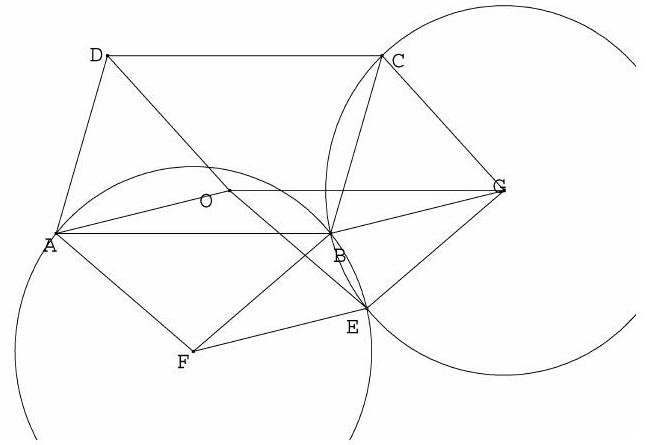 |
| |
| Figure 1. |
| |
| 87.2. Let $A B C D$ be a parallelogram in the plane. We draw two circles of radius $R$, one through the points $A$ and $B$, the other through $B$ and $C$. Let $E$ be the other point of |
| intersection of the circles. We assume that $E$ is not a vertex of the parallelogram. Show that the circle passing through $A, D$, and $E$ also has radius $R$. |
| |
| Solution. (See Figure 1.) Let $F$ and $G$ be the centers of the two circles of radius $R$ passing through $A$ and $B$; and $B$ and $C$, respectively. Let $O$ be the point for which the the rectangle $A B G O$ is a parallelogram. Then $\angle O A D=\angle G B C$, and the triangles $O A D$ and $G B C$ are congruent (sas). Since $G B=G C=R$, we have $O A=O D=R$. The quadrangle $E F B G$ is a rhombus. So $E F\|G B\| O A$. Moreover, $E F=O A=R$, which means that $A F E O$ is a parallelogram. But this implies $O E=A F=R$. So $A, D$, and $E$ all are on the circle of radius $R$ centered at $O$. |
| |
| 87.3. Let $f$ be a strictly increasing function defined in the set of natural numbers satisfying the conditions $f(2)=a>2$ and $f(m n)=f(m) f(n)$ for all natural numbers $m$ and $n$. Determine the smallest possible value of $a$. |
| |
| Solution. Since $f(n)=n^{2}$ is a function satisfying the conditions of the problem, the smallest posiible $a$ is at most 4. Assume $a=3$. It is easy to prove by induction that $f\left(n^{k}\right)=f(n)^{k}$ for all $k \geq 1$. So, taking into account that $f$ is strictly increasing, we get |
| |
| $$ |
| \begin{gathered} |
| f(3)^{4}=f\left(3^{4}\right)=f(81)>f(64)=f\left(2^{6}\right)=f(2)^{6} \\ |
| =3^{6}=27^{2}>25^{2}=5^{4} |
| \end{gathered} |
| $$ |
| |
| as well as |
| |
| $$ |
| \begin{aligned} |
| & f(3)^{8}=f\left(3^{8}\right)=f(6561)<f(8192) \\ |
| & \quad=f\left(2^{13}\right)=f(2)^{13}=3^{13}<6^{8} |
| \end{aligned} |
| $$ |
| |
| So we arrive at $5<f(3)<6$. But this is not possible, since $f(3)$ is an integer. So $a=4$. |
| |
| 87.4. Let $a, b$, and $c$ be positive real numbers. Prove: |
| |
| $$ |
| \frac{a}{b}+\frac{b}{c}+\frac{c}{a} \leq \frac{a^{2}}{b^{2}}+\frac{b^{2}}{c^{2}}+\frac{c^{2}}{a^{2}} |
| $$ |
| |
| Solution. The arithmetic-geometric inequality yields |
| |
| $$ |
| 3=3 \sqrt[3]{\frac{a^{2}}{b^{2}} \cdot \frac{b^{2}}{c^{2}} \cdot \frac{c^{2}}{a^{2}}} \leq \frac{a^{2}}{b^{2}}+\frac{b^{2}}{c^{2}}+\frac{c^{2}}{a^{2}} |
| $$ |
| |
| or |
| |
| $$ |
| \sqrt{3} \leq \sqrt{\frac{a^{2}}{b^{2}}+\frac{b^{2}}{c^{2}}+\frac{c^{2}}{a^{2}}} |
| $$ |
| |
| On the other hand, the Cauchy-Schwarz inequality implies |
| |
| $$ |
| \begin{aligned} |
| \frac{a}{b}+\frac{b}{c}+ & \frac{c}{a} \leq \sqrt{1^{2}+1^{2}+1^{2}} \sqrt{\frac{a^{2}}{b^{2}}+\frac{b^{2}}{c^{2}}+\frac{c^{2}}{a^{2}}} \\ |
| & =\sqrt{3} \sqrt{\frac{a^{2}}{b^{2}}+\frac{b^{2}}{c^{2}}+\frac{c^{2}}{a^{2}}} |
| \end{aligned} |
| $$ |
| |
| We arrive at the inequality of the problem by combining (1) and (2). |
| |
| 88.1. The positive integer $n$ has the following property: if the three last digits of $n$ are removed, the number $\sqrt[3]{n}$ remains. Find $n$. |
| |
| Solution. If $x=\sqrt[3]{n}$, and $y, 0 \leq y<1000$, is the number formed by the three last digits of $n$, we have |
| |
| $$ |
| x^{3}=1000 x+y |
| $$ |
| |
| So $x^{3} \geq 1000 x, x^{2}>1000$, and $x>31$. On the other hand, $x^{3}<1000 x+1000$, or $x\left(x^{2}-1000\right)<1000$. The left hand side of this inequality is an increasing function of $x$, and $x=33$ does not satisfy the inequality. So $x<33$. Since $x$ is an integer, $x=32$ and $n=32^{3}=32768$. |
| |
| 88.2. Let $a, b$, and $c$ be non-zero real numbers and let $a \geq b \geq c$. Prove the inequality |
| |
| $$ |
| \frac{a^{3}-c^{3}}{3} \geq a b c\left(\frac{a-b}{c}+\frac{b-c}{a}\right) |
| $$ |
| |
| When does equality hold? |
| |
| Solution. Since $c-b \leq 0 \leq a-b$, we have $(a-b)^{3} \geq(c-b)^{3}$, or |
| |
| $$ |
| a^{3}-3 a^{2} b+3 a b^{2}-b^{3} \geq c^{3}-3 b c^{2}+3 b^{2} c-b^{3} |
| $$ |
| |
| On simplifying this, we immediately have |
| |
| $$ |
| \frac{1}{3}\left(a^{3}-c^{3}\right) \geq a^{2} b-a b^{2}+b^{2} c-b c^{2}=a b c\left(\frac{a-b}{c}+\frac{b-c}{a}\right) |
| $$ |
| |
| A sufficient condition for equality is $a=c$. If $a>c$, then $(a-b)^{3}>(c-b)^{3}$, which makes the proved inequality a strict one. So $a=c$ is a necessary condition for equality, too. |
| |
| 88.3. Two concentric spheres have radii $r$ and $R, r<R$. We try to select points $A, B$ and $C$ on the surface of the larger sphere such that all sides of the triangle $A B C$ would be tangent to the surface of the smaller sphere. Show that the points can be selected if and only if $R \leq 2 r$. |
| |
| Solution. Assume $A, B$, and $C$ lie on the surface $\Gamma$ of a sphere of radius $R$ and center $O$, and $A B, B C$, and $C A$ touch the surface $\gamma$ of a sphere of radius $r$ and center $O$. The circumscribed and inscribed circles of $A B C$ then are intersections of the plane $A B C$ with $\Gamma$ and $\gamma$, respectively. The centers of these circles both are the foot $D$ of the perpendicular dropped from $O$ to the plane $A B C$. This point lies both on the angle bisectors of the triangle $A B C$ and on the perpendicular bisectors of its sides. So these lines are the same, which means that the triangle $A B C$ is equilateral, and the center of the circles is the common point of intersection of the medians of $A B C$. This again implies that the radii of the two circles are $2 r_{1}$ and $r_{1}$ for some real number $r_{1}$. Let $O D=d$. Then $2 r_{1}=\sqrt{R^{2}-d^{2}}$ and $r_{1}=\sqrt{r^{2}-d^{2}}$. Squaring, we get $R^{2}-d^{2}=4 r^{2}-4 d^{2}, 4 r^{2}-R^{2}=3 d^{2} \geq 0$, and $2 r \geq R$. On the other hand, assume $2 r \geq R$. Consider a plane at the distance |
| |
| $$ |
| d=\sqrt{\frac{4 r^{2}-R^{2}}{3}} |
| $$ |
| |
| from the common center of the two spheres. The plane cuts the surfaces of the spheres along concentric circles of radii |
| |
| $$ |
| r_{1}=\sqrt{\frac{R^{2}-r^{2}}{3}}, \quad R_{1}=2 \sqrt{\frac{R^{2}-r^{2}}{3}} |
| $$ |
| |
| The points $A, B$, and $C$ can now be chosen on the latter circle in such a way that $A B C$ is equilateral. |
| |
| 88.4. Let $m_{n}$ be the smallest value of the function |
| |
| $$ |
| f_{n}(x)=\sum_{k=0}^{2 n} x^{k} |
| $$ |
| |
| Show that $m_{n} \rightarrow \frac{1}{2}$, as $n \rightarrow \infty$. |
| |
| Solution. For $n>1$, |
| |
| $$ |
| \begin{gathered} |
| f_{n}(x)=1+x+x^{2}+\cdots \\ |
| =1+x\left(1+x^{2}+x^{4}+\cdots\right)+x^{2}\left(1+x^{2}+x^{4} \cdots\right) \\ |
| =1+x(1+x) \sum_{k=0}^{n-1} x^{2 k} |
| \end{gathered} |
| $$ |
| |
| From this we see that $f_{n}(x) \geq 1$, for $x \leq-1$ and $x \geq 0$. Consequently, $f_{n}$ attains its minimum value in the interval $(-1,0)$. On this interval |
| |
| $$ |
| f_{n}(x)=\frac{1-x^{2 n+1}}{1-x}>\frac{1}{1-x}>\frac{1}{2} |
| $$ |
|
|
| So $m_{n} \geq \frac{1}{2}$. But |
| |
| $$ |
| m_{n} \leq f_{n}\left(-1+\frac{1}{\sqrt{n}}\right)=\frac{1}{2-\frac{1}{\sqrt{n}}}+\frac{\left(1-\frac{1}{\sqrt{n}}\right)^{2 n+1}}{2-\frac{1}{\sqrt{n}}} |
| $$ |
| |
| As $n \rightarrow \infty$, the first term on the right hand side tends to the limit $\frac{1}{2}$. In the second term, the factor |
| |
| $$ |
| \left(1-\frac{1}{\sqrt{n}}\right)^{2 n}=\left(\left(1-\frac{1}{\sqrt{n}}\right)^{\sqrt{n}}\right)^{2 \sqrt{n}} |
| $$ |
| |
| of the nominator tehds to zero, because |
| |
| $$ |
| \lim _{k \rightarrow \infty}\left(1-\frac{1}{k}\right)^{k}=e^{-1}<1 |
| $$ |
|
|
| So $\lim _{n \rightarrow \infty} m_{n}=\frac{1}{2}$. |
|
|
| 89.1 Find a polynomial $P$ of lowest possible degree such that |
|
|
| (a) $P$ has integer coefficients, |
|
|
| (b) all roots of $P$ are integers, |
|
|
| (c) $P(0)=-1$, |
|
|
| (d) $P(3)=128$. |
|
|
| Solution. Let $P$ be of degree $n$, and let $b_{1}, b_{2}, \ldots, b_{m}$ be its zeroes. Then |
| |
| $$ |
| P(x)=a\left(x-b_{1}\right)^{r_{1}}\left(x-b_{2}\right)^{r_{2}} \cdots\left(x-b_{m}\right)^{r_{m}} |
| $$ |
| |
| where $r_{1}, r_{2}, \ldots, r_{m} \geq 1$, and $a$ is an integer. Because $P(0)=-1$, we have $a b_{1}^{r_{1}} b_{2}^{r_{2}} \cdots b_{m}^{r_{m}}(-1)^{n}=-1$. This can only happen, if $|a|=1$ and $\left|b_{j}\right|=1$ for all $j=1,2, \ldots, m$. So |
| |
| $$ |
| P(x)=a(x-1)^{p}(x+1)^{n-p} |
| $$ |
| |
| for some $p$, and $P(3)=a \cdot 2^{p} 2^{2 n-2 p}=128=2^{7}$. So $2 n-p=7$. Because $p \geq 0$ and $n$ are integers, the smallest possible $n$, for which this condition can be true is 4 . If $n=4$, then $p=1, a=1$. - The polynomial $P(x)=(x-1)(x+1)^{3}$ clearly satisfies the conditions of the problem. |
| |
| 89.2. Three sides of a tetrahedron are right-angled triangles having the right angle at their common vertex. The areas of these sides are $A, B$, and $C$. Find the total surface area of the tetrahedron. |
| |
| Solution 1. Let $P Q R S$ be the tetrahedron of the problem and let $S$ be the vertex common to the three sides which are right-angled triangles. Let the areas of $P Q S, Q R S$, and $R P S$ be $A, B$, and $C$, respectively. Denote the area of $Q R S$ by $X$. If $S S^{\prime}$ is the altitude from $S$ (onto $P Q R$ ) and $\angle R S S^{\prime}=\alpha, \angle P S S^{\prime}=\beta, \angle Q S S^{\prime}=\gamma$, the rectangular parallelepiped with $S S^{\prime}$ as a diameter, gives by double use of the Pythagorean theorem |
| |
| $$ |
| \begin{gathered} |
| S S^{\prime 2}=\left(S S^{\prime} \cos \alpha\right)^{2}+\left(S S^{\prime} \sin \alpha\right)^{2} \\ |
| =\left(S S^{\prime} \cos \alpha\right)^{2}+\left(S S^{\prime} \cos \beta\right)^{2}+\left(S S^{\prime} \cos \gamma\right)^{2} |
| \end{gathered} |
| $$ |
| |
| or |
| |
| $$ |
| \cos ^{2} \alpha+\cos ^{2} \beta+\cos ^{2} \gamma=1 |
| $$ |
| |
| (a well-known formula). The magnitude of the dihedral angle between two planes equals the angle between the normals of the planes. So $\alpha, \beta$, and $\gamma$ are the magnitudes of the dihedral angles between $P Q R$ and $P Q S, Q R S$, and $R P S$, respectively. Looking at the projections of $P Q R$ onto the three other sides of $P Q R S$, we get $A=X \cos \alpha, B=X \cos \beta$, and $C=X \cos \gamma$. But (1) now yields $X^{2}=A^{2}+B^{2}+C^{2}$. The total area of $P Q R S$ then equals $A+B+C+\sqrt{A^{2}+B^{2}+C^{2}}$. |
| |
| Solution 2. Use the symbols introduced in the first solution. Align the coordinate axes so that $\overrightarrow{S P}=a \vec{i}, \overrightarrow{S Q}=b \vec{j}$, and $\overrightarrow{C R}=c \vec{k}$. The $2 A=a b, 2 B=b c$, and $2 C=a c$. By the well-known formula for the area of a triangle, we get |
| |
| $$ |
| \begin{aligned} |
| & 2 X=|\overrightarrow{P Q} \times \overrightarrow{P R}|=|(b \vec{j}-a \vec{i}) \times(c \vec{k}-a \vec{i})| \\ |
| & =|b c \vec{i}+b a \vec{k}+a c \vec{j}|=2 \sqrt{(b c)^{2}+(b a)^{2}+(a c)^{2}} \\ |
| & =2 \sqrt{B^{2}+A^{2}+c^{2}} |
| \end{aligned} |
| $$ |
| |
| So $X=\sqrt{B+A+C}$, and we have $A+B+C+\sqrt{B+A+C}$ as the total area. |
| |
| 89.3. Let $S$ be the set of all points $t$ in the closed interval $[-1,1]$ such that for the sequence $x_{0}, x_{1}, x_{2}, \ldots$ defined by the equations $x_{0}=t, x_{n+1}=2 x_{n}^{2}-1$, there exists a positive integer $N$ such that $x_{n}=1$ for all $n \geq N$. Show that the set $S$ has infinitely many elements. |
|
|
| Solution. All numbers in the sequence $\left\{x_{n}\right\}$ lie in the interval $[-1,1]$. For each $n$ we can pick an $\alpha_{n}$ such that $x_{n}=\cos \alpha_{n}$. If $x_{n}=\cos \alpha_{n}$, then $x_{n+1}=2 \cos ^{2} \alpha_{n}-1=\cos \left(2 \alpha_{n}\right)$. The nuber $\alpha_{n+1}$ can be chosen as $2 \alpha_{n}$, and by induction, $\alpha_{n}$ can be chosen as $2^{n} \alpha_{0}$. Now $x_{n}=1$ if and only if $\alpha_{n}=2 k \pi$ for some integer $k$. Take $S^{\prime}=\left\{\cos \left(2^{-m} \pi\right) \mid m \in \mathbb{N}\right\}$. Since every $\alpha_{0}=2^{-m} \pi$ multiplied by a sufficiently large power of 2 is a multiple of $2 \pi$, it follows from what was said above that $S^{\prime} \subset S$. Since $S^{\prime}$ is infinite, so is $S$. |
|
|
| 89.4 For which positive integers $n$ is the following statement true: if $a_{1}, a_{2}, \ldots, a_{n}$ are positive integers, $a_{k} \leq n$ for all $k$ and $\sum_{k=1}^{n} a_{k}=2 n$, then it is always possible to choose $a_{i_{1}}, a_{i_{2}}, \ldots, a_{i_{j}}$ in such a way that the indices $i_{1}, i_{2}, \ldots, i_{j}$ are different numbers, and $\sum_{k=1}^{j} a_{i_{k}}=n$ ? |
|
|
| Solution. The claim is not true for odd $n$. A counterexample is provided by $a_{1}=a_{2}=$ $\cdots=a_{n}=2$. We prove by induction that the claim is true for all even $n=2 k$. If $k=1$, then $a_{1}+a_{2}=4$ and $1 \leq a_{1}, a_{2} \leq 2$, so necessarily $a_{1}=a_{2}=2$. A choice satisfying the condition of the problem is $a_{1}$. Now assume that the claim holds for any $2 k-2$ integers with sum $4 k-4$. Let $a_{1}, a_{2}, \ldots, a_{2 k}$ be positive integers $\leq 2 k$ with sum $4 k$. If one of the numbers is $2 k$, the case is clear: this number alone can form the required subset. So we may assume that all the numbers are $\leq 2 k-1$. If there are at least two 2's among the numbers, we apply our induction hypothesis to the $2 k-2$ numbers which are left when two 2's are removed. the sum of these numbers is $4 k-4$, so among them there is a subcollection with sum $2 k-2$. Adding one 2 to the collection raises the sum to $2 k$. As the next case we assume that there are no 2's among the numbers. Then there must be some 1's among them. Assume there are $x$ 1's among the numbers. Then $2 k-x$ of the numbers are $\geq 3$. So $x+3(2 k-x) \leq 4 k$ or $k \leq x$. Now $4 k-x$ is between $2 k$ and $3 k$, and it is and it is the sum of more than one of the numbers in the collection, and these numbers are at least 3 and at most $2 k-1$. It follows that we can find numbers $\geq 3$ in the collection with sum between $k$ and $2 k$. Adding a sufficient number of 1 's to this collection we obtain the sum $2 k$. We still have the case in which there is exactly one 2 in the collection. Again, denoting the number of 1's by $x$, we obtain $x+2+3(2 k-x-1) \leq 4 k$, which implies $2 k-1 \leq 2 x$. Because $x$ is an integer, we have $k \leq x$. The rest of the proof goes as in the previous case. |
| |
| 90.1. Let $m, n$, and $p$ be odd positive integers. Prove that the number |
| |
| $$ |
| \sum_{k=1}^{(n-1)^{p}} k^{m} |
| $$ |
|
|
| is divisible by $n$. |
|
|
| Solution. Since $n$ is odd, the sum has an even number of terms. So we can write it as |
|
|
| $$ |
| \sum_{k=1}^{\frac{1}{2}(n-1)^{p}}\left(k^{m}+\left((n-1)^{p}-k+1\right)^{m}\right) |
| $$ |
| |
| Because $m$ is odd, each term in the sum has $k+(n-1)^{p}-k+1=(n-1)^{p}+1$ as a factor. As $p$ is odd, too, $(n-1)^{p}+1=(n-1)^{p}+1^{p}$ has $(n-1)+1=n$ as a factor. So each term in the sum (1) is divisible by $n$, and so is the sum. |
| |
| 90.2. Let $a_{1}, a_{2}, \ldots, a_{n}$ be real numbers. Prove |
|
|
| $$ |
| \sqrt[3]{a_{1}^{3}+a_{2}^{3}+\ldots+a_{n}^{3}} \leq \sqrt{a_{1}^{2}+a_{2}^{2}+\ldots+a_{n}^{2}} |
| $$ |
|
|
| When does equality hold in (1)? |
|
|
| Solution. If $0 \leq x \leq 1$, then $x^{3 / 2} \leq x$, and equality holds if and only if $x=0$ or $x=1$. - The inequality is true as an equality, if all the $a_{k}$ 's are zeroes. Assume that at least one of the numbers $a_{k}$ is non-zero. Set |
|
|
| $$ |
| x_{k}=\frac{a_{k}^{2}}{\sum_{j=1}^{n} a_{j}^{2}} |
| $$ |
|
|
| Then $0 \leq x_{k} \leq 1$, and by the remark above, |
| |
| $$ |
| \sum_{k=1}^{n}\left(\frac{a_{k}^{2}}{\sum_{j=1}^{n} a_{j}^{2}}\right)^{3 / 2} \leq \sum_{k=1}^{n} \frac{a_{k}^{2}}{\sum_{j=1}^{n} a_{j}^{2}}=1 |
| $$ |
| |
| So |
| |
| $$ |
| \sum_{k=1}^{n} a_{k}^{3} \leq\left(\sum_{j_{1}}^{n} a_{j}^{2}\right)^{3 / 2} |
| $$ |
|
|
| which is what was supposed to be proved. For equality, exactly on $x_{k}$ has to be one and the rest have to be zeroes, which is equivalent to having exactly one of the $a_{k}$ 's positive and the rest zeroes. |
|
|
|  |
|
|
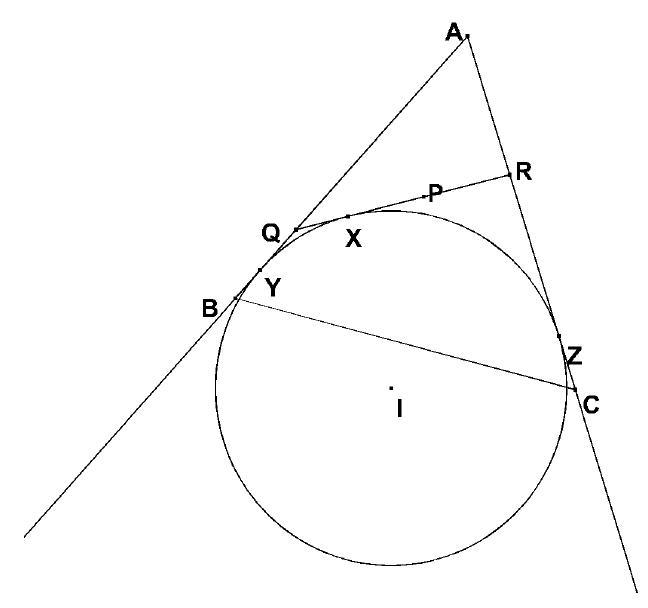
| Figure 2. |
|
|
| 90.3. Let $A B C$ be a triangle and let $P$ be an interior point of $A B C$. We assume that a line $l$, which passes through $P$, but not through $A$, intersects $A B$ and $A C$ (or their extensions over $B$ or $C$ ) at $Q$ and $R$, respectively. Find $l$ such that the perimeter of the triangle $A Q R$ is as small as possible. |
|
|
| Solution. (See Figure 2.) Let |
|
|
| $$ |
| s=\frac{1}{2}(A R+R Q+Q A) |
| $$ |
|
|
| Let $\mathcal{C}$ be the excircle of $A Q R$ tangent to $Q R$, i.e. the circle tangent to $Q R$ and the extensions of $A R$ and $A Q$. Denote the center of $\mathcal{C}$ by $I$ and the measure of $\angle Q A R$ by $\alpha . I$ is on the bisector of $\angle Q A R$. Hence $\angle Q A I=\angle I A R=\frac{1}{2} \alpha$. Let $\mathcal{C}$ touch $R Q$, the extension of $A Q$, and the extension of $A R$ at $X, Y$, and $Z$, respectively. Clearly |
|
|
| $$ |
| A Q+Q X=A Y=A Z=A R+R X |
| $$ |
|
|
| so |
|
|
| $$ |
| A Z=A I \cos \frac{1}{2} \alpha=s |
| $$ |
|
|
| Hence $s$ and the perimeter of $A Q R$ is smallest, when $A I$ is smallest. If $P \neq X$, it is possible to turn the line through $P$ to push $\mathcal{C}$ deeper into the angle $B A C$. So the minumum for $A I$ is achieved precisely as $X=P$. To construct minimal triangle, we have to draw a circle touching the half lines $A B$ and $A C$ and passing through $P$. This is accomplished by first drawing an arbitrary circle touching the half lines, and then performing a suitable homothetic transformation of the circle to make it pass through $P$. |
|
|
| 90.4. It is possible to perform three operations $f, g$, and $h$ for positive integers: $f(n)=$ $10 n, g(n)=10 n+4$, and $h(2 n)=n$; in other words, one may write 0 or 4 in the end of the number and one may divide an even number by 2. Prove: every positive integer can be constructed starting from 4 and performing a finite number of the operations $f, g$, and $h$ in some order. |
|
|
| Solution. All odd numbers $n$ are of the form $h(2 n)$. All we need is to show that every even number can be obtained fron 4 by using the operations $f, g$, and $h$. To this end, we show that a suitably chosen sequence of inverse operations $F=f^{-1}, G=g^{-1}$, and $H=h^{-1}$ produces a smaller even number or the number 4 from every positive even integer. The operation $F$ can be applied to numbers ending in a zero, the operation $G$ can be applied to numbers ending in 4 , and $H(n)=2 n$. We obtain |
|
|
| $$ |
| \begin{gathered} |
| H(F(10 n))=2 n \\ |
| G(H(10 n+2))=2 n, \quad n \geq 1 \\ |
| H(2)=4 \\ |
| H(G(10 n+4))=2 n \\ |
| G(H(H(10 n+6)))=4 n+2 \\ |
| G(H(H(H(10 n+8))))=8 n+6 |
| \end{gathered} |
| $$ |
|
|
| After a finite number of these steps, we arrive at 4 . |
|
|
| 91.1. Determine the last two digits of the number |
|
|
| $$ |
| 2^{5}+2^{5^{2}}+2^{5^{3}}+\cdots+2^{5^{1991}} |
| $$ |
|
|
| written in decimal notation. |
|
|
| Solution. We first show that all numbers $2^{5^{k}}$ are of the form $100 p+32$. This can be shown by induction. The case $k=1$ is clear $\left(2^{5}=32\right)$. Assume $2^{5^{k}}=100 p+32$. Then, by the binomial formula, |
|
|
| $$ |
| 2^{5^{k+1}}=\left(2^{5^{k}}\right)^{5}=(100 p+32)^{5}=100 q+32^{5} |
| $$ |
|
|
| and |
|
|
| $$ |
| \begin{gathered} |
| (30+2)^{5}=30^{5}+5 \cdot 30^{4} \cdot 2+10 \cdot 30^{3} \cdot 4+10 \cdot 30^{2} \cdot 8+5 \cdot 30 \cdot 16+32 \\ |
| =100 r+32 |
| \end{gathered} |
| $$ |
|
|
| So the last two digits of the sum in the problem are the same as the last digits of the number $1991 \cdot 32$, or 12 . |
|
|
| 91.2. In the trapezium $A B C D$ the sides $A B$ and $C D$ are parallel, and $E$ is a fixed point on the side $A B$. Determine the point $F$ on the side $C D$ so that the area of the intersection of the triangles $A B F$ and $C D E$ is as large as possible. |
|
|
|  |
|
|
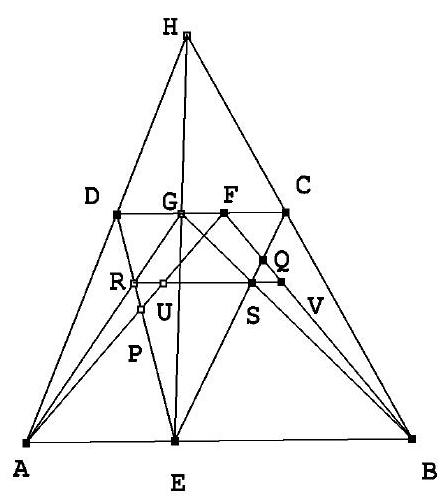
| Figure 3. |
|
|
| Solution 1. (See Figure 3.) We assume $C D<A B$. Let $A D$ and $B C$ intersect at $H$ and $E H$ and $D C$ at $G$. Let $D E$ intersect $A F$ at $P$ and $F B$ intersect $E C$ at $Q$. Denote the area of a figure $\mathcal{F}$ by $|\mathcal{F}|$. Since $|A B F|$ does not depend on the choice of $F$ on $D C,|E Q F P|$ is maximized when $|A E P|+|E B Q|$ is minimized. We claim that this takes place when $F=G$. Let $R$ and $S$ be the points of intersection of the trapezia $A E G D$ and $E B C G$, respectively. Then $R S \| A B$. (To see this, consider the pairs $A E R$ and $G D R ; E B S$ and $C G S$ of similar triangles. The ratios of their altitudes are $A E: D G$ and $E B: G C$, |
| respectively. But both ratios are equal to $E G: H G$. As the sum of the ratios in both pairs is the altitude of $A B C D$, the altitudes of, say $A E R$ and $E B S$ are equal, which inplies the claim.) Denote the points where $R S$ intersects $F A$ and $F B$ by $U$ and $V$, respectively. Then $|A U R|=|B V S|$. (RU and $S V$ are the same fraction of $G F$, and both triangles have the same altitude.) Assume that $F$ lies between $G$ and $C$. Then |
| |
| $$ |
| \begin{gathered} |
| |A P E|+|E B Q|>|A P E|+|E B S|+|B S V| \\ |
| =|A P E|+|E B S|+|A U R|>|A P E|+|E B S|+|A P R| \\ |
| =|A R E|+|E B S| |
| \end{gathered} |
| $$ |
|
|
| A similar inequality can be established, when $F$ is between $G$ and $D$. So the choice $F=G$ minimizes $|A E P|+|E B Q|$ and maximizes $|E Q F P|$. - Proofs in the cases $A B=C D$ and $A B<C D$ go along similar lines. |
| |
| Solution 2. We again minimize $|A E P|+|E B Q|$. Set $A B=a, C D=b, A E=c, D F=x$, and denote the altitude of $A B C D$ by $h$ and the altitudes of $A E P$ and $E B Q$ by $h_{1}$ and $h_{2}$, respectively. Since $A E P$ and $F D P$ are similar, as well as $E B Q$ and $C F Q$, we have |
| |
| $$ |
| \frac{c}{x}=\frac{h_{1}}{h-h_{1}}, \quad \text { and } \quad \frac{a-c}{b-x}=\frac{h_{2}}{h-h_{2}} |
| $$ |
| |
| Solving from these, we obtain |
| |
| $$ |
| h_{1}=\frac{c h}{x+c}, \quad h_{2}=\frac{(a-c) h}{a+b-c-x} |
| $$ |
| |
| As $h_{1} c+h_{2}(a-c)$ is double the area to be minimized, we seek the minimum of |
| |
| $$ |
| f(x)=\frac{c^{2}}{x+c}+\frac{(a-c)^{2}}{2 a-c-x} |
| $$ |
| |
| The necessary minimum condition $f^{\prime}(x)=0$ means |
| |
| $$ |
| \frac{c^{2}}{(x+c)^{2}}=\frac{(a-c)^{2}}{(a+b-c-x)^{2}} |
| $$ |
| |
| Solving this, we obtain $x=\frac{b c}{a}$, and since the left hand side of the equation has a decreasing and the right hand side an increasing function of $x$ in the relevant interval $0 \leq x \leq b$, we see that $x=c$ is the only root of $\left.\left.f^{\prime}\right) x\right)=0$, and we also note that $f^{\prime}(x)$ is increasing. So $f(x)$ has a global minimum at $x=\frac{b c}{a}$. This means that, in terms of the notation of the first solution, $F=G$ is the solution of the problem. |
| |
| 91.3. Show that |
| |
| $$ |
| \frac{1}{2^{2}}+\frac{1}{3^{2}}+\ldots+\frac{1}{n^{2}}<\frac{2}{3} |
| $$ |
| |
| for all $n \geq 2$. |
| |
| Solution. Since |
| |
| $$ |
| \frac{1}{j^{2}}<\frac{1}{j(j-1)}=\frac{1}{j-1}-\frac{1}{j} |
| $$ |
| |
| we have |
| |
| $$ |
| \begin{gathered} |
| \sum_{j=k}^{n} \frac{1}{j^{2}}<\left(\frac{1}{k-1}-\frac{1}{k}\right)+\left(\frac{1}{k}-\frac{1}{k+1}\right)+\cdots+\left(\frac{1}{n-1}-\frac{1}{n}\right) \\ |
| =\frac{1}{k-1}-\frac{1}{n}<\frac{1}{k-1} |
| \end{gathered} |
| $$ |
| |
| From this we obtain for $k=6$ |
| |
| $$ |
| \frac{1}{2^{2}}+\frac{1}{3^{2}}+\ldots+\frac{1}{n^{2}}<\frac{1}{4}+\frac{1}{9}+\frac{1}{16}+\frac{1}{25}+\frac{1}{5}=\frac{2389}{3600}<\frac{2}{3} |
| $$ |
| |
| 91.4. Let $f(x)$ be a polynomial with integer coefficients. We assume that there exists a positive integer $k$ and $k$ consecutive integers $n, n+1, \ldots, n+k-1$ so that none of the numbers $f(n), f(n+1), \ldots, f(n+k-1)$ is divisible by $k$. Show that the zeroes of $f(x)$ are not integers. |
| |
| Solution. Let $f(x)=a_{0} x^{d}+a_{1} x^{d-1}+\cdots+a_{d}$. Assume that $f$ has a zero $m$ which is an integer. Then $f(x)=(x-m) g(x)$, where $g$ is a polynomial. If $g(x)=b_{0} x^{d-1}+b_{1} x^{d-2}+$ $\cdots+b_{d-1}$, then $a_{0}=b_{0}$, and $a_{k}=b_{k}-m b_{k-1}, 1 \leq k \leq d-1$. So $b_{0}$ is an integer, and by induction all $b_{k}$ 's are integers. Because $f(j)$ is not divisible by $k$ for $k$ consequtive values of $j$, no one of the $k$ consequtive integers $j-m, j=n, n+1, \ldots, n+k-1$, is divisible by $k$. But this is a contradiction, since exactly one of $k$ consequtive integers is divisible by $k$. So $f$ cannot have an integral zero. |
| |
| 92.1. Determine all real numbers $x>1, y>1$, and $z>1$, satisfying the equation |
|
|
| $$ |
| \begin{aligned} |
| x+y+z+\frac{3}{x-1} & +\frac{3}{y-1}+\frac{3}{z-1} \\ |
| & =2(\sqrt{x+2}+\sqrt{y+2}+\sqrt{z+2}) |
| \end{aligned} |
| $$ |
|
|
| Solution. Consider the function $f$, |
|
|
| $$ |
| f(t)=t+\frac{3}{t-1}-2 \sqrt{t+2} |
| $$ |
|
|
| defined for $t>1$. The equation of the problem can be written as |
|
|
| $$ |
| f(x)+f(y)+f(z)=0 |
| $$ |
|
|
| We reformulate the formula for $f$ : |
|
|
| $$ |
| \begin{aligned} |
| f(t) & =\frac{1}{t-1}\left(t^{2}-t+3-2(t-1) \sqrt{t+2}\right) \\ |
| & =\frac{1}{t-1}\left(t^{2}-2 t+1+(\sqrt{t+2})^{2}-2(t-1) \sqrt{t+2}\right) \\ |
| & =\frac{1}{t-1}(t-1-\sqrt{t+2})^{2} |
| \end{aligned} |
| $$ |
|
|
| So $f(t) \geq 0$, and $f(t)=0$ for $t>1$ only if |
|
|
| $$ |
| t-1=\sqrt{t+2} |
| $$ |
|
|
| or |
|
|
| $$ |
| t^{2}-3 t-1=0 |
| $$ |
|
|
| The only $t$ satisfying this condition is |
|
|
| $$ |
| t=\frac{3+\sqrt{13}}{2} |
| $$ |
|
|
| So the only solution to the equation in the problem is given by |
|
|
| $$ |
| x=y=z=\frac{3+\sqrt{13}}{2} |
| $$ |
|
|
| 92.2. Let $n>1$ be an integer and let $a_{1}, a_{2}, \ldots, a_{n}$ be $n$ different integers. Show that the polynomial |
| |
| $$ |
| f(x)=\left(x-a_{1}\right)\left(x-a_{2}\right) \cdots\left(x-a_{n}\right)-1 |
| $$ |
|
|
| is not divisible by any polynomial with integer coefficients and of degree greater than zero but less than $n$ and such that the highest power of $x$ has coefficient 1. |
|
|
| Solution. Suppose $g(x)$ is a polynomial of degree $m$, where $1 \leq m<n$, with integer coefficients and leading coefficient 1 , such that |
| |
| $$ |
| f(x)=g(x) h(x) |
| $$ |
| |
| whre $h(x)$ is a polynomial. Let |
| |
| $$ |
| \begin{aligned} |
| & g(x)=x^{m}+b_{m-1} x^{m-1}+\cdots+b_{1} x+b_{0} \\ |
| & h(x)=x^{n-m}+c_{n-m-1} x^{n-m-1}+\cdots+c_{1} x+c_{0} |
| \end{aligned} |
| $$ |
| |
| We show that the coefficients of $h(x)$ are integers. If they are not, there is a greatest index $j=k$ such that $c_{k}$ is not an integer. But then the coefficient of $f$ multiplying $x^{k+m}-$ which is an integer - would be $c_{k}+b_{m-1} c_{k+1}+b_{m-2} c_{k+2}+\ldots b_{k-m}$. All terms except the first one in this sum are integers, so the sum cannot be an integer. A contradiction. So $h(x)$ is a polynomial with integral coefficients. Now |
| |
| $$ |
| f\left(a_{i}\right)=g\left(a_{i}\right) h\left(a_{i}\right)=-1 |
| $$ |
| |
| for $i=1,2, \ldots, n$, and $g\left(a_{i}\right)$ and $h\left(a_{i}\right)$ are integers. This is only possible, if $g\left(a_{i}\right)=$ $-f\left(a_{i}\right)= \pm 1$ and $g\left(a_{i}\right)+h\left(a_{i}\right)=0$ for $i=1,2, \ldots, n$. So the polynomial $g(x)+h(x)$ has at least $n$ zeroes. But the degree of $g(x)+h(x)$ is less than $n$. So $g(x)=-h(x)$ for all $x$, and $f(x)=-g(x)^{2}$. This is impossible, however, because $f(x) \rightarrow+\infty$, as $x \rightarrow+\infty$. This contradiction proves the claim. |
| |
|  |
| |
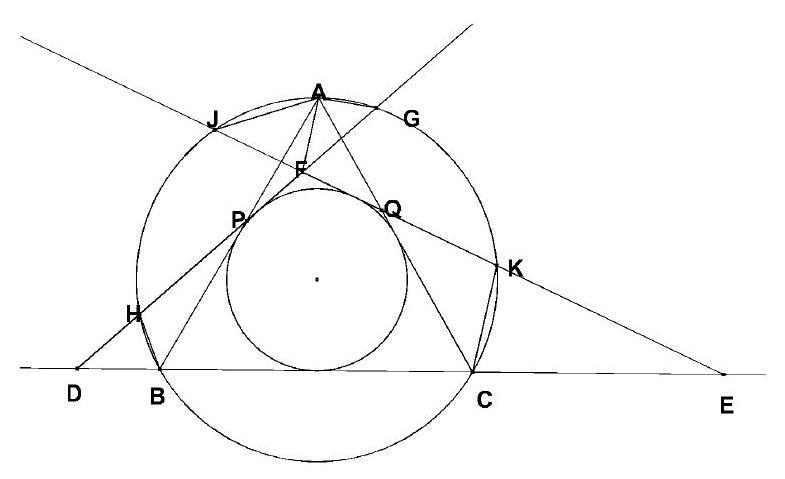
| Figure 4 . |
| |
| 92.3 Prove that among all triangles with inradius 1, the equilateral one has the smallest perimeter. |
| |
| Solution. (See Figure 4.) The area $T$, perimeter $p$ and inradius $r$ satisfy $2 T=r p$. (Divide the triangle into three triangles with a common vertex at the incenter of the triangle.) So for a fixed inradius, the triangle with the smallest perimeter is the one which has the smallest area. To prove that the equilateral triangles minimize the area among triangles with a fixed incircle, we utilize three trivial facts, which the reader may prove for his/her enjoyment: |
| |
| Lemma 1. If $A B$ and $C D$ are two equal chords of a circle and if they intersect at $P$, and if $D$ is on the shorter arc $A B$, then $A P D$ and $C P B$ are congruent triangles. |
| |
| Lemma 2. If $\mathcal{C}_{1}$ and $\mathcal{C}_{2}$ concentric circles, then all chords of $\mathcal{C}_{1}$ which are tangent to $\mathcal{C}_{2}$ are equal. |
| |
| Lemma 3. Given a circle $\mathcal{C}$, the set of points $P$ such that the tangents to $\mathcal{C}$ through $P$ meet at a fixed angle, is a circle concentric to $\mathcal{C}$. |
| |
| Now consider an equilateral triangle $A B C$ with incircle $\mathcal{C}_{1}$ and circumcircle $\mathcal{C}_{2}$. Let $D E F$ be another triangle with incircle $\mathcal{C}_{1}$. If $D E F$ is not equilateral, it either has two angles $<60^{\circ}$ and one angle $>60^{\circ}$, two angles $>60^{\circ}$ and one angle $<60^{\circ}$, or one angle $<60$, one $=60^{\circ}$, and one $>60^{\circ}$. In the first case, using Lemma 3 and its immediate consequences, we may rotate the triangles and rename the vertices so that $F$ is inside $\mathcal{C}_{2}$ and $D$ and $E$ are outside it. Let $D F$ intersect $\mathcal{C}_{2}$ at $G$ and $H$, let $E F$ intersect $\mathcal{C}_{2}$ at $K$ and $J$ ( $J$ on the shorter arc $H G)$, and let $A B$ and $H G$ intersect at $P$, and $A C$ and $J K$ at $Q$. Since $A$ is on different sides of $H G$ and $J K$ than $B$ and $C$, respectively, $A$ must be on the shorter arc $J G$. By Lemma $1, B P H$ and $A P G$ are congruent and $J Q A$ and $Q C K$ are congruent. We compute, denoting the area of a figure $\mathcal{F}$ by $|\mathcal{F}|$ : |
| |
| $$ |
| \begin{gathered} |
| |F D E|=|A B C|+|D B P|-|P F A|+|Q C E|-|A F Q| \\ |
| >|A B C|+|P H B|-|P F A|+|C K Q|-|A F G| \\ |
| >|A B C|+|P H B|-|P G A|+|C K Q|-|Q A J|=|A B C| |
| \end{gathered} |
| $$ |
| |
| The two other cases can be treated analogously. |
| |
| 92.4. Peter has many squares of equal side. Some of the squares are black, some are white. Peter wants to assemble a big square, with side equal to $n$ sides of the small squares, so that the big square has no rectangle formed by the small squares such that all the squares in the vertices of the rectangle are of equal colour. How big a square is Peter able to assemble? |
| |
| Solution. We show that Peter only can make a $4 \times 4$ square. The construction is possible, if $n=4$ : |
| |
| 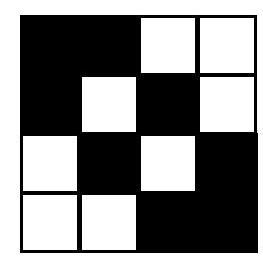 |
| |
| Now consider the case $n=5$. We may assume that at least 13 of the 25 squares are black. If five black squares are on one horizontal row, the remaining eight ones are distributed on the other four rows. At least one row has two black squres. A rectangle with all corners black is created. Next assume that one row has four black squares. Of the remaing 9 squares, at least three are one row. At least two of these three have to be columns having the assumed four black squares. If no row has more than four black squares, there have to be at least three rows with exactly three black squares. Denote these rows by $A, B$, and $C$. Let us call the columns in which the black squares on row $A$ lie black columns, and the other two columns white columns. If either row $B$ or row $C$ has at least two black squares which are on black columns, a rectancle with black corners arises. If both rows $B$ and $C$ have only one black square on the black columns, then both of them have two black squares on the two white columns, and they make the black corners of a rectangle. So Peter cannot make a $5 \times 5$ square in the way he wishes. |
| |
| 93.1. Let $F$ be an increasing real function defined for all $x, 0 \leq x \leq 1$, satisfying the conditions |
| |
| $$ |
| \begin{aligned} |
| & F\left(\frac{x}{3}\right)=\frac{F(x)}{2} \\ |
| & F(1-x)=1-F(x) |
| \end{aligned} |
| $$ |
| |
| Determine $F\left(\frac{173}{1993}\right)$ and $F\left(\frac{1}{13}\right)$. |
| |
| Solution. Condition (i) implies $F(0)=\frac{1}{2} F(0)$, so $F(0)=0$. Because of condition (ii), $F(1)=1-F(0)=1$. Also $F\left(\frac{1}{3}\right)=\frac{1}{2}$ and $F\left(\frac{2}{3}\right)=1-F\left(\frac{1}{3}\right)=\frac{1}{2}$. Since $F$ is an increasing function, this is possible only if $F(x)=\frac{1}{2}$ for all $x \in\left[\frac{1}{3}, \frac{2}{3}\right]$. To determine the first of the required values of $F$, we use (i) and (ii) to transform the argument into the middle third of $[0,1]$ : |
| |
| $$ |
| F\left(\frac{173}{1993}\right)=\frac{1}{2} F\left(\frac{519}{1993}\right)=\frac{1}{4} F\left(\frac{1557}{1993}\right) |
| $$ |
| |
| $$ |
| \begin{gathered} |
| =\frac{1}{4}\left(1-F\left(\frac{436}{1993}\right)\right)=\frac{1}{4}\left(1-\frac{1}{2} F\left(\frac{1308}{1993}\right)\right) \\ |
| =\frac{1}{4}\left(1-\frac{1}{4}\right)=\frac{3}{16} |
| \end{gathered} |
| $$ |
| |
| To find the second value of $F$, we use (i) and (ii) to form an equation fron which the value can be solved. Indeed, |
| |
| $$ |
| \begin{gathered} |
| F\left(\frac{1}{13}\right)=1-F\left(\frac{12}{13}\right)=1-2 F\left(\frac{4}{13}\right) \\ |
| =1-2\left(1-F\left(\frac{9}{13}\right)\right)=2 F\left(\frac{9}{13}\right)-1=4 F\left(\frac{3}{13}\right)-1 \\ |
| =8 F\left(\frac{1}{13}\right)-1 |
| \end{gathered} |
| $$ |
| |
| From this we solve |
| |
| $$ |
| F\left(\frac{1}{13}\right)=\frac{1}{7} |
| $$ |
| |
| 93.2. A hexagon is inscribed in a circle of radius $r$. Two of the sides of the hexagon have length 1, two have length 2 and two have length 3. Show that $r$ satisfies the equation |
| |
| $$ |
| 2 r^{3}-7 r-3=0 |
| $$ |
| |
| 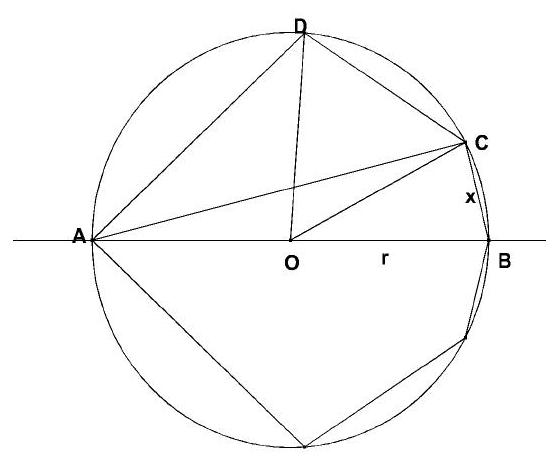 |
| |
| Figure 5. |
| |
| Solution. (See Figure 5.) We join the vertices of the hexagon to the center $O$ of its circumcircle. We denote by $\alpha$ the central angles corresponding the chords of length 1 , by $\beta$ those corresponding the chords of length 2 , and by $\gamma$ those corresponding the chords of length 3. Clearly $\alpha+\beta+\gamma=180^{\circ}$. We can move three chords of mutually different length so that they follow each other on the circumference. We thus obtain a quadrilateral $A B C D$ where $A B=2 r$ is a diameter of the circle, $B C=1, C D=2$, and $D A=3$. Then |
| $\angle C O B=\alpha$ and $\angle C A B=\frac{\alpha}{2}$. Then $\angle A B C=90^{\circ}-\frac{\alpha}{2}$, and, as $A B C D$ is an inscribed quafdrilateral, $\angle C D A=90^{\circ}+\frac{\alpha}{2}$. Set $A C=x$. From triangles $A B C$ and $A C D$ we obtain $x^{2}+1=4 r^{2}$ and |
| |
| $$ |
| x^{2}=4+9-2 \cdot 2 \cdot 3 \cos \left(90^{\circ}+\frac{\alpha}{2}\right)=13+12 \sin \left(\frac{\alpha}{2}\right) |
| $$ |
| |
| From triangle $A B C$, |
| |
| $$ |
| \sin \left(\frac{\alpha}{2}\right)=\frac{1}{2 r} |
| $$ |
| |
| We put this in the expression for $x^{2}$ to obtain |
| |
| $$ |
| 4 r^{2}=x^{2}+1=14+12 \cdot \frac{1}{2 r} |
| $$ |
| |
| which is equivalent to |
| |
| $$ |
| 2 r^{3}-7 r-3=0 |
| $$ |
| |
| 93.3. Find all solutions of the system of equations |
| |
| $$ |
| \left\{\begin{aligned} |
| s(x)+s(y) & =x \\ |
| x+y+s(z) & =z \\ |
| s(x)+s(y)+s(z) & =y-4 |
| \end{aligned}\right. |
| $$ |
| |
| where $x, y$, and $z$ are positive integers, and $s(x), s(y)$, and $s(z)$ are the numbers of digits in the decimal representations of $x, y$, and $z$, respectively. |
| |
| Solution. The first equation implies $x \geq 2$ and the first and third equation together imply |
| |
| $$ |
| s(z)=y-x-4 |
| $$ |
| |
| So $y \geq x+5 \geq 7$. From (1) and the second equation we obtain $z=2 y-4$. Translated to the values of $s$, these equation imply $s(x) \leq s(2 y) \leq s(y)+1$ and $s(x) \leq s(y)$. We insert these inequalitien in the last equation of the problem to obtain $y-4 \leq 3 s(y)+1$ or $y \leq 3 s(y)+5$. Since $10^{s(y)-1} \leq y$, the only possible values of $s(y)$ are 1 and 2 . If $s(y)=1$, then $7 \leq y \leq 3+5=8$. If $y=7, x$ must be 2 and $z=2 \cdot 7-4=10$. But this does not fit in the second equation: $2+7+2 \neq 10$. If $y=8$, then $z=12, x=2$. The triple $(2,8,12)$ satisfies all the equations of the problem. If $s(y)=2$, then $y \leq 6+5=11$. The only possibilities are $y=10$ and $y=11$. If $y=10$, then $z=16$ and $x \leq 5$. The equation $s(x)+s(y)+s(z)=y-4=6$ is not satisfied. If $y=11$, then $z=18$ and $x \leq 6$. Again, the third equation is not satisfied. So $x=2, y=8$, and $z=12$ is the only solution. |
| |
| 93.4. Denote by $T(n)$ the sum of the digits of the decimal representation of a positive integer $n$. |
| |
| a) Find an integer $N$, for which $T(k \cdot N)$ is even for all $k, 1 \leq k \leq 1992$, but $T(1993 \cdot N)$ is odd. |
| b) Show that no positive integer $N$ exists such that $T(k \cdot N)$ is even for all positive integers $k$. |
| |
| Solution. a) If $s$ has $n$ decimal digits and $m=10^{n+r} s+s$, then $T(k m)$ is even at least as long as $k s<10^{n+r}$, because all non-zero digits appear in pairs in $k m$. Choose $N=5018300050183$ or $s=50183, n=5, r=3$. Now $1992 \cdot s=99964536<10^{8}$, so $T(k N)$ is even for all $k \leq 1992$. But $1993 \cdot s=100014719,1993 \cdot N=10001472000014719$, and $T(1993 \cdot N)=39$ is odd. |
| |
| b) Assume that $N$ is a positive integer for which $T(k N)$ is even for all $k$. Consider the case $N=2 m$ first. Then $T(k m)=T(10 k m)=T(5 k N)$. As $T(5 k N)$ is even for every $k$, then so is $T(k m)$. Repeating the argument suffiently many times we arrive at an odd $N$, such that $T(k N)$ is even for all $k$. Assume now $N=10 r+5$. Then $T(k(2 r+1))=T(10 k(2 r+1))=$ $T(2 k N)$. From this we conclude that the number $\frac{N}{5}=2 r+1$ has the the property we are dealing with. By repeating the argument, we arrive at an odd number $N$, which does not have 5 as a factor, such that $T(k N)$ is even for all $k$. Next assume $N=10 r+9$. If $N$ has $n$ digits and the decimal representation of $N$ is $\overline{a x \ldots x b 9}$, where the $x$ 's can be any digits, then, if $b<9$, the decimal representation of $10^{n-1} N+N$ is $\overline{a x \ldots x(b+1)(a-1) x \ldots x b 9}$. This implies $T\left(10^{n-2} N+N\right)=2 T(N)-9$, which is an odd number. If the second last digit $b$ of $N$ is 9 , then $11 N$ has 89 as its two last digits, and again we see that $N$ has a multiple $k N$ with $T(k n)$ odd. Finally, if the last digit of $N$ is 1 , the last digit of $9 N$ is 9 , if the last digit of $N$ is 3 , the last digit of $3 N$ is 9 , and if the last digit of $N$ is 7 , the last digit of $7 N$ is 9 . All these cases thus can be reduced to the cases already treated. So all odd numbers have multiples with an odd sum of digits, and the proof is complete. |
| |
| 94.1. Let $O$ be an interior point in the equilateral triangle $A B C$, of side length $a$. The lines $A O, B O$, and $C O$ intersect the sides of the triangle in the points $A_{1}, B_{1}$, and $C_{1}$. Show that |
|
|
| $$ |
| \left|O A_{1}\right|+\left|O B_{1}\right|+\left|O C_{1}\right|<a |
| $$ |
| |
| Solution. Let $H_{A}, H_{B}$, and $H_{C}$ be the orthogonal projections of $O$ on $B C, C A$, and $A B$, respectively. Because $60^{\circ}<\angle O A_{1} B<120^{\circ}$, |
| |
| $$ |
| \left|O H_{A}\right|=\left|O A_{1}\right| \sin \left(\angle O A_{1} B\right)>\left|O A_{1}\right| \frac{\sqrt{3}}{2} |
| $$ |
|
|
| In the same way, |
|
|
| $$ |
| \left|O H_{B}\right|>\left|O B_{1}\right| \frac{\sqrt{3}}{2} \quad \text { and } \quad\left|O H_{C}\right|>\left|O C_{1}\right| \frac{\sqrt{3}}{2} |
| $$ |
|
|
| The area of $A B C$ is $a^{2} \frac{\sqrt{3}}{4}$ but also $\frac{a}{2}\left(O H_{A}+O H_{B}+O H_{C}\right)$ (as the sum of the areas of the three triangles with common vertex $O$ which together comprise $A B C$ ). So |
| |
| $$ |
| \left|O H_{A}\right|+\left|O H_{B}\right|+\left|O H_{C}\right|=a \frac{\sqrt{3}}{2} |
| $$ |
|
|
| and the claim follows at once. |
|
|
| 94.2. We call a finite plane set $S$ consisting of points with integer coefficients a twoneighbour set, if for each point $(p, q)$ of $S$ exactly two of the points $(p+1, q),(p, q+1)$, $(p-1, q),(p, q-1)$ belong to $S$. For which integers $n$ there exists a two-neighbour set which contains exactly $n$ points? |
|
|
| Solution. The points $(0,0),(1,0),(1,1),(0,1)$ clearly form a two-neighbour set (which we abbreviate as $2 \mathrm{NS})$. For every even number $n=2 k \geq 8$, the set $S=\{(0,0), \ldots$, $(k-2,0),(k-2,1),(k-2,2), \ldots,(0,2),(0,1)\}$ is a $2 \mathrm{NS}$. We show that there is no $2 \mathrm{NS}$ with $n$ elements for other values $n$. |
|
|
| Assume that $S$ is a $2 \mathrm{NS}$ and $S$ has $n$ points. We join every point in $S$ to two of its neighbours by a unit line segment. The ensuing figures are closed polygonal lines, since an end-point of such a line would have only one neighbour. The polygons contains altogether $n$ segments (from each point, two segments emanate, and counting the emanating segments means that the segments will be counted twice.) In each of the polygons, the number of segments is even. When walking around such a polygon one has to take equally many steps to the left as to the right, and equally many up and down. Also, $n \neq 2$. |
|
|
| What remains is to show is that $n \neq 6$. We may assume $(0,0) \in S$. For reasons of symmetry, essentially two possibilities exist: a) $(-1,0) \in S$ and $(1,0) \in S$, or b) $(1,0) \in S$ and $(0,1) \in S$. In case a), $(0,1) \notin S$ and $(0,-1) \notin S$. Because the points $(-1,0),(0,0)$, and $(1,0)$ of $S$ belong to a closed polygonal line, this line has to wind around either $(0,1)$ or $(0,-1)$. In both cases, the polygon has at least 8 segments. In case b) $(1,1) \notin S$ (because otherwise $S$ would generate two polygons, a square an one with two segments). Also $(-1,0) \notin S$, and $(0,-1) \notin S$. The polygon which contains $(1,0),(0,0)$, and $(0,1)$ thus either winds around the point $(1,1)$, in which case it has at least 8 segments, or it turns around the points $(-1,0)$ and $(0,-1)$, in which case it has at least 10 segments. So $n=6$ always leads to a contradiction. |
|
|
| 94.3. A piece of paper is the square $A B C D$. We fold it by placing the vertex $D$ on the point $H$ of the side $B C$. We assume that $A D$ moves onto the segment $G H$ and that $H G$ intersects $A B$ at $E$. Prove that the perimeter of the triangle $E B H$ is one half of the perimeter of the square. |
|
|
| 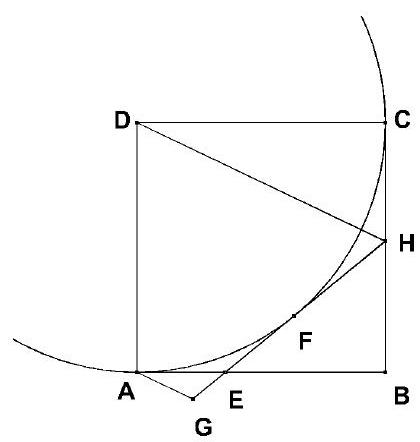 |
|
|
| Figure 6 . |
|
|
| Solution. (See Figure 6.) The fold gives rise to an isosceles trapezium $A D H G$. Because of symmetry, the distance of the vertex $D$ from the side $G H$ equals the distance of the vertex |
| $H$ from side $A D$; the latter distance is the side length $a$ of the square. The line $G H$ thus is tangent to the circle with center $D$ and radius $a$. The lines $A B$ and $B C$ are tangent to the same circle. If the point common to $G H$ and the circle is $F$, then $A E=E F$ and $F H=H C$. This implies $A B+B C=A E+E B+B H+H C=E F+E B+B H+H F=E H+E B+B H$, which is equivalent to what we were asked to prove. |
|
|
| 94.4. Determine all positive integers $n<200$, such that $n^{2}+(n+1)^{2}$ is the square of an integer. |
|
|
| Solution. We determine the integral solutions of |
|
|
| $$ |
| n^{2}+(n+1)^{2}=(n+p)^{2}, \quad p \geq 2 |
| $$ |
|
|
| The root formula for quadratic equations yields |
|
|
| $$ |
| n=p-1+\sqrt{2 p(p-1)} \geq 2(p-1) |
| $$ |
|
|
| Because $n<200$, we have $p \leq 100$. Moreover, the number $2 p(p-1)$ has to be the square of an integer. If $p$ is odd, $p$ and $2(p-1)$ have no common factors. Consequently, both $p$ and $2(p-1)$ have to be squares. The only possible candidates are $p=9, p=25, p=49$, $p=81$. The respective numbers $2(p-1)$ are $16,48,96$, and 160 . Of these, only 16 is a square. We thus have one solution $n=8+\sqrt{2 \cdot 9 \cdot 8}=20,20^{2}+21^{2}=841=29^{2}$. If $p$ is even, the numbers $2 p$ and $p-1$ have no factors in common, so both are squares. Possible candidates for $2 p$ are $4,16,36,64,100,144$, and 196. The corresponding values of $p-1$ are $1,7,31,49,71,97$. We obtain two more solutions: $n=1+2=3,3^{2}+4^{2}=5^{2}$, and $n=49+70=119,119^{2}+120^{2}=169^{2}$. |
|
|
| 95.1. Let $A B$ be a diameter of a circle with centre $O$. We choose a point $C$ on the circumference of the circle such that $O C$ and $A B$ are perpendicular to each other. Let $P$ be an arbitrary point on the (smaller) arc $B C$ and let the lines $C P$ and $A B$ meet at $Q$. We choose $R$ on $A P$ so that $R Q$ and $A B$ are perpendicular to each other. Show that $|B Q|=|Q R|$. |
|
|
| 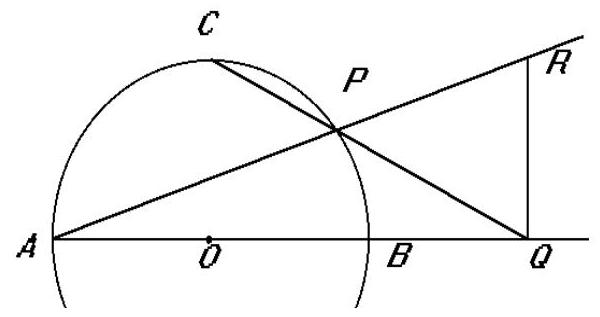 |
|
|
| Figure 7 . |
|
|
| Solution 1. (See Figure 7.) Draw $P B$. By the Theorem of Thales, $\angle R P B=\angle A P B=$ $90^{\circ}$. So $P$ and $Q$ both lie on the circle with diameter $R B$. Because $\angle A O C=90^{\circ}$, $\angle R P Q=\angle C P A=45^{\circ}$. Then $\angle R B Q=45^{\circ}$, too, and $R B Q$ is an isosceles right triangle, or $|B Q|=|Q R|$. |
|
|
| Solution 2. Set $O=(0,0), A=(-1,0), B=(1,0), C=(0,1)$, and $P=(t, u)$, where $t>0, u>0$, and $t^{2}+u^{2}=1$. The equation of line $C P$ is $y-1=\frac{u-1}{t} x$. So $Q=\left(\frac{t}{1-u}, 0\right)$ and $|B Q|=\frac{t}{1-u}-1=\frac{t+u-1}{1-u}$. On the other hand, the equation of line $A P$ is $y=\frac{u}{t+1}(x+1)$. The $y$ coordinate of $R$ and also $|Q R|$ is $\frac{u}{t+1}\left(\frac{t}{1-u}+1\right)=$ $\frac{u t+u-u^{2}}{(t+1)(1-u)}=\frac{u t+u-1+t^{2}}{(t+1)(1-u)}=\frac{u+t-1}{1-u}$. The claim has been proved. |
|
|
| 95.2. Messages are coded using sequences consisting of zeroes and ones only. Only sequences with at most two consecutive ones or zeroes are allowed. (For instance the sequence 011001 is allowed, but 011101 is not.) Determine the number of sequences consisting of exactly 12 numbers. |
|
|
| Solution 1. Let $S_{n}$ be the set of acceptable sequences consisting of $2 n$ digits. We partition $S_{n}$ in subsets $A_{n}, B_{n}, C_{n}$, and $D_{n}$, on the basis of the two last digits of the sequence. Sequences ending in 00 are in $A_{n}$, those ending in 01 are in $B_{n}$, those ending in 10 are in $C_{n}$, and those ending in 11 are in $D_{n}$. Denote by $x_{n}, a_{n}, b_{n}, c_{n}$, and $d_{n}$ the number of elements in $S_{n}, A_{n}, B_{n}, C_{n}$, and $D_{n}$. We compute $x_{6}$. Because $S_{1}=\{00,01,10,11\}$, $x_{1}=4$ and $a_{1}=b_{1}=c_{1}=d_{1}=1$. Every element of $A_{n+1}$ can be obtained in a unique manner from an element of $B_{n}$ or $D_{n}$ by adjoining 00 to the end. So $a_{n+1}=b_{n}+d_{n}$. The elements of $B_{n+1}$ are similarly obtained from elements of $B_{n}, C_{n}$, and $D_{n}$ by adjoining 01 to the end. So $b_{n+1}=b_{n}+c_{n}+d_{n}$. In a similar manner we obtain the recursion formulas $c_{n+1}=a_{n}+b_{n}+c_{n}$ and $d_{n+1}=a_{n}+c_{n}$. So $a_{n+1}+d_{n+1}=\left(b_{n}+d_{n}\right)+\left(a_{n}+c_{n}\right)=x_{n}$ and $x_{n+1}=2 a_{n}+3 b_{n}+3 c_{n}+2 d_{n}=3 x_{n}-\left(a_{n}+b_{n}\right)=3 x_{n}-x_{n-1}$. Starting from the initial values $a_{1}=b_{1}=c_{1}=d_{1}=1$, we obtain $a_{2}=d_{2}=2, b_{2}=c_{2}=3$, and $x_{2}=10$. So $x_{3}=3 x_{2}-x_{1}=3 \cdot 10-4=26, x_{4}=3 \cdot 26-10=68, x_{5}=3 \cdot 68-26=178$, and $x_{6}=3 \cdot 178-68=466$. |
|
|
| Solution 2. We can attach a sequence of ones and twos to each acceptable sequence by indicating the number of consequtive equal numbers; these one's and twos then add up to the length of the sequence. Interchnaging all ones and zeros in the sequence results in another acceptabe sequence which in turn yields the same sequence of ones and twos. Thus any way of writing 12 as a sum of ones and twos, in a specified order, corresponds to exactly two acceptable sequences of lenghth 12 . The number of sums with 12 ones is one, the number of sums with one 2 and 10 ones is $\binom{11}{10}$ etc. The number of acceptable sequences is |
|
|
| $$ |
| 2 \cdot \sum_{k=0}^{6}\binom{12-k}{2 k}=2 \cdot(1+11+45+84+70+21+1)=466 |
| $$ |
| |
| 95.3. Let $n \geq 2$ and let $x_{1}, x_{2}, \ldots x_{n}$ be real numbers satisfying $x_{1}+x_{2}+\ldots+x_{n} \geq 0$ and $x_{1}^{2}+x_{2}^{2}+\ldots+x_{n}^{2}=1$. Let $M=\max \left\{x_{1}, x_{2}, \ldots, x_{n}\right\}$. Show that |
| |
| $$ |
| M \geq \frac{1}{\sqrt{n(n-1)}} |
| $$ |
| |
| When does equality hold in (1)? |
| |
| Solution. Denote by $I$ the set of indices $i$ for which $x_{i} \geq 0$, and by $J$ the set of indices $j$ for which $x_{j}<0$. Let us assume $M<\frac{1}{\sqrt{n(n-1)}}$. Then $I \neq\{1,2, \ldots, n\}$, since otherwise we would have $\left|x_{i}\right|=x_{i} \leq \frac{1}{\sqrt{n(n-1)}}$ for every $i$, and $\sum_{i=1}^{n} x_{i}^{2}<\frac{1}{n-1} \leq 1$. So $\sum_{i \in I} x_{i}^{2}<(n-1) \cdot \frac{1}{n(n-1)}=\frac{1}{n}$, and $\sum_{i \in I} x_{i}<(n-1) \frac{1}{\sqrt{n(n-1)}}=\sqrt{\frac{n-1}{n}}$. Because |
| |
| $$ |
| 0 \leq \sum_{i=1}^{n} x_{i}=\sum_{i \in I} x_{i}-\sum_{i \in J}\left|x_{i}\right| |
| $$ |
| |
| we must have $\sum_{i \in J}\left|x_{i}\right| \leq \sum_{i \in I} x_{i}<\sqrt{\frac{n-1}{n}}$ and $\sum_{i \in J} x_{i}^{2} \leq\left(\sum_{i \in J}\left|x_{i}\right|\right)^{2}<\frac{n-1}{n}$. But then |
| |
| $$ |
| \sum_{i=1}^{n} x_{i}^{2}=\sum_{i \in I} x_{i}^{2}+\sum_{i \in J} x_{i}^{2}<\frac{1}{n}+\frac{n-1}{n}=1 |
| $$ |
| |
| and we have a contradiction. - To see that equality $M=\frac{1}{\sqrt{n(n-1)}}$ is possible, we choose $x_{i}=\frac{1}{\sqrt{n(n-1)}}, i=1,2, \ldots, n-1$, and $x_{n}=-\sqrt{\frac{n-1}{n}}$. Now |
| |
| $$ |
| \sum_{i=1}^{n} x_{i}=(n-1) \frac{1}{\sqrt{n(n-1)}}-\sqrt{\frac{n-1}{n}}=0 |
| $$ |
| |
| and |
| |
| $$ |
| \sum_{i=1}^{n} x_{i}^{2}=(n-1) \cdot \frac{1}{n(n-1)}+\frac{n-1}{n}=1 |
| $$ |
| |
| We still have to show that equality can be obtained only in this case. Assume $x_{i}=$ $\frac{1}{\sqrt{n(n-1)}}$, for $i=1, \ldots, p, x_{i} \geq 0$, for $i \leq q$, and $x_{i}<0$, kun $q+1 \leq i \leq n$. As before we get |
|
|
| $$ |
| \sum_{i=1}^{q} x_{i} \leq \frac{q}{\sqrt{n(n-1)}}, \quad \sum_{i=q+1}^{n}\left|x_{i}\right| \leq \frac{q}{\sqrt{n(n-1)}} |
| $$ |
|
|
| and |
|
|
| $$ |
| \sum_{i=q+1}^{n} x_{i}^{2} \leq \frac{q^{2}}{n(n-1)} |
| $$ |
|
|
| so |
|
|
| $$ |
| \sum_{i=1}^{n} x_{i}^{2} \leq \frac{q+q^{2}}{n^{2}-n} |
| $$ |
|
|
| It is easy to see that $q^{2}+q<n^{2}+n$, for $n \geq 2$ and $q \leq n-2$, but $(n-1)^{2}+(n-1)=n^{2}-n$. Consequently, a necessary condition for $M=\frac{1}{\sqrt{n(n-1)}}$ is that the sequence only has one negative member. But if among the positive members there is at least one smaller than $M$ we have |
| |
| $$ |
| \sum_{i=1}^{n}<\frac{q+q^{2}}{n(n-1)} |
| $$ |
| |
| so the conditions of the problem are not satisfied. So there is equality if and only if $n-1$ of the numbers $x_{i}$ equal $\frac{1}{\sqrt{n(n-1)}}$, and the last one is $\frac{1-n}{\sqrt{n(n-1)}}$. |
| |
| 95.4. Show that there exist infinitely many mutually non-congruent triangles $T$, satisfying |
| |
| (i) The side lengths of $T$ are consecutive integers. |
| |
| (ii) The area of $T$ is an integer. |
| |
| Solution. Let $n \geq 3$, and let $n-1, n, n+1$ be the side lengths of the triangle. The semiperimeter of the triangle then equals on $\frac{3 n}{2}$. By Heron's formula, the area of the triangle is |
| |
| $$ |
| \begin{gathered} |
| T=\sqrt{\frac{3 n}{2} \cdot\left(\frac{3 n}{2}-n+1\right)\left(\frac{3 n}{2}-n\right)\left(\frac{3 n}{2}-n-1\right)} \\ |
| =\frac{n}{2} \sqrt{\frac{3}{4}\left(n^{2}-4\right)} . |
| \end{gathered} |
| $$ |
| |
| If $n=4$, then $T=6$. So at least one triangle of the kind required exists. We prove that we always can form new triangles of the required kind from ones already known to exist. Let $n$ be even, $n \geq 4$, and let $\frac{3}{4}\left(n^{2}-4\right)$ be a square number. Set $m=n^{2}-2$. Then $m>n$, $m$ is even, and $m^{2}-4=(m+2)(m-2)=n^{2}\left(n^{2}-4\right)$. So $\frac{3}{4}\left(m^{2}-4\right)=n^{2} \cdot \frac{3}{4}\left(n^{2}-4\right)$ is a square number. Also, $T=\frac{m}{2} \sqrt{\frac{3}{4}\left(m^{2}-4\right)}$ is an integer. The argument is complete. |
|
|
| 96.1. Show that there exists an integer divisible by 1996 such that the sum of the its decimal digits is 1996 . |
|
|
| Solution. The sum of the digits of 1996 is 25 and the sum of the digits of $2 \cdot 1996=3992$ is 23 . Because $1996=78 \cdot 25+46$, the number obtained by writing 781996 's and two 3992 in succession satisfies the condition of the problem. - As $3 \cdot 1996=5998$, the sum of the digits of 5988 is 30 , and $1996=65 \cdot 30+46$, the number $39923992 \underbrace{5988 \ldots 5988}_{65 \text { times }}$ also can be be given as an answer, indeed a better one, as it is much smaller than the first suggestion. |
| |
| 96.2. Determine all real numbers $x$, such that |
| |
| $$ |
| x^{n}+x^{-n} |
| $$ |
| |
| is an integer for all integers $n$. |
| |
| Solution. Set $f_{n}(x)=x^{n}+x^{-n}$. $f_{n}(0)$ is not defined for any $n$, so we must have $x \neq 0$. Since $f_{0}(x)=2$ for all $x \neq 0$, we have to find out those $x \neq 0$ for which $f_{n}(x)$ is an integer foe every $n>0$. We note that |
| |
| $$ |
| x^{n}+x^{-n}=\left(x+x^{-1}\right)\left(x^{n-1}+x^{1-n}\right)-\left(x^{n-2}+x^{2-n}\right) |
| $$ |
| |
| From this we obtain by induction that $x^{n}+x^{-n}$ is an integer for all $n>1$ as soon as $x+x^{-1}$ is an integer. So $x$ has to satisfy |
| |
| $$ |
| x+x^{-1}=m |
| $$ |
| |
| where $m$ is an integer. The roots of this quadratic equation are |
| |
| $$ |
| x=\frac{m}{2} \pm \sqrt{\frac{m^{2}}{4}-1} |
| $$ |
| |
| and they are real, if $m \neq-1,0,1$. |
| |
| 96.3. The circle whose diameter is the altitude dropped from the vertex $A$ of the triangle $A B C$ intersects the sides $A B$ and $A C$ at $D$ and $E$, respectively $(A \neq D, A \neq E)$. Show that the circumcentre of $A B C$ lies on the altitude dropped from the vertex $A$ of the triangle $A D E$, or on its extension. |
| |
| 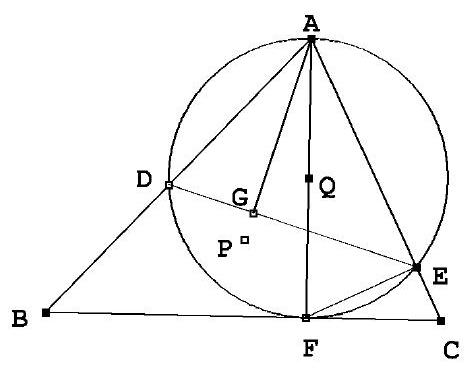 |
| |
| Figure 8. |
| |
| Solution. (See Figure 8.) Let $A F$ be the altitude of $A B C$. We may assume that $\angle A C B$ is sharp. From the right triangles $A C F$ and $A F E$ we obtain $\angle A F E=\angle A C F . \angle A D E$ and $\angle A F E$ subtend the same arc, so they are equal. Thus $\angle A C B=\angle A D E$, and the triangles $A B C$ and $A E D$ are similar. Denote by $P$ and $Q$ the circumcenters of $A B C$ and $A E D$, respectively. Then $\angle B A P=\angle E A Q$. If $A G$ is the altitude of $A E D$, then $\angle D A G=\angle C A F$. But this implies $\angle B A P=\angle D A G$, which means that $P$ is on the altitude $A G$. |
| |
| 96.4. The real-valued function $f$ is defined for positive integers, and the positive integer a satisfies |
| |
| $$ |
| \begin{gathered} |
| f(a)=f(1995), \quad f(a+1)=f(1996), \quad f(a+2)=f(1997) \\ |
| f(n+a)=\frac{f(n)-1}{f(n)+1} \quad \text { for all positive integers } n |
| \end{gathered} |
| $$ |
| |
| (i) Show that $f(n+4 a)=f(n)$ for all positive integers $n$. |
| (ii) Determine the smallest possible $a$. |
| |
| Solution. To prove (i), we the formula $f(n+a)=\frac{f(n)-1}{f(n)+1}$ repeatedly: |
| |
| $$ |
| \begin{gathered} |
| f(n+2 a)=f((n+a)+a)=\frac{\frac{f(n)-1}{f(n)+1}-1}{\frac{f(n)-1}{f(n)+1}+1}=-\frac{1}{f(n)} \\ |
| f(n+4 a)=f((n+2 a)+2 a)=-\frac{1}{-\frac{1}{f(n)}}=f(n) |
| \end{gathered} |
| $$ |
| |
| (ii) If $a=1$, then $f(1)=f(a)=f(1995)=f(3+498 \cdot 4 a)=f(3)=f(1+2 a)=-\frac{1}{f(1)}$. This clearly is not possible, since $f(1)$ and $\frac{1}{f(1)}$ have equal sign. So $a \neq 1$. |
| |
| If $a=2$, we obtain $f(2)=f(a)=f(1995)=f(3+249 \cdot 4 a)=f(3)=f(a+1)=f(1996)=$ $f(4+249 \cdot 4 a)=f(4)=f(2+a)=\frac{f(2)-1}{f(2)+1}$, or $f(2)^{2}+f(2)=f(2)-1$. This quadratic equation in $f(2)$ has no real solutions. So $a \neq 2$. |
| |
| If $a=3$, we try to construct $f$ by choosing $f(1), f(2)$, and $f(3)$ arbitrarily and by computing the other values of $f$ by the recursion formula $f(n+3)=\frac{f(n)-1}{f(n)+1}$. We have to check that $f$ defined in this way satisfies the conditions of the problem. |
| |
| The condition |
| |
| $$ |
| f(n+a)=f(n+3)=\frac{f(n)-1}{f(n)+1} |
| $$ |
| |
| is valid because of the construction. Further, by (i), |
| |
| $$ |
| f(n+12)=f(n+4 a)=f(n) |
| $$ |
| |
| which implies |
| |
| $$ |
| \begin{gathered} |
| f(a)=f(3)=f(3+166 \cdot 12)=f(1995) \\ |
| f(a+1)=f(4)=f(4+166 \cdot 12)=f(1996) \\ |
| f(a+2)=f(5)=f(5+166 \cdot 12)=f(1997) |
| \end{gathered} |
| $$ |
| |
| as required. |
| |
| We remark that the choice $f(n)=-1$ makes $f(n+3)$ undefined, the choice $f(n)=0$ makes $f(n+3)=-1$ and $f(n+6)$ is undefined, and $f(n)=1$ makes $f(n+3)=0$ so $f(n+9)$ is undefined. In the choice of $f(1), f(2)$, and $f(3)$ we have to avoid $-1,0,1$. |
| |
| In conclusion, we see that $a=3$ is the smallest possible value for $a$. |
| |
| 97.1. Let A be a set of seven positive numbers. Determine the maximal number of triples $(x, y, z)$ of elements of A satisfying $x<y$ and $x+y=z$. |
| |
| Solution. Let $0<a_{1}<a_{2}<\ldots<a_{7}$ be the elements of the set $A$. If $\left(a_{i}, a_{j}, a_{k}\right)$ is a triple of the kind required in the problem, then $a_{i}<a_{j}<a_{i}+a_{j}=a_{k}$. There are at most $k-1$ pairs $\left(a_{i}, a_{j}\right)$ such that $a_{i}+a_{j}=a_{k}$. The number of pairs satisfying $a_{i}<a_{j}$ is at most $\left\lfloor\frac{k-1}{2}\right\rfloor$. The total number of pairs is at most |
| |
| $$ |
| \sum_{k=3}^{7}\left\lfloor\frac{k-1}{2}\right\rfloor=1+1+2+2+3=9 |
| $$ |
| |
| The value 9 can be reached, if $A=\{1,2, \ldots, 7\}$. In this case the triples $(1,2,3),(1,3,4)$, $(1,4,5),(1,5,6),(1,6,7),(2,3,5),(2,4,6),(2,5,7)$, and $(3,4,7)$ satisfy the conditions of the problem. |
| |
| 97.2. Let $A B C D$ be a convex quadrilateral. We assume that there exists a point $P$ inside the quadrilateral such that the areas of the triangles $A B P, B C P, C D P$, and $D A P$ are equal. Show that at least one of the diagonals of the quadrilateral bisects the other diagonal. |
| |
| 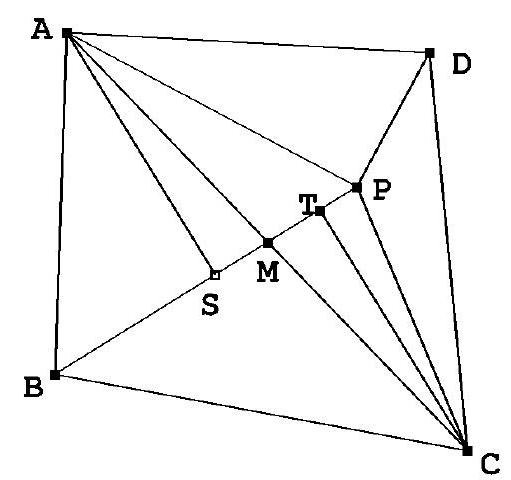 |
| |
| Figure 9. |
| |
| Solution. (See Figure 9.) We first assume that $P$ does not lie on the diagonal $A C$ and the line $B P$ meets the diagonal $A C$ at $M$. Let $S$ and $T$ be the feet of the perpendiculars from $A$ and $C$ on the line $B P$. The triangles $A P B$ and $C B P$ have equal area. Thus $A S=C T$. If $S \neq T$, then the right trianges $A S M$ and $C T M$ are congruent, and $A M=C M$. If, on the other hand, $S=T$, the $A C \perp P B$ and $S=M=T$, and again $A M=C M$. In both cases $M$ is the midpoint of the diagonal $A C$. We prove exactly in the same way that the line $D P$ meets $A C$ at the midpoint of $A C$, i.e. at $M$. So $B, M$, and $P$, and also $D, M$, and $P$ are collinear. So $M$ is on the line $D B$, which means that $B D$ divides the diagonal $A C$ in two equal parts. |
| |
| We then assume that $P$ lies on the diagonal $A C$. Then $P$ is the midpoint of $A C$. If $P$ is not on the diagonal $B D$, we argue as before that $A C$ divides $B D$ in two equal parts. If $P$ lies also on the diagonal $B D$, it has to be the common midpoint of the diagonals. |
| |
| 97.3. Let $A, B, C$, and $D$ be four different points in the plane. Three of the line segments $A B, A C, A D, B C, B D$, and $C D$ have length a. The other three have length $b$, where $b>a$. Determine all possible values of the quotient $\frac{b}{a}$. |
| |
| Solution. If the three segments of length $a$ share a common endpoint, say $A$, then the other three points are on a circle of radius $a$, centered at $A$, and they are the vertices of an equilateral triangle of side length $b$. But this means that $A$ is the center of the triangle $B C D$, and |
| |
| $$ |
| \frac{b}{a}=\frac{b}{\frac{2}{3} \frac{\sqrt{3}}{2} b}=\sqrt{3} |
| $$ |
| |
| Assume then that of the segments emanating from $A$ at least one has lenght $a$ and at least one has length $b$. We may assume $A B=a$ and $A D=b$. If only one segment of length $a$ would emanate from each of the four poits, then the number of segments of length $a$ would be two, as every segment is counted twice when we count the emanating segments. So we may assume that $A C$ has length $a$, too. If $B C=a$, then $A B C$ would be an equilateral triangle, and the distance of $D$ from each of its vertices would be $b$. This is not possible, since $b>a$. So $B C=b$. Of the segments $C D$ and $B D$ one has length $a$. We may assume $D C=a$. The segments $D C$ and $A B$ are either on one side of thye line $A C$ or on opposite sides of it. In the latter case, $A B C D$ is a parallelogram with a pair of sides of length $a$ and a pair of sides of length $b$, and its diagonals have lengths $a$ and $b$. This is not possible, due to the fact that the sum of the squares of the diagonals of the parallelogram, $a^{2}+b^{2}$, would be equal to the sum of the squares of its sides, i.e. $2 a^{2}+2 b^{2}$. This means that we may assume that $B A C D$ is a convex quadrilateral. Let $\angle A B C=\alpha$ and $\angle A D B=\beta$. From isosceles triangles we obtain for instance $\angle C B D=\beta$, and from the triangle $A B D$ in particular $2 \alpha+2 \beta+\beta=\pi$ as well as $\angle C D A=\alpha, \angle D C B=\frac{1}{2}(\pi-\beta), \angle C A D=\alpha$. The triangle $A D C$ thus yields $\alpha+\alpha+\alpha+\frac{1}{2}(\pi-\beta)=\pi$. From this we solve $\alpha=\frac{1}{5} \pi=36^{\circ}$. The sine theorem applied to $A B C$ gives |
| |
| $$ |
| \frac{b}{a}=\frac{\sin 108^{\circ}}{\sin 36^{\circ}}=\frac{\sin 72^{\circ}}{\sin 36^{\circ}}=2 \cos 36^{\circ}=\frac{\sqrt{5}+1}{2} |
| $$ |
| |
| (In fact, $a$ is the side of a regular pentagon, and $b$ is its diagonal.) - Another way of finding the ratio $\frac{b}{a}$ is to consider the trapezium $C D B A$, with $C D \| A B$; if $E$ is the orthogonal projection of $B$ on the segment $C D$, then $C E=b-\frac{1}{2}(b-a)=\frac{1}{2}(b+a)$. The right triangles $B C E$ and $D C E$ yield $C E^{2}=b^{2}-\left(\frac{b+a}{2}\right)^{2}=a^{2}-\left(\frac{b-a}{2}\right)^{2}$, which can be written as $b^{2}-a b-a^{2}=0$. From this we solve $\frac{b}{a}=\frac{\sqrt{5}+1}{2}$. |
| |
| 97.4. Let $f$ be a function defined in the set $\{0,1,2, \ldots\}$ of non-negative integers, satisfying $f(2 x)=2 f(x), f(4 x+1)=4 f(x)+3$, and $f(4 x-1)=2 f(2 x-1)-1$. Show that $f$ is an injection, i.e. if $f(x)=f(y)$, then $x=y$. |
| |
| Solution. If $x$ is even, then $f(x)$ is even, and if $x$ is odd, then $f(x)$ is odd. Moreover, if $x \equiv 1 \bmod 4$, then $f(x) \equiv 3 \bmod 4$, and if $x \equiv 3 \bmod 4$, then $f(x) \equiv 1 \bmod 4$. Clearly $f(0)=0, f(1)=3, f(2)=6$, and $f(3)=5$. So at least $f$ restricted to the set $\{0,1,2,3\}$ ia an injection. We prove that $f(x)=f(y) \Longrightarrow x=y$, for $x, y<k$ implies $f(x)=f(y) \Longrightarrow x=y$, for $x, y<2 k$. So assume $x$ and $y$ are smaller than $2 k$ and $f(x)=f(y)$. If $f(x)$ is even, then $x=2 t, y=2 u$, and $2 f(t)=2 f(u)$. As $t$ and $u$ are less than $k$, we have $t=u$, and $x=y$. Assume $f(x) \equiv 1 \bmod 4$. Then $x \equiv 3 \bmod 4 ;$ $x=4 u-1$, and $f(x)=2 f(2 u-1)-1$. Also $y=4 t-1$ and $f(y)=2 f(2 t-1)-1$. Moreover, $2 u-1<\frac{1}{2}(4 u-1)<k$ and $2 t-1<k$, so $2 u-1=2 t-1, u=t$, and $x=y$. If, finally, $f(x) \equiv 3 \bmod 4$, then $x=4 u+1, y=4 t+1, u<k, t<k, 4 f(u)+3=4 f(t)+3, u=t$, and $x=y$. Since for all $x$ and $y$ there is an $n$ such that the larger one of the numbers $x$ and $y$ is $<2^{n} \cdot 3$, the induction argument above shows that $f(x)=f(y) \Rightarrow x=y$. |
| |
| 98.1. Determine all functions $f$ defined in the set of rational numbers and taking their values in the same set such that the equation $f(x+y)+f(x-y)=2 f(x)+2 f(y)$ holds for all rational numbers $x$ and $y$. |
| |
| Solution. Insert $x=y=0$ in the equation to obtain $2 f(0)=4 f(0)$, which implies $f(0)=0$. Setting $x=0$, one obtains $f(y)+f(-y)=2 f(y)$ of $f(-y)=f(y)$. Then assume $y=n x$, where $n$ is a positive integer. We obtain |
| |
| $$ |
| f((n+1) x)=2 f(x)+2 f(n x)-f((n-1) x) |
| $$ |
| |
| In particular, $f(2 x)=2 f(x)+2 f(x)-f(0)=4 f(x)$ and $f(3 x)=2 f(x)+2 f(2 x)-f(x)=$ $9 f(x)$. We prove $f(n x)=n^{2} f(x)$ for all positive integers $n$. This is true for $n=1$. Assume $f(k x)=k^{2} f(x)$ for $k \leq n$. Then |
| |
| $$ |
| \begin{aligned} |
| & f((n+1) x)=2 f(x)+2 f(n x)-f((n-1) x) \\ |
| & =\left(2+2 n^{2}-(n-1)^{2}\right) f(x)=(n+1)^{2} f(x) |
| \end{aligned} |
| $$ |
| |
| and we are done. If $x=1 / q$, where $q$ is a positive integer, $f(1)=f(q x)=q^{2} f(x)$. So $f(1 / q)=f(1) / q^{2}$. This again implies $f(p / q)=p^{2} f(1 / q)=(p / q)^{2} f(1)$. We have shown that there is a rational number $a=f(1)$ such that $f(x)=a x^{2}$ for all positive rational numbers $x$. But since $f$ is an even function, $f(x)=a x^{2}$ for all rational $x$. We still have to check that for every rational $a, f(x)=a x^{2}$ satisfies the conditions of the problem. In fact, if $f(x)=a x^{2}$, then $f(x+y)+f(x-y)=a(x+y)^{2}+a(x-y)^{2}=2 a x^{2}+2 a y^{2}=2 f(x)+2 f(y)$. So the required functions are all functions $f(x)=a x^{2}$ where $a$ is any rational number. |
| |
| 98.2. Let $C_{1}$ and $C_{2}$ be two circles intersecting at $A$ and $B$. Let $S$ and $T$ be the centres of $C_{1}$ and $C_{2}$, respectively. Let $P$ be a point on the segment $A B$ such that $|A P| \neq|B P|$ and $P \neq A, P \neq B$. We draw a line perpendicular to $S P$ through $P$ and denote by $C$ and $D$ the points at which this line intersects $C_{1}$. We likewise draw a line perpendicular to TP through $P$ and denote by $E$ and $F$ the points at which this line intersects $C_{2}$. Show that $C, D, E$, and $F$ are the vertices of a rectangle. |
| |
| Solution. (See Figure 10.) The power of the point $P$ with respect to the circles $C_{1}$ and $C_{2}$ is $P A \cdot P B=P C \cdot P D=P E \cdot P F$. Since $S P$ is perpendicular to the chord $C D, P$ |
| |
| 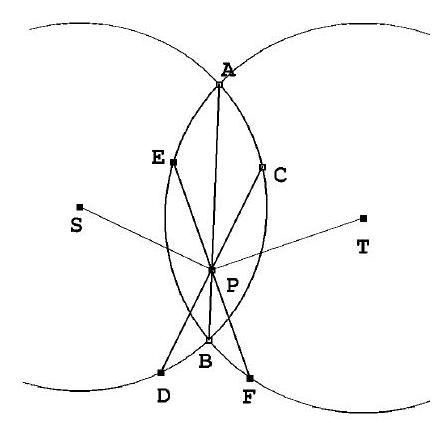 |
| |
| Figure 10 . |
| |
| has to be the midpoint of $C D$. So $P C=P D$. In a similar manner, we obtain $P E=P F$. Alltogether $P C=P D=P E=P F=\sqrt{P A \cdot P B}$. Consequently the points $C, D, E$, and $F$ all lie on a circle withe center $P$, and $C D$ and $E F$ as diameters. By Thales' theorem, the angles $\angle E C F, \angle C F D$ etc. are right angles. So $C D E F$ is a rectangle. |
| |
| 98.3. (a) For which positive numbers $n$ does there exist a sequence $x_{1}, x_{2}, \ldots, x_{n}$, which contains each of the numbers 1, 2, ..., $n$ exactly once and for which $x_{1}+x_{2}+\cdots+x_{k}$ is divisible by $k$ for each $k=1,2, \ldots, n$ ? |
| |
| (b) Does there exist an infinite sequence $x_{1}, x_{2}, x_{3}, \ldots$, which contains every positive integer exactly once and such that $x_{1}+x_{2}+\cdots+x_{k}$ is divisible by $k$ for every positive integer $k$ ? |
| |
| Solution. (a) We assume that $x_{1}, \ldots, x_{n}$ is the sequence required in the problem. Then $x_{1}+x_{2}+\cdots+x_{n}=\frac{n(n+1)}{2}$. This sum should be divisible by $n$. If $n$ is odd, this is possible, since $\frac{(n+1)}{2}$ is an integer. If, on the other hand, $n=2 m$, then $\frac{n(n+1)}{2}=m(2 m+1)=$ $2 m^{2}+m \equiv m \bmod 2 m$. So even $n$ 's are ruled out. Assume $n=2 m+1>1$. We require that $n-1=2 m$ divides evenly the number $x_{1}+\cdots+x_{n-1}$. Since $x_{1}+\cdots+x_{n-1}=$ $(m+1)(2 m+1)-x_{n} \equiv m+1-x_{n} \bmod 2 m$, and $1 \leq x_{n} \leq n$, we must have $x_{n}=m+1$. We also require that $n-2=2 m-1$ divides evenly the number $x_{1}+\cdots+x_{n-2}$. Now $x_{1}+\cdots+x_{n-2}=(m+1)(2 m+1)-x_{n}-x_{n-1} \equiv m+1-x_{n-1} \bmod (2 m-1)$ and $-m \leq m+1-x_{n-1} \leq m$, we have $x_{n-1}=m+1 \bmod (2 m-1)$. If $n>3$ or $m \geq 1$, we must have $x_{n-1}=m+1=x_{n}$, which is not allowed. So the only possibilities are $n=1$ or $n=3$. If $n=1, x_{1}=1$ is a possible sequence. If $n=3$, we must have $x_{3}=2 . x_{1}$ and $x_{2}$ are 1 and 3 in any order. |
|
|
| (b) Let $x_{1}=1$. We define the sequence by a recursion formula. Assume that $x_{1}, x_{2}, \ldots, x_{n-1}$ have been chosen and that the sum of these numbers is $A$. Let $m$ be the smallest integer not yet chosen into the sequence. If $x_{n+1}$ is chosen to be $m$, there will be two restrictions on $x_{n}$ : |
|
|
| $$ |
| A+x_{n} \equiv 0 \bmod n \quad \text { and } \quad A+x_{n}+m \equiv 0 \bmod n+1 |
| $$ |
|
|
| Since $n$ and $n+1$ are relatively prime, there exists, by the Chinese Remainder Theorem, a $y$ such that $y \equiv-A \bmod n$ and $y \equiv-A-m \bmod n+1$. If one adds a suitably large |
| multiple of $n(n+1)$ to $y$, one obtains a number not yet in the sequence. So the sequence always can be extended by two numbers, and eventually every positive integer will be included. |
|
|
| 98.4. Let $n$ be a positive integer. Count the number of numbers $k \in\{0,1,2, \ldots, n\}$ such that $\binom{n}{k}$ is odd. Show that this number is a power of two, i.e. of the form $2^{p}$ for some nonnegative integer $p$. |
|
|
| Solution. The number of odd binomial coefficients $\binom{n}{k}$ equals the number of ones on the $n$ :th line of the Pascal Triangle $\bmod 2$ : |
|
|
| 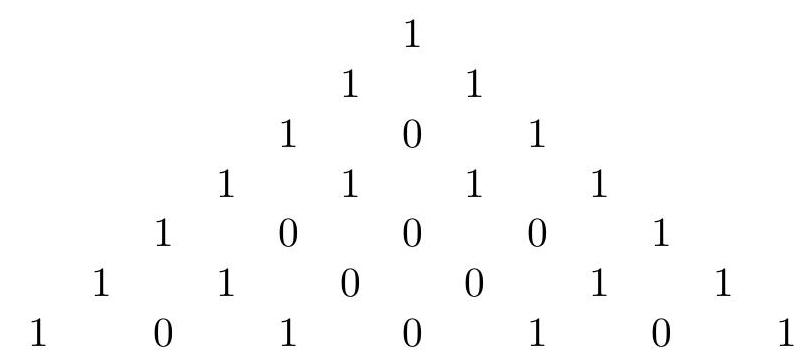 |
|
|
| (We count the lines so that the uppermost line is line 0 ). We notice that line 1 has two copies of line 0 , lines 2 and 3 contain two copies of lines 1 and 2 , etc. |
|
|
| The fundamental property $\binom{n+1}{p}=\binom{n}{p-1}+\binom{n}{p}$ of the Pascal Triangle implies that if all numbers on line $k$ are $\equiv 1 \bmod 2$, then on line $k+1$ exactly the first and last numbers are $\equiv 1 \bmod 2$. If, say on line $k$ exactly the first and last numbers are $\equiv 1 \bmod 2$, then the lines $k, k+1, \ldots, 2 k-1$ are formed by two copies of lines $0,1, \ldots k-1$, separated by zeroes. As line 0 has number 1 and line 1 is formed by two ones, the lines 2 and three are formed by two copies of lines 0 and 1 , etc. By induction we infer that for every $k$, the line $2^{k}-1$ is forned of ones only - it has two copies of line $2^{k-1}-1$, and the line $0=2^{0}-1$ is a one. The line $2^{k}$ has ones in the end and zeroes in between. Now let $N_{n}$ be the number of ones on line $n=2^{k}+m, m<2^{k}$. Then $N_{1}=2$ and $N_{n}=2 N_{m}$. So $N_{n}$ always is a power of two. To be more precise, we show that $N_{n}=2^{e(n)}$, where $e(n)$ is the number of ones in the binary representation of $n$. The formula is true for $n=0$, as $N_{0}=1=2^{e(0)}$. Also, if $m<2^{k}, e\left(2^{k}+m\right)=e(m)+1$. On the other hand, if $n=2^{k}+m, m<2^{k}$ then $N_{n}=2 N_{m}=2 \cdot 2^{e(m)}=2^{e(m)+1}=2^{e(n)}$. |
| |
| 99.1. The function $f$ is defined for non-negative integers and satisfies the condition |
| |
| $$ |
| f(n)= \begin{cases}f(f(n+11)), & \text { if } n \leq 1999 \\ n-5, & \text { if } n>1999\end{cases} |
| $$ |
| |
| Find all solutions of the equation $f(n)=1999$. |
| |
| Solution. If $n \geq 2005$, then $f(n)=n-5 \geq 2000$, and the equation $f(n)=1999$ has no solutions. Let $1 \leq k \leq 4$. Then |
| |
| $$ |
| \begin{gathered} |
| 2000-k=f(2005-k)=f(f(2010-k)) \\ |
| =f(1999-k)=f(f(2004-k))=f(1993-k) |
| \end{gathered} |
| $$ |
| |
| Let $k=1$. We obtain three solutions $1999=f(2004)=f(1998)=f(1992)$. Moreover, $1995=f(2000)=f(f(2005))=f(1994)$ and $f(1993)=f(f(2004))=f(1999)=$ $f(f(2010))=f(2005)=2000$. So we have shown that $2000-k=f(1999-k)$, for $k=0,1,2,3,4,5$, and $2000-k=f(1993-k)$ for $k=0,1,2,3,4$. We now show by downwards induction that $f(6 n+1-k)=2000-k$ for $n \leq 333$ and $0 \leq k \leq 5$. This has already been proved for $n=333$ and $n=332$. We assume that the claim is true for $n=m+2$ and $n=m+1$. Then $f(6 m+1-k)=f(f(6 m+12-k))=$ $f(f(6(m+2)+1-(k+1))=f(2000-k-1)=f(1999-k)=2000-k$ for $k=0,1,2,3,4$, and $f(6 m+1-5)=f(6 m-4)=f(f(6 m+7))=f(f(6(m+1)+1))=f(2000)=1995=2000-5$. So the claim is true for $n=m$. Summing up, $1999=2000-1=f(6 n)$, if and only if $n=1,2, \ldots, 334$. |
| |
| 99.2. Consider 7-gons inscribed in a circle such that all sides of the 7-gon are of different length. Determine the maximal number of $120^{\circ}$ angles in this kind of a 7-gon. |
| |
| Solution. It is easy to give examples of heptagons $A B C D E F G$ inscribed in a circle with all sides unequal and two angles equal to $120^{\circ}$. These angles cannot lie on adjacent vertices of the heptagon. In fact, if $\angle A B C=\angle B C D=120^{\circ}$, and arc $B C$ equals $b^{\circ}$, then arcs $A B$ and $C D$ both are $120^{\circ}-b^{\circ}$ (compute angles in isosceles triangles with center of the circle as the to vertex), and $A B=C D$, contrary to the assumption. So if the heptagon has three angles of $120^{\circ}$, their vertices are, say $A, C$, and $E$. Then each of the arcs $G A B, B C D$, $D E F$ are $360^{\circ}-240^{\circ}=120^{\circ}$. The arcs are disjoint, so they cover the whole circumference. The $F$ has to coincide with $G$, and the heptagon degenerates to a hexagon. There can be at most two $120^{\circ}$ angles. |
| |
| 99.3. The infinite integer plane $\mathbb{Z} \times \mathbb{Z}=\mathbb{Z}^{2}$ consists of all number pairs $(x, y)$, where $x$ and $y$ are integers. Let $a$ and $b$ be non-negative integers. We call any move from a point $(x, y)$ to any of the points $(x \pm a, y \pm b)$ or $(x \pm b, y \pm a) a(a, b)$-knight move. Determine all numbers $a$ and $b$, for which it is possible to reach all points of the integer plane from an arbitrary starting point using only $(a, b)$-knight moves. |
| |
| Solution. If the greatest common divisor of $a$ and $b$ is $d$, only points whose coordinates are multiples of $d$ can be reached by a sequence of $(a, b)$-knight moves starting from the origin. So $d=1$ is a necessary condition for the possibility of reaching every point in the integer plane. In any $(a, b)$-knight move, $x+y$ either stays constant or increases or diminishes by $a+b$. If $a+b$ is even, then all points which can be reached from the origin have an even coordinate sum. So $a+b$ has to be odd. We now show that if $d=1$ and $a+b$ is odd, then all points can be reached. We may assume $a \geq 1$ and $b \geq 1$, for if $a b=0, d=1$ is possible only if one of the numbers $a, b$ is 0 and the other one 1 . In this case clearly all points can be reached. Since $d=1$, there exist positive numbers $r$ and $s$ such that either $r a-s b=1$ or $s b-r a=1$. Assume $r a-s b=1$. Make $r$ moves $(x, y) \rightarrow(x+a, y+b)$ and $r$ moves $(x, y) \rightarrow(x+a, y-b)$ to travel from point $(x, y)$ to point $(x+2 r a, y)$. After this, make $s$ moves $(x, y) \rightarrow(x-b, a)$ and $s$ moves $(x, y) \rightarrow(x-b,-a)$ to arrive at point $(x+2 r a-2 s b, y)=(x+2, y)$. In a similar manner we construct sequences of moves carrying us from point $(x, y)$ to points $(x-2, y),(x, y+2)$, and $(x, y-2)$. This means that we can reach all points with both coordinates even from the origin. Exactly one of the numbers $a$ and $b$ is odd. We may assume $a=2 k+1, b=2 m$. A move $(x, y) \rightarrow(x+a, y+b)=(x+1+2 k, y+2 m)$, followed by $k$ sequences of moves |
| $(x, y) \rightarrow(x-2, y)$ and $m$ sequences of moves $(x, y) \rightarrow(x, y-2)$ takes us to the point $(x+1, y)$. In a similar manner we reach the points $(x-1, y)$ and $(x, y \pm 1)$ from $(x, y)$. So all points can be reached from the origin. - If $s b-r a=1$, the argument is similar. |
| |
| 99.4. Let $a_{1}, a_{2}, \ldots, a_{n}$ be positive real numbers and $n \geq 1$. Show that |
|
|
| $$ |
| \begin{aligned} |
| & n\left(\frac{1}{a_{1}}+\cdots+\frac{1}{a_{n}}\right) \\ |
| & \quad \geq\left(\frac{1}{1+a_{1}}+\cdots+\frac{1}{1+a_{n}}\right)\left(n+\frac{1}{a_{1}}+\cdots+\frac{1}{a_{n}}\right) |
| \end{aligned} |
| $$ |
|
|
| When does equality hold? |
|
|
| Solution. The inequality of the problem can be written as |
|
|
| $$ |
| \frac{1}{1+a_{1}}+\cdots+\frac{1}{1+a_{n}} \leq \frac{n\left(\frac{1}{a_{1}}+\cdots+\frac{1}{a_{n}}\right)}{n+\frac{1}{a_{1}}+\cdots+\frac{1}{a_{n}}} |
| $$ |
|
|
| A small manipulation of the right hand side brings the inequality to the equivalent form |
|
|
| $$ |
| \frac{1}{\frac{1}{a_{1}^{-1}}+1}+\cdots+\frac{1}{\frac{1}{a_{n}^{-1}}+1} \leq \frac{n}{\frac{1}{\frac{a_{1}^{-1}+\cdots+a_{n}^{-1}}{n}}+1} |
| $$ |
|
|
| Consider the function |
|
|
| $$ |
| f(x)=\frac{1}{\frac{1}{x}+1}=\frac{x}{1+x} |
| $$ |
|
|
| We see that it is concave, i.e. |
|
|
| $$ |
| t f(x)+(1-t) f(y)<f(t x+(1-t) y) |
| $$ |
| |
| for all $t \in(0,1)$. In fact, the inequality |
| |
| $$ |
| t \frac{x}{1+x}+(1-t) \frac{y}{1+y}<\frac{t x+(1-t) y}{1+t x+(1-t) y} |
| $$ |
| |
| can be written as |
| |
| $$ |
| t^{2}(x-y)^{2}<t(x-y)^{2} |
| $$ |
| |
| and because $0<t<1$, it is true. [Another standard way to see this is to compute |
| |
| $$ |
| f^{\prime}(x)=\frac{1}{(1+x)^{2}}, \quad f^{\prime \prime}(x)=-\frac{2}{(1+x)^{3}}<0 |
| $$ |
| |
| A function with a positive second derivative is concave.] For any concave function $f$, the inequality |
| |
| $$ |
| \frac{1}{n}\left(f\left(x_{1}\right)+f\left(x_{2}\right)+\cdots+f\left(x_{n}\right)\right) \leq f\left(\frac{x_{1}+\cdots+x_{n}}{n}\right) |
| $$ |
| |
| holds, with equality only for $x_{1}=x_{2}=\ldots=x_{n}$. So (1) is true, and equality holds only if all $a_{i}$ 's are equal. |
| |
| 00.1. In how many ways can the number 2000 be written as a sum of three positive, not necessarily different integers? (Sums like $1+2+3$ and $3+1+2$ etc. are the same.) |
| |
| Solution. Since 3 is not a factor of 2000 , there has to be at least two different numbers among any three summing up to 2000 . Denote by $x$ the number of such sums with three different summands and by $y$ the number of sums with two different summands. Consider 3999 boxes consequtively numbered fron 1 to 3999 such that all boxes labelled by an odd number contain a red ball. Every way to put two blue balls in the even-numbered boxes produces a partition of 2000 in three summands. There are $\binom{1999}{2}=999 \cdot 1999$ ways to place the blue balls. But htere are $3!=6$ different placements, which produce the same partition of 2000 into three different summands, and $\frac{3!}{2}=3$ different placements, which produce the same partition of 2000 into summands two which are equal. Thus $6 x+3 y=$ 1999.999. But $y=999$, because the number appering twice in the partition can be any of the numbers $1,2, \ldots, 999$. This leads to $x=998 \cdot 333$, so $x+y=1001 \cdot 333=333333$. |
| |
| 00.2. The persons $P_{1}, P_{1}, \ldots, P_{n-1}, P_{n}$ sit around a table, in this order, and each one of them has a number of coins. In the start, $P_{1}$ has one coin more than $P_{2}, P_{2}$ has one coin more than $P_{3}$, etc., up to $P_{n-1}$ who has one coin more than $P_{n}$. Now $P_{1}$ gives one coin to $P_{2}$, who in turn gives two coins to $P_{3}$ etc., up to $P_{n}$ who gives $n$ coins to $P_{1}$. Now the process continues in the same way: $P_{1}$ gives $n+1$ coins to $P_{2}, P_{2}$ gives $n+2$ coins to $P_{3}$; in this way the transactions go on until someone has not enough coins, i.e. a person no more can give away one coin more than he just received. At the moment when the process comes to an end in this manner, it turns out that there are to neighbours at the table such that one of them has exactly five times as many coins as the other. Determine the number of persons and the number of coins circulating around the table. |
| |
| Solution. Assume that $P_{n}$ has $m$ coins in the start. Then $P_{n-1}$ has $m+1$ coins, ... and $P_{1}$ has $m+n-1$ coins. In every move a player receives $k$ coins and gives $k+1$ coins away, so her net loss is one coin. After the first round, when $P_{n}$ has given $n$ coins to $P_{1}$, $P_{n}$ has $m-1$ coins, $P_{n-1}$ has $m$ coins etc., after two rounds $P_{n}$ has $m-2$ coins, $P_{n-1}$ has $m-1$ coins etc. This can go on during $m$ rounds, after which $P_{n}$ has no money, $P_{n-1}$ has one coin etc. On round $m+1$ each player still in possession of money can receive and give away coins as before. The penniless $P_{n}$ can no more give away coins according to the rule. She receives $n(m+1)-1$ coins from $P_{n-1}$, but is unable to give $n(m+1)$ coins to $P_{1}$. So when the game ends, $P_{n-1}$ has no coins and $P_{1}$ has $n-2$ coins. The only pair of neighbours such that one has 5 times as many coins as the other can be $\left(P_{1}, P_{n}\right)$. Because $n-2<n(m+1)-1$, this would mean $5(n-2)=n(m+1)-1$ or $n(4-m)=9$. Since $n>1$, the possibilities are $n=3, m=1$ or $n=9, m=3$. Both are indeed possible. In the first case the number of coins is $3+2+1=6$, in the second $11+10+\cdots+3=63$. |
|
|
| 00.3. In the triangle $A B C$, the bisector of angle $B$ meets $A C$ at $D$ and the bisector of angle $C$ meets $A B$ at $E$. The bisectors meet each other at $O$. Furthermore, $O D=O E$. Prove that either $A B C$ is isosceles or $\angle B A C=60^{\circ}$. |
|
|
| Solution. (See Figure 11.) Consider the triangles $A O E$ and $A O D$. They have two equal pairs of sides and the angles facing one of these pairs are equal. Then either $A O E$ and $A O D$ are congruent or $\angle A E O=180^{\circ}-\angle A D O$. In the first case, $\angle B E O=\angle C D O$, and |
|
|
| 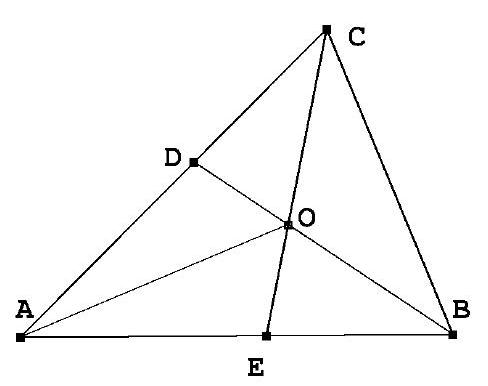 |
|
|
| Figure 11. |
|
|
| the triangles $E B O$ and $D C O$ are congruent. Then $A B=A C$, and $A B C$ is isosceles. In the second case, denote the angles of $A B C$ by $2 \alpha, 2 \beta$, and $2 \gamma$, and the angle $A E O$ by $\delta$. By the theorem on the adjacent angle of an angle of a triangle, $\angle B O E=\angle D O C=\beta+\gamma$, $\delta=2 \beta+\gamma$, and $180^{\circ}-\delta=\beta+2 \gamma$. Adding these equations yields $3(\beta+\gamma)=180^{\circ}$ eli $\beta+\gamma=60^{\circ}$. Combining this with $2(\alpha+\beta+\gamma)=180^{\circ}$, we obtain $2 \alpha=60^{\circ}$. |
|
|
| 00.4. The real-valued function $f$ is defined for $0 \leq x \leq 1, f(0)=0, f(1)=1$, and |
|
|
| $$ |
| \frac{1}{2} \leq \frac{f(z)-f(y)}{f(y)-f(x)} \leq 2 |
| $$ |
|
|
| for all $0 \leq x<y<z \leq 1$ with $z-y=y-x$. Prove that |
| |
| $$ |
| \frac{1}{7} \leq f\left(\frac{1}{3}\right) \leq \frac{4}{7} |
| $$ |
| |
| Solution. We set $f\left(\frac{1}{3}\right)=a$ and $f\left(\frac{2}{3}\right)=b$. Applying the inequality of the problem for $x=\frac{1}{3}, y=\frac{2}{3}$ and $z=1$, as well as for $x=0, y=\frac{1}{3}$, and $z=\frac{2}{3}$, we obtain |
| |
| $$ |
| \frac{1}{2} \leq \frac{1-b}{b-a} \leq 2, \quad \frac{1}{2} \leq \frac{b-a}{a} \leq 2 |
| $$ |
| |
| If $a<0$, we would have $b-a<0$ and $b<0$. In addition, we would have $1-b<0$ or $b>1$. A similar contradiction would be implied by the assumption $b-a<0$. So $a>0$ and $b-a>0$, so |
|
|
| $$ |
| \frac{1}{3}\left(\frac{2}{3} a+\frac{1}{3}\right) \leq a \leq \frac{2}{3}\left(\frac{1}{3} a+\frac{2}{3}\right) |
| $$ |
|
|
| or $a \leq 2 b-2 a, b-a \leq 2 a, b-a \leq 2-2 b$, and $1-b \leq 2 b-2 a$. Of these inequalities the first and third imply $3 a \leq 2 b$ and $3 b \leq 2+a$. Eliminate $b$ to obtain $3 a \leq \frac{4}{3}+\frac{2 a}{3}$, $a \leq \frac{4}{7}$. In a corresponding manner, the second and fourth inequality imply $1+2 a \leq 3 b$ |
| and $b \leq 3 a$, from which $1 \leq 7 a$ or $\frac{1}{7} \leq a$ follows. [The bounds can be improved. In fact the sharp lower and upper bounds for $a$ are known to be $\frac{4}{27}$ and $\frac{76}{135}$.] |
|
|
| 01.1. Let $A$ be a finite collection of squares in the coordinate plane such that the vertices of all squares that belong to $A$ are $(m, n),(m+1, n),(m, n+1)$, and $(m+1, n+1)$ for some integers $m$ and $n$. Show that there exists a subcollection $B$ of $A$ such that $B$ contains at least $25 \%$ of the squares in $A$, but no two of the squares in $B$ have a common vertex. |
|
|
| Solution. Divide the plane into two sets by painting the strips of squares parallel to the $y$ axis alternately red and green. Denote the sets of red and green squares by $R$ and $G$, respectively. Of the sets $A \cap R$ and $A \cap G$ at least one contains at least one half of the squares in $A$. Denote this set by $A_{1}$. Next partition the strips of squares which contain squares of $A_{1}$ into two sets $E$ and $F$ so that each set contains every second square of $A_{1}$ on each strip. Now neither of the dets $E$ and $F$ has a common point with a square in the same set. On the other hand, at least one of the sets $E \cap A_{1}, F \cap A_{1}$ contains at least one half of the squares in $A_{1}$ and thus at least one quarter of the sets in $A$. This set is good for the required set $B$. |
|
|
| 01.2. Let $f$ be a bounded real function defined for all real numbers and satisfying for all real numbers $x$ the condition |
|
|
| $$ |
| f\left(x+\frac{1}{3}\right)+f\left(x+\frac{1}{2}\right)=f(x)+f\left(x+\frac{5}{6}\right) |
| $$ |
|
|
| Show that $f$ is periodic. (A function $f$ is bounded, if there exists a number $L$ such that $|f(x)|<L$ for all real numbers $x$. A function $f$ is periodic, if there exists a positive number $k$ such that $f(x+k)=f(x)$ for all real numbers $x$.) |
| |
| Solution. Let $g(6 x)=f(x)$. Then $g$ is bounded, and |
| |
| $$ |
| \begin{gathered} |
| g(t+2)=f\left(\frac{t}{6}+\frac{1}{3}\right), \quad g(t+3)=f\left(\frac{t}{6}+\frac{1}{2}\right) \\ |
| g(t+5)=f\left(\frac{t}{6}+\frac{5}{6}\right), \quad g(t+2)+g(t+3)=g(t)+g(t+5) \\ |
| g(t+5)-g(t+3)=g(t+2)-g(t) |
| \end{gathered} |
| $$ |
| |
| for all real numbers $t$. But then |
| |
| $$ |
| \begin{gathered} |
| g(t+12)-g(6) \\ |
| =g(t+12)-g(t+10)+g(t+10)-g(t+8)+g(t+8)-g(t+6) \\ |
| =g(t+9)-g(t+7)+g(t+7)-g(t+5)+g(t+5)-g(t+3) \\ |
| =g(t+6)-g(t+4)+g(t+4)-g(t+2)+g(t+2)-g(t) \\ |
| =g(t+6)-g(t) |
| \end{gathered} |
| $$ |
| |
| By induction, then $g(t+6 n)-g(t)=n(g(t+6)-g(0))$ for all positive integers $n$. Unless $g(t+6)-g(t)=0$ for all real $t, g$ cannot be bounded. So $g$ has to be periodic with 6 as a period, whence $f$ is periodic, with 1 as a period. |
| |
| 01.3. Determine the number of real roots of the equation |
| |
| $$ |
| x^{8}-x^{7}+2 x^{6}-2 x^{5}+3 x^{4}-3 x^{3}+4 x^{2}-4 x+\frac{5}{2}=0 |
| $$ |
| |
| Solution. Write |
| |
| $$ |
| \begin{gathered} |
| x^{8}-x^{7}+2 x^{6}-2 x^{5}+3 x^{4}-3 x^{3}+4 x^{2}-4 x+\frac{5}{2} \\ |
| =x(x-1)\left(x^{6}+2 x^{4}+3 x^{2}+4\right)+\frac{5}{2} |
| \end{gathered} |
| $$ |
| |
| If $x(x-1) \geq 0$, i.e. $x \leq 0$ or $x \geq 1$, the equation has no roots. If $0<x<1$, then $0>x(x-1)=\left(x-\frac{1}{2}\right)^{2}-\frac{1}{4} \geq-\frac{1}{4}$ and $x^{6}+2 x^{4}+3 x+4<1+2+3+4=10$. The value of the left-hand side of the equation now is larger than $-\frac{1}{4} \cdot 10+\frac{5}{2}=0$. The equation has no roots in the interval $(0,1)$ either. |
|
|
| 01.4. Let $A B C D E F$ be a convex hexagon, in which each of the diagonals $A D, B E$, and $C F$ divides the hexagon in two quadrilaterals of equal area. Show that $A D, B E$, and $C F$ are concurrent. |
|
|
| 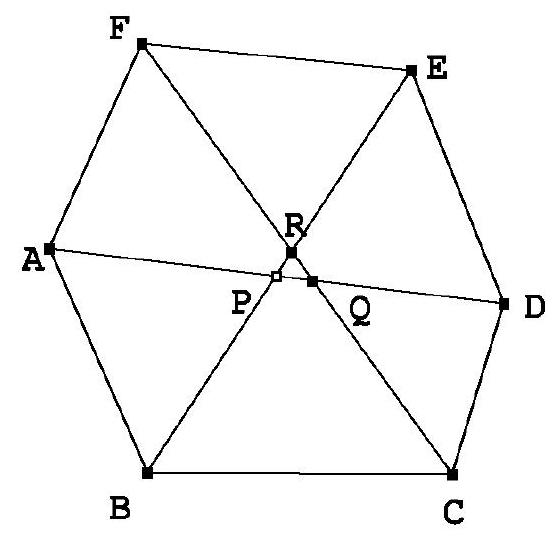 |
|
|
| Figure 12. |
|
|
| Solution. (See Figure 12.) Denote the area of a figure by $|\cdot|$. Let $A D$ and $B E$ intersect at $P, A D$ and $C F$ at $Q$, and $B E$ and $C F$ at $R$. Assume that $P, Q$, and $R$ are different. We may assume that $P$ lies between $B$ and $R$, and $Q$ lies between $C$ and $R$. Both $|A B P|$ and $|D E P|$ differ from $\frac{1}{2}|A B C D E F|$ by $|B C D P|$. Thus $A B P$ and $D E P$ have equal area. Since $\angle A P B=\angle D P E$, we have $A P \cdot B P=D P \cdot E P=(D Q+Q P)(E R+R P)$. Likewise $C Q \cdot D Q=(A P+P Q)(F R+R Q)$ and $E R \cdot F R=(C Q+Q R)(B P+P R)$. When we multiply the three previous equalities, we obtain $A P \cdot B P \cdot C Q \cdot D Q \cdot E R \cdot F R=$ $D Q \cdot E R \cdot A P \cdot F R \cdot C Q \cdot B P+$ positive terms containing $P Q, Q R$, and $P R$. This is a contradiction. So $P, Q$ and $R$ must coincide. |
|
|
| 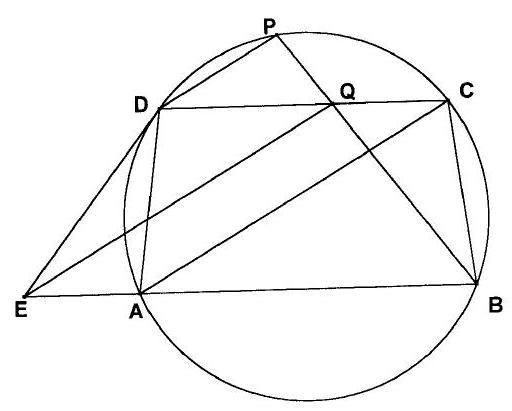 |
|
|
| Figure 13. |
|
|
| 02.1. The trapezium $A B C D$, where $A B$ and $C D$ are parallel and $A D<C D$, is inscribed in the circle c. Let DP be a chord of the circle, parallel to AC. Assume that the tangent to $c$ at $D$ meets the line $A B$ at $E$ and that $P B$ and $D C$ meet at $Q$. Show that $E Q=A C$. |
| |
| Solution. (See Figure 13.) since $A D<C D, \angle P D C=\angle D C A<\angle D A C$. This implies that arc $C P$ is smaller than arc $C D$, and $P$ lies on that arc $C D$ which does not include $A$ and $B$. We show that the triangles $A D E$ and $C B Q$ are congruent. As a trapezium inscribed in a circle, $A B C D$ is isosceles (because $A B \| C D, \angle B A C=\angle D C A$, hence $B C=$ $A D)$. Because $D P \| A C, \angle P D C=\angle C A B$. But $\angle E D A=\angle C A B$ (angles subtending equal arcs) and $\angle P B C=\angle P D C$ (by the same argument). So $\angle E D A=\angle Q B C$. Because $A B C D$ is an inscribed quadrilateral, $\angle E A D=180^{\circ}-\angle D A B=\angle D C B$. So $\angle E A D=$ $\angle Q C B$. The triangles $A D E$ and $C B Q$ are congruent (asa). But then $E A=Q C$. As, in addition, $E A \| Q C, E A C Q$ is a parallelogram. And so $A C=E Q$, as opposite sides of a parallelogram. |
| |
| 02.2. In two bowls there are in total $N$ balls, numbered from 1 to $N$. One ball is moved from one of the bowls to the other. The average of the numbers in the bowls is increased in both of the bowls by the same amount, $x$. Determine the largest possible value of $x$. |
| |
| Solution. Consider the situation before the ball is moved from urn one to urn two. Let the number of balls in urn one be $n$, and let the sum of numbers in the balls in that urn be $a$. The number of balls in urn two is $m$ and the sum of numbers $b$. If $q$ is the number written in the ball which was moved, the conditions of the problem imply |
| |
| $$ |
| \left\{\begin{array}{l} |
| \frac{a-q}{n-1}=\frac{a}{n}+x \\ |
| \frac{b+q}{m+1}=\frac{b}{m}+x |
| \end{array}\right. |
| $$ |
| |
| or |
| |
| $$ |
| \left\{\begin{array}{l} |
| a=n q+n(n-1) x \\ |
| b=m q-m(m+1) x |
| \end{array}\right. |
| $$ |
| |
| Because $n+m=N$ and $a+b=\frac{1}{2} N(N+1)$, we obtain |
| |
| $$ |
| \frac{1}{2} N(N+1)=N q+x\left(n^{2}-m^{2}-N\right)=N q+x N(n-m-1) |
| $$ |
| |
| and $q=\frac{1}{2}(N+1)-x(n-m-1), b=\frac{1}{2} m(N+1)-x m n$. But $b \geq 1+2+\cdots+m=\frac{1}{2} m(m+1)$. So $\frac{1}{2}(N+1)-x n=\frac{1}{2}(m+n+1)-x n \geq \frac{1}{2}(m+1)$ or $\frac{n}{2}-x n \geq 0$. Hence $x \leq \frac{1}{2}$. The inequality is sharp or $x=\frac{1}{2}$, when the nubers in the balls in urn one are $m+1, m+2$, $\ldots, N$, the numbers in urn two are $1,2, \ldots, m$, and $q=m+1$. |
| |
| 02.3. Let $a_{1}, a_{2}, \ldots, a_{n}$, and $b_{1}, b_{2}, \ldots, b_{n}$ be real numbers, and let $a_{1}, a_{2}, \ldots, a_{n}$ be all different.. Show that if all the products |
| |
| $$ |
| \left(a_{i}+b_{1}\right)\left(a_{i}+b_{2}\right) \cdots\left(a_{i}+b_{n}\right) |
| $$ |
| |
| $i=1,2, \ldots, n$, are equal, then the products |
| |
| $$ |
| \left(a_{1}+b_{j}\right)\left(a_{2}+b_{j}\right) \cdots\left(a_{n}+b_{j}\right) |
| $$ |
| |
| $j=1,2, \ldots, n$, are equal, too. |
| |
| Solution. Let $P(x)=\left(x+b_{1}\right)\left(x+b_{2}\right) \cdots\left(x+b_{n}\right)$. Let $P\left(a_{1}\right)=P\left(a_{2}\right)=\ldots=P\left(a_{n}\right)=d$. Thus $a_{1}, a_{2}, \ldots, a_{n}$ are the roots of the $n$ :th degree polynomial equation $P(x)-d=0$. Then $P(x)-d=c\left(x-a_{1}\right)\left(x-a_{2}\right) \cdots\left(x-a_{n}\right)$. Clearly the $n$ :th degree terms of $P(x)$ and $P(x)-d$ are equal. So $c=1$. But $P\left(-b_{j}\right)=0$ for each $b_{j}$. Thus for every $j$, |
| |
| $$ |
| \begin{gathered} |
| -d=\left(-b_{j}-a_{1}\right)\left(-b_{j}-a_{2}\right) \cdots\left(-b_{j}-a_{n}\right) \\ |
| =(-1)^{n}\left(a_{1}+b_{j}\right)\left(a_{2}+b_{j}\right) \cdots\left(a_{n}+b_{j}\right) |
| \end{gathered} |
| $$ |
| |
| and the claim follows. |
| |
| 02.4. Eva, Per and Anna play with their pocket calculators. They choose different integers and check, whether or not they are divisible by 11. They only look at nine-digit numbers consisting of all the digits 1, 2, .., 9. Anna claims that the probability of such a number to be a multiple of 11 is exactly 1/11. Eva has a different opinion: she thinks the probability is less than $1 / 11$. Per thinks the probability is more than $1 / 11$. Who is correct? |
| |
| Solution. We write the numbers in consideration, $n=a_{0}+10 a_{1}+10^{2} a_{2}+\cdots+10^{8} a_{8}$, in the form |
| |
| $$ |
| \begin{gathered} |
| a_{0}+(11-1) a_{1}+(99+1) a_{2}+(1001-1) a_{3} \\ |
| +(9999+1) a_{4}+(100001-1) a_{5}+(999999+1) a_{6} \\ |
| \quad+(10000001-1) a_{7}+(99999999+1) a_{8} \\ |
| =\left(a_{0}-a_{1}+a_{2}-a_{3}+a_{4}-a_{5}+a_{6}-a_{7}+a_{8}\right)+11 k \\ |
| =\left(a_{0}+a_{1}+\cdots+a_{8}\right)-2\left(a_{1}+a_{3}+a_{5}+a_{7}\right)+11 k \\ |
| =44+1+11 k-2\left(a_{1}+a_{3}+a_{5}+a_{7}\right) |
| \end{gathered} |
| $$ |
| |
| So $n$ is divisible by 11 if and only if $2\left(a_{1}+a_{3}+a_{5}+a_{7}\right)-1$ is divisible by 11 . Let $s=a_{1}+a_{3}+a_{5}+a_{7}$. Then $1+2+3+4=10 \leq s \leq 6+7+8+9=30$ and $19 \leq 2 s-1 \leq 59$. The only multiples of 11 in the desired interval are 33 and 55 , so $s=17$ |
| or $s=28$. If $s=17$, the smallest number in the set $A=\left\{a_{1}, a_{3}, a_{5}, a_{7}\right\}$ is either 1 or 2 $(3+4+5+6=18)$. Checking the cases, we see that there are 9 possible sets $A:\{2,4,5,6\}$, $\{2,3,5,7\},\{2,3,4,8\},\{1,4,5,7\},\{1,3,6,7\},\{1,3,5,8\},\{1,3,4,9\},\{1,2,6,8\}$, and $\{1,2,5,9\}$. If $s=28$, the largest number in $A$ is $9(5+6+7+8=26)$ and the second largest $8(5+6+7+9=27)$. The only possible $A$ 's are $\{4,7,8,9\}$ and $\{5,6,8,9\}$. The number of different ways to choose the set $A$ is $\binom{9}{4}=\frac{9 \cdot 8 \cdot 7 \cdot 6}{2 \cdot 3 \cdot 4}=126$. Of these, the number of choices leading to a number which is a multiple of 11 is $9+2=11$. This means that the probability of picking a number which is divisible by 11 is $\frac{11}{126}<\frac{11}{121}=\frac{1}{11}$. So Eva's opinion is correct. |
| |
| 03.1. Stones are placed on the squares of a chessboard having 10 rows and 14 columns. There is an odd number of stones on each row and each column. The squares are coloured black and white in the usual fashion. Show that the number of stones on black squares is even. Note that there can be more than one stone on a square. |
| |
| Solution. Changing the order of rows or columns does not influence the number of stones on a row, on a column or on black squares. Thus we can order the rows and columns in such a way that the $5 \times 7$ rectangles in the upper left and lower right corner are black and the other two $5 \times 7$ rectangles are white. If the number of stones on black squares would be odd, then one of the black rectangles would have an odd number of stones while the number of stones on the other would be even. Since the number of stones is even, one of the white rectangles would have an odd number of stones and the other an even number. But this would imply either a set of five rows or a set of seven columns with an even number of stones. But this is not possible, because every row and column has an odd number of stones. So the number of stones on black squares has to be even. |
| |
| 03.2. Find all triples of integers $(x, y, z)$ satisfying |
| |
| $$ |
| x^{3}+y^{3}+z^{3}-3 x y z=2003 |
| $$ |
| |
| Solution. It is a well-known fact (which can be rediscovered e.g. by noticing that the left hand side is a polynomial in $x$ having $-(y+z)$ as a zero) that |
| |
| $$ |
| \begin{aligned} |
| & x^{3}+y^{3}+z^{3}-3 x y z=(x+y+z)\left(x^{2}+y^{2}+z^{2}-x y-y z-z x\right) \\ |
| &=(x+y+z) \frac{(x-y)^{2}+(y-z)^{2}+(z-x)^{2}}{2} |
| \end{aligned} |
| $$ |
| |
| The second factor in the right hand side is non-negative. It is not hard to see that 2003 is a prime. So the solutions of the equation either satisfy |
| |
| $$ |
| \left\{\begin{aligned} |
| x+y+z & =1 \\ |
| (x-y)^{2}+(y-z)^{2}+(z-x)^{2} & =4006 |
| \end{aligned}\right. |
| $$ |
| |
| or |
| |
| $$ |
| \left\{\begin{aligned} |
| x+y+z & =2003 \\ |
| (x-y)^{2}+(y-z)^{2}+(z-x)^{2} & =2 |
| \end{aligned}\right. |
| $$ |
| |
| Square numbers are $\equiv 0$ or $\equiv 1 \bmod 3$. So in the first case, exactly two of the squares $(x-y)^{2},(y-z)^{2}$, and $(z-x)^{2}$ are multiples of 3. Clearly this is not possible. So we must have $x+y+z=2003$ and $(x-y)^{2}+(y-z)^{2}+(z-x)^{2}=2$. This is possible if and only if one of the squares is 0 and two are 1's. So two of $x, y, z$ have to be equal and the third must differ by 1 of these. This means that two of the numbers have to be 668 and one 667. A substitution to the original equation shows that this necessary condition is also sufficient. |
| |
| 03.3. The point $D$ inside the equilateral triangle $\triangle A B C$ satisfies $\angle A D C=150^{\circ}$. Prove that a triangle with side lengths $|A D|,|B D|,|C D|$ is necessarily a right-angled triangle. |
| |
| 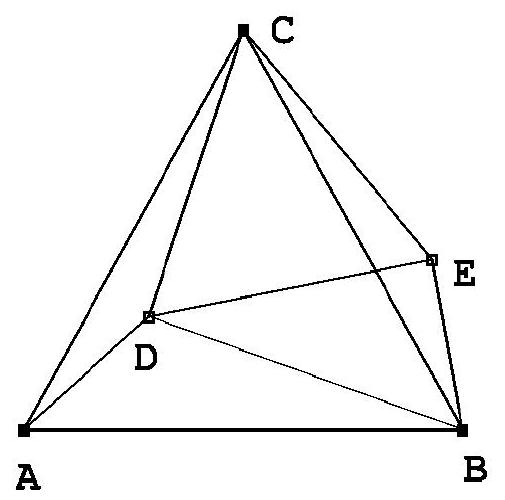 |
| |
| Figure 14 . |
| |
| Solution. (See Figure 14.) We rotate the figure counterclockwise $60^{\circ}$ around $C$. Because $A B C$ is an equilateral triangle, $\angle B A C=60^{\circ}$, so $A$ is mapped on $B$. Assume $D$ maps to $E$. The properties of rotation imply $A D=B E$ and $\angle B E C=150^{\circ}$. Because the triangle $D E C$ is equilateral, $D E=D C$ and $\angle D E C=60^{\circ}$. But then $\angle D E B=150^{\circ}-60^{\circ}=90^{\circ}$. So segments having the lengths as specified in the problem indeed are sides of a right triangle. |
| |
| 03.4. Let $\mathbb{R}^{*}=\mathbb{R} \backslash\{0\}$ be the set of non-zero real numbers. Find all functions $f: \mathbb{R}^{*} \rightarrow \mathbb{R}^{*}$ satisfying |
| |
| $$ |
| f(x)+f(y)=f(x y f(x+y)) |
| $$ |
| |
| for $x, y \in \mathbb{R}^{*}$ and $x+y \neq 0$. |
| |
| Solution. If $x \neq y$, then |
| |
| $$ |
| f(y)+f(x-y)=f(y(x-y) f(x)) |
| $$ |
| |
| Because $f(y) \neq 0$, we cannot have $f(x-y)=f(y(x-y) f(x))$ or $x-y=y(x-y) f(x)$. So for all $x \neq y, y f(x) \neq 1$. The only remaining possibility is $f(x)=\frac{1}{x}$. - One easily checks that $f, f(x)=\frac{1}{x}$, indeed satisfies the original functional equation. |
| |
| 04.1. 27 balls, labelled by numbers from 1 to 27, are in a red, blue or yellow bowl. Find the possible numbers of balls in the red bowl, if the averages of the labels in the red, blue, and yellow bowl are 15, 3 ja 18, respectively. |
| |
| Solution. Let $R, B$, and $Y$, respectively, be the numbers of balls in the red, blue, and yellow bowl. The mean value condition implies $B \leq 5$ (there are at most two balls with a number $<3$, so there can be at most two balls with a number $>3$ ). $R, B$ and $Y$ satisfy the equations |
|
|
| $$ |
| \begin{aligned} |
| R+B+Y & =27 \\ |
| 15 R+3 S+18 Y & =\sum_{j=1}^{27} j=14 \cdot 27=378 |
| \end{aligned} |
| $$ |
| |
| We eliminate $S$ to obtain $4 R+5 Y=99$. By checking the possibilities we note that the pairs of positive integers satisfying the last equation are $(R, Y)=(21,3),(16,7),(11,11)$, $(6,15)$, and $(1,19)$. The last two, however, do not satisfy $B=27-(R+Y) \leq 5$. We still have to ascertain that the three first alternatives are possible. In the case $R=21$ we can choose the balls $5,6, \ldots, 25$, in the red bowl, and 2,3 and 4 in the blue bowl; if $P=16$, $7,8, \ldots, 14,16,17, \ldots, 23$, can go to the red bowl and $1,2,4$ and 5 in the blue one, and if $P=11$, the red bowl can have balls $10,11, \ldots 20$, and the blue one $1,2,3,4,5$. The red bowl can contain 21,16 or 11 balls. |
| |
| 04.2. Let $f_{1}=0, f_{2}=1$, and $f_{n+2}=f_{n+1}+f_{n}$, for $n=1$, 2, ..., be the Fibonacci sequence. Show that there exists a strictly increasing infinite arithmetic sequence none of whose numbers belongs to the Fibonacci sequence. [A sequence is arithmetic, if the difference of any of its consecutive terms is a constant.] |
|
|
| Solution. The Fibonacci sequence modulo any integer $n>1$ is periodic. (Pairs of residues are a finite set, so some pair appears twice in the sequence, and the sequence from the second appearance of the pair onwards is a copy of the sequence from the first pair onwards.) There are integers for which the Fibonacci residue sequence does not contain all possible residues. For instance modulo 11 the sequence is $0,1,1,2,3,5,8,2,10,1$, $0,1,1, \ldots$ Wee see that the number 4 is missing. It follows that no integer of the form $4+11 k$ appears in the Fibonacci sequence. But here we have an arithmetic sequence of the kind required. |
|
|
| 04.3. Let $x_{11}, x_{21}, \ldots, x_{n 1}, n>2$, be a sequence of integers. We assume that all of the numbers $x_{i 1}$ are not equal. Assuming that the numbers $x_{1 k}, x_{2 k}, \ldots, x_{n k}$ have been defined, we set |
| |
| $$ |
| \begin{aligned} |
| x_{i, k+1} & =\frac{1}{2}\left(x_{i k}+x_{i+1, k}\right), i=1,2, \ldots, n-1 \\ |
| x_{n, k+1} & =\frac{1}{2}\left(x_{n k}+x_{1 k}\right) |
| \end{aligned} |
| $$ |
| |
| Show that for $n$ odd, $x_{j k}$ is not an integer for some $j, k$. Does the same conclusion hold for $n$ even? |
|
|
| Solution. We compute the first index modulo $n$, i.e. $x_{1 k}=x_{n+1, k}$. Let $M_{k}=\max _{j} x_{j k}$ and $m_{k}=\min _{j} x_{j k}$. Evidently $\left(M_{k}\right)$ is a non-increasing and $\left(m_{k}\right)$ a non-decreasing sequence, and $M_{k+1}=M_{k}$ is possible only if $x_{j k}=x_{j+1, k}=M_{k}$ for some $j$. If exactly $p$ |
| consequtive numbers $x_{j k}$ equal $M_{k}$, then exactly $p-1$ consequtive numbers $x_{j, k+1}$ equal $M_{k+1}$ which is equal to $M_{k}$. So after a finite number of steps we arrive at the situation $M_{k+1}<M_{k}$. In a corresponding manner we see that $m_{k+1}>m_{k}$ for some $k$ 's. If all the numbers in all the sequences are integers, then all $m_{k}$ 's and $M_{k}$ 's are integers. So after a finite number of steps $m_{k}=M_{k}$, and all numbers $x_{j k}$ are equal. Then $x_{1, k-1}+x_{2, k-1}=x_{2, k-1}+x_{3, k-1}=\cdots=x_{n-1, k-1}+x_{n, k-1}=x_{n, k-1}+x_{1, k-1}$. If $n$ is odd, then $x_{1, k-1}=x_{3, k-1}=\cdots=x_{n, k-1}$ and $x_{1, k-1}=x_{n-1, k-1}=\cdots=x_{2, k-1}$. But then we could show in a similar way that all numbers $x_{j, k-2}$ are equal and finally that all numbers $x_{j, 1}$ are equal, contrary to the assumption. If $n$ is even, then all $x_{i, k}$ 's can be integers. Take, for instance, $x_{1,1}=x_{3,1}=\cdots=x_{n-1,1}=0, x_{2,1}=x_{4,1}=\cdots=x_{n, 1}=2$. Then every $x_{j, k}=1, k \geq 2$. |
| |
| 04.4. Let $a, b$, and $c$ be the side lengths of a triangle and let $R$ be its circumradius. Show that |
| |
| $$ |
| \frac{1}{a b}+\frac{1}{b c}+\frac{1}{c a} \geq \frac{1}{R^{2}} |
| $$ |
| |
| Solution 1. By the well-known (Euler) theorem, the inradius $r$ and circumradius $R$ of any triangle satisfy $2 r \leq R$. (In fact, $R(R-2 r)=d^{2}$, where $d$ is the distance between the incenter and circumcenter.) The area $S$ of a triangle can be written as |
| |
| $$ |
| A=\frac{r}{2}(a+b+c) |
| $$ |
| |
| and, by the sine theorem, as |
| |
| $$ |
| A=\frac{1}{2} a b \sin \gamma=\frac{1}{4} \frac{a b c}{R} |
| $$ |
| |
| Combining these, we obtain |
| |
| $$ |
| \frac{1}{a b}+\frac{1}{b c}+\frac{1}{c a}=\frac{a+b+c}{a b c}=\frac{2 A}{r} \cdot \frac{1}{4 R A}=\frac{1}{2 r R} \geq \frac{1}{R^{2}} |
| $$ |
| |
| Solution 2. Assume $a \leq b \leq c$. Then $b=a+x$ and $c=a+x+y, x \geq 0, y \geq 0$. Now $a b c-(a+b-c)(a-b+c)(-a+b+c)=a(a+x)(a+x+y)-(a-y)(a+2 x+y)(a+y)=a x^{2}+$ $a x y+a y^{2}+2 x y^{2}+y^{3} \geq 0$. So $a b c(a+b+c) \geq(a+b+c)(a+b-c)(a-b+c)(-a+b+c)=16 A^{2}$, where the last inequality is implied by Heron's formula. When we substitute $A=\frac{a b c}{4 R}$ (see Solution 1) we obtain, after simplification, |
| |
| $$ |
| a+b+c \geq \frac{a b c}{R^{2}} |
| $$ |
| |
| which is equivalent to the claim. |
| |
| 05.1. Find all positive integers $k$ such that the product of the digits of $k$, in the decimal system, equals |
| |
| $$ |
| \frac{25}{8} k-211 |
| $$ |
| |
| Solution. Let |
| |
| $$ |
| a=\sum_{k=0}^{n} a_{k} 10^{k}, \quad 0 \leq a_{k} \leq 9, \text { for } 0 \leq k \leq n-1,1 \leq a_{n} \leq 9 |
| $$ |
| |
| Set |
| |
| $$ |
| f(a)=\prod_{k=0}^{n} a_{k} |
| $$ |
| |
| Since |
| |
| $$ |
| f(a)=\frac{25}{8} a-211 \geq 0 |
| $$ |
| |
| $a \geq \frac{8}{25} \cdot 211=\frac{1688}{25}>66$. Also, $f(a)$ is an integer, and $\operatorname{gcf}(8,25)=1$, so $8 \mid a$. On the other hand, |
| |
| $$ |
| f(a) \leq 9^{n-1} a_{n} \leq 10^{n} a_{n} \leq a |
| $$ |
| |
| So |
| |
| $$ |
| \frac{25}{8} a-211 \leq a |
| $$ |
| |
| or $a \leq \frac{8}{17} \cdot 211=\frac{1688}{17}<100$. The only multiples of 8 between 66 and 100 are $72,80,88$, and 96. Now $25 \cdot 9-211=17=7 \cdot 2,25 \cdot 10-211=39 \neq 8 \cdot 0,25 \cdot 11-211=64=8 \cdot 8$, and $25 \cdot 12-211=89 \neq 9 \cdot 6$. So 72 and 88 are the numbers asked for. |
| |
| 05.2. Let $a, b$, and $c$ be positive real numbers. Prove that |
| |
| $$ |
| \frac{2 a^{2}}{b+c}+\frac{2 b^{2}}{c+a}+\frac{2 c^{2}}{a+b} \geq a+b+c |
| $$ |
| |
| Solution 1. Use brute force. Removing the denominators and brackets and combining simililar terms yields the equivalent inequality |
| |
| $$ |
| \begin{gathered} |
| 0 \leq 2 a^{4}+2 b^{4}+2 c^{4}+a^{3} b+a^{3} c+a b^{3}+b^{3} c+a c^{3}+b c^{3} \\ |
| -2 a^{2} b^{2}-2 b^{2} c^{2}-2 a^{2} c^{2}-2 a b c^{2}-2 a b^{2} c-2 a^{2} b c \\ |
| =a^{4}+b^{4}-2 a^{2} b^{2}+b^{4}+c^{4}-2 b^{2} c^{2}+c^{4}+a^{4}-2 a^{2} c^{2} \\ |
| +a b\left(a^{2}+b^{2}-2 c^{2}\right)+b c\left(b^{2}+c^{2}-2 a^{2}\right)+c a\left(c^{2}+a^{2}-2 b^{2}\right) \\ |
| =\left(a^{2}-b^{2}\right)^{2}+\left(b^{2}-c^{2}\right)^{2}+\left(c^{2}-a^{2}\right)^{2} \\ |
| +a b(a-b)^{2}+b c(b-c)^{2}+c a(c-a)^{2} \\ |
| +a b\left(2 a b-2 c^{2}\right)+b c\left(2 b c-2 a^{2}\right)+c a\left(2 c a-2 b^{2}\right) |
| \end{gathered} |
| $$ |
| |
| The six first terms on the right hand side are non-negative and the last three can be written as |
| |
| $$ |
| \begin{gathered} |
| 2 a^{2} b^{2}-2 a b c^{2}+2 b^{2} c^{2}-2 a^{2} b c+2 c^{2} a^{2}-2 a b^{2} c \\ |
| =a^{2}\left(b^{2}+c^{2}-2 b c\right)+b^{2}\left(a^{2}+c^{2}-2 a c\right)+c^{2}\left(a^{2}+b^{2}-2 a b\right) \\ |
| =a^{2}(b-c)^{2}+b^{2}(c-a)^{2}+c^{2}(a-b)^{2} \geq 0 |
| \end{gathered} |
| $$ |
| |
| So the original inequality is true. |
| |
| Solution 2. The inequality is equivalent to |
| |
| $$ |
| \begin{gathered} |
| 2\left(a^{2}(a+b)(a+c)+b^{2}(b+c)(b+a)+c^{2}(c+a)(c+b)\right) \\ |
| \geq(a+b+c)(a+b)(b+c)(c+a) |
| \end{gathered} |
| $$ |
| |
| The left hand side can be factored as $2(a+b+c)\left(a^{3}+b^{3}+c^{3}+a b c\right)$. Because $a+b+c$ is positive, the inequality is equivalent to |
| |
| $$ |
| 2\left(a^{3}+b^{3}+c^{3}+a b c\right) \geq(a+b)(b+c)(c+a) |
| $$ |
| |
| After expanding the right hand side and subtracting $2 a b c$, we get the inequality |
| |
| $$ |
| 2\left(a^{3}+b^{3}+c^{3}\right) \geq\left(a^{2} b+b^{2} c+c^{2} a\right)+\left(a^{2} c+b^{2} a+c^{2} b\right) |
| $$ |
| |
| still equivalent to the original one. But we now have two instances of the well-known inequality $x^{3}+y^{3}+z^{3} \geq x^{2} y+y^{2} z+z^{2} x$ or $x^{2}(x-y)+y^{2}(y-z)+z^{2}(z-x) \geq 0$. [Proof: We may assume $x \geq y, x \geq z$. If $y \geq z$, write $z-x=z-y+y-z$ to obtain the equivalent and true inequality $\left(y^{2}-z^{2}\right)(y-z)+\left(x^{2}-z^{2}\right)(x-y) \geq 0$, if $z \geq y$, similarly write $x-y=x-z+z-y$, and get $\left(x^{2}-z^{2}\right)(x-z)+\left(x^{2}-y^{2}\right)(z-y) \geq 0$.] |
| |
| Solution 3. The original inequality is symmetric in $a, b, c$. So we may assume $a \geq b \geq c$, which implies |
| |
| $$ |
| \frac{1}{b+c} \geq \frac{1}{c+a} \geq \frac{1}{a+b} |
| $$ |
| |
| The power mean inequality gives |
| |
| $$ |
| \frac{a^{2}+b^{2}+c^{2}}{3} \geq\left(\frac{a+b+c}{3}\right)^{2} |
| $$ |
| |
| We combine this and the Chebyshev inequality to obtain |
| |
| $$ |
| \begin{gathered} |
| \frac{2 a^{2}}{b+c}+\frac{2 b^{2}}{c+a}+\frac{2 c^{2}}{a+b} \\ |
| \geq \frac{2}{3}\left(a^{2}+b^{2}+c^{2}\right)\left(\frac{1}{b+c}+\frac{1}{c+a}+\frac{1}{a+b}\right) \\ |
| \geq \frac{2}{9}(a+b+c)^{2}\left(\frac{1}{b+c}+\frac{1}{c+a}+\frac{1}{a+b}\right) |
| \end{gathered} |
| $$ |
| |
| To complete the proof, we have to show that |
| |
| $$ |
| 2(a+b+c)\left(\frac{1}{b+c}+\frac{1}{c+a}+\frac{1}{a+b}\right) \geq 9 |
| $$ |
| |
| But this is equivalent to the harmonic-arithmetic mean inequality |
| |
| $$ |
| \frac{3}{\frac{1}{x}+\frac{1}{y}+\frac{1}{z}} \leq \frac{x+y+z}{3} |
| $$ |
| |
| with $x=a+b, y=b+c, z=c+a$. |
| |
| 05.3 There are 2005 young people sitting around a (large!) round table. Of these at most 668 are boys. We say that a girl $G$ is in a strong position, if, counting from $G$ to either direction at any length, the number of girls is always strictly larger than the number of boys. (G herself is included in the count.) Prove that in any arrangement, there always is a girl in a strong position. |
| |
| Solution. Assume the number of girls to be $g$ and the number of boys $b$. Call a position clockwise fairly strong, if, counting clockwise, the number of girls always exceeds the number of boys. No girl immediately followed by a boy has a fairly strong position. But no pair consisting of a girl and a boy following her has any effect on the fairly strongness of the other positions. So we may remove all such pairs. so we are left with at least $g-b$ girls, all in a clockwise fairly strong position. A similar count of counterclockwise fairly strong positions can be given, yielding at least $g-b$ girls in such a position. Now a sufficient condition for the existence of a girl in a strong position is that the sets consisting of the girls in clockwise and counterclockwise fairly strong position is nonempty. This is certainly true if $2(g-b)>g$, or $g>2 b$. With the numbers in the problem, this is true. |
| |
| 05.4. The circle $\mathcal{C}_{1}$ is inside the circle $\mathcal{C}_{2}$, and the circles touch each other at $A$. A line through $A$ intersects $\mathcal{C}_{1}$ also at $B$ and $\mathcal{C}_{2}$ also at $C$. The tangent to $\mathcal{C}_{1}$ at $B$ intersects $\mathcal{C}_{2}$ at $D$ and $E$. The tangents of $\mathcal{C}_{1}$ passing through $C$ touch $\mathcal{C}_{1}$ at $F$ and $G$. Prove that $D$, $E, F$, and $G$ are concyclic. |
| |
| 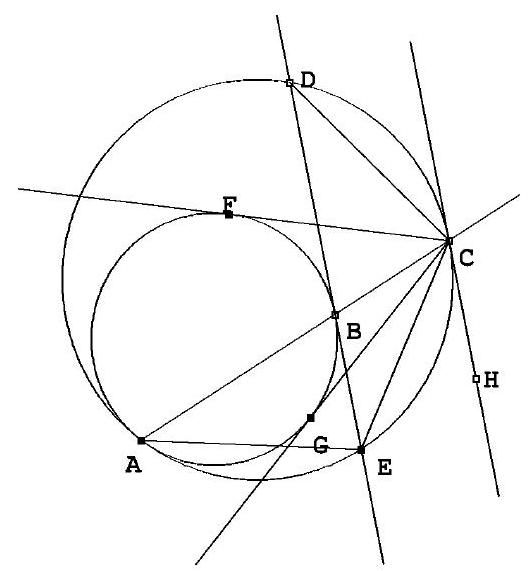 |
| |
| Figure 15. |
| |
| Solution. (See Figure 15.) Draw the tangent $\mathrm{CH}$ to $\mathcal{C}_{2}$ at $C$. By the theorem of the angle between a tangent and chord, the angles $A B H$ and $A C H$ both equal the angle at $A$ between $B A$ and the common tangent of the circles at $A$. But this means that the angles $A B H$ and $A C H$ are equal, and $C H \| B E$. So $C$ is the midpoint of the arc $D E$. This again implies the equality of the angles $C E B$ and $B A E$, as well as $C E=C D$. So the triangles $A E C, C E B$, having also a common angle $E C B$, are similar. So |
|
|
| $$ |
| \frac{C B}{C E}=\frac{C E}{A C} |
| $$ |
|
|
| and $C B \cdot A C=C E^{2}=C D^{2}$. But by the power of a point theorem, $C B \cdot C A=C G^{2}=C F^{2}$. We have in fact proved $C D=C E=C F=C G$, so the four points are indeed concyclic. |
|
|
| 06.1 Let $B$ and $C$ be points on two fixed rays emanating from a point $A$ such that $A B+A C$ is constant. Prove that there exists a point $D \neq A$ such that the circumcircles of the triangels $A B C$ pass through $D$ for every choice of $B$ and $C$. |
|
|
| 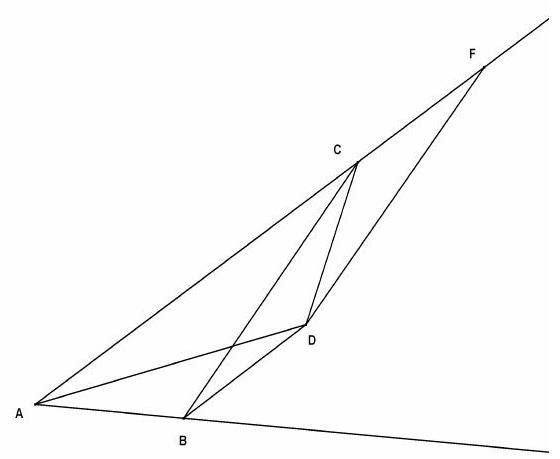 |
|
|
| Figure 16 . |
|
|
| Solution. (See Figure 16.) Let $E$ and $F$ be the points on rays $A B$ and $A C$, respectively, such that $A E=A F=A B+A C$. Let the perpendicular bisectors of the segments $A E$ and $A F$ intersect at $D$. It is easy to see, for instance from the right triangles with $A D$ as the common hypothenuse and the projections of $A D$ on $A B$ and $A C$ as legs, that $D$ lies on the angle bisector of angle $B A C$. Moreover, $\angle A D F=180^{\circ}-2 \cdot \angle C A D=180^{\circ}-\angle B A C$. The triangle $A D F$ is isosceles, so $\angle B A D=\angle D A C=\angle C F D$ and $A D=D F$ in the triangles $A B D$ and $D C F$. Moreover, we know that $C F=A F-A C=A B$. The triangles $A D B$ and $F D C$ are congruent (sas). So $\angle B D A=\angle C D F$. But this implies $\angle B D C=\angle A D F=$ $180^{\circ}-\angle B A C$. This is sufficient for $A B D C$ to be an inscribed quadrilateral, and the claim has been proved. |
|
|
| 06.2. The real numbers $x, y$ and $z$ are not all equal and satisfy |
|
|
| $$ |
| x+\frac{1}{y}=y+\frac{1}{z}=z+\frac{1}{x}=k |
| $$ |
|
|
| Determine all possible values of $k$. |
|
|
| Solution. Let $(x, y, z)$ be a solution of the system of equations Since |
|
|
| $$ |
| x=k-\frac{1}{y}=\frac{k y-1}{y} \quad \text { and } \quad z=\frac{1}{k-y} |
| $$ |
|
|
| the equation |
|
|
| $$ |
| \frac{1}{k-y}+\frac{y}{k y-1}=k |
| $$ |
|
|
| to be simplified into |
|
|
| $$ |
| \left(1-k^{2}\right)\left(y^{2}-k y+1\right)=0 |
| $$ |
|
|
| is true. So either $|k|=1$ or |
|
|
| $$ |
| k=y+\frac{1}{y} |
| $$ |
|
|
| The latter alternative, substituted to the original equations, yields immediately $x=y$ and $z=y$. So $k= \pm 1$ is the only possibility. If $k=1$, for instance $x=2, y=-1$ and $z=\frac{1}{2}$ is a solution; if $k=-1$, a solution is obtained by reversing the signs for a solution with $k=1$. So $k=1$ and $k=-1$ are the only possible values for $k$. |
|
|
| 06.3. A sequence of positive integers $\left\{a_{n}\right\}$ is given by |
| |
| $$ |
| a_{0}=m \quad \text { and } \quad a_{n+1}=a_{n}^{5}+487 |
| $$ |
|
|
| for all $n \geq 0$. Determine all values of $m$ for which the sequence contains as many square numbers as possible. |
|
|
| Solution. Consider the expression $x^{5}+487$ modulo 4. Clearly $x \equiv 0 \Rightarrow x^{5}+487 \equiv 3$, $x \equiv 1 \Rightarrow x^{5}+487 \equiv 0 ; x \equiv 2 \Rightarrow x^{5}+487 \equiv 3$, and $x \equiv 3 \Rightarrow x^{5}+487 \equiv 2$. Square numbers are always $\equiv 0$ or $\equiv 1 \bmod 4$. If there is an even square in the sequence, then all subsequent numbers of the sequence are either $\equiv 2$ or $\equiv 3 \bmod 4$, and hence not squares. If there is an odd square in the sequence, then the following number in the sequence can be an even square, but then none of the other numbers are squares. So the maximal number of squares in the sequence is two. In this case the first number of the sequence has to be the first square, since no number of the sequence following another one satisfies $x \equiv 1 \bmod 4$. We have to find numbers $k^{2}$ such that $k^{10}+487=n^{2}$. We factorize $n^{2}-k^{10}$. Because 487 is a prime, $n-k^{5}=1$ and $n+k^{5}=487$ or $n=244$ and $k=3$. The only solution of the problem thus is $m=3^{2}=9$. |
|
|
| 06.4. The squares of a $100 \times 100$ chessboard are painted with 100 different colours. Each square has only one colour and every colour is used exactly 100 times. Show that there exists a row or a column on the chessboard in which at least 10 colours are used. |
|
|
| Solution. Denote by $R_{i}$ the number of colours used to colour the squares of the $i$ 'th row and let $C_{j}$ be the number of colours used to colour the squares of the $j$ 'th column. Let $r_{k}$ be the number of rows on which colour $k$ appears and let $c_{k}$ be the number of columns on which colour $k$ appears. By the arithmetic-geometric inequality, $r_{k}+c_{k} \geq 2 \sqrt{r_{k} c_{k}}$. Since colour $k$ appears at most $c_{k}$ times on each of the $r_{k}$ columns on which it can be found, $c_{k} r_{k}$ must be at least the total number of occurences of colour $k$, which equals 100 . So $r_{k}+c_{k} \geq 20$. In the sum $\sum_{i=1}^{100} R_{i}$, each colour $k$ contributes $r_{k}$ times and in the sum $\sum_{j=1}^{100} C_{j}$ each colour $k$ contributes $c_{k}$ times. Hence |
|
|
| $$ |
| \sum_{i=1}^{100} R_{i}+\sum_{j=1}^{100} C_{j}=\sum_{k=1}^{100} r_{k}+\sum_{k=1}^{100} c_{k}=\sum_{k=1}^{100}\left(r_{k}+c_{k}\right) \geq 2000 |
| $$ |
| |
| But if the sum of 200 positive integers is at least 2000, at least one of the summands is at least 10. The claim has been proved. |
| |
| 07.1. Find one solution in positive integers to the equation |
| |
| $$ |
| x^{2}-2 x-2007 y^{2}=0 |
| $$ |
| |
| Solution. The equation can be written in the form |
| |
| $$ |
| x(x 2)=223 \cdot(3 y)^{2} |
| $$ |
| |
| Here the prime number 223 must divide $x$ or $x 2$. In fact, for $x=225$ we get $x(x 2)=$ $15^{2} \cdot 223$, which is equivalent to $223 \cdot(3 y)^{2}$ for $y=5$. Thus, $(x, y)=(225,5)$ is one solution. |
| |
| 07.2. A triangle, a line and three rectangles, with one side parallel to the given line, are given in such a way that the rectangles completely cover the sides of the triangle. Prove that the rectangles must completely cover the interior of the triangle. |
| |
| Solution. Take any point $P$ inside the triangle and draw through $P$ the line parallel to the given line as well as the line perpendicular to it. These lines meet the sides of the triangle in four points. Of these four, two must be in one of the three rectangles. Now if the two points are on the same line, then the whole segment between them, $P$ included, is in the same rectangle. If the two points, say $Q$ and $R$, are on perpendicular lines, the perpendicular segments $R P$ and $P Q$ are also in the same rectangle. So in any case, $P$ is in one of the rectangles. |
| |
| 07.3. The number $10^{2007}$ is written on a blackboard, Anne and Berit play a game where the player in turn makes one of two operations: |
| |
| (i) replace a number $x$ on the blackboard by two integer numbers a and $b$ greater than 1 such that $x=a b$; |
| |
| (ii) erase one or both of two equal numbers on the blackboard. |
| |
| The player who is not able to make her turn loses the game. Who has a winning strategy? |
| |
| Solution. We describe a winning strategy for Anne. Her first move is |
| |
| $$ |
| 10^{2007} \rightarrow 2^{2007}, 5^{2007} |
| $$ |
| |
| We want to show that Anne can act in such a way that the numbers on the blackboard after each of her moves are of the form |
| |
| $$ |
| 2^{\alpha_{1}}, \ldots, 2^{\alpha_{k}}, 5^{\alpha_{1}}, \ldots, 5^{\alpha_{k}} |
| $$ |
| |
| This is the case after Anne's first move. If Berit for example replaces $2^{\alpha_{j}}$ by $2^{\beta_{1}}$ and $2^{\beta_{2}}$, then Anne would replace $5^{\alpha_{j}}$ by $5^{\alpha_{1}}$ and $5^{\alpha_{2}}$. If Berit for example erases $5^{\alpha_{j}}$ or two $5^{\alpha_{j}}$ 's, (which means that there is an $\alpha_{i}=\alpha_{j}$ ) then Anne would erase $2^{\alpha_{j}}$ or $22^{\alpha_{j}}$ 's. Thus for each move Berit makes, Anne can answer with a 'symmetric' move. Since the game is finite, Berit must be the first player failing to make a move. Thus Anne has a winning strategy. |
| |
| 07.4. A line through a point $A$ intersects a circle in two points, $B$ and $C$, in such a way that $B$ lies between $A$ and $C$. From the point $A$ draw the two tangents to the circle, meeting the circle at points $S$ and $T$. Let $P$ be the intersection of the lines $S T$ and AC. Show that $A P / P C=2 \cdot A B / B C$. |
| |
| Solution. First we show that if we fix the points $A, B$ and $C$ but vary the circle, then the point $P$ stays fixed. To that end, suppose we have two different circles through $B$ and $C$. Draw the tangents from $A$ to one circle, meeting the circle at points $S_{1}$ and $T_{1}$, and the tangents to the other circle, meeting that circle at points $S_{2}$ and $T_{2}$. Then, according to the power of a point theorem |
| |
| $$ |
| A S_{1}^{2}=A T_{1}^{2}=A B \cdot A C=A S_{2}^{2}=A T_{2}^{2} |
| $$ |
| |
| 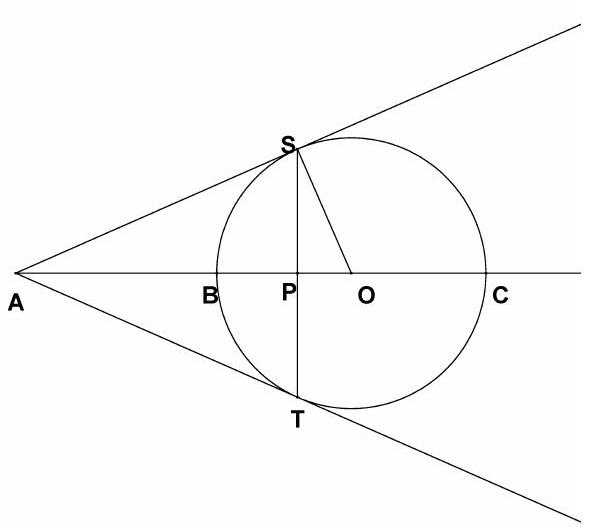 |
| |
| This implies that all the tangent points $S_{1}, T_{1}, S_{2}$ and $T_{2}$ lie on the same circle with center $A$. Let $Q$ be the intersection of $S_{1} T_{1}$ and $S_{2} T_{2}$. Then by applying again the theorem of a power of a point but now with respect to the circle with center A, we have that $Q S_{1} \cdot Q T_{1}=Q S_{2} \cdot Q T_{2}$. But this in turn means that the point $Q$ has the same power with respect to the two circles we started with, and hence lies on the radical axis of those two circles, that is, the line $B C$ (the radical axis is the locus of points of equal power with respect to two given circles). So $Q$ is the intersection of $A C$ and both $S_{1} T_{1}$ and $S_{2} T_{2}$, which proves that the intersection point defined in the problem is the same for both circles. |
| |
| Since the location of $P$ is independent of the circle through $B$ and $C$ we can, without loss of generality, choose the circle with $B C$ as diameter. Let $O$ be the center of this circle, $R$ its radius, $d=A O$, and $r=P O$. Then the triangles $A S O$ and $S P O$ are similar, so $O S / A O=P O / O S$, that is, $R / d=r / R$, or $R^{2}=d r$. Then finally we have |
| |
| $$ |
| \frac{A P}{P C}=\frac{d-r}{R+r}=\frac{d^{2}-d r}{d R+d r}=\frac{d^{2}-{ }^{R} 2}{d r+r^{2}}=\frac{d-R}{R}=2 \cdot \frac{d-R}{2 R}=2 \cdot \frac{A B}{B C} |
| $$ |
| |
| 08.1. Determine all real numbers $A, B$ and $C$ such that there exists a real function $f$ that satisfies |
| |
| $$ |
| f(x+f(y))=A x+B y+C |
| $$ |
| |
| for all real $x$ and $y$. |
| |
| Solution. Let $A, B$ and $C$ be real numbers and $f$ a function such that $f(x+f(y))=$ $A x+B y+C$ for all $x$ and $y$. Let $z$ be a real number and set $x=z-f(0)$ and $y=0$. Then |
| |
| $$ |
| f(z)=f(z-f(0)+f(0))=A(z-f(0))+B \cdot 0+C=A z-A f(0)+C |
| $$ |
| |
| so there are numbers $a$ and $b$ such that $f(z)=a z+b$ for all $z$. Now $f(x+f(g))=$ $a x+a^{2} y+(a+1) b$, and $(A, B, C)=\left(a, a^{2},(a+1) b\right)$, where $a$ and $b$ are arbitrary real numbers, that is, $(A, B, C)=\left(a, a^{2}, c\right)$, where $a \neq-1$ and $c$ are arbitrary, or $(A, B, C)=(-1,1,0)$ |
| |
| 08.2. Assume that $n \geq 3$ people with different names sit around a round table. We call any unordered pair of them, say $M$ and $N$, dominating, if |
| |
| (i) $M$ and $N$ do not sit on adjacent seats, and |
| |
| (ii) on one (or both) of the arcs connecting $M$ and $N$ along the table edge, all people have names that come alphabetically after the names of $M$ and $N$. |
| |
| Determine the minimal number of dominating pairs. |
| |
| Solution. We will show by induction that the number of dominating pairs (hence also the minimal number of dominating pairs) is $n-3$ for $n \geq 3$. If $n=3$, all pairs of people sit on adjacent seats, so there are no dominating pairs. Assume that the number of dominating pairs is $n-3$ for some $n>3$. If there are $n+1$ people around the table, let the person whose name is alphabetically last leave the table. The two people sitting next to that person, who formed a dominating pair, no longer do. On the other hand, any other dominating pair remains a dominating pair in the new configuration of $n$ people, and any dominating pair in the new configuration was also a dominating pair in the old. The number of dominating pairs in the new configuration is $n-3$, so the number in the old was $(n+1)-3$. |
| |
| 08.3. Let $A B C$ be a triangle and let $D$ and $E$ be points on $B C$ and $C A$, respectively, such that $A D$ and $B E$ are angle bisectors of $A B C$. Let $F$ and $G$ be points on the circumcircle of $A B C$ such that $A F$ and $D E$ are parallel and $F G$ and $B C$ are parallel. Show that |
| |
| $$ |
| \frac{A G}{B G}=\frac{A C+B C}{A B+C B} |
| $$ |
| |
| 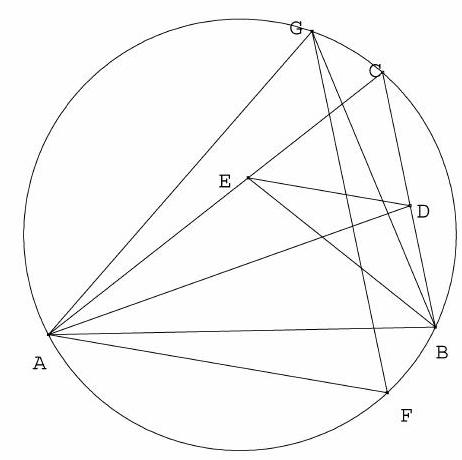 |
| |
| Solution. Let $A B=c, B C=a$ and $C A=b$. Then it follows from the angle bisector theorem that $C D=$ $a b /(b+c)$. Similarly, $C E=a b /(a+c)$, so $C D / C E=(a+c) /(b+c)$. The angles $\angle A B G, \angle A F G$ and $\angle E D C$ are equal, and so are $\angle A G B$ and $\angle A C B$, and consequently, the triangles $C E D$ and $G A B$ are similar. The conclusion follows. |
| |
| 08.4. The difference between the cubes of two consecutive positive integers is a square $n^{2}$, where $n$ is a positive integer. Show that $n$ is the sum of two squares. |
| |
| Solution. Assume that $(m+1)^{3}-m^{3}=n^{2}$. Rearranging, we get $3(2 m+1)^{2}=(2 n+$ $1)(2 n-1)$. Since $2 n+1$ and $2 n-1$ are relatively prime (if they had a common divisor, it would have divided the difference, which is 2 , but they are both odd), one of them is a square (of an odd integer, since it is odd) and the other divided by 3 is a square. An odd number squared minus 1 is divisible by 4 since $(2 t+1)^{2}-1=4\left(t^{2}+t\right)$. From the first equation we see that $n$ is odd, say $n=2 k+1$. Then $2 n+1=4 k+3$, so the square must be $2 n-1$, say $2 n-1=(2 t+1)^{2}$. Rearrangement yields $n=t^{2}+(t+1)^{2}$. (An example: $8^{3}-7^{3}=\left(2^{2}+3^{2}\right)^{2}$. $)$ |
| |
| 09.1. A point $P$ is chosen in an arbitrary triangle. Three lines are drawn through $P$ which are parallel to the sides of the triangle. The lines divide the triangle into three smaller |
| triangles and three parallelograms. Let $f$ be the ratio between the total area of the three smaller triangles and the area of the given triangle. Show that $f \geq \frac{1}{3}$ and determine those points $P$ for which $f=\frac{1}{3}$. |
| |
| Solution. Let $A B C$ be the triangle and let the lines through $P$ parallel to its sides intersect the sides in the points $D, E ; F, G$ and $H, I$. The triangles $A B C$, $D E P, P F G$ and $I P H$ are similar and $B D=I P$, $E C=P F$. If $B C=a, I P=a_{1}, D E=a_{2}$ ja $P F=a_{3}$, then $a_{1}+a_{2}+a_{3}=a$. There is a posi- |
| |
| 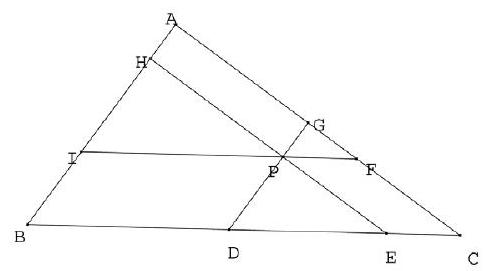 |
| tive $k$ such that the areas of the triangles are $k a^{2}, k a_{1}^{2}$, $k a_{2}^{2}$ and $k a_{3}^{2}$. But then |
|
|
| $$ |
| f=\frac{k a_{1}^{2}+k a_{2}^{2}+k a_{3}^{2}}{k a^{2}}=\frac{a_{1}^{2}+a_{2}^{2}+a_{3}^{2}}{\left(a_{1}+a_{2}+a_{3}\right)^{2}} |
| $$ |
| |
| By the arithmetic-quadratic inequality, |
| |
| $$ |
| \frac{\left(a_{1}+a_{2}+a_{3}\right)^{2}}{9} \leq \frac{a_{1}^{2}+a_{2}^{2}+a_{3}^{2}}{3} |
| $$ |
| |
| where equality holds if and only if $a_{1}=a_{2}=a_{3}$. It is easy to see that $a_{1}=a_{2}=a_{3}$ implies that $P$ is the centroid of $A B C$. So $f \geq \frac{1}{3}$, and $f=\frac{1}{3}$ if and only if $P$ is the centroid of $A B C$. |
| |
| 09.2. On a faded piece of paper it is possible, with some effort, to discern the following: |
| |
| $$ |
| \left(x^{2}+x+a\right)\left(x^{15}-\ldots\right)=x^{17}+x^{13}+x^{5}-90 x^{4}+x-90 |
| $$ |
| |
| Some parts have got lost, partly the constant term of the first factor of the left side, partly the main part of the other factor. It would be possible to restore the polynomial forming the other factor, but we restrict ourselves to asking the question: What is the value of the constant term a? We assume that all polynomials in the statement above have only integer coefficients. |
| |
| Solution. We denote the polynomial $x^{2}+x+a$ by $P_{a}(x)$, the polynomial forming the other factor of the left side by $Q(x)$ and the polynomial on the right side by $R(x)$. The polynomials are integer valued for every integer $x$. For $x=0$ we get $P_{a}(0)=a$ and $R(0)=-90$, so $a$ is a divisor of $90=2 \cdot 3 \cdot 3 \cdot 5$. For $x=-1$ we get $P_{a}(-1)=-184$, so $a$ is also a divisor of $184=2 \cdot 2 \cdot 2 \cdot 23$. But the only prime factor in common is 2 . So the only possibilities for $a$ are $\pm 2$ and $\pm 1$. If $a=1$, we get for $x=1$ that $P_{1}(1)=3$, while $R(1)=4-180=-176$, which cannot be divided by 3 . If $a=-2$ we get for $x=1$ that $P_{2}(1)=0$, i.e. the left side is equal to 0 , while the right side is equal to $R(1)=-176$, which is different from 0 . Neither $a=1$ nor $a=-2$ will thus work. It remains to check $a=2$ and $a=-1$. Before we use the procedure above again, we need a factorization of $R(x)$. We observe that $x^{4}+1$ is a divisor of $R(x)$, since the right side may be written as $\left(x^{4}+1\right)\left(x^{13}+x-90\right)$. If $a=-1$ we get for $x=2$ that $P_{1}(2)=5$, while $x^{4}+1=17$ and $x^{13}+x-90=8104$. So the right hand side is not divisible by 5 . Now, the only remaining possibility is $a=2$, i.e. $x^{2}+x+2$ is a divisor of $R(x)$. |
| |
| 09.3. The integers 1, 2, 3, 4 and 5 are written on a blackboard. It is allowed to wipe out two integers $a$ and $b$ and replace them with $a+b$ and $a b$. Is it possible, by repeating this procedure, to reach a situation where three of the five integers on the blackboard are 2009? |
| |
| Solution. The answer is no. First notice that in each move two integers will be replaced with two greater integers (except in the case where the number 1 is wiped out). Notice also that from the start there are three odd integers. If one chooses to replace two odd integers on the blackboard, the number of odd integers on the blackboard decreases. If one chooses to replace two integers, which are not both odd, the number of odd integers on the blackboard is unchanged. To end up in a situation, where three of the integers on the blackboard are 2009, then it is not allowed in any move to replace two odd integers. Hence the number 2009 can only be obtained as a sum $a+b$. In the first move that gives the integer 2009 on the blackboard, one has to choose $a$ and $b$ such that $a+b=2009$. In this case either $a b>2009$ or $a b=2008$. In the case $a b=2008$, one of the factors is equal to 1 , and hence 1 does no longer appear on the blackboard. The two integers $a+b=2009$ and $a b$ that appears in the creation of the first 2009 cannot be used any more in creation of the remaining two integers of 2009. Also the next 2009 can only be obtained if one chooses c and d such that $c+d=2009$ and $c d>2009$ or $c d=2008$, and in the last case 1 does not appear any longer on the blackboard. The numbers $c+d=2009$ and $c d$ cannot be used in obtaining the last integer 2009. Hence the last integer 2009 cannot be obtained. |
| |
| 09.4. There are 32 competitors in a tournament. No two of them are equal in playing strength, and in a one against one match the better one always wins. Show that the gold, silver, and bronze medal winners can be found in 39 matches. |
| |
| Solution. To determine the gold medalist, we organize 16 pairs and matches, then 8 matches of the winners, 4 matches of the winners, 2 and finally one match, 31 matches altogether. Now the silver medal winner has at some point lost to number 1 ; as there were 5 rounds, there are 5 candidates. Let $C_{i}$ be the candidate who lost to the gold medalist in round $i$. Now let $C_{l}$ and $C_{2}$ play, the winner then play with $C_{3}$ etc. After 4 matches we know the silver medalist; assume she was $C_{k}$. Now the bronze medalist must have lost against the gold medalist or against $C_{k}$ or both. (If she lost to someone else, this someone else was below the second place). Now the silver medalist $C_{k}$ won $k-1$ times in the first rounds and the $5-k$ players $C_{k+1}, \ldots, C_{5}$, and if $\mathrm{k} i 1$ one player $C_{j}$ with $j<k$. So there are either $k-1+5-k=4$ or 5 candidates for the third place. At most 4 matches are again needed to determine the bronze winner. |
| |
| 10.1. A function $f: \mathbb{Z} \rightarrow \mathbb{Z}_{+}$, where $\mathbb{Z}_{+}$is the set of positive integers, is non-decreasing and satisfies $f(m n)=f(m) f(n)$ for all relatively prime positive integers $m$ and $n$. Prove that $f(8) f(13) \geq(f(10))^{2}$. |
| |
| Solution. Since $\mathrm{f}$ is non-decreasing, $f(91) \geq f(90)$, which (by factorization into relatively prime factors) implies $f(13) f(7) \geq f(9) f(10)$. Also $f(72) \geq f(70)$, and therefore $f(8) f(9) \geq f(7) f(10)$. Since all values of $\mathrm{f}$ are positive, we get $f(8) f(9) \cdot f(13) f(7) \geq$ $f(7) f(10) \cdot f(9) f(10)$, and dividing both sides by $f(7) f(9)>0, f(8) f(13) \geq f(l 0) f(10)=$ $(f(10))^{2}$. |
| |
| 10.2. Three circles $\Gamma_{A}, \Gamma_{B}$ and $\Gamma_{C}$ share a common point of intersection $O$. The other common of $\Gamma_{A}$ and $\Gamma_{B}$ is $C$, that of $\Gamma_{A}$ and $\Gamma_{C}$ is $B$ and that of $\Gamma_{C}$ and $\Gamma_{B}$ is $A$. The |
| line $A O$ intersects the circle $\Gamma_{C}$ in the poin $X \neq O$. Similarly, the line $B O$ intersects the circle $\Gamma_{B}$ in the point $Y \neq O$, and the line $C O$ intersects the circle $\Gamma_{C}$ in the point $Z \neq O$. Show that |
| |
| $$ |
| \frac{|A Y||B Z||C X|}{|A Z||B X||C Y|}=1 |
| $$ |
| |
| Solution 1. Let $\angle A O Y=\alpha, \angle A O Z=\beta$ and $\angle Z O B=\gamma$. So $\alpha+\beta+\gamma=180^{\circ}$. Also $\angle B O X=\alpha$ (vertical angles) and $\angle A C Y=\alpha=\angle B C X$ (angles subtending equal arcs); similarly $\angle C O X=\beta$, $\angle A B Z=\beta=\angle C B X ; \angle C O Y=\gamma ; \angle B A Z=\gamma=$ $\angle C A Y$. Each of the triangles $C Y A, C B X$ and $Z B A$ have two angles from the set $\{\alpha, \beta, \gamma\}$. All triangles are then similar. |
| |
| 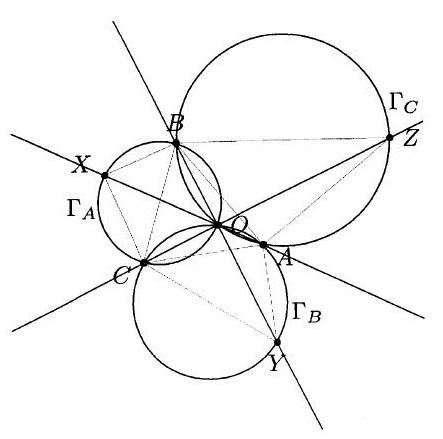 |
| |
| Similarity implies |
| |
| $$ |
| \frac{A Y}{C Y}=\frac{A B}{B Z}, \quad \frac{C X}{B X}=\frac{A Z}{A B} |
| $$ |
| |
| Consequently |
| |
| $$ |
| \frac{A Y}{A Z} \cdot \frac{B Z}{B X} \cdot \frac{C X}{C Y}=\frac{A B}{B Z} \cdot \frac{A Z}{A B} \cdot \frac{B Z}{A Z}=1 |
| $$ |
| |
| Solution 2. Define $\alpha, \beta$ and $\gamma$ as in Solution 1. Let the radii of the circles $\Gamma_{A}, \Gamma_{B}$ and $\Gamma_{C}$ be $R_{A}, R_{B}$ and $R_{C}$, respectively. The sine theorem implies $A Y=2 R_{B} \sin \alpha$, $B Z=2 R_{C} \sin \gamma, C X=2 R_{A} \sin \beta, A Z=2 R_{C} \sin \beta, B X=2 R_{A} \sin \alpha$ and $C Y=2 R_{B} \sin \gamma$. Inserting these in the expression given in the problem one immediately sees that the expression has the value 1 . |
| |
| 10.3. Laura has 2010 lamps connected with 2010 buttons in front of her. For each button, she wants to know the corresponding lamp. In order to do this, she observes which lamps are lit when Richard presses a selection of buttons. (Not pressing anything is also a possible selection.) Richard always presses the buttons simultaneously, so the lamps are lit simultaneously, too. |
| |
| a) If Richard chooses the buttons to be pressed, what is the maximum number of different combinations of buttons he can press until Laura can assign the buttons to the lamps correctly? |
| |
| b) Supposing that Laura will choose the combinations of buttons to be pressed, what is the minimum number of attempts she has to do until she is able to associate the buttons with the lamps in a correct way? |
| |
| Solution. a) Let us say that two lamps are separated, if one of the lamps is turned on while the other lamp remains off. Laura can find out which lamps belong to the buttons if every two lamps are separated. Let Richard choose two arbitrary lamps. To begin with, he turns both lamps on and then varies all the other lamps in all possible ways. There are $2^{2008}$ different combinations for the remaining $2010-2=2008$ lamps. Then Richard turns |
| the two chosen lamps off. Also, at this time there are $2^{2008}$ combinations for the remaining lamps. Consequently, for the $2^{2009}$ combinations in all, it is not possible to separate the two lamps of the first pair. However, we cannot avoid the separation if we add one more combination. Indeed, for every pair of lamps, we see that if we turn on a combination of lamps $2^{2009}+1$ times, there must be at least one setup where exactly one of the lamps is turned on and the other is turned off. Thus, the answer is $2^{2009}+1$. |
| |
| b) For every new step with a combination of lamps turned on, we get a partition of the set of lamps into smaller and smaller subsets where elements belonging to the same subset cannot be separated. In each step every subset is either unchanged or divided into two smaller parts, i.e. the total number of subsets after $\mathrm{k}$ steps will be at most $2^{k}$. We are finished when the number of subsets is equal to 2010 , so the answer is at least $\left\lceil\log _{2} 2010\right\rceil=11$. But it is easy to see that Laura certainly can choose buttons in every step in such a way that there are at most $2^{11-k}$ lamps in every part of the partition after $k$ steps. Thus, the answer is 11 . |
|
|
| 10.4. A positive integer is called simple if its ordinary decimal representation consists entirely of zeroes and ones. Find the least positive integer $k$ such that each positive integer $n$ can be written as $n=a_{1} \pm a_{2} \pm a_{3} \pm \cdots \pm a_{k}$, where $a_{1}, \ldots, a_{k}$ are simple. |
|
|
| Solution. We can always write $n=a_{l}+a_{2}+\cdots+a_{9}$ where $a_{j}$ has 1 's in the places where $n$ has digits greater or equal to $j$ and 0 's in the other places. So $k \leq 9$. To show that $k \geq 9$, consider $n=10203040506070809$. Suppose $n=a_{l}+a_{2}+\cdots+a_{j}-a_{j+l}-a_{j+2}-\cdots-a_{k}$, where $a_{l}, \ldots, a_{k}$ are simple, and $k<9$. Then all digits of $b_{l}=a_{l}+\cdots+a_{j}$ are not greater than $j$ and all digits of $b_{2}=a_{j+l}+\cdots+a_{k}$ are not greater than $k-j$. We have $n+b_{2}=b_{l}$. We perform column addition of $n$ and $b_{2}$ and consider digit $j+1$ in the number $n$. There will be no carry digit coming from lower decimal places, since the sum there is less that $10 \ldots 0+88 \ldots 8=98 \ldots 8$. So in the column of $j+1$ we get the sum of $j+1$ and the corresponding digit in $b_{2}$. The resulting digit should be less than $j+1$. Thus in the corresponding place in $b_{2}$ we have at least $9-j$. But $9-j \leq k-j$, implying $k \geq 9$. Hence, we have proved that the maximal $k$ is 9 . |
| |
| 11.1. When $a_{0}, a_{1}, \ldots, a_{1000}$ denote digits, can the sum of the 1001-digit numbers $a_{0} a_{1} \ldots a_{1000}$ and $a_{1000} a_{999} \ldots a_{0}$ have odd digits only? |
|
|
| Solution. The answer is no. The following diagram illustrates the calculation of the sum digit by digit. |
|
|
| | $a_{0}$ | $a_{1}$ | $\ldots$ | $a_{i}$ | $\ldots$ | $a_{500}$ | $\ldots$ | $a_{1000-i}$ | $\ldots$ | $a_{999}$ | $a_{1000}$ | |
| | :---: | :---: | :---: | :---: | :---: | :---: | :---: | :---: | :---: | :---: | :---: | |
| | $a_{1000}$ | $a_{999}$ | $\ldots$ | $a_{1000-i}$ | $\ldots$ | $a_{500}$ | $\ldots$ | $a_{i}$ | $\ldots$ | $a_{1}$ | $a_{0}$ | |
| | $s_{1000}$ | $s_{999}$ | $\ldots$ | $s_{1000-i}$ | $\ldots$ | $s_{500}$ | $\ldots$ | $s_{i}$ | $\ldots$ | $s_{1}$ | $s_{0}$ | |
| |
| Thus $s_{i}$ are the digits of the sum. The digit $s_{\text {lool }}$ may be absent. We call column $i$ the column in the diagram with the digit $s_{i}$. Assume that $s_{i}$ is odd for $i=0,1, \ldots, 1000$. By induction on $i$ we prove that $a_{2 i}+a_{\text {looo }-2 i}$ is odd for $i=0,1, \ldots, 250$. This implies that $a_{2.250}+a_{l 000-2.250}=2 a_{500}$ is odd, which is a contradiction. Here is the proof: Since $s_{0}$ is odd, $a_{0}+a_{1000}$ is odd, so the statement is true for $\mathrm{i}=0$. Assume that $a_{2 i}+a_{1000-2 i}$ is odd for some $i \in\{0,1, \ldots, 224\}$. Since $s_{1000-2 i}$ is odd and $a_{2 i}+a_{1000-2 i}$ is odd, there is no |
| carry in column $1000-2 i$, so $a_{2 i+1}+a_{1000-(2 i+1)} \leq 9$. But then because $s_{2 i+1}$ is odd and $a_{2 i+1}+a_{1000-(2 i+1)} \leq 9$, there is no carry in column $2 i+2$. Hence $a_{2 i+2}+a_{1000-(2 i+2)}$ is odd because $s_{2 i+2}$ is odd. This completes the induction step. |
|
|
| 11.2. In a triangle $A B C$ assume $A B=A C$, and let $D$ and $E$ be points on the extension of segment $B A$ beyond $A$ and on the segment $B C$, respectively, such that the lines $C D$ and $A E$ are parallel. Prove that $C D \geq \frac{4 h}{B C} C E$, where $h$ is the height from $A$ in triangle ABC. When does equality hold? |
|
|
| Solution. Because $A E \| D C$, the triangles $A B E$ and $D B C$ are similar. So |
|
|
| $$ |
| C D=\frac{B C}{B E} \cdot A E |
| $$ |
|
|
| $\mathrm{ja}$ |
|
|
| $$ |
| C D=\frac{A E \cdot B C}{B E \cdot C E} \cdot C E |
| $$ |
|
|
| 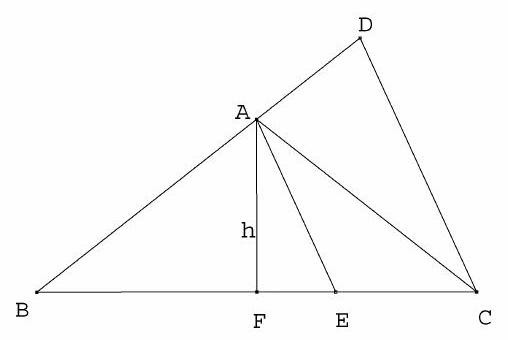 |
|
|
| Let $A F$ be an altitude of $A B C$. Then $A E \geq A F=h$, and equality holds if and only if $E=F$. Because $A B C$ is isosceles, $F$ is the midpoint of $B C$. The arithmetic-geometric mean inequality yields |
|
|
| $$ |
| B E \cdot C E \leq\left(\frac{B E+E C}{2}\right)^{2}=\left(\frac{B C}{2}\right)^{2} |
| $$ |
|
|
| and equality holds if and only if $E$ is the midpoint of $B C$ i.e. $E=F$. The conclusion folows when these estimates are inserted in (1); furthermore, equality is equivalent to $E=F$ |
|
|
| 11.3. Find all functions $f$ such that |
|
|
| $$ |
| f(f(x)+y)=f\left(x^{2}-y\right)+4 y f(x) |
| $$ |
|
|
| for all real numbers $x$ and $y$. |
|
|
| Solution. Substituting $y=x^{2}$ yields $f\left(f(x)+x^{2}\right)=f(0)+4 x^{2} f(x)$ for all real $x$. And $y=-f(x)$ gives $f(0)=f\left(x^{2}+f(x)\right)-4 f(x)^{2}$ for all $x$. Combining these two equations gives $4 f(x)^{2}=4 x^{4} f(x)$, so for each $x$ either $f(x)=0$ or $f(x)=x^{2}$. In particular $f(0)=0$. Now suppose there exists a real number $a \neq 0$ such that $f(a) \neq 0$. Then $f(a)=a^{2}$ and $f\left(a^{2}+y\right)=f\left(a^{2}-y\right)+4 y a^{2}$ for all $y$. If $f\left(a^{2}-y\right)=0$ for some $y \neq 0$, then $f\left(a^{2}+y\right)=4 y a^{2} \neq 0$, so $f\left(a^{2}+y\right)=\left(a^{2}+y\right)^{2}$ must hold and then $\left(a^{2}+y\right)^{2}=4 y a^{2}$, which yields $\left(a^{2}-y\right)^{2}=0$, or $a^{2}-y=0$. This shows that if $f(a) \neq 0$ for some $a$ then $f(x)=0$ only when $x=0$. So either $f(x)=0$ for all $x$ or $f(x)=x^{2}$ for all $x$. It can easily be verified that these two functions are indeed solutions to the given equation. |
|
|
| 11.4. Show that for any integer $n \geq 2$ the sum of the fractions $\frac{1}{a b}$, where $a$ and $b$ are relatively prime positive integers such that $a<b \leq n$ and $a+b>n$, equals $\frac{1}{2}$. |
|
|
| Solution. We prove this by induction. First observe that the statement holds for $n=2$, because $a=1$ and $b=2$ are the only numbers which satisfy the conditions. Next we show that increasing $n$ by 1 does not change the sum, so it remains equal to $\frac{1}{2}$. To that end it suffices to show that the sum of the terms removed from the sum equals the sum of the new terms added. All the terms in the sum for $n-1$ remain in the sum for $n$ except the fractions $\frac{1}{a b}$ with $a$ and $b$ relatively prime, $0<a<b \leq_{n}$ and $a+b=n$. On the other hand the new fractions added to the sum for $n$ have the form $\frac{1}{a n}$ with $0<a<n$. So it suffices to show |
| |
| $$ |
| \sum_{\substack{0<a<n / 2 \\(a, n-a)=1}} \frac{1}{n(a-n)}=\sum_{\substack{0<a<n \\(a, n)=1}} \frac{1}{a n} |
| $$ |
| |
| (We denote the greatest common factor of $x$ and $y$ by $(x, y)$.) Since $(a, n)=(n-a, n)$, the terms in the sum on the right hand side can be grouped into pairs |
| |
| $$ |
| \frac{1}{a n}+\frac{1}{(n-a) n}=\frac{(n-a)+a}{a(n-a) n}=\frac{1}{a(n-a)} |
| $$ |
| |
| No term is left out because if $\mathrm{n}$ is even and greater than 2 then $(n / 2, n)=\frac{n}{2}>1$. So the right hand side is given by |
|
|
| $$ |
| \sum_{\substack{0<a<n \\(a, n)=1}} \frac{1}{a n}=\sum_{\substack{0<a<n / 2 \\(a, n)=1}} \frac{1}{a(n-a)}=\sum_{\substack{0<a<n / 2 \\(a, n-a)=1}} \frac{1}{a(n-a)} |
| $$ |
| |
| which is what we had to prove. |
| |
| |


