


Solutions NMC 2018
Solution to problem 1
It is clear that $2 k$ lines do not suffice, as the two rays parallel to any fixed line intersect a total of $2 k-1$ lines, so one intersects at most $k-1$. We shall show that $2 k+1$ lines are sufficient.
Let $P$ be at the origin. Given an angle $v$, let $s(v)$ denote the ray from $P$ that intersects the unit circle at the point $(\cos v, \sin v)$. For each angle $v_{i}$ and each $\epsilon>0$, by drawing two "almost parallel" lines on each side of $P$ guarantee that all rays from $P$ that are not $s(v)$ for some $v_{i} \leq v \leq v_{i}+\epsilon$ intersect at least one of these two lines. If we for example choose $v_{i}=2 i \epsilon$ and $\epsilon$ sufficiently small, we may see that $\left[v_{i}, v_{i}+\epsilon\right], i \in{1, \ldots, k}$ are pairwise disjoint and $0<v_{i}<\pi-\epsilon$. We then have $2 k$ lines with the property that each $s(v), 0<v<\pi$, intersects at least $k-1$ lines and each $s(v), \pi \leq v \leq 2 \pi$, intersects $k$ lines. Now add the line that is tangent to the unit circle at $(0,1)$ and we have $2 k+1$ lines with the required properties.
An alternative description is as follows. Pick any line that does not go through $P$, and call it $\ell$. Then choose points $Q_{1}, Q_{2}, \ldots, Q_{2 k}$ on $\ell$ so that they appear in this order. For each $1 \leq j \leq k$, choose a point $S_{j}$ so that the triangle $Q_{2 j-1} Q_{2 j} S_{j}$ contains $P$ in its interior. Our remaining $k$ lines are then going to be $Q_{2 j-1} S_{j}$ and $Q_{2 j} S_{j}$ with $1 \leq j \leq k$. Note that for any ray $s$ from $P$ and index $j$, the ray $s$ intersects at least one of the lines $Q_{2 j-1} S_{j}$ and $Q_{2 j} S_{j}$ unless it intersects the segment $Q_{2 j-1} Q_{2 j}$. Since these segments are pairwise disjoint, this may happen at most once, in which case $\ell$ provides the $k$-th intersection.
Solution to problem 2
First we prove that $p_{n+2} \leq \max \left(p_{n}, p_{n}+1\right)+2020$ for all positive integers $n$. Assume that $p_{n}, p_{n+1}>2$. Then $p_{n}+p_{n+1}+2018$ is even, og and hence
If $p_{n}$ or $p_{n+1}$ is 2 , then
Choose $m$ such that $M=m \cdot 2021$ ! is greater than both $p_{1}$ and $p_{2}$. Now $M+2, M+3, \ldots, M+2021$ are 2020 consecutive integers and none of which are primes. By induction it follows that all primes of the sequnce are less than or equal to $M+1$ :
By construction $p_{1}$ and $p_{2}$ are less than $M+1$. Assume that $p_{1}, p_{2}, \ldots, p_{n+1}$ all are less than or equal to $M+1$ for some $n \geq 1$. Then
Since $p_{n+2}$ is a prime, and none of the integers $M+2, M+3, \ldots, M+2021$ are primes, we conclude $p_{n+2} \leq M+1$.
Hence the sequence only contains finitely many primes.
Solution to problem 3
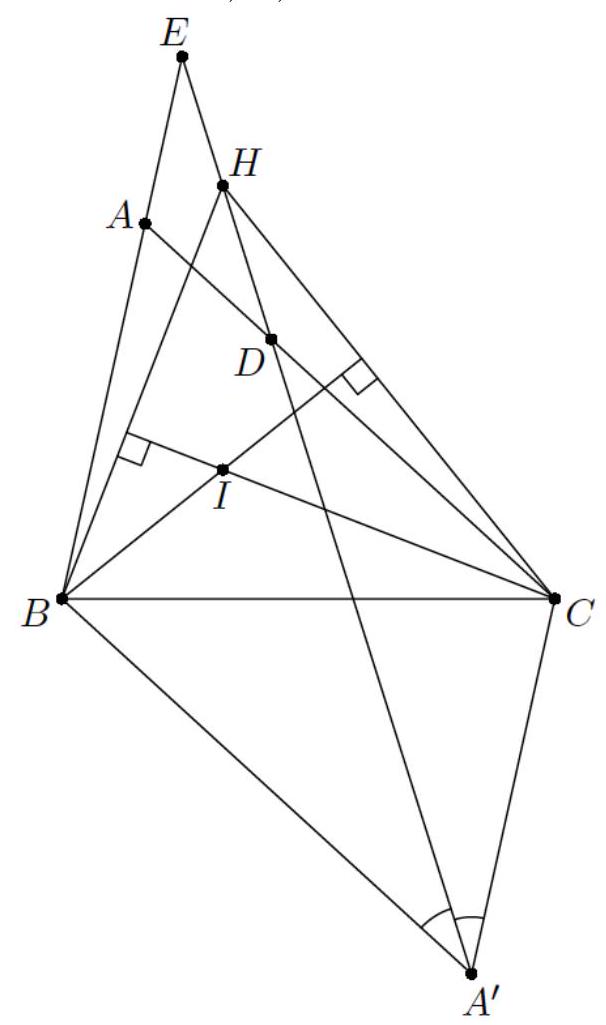
Let the point $A^{\prime}$ be such that $A B A^{\prime} C$ is a parallelogram with $A B | A^{\prime} C$ and $A C | A^{\prime} B$. Denote $\alpha=\angle B A C=\angle C A^{\prime} B$.
Since $C D=A B=C A^{\prime}$, we find that $C D A^{\prime}$ is an isosceles triangle. As $\angle D C A^{\prime}=180^{\circ}-\alpha$, we deduce that $\angle A^{\prime} D C=\angle C A^{\prime} D=\frac{\alpha}{2}$, so that $D$ lies on the angle bisector $\ell$ of $\angle C A^{\prime} B$. Similarly $E$ lies on $\ell$.
Next notice that $\angle C B H=90^{\circ}-\angle B C I=90^{\circ}-\frac{1}{2} \angle B C A=90^{\circ}-\frac{1}{2} \angle A^{\prime} B C$, so $B H$ is the exterior angle bisector of $\angle A^{\prime} B C$. Similarly $C H$ is the exterior angle bisector of $\angle A^{\prime} C B$, so $H$ is in fact the excenter of triangle $A^{\prime} B C$ opposite $A^{\prime}$. Therefore we conclude that $D, E$, and $H$ all lie on $\ell$.
Solution to problem 4
Introducing new variables $X=x-y, Y=y-z$, we may write $f$ as $A_{1}(X, Y, z) X+$ $B_{1}(X, Y, z) Y+c(z)$. To see this, note that this transformation is invertible, i.e., we can express the original variables as polynomials of the new ones: $x=X+Y+z$ and $y=Y+z$, and plugging in yields a polynomial in the three variables $X, Y, z$. Then we group the terms in the new expression with those having a factor $X$ in the first group, among the remaining ones, those containing a factor $Y$ in the second, and the rest in the third group. This yields the desired expression (note that we have some freedom as to where we want to put terms with factor XY).
Alternatively, we may consider $f$ as a polynomial in one variable, $x$, and with $y, z$ as parameters. Then performing a polynomial division with $x-y$, we obtain $f(x, y, z)=g(x, y, z) \cdot(x-y)+r(x, y, z)$. Note that $r$ has to have degree zero as a polynomial in $x$, so in fact $r(x, y, z)=r(y, z)$. Now repeat this with $r$ as a polynomial in $y$ with parameter $z$, divided by $y-z$. This yields the same result as the above approach.
Thus $f=A_{2}(x, y, z)(x-y)+B_{2}(x, y, z)(y-z)+c(z)$. Since $f(w, w, w)=0$, we obtain $c(w)=0$ for all $w$, that is $c(z)=0$. Let $C(x, y, z)=-\frac{A_{2}+B_{2}}{3}, A=$ $A_{2}+C, B=B_{2}+C$. Then $A+B+C=A_{2}+B_{2}+3 C=A_{2}+B_{2}-\left(A_{2}+B_{2}\right)=0$, and
The representation is never unique. To show this, it is by additivity enough to show that the representation is not unique for the zero polynomial. Let
where $A+B+C=A \cdot(x-y)+B \cdot(y-z)+C \cdot(z-x)=0$, showing that 0 has two different representations (the other being the trivial one).