| # The 33rd Nordic Mathematical Contest <br> Monday, April 1st, 2019 <br> English version |
|
|
| Time allowed: 4 hours. Each problem is worth 7 points. |
|
|
| Only writing and drawing tools are allowed. |
|
|
| Problem 1 A set of different positive integers is called meaningful if for any finite nonempty subset the corresponding arithmetic and geometric means are both integers. |
|
|
| a) Does there exist a meaningful set which consists of 2019 numbers? |
|
|
| b) Does there exist an infinite meaningful set? |
|
|
| Note: The geometric mean of the non-negative numbers $a_{1}, a_{2}, \ldots, a_{n}$ is defined as $\sqrt[n]{a_{1} a_{2} \cdots a_{n}}$ |
|
|
| Problem 2 Let $a, b, c$ be the side lengths of a right angled triangle with $c>a, b$. |
|
|
| Show that |
|
|
| $$ |
| 3<\frac{c^{3}-a^{3}-b^{3}}{c(c-a)(c-b)} \leq \sqrt{2}+2 |
| $$ |
|
|
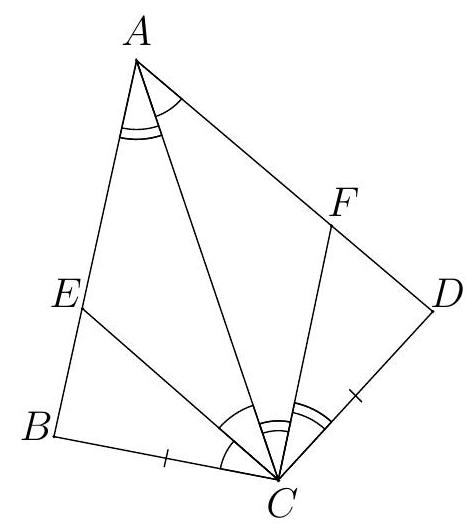
| Problem 3 The quadrilateral $A B C D$ satisfies $\angle A C D=2 \angle C A B, \angle A C B=2 \angle C A D$ and $C B=C D$. |
|
|
| Show that $\angle C A B=\angle C A D$. |
|
|
| Problem 4 Let $n$ be an integer with $n \geq 3$ and assume that $2 n$ vertices of a regular $(4 n+1)$-gon are coloured. Show that there must exist three of the coloured vertices forming an isosceles triangle. |
|
|
| Solution 1 a) Notice that $\left\{2019!\cdot 1^{2019!}, 2019!\cdot 2^{2019!}, \ldots, 2019!\cdot 2019^{2019!}\right\}$ is such a set. Observe that if all the elements are divisible by 2019! then the arithmetic means will be integer for all the subsets. Also, if $A$ is a set such that the geometric means are integer for all non-empty subsets and the set $B$ is obtained from the set $A$ by multiplying each element with with a given integer $c$ then all the non-empty subsets of $B$ will have an integer geometric mean, since |
|
|
| $$ |
| \sqrt[k]{c a_{i_{1}} c a_{i_{2}} \cdots c a_{i_{k}}}=c \sqrt[k]{a_{i_{1}} a_{i_{2}} \cdots a_{i_{k}}} |
| $$ |
|
|
| It is thus sufficient to find a set of 2019 positive integers such that the geometric mean of every non-empty subset in an integer. Now, for an integer $a$ the number $\sqrt[k]{a^{2019!}}=a^{\frac{2019!}{k}}$ for all integers $1 \leq k \leq 2019$ so $\left\{1^{2019!}, 2^{2019!}, \ldots, 2019^{2019!}\right\}$ is a set such that the geometric mean of every non-empty subset is an integer. |
|
|
| b) Assume there exist such a set $A$ and let $n, m, a_{1}, a_{2}, \ldots, a_{m-1}$ be distinct elements in $A$ with $n<m$. Then $\frac{n+a_{1}+a_{2}+\cdots+a_{m-1}}{m}$ and $\frac{m+a_{1}+a_{2}+\cdots+a_{m-1}}{m}$ are integers and also their difference |
| |
| $$ |
| \frac{m+a_{1}+a_{2}+\cdots+a_{m-1}}{m}-\frac{n+a_{1}+a_{2}+\cdots+a_{m-1}}{m}=\frac{m-n}{m} |
| $$ |
| |
| Therefore, we have $\frac{n}{m}$ is an integer and since $m$ and $n$ are positive integers we have $m \leq n$ which is a contradiction. |
| |
| Solution 2 Observe that |
| |
| $$ |
| \begin{gathered} |
| c^{3}-a^{3}-b^{3}=c a^{2}+c b^{2}-a^{3}-b^{3}=a^{2}(c-a)+b^{2}(c-b)= \\ |
| \left(c^{2}-b^{2}\right)(c-a)+\left(c^{2}-b^{2}\right)(c-b)=(c-a)(c-b)(c+a+c+b) |
| \end{gathered} |
| $$ |
| |
| Therefore, it is equivalent to prove that |
| |
| $$ |
| c<a+b \leq \sqrt{2} c |
| $$ |
| |
| The left inequality we get from the triangle inequality and the right inequality we get from |
| |
| $$ |
| a+b \leq \sqrt{2} c \Leftrightarrow(a+b)^{2} \leq 2 c^{2}=2 a^{2}+2 b^{2} \Leftrightarrow 0 \leq(a-b)^{2} |
| $$ |
| |
| Solution 3 Let the angle bisectors from angle $C$ in triangle $A C B$ and $A C D$ intersect $A B$ and $A D$ in points $E$ and $F$ respectively. From $\angle A C E=\angle C A D$ it follows that $C E$ and $A D$ are parallel. Similarly $C F$ and $A B$ are parallel. Hence $A E C F$ is a parallelogram. From this it follows that $\angle B E C=\angle B A D=\angle C F D$. |
| |
|  |
| |
| The angle bisector theorem yields |
| |
| $$ |
| \frac{B E}{C F}=\frac{B E}{A E}=\frac{C B}{C A}=\frac{C D}{C A}=\frac{D F}{A F}=\frac{D F}{C E} |
| $$ |
| |
| which gives |
| |
| $$ |
| |B E| \cdot|C E|=|D F| \cdot|C F| \text {. } |
| $$ |
| |
| By the sine area formula we obtain that $B C E$ have $D C F$ have equal area. Hence triangles $B C A$ and $D C A$ also have equal areal. By the sine area formula we now get |
| |
| $$ |
| \sin (\angle A C B)=\sin (\angle D C A) |
| $$ |
| |
| Since $A B C D$ is a quadrilateral, $\angle A C B+\angle D C A \neq 180$ and hence we conclude from the above that $\angle C A B=\angle C A D$. |
| |
| Solution 4 Assume that it is possible to color $2 n$ of the vertices of a $4 n+1$-gon such that there are no three colored vertices forming an isosceles triangle. Enumerate the vertices consecutively as $H_{-2 n}, H_{-2 n+1}, \ldots, H_{0}, H_{1}, H_{2}, \ldots, H_{2 n}$ and consider first the case where there are two colored neighboring vertices. Assume wlog that the vertices $H_{0}$ and $H_{1}$ are colored. Then at most one of the vertices $H_{-i}$ and $H_{i}$ are colored for all $i=1,2, \ldots, 2 n$ since these form an isosceles triangle with $H_{0}$. Similarly at most one of $H_{-i}$ and $H_{i+2}$ are colored for all $i=1,2, \ldots, 2 n-2$, and at most one of $H_{-(2 n-1)}$ and $H_{-2 n}$ are colored since these form an isosceles triangles with $H_{1}$. The three vertices $H_{0}, H_{1}, H_{i}, i=2,-1,-2 n$ also form isoceles triangles and hence $H_{-1}, H_{2}, H_{-2 n}$ are not colored. It follows that no consecutive vertices in the two strings |
| |
| $$ |
| \begin{array}{r} |
| H_{-2}-H_{4}-H_{-4}-H_{6}-\ldots-H_{2 n-2}-H_{-(2 n-2)}-H_{2 n} \\ |
| H_{3}-H_{-3}-H_{5}-H_{-5}-\ldots-H_{2 n-1}-H_{-(2 n-1)} |
| \end{array} |
| $$ |
| |
| are colored. Since each string contains an even amount of vertices, at most half of each string are colored and this is obtained only when every second vertex is colored in each string. By counting we see that each string contains $2 n-2$ vertices and we conclude that every second vertex is colored in each string. Because $n \geq 3$ at least one of the isoceles |
| triangles $H_{0} H_{-2} H_{-4}, H_{1} H_{3} H_{5}$ or $H_{2 n-2} H_{2 n} H_{-(2 n-1)}$ must be colored. Hence there are no colored neighboring vertices. |
| |
| If there are no colored neighboring vertices we can assume wlog that $H_{i}$ is colored for all odd $i$, but then $H_{1} H_{3} H_{5}$ is an isosceles colored triangle. Hence we have a contradiction, showing that there must neccesarily exists 3 colored vertices forming an isosceles triangle. |
| |
| |


