


APMO 2004 - Problems and Solutions
Problem 1
Determine all finite nonempty sets $S$ of positive integers satisfying
where $(i, j)$ is the greatest common divisor of $i$ and $j$. Answer: $S={2}$.
Solution
Let $k \in S$. Then $\frac{k+k}{(k, k)}=2$ is in $S$ as well. Suppose for the sake of contradiction that there is an odd number in $S$, and let $k$ be the largest such odd number. Since $(k, 2)=1, \frac{k+2}{(k, 2)}=k+2>k$ is in $S$ as well, a contradiction. Hence $S$ has no odd numbers. Now suppose that $\ell>2$ is the second smallest number in $S$. Then $\ell$ is even and $\frac{\ell+2}{(\ell, 2)}=\frac{\ell}{2}+1$ is in $S$. Since $\ell>2 \Longrightarrow \frac{\ell}{2}+1>2, \frac{\ell}{2}+1 \geq \ell \Longleftrightarrow \ell \leq 2$, a contradiction again. Therefore $S$ can only contain 2 , and $S={2}$ is the only solution.
Problem 2
Let $O$ be the circumcentre and $H$ the orthocentre of an acute triangle $A B C$. Prove that the area of one of the triangles $\mathrm{AOH}, \mathrm{BOH}$ and COH is equal to the sum of the areas of the other two.
Solution 1
Suppose, without loss of generality, that $B$ and $C$ lies in the same side of line $O H$. Such line is the Euler line of $A B C$, so the centroid $G$ lies in this line.
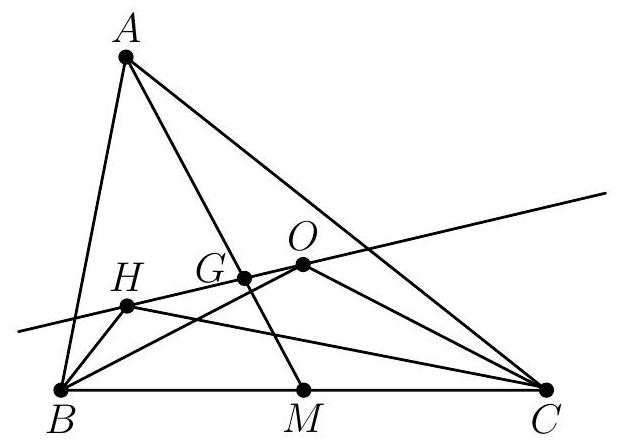
Let $M$ be the midpoint of $B C$. Then the distance between $M$ and the line $O H$ is the average of the distances from $B$ and C to OH , and the sum of the areas of triangles BOH and COH is
Since $A G=2 G M, d(A, O H)=2 d(M, O H)$. Hence
and the result follows.
Solution 2
One can use barycentric coordinates: it is well known that
Then the (signed) area of $A O H$ is proportional to
Adding all three expressions we find that the sum of the signed sums of the areas is a constant times
By multilinearity of the determinant, this sum equals
which contains, in its rows, the coordinates of the centroid, the circumcenter, and the orthocenter. Since these three points lie in the Euler line of $A B C$, the signed sum of the areas is 0 , which means that one of the areas of $A O H, B O H, C O H$ is the sum of the other two areas. Comment: Both solutions can be adapted to prove a stronger result: if the centroid $G$ of triangle $A B C$ belongs to line $X Y$ then one of the areas of triangles $A X Y, B X Y$, and $C X Y$ is equal to the sum of the other two.
Problem 3
Let a set $S$ of 2004 points in the plane be given, no three of which are collinear. Let $\mathcal{L}$ denote the set of all lines (extended indefinitely in both directions) determined by pairs of points from the set. Show that it is possible to colour the points of $S$ with at most two colours, such that for any points $p, q$ of $S$, the number of lines in $\mathcal{L}$ which separate $p$ from $q$ is odd if and only if $p$ and $q$ have the same colour. Note: A line $\ell$ separates two points $p$ and $q$ if $p$ and $q$ lie on opposite sides of $\ell$ with neither point on $\ell$.
Solution
Choose any point $p$ from $S$ and color it, say, blue. Let $n(q, r)$ be the number of lines from $\mathcal{L}$ that separates $q$ and $r$. Then color any other point $q$ blue if $n(p, q)$ is odd and red if $n(p, q)$ is even.
Now it remains to show that $q$ and $r$ have the same color if and only if $n(q, r)$ is odd for all $q \neq p$ and $r \neq p$, which is equivalent to proving that $n(p, q)+n(p, r)+n(q, r)$ is always odd. For this purpose, consider the seven numbered regions defined by lines $p q$, $p r$, and $q r$ :
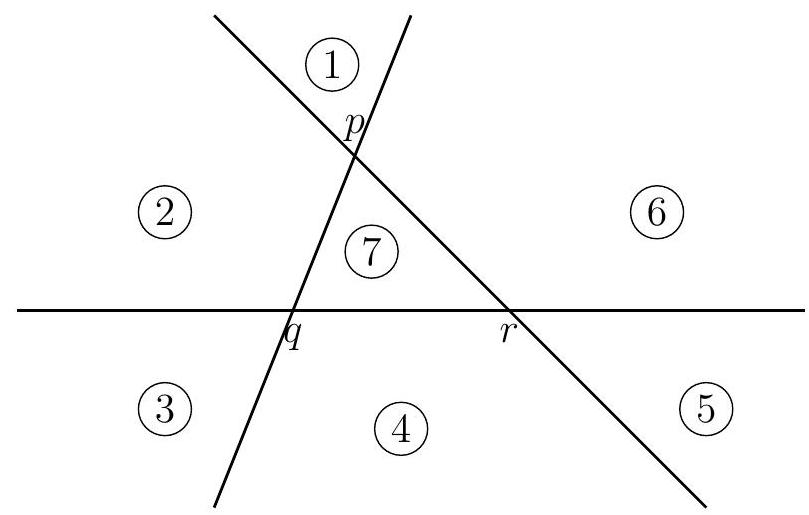
Any line that do not pass through any of points $p, q, r$ meets the sides $p q, q r, p r$ of triangle $p q r$ in an even number of points (two sides or no sides), so these lines do not affect the parity of $n(p, q)+n(p, r)+n(q, r)$. Hence the only lines that need to be considered are the ones that pass through one of vertices $p, q, r$ and cuts the opposite side in the triangle $p q r$. Let $n_{i}$ be the number of points in region $i, p, q$, and $r$ excluded, as depicted in the diagram. Then the lines through $p$ that separate $q$ and $r$ are the lines passing through $p$ and points from regions 1,4 , and 7 . The same applies for $p, q$ and regions 2,5 , and 7 ; and $p, r$ and regions 3,6 , and 7. Therefore
and the result follows. Comment: The problem statement is also true if 2004 is replaced by any even number and is not true if 2004 is replaced by any odd number greater than 1.
Problem 4
For a real number $x$, let $\lfloor x\rfloor$ stand for the largest integer that is less than or equal to $x$. Prove that
is even for every positive integer $n$.
Solution
Consider four cases:
- $n \leq 5$. Then $\left\lfloor\frac{(n-1)!}{n(n+1)}\right\rfloor=0$ is an even number.
- $n$ and $n+1$ are both composite (in particular, $n \geq 8$ ). Then $n=a b$ and $n+1=c d$ for $a, b, c, d \geq 2$. Moreover, since $n$ and $n+1$ are coprime, $a, b, c, d$ are all distinct and smaller than $n$, and one can choose $a, b, c, d$ such that exactly one of these four numbers is even. Hence $\frac{(n-1)!}{n(n+1)}$ is an integer. As $n \geq 8>6,(n-1)!$ has at least three even factors, so $\frac{(n-1)!}{n(n+1)}$ is an even integer.
- $n \geq 7$ is an odd prime. By Wilson's theorem, $(n-1)!\equiv-1(\bmod n)$, that is, $\frac{(n-1)!+1}{n}$ is an integer, as $\frac{(n-1)!+n+1}{n}=\frac{(n-1)!+1}{n}+1$ is. As before, $\frac{(n-1)!}{n+1}$ is an even integer; therefore $\frac{(n-1)!+n+1}{n+1}=\frac{(n-1)!}{n+1}+1$ is an odd integer. Also, $n$ and $n+1$ are coprime and $n$ divides the odd integer $\frac{(n-1)!+n+1}{n+1}$, so $\frac{(n-1)!+n+1}{n(n+1)}$ is also an odd integer. Then
is even.
- $n+1 \geq 7$ is an odd prime. Again, since $n$ is composite, $\frac{(n-1)!}{n}$ is an even integer, and $\frac{(n-1)!+n}{n}$ is an odd integer. By Wilson's theorem, $n!\equiv-1(\bmod n+1) \Longleftrightarrow(n-1)!\equiv 1$ $(\bmod n+1)$. This means that $n+1$ divides $(n-1)!+n$, and since $n$ and $n+1$ are coprime, $n+1$ also divides $\frac{(n-1)!+n}{n}$. Then $\frac{(n-1)!+n}{n(n+1)}$ is also an odd integer and
is even.
Problem 5
Prove that
for all real numbers $a, b, c>0$.
Solution 1
Let $p=a+b+c, q=a b+b c+c a$, and $r=a b c$. The inequality simplifies to
Since $a^{2} b^{2}+b^{2} c^{2}+c^{2} a^{2}=q^{2}-2 p r$ and $a^{2}+b^{2}+c^{2}=p^{2}-2 q$,
which simplifies to
Bearing in mind that equality occurs for $a=b=c=1$, which means that, for instance, $p=3 r$, one can rewrite $(I)$ as
Since $(a b-b c)^{2}+(b c-c a)^{2}+(c a-a b)^{2} \geq 0$ is equivalent to $q^{2} \geq 3 p r$, rewrite $(I I)$ as
Finally, $a=b=c=1$ implies $q=3$; then rewrite (III) as
This final inequality is true because $q^{2} \geq 3 p r$ and $p^{2}-3 q=\frac{1}{2}\left[(a-b)^{2}+(b-c)^{2}+(c-a)^{2}\right] \geq 0$.
Solution 2
We prove the stronger inequality
which implies the proposed inequality because $(a+b+c)^{2} \geq 3(a b+b c+c a)$ is equivalent to $(a-b)^{2}+(b-c)^{2}+(c-a)^{2} \geq 0$, which is immediate. The inequality $(*)$ is equivalent to
Seeing this inequality as a quadratic inequality in $a$ with positive leading coefficient $\left(b^{2}+2\right)\left(c^{2}+\right.$ 2) $-3=b^{2} c^{2}+2 b^{2}+2 c^{2}+1$, it suffices to prove that its discriminant is non-positive, which is equivalent to
This simplifies to
Now we look $(* *)$ as a quadratic inequality in $b$ with negative leading coefficient $-2 c^{2}-1$ :
If suffices to show that the discriminant of $(* *)$ is non-positive, which is equivalent to
It simplifies to $-2\left(c^{2}-1\right)^{2} \leq 0$, which is true. The equality occurs for $c^{2}=1$, that is, $c=1$, for which $b=\frac{6 c}{2\left(2 c^{2}+1\right)}=1$, and $a=\frac{6(b+c)}{2\left(\left(b^{2}+2\right)\left(c^{2}+2\right)-3\right)}=1$.
Solution 3
Let $A, B, C$ angles in $(0, \pi / 2)$ such that $a=\sqrt{2} \tan A, b=\sqrt{2} \tan B$, and $c=\sqrt{2} \tan C$. Then the inequality is equivalent to
Substituting $\sec x=\frac{1}{\cos x}$ for $x \in{A, B, C}$ and clearing denominators, the inequality is equivalent to
Since
we rewrite our inequality as
The cosine function is concave down on $(0, \pi / 2)$. Therefore, if $\theta=\frac{A+B+C}{3}$, by the AM-GM inequality and Jensen's inequality,
Therefore, since $\cos A \cos B \cos C-\cos (A+B+C)=\sin A \sin B \cos C+\cos A \sin B \sin C+$ $\sin A \cos B \sin C>0$, and recalling that $\cos 3 \theta=4 \cos ^{3} \theta-3 \cos \theta$, $\cos A \cos B \cos C(\cos A \cos B \cos C-\cos (A+B+C)) \leq \cos ^{3} \theta\left(\cos ^{3} \theta-\cos 3 \theta\right)=3 \cos ^{4} \theta\left(1-\cos ^{2} \theta\right)$. Finally, by AM-GM (notice that $1-\cos ^{2} \theta=\sin ^{2} \theta>0$ ), $3 \cos ^{4} \theta\left(1-\cos ^{2} \theta\right)=\frac{3}{2} \cos ^{2} \theta \cdot \cos ^{2} \theta\left(2-2 \cos ^{2} \theta\right) \leq \frac{3}{2}\left(\frac{\cos ^{2} \theta+\cos ^{2} \theta+\left(2-2 \cos ^{2} \theta\right)}{3}\right)^{3}=\frac{4}{9}$, and the result follows.