


Algebra
A-1 DEN
The real numbers $x_{1}, \ldots, x_{2011}$ satisfy
where $x_{1}^{\prime}, x_{2}^{\prime}, \ldots, x_{2011}^{\prime}$ is a permutation of $x_{1}, x_{2}, \ldots, x_{2011}$. Prove that $x_{1}=x_{2}=\cdots=x_{2011}$.
Solution 1 For convenience we call $x_{2011}$ also $x_{0}$. Let $k$ be the largest of the numbers $x_{1}, \ldots, x_{2011}$, and consider an equation $x_{n-1}+x_{n}=2 k$, where $1 \leq n \leq 2011$. Hence we get $2 \max \left(x_{n-1}, x_{n}\right) \geq x_{n-1}+x_{n}=2 k$, so either $x_{n-1}$ or $x_{n}$, say $x_{n-1}$, satisfies $x_{n-1} \geq k$. Since also $x_{n-1} \leq k$, we then have $x_{n-1}=k$, and then also $x_{n}=2 k-x_{n-1}=2 k-k=k$. That is, in such an equation both variables on the left equal $k$. Now let $\mathcal{E}$ be the set of such equations, and let $\mathcal{S}$ be the set of subscripts on the left of these equations. From $x_{n}=k \forall n \in \mathcal{S}$ we get $|\mathcal{S}| \leq|\mathcal{E}|$. On the other hand, since the total number of appearances of these subscripts is $2|\mathcal{E}|$ and each subscript appears on the left in no more than two equations, we have $2|\mathcal{E}| \leq 2|\mathcal{S}|$. Thus $2|\mathcal{E}|=2|\mathcal{S}|$, so for each $n \in \mathcal{S}$ the set $\mathcal{E}$ contains both equations with the subscript $n$ on the left. Now assume $1 \in \mathcal{S}$ without loss of generality. Then the equation $x_{1}+x_{2}=2 k$ belongs to $\mathcal{E}$, so $2 \in \mathcal{S}$. Continuing in this way we find that all subscripts belong to $\mathcal{S}$, so $x_{1}=x_{2}=\cdots=x_{2011}=k$.
Solution 2 Again we call $x_{2011}$ also $x_{0}$. Taking the square on both sides of all the equations and adding the results, we get
which can be transformed with some algebra into
Hence the assertion follows.
A-2 NOR
Let $f: \mathbb{Z} \rightarrow \mathbb{Z}$ be a function such that, for all integers $x$ and $y$, the following holds:
Show that $f$ is bounded, i.e. that there is a constant $C$ such that
for all integers $x$.
First, setting $y=f(x)$ one obtains $f(0)=0$. Secondly $y=0$ yields $f(f(x))=0$ for all $x$, thus
Setting $x=0$ yields $f(-y)=f(y)$, and finally $y:=-z$ yields
If $f(x)=0$ for all $x$, then $f$ is obviously bounded. If on the other hand there exists an $x_{0}$ such that $f\left(x_{0}\right) \neq 0$, then, with $x=x_{0}$, the last equality gives that $f$ is periodic with period $\left|f\left(x_{0}\right)\right|$, and thus $f$ must be bounded.
A-3 NOR
A sequence $a_{1}, a_{2}, a_{3}, \ldots$ of non-negative integers is such that $a_{n+1}$ is the last digit of $a_{n}^{n}+a_{n-1}$ for all $n>2$. Is it always true that for some $n_{0}$ the sequence $a_{n_{0}}, a_{n_{0}+1}, a_{n_{0}+2}, \ldots$ is periodic?
Since for $n>2$, we actually consider the sequence $\bmod 10$, and $\varphi(10)=4$, we have that the recursive formula itself has a period of 4 . Furthermore, the subsequent terms of the sequence are uniquely determined by two consecutive terms. Therefore if there exist integers $n_{0}>2$ and $k>0$ such that $a_{n_{0}}=a_{n_{0}+4 k}$ and $a_{n_{0}+1}=a_{n_{0}+4 k+1}$, then the sequence is periodic from $a_{n_{0}}$ on with period $4 k$. Consider the pairs $\left(a_{2+4 j}, a_{3+4 j}\right)$ for $0 \leq j \leq 100$. Since there are at most 100 possible different amongst these, there have to exist $0 \leq j_{1}<j_{2} \leq 100$ such that $a_{2+4 j_{1}}=a_{2+4 j_{2}}$ and $a_{3+4 j_{1}}=a_{3+4 j_{2}}$. Choosing $n_{0}:=2+4 j_{1}$ we are done.
Remark: Note, that if $a_{1}, a_{2}$ both are between 0 and 9 , then the recursion is invertible and the sequence can be extended to the left. By invertibility it then follows that the original sequence is actually periodic with the choice $n_{0}=1$. Similar arguments show, that in general, $n_{0}$ can be chosen to be 3 .
A-4 RUS
Let $a, b, c, d$ be non-negative reals such that $a+b+c+d=4$. Prove the inequality
By the means inequality we have $a^{3}+2=a^{3}+1+1 \geq 3 \sqrt[3]{a^{3} \cdot 1 \cdot 1}=3 a$. Therefore it is sufficient to prove the inequality
We can write the last inequality in the form
Now it follows by the harmonic and arithmetic means inequality:
$\frac{1}{4}\left(\frac{1}{a+2}+\frac{1}{b+2}+\frac{1}{c+2}+\frac{1}{d+2}\right) \geq \frac{4}{(a+2)+(b+2)+(c+2)+(d+2)}=\frac{4}{4+2+2+2+2}=\frac{1}{3}$.
A-5 SAF
Let $f: \mathbb{R} \rightarrow \mathbb{R}$ be a function such that
for all real numbers $x$. Determine $f(0)$.
Let $f(0)=a$ and $f(1)=b$.
Then $f(f(0))=f(a)$.
But $f(f(0))=0^{2}-0+1=1$. So $f(a)=1$.
Also $f(f(1))=f(b)$.
But $f(f(1))=1^{2}-1+1=1$. So $f(b)=1$.
From (1), $f(f(a))=f(1)$.
But $f(f(a))=a^{2}-a+1$. So $a^{2}-a+1=b$.
From (2), $f(f(b))=f(1)$, giving $b^{2}-b+1=b$. So $b=1$.
Putting $b=1$ in (3) gives $a=0$ or 1 .
But $a=0 \Rightarrow f(0)=0 \Rightarrow f(f(0))=0$, contradicting (1).
So $a=1$, i.e. $f(0)=1$.
Combinatorics
C-1 FIN
Let $n$ be a positive integer. Prove that the number of lines which go through the origin and precisely one other point with integer coordinates $(x, y), 0 \leq x, y \leq n$, is at least $\frac{n^{2}}{4}$.
Let $n^{\prime}=[n / 2]$ be the largest integer satisfying $n^{\prime} \leq n / 2$. We solve the problem with $n^{2}-3 n^{\prime 2}$ instead of $n^{2} / 4$, which is exactly what we are supposed to do if $n$ is even and slighly better than our original goal if $n$ is odd.
A point is called relevant if both of its coordinates are integers between 1 and $n$, inclusively. A relevant point is called tiny if both of its coordinates are at most $n^{\prime}$ and large otherwise. Note that there are $n^{2}$ tiny points. A line through the origin is called vicious if contains at least two relevant points.
Consider any vicious line $\ell$. Suppose that $\ell$ passes through exactly $k$ vicious points and that $P=(x, y)$ is that one among them that is closest to the origin. Defining $P_{i}=(x \cdot i, y \cdot i)$ for all integers $i$, the relevant points on $\ell$ are $P_{1}, P_{2}, \ldots, P_{k}$. Since $k \geq 2$, it follows that $P=P_{1}$ itself is tiny. Now let $k^{\prime}$ denote that positive integer for which $P_{1}, P_{2}, \ldots, P_{k^{\prime}}$ are the tiny points on $\ell$, whereas $P_{k^{\prime}+1}, \ldots, P_{k}$ are the large points on $\ell$. Since $P_{k^{\prime}+1}$ is not tiny, the point $P_{2\left(k^{\prime}+1\right)}$ cannot be relevant, for which reason $k \leq 2 k^{\prime}+1$; in particular, it follows that $k \leq 3 k^{\prime}$.
Summing the inequality just obtained over all vicious lines, we learn that the number of all relevant points lying on vicious lines is at most three times the number of all tiny points, i.e. at most $3 n^{\prime 2}$. Thus there are at least $n^{2}-3 n^{2}$ relevant points not belonging to any vicious line. As expained in the beginning, this solves the problem.
C-2 GER
Let $T$ denote the 15-element set ${10 a+b: a, b \in \mathbb{Z}, 1 \leq a<b \leq 6}$. Let $S$ be a subset of $T$ in which all six digits $1,2, \ldots, 6$ appear and in which no three elements together use all these six digits. Determine the largest possible size of $S$.
Consider the numbers of $T$, which contain 1 or 2 . Certainly, no 3 of them can contain all 6 digits and all 6 digits appear. Hence $n \geq 9$.
Consider the partitions:
Since every row is a partition of ${1,2, \ldots, 6}$, it contains all 6 digits, $S$ can contain at most two numbers of each of the 5 rows, i.e. $n \leq 10$.
Now we will prove that $n=9$ is the correct number. Therefore we assume that $n=10$ and will exclude this case by contradiction. Certainly, there is a digit, say 1, which does not appear at least twice (otherwise at most 3 numbers are missing in $S$ ) and at most 4 times (otherwise this digit does not appear in the members of $S$ at all). Obviously, every row of the above set of partitions contains exactly 2 members of $S$. W.l.o.g. assume that $12,13 \notin S$ and $16 \in S$. Then consider the following partitions, where bold-faced numbers are members of $S$ and numbers in italics are not:
By $16,45 \in S$ it follows $23 \notin S$ and by $24,36 \in S$ it follows $15 \notin S$. Now $S$ is missing at least 2 members $(15,23)$ of the partition $15,23,46$, which is a contradiction.
C-3 GER
In Greifswald there are three schools called $A, B$ and $C$, each of which is attended by at least one student. Among any three students, one from $A$, one from $B$ and one from $C$, there are two knowing each other and two not knowing each other. Prove that at least one of the following holds:
- Some student from $A$ knows all students from $B$.
- Some student from $B$ knows all students from $C$.
- Some student from $C$ knows all students from $A$.
Assume the contrary and let $a$ be a student from $A$ knowing as many students from $B$ as possible. As $a$ does not know all students from $B$, there is a student $b$ from $B$ not known to $a$. Similarly, we may pick a student $c$ from $C$ not known to $b$ and then a student $a^{\prime}$ from $A$ not known to $c$. Applying the assumption to the sets of students ${a, b, c}$ and $\left{a^{\prime}, b, c\right}$, we learn that $a$ and $c$ know each other other, and so do $a^{\prime}$ and $b$. As $b$ knows $a^{\prime}$ but not $a$, we have $a \neq a^{\prime}$. Moreover, the maximality condition imposed on $a$ tells us that some student $b^{\prime}$ from $B$ is known to $a$ but not to $a^{\prime}$. Now if $b^{\prime}$ and $c$ knew each other, then any two students from $\left{a, b^{\prime}, c\right}$ would know one another, which is not possible. Thus $b^{\prime}$ and $c$ do not know each other, but this means that no two students from $\left{a^{\prime}, b^{\prime}, c\right}$ know one another, which is likewise impossible. Thereby the problem is solved.
C-4 GER
Given a rectangular grid, split into $m \times n$ squares, a colouring of the squares in two colours (black and white) is called valid if it satisfies the following conditions:
- All squares touching the border of the grid are coloured black.
- No four squares forming a $2 \times 2$-square are coloured in the same colour.
- No four squares forming a $2 \times 2$-square are coloured in such a way that only diagonally touching squares have the same colour.
Which grid sizes $m \times n$ (with $m, n \geq 3$ ) have a valid colouring?
There exist a valid colouring iff $n$ or $m$ is odd.
Proof. If, without loss of generality, the number of rows is odd, colour every second row black, as well as the boundary, and all other squares white. It is easy to check that this coloring is valid.
If both $n$ and $m$ are even, there is no valid coloring. To prove this, consider the following graph $G$ : The vertices are the squares, and edges are drawn between two diagonally adjacent squares $A$ and $B$ iff the two other squares touching both $A$ and $B$ at a side have the same color.
This graph of a valid coloring has the following properties:
- The corner squares have degree 1.
- Squares at a side of the grid have degree 0 or 2 .
- Squares in the middle have degree 0,2 or 4 .
- The "forbidden patterns" are equivalent to the statement that no two edges of the graph are intersecting.
- If you put a checkboard pattern on the grid, no edge connects squares of different colours.
- Hence, if $m$ and $n$ are even, the corner squares sharing a side of the grid are in different connected components of the graph.
- Since the sum of degrees in each connected component is even, the opposing corner-squares have to be in the same connected component.
- Hence, there is a path from each corner to the opposing one.
But those two paths can not exist without intersecting, thus some forbidden pattern exists always, i.e. there is no valid colouring.
C-5 RUS
Two persons play the following game with integers. The initial number is $2011^{2011}$. The players move in turns. Each move consists of subtraction of an integer between 1 and 2010 inclusive, or division by 2011, rounding down to the closest integer when necessary. The player who first obtains a non-positive integer wins. Which player has a winning strategy?
Answer: the second player wins.
Though the problem is taken from the recent article (A.Guo. Winning strategies for aperiodic subtraction games // arXiv: 1108.1239v2), it could be known for the smaller numbers, say, for 2 instead of 2011.
The initial numbers $N$ for which the second player has a winning strategy are those ones that have odd numbers of trailing 0's in base 2011 (i.e. if the biggest power of 2011 that divides $N$ is odd). The main difficulty of the problem is to invent this answer. The proof is trivial: each move of the first player makes this biggest power to be even, and after that the second player can make this power odd by a suitable move.
G-1 FIN
Geometry
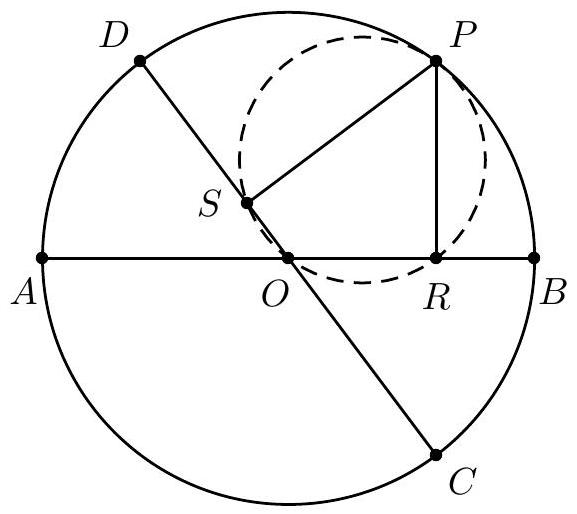
Let $A B$ and $C D$ be two diameters of the circle $\mathcal{C}$. For an arbitrary point $P$ on $\mathcal{C}$, let $R$ and $S$ be the feet of the perpendiculars from $P$ to $A B$ and $C D$, respectively. Show that the length of $R S$ is independent of the choice of $P$.
Solution. Let $O$ be the centre of $\mathcal{C}$. Then $P, R, S$, and $O$ are points on a circle $\mathcal{C}^{\prime}$ with diameter $O P$, equal to the radius of $\mathcal{C}$. The segment $R S$ is a chord in this circle subtending the angle $B O D$ or a supplementary angle. Since the angle as well as radius of $\mathcal{C}^{\prime}$ are independent of $P$, so is $R S$.
G-2 DEN
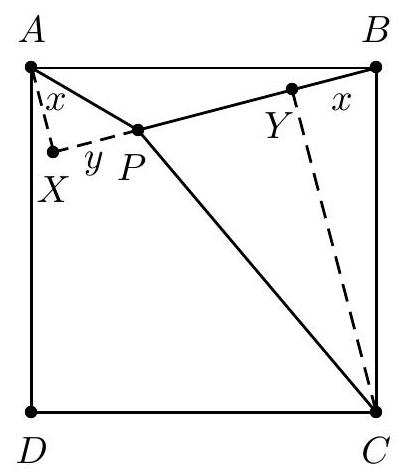
Let $P$ be a point inside a square $A B C D$ such that $P A: P B: P C$ is $1: 2: 3$. Determine the angle $\angle B P A$.
First Solution. Rotate the triangle $A B P$ by $90^{\circ}$ around $B$ such that $A$ goes to $C$ and $P$ is mapped to a new point $Q$. Then $\angle P B Q=\angle P B C+\angle C B Q=\angle P B C+\angle A B P=90^{\circ}$. Hence the triangle $P B Q$ is an isosceles right-angled triangle, and $\angle B Q P=45^{\circ}$. By Pythagoras $P Q^{2}=2 P B^{2}=8 A P^{2}$. Since $C Q^{2}+P Q^{2}=A P^{2}+8 A P^{2}=9 A P^{2}=P C^{2}$, by the converse Pythagoras $P Q C$ is a right-angled triangle, and hence

Second Solution. Let $X$ and $Y$ be the feet of the perpendiculars drawn from $A$ and $C$ to $P B$. Put $x=A X$ and $y=X P$. Suppose without loss of generality that $P A=1, P B=2$, and $P C=3$. Since the right angled triangles $A B X$ and $B C Y$ are congruent, we have $B Y=x$ and $C Y=2+y$. Applying Pythagoras' Theorem to the triangles $A P X$ and $P Y C$, we get
Substituting the former equation into the latter, we infer $x=y$, which in turn discloses $\angle B P A=135^{\circ}$.
G-3 DEN
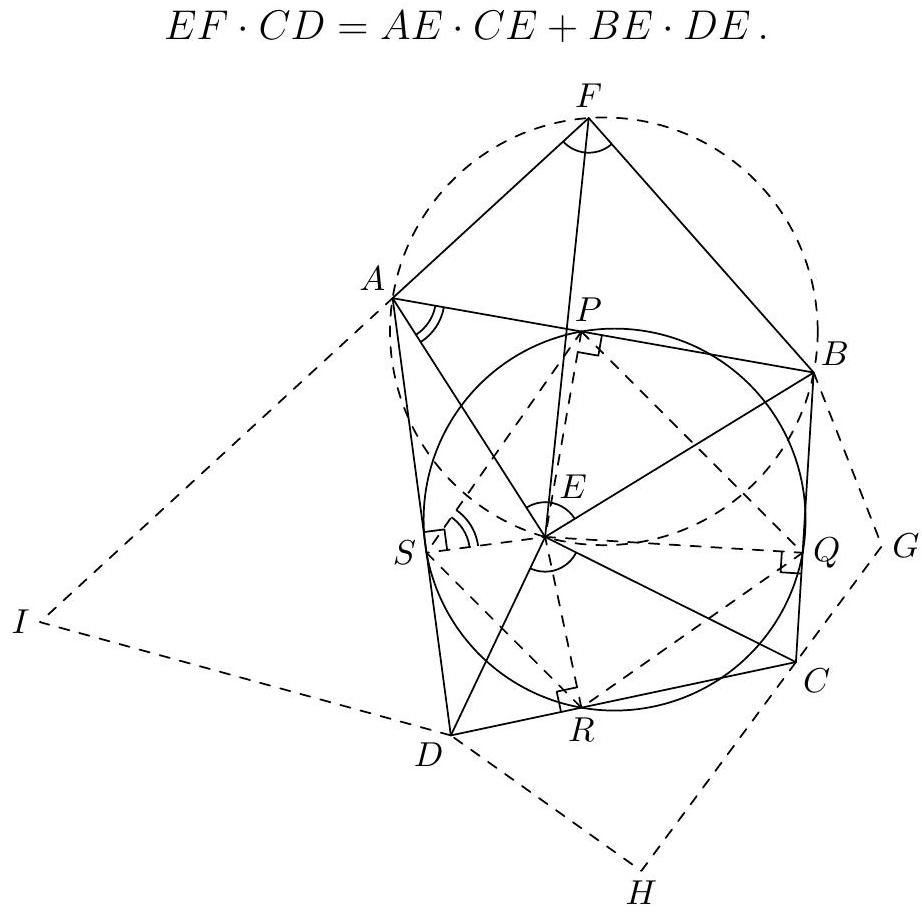
Let $E$ be an interior point of the convex quadrilateral $A B C D$. Construct triangles $\triangle A B F$, $\triangle B C G, \triangle C D H$ and $\triangle D A I$ on the outside of the quadrilateral such that the similarities $\triangle A B F \sim \triangle D C E, \triangle B C G \sim \triangle A D E, \triangle C D H \sim \triangle B A E$ and $\triangle D A I \sim \triangle C B E$ hold. Let $P$, $Q, R$ and $S$ be the projections of $E$ on the lines $A B, B C, C D$ and $D A$, respectively. Prove that if the quadrilateral $P Q R S$ is cyclic, then
Solution. We consider oriented angles modulo $180^{\circ}$. From the cyclic quadrilaterals $A P E S$, $B Q E P, P Q R S, C R E Q, D S E R$ and $\triangle D C E \sim \triangle A B F$ we get
so the quadrilateral $A E B F$ is cyclic. By Ptolemy we then have
This transforms by $A B: B F: A F=D C: C E: D E$ into
Since the expression on the right of this equation is invariant under cyclic permutation of the vertices of the quadrilateral $A B C D$, the asserted equation follows immediately.
G-4 POL
The incircle of a triangle $A B C$ touches the sides $B C, C A, A B$ at $D, E, F$, respectively. Let $G$ be a point on the incircle such that $F G$ is a diameter. The lines $E G$ and $F D$ intersect at $H$. Prove that $C H | A B$.
Solution. We work in the opposite direction. Suppose that $H^{\prime}$ is the point where $D F$ intersect the line through $C$ parallel to $A B$. We need to show that $H^{\prime}=H$. For this purpose it suffices to prove that $E, G, H^{\prime}$ are collinear, which reduces to showing that if $G^{\prime} \neq E$ is the common point of $E H^{\prime}$ and the incircle, then $G^{\prime}=G$.
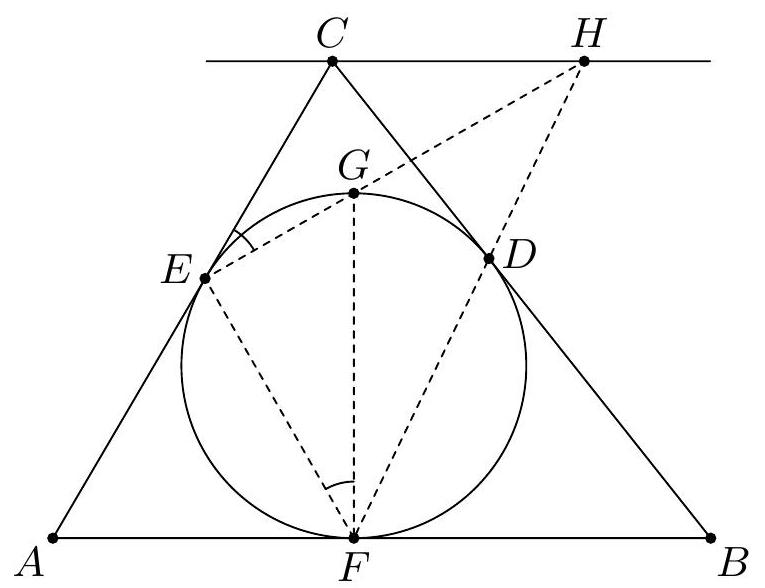
Note that $H^{\prime}$ and $B$ lie on the same side of $A C$. Hence $C H^{\prime} | A B$ gives $\angle A C H^{\prime}=180^{\circ}-\angle B A C$. Also, some homothety with center $D$ maps the segment $B F$ to the segment $C H^{\prime}$. Thus the equality $B D=B F$ implies that $C H^{\prime}=C D=C E$, i.e. the triangle $E C H^{\prime}$ is isosceles and
But $G^{\prime}$ and $H^{\prime}$ lie on the same side of $A C$, so $\angle G^{\prime} E C=\angle H^{\prime} E C$ and consequently
so that
Hence $F G^{\prime}$ is a diameter of the incircle and the desired equality $G^{\prime}=G$ follows.
Remark. A similar proof also works in the forward direction: one may compute $\angle E H D=$ $\frac{1}{2} \angle A C B$. Hence $H$ lies on the circle centred at $C$ that passes through $D$ and $E$. Consequently the triangle $E H C$ is isosceles, wherefore
Thus the lines $A B$ and $C H$ are indeed parallel.
G-5 POL
Let $A B C D$ be a convex quadrilateral such that $\angle A D B=\angle B D C$. Suppose that a point $E$ on the side $A D$ satisfies the equality
Show that $\angle E B A=\angle D C B$.
Solution. Let $F$ be the point symmetric to $E$ with respect to the line $D B$. Then the equality $\angle A D B=\angle B D C$ shows that $F$ lies on the line $D C$, on the same side of $D$ as $C$. Moreover, we have $A E \cdot E D<C D \cdot A E$, or $F D=E D<C D$, so in fact $F$ lies on the segment $D C$.
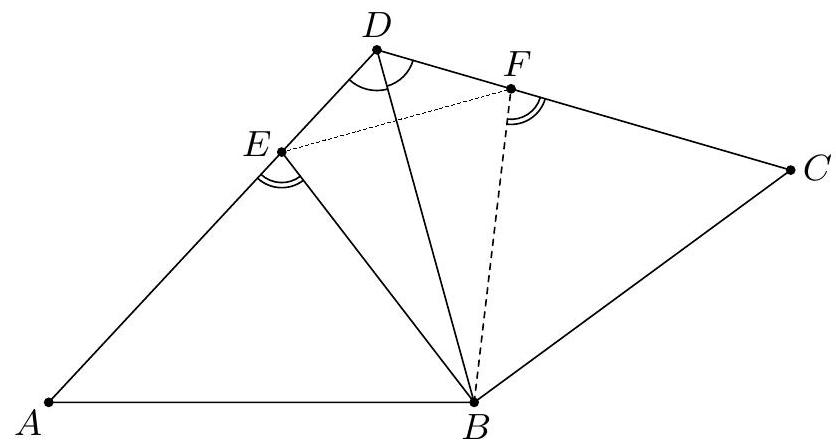
Note now that triangles $D E B$ and $D F B$ are congruent (symmetric with respect to the line $D B)$, so $\angle A E B=\angle B F C$. Also, we have
Therefore
This shows that the triangles $B E A$ and $C F B$ are similar, which gives $\angle E B A=\angle F C B=$ $\angle D C B$, as desired.
Number Theory
N-1 DEN
Let $a$ be any integer. Define the sequence $x_{0}, x_{1}, \ldots$ by $x_{0}=a, x_{1}=3$ and
Determine the largest integer $k_{a}$ for which there exists a prime $p$ such that $p^{k_{a}}$ divides $x_{2011}-1$.
Let $y_{n}=x_{n}-1$. Hence
$y_{n}=x_{n}-1=2\left(y_{n-1}+1\right)-4\left(y_{n-2}+1\right)+3-1=2 y_{n-1}-4 y_{n-2}=2\left(2 y_{n-2}-4 y_{n-3}\right)-4 y_{n-2}=-8 y_{n-3}$
for all $n>2$. Hence
Hence $k=2011$.
N-2 DEN
Determine all positive integers $d$ such that whenever $d$ divides a positive integer $n, d$ will also divide any integer obtained by rearranging the digits of $n$.
Answer: $d=1, d=3$ or $d=9$. It is known that 1,3 and 9 have the given property. Assume that $d$ is a $k$ digit number such that whenever $d$ divides an integer $n, d$ will also divide any integer $m$ having the same digits as $n$. Then there exists a $k+2$ digit number $10 a_{1} a_{2} \ldots a_{k}$ which is divisible by $d$. Hence $a_{1} a_{2} \cdots a_{k} 10$ and $a_{1} a_{2} \cdots a_{k} 01$ are also divisible by $d$. Since $a_{1} a_{2} \cdots a_{k} 10-a_{1} a_{2} \cdots a_{k} 01=9, d$ divides 9 , and hence $d=1, d=3$ or $d=9$ as stated.
N-3 GER
Determine all pairs $(p, q)$ of primes for which both $p^{2}+q^{3}$ and $q^{2}+p^{3}$ are perfect squares.
Answer. There is only one such pair, namely $(p, q)=(3,3)$.
Proof. Let the pair $(p, q)$ be as described in the statement of the problem.
1.) First we show that $p \neq 2$. Otherwise, there would exist a prime $q$ for which $q^{2}+8$ and $q^{3}+4$ are perfect squares. Because of $q^{2}<q^{2}+8$, the second condition gives $(q+1)^{2} \leqslant q^{2}+8$ and hence $q \leqslant 3$. But for $q=2$ or $q=3$ the expression $q^{3}+4$ fails to be a perfect square. Hence indeed $p \neq 2$ and due to symmetry we also have $q \neq 2$.
2.) Next we consider the special case $p=q$. Then $p^{2}(p+1)$ is a perfect square, for which reason there exists an integer $n$ satisfying $p=n^{2}-1=(n+1)(n-1)$. Since $p$ is prime, this factorization yields $n=2$ and thus $p=3$. This completes the discussion of the case $p=q$.
3.) So from now on we may suppose that $p$ and $q$ are distinct odd primes. Let $a$ be a positive integer such that $p^{2}+q^{3}=a^{2}$, i.e. $q^{3}=(a+p)(a-p)$. If both factors $a+p$ and $a-p$ were divisible by $q$, then so were their difference $2 p$, which is absurd. So by uniqueness of prime factorization we have $a+p=q^{3}$ and $a-p=1$. Subtracting these equations we learn $q^{3}=2 p+1$. Due to symmetry we also have $p^{3}=2 q+1$. Now if $p<q$, then $q^{3}=2 p+1<2 q+1=p^{3}$, which gives a contradiction, and the case $q<p$ is excluded similarly.
Thereby the problem is solved.
N-4 FIN
Let $p \neq 3$ be a prime number. Show that there is a non-constant arithmetic sequence of positive integers $x_{1}, x_{2}, \ldots, x_{p}$ such that the product of the terms of the sequence is a cube.
Let $a_{1}, a_{2}, \ldots, a_{p}$ be any arithmetic sequence of positive integers and let $P$ be the product of the terms of this sequence. For any $n$, the sequence $P^{n} a_{1}, P^{n} a_{2}, \ldots, P^{n} a_{p}$ is also arithmetic, and the product of terms is $P^{n p+1}$. Now either $p \equiv 1 \bmod 3$ or $p \equiv-1 \bmod 3$. In the former case, $2 p+1=3 q$ for some $q$ and in the latter case, $1 p+1=3 q$ for some $q$. So we can choose either $x_{i}=P^{2} a_{i}$ or $x_{i}=P a_{i}$ to obtain the sequence we are looking for.
N-5 POL
An integer $n \geq 1$ is called balanced if it has an even number of distinct prime divisors. Prove that there exist infinitely many positive integers $n$ such that there are exactly two balanced numbers among $n, n+1, n+2$ and $n+3$.
We argue by contradiction. Choose $N$ so large that no $n \geq N$ obeys this property. Now we partition all integers $\geq N$ into maximal blocks of consecutive numbers which are either all balanced or not. We delete the first block from the following considerations, now starting from $N^{\prime}>N$. Clearly, by assumption, there cannot meet two blocks with length $\geq 2$. It is also impossible that there meet two blocks of length 1 (remember that we deleted the first block). Thus all balanced or all unbalanced blocks have length 1. All other blocks have length 3, at least.
Case 1: All unbalanced blocks have length 1.
We take an unbalanced number $u>2 N^{\prime}+3$ with $u \equiv 1(\bmod 4)$ (for instance $u=p^{2}$ for an odd prime $p$ ). Since all balanced blocks have length $\geq 3, u-3, u-1$, and $u+1$ must be balanced. This implies that $(u-3) / 2$ is unbalanced, $(u-1) / 2$ is balanced, and $(u+1) / 2$ is again unbalanced. Thus ${(u-1) / 2}$ is an balanced block of length 1 - contradiction.
Case 2: All balanced blocks have length 1.
Now we take a balanced number $b>2 N^{\prime}+3$ with $b \equiv 1(\bmod 4)\left(\right.$ for instance $b=p^{2} q^{2}$ for distinct odd primes $p, q)$. By similar arguments, $(b-3) / 2$ is balanced, $(b-1) / 2$ is unbalanced, and $(b+1) / 2$ is again balanced. Now the balanced block ${(b-1) / 2}$ gives the desired contradiction.